
Running Answer Engine Optimization (AEO) for a roster of clients isn’t the same job as running it for one brand. You're tracking visibility across every account at once, auditing a prospect's AI presence the night before a pitch, explaining share of answers to a client's CMO, and trying to tie all of it back to pipeline. Not every platform that markets itself as an "AI visibility tool for marketing agencies" was built to withstand that level of complexity.
The list below covers the 18 tools worth an agency's time. We evaluate each one on how it manages client accounts and prospect pitches, where its data comes from, whether it can produce content or only point at problems, how it reports, and the quality of the partner program behind it.
For a quick glance at how the platforms compare, check out the table below:
What to look for in an AI visibility tool for agencies
The non-negotiables you should bring to every sales conversation are:
- Client and prospect management: Per-client workspaces are the baseline. The ones worth paying for add pitch environments, so you can pull up a prospect's AI visibility live on a sales call, and promote that pitch into a full account the day the contract lands.
- Answer engine coverage: ChatGPT, Claude, and Google AI Overviews are the foundation. Whether you also need Perplexity, Gemini, Copilot, Grok, Meta AI, or DeepSeek depends on where your clients' buyers are.
- Data quality: Some platforms watch real user prompts, while others infer demand from an SEO keyword database and dress it up as prompt data. That distinction determines whether the advice you give a client rests on what people ask AI or an approximation of it.
- Content creation and workflows: Monitoring names the problem, but content workflows let you fix it. Once you're working across a dozen accounts, a tool that generates and optimizes in-house, based on AEO best practices and visibility insights, saves you from introducing three extra products into the process.
- Reporting and integrations: Look at how cleanly the platform exports data and whether it plugs into what you already report in, whether that's Looker Studio, GA4, or a BI stack.
- Agency partnership and support: A discount isn’t the same as a program. The partner setups that pay off come with dedicated support, referral or revenue share, co-marketing, and a pipeline of leads pointed at your agency rather than just the vendor's.
The 18 best AI visibility tools for marketing agencies
Below are the top AI visibility platforms for agencies, reviewed against the most important capabilities.
1. Profound
Best for:
- Agencies running AEO as a repeatable service across a portfolio of clients
- Teams that pitch AI visibility and need to prove it before the contract is signed
- Agencies that have to tie AI search work back to client pipeline and revenue
What it does
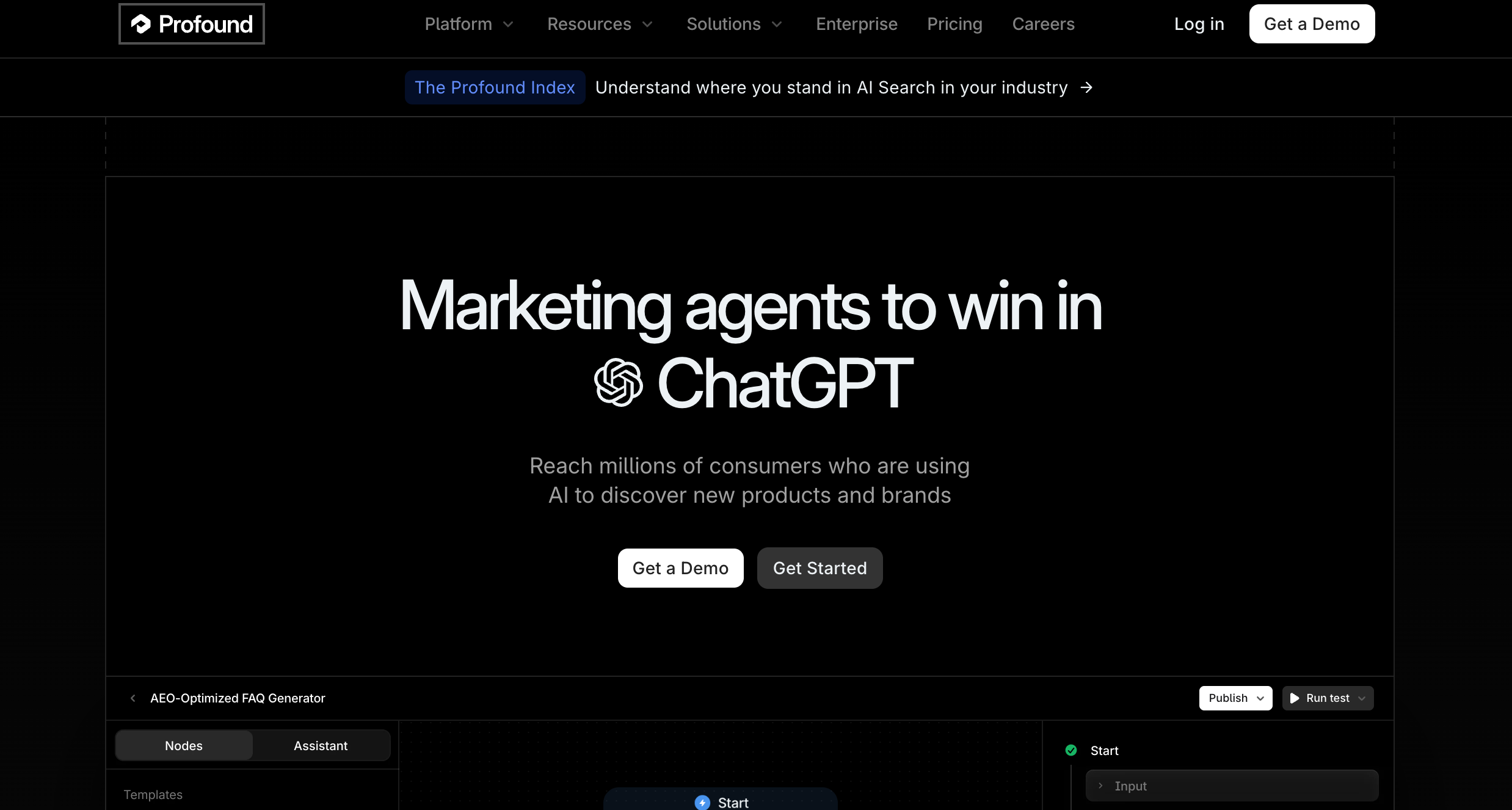
Profound is an agentic marketing platform that shows you where your brand is missing from AI answers, then runs the content pipeline that fills the gap.
The data foundation is what agencies notice first. Prompt Volumes runs on more than 1.9 billion real user prompts—actual conversations people are having with answer engines, broken down by intent and by demographics like age, income, and region. Answer Engine Insights sits alongside it, tracking visibility, citation share, accuracy, and sentiment across every engine and every competitor in a client's category.
Agency Mode is the piece designed for how agencies operate. One dashboard holds every client workspace, and separate pitch environments let you audit a prospect's AI presence before the sales call and screen-share the gaps. When the prospect signs, the pitch environment becomes their live account without a rebuild. It removes the awkward stretch many agencies know well, where you want to show a prospect their AI visibility but can't without spinning up a paid seat first.
Then there's the part that retains customers: proof. Agent Analytics reads server logs through CDN integrations to show which AI crawlers hit a client's site, how often, and which pages they pull, then a GA4 connection traces that activity through to human traffic. And once you’re ready to act, Agents run the content cycle inside the platform, generating briefs, drafts, and optimizations from templates built on millions of the most-cited pages, with a feedback loop that sharpens recommendations as content earns citations.
Jordan Digital Marketing grew agency revenue 34% and nearly doubled profit after building an AEO practice on Profound, and took one client from invisible to 80% visibility in a priority category. "Profound shows us exactly how our clients perform across AI platforms and how to improve," says Adam Tanguay, the agency's Head of Growth. "We are far ahead of everybody else in the AEO space because of their platform." GR0 also built its entire AEO offering on Profound and took a single client from $1,000 to over $100,000 in monthly revenue attributed to AI answers.
What you'll like
- Agency Mode centralizes client workspaces and pitch environments, and pitches convert straight into live accounts
- All major answer engines, tracked daily on front-end browsers
- Prompt Volumes runs on 1.9B+ real user prompts, segmented by intent and demographics
- Agent Analytics ties AI crawler activity to traffic and conversions
- Ranked #1 on G2 for AEO with 300+ reviews at 4.6/5
- Every account comes with a dedicated AI strategist and engagement manager
Why Profound might not be a fit
- If all you want is a lead-generation directory, this isn't that; Profound's agency value is in winning, running, and proving client work
- Agencies shopping for a standalone content generator will be paying for monitoring and attribution they don't plan to use
2. Scrunch
Best for:
- Agencies that want a genuinely well-built referral and co-marketing program
- Teams comfortable exporting insights and executing elsewhere
What it does
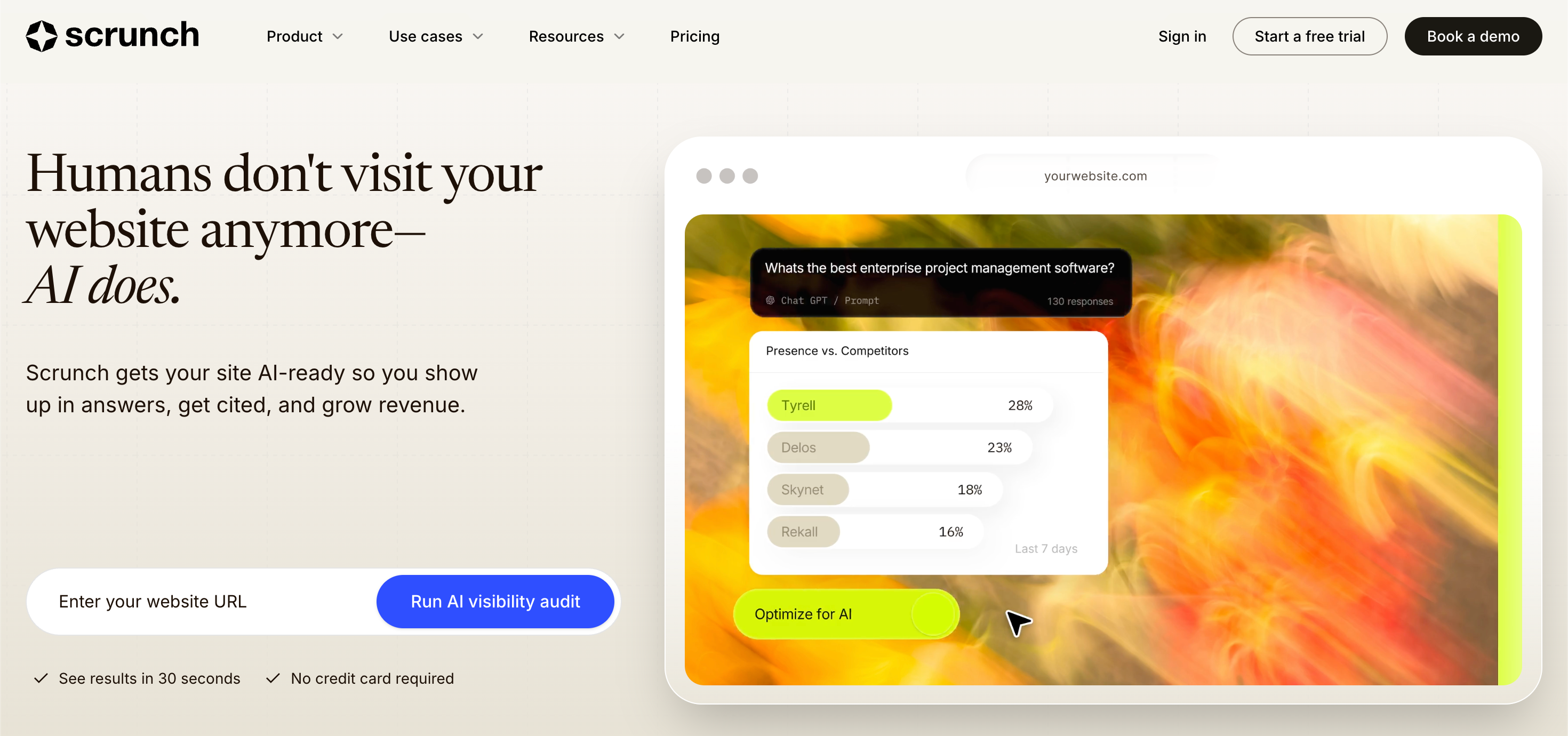
Scrunch monitors brand visibility across answer engines for 500-plus brands, adds site auditing, and runs an Agent Experience Platform that serves an AI-optimized version of a page to crawlers without touching what humans see. For agencies, the pull is the partner program, which includes up to 20% referral commission, prospecting licenses for pitches, co-marketing funds, and dedicated go-to-market support.
Where it thins out is execution and data depth, and that's the line that separates Scrunch from a full AEO platform. Its AI Search Trends data is directional and sits at the topic level rather than the individual prompt, it doesn’t offer content generation capabilities, and its monitored prompts are ones you configure, not conversations pulled from real users. For an agency that mainly needs clean reporting and a strong incentive to resell, that's a fair trade.
What you'll like
- Agency Partner Program with up to 20% referral commission, prospecting licenses, and co-marketing funds
- Agent Experience Platform serves AI-friendly content to crawlers without changing the human page
- Bot tracking separates training, indexer, and retrieval crawlers
Where it falls short
- AI Search Trends data is topic-level and directional, not real prompt-level demand
- Content generation isn't shipped yet, so acting on insights means leaving the tool
- Core plan caps at four engines, one country, and 125 prompts
3. Otterly
Best for:
- Solo marketers, consultants, and small agencies taking their first run at AEO
- Teams that want fast setup and plain-spoken guidance
What it does
There’s a reason Otterly markets itself as "otterly simple" tagline. Setup takes minutes, the interface is clean, and small agencies managing SMB clients can be tracking visibility the same afternoon. It watches four base engines, ChatGPT, Perplexity, Google AI Overviews, and Copilot, with Gemini and Google AI Mode as add-ons, and pairs monitoring with AEO recommendations, content briefs, and crawlability checks.
A Looker Studio connector on higher tiers folds AI visibility straight into the dashboards you already send clients, and there's a proper agency partner program with workspace management and a partner directory behind it.
Otterly’s ceiling is data and execution. The platform turns your SEO keywords into prompt formats rather than showing what real users are actually asking and how often, so prompt prioritization stays a judgment call, and there's no content generation inside the tool, so every recommendation ends with a handoff to somewhere else. On a modest budget, though, dependable monitoring and clear direction count for a lot, and Otterly delivers both.
What you'll like
- Agency partner program with workspace management and a partner directory
- Clear GEO recommendations and content briefs teams can act on
- Looker Studio connector drops AI visibility into client reporting
Where it falls short
- No real prompt-volume data, so prioritization leans on intuition
- No in-platform content generation
- No public SOC 2 or HIPAA, which can stall enterprise-client procurement
4. AthenaHQ
Best for:
- Agencies that want qualified leads sent their way
- Self-directed teams happy with a monitoring-first tool
What it does
AthenaHQ tracks AI visibility across eight engines and pushes prescriptive fixes through its Action Center. Its most distinctive agency feature is inbound: the partner program refers qualified leads based on an agency's focus areas, and offers discounted client licenses, on top of client workspaces and pitch environments. If your growth model runs on referrals, that's a genuine draw.
The catch is what sits under Athena HQ’s recommendations. The platform estimates prompt volume with a proprietary machine learning model it doesn't fully disclose, and it meters tracking on credits tied to your plan. It's a capable monitor with a strong lead program; just plan to review its output closely.
What you'll like
- Partner program refers qualified leads by focus area and discounts client licenses
- Client workspaces and pitch environments for prospects
- Integrates with GA4, Search Console, Looker Studio, Tableau, Power BI, Shopify, and Webflow
Where it falls short
- Prompt volume comes from an undisclosed estimation model, not real conversations
- Credit-based tracking ties data volume to plan tier
- Recommendations and AI content often need real editing before client use
5. Rankability
Best for:
- Agencies that want SEO and AI visibility running in one place
- Teams that value client reporting out of the box
What it does
Rankability was built for agencies from the start, folding keyword research, content, rank tracking, AI visibility, and client reporting into one workflow. Its Reporter tool tracks mentions and citations across up to nine AI platforms on the Agency plan (four on lower tiers) by scanning your tracked keywords, and its Copywriter tool reads up to 45 Google and AI sources to spin up briefs and drafts. For an agency that wants a single, affordable tool spanning old and new search, the all-in-one packaging is the appeal.
The compromise with Rankability is in the data. The platform tells you whether a client shows up for the keywords you feed it, but it can't tell you what people are actually prompting or who's asking. For agencies whose clients need light AI monitoring bundled with their SEO, that's often enough.
What you'll like
- Purpose-built for agencies, with client reporting and one SEO-plus-AI workflow
- Copywriter tool reviews up to 45 sources for briefs and drafts
- Accessible next to enterprise platforms
Where it falls short
- AI visibility is keyword-configured, not real prompt demand
- Full nine-platform coverage requires the top plan; lower tiers see four
- No connection between AEO visibility data and content creation
6. Peec AI
Best for:
- Agencies that want a clean, client-friendly dashboard
- European teams fine with a monitoring-only tool
What it does
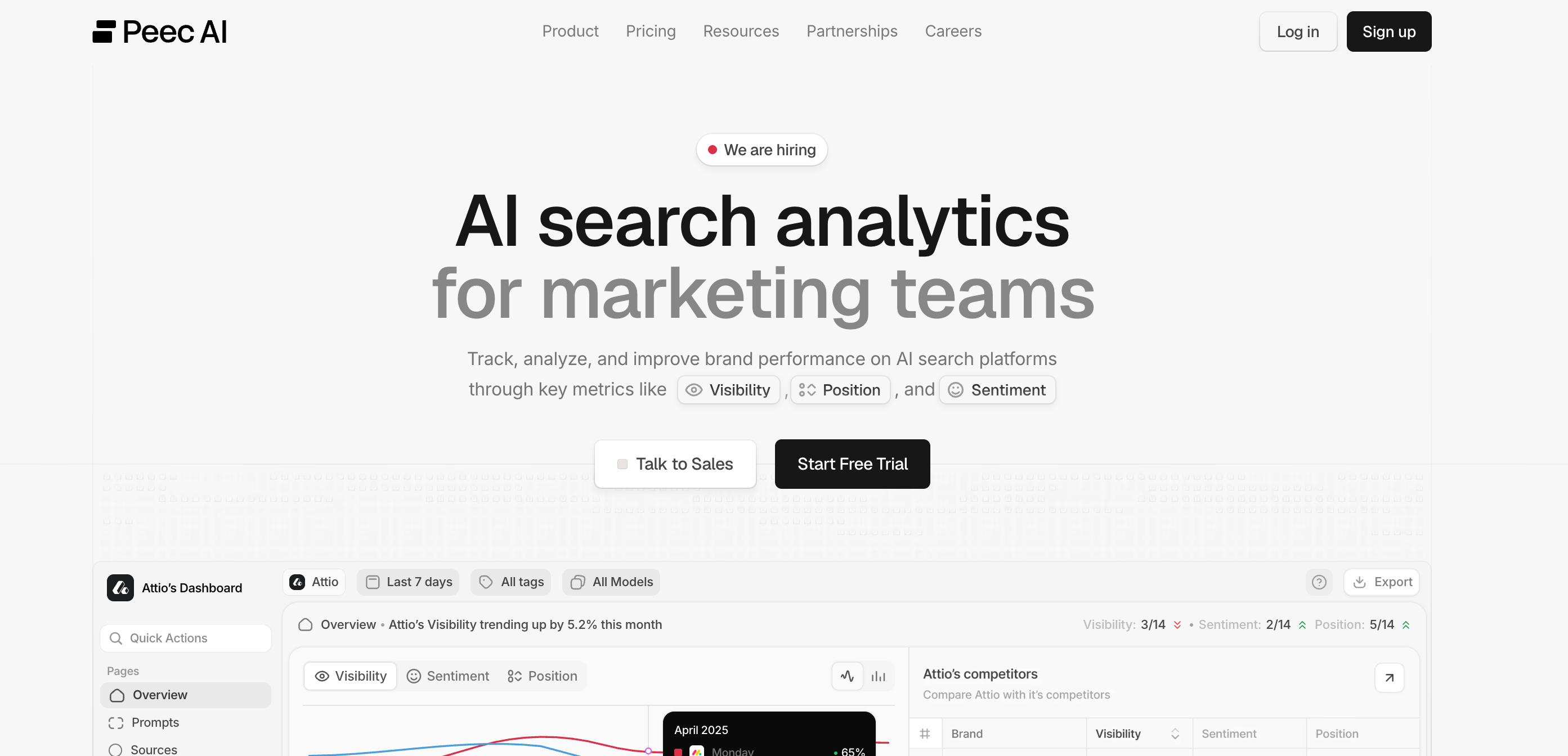
Peec AI is a Berlin-built AI search analytics tool made for marketing teams and agencies, and reviewers keep coming back to how clean the interface is. It does three things well: visibility, position, and sentiment, across major engines, with daily scraping and screenshot audit trails that make client reporting easy to trust.
It's a monitor, though, and it stays one. Peec AI leans on clickstream-based volume indicators rather than a proprietary set of real LLM conversations, and it has no content workflows. If the brief is attractive, reliable monitoring that clients enjoy looking at, and you're set up to execute elsewhere, Peec AI does that job well.
What you'll like
- Clean, client-ready interface with clear visibility, position, and sentiment
- Daily tracking with screenshot audit trails
- Designed with marketing teams and agencies in mind
Where it falls short
- Volume data is clickstream-based, not sourced from real conversations
- No content creation or workflows
- No SOC 2, which can block enterprise-client procurement
7. Semrush
Best for:
- Agencies already running their SEO inside Semrush
- Teams that want AI metrics next to keyword and backlink data
What it does
Semrush has been an SEO fixture for 15 years, and for the 100,000-plus teams already inside it, the AI Visibility Toolkit adds share of voice, sentiment, and prompt tracking without adopting another login. For an agency that lives in Semrush all day, that convenience is nothing to scoff at.
The trouble is that the AI coverage is narrower than Semrush’s SEO suite makes it look. Brand Performance updates weekly across five engines, Prompt Tracking covers fewer, and Claude, Copilot, Grok, Meta AI, and DeepSeek don't appear at all. There are no AEO-specific content workflows and no crawler-level attribution. As a light AI layer on the SEO platform an agency already pays for, it holds up; as the backbone of a serious AEO practice, it runs out of room.
What you'll like
- AI visibility metrics sit beside the SEO tools agencies already use
- Large prompt database with daily Prompt Tracking on select engines
- Deep traditional SEO tooling for keyword and backlink work
Where it falls short
- Brand Performance updates weekly and covers only four to five engines
- No Claude, Copilot, Grok, Meta AI, or DeepSeek
- No AEO-specific content workflows or CDN-level attribution
8. Ahrefs
Best for:
- Agencies bridging traditional SEO with early AI visibility
- Teams already embedded in Ahrefs
What it does
Ahrefs is a genuinely great SEO platform, and Brand Radar lets agencies already working there watch AI mentions across about six engines without adding a tool.
Ahrefs’ real gaps sit elsewhere. Brand Radar's prompts are derived from People Also Ask questions and Ahrefs' keyword index rather than real AI conversations. Most chatbot platforms refresh only monthly on a 90-day rolling window, and Ahrefs itself calls the numbers directional, modeled signals rather than performance data. Add no AEO content workflows and no published enterprise compliance on the AI product, and it's clearly a strong SEO tool feeling its way into AI, not a platform built for it. For directional monitoring inside a tool your team already trusts, that's fine.
What you'll like
- A familiar, deeply built SEO environment with AI monitoring added
- Front-end collection reflects what real users see
- Broad topic coverage via keyword expansion
Where it falls short
- Prompts are keyword-derived, not real user AI conversations
- Most chatbot platforms refresh monthly, not daily
- No AEO content workflows and no published SOC 2 or HIPAA on the AI product
9. AirOps
Best for:
- Agencies with technical staff producing content at scale
- Teams that want programmatic, multi-URL workflows
What it does
AirOps came up as a content automation platform and added AI visibility later, and content throughput is still where it shines. Grid runs a workflow across hundreds of client URLs at once, and Power Agents package recurring jobs like refreshes into forkable templates. An agency with a big content operation and engineers to drive it can move real volume.
The costs are a steep learning curve, output that rarely ships without editing, and monitoring that stays shallow, which is the content-first heritage showing through. AirOps covers four engines (no Claude, Meta AI, Grok, DeepSeek, or Copilot), runs prompts through APIs instead of front-end browsers, and bases prompt "popularity" on an estimate rather than real conversations. If your bottleneck is producing content rather than measuring it, AirOps is built for that.
What you'll like
- Grid runs content workflows across hundreds of client URLs at once
- Power Agents turn recurring jobs into reusable templates
- Strong for agencies with existing content libraries and technical resources
Where it falls short
- Steep learning curve and output that usually needs cleanup
- Around five engines, API-based prompts, US-only data below Enterprise
- Prompt popularity is an estimate, not real user demand
10. Writesonic
Best for:
- Agencies whose constraint is content volume, not measurement
- Teams pushing out high volumes of AI-optimized articles
What it does
Writesonic made its name as an AI writing tool for millions of content professionals and then repositioned toward AI visibility. Speed is the selling point: Article Writer 6.0 handles research, competitor analysis, internal linking, and FAQ generation, and an agency can churn out optimized drafts across many accounts quickly. It also bundles free AI traffic analytics for crawler tracking.
What the move from writing tool to visibility platform leaves behind is a real data spine. Writesonic’s content runs on SEO methodology with AEO bolted on and isn't shaped by real prompt demand or citation analysis, so quality gets uneven when you push volume. Plus, its monitoring and content layers run as separate systems with no loop between them. For an agency whose scarce resource is output, though, Writesonic covers a lot of ground fast.
What you'll like
- Fast, high-volume AI content across many accounts
- Article Writer 6.0 handles research, linking, and FAQ generation
- Free AI traffic analytics for crawler tracking
Where it falls short
- Content is SEO-based with AEO added on, not built on real prompt demand
- No loop between monitoring and content creation
- Data methodology and validation aren't clearly disclosed
11. Conductor
Best for:
- Enterprise agencies already running Conductor for SEO
- Teams serving large, multi-market clients
What it does
Conductor spent a decade becoming a trusted enterprise SEO platform for the likes of Microsoft, Verizon, and FedEx, and it extended into AI visibility from there. For agencies whose enterprise clients already run Conductor, the AI features are a reasonable add to something they pay for anyway: an Intelligence dashboard for mentions, citations, and sentiment, AI Bot Crawling Reports, and coverage across 160-plus countries.
But Conductor is an AI layer sitting on a decade of SEO infrastructure, and it behaves like one. The prompts are synthetic, generated from keyword data rather than real conversations; collection is API-first; updates land twice a week rather than daily; and the bot tracking and content tools work as separate modules with no feedback loop between them. For enterprise agencies already committed to Conductor, it's a sensible extension rather than a reason to switch.
What you'll like
- Extends an enterprise SEO platform agencies may already run
- 160+ countries and city-level tracking for large clients
- AI Bot Crawling Reports inside existing site monitoring
Where it falls short
- Prompts are synthetic, generated from keyword data
- API-first collection with twice-weekly updates
- Bot tracking and content tools are separate modules, no feedback loop
12. BrightEdge
Best for:
- Agencies serving entity-heavy enterprise clients
- Teams that want AI visibility on top of deep SEO infrastructure
What it does
BrightEdge is a long-standing enterprise SEO platform positioning itself as a unified SEO-and-AEO play, and its real strength is entity work: structuring a client's content so answer engines recognize the brand and its knowledge graph, backed by billions of data points and years of keyword history. AI Catalyst and AI Hyper Cube surface mentions, sentiment, and citations across ChatGPT, Google AI Overviews, and Perplexity.
The limitation is upstream of all that. BrightEdge's prompt suggestions are synthesized from SEO keyword data, so the entity-first approach never fully answers what a client's audience is really asking AI. It's strong on Google surfaces and still finding its feet on standalone engines. Where an enterprise client prizes entity structure, though, BrightEdge brings depth the newer tools can't match.
What you'll like
- Entity optimization and knowledge graph alignment for enterprise content
- Deep SEO infrastructure to lean on for large clients
- AI visibility sits inside existing BrightEdge workflows
Where it falls short
- Prompt suggestions are synthesized from SEO data, not real conversations
- AI features are less mature than the core SEO tooling
13. Bluefish
Best for:
- Agencies whose clients care most about brand safety and reputation
- Teams watching how AI represents sensitive brands
What it does
Bluefish approaches AI visibility from the brand-safety side, with persona-based insights and AI Brand Safety and Commerce features aimed at agencies protecting client reputations. It tracks the major engines and added AI Impact and Influence Analytics to measure how closely cited content maps to what AI actually says.
For agency work, the constraints are prompt control and citation depth: clients can't freely customize the prompts they track, citation data stops at frequency without page-level detail, and there's no content generation, agent analytics, or real prompt-volume data. It's also an early-stage company with SOC 2 still in progress. For agencies whose priority is watching reputation rather than producing content, Bluefish is worth a look.
What you'll like
- Brand-safety and reputation monitoring across AI channels
- Persona-based insights and AI Impact and Influence Analytics
- Focused on how AI represents a client's brand
Where it falls short
- Rigid prompt generation with limited customization
- No content workflows, agent analytics, or real prompt-volume data
- Early-stage, with SOC 2 still in progress
14. Evertune
Best for:
- Agencies tracking brand accuracy and reputation risk for clients
- Teams focused on how AI describes a brand rather than on output
What it does
Evertune, founded by early members of the Trade Desk team, is an Answer Engine Optimization platform built around brand monitoring and sentiment. Its EverPanel consumer panel of 25 million people feeds an AI Brand Index, Word Association, and Consumer Preferences reports that give agencies a clean read on how AI models describe a client, which suits reputation-sensitive accounts.
The differences show up in the data infrastructure. Evertune clusters prompts into broad topics rather than tracking prompt-level demand, uses direct LLM API access as one data layer (which can diverge from what real users see), and publishes no security certifications like SOC 2 Type II. It's monitoring-first, with content actions handled through partners. When a client's chief worry is accuracy rather than output, Evertune is a focused fit.
What you'll like
- Strong brand-accuracy and sentiment monitoring for client reputations
- A 25-million-person consumer panel behind its topic-level data
- AI Brand Index and Word Association reports are easy to share with clients
Where it falls short
- Topic-level clustering rather than prompt-level demand
- API-level access that can differ from real user front-end responses
- No published SOC 2 Type II or equivalent
15. Adobe LLM Optimizer
Best for:
- Agencies whose clients already run on Adobe Experience Cloud
- Enterprise teams standardizing AI visibility inside an Adobe stack
What it does
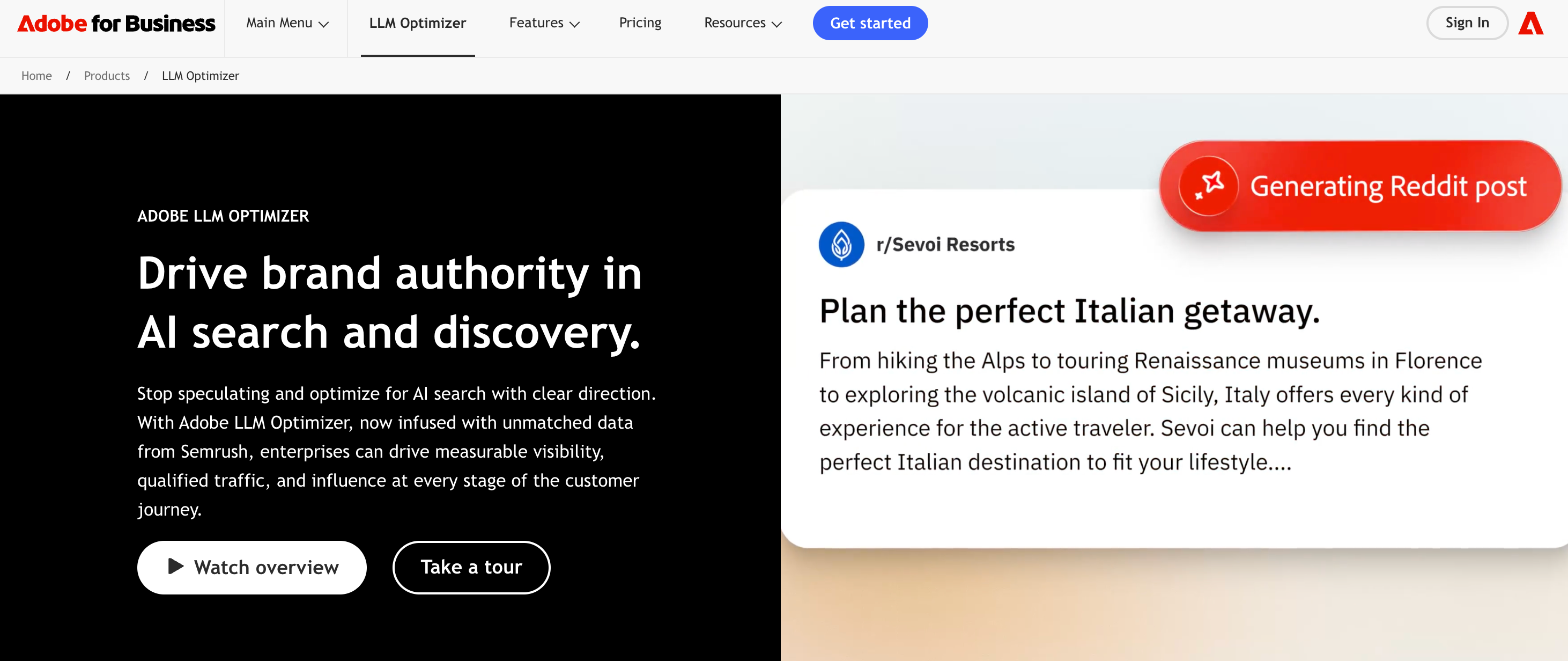
Adobe LLM Optimizer is Adobe's AEO entry, delivered as one application inside Experience Cloud, with visibility tracking, an opportunities dashboard, and attribution reporting. It also pulls prompt data from Semrush following that acquisition. For agencies whose enterprise clients already live in Adobe, the appeal is consolidation: AI visibility inside a stack they already administer, with attribution wired into Adobe Analytics.
The tradeoff is that AI visibility is one product line rather than the whole platform. Adobe's own documentation describes its method as a statistical approximation; its prompt data is modeled from clickstream and search panels rather than captured from real AI conversations, and its content help is a fixed set of opportunity fixes, not open generation. For agencies serving Adobe-standardized clients, it slots neatly into that world.
What you'll like
- Fits inside an existing Adobe Experience Cloud stack
- Attribution ties into Adobe Analytics for clients already there
- Opportunities dashboard offers one-click deploys for common fixes
Where it falls short
- AI visibility is one app among many, not a dedicated platform
- Prompt data is modeled from clickstream and search panels
- Content help is limited to a fixed set of opportunity fixes
16. SE Visible
Best for:
- Budget-conscious agencies that want SEO and AEO in one ecosystem
- Small teams managing several client brands without much spend
What it does
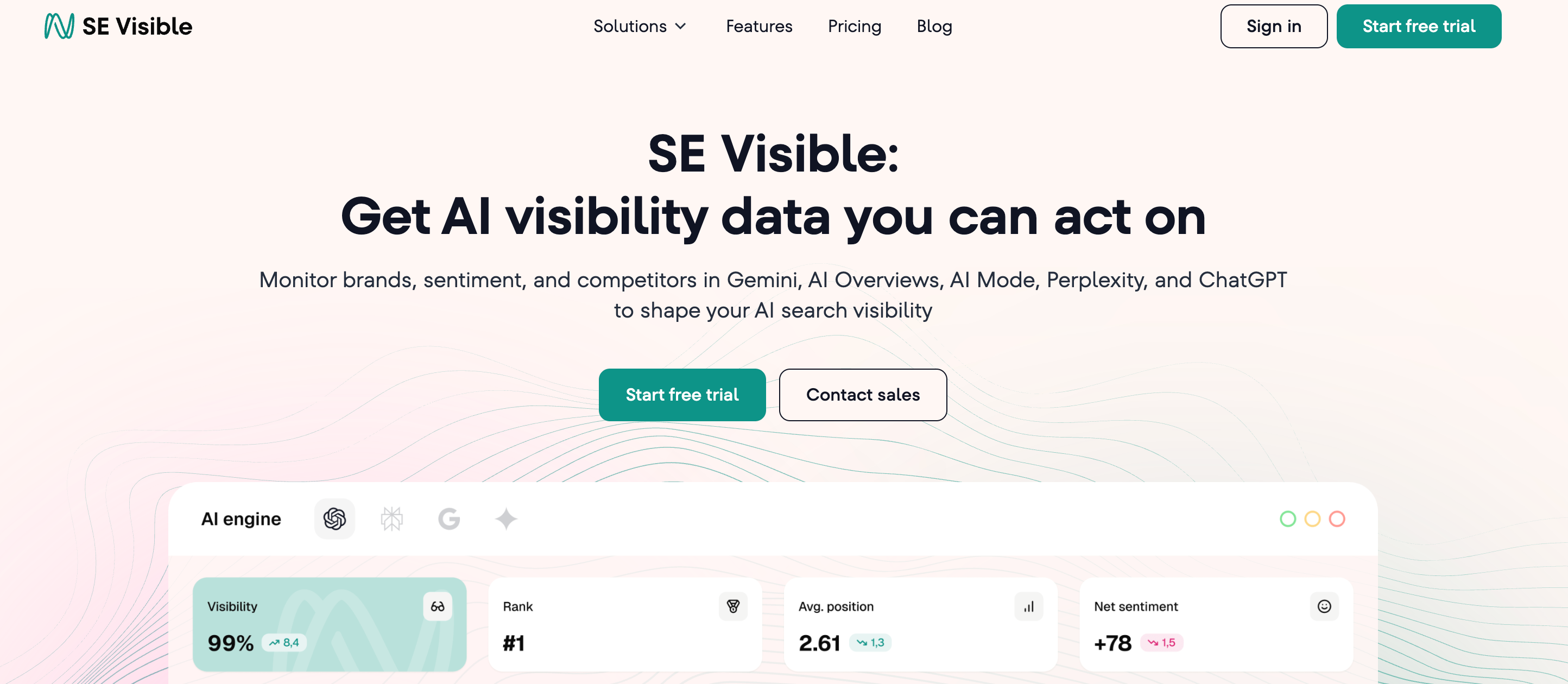
SE Visible is SE Ranking's standalone AI visibility product, monitoring brand mentions, citations, and sentiment across the major answer engines. Because it's newer, its coverage is still filling in, but it draws on SE Ranking's wider AI Search Toolkit, which spans ChatGPT, Google AI Mode, Perplexity, Gemini, and AI Overviews, along with source data showing which domains AI answers pull from and cached copies of past answers. There's no dedicated agency plan, but every tier supports multiple brands from one workspace, and the entry price is among the lowest, which makes it workable for agencies watching budget or already using SE Ranking for SEO.
Feature depth is the tradeoff. SE Visible has no generative content workflows and a thinner integration set, so agencies that need to act on findings or route data across a larger stack will outgrow it.
What you'll like
- Low entry point with multi-brand support on every tier
- Part of the SE Ranking ecosystem for agencies wanting SEO and AEO together
- Source data and cached AI answers help explain how brands get framed
Where it falls short
- Newer product with engine coverage still expanding
- No content workflows and a limited integration set
- No dedicated agency plan or agency-specific support
17. AIclicks
Best for:
- Agencies that want done-for-you AI content and outreach at scale
- Teams drawn to a partner directory and recurring revenue share
What it does
AIclicks tracks brand mentions across more than 10 platforms, and, like the stronger tools here, queries them through real user interfaces rather than APIs. Its Recommendations tab turns visibility data into a prioritized action list across three fronts: create AI-optimized content, earn mentions on the sources engines already trust, and join conversations on platforms like Reddit. The agency program is real, with a Certified Partners Directory and recurring revenue on client accounts, and AIclicks says it's used by 400-plus agencies.
One thing to weigh: AIclicks also runs its own AI SEO agency service. For an agency, buying tooling from a company that also sells the service you sell is a relationship worth thinking through. Its analytics are also lighter than the dedicated visibility platforms, so it fits agencies that value content-and-outreach execution over deep measurement.
What you'll like
- Tracks 10+ answer engines through real user interfaces, updated daily
- Recommendations tab spans content, source outreach, and community
- Partner directory and recurring revenue share for agencies
Where it falls short
- The vendor also operates a competing AI SEO agency
- Analytics run shallower than dedicated visibility platforms
- Positioned around content volume more than strategic AEO depth
18. Brandlight
Best for:
- Enterprise-leaning agencies focused on who shapes AI answers
- Teams that need source-level influence mapping for clients
What it does
Brandlight is an enterprise AI visibility platform that covers the major engines from several angles and studies how they mention a brand, the sentiment, and the sources behind each answer. Its strongest feature for agencies is source attribution: identifying the publishers and pages that most influence what AI says about a client, which turns into a targeting list for earned media and outreach. It also includes an AEO feature that automates optimization of product FAQs and snippets, and it recently partnered with Data Axle.
Brandlight is one of the newest names here, out of stealth only in April 2025, and it's built for enterprise brands more than as an agency-program play. Its real value shows up when an enterprise client wants to understand and shift the sources feeding AI answers, where the source lens has few equals.
What you'll like
- Source attribution maps the publishers shaping a client's AI answers
- Competitive analysis and sentiment across major engines
- AEO automation for product FAQs and snippets
Where it falls short
- Newest platform on the list, with a short track record
- Enterprise-oriented rather than built around an agency program
Build your agency's AEO practice on the industry’s leading platform
The agencies pulling ahead in AI search aren't just watching a visibility score move. They walk into pitches with a prospect's real AI data on screen, produce the content that closes the gap, and show the client what it returned in terms of ROI.
That full loop, from pitch to proof, is the thing most tools on this list can do one slice of. Profound was built to run all of it: Agency Mode for your client workspaces and pitches, Prompt Volumes and Answer Engine Insights for what to work on, Agents for the work itself, and Agent Analytics for the results your clients' executives ask about.
Learn more about what your agency could build with us. Book a demo of Profound and turn AI search into a profitable service line.
AI visibility tools for marketing agencies frequently asked questions (FAQs)
What does an AI visibility tool do for an agency?
It shows you how your clients are represented inside answer engines like ChatGPT, Perplexity, and Google AI Overviews, then helps you do something about it. For an agency, the useful versions go past a single visibility score: they manage every client account from one place, let you audit a prospect before a pitch, generate or guide the content that closes gaps, and tie AI activity back to traffic and pipeline so you have something concrete to show on a client call.
Which of these tools have real agency programs?
A handful are built with agencies in mind rather than bolting on a discount. Profound's Agency Mode runs client workspaces and pitch environments; Scrunch offers referral commission, prospecting licenses, and co-marketing funds; Otterly runs a partner program with workspace management and a directory; AthenaHQ refers qualified leads by focus area; Rankability was designed for agencies from the start; and AIclicks has a partner directory with revenue share. The rest are usable by agencies but weren't built around the agency motion.
Can these tools help win new clients, not just serve existing ones?
Yes, and it's one of the clearest dividing lines. Pitch environments (Profound and AthenaHQ) let you pull up a prospect's real AI visibility on a sales call instead of describing the problem in the abstract, and Profound converts that pitch workspace straight into a live account when the deal closes. Lead-referral programs (AthenaHQ) and partner directories (Otterly, AIclicks) add an inbound channel on top.
How do agencies prove AEO ROI to clients?
Because AI answers often don't produce a click, attribution takes more than a traffic report. The strongest signal is crawler-level analytics tied to outcomes: Profound's Agent Analytics traces the chain from AI crawler visit to citation to human traffic to conversion through a GA4 connection. Most agencies pair that with self-reported attribution on demo forms and mentions in sales calls, building a picture across several directional signals rather than chasing one perfect number.
Does an agency need a dedicated AEO tool, or is an SEO platform enough?
SEO suites like Semrush, Ahrefs, BrightEdge, and Conductor have all added AI visibility, and for agencies already living in those tools, the convenience is real. But each one treats AI as an add-on, with narrower engine coverage, keyword-derived rather than real prompt data, and no AEO-specific content workflows. Plenty of agencies run both: an SEO platform for keywords, backlinks, and rank tracking, and a purpose-built AEO platform for the AI side.
How many answer engines should an agency track?
Enough to cover where your clients' buyers actually are. ChatGPT, Perplexity, and Google AI Overviews are the baseline every serious tool should hit. From there, Claude, Gemini, Copilot, Grok, Meta AI, and DeepSeek matter to different degrees depending on a client's audience and region. Tools that cap at four or five engines leave blind spots in your reporting; the ones tracking all 10 give you the full picture across a varied client base.


