
Answer engines don't just mention brands in straightforward, neutral ways. AI responses often reflect positive or negative sentiment that can have a significant effect on your brand's visibility. Tracking brand sentiment:
- Helps you ensure that your company is positioned as an authoritative, trustworthy brand with a positive image
- Increases the chance that your target audience views your brand in a positive light throughout the customer journey
- Alerts you to misinformation or outdated details that might prevent potential customers from choosing your brand
- Makes it easy to spot negative trends before they escalate, causing customer churn or harming your brand reputation
To monitor this metric, you need a sentiment analysis tool for AI answer engines. I'll walk you through to track sentiment with Profound and how to use its AI visibility data helps you improve this metric.
How do you track brand sentiment with Profound?
From setting benchmarks to understanding themes to identifying trends, use these tactics to track brand sentiment with Profound.
Benchmark your brand sentiment
First things first: establish a brand sentiment benchmark. Profound automatically calculates positive and negative sentiment based on the prompts you track for your brand.
To find this data, open Profound's Answer Engine Insights and navigate to the sentiment dashboard. You'll see your current brand sentiment (measured as a percentage), including a daily breakdown for this metric.
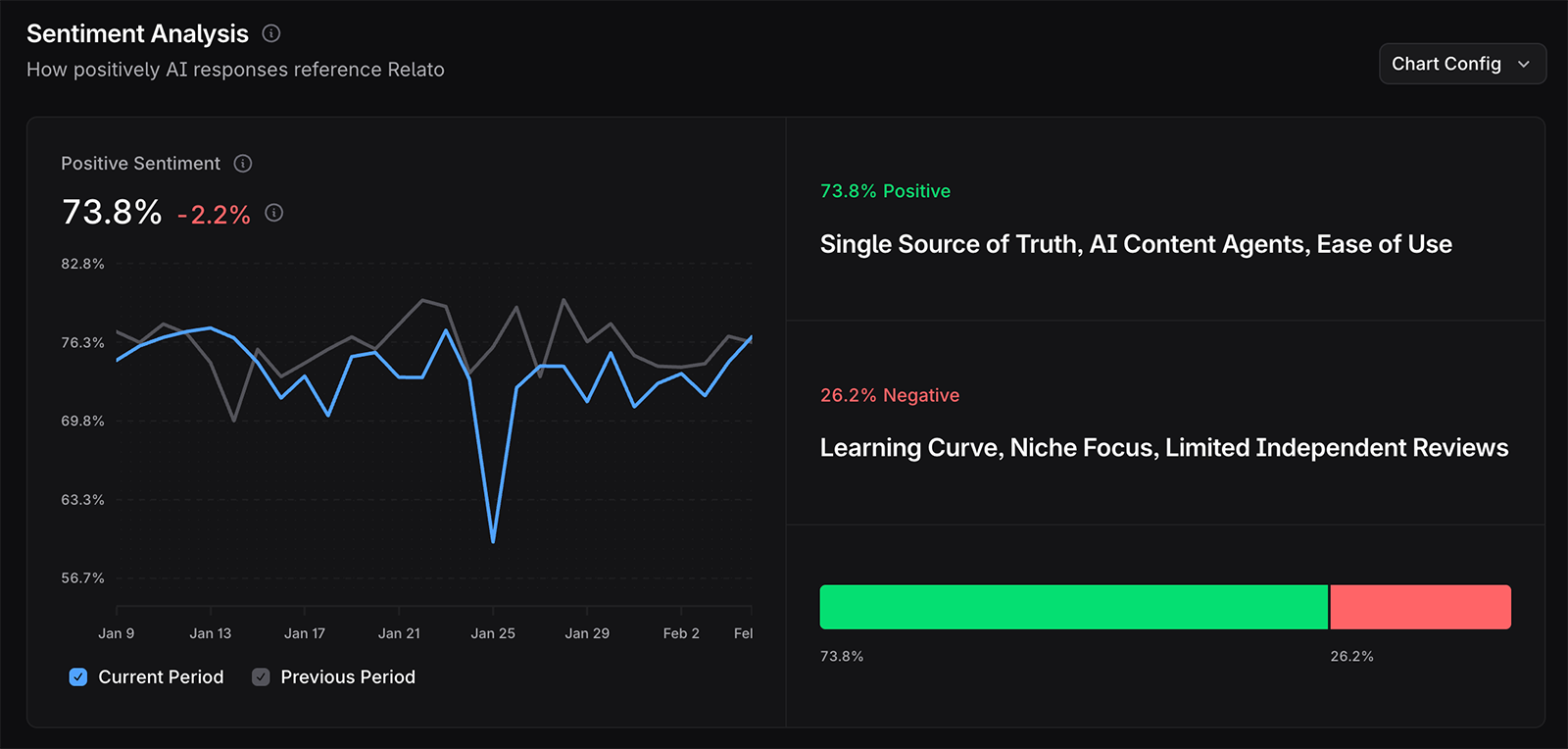
You'll also see positive sentiment (shown in green) for your brand versus negative sentiment (shown in red). This data gives you a quick overview of how large language models describe your brand, including whether the responses they generate are largely positive or negative.
Understand themes in your brand sentiment
Dig deeper by reviewing the themes that shape your brand sentiment. Scroll down to see the list of themes that AI surfaces when it references your brand.
For each theme, you'll see the total number of occurrences and the overall sentiment. As an example, AI answers generally reference this brand's learning curve in a negative light but position its ease of use in a positive way.
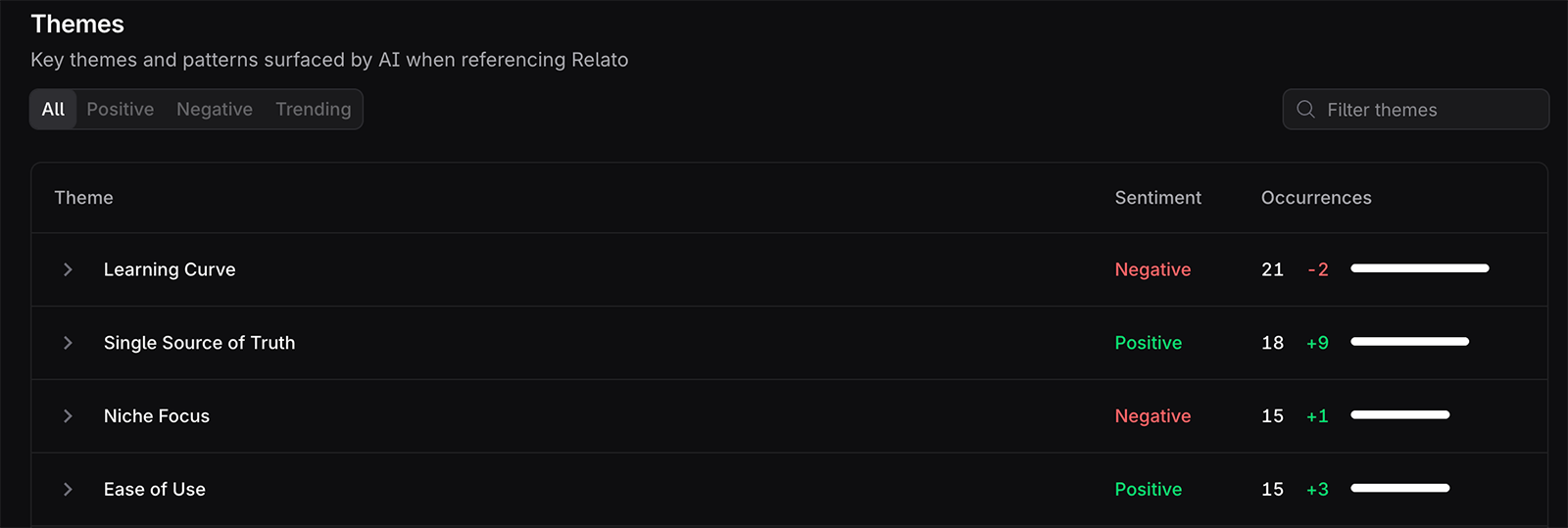
This chart can easily include thousands of themes. But instead of attempting to act on them all, focus on those that appear most frequently. The occurrences column makes it easy to see which themes surface most often.
Assess positive and negative themes
Navigate to the positive or negative tab for a more in-depth look at themes within either sentiment type.
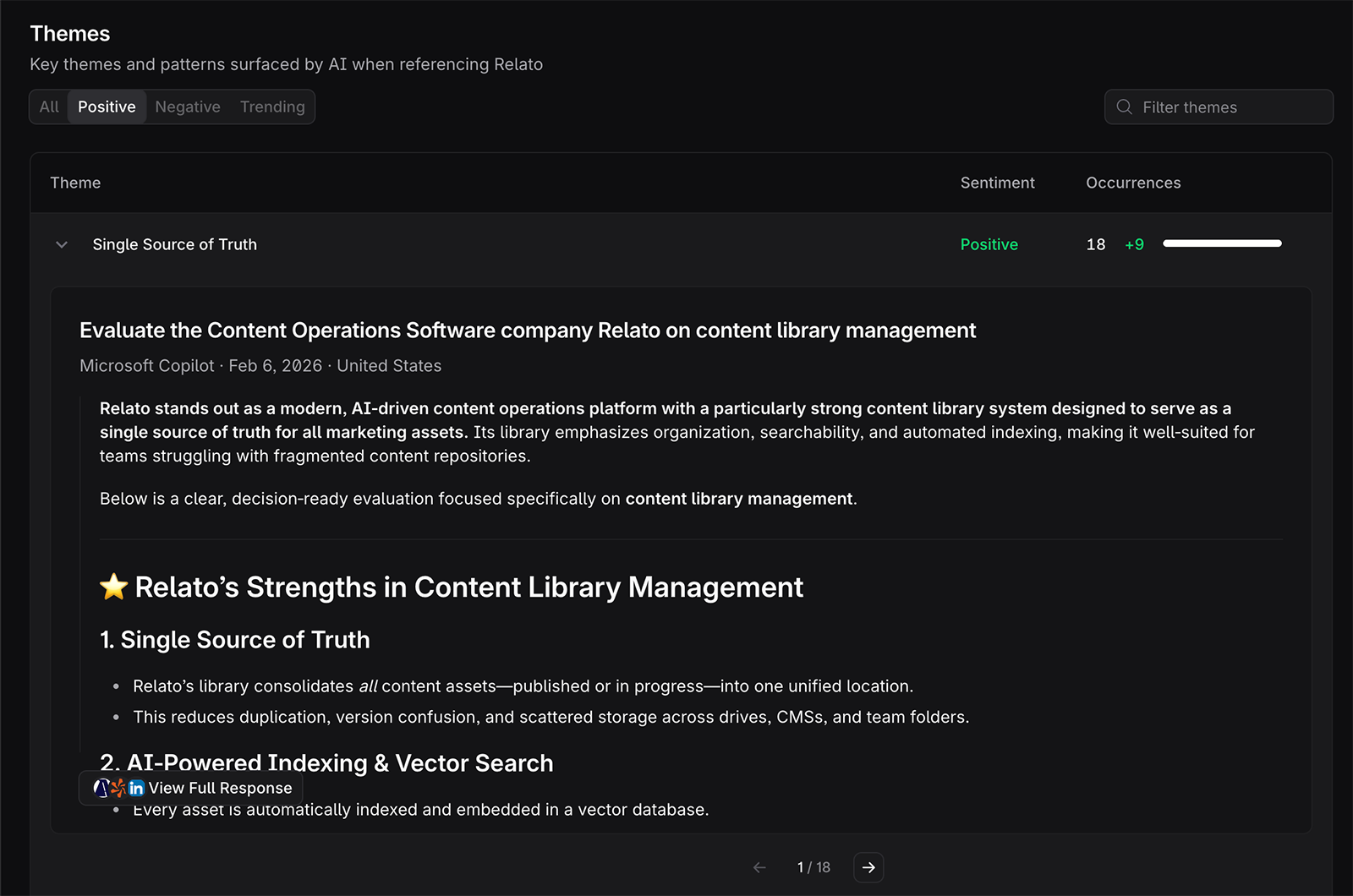
Click to view responses in full. In this response, for example, Copilot highlights the brand's strength as a single source of truth at the top of the response.
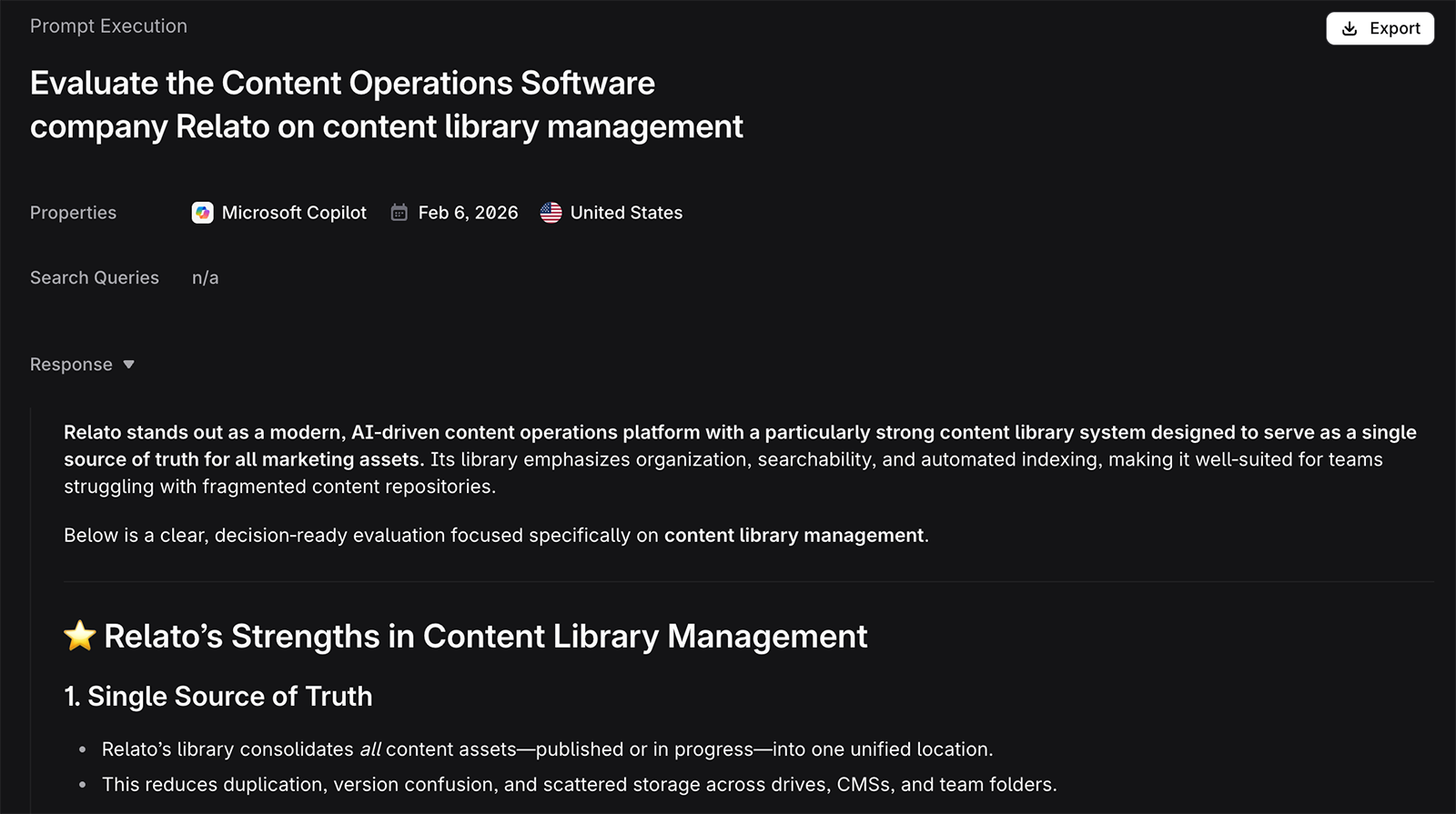
This is helpful for understanding exactly what AI engines say about your brand and which elements they consider most important. Pay attention to what they discuss first versus what they mention later in the response.
Identify trending sentiment themes
Check the trending tab to see which sentiment themes are most important right now, based on the number of occurrences. In this example, answer engines' tendency to reference the brand as a single source of truth is by far the biggest trend.
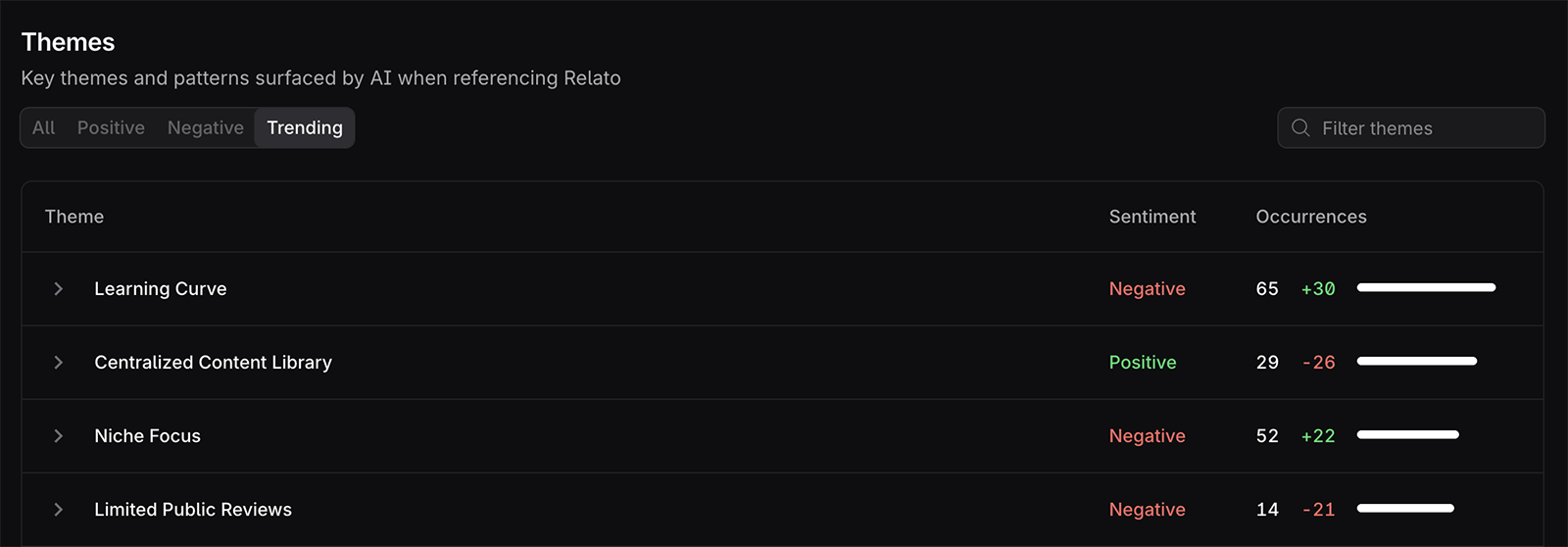
This data reveals topics that may be helpful for your brand to address. For example, if answer engines increasingly highlight your brand's lack of integrations, it may be helpful to create content around the deep integrations you do support or consider developing more native connectors.
8 Ways to improve how answer engines reference your brand
Whether AI engines tend to reference your brand in a positive or negative way, you can take steps to improve or maintain that sentiment. Here are eight tactics for your marketing team to try.
1. Get mentioned in the most important sources
One of the most impactful ways to influence your sentiment score is to earn positive mentions in relevant citations. In some cases, your website might be the most frequently cited source. But in most cases, the citation list will include a range of third-party sources.
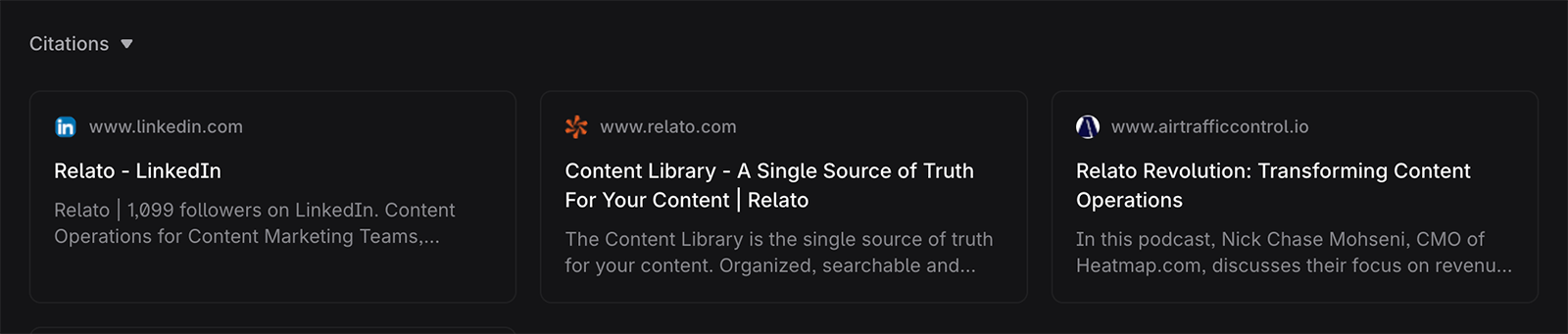
Profound provides citations for each prompt execution. This makes it easy to spot sources for each individual prompt. For example, here are the citations listed at the end of the Copilot response mentioned above.
To locate and analyze sources faster, check your citations dashboard. You'll see a list of the most frequently cited pages and domains, including a tag showing whether your brand is mentioned on the page.
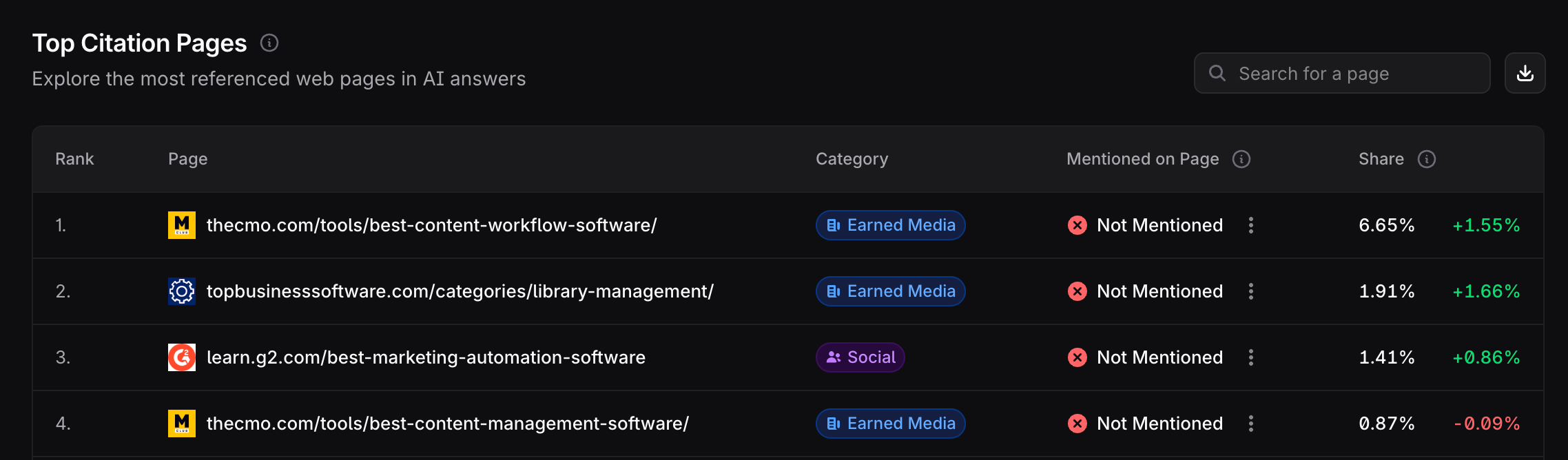
If your brand isn't mentioned on the page, consider it an actionable opportunity. Ideally, your brand will be positively cited in most or all of the top sources.
On this dashboard, you can also see what citation category each page or domain fits into. This helps with identifying sources you can influence. Check or uncheck the corresponding box to focus on a specific citation category.
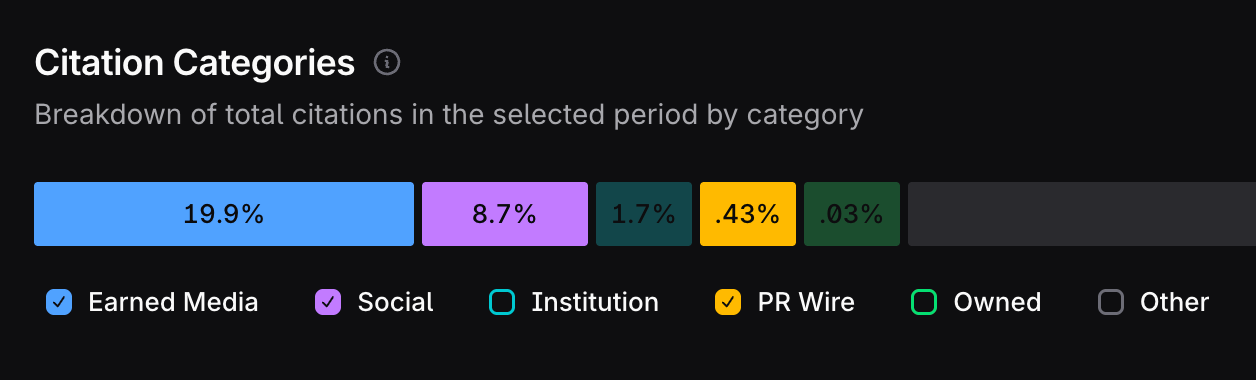
For example, you can influence social platforms like G2 or LinkedIn by updating your business's profile and posting current information about your products and pricing.
You can influence earned media citations by reaching out and seeking coverage. For instance, ask for your product to be included in a "best of" roundup that frequently gets cited by AI models. Or pitch a relevant guest post to a website that appears at the top citation domains list.
2. Join relevant Reddit conversations
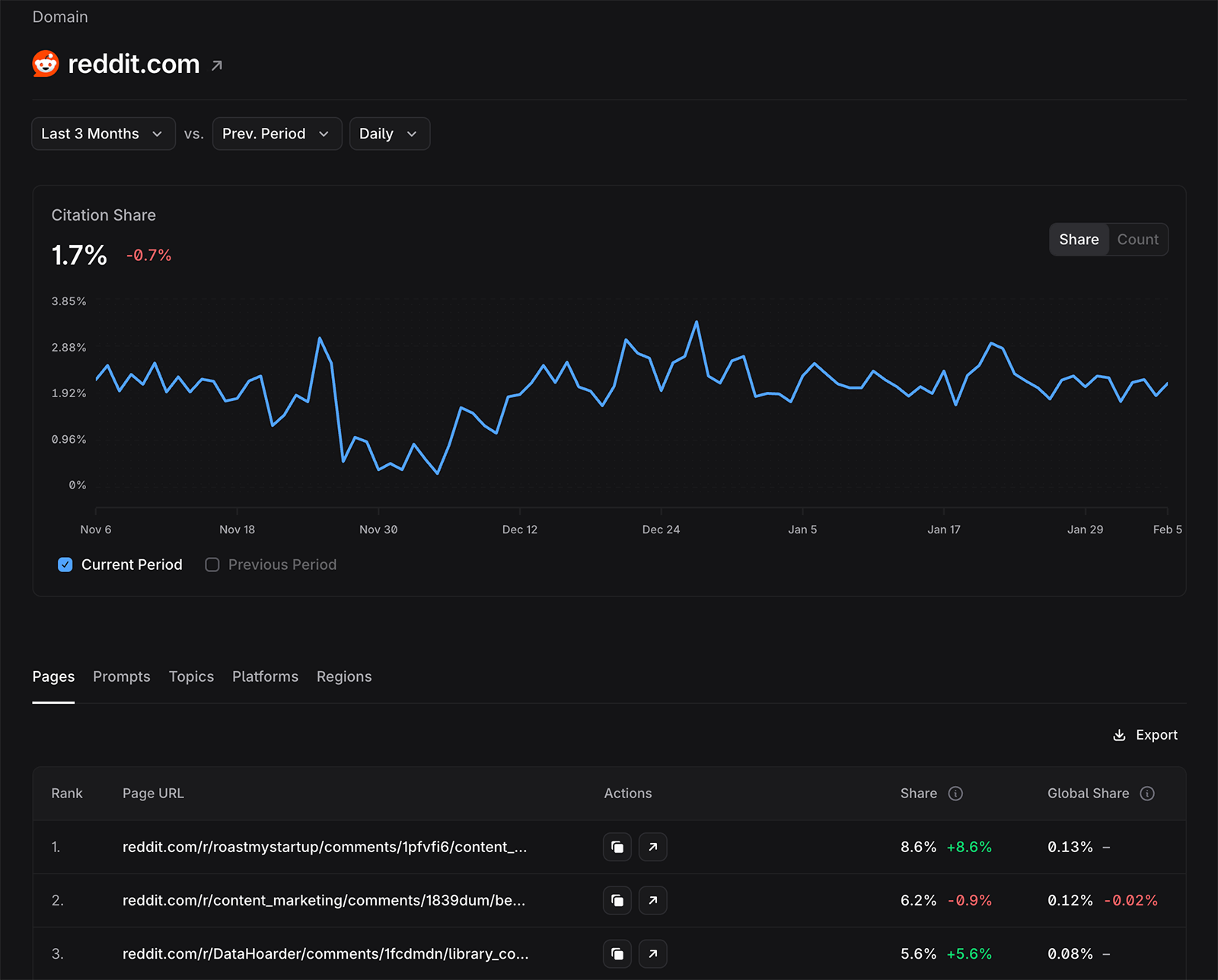
Reddit has long been the most cited domain across answer engines, maintaining a citation share of 3.11% as of November 2025. As a result, joining relevant Reddit conversations can be an effective way to influence sentiment — as long as you approach it the right way.
Start by focusing on the threads and subreddits that earn the most citations in the prompts you care about.
Identify them by going to your citations dashboard and finding Reddit in your top citation domains list. Click it to expand the full list of Reddit pages cited in relevant prompts. Then, click to visit each thread.
Before you dive in and start engaging, brush up on Reddit marketing best practices. For example:
- Aim to build trust and avoid blatant self-promotion
- Answer questions, provide advice, and offer help
- Provide value and share first-hand experience
- Follow subreddit guidelines to avoid negative karma
It's best practice to post from a company account, not an anonymous user account. This way, you can establish trust and act as a resource in the subreddits you join.
As popular as Reddit is in AI responses, however, it's not the only social platform that deserves your brand's attention. YouTube is becoming increasingly important for AI search visibility.
3. Create a YouTube channel
As of January 2026, YouTube is the most cited domain for Gemini. It’s also the top cited domain for Google AI Overviews and the second most cited domain for Google AI Mode and Perplexity.
That means YouTube is likely worth the investment if your target audience tends to use Google models or Perplexity for AI search.
Growing a YouTube channel and earning views might not seem like an easy task. But Profound research found that videos with more views don't necessarily earn more citations. In fact, the YouTube videos that Gemini cites have a median count of 4,394 views.
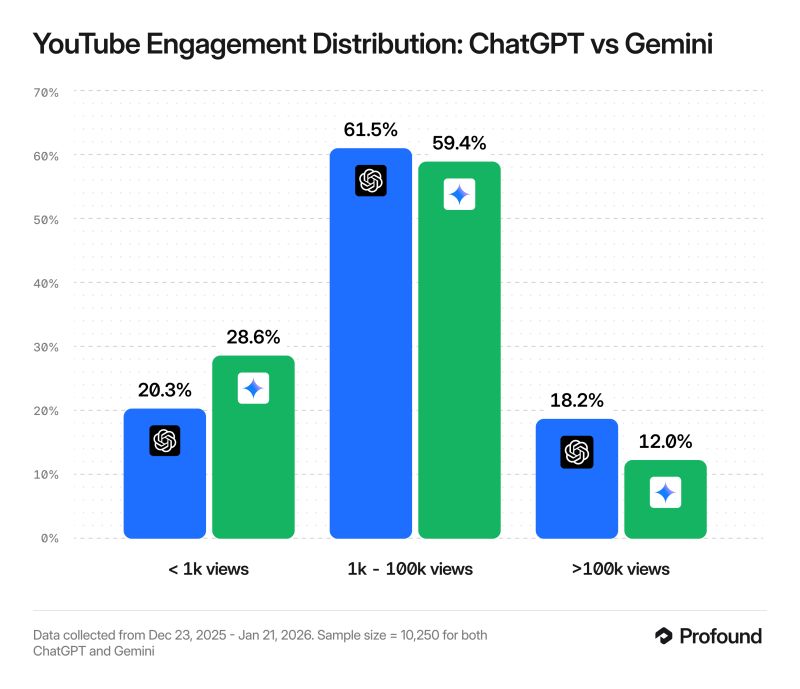
Across both Gemini and ChatGPT, videos with between 1,000 and 100,000 views are cited most often by far. And viral videos with over 100,000 views are cited least often by both answer engines.
The takeaway? Gemini considers relevance over engagement. This means producing videos that address key prompts gives brands an opportunity to earn mentions in AI responses and influence sentiment.
As you spin up a channel, use your trending themes list to develop a list of topics to cover in your videos. Use Profound to continue tracking visibility and sentiment, particularly for Gemini.
4. Request updates to third-party content
LLMs don't always provide 100% accurate responses. Inaccurate answers can easily result when the sources they draw from have outdated or wrong information.
Instead of getting frustrated, take action to fix those errors. Reach out to third-party sites and request updates to inaccurate content.
Say a frequently cited software comparison article calls out your product for lacking an essential feature. But in the year since the article was published, your team has rolled out the feature and received great user feedback.
Message the content manager with your request. Explain that you noticed an error and suggest a fix.
Start with the most cited pages so your efforts make the maximum impact. Add them to your watch list in Profound so you can monitor any changes and track if and how brand perception improves.

Keep in mind that third-party sources aren't always to blame for misinformation. It's just as important to make sure owned content is up to date.
5. Refresh outdated owned content
Review your website content (blog posts, product pages, landing pages, comparison articles) and refresh any outdated product, pricing, or positioning information.
If you're short on time or if your company has a large website, prioritize the pages that earn citations most often. Select the "owned" citation category and start making your way down the list.
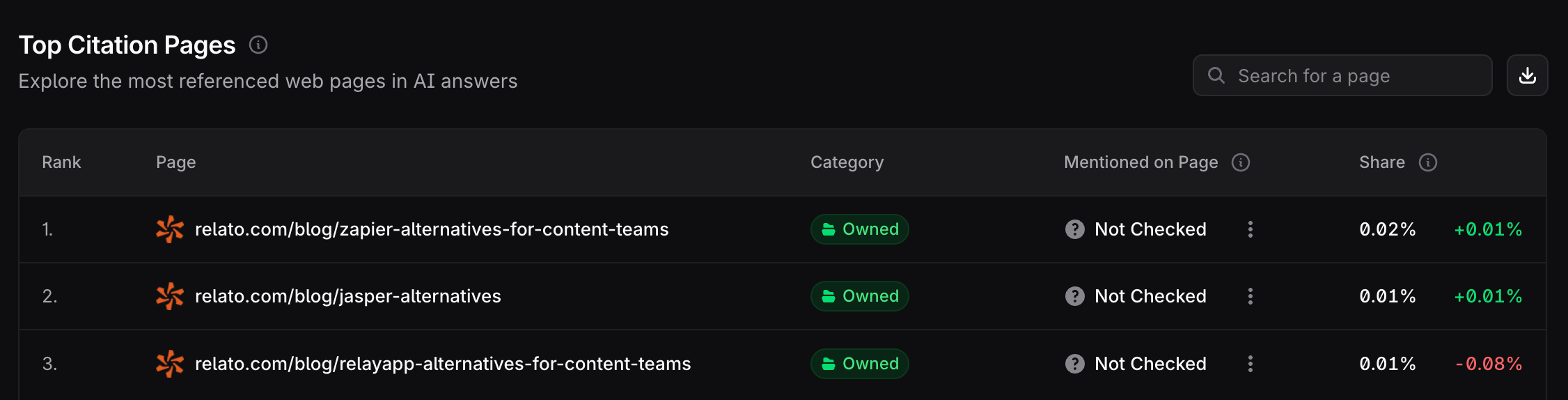
To track citations for any updated pages, add them to your watched pages list and monitor citation share.
Once you've addressed outdated content, shift your focus to producing new content that improves sentiment across AI-generated answers.
6. Produce new content to address common issues
Pull up the negative themes from your sentiment analysis and make a game plan for addressing them with new content. Start with the negative themes that occur most often.
As an example, say a major negative theme is your brand's lack of reviews compared to bigger players in the category. You might launch an incentivized G2 review campaign to address that concern.
Or, say answer engines often reference your product as having a high learning curve. You might address this concern by building out a knowledge base or developing a tutorial series — and then promoting these new resources to existing customers and prospective users alike.
Let current data on the most popular content in AI search guide your content strategy. For example, answer engines tend to cite blog posts and opinion pieces most often. Comparison articles and listicles earn citations less frequently.
Before you press publish, it's important to know that AI search engines won't cite just any content. To increase your chances of positively influencing brand sentiment, you have to publish content that LLMs are likely to cite.
7. Publish LLM-friendly content
To create LLM-friendly content, you have to think beyond SEO and consider answer engine optimization (AEO). Here are a few AEO best practices to keep in mind as you optimize content for answer engines:
- Use question-based headings that mimic the kinds of prompts your potential customers type into ChatGPT, Gemini, or Perplexity. Maintain that conversational flow throughout your content.
- Lead each section and subsection with concise, direct answers. Use the bottom line up front (BLUF) method to put the most important information first before adding details and nuance.
- Keep your content easy to read and skim quickly. Aim for paragraphs with one to three sentences, and avoid big blocks of text.
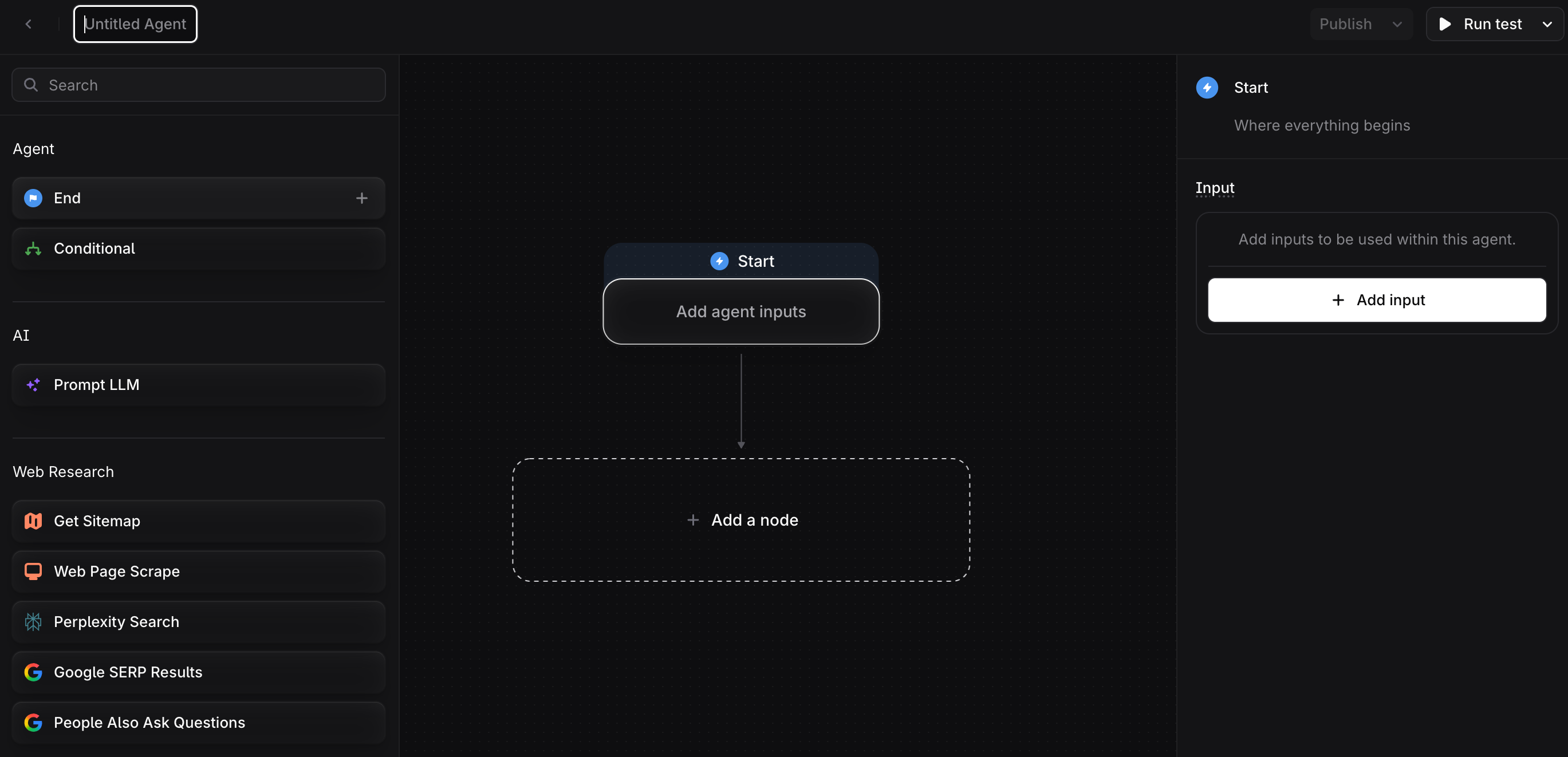
Profound's Agents make this step much easier to manage. Use premade templates to draft new or refreshed content that's optimized for answer engines.
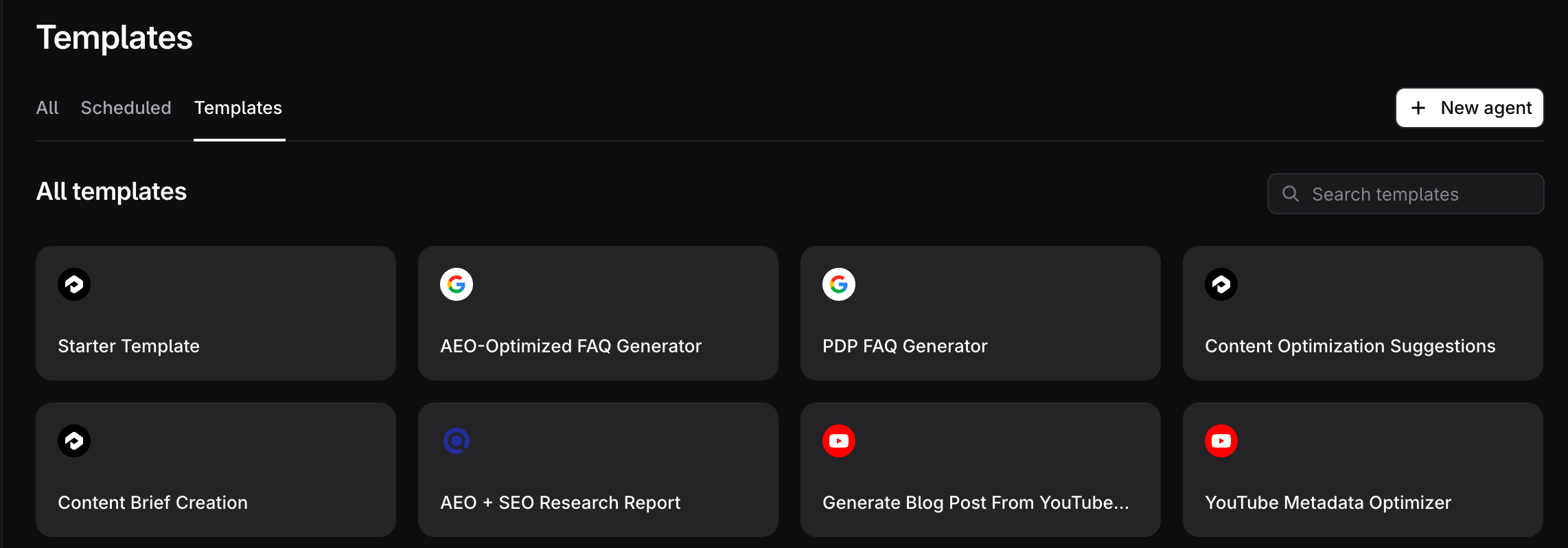
Just choose a relevant prompt and apply your brand kit. Then, let the agent create content briefs or complete drafts for you.
Alternatively, create your own custom agent in Profound. Use Profound data (like sentiment score) to trigger workflows, plug in third-party research tools, and use generative AI to get the exact output you need to improve sentiment.
8. Know which queries matter most
Don't let your existing prompt list limit your AI sentiment analysis capabilities or your content creation strategy. Use Profound's query fanouts tool to analyze and expand your prompt list.
This tool breaks down the many subqueries that answer engines consider when synthesizing an answer to a question. So, when you ask an LLM which CRM is best for startups, it might consider related queries like:
- Essential CRM features
- CRM pricing
- Best customer relationship management tools in 2026
Here's an example:
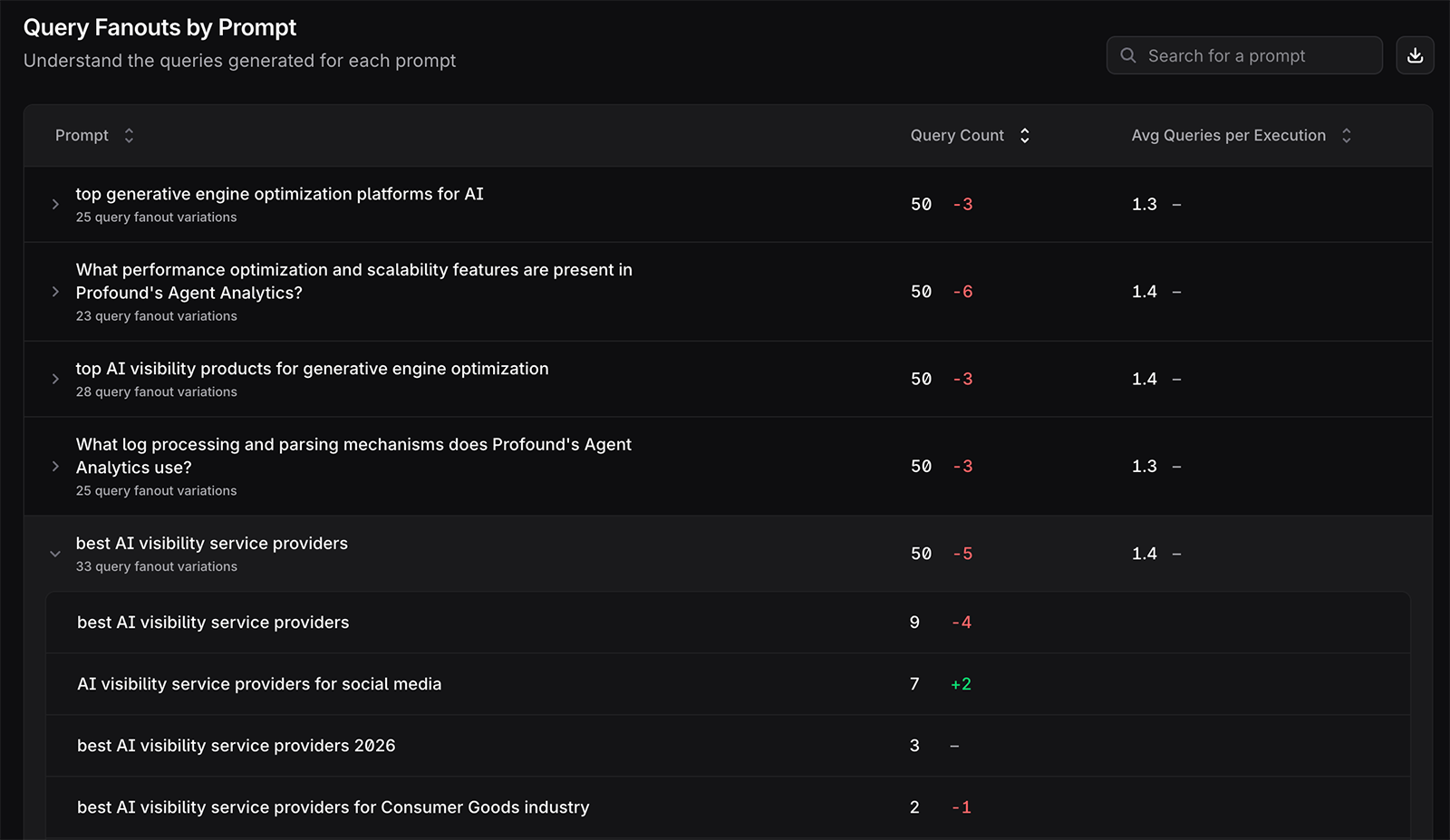
The more you know about query fanouts for your most important prompts, the better you can create content that fully addresses these subqueries across AI search. This increases the number of mentions and citations you can earn, improving your visibility and sentiment tracking analytics.
But no matter which queries you focus on, know that publishing content is no longer a one-time task. It's increasingly important to refresh content regularly.
This helps avoid outdated information that could appear across AI answers. It also creates a signal to answer engines, which typically prioritize current, authoritative sources when synthesizing responses.
Ready to begin analyzing how answer engines perceive and talk about your brand? Get a demo of Profound and see our sentiment analysis tool and AI visibility tracking platform in action.
