
AI visibility is the new SEO. To optimize your brand for AI-powered discovery and conversions, you need to track metrics like share of visibility, citations, and sentiment.
But traditional SEO tools can't tell you if your brand is visible in AI answers. AI search has its own ranking system, and ChatGPT's sources have only a 39% overlap with Google's sources.
That's why you need a dedicated AI search visibility tool to monitor results across AI platforms.
I'll show you exactly how to track AI visibility with Profound, from setting up prompts to analyzing results to finding optimization opportunities.
How to track your brand's AI visibility with Profound
Let's walk through the steps to track prompts, monitor visibility across AI engines, and benchmark your brand against the competition using Profound.
1. Identify the prompts that matter for your brand
First, you need a list of topics and prompts to monitor. Profound monitors the prompts that searchers enter into answer engines like ChatGPT and Google AI Mode, organizing them into broader categories called topics.
Keywords can be a good start for identifying relevant topics for your brand. Profound estimates search volume for each topic you input so you can assess whether the topic has enough traction to be worth tracking.
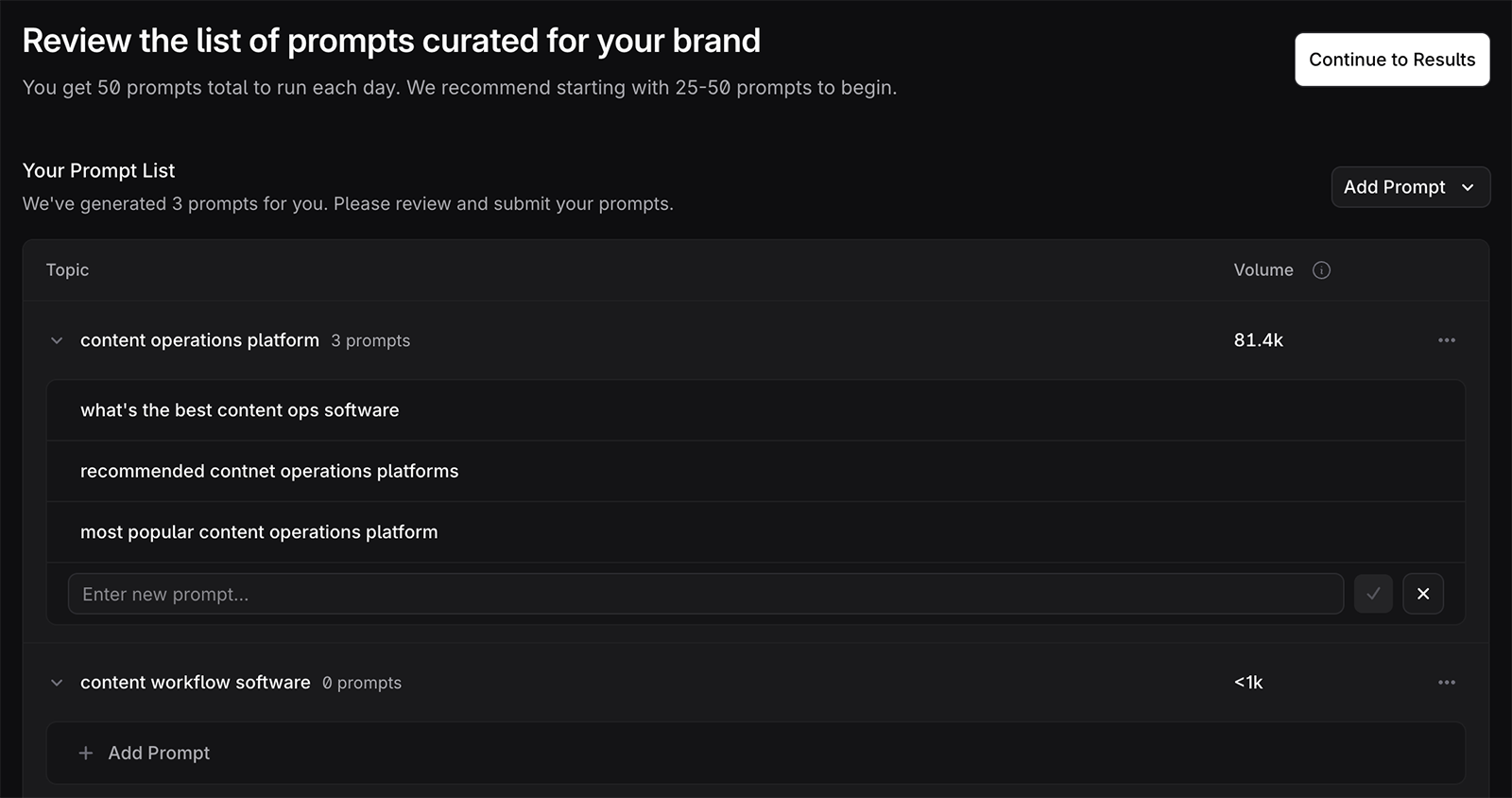
But when you brainstorm prompts, think beyond keywords. Compared to traditional search, AI prompts tend to involve longer, more conversational queries.
To develop your list:
- Ask current customers how they found you via AI. Add a field to your contact form, encouraging customers to share the prompts they used so you can learn how searchers are looking for the solutions your brand offers.
- Poll your employees. Ask your sales, customer success, and marketing teams to submit prompts they'd use to find your product or service in AI search.
Once you've built out your prompt list, you're ready to start tracking how your brand appears in AI search.
2. Establish your brand's AI visibility baseline
Use Profound's Answer Engine Insights to establish a baseline for your brand's AI visibility. You'll want to know your overall visibility score, share of voice, and average position in AI search. Together, these metrics tell you how visible your brand is and reflect its relative performance in your industry.
Visibility Score
Profound's Visibility Score measures the percentage of mentions out of the total responses tracked. Think of it as a quick snapshot of your brand's visibility within the prompts you've chosen.
Here, the tracked brand appears in 0.1% of relevant AI-generated answers, ranking 339 compared to other brands. This means it's secured some mentions but it has plenty of room for improvement.
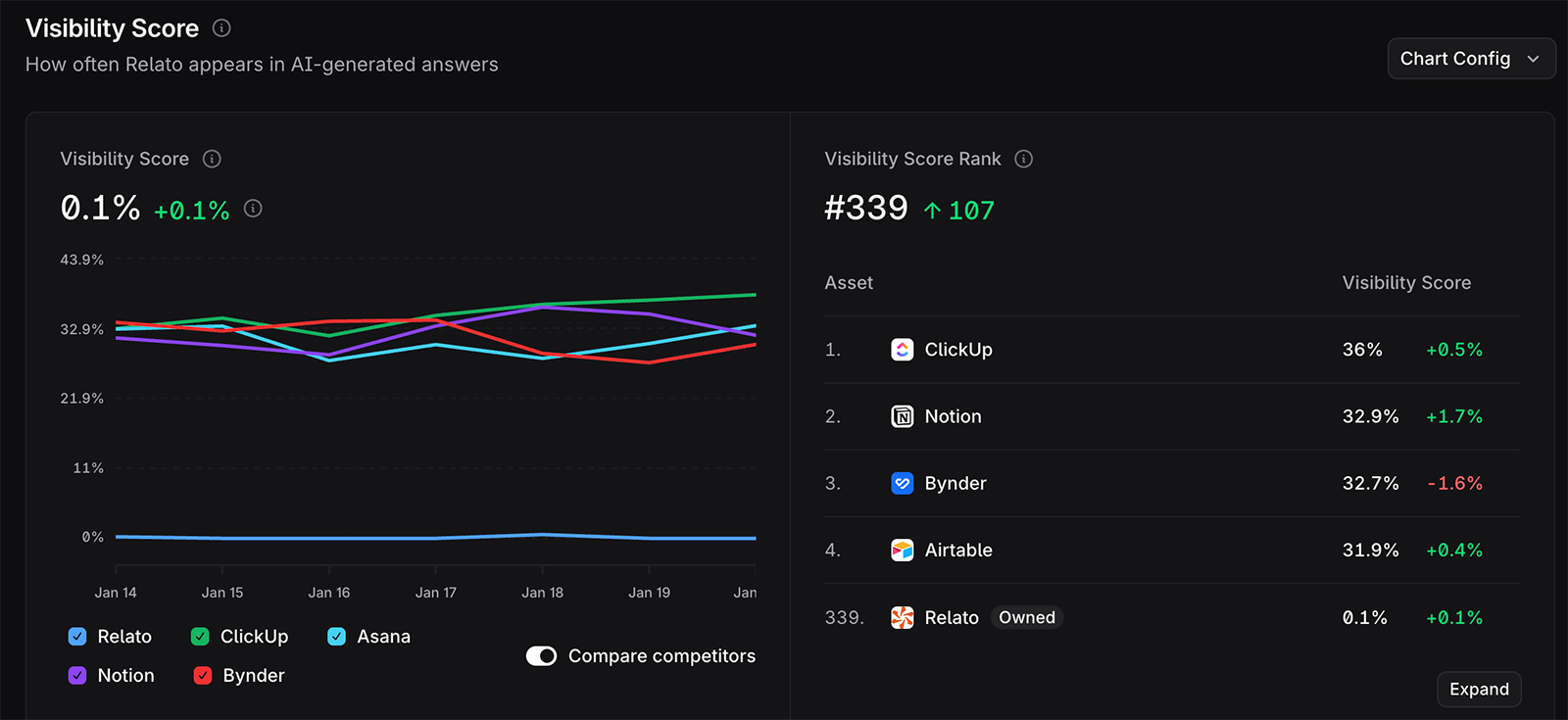
Once your dashboard has collected more than a couple days worth of data, check the "Previous period" box to compare results. Are you making steady progress? Does the data show a sizable spike or dip? Use these insights to adjust your AEO strategy over time.
To check your brand against the competition, toggle "Compare competitors." You'll see how your visibility score compares to the top competitors in your space, and you'll identify trending brands to beat.
Share of Voice
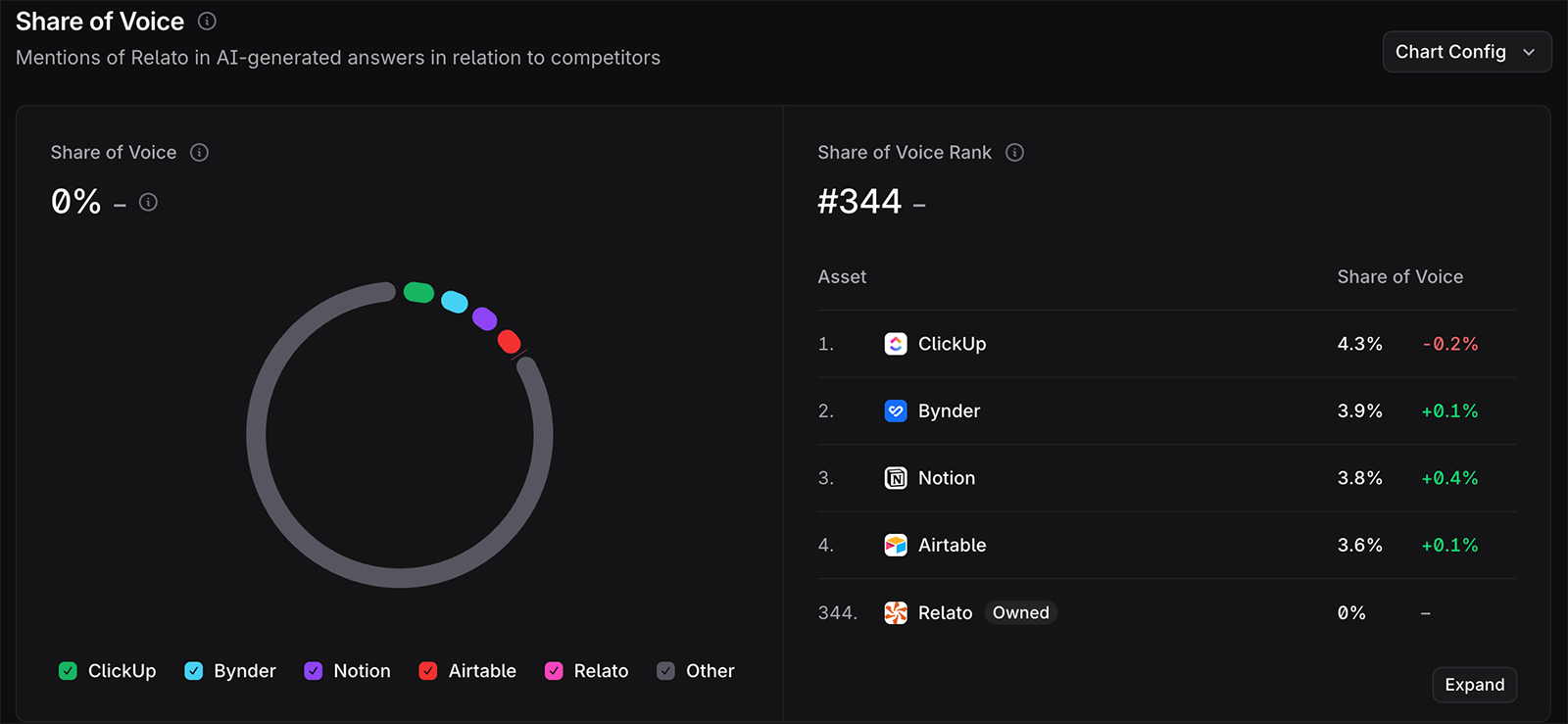
Profound's Share of Voice score compares your brand mentions to competitors' mentions across all responses tracked. It's a quick way to benchmark your brand against the competition.
Check or uncheck any of your top competitors to visualize how your brand's share of voice compares to theirs. And use the Share of Voice Rank to see where your brand sits in the overall rankings.
Here, the tracked brand has 0% share of voice and holds spot 344 in the Share of Voice Rank. This indicates its competitors currently land more brand mentions.
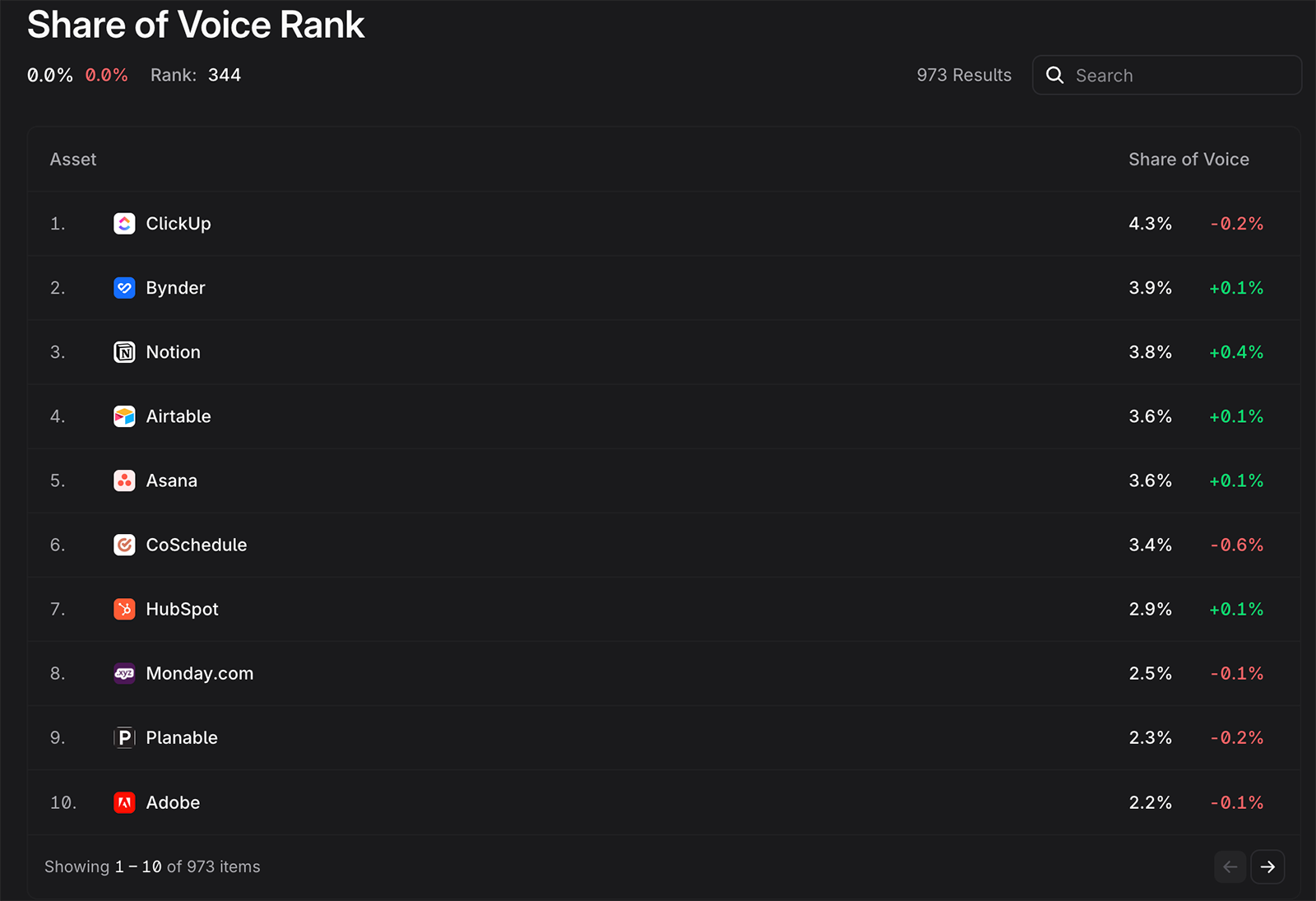
Expanding the list reveals just how competitive this category is. Across the top 10 brands, share of voice varies by only about 2%.
Average Position
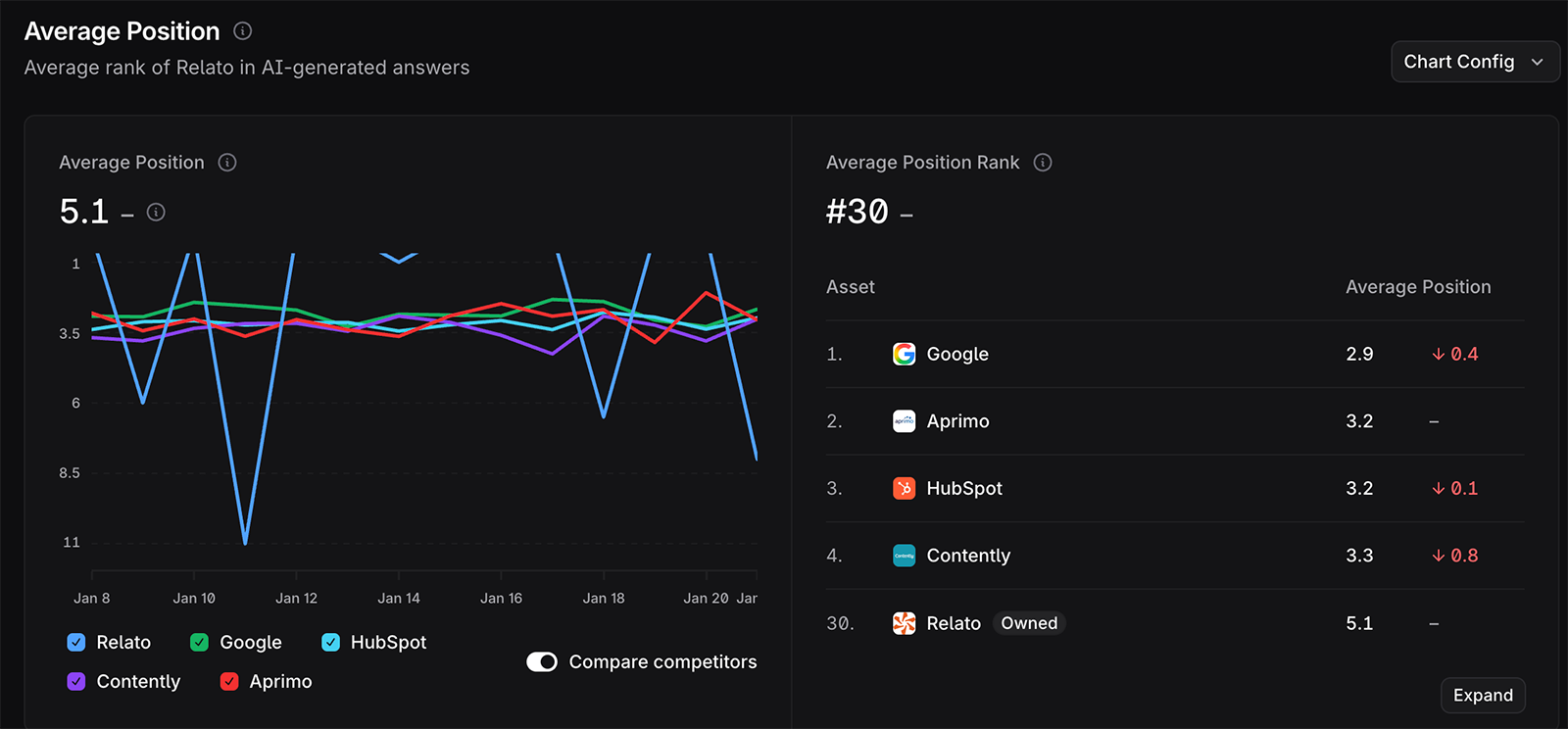
Profound's Average Position data shows where your brand ranks in relevant AI-generated answers. Think of it as a way to gauge if your brand typically appears before competitors in AI responses.
On average, your brand will ideally appear closer to the first position. This happens when your brand is consistently mentioned near the beginning of relevant AI search results.
Here, the tracked brand appears in an average position of 5.1, with fluctuations over time. This indicates that while the brand performs well in some AI answers, it doesn't reliably land top mentions across all tracked topics.
3. Find your brand's most important AI models and topics
Profound's Visibility dashboard shows results for all topics and AI models you're tracking. But you'll likely see that some perform better than others. This is a good indicator that they're a better fit for your brand and audience.
To find your brand's most important AI models and topics, navigate to the top of the visibility dashboard and expand the "Topics" and "Platforms" dropdowns. Then, uncheck the topics and platforms you don't want to view and compare the results.
For example, the tracked brand has a noticeably higher visibility score for specific topics (content operations platform) and AI engines (Grok).
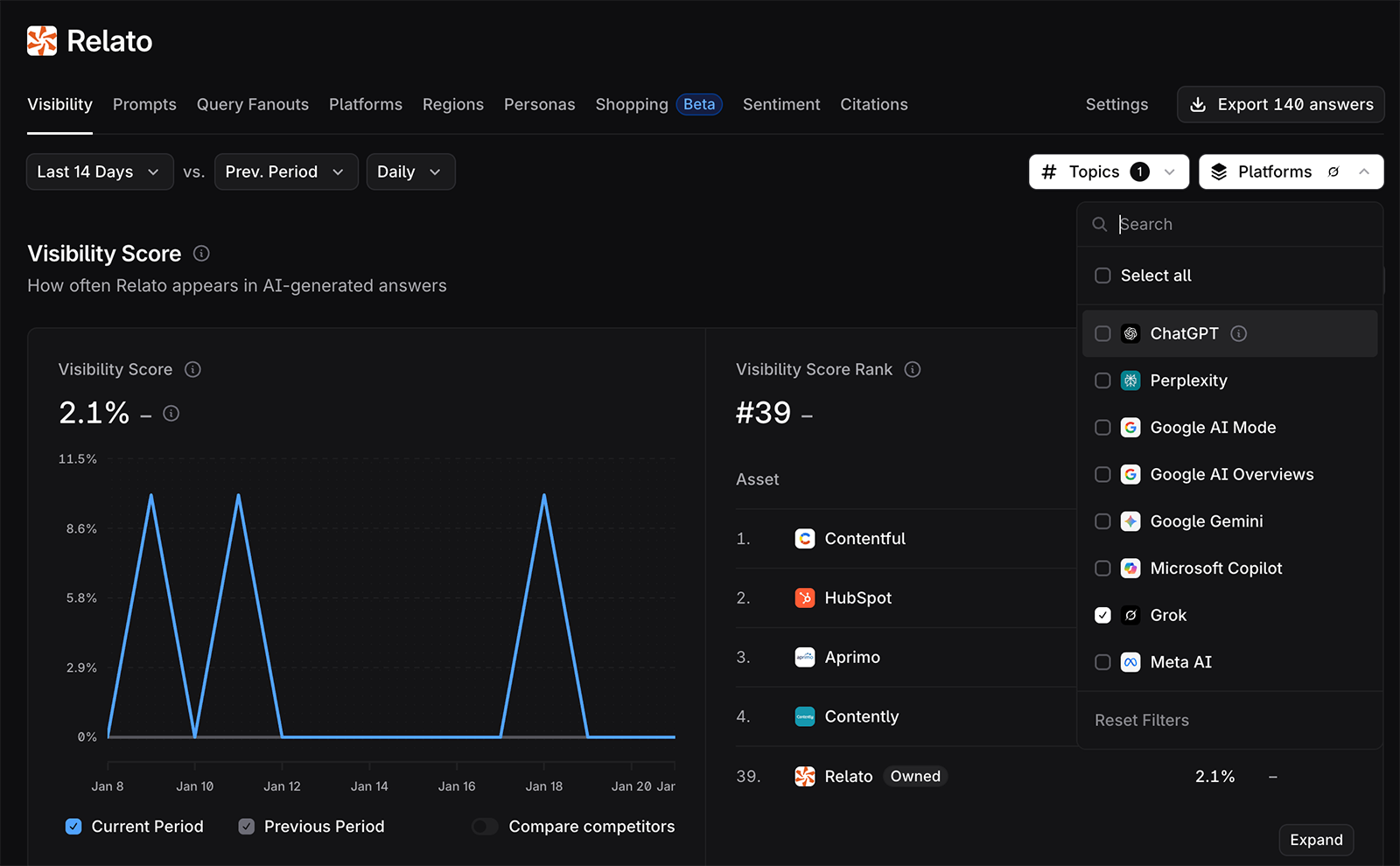
These insights reveal where your brand is already winning, including topics where you already have a strong share of voice and where it may make sense to invest additional resources. They also help you see which AI search engines your customers use, which varies widely by industry and niche.
Note that the Profound plan you choose determines the answer engines you can track:
- All plans track ChatGPT
- The Growth plan adds on Perplexity and Google AI Overviews
- The Enterprise plan supports all 10 major answer engines
4. Benchmark your brand's visibility rankings against the competition
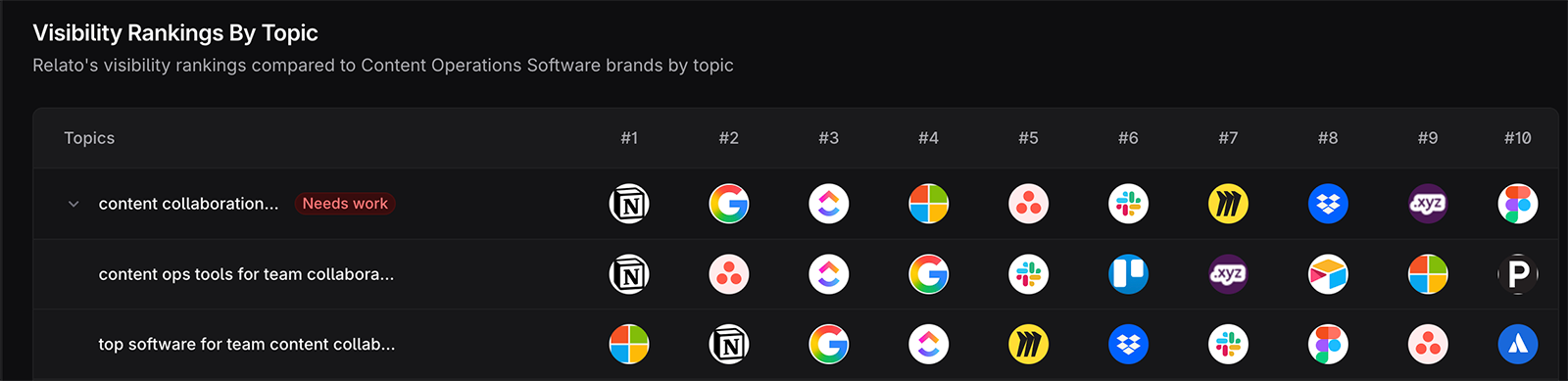
Dive deeper into competitive insights with Profound's Visibility Rankings By Topic dashboard. It generates a leader board for all the prompts you're tracking, broken out by topic.
This visualization makes it easy to benchmark your brand's visibility across topics and find visibility gaps. Plus, the list automatically notes the topics where your brand is leading and where it needs work.
Hover over any competitor to instantly focus on where they appear across the leader board. This helps you see which brands dominate the leader board for specific topics.
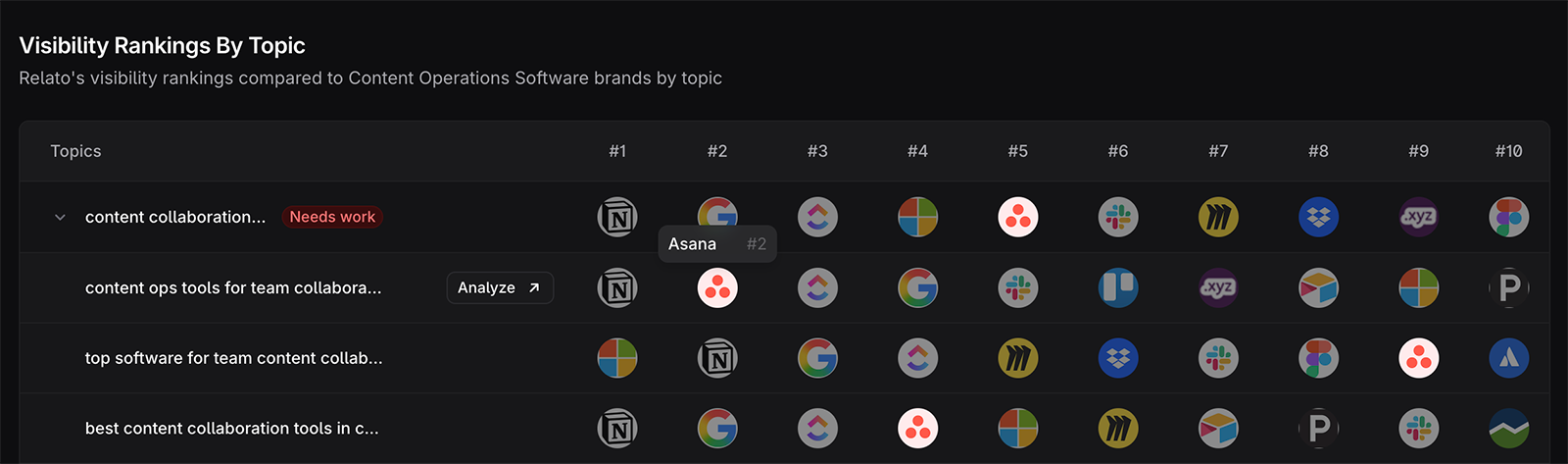
Click any prompt to analyze it further. You'll see your brand's visibility score, average position, and citation share for the prompt. You'll also see a list of prompt executions, including whether your brand was mentioned in the response.
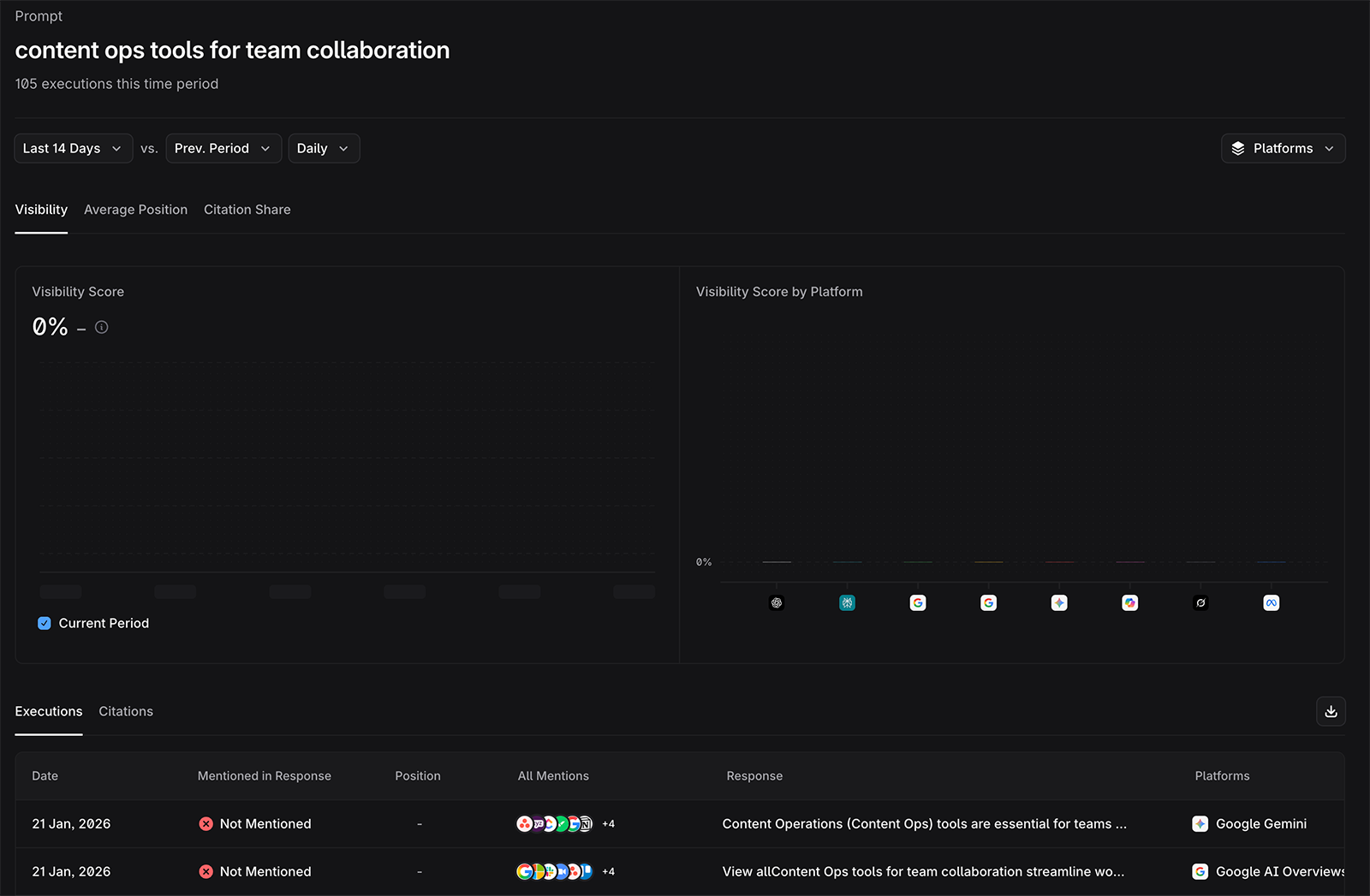
From this data, you can start to get a sense of what relevant responses say, which brands they mention, and how you can work your brand into the conversation.
5. Monitor AI citations to see which sites are top sources for AI engines
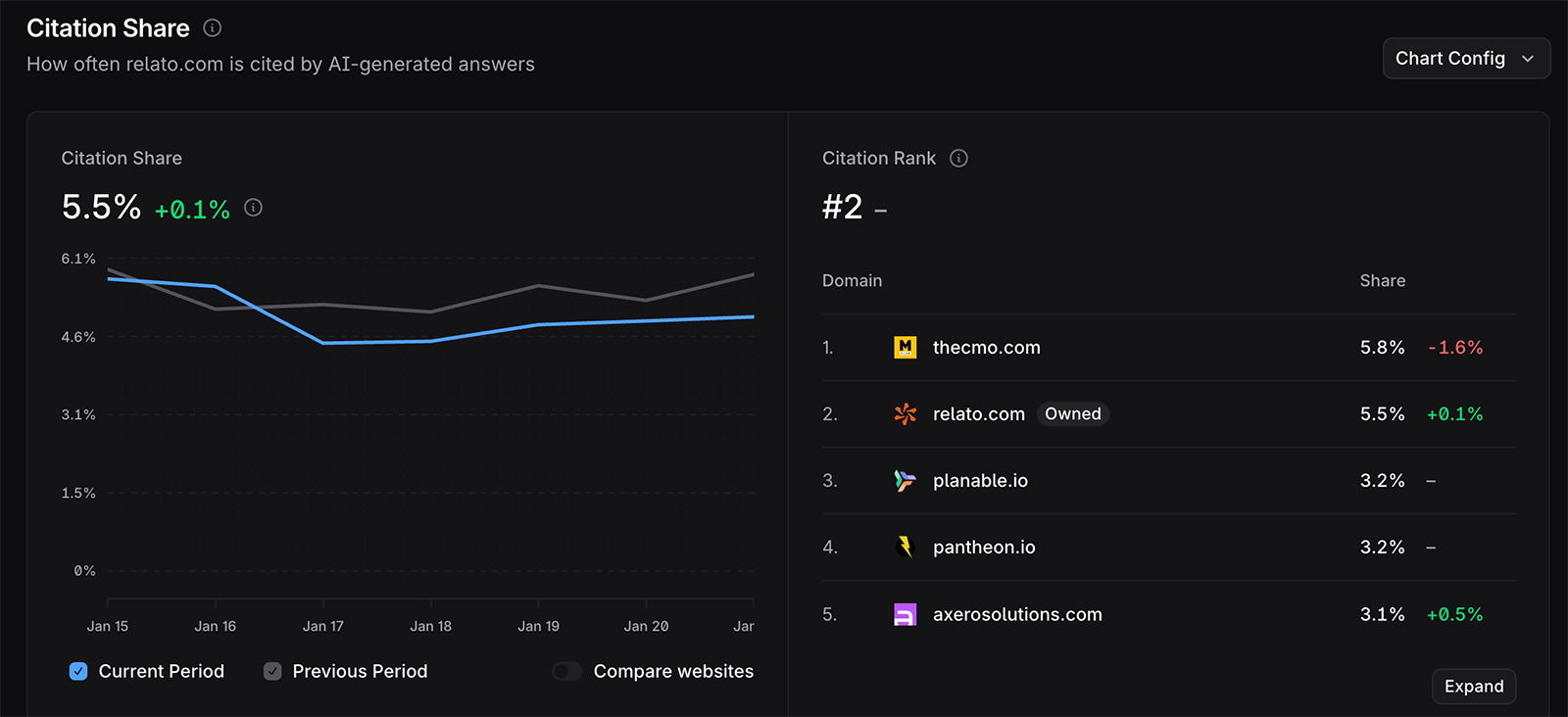
Find where and how often your brand is cited in AI tools using Profound's Citations dashboard. It tracks how often AI engines link to your brand's website and which other domains and pages are top sources for your tracked prompts.
Use Citation Share data to see how often your brand is cited in AI-generated answers. And to see how your brand compares to the competition, check the Citation Rank list.
Think of the Top Citation Domains list your roadmap to success. It shows you which pages answer engines prefer most right now.
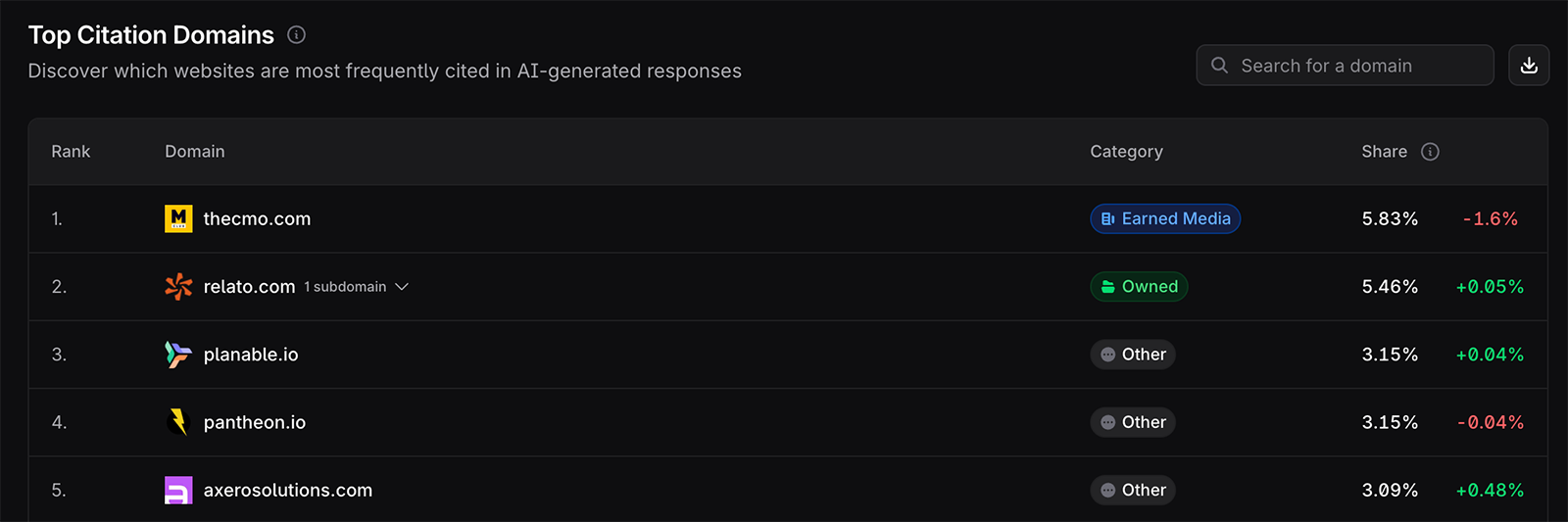
There are two ways to act on this data:
- Make your website the top-cited domain. This requires writing and updating owned content that gets cited by AI platforms.
- Get listed in the top-cited domains. This requires more of an off-page AI SEO strategy based around outreach and getting top sites to mention your brand.
Not sure which method to prioritize? Check the list of Top Citation Pages.
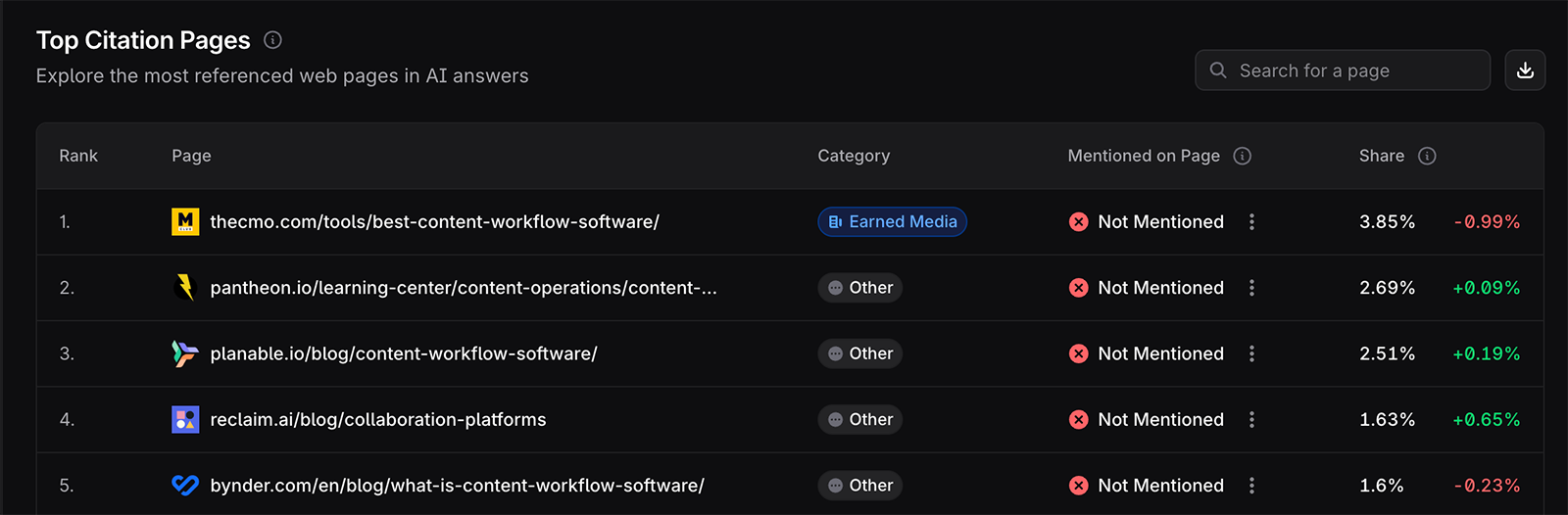
If any owned pages appear on this list, it's worth monitoring them to ensure they continue to earn citations. Click to track specific pages so you can keep them in your Watched Pages list and monitor their citation share.
But if most or all top pages are earned media or competitors, an off-page strategy is likely your best bet. Click to visit any top-cited page and get ideas to craft compelling outreach.
6. Check sentiment to see how AI engines perceive your brand
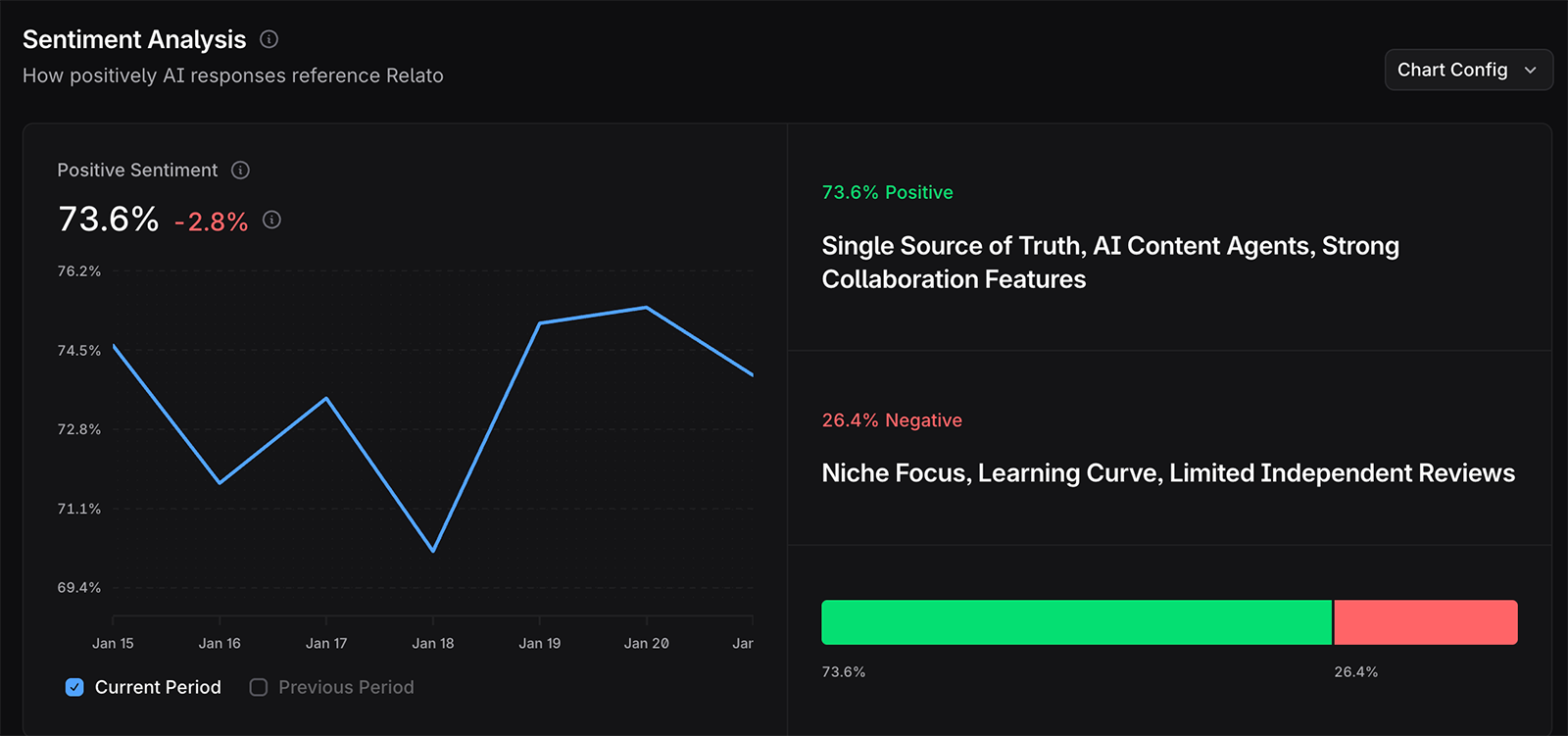
Not every AI answer citation or mention will position your brand in a positive way. Use Profound's Sentiment dashboard to analyze the tone AI engines typically use when referencing your brand.
The Sentiment Analysis chart provides an overall rating, breaking down positive and negative sentiment for your brand. It also highlights common themes associated with both positive and negative references.
Check the Themes list for a detailed breakdown of how many times each theme appears across AI answers. You can also see the full responses, which show exactly how AI engines describe your brand.
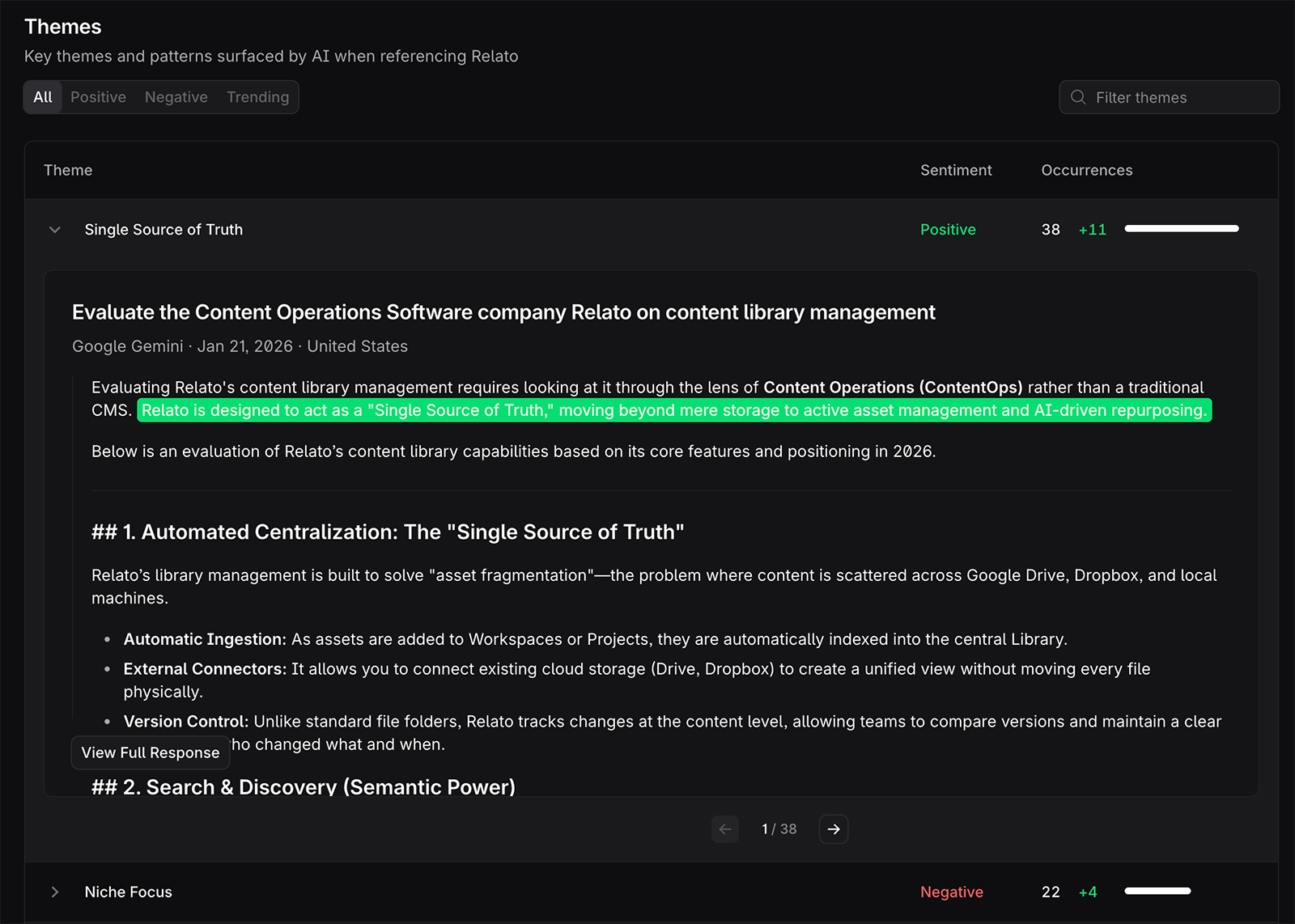
Use this list to find patterns and areas for improvement. For example, do AI engines say your software product has a steep learning curve? Consider creating detailed tutorials or providing extra onboarding support.
Do answer engines say your brand's product or service has minimal reviews? Think about asking customers for G2 or Google reviews or even making this request a standard part of your onboarding workflow.
7. See how AI engines interpret your website content
To guide how AI engines perceive and cite your brand, you need to know how they navigate your website content. But you won't get this data from Google Analytics or other traditional analytics solutions.
Profound's Agent Analytics tool acts as a server-side tracker that identifies and confirms AI user agents and then analyzes how they use your website. It reveals whether AI crawlers are visiting your site to index content or if they're operating as on-demand retrieval bots, fetching current content in real time.
After installing this tool, check your Agent Analytics dashboard to see which website pages AI search engines access (and cite, by extension) most often.
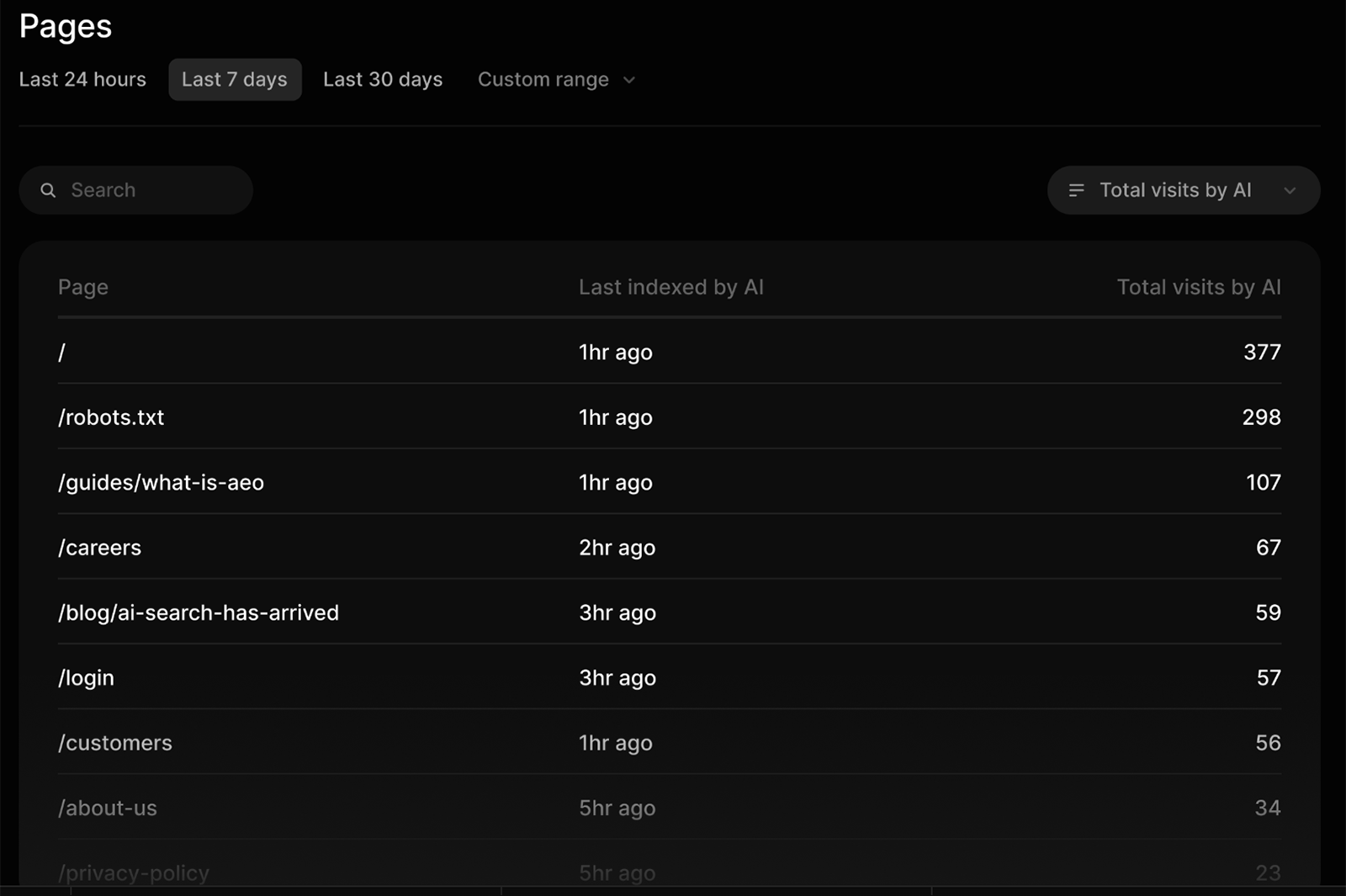
This data helps you identify the most important pages to update and optimize. This way, you take steps to continue to secure citations in relevant prompts.
8. Connect AI visibility to real business outcomes
Now you know which website pages AI engines access and cite most often. But which pages matter for leads and drive revenue? Agent Analytics shows how your brand's AI visibility connects to business outcomes.
Check the Google Analytics panel on your Agent Analytics dashboard to track AI traffic and see how that traffic contributes to revenue.
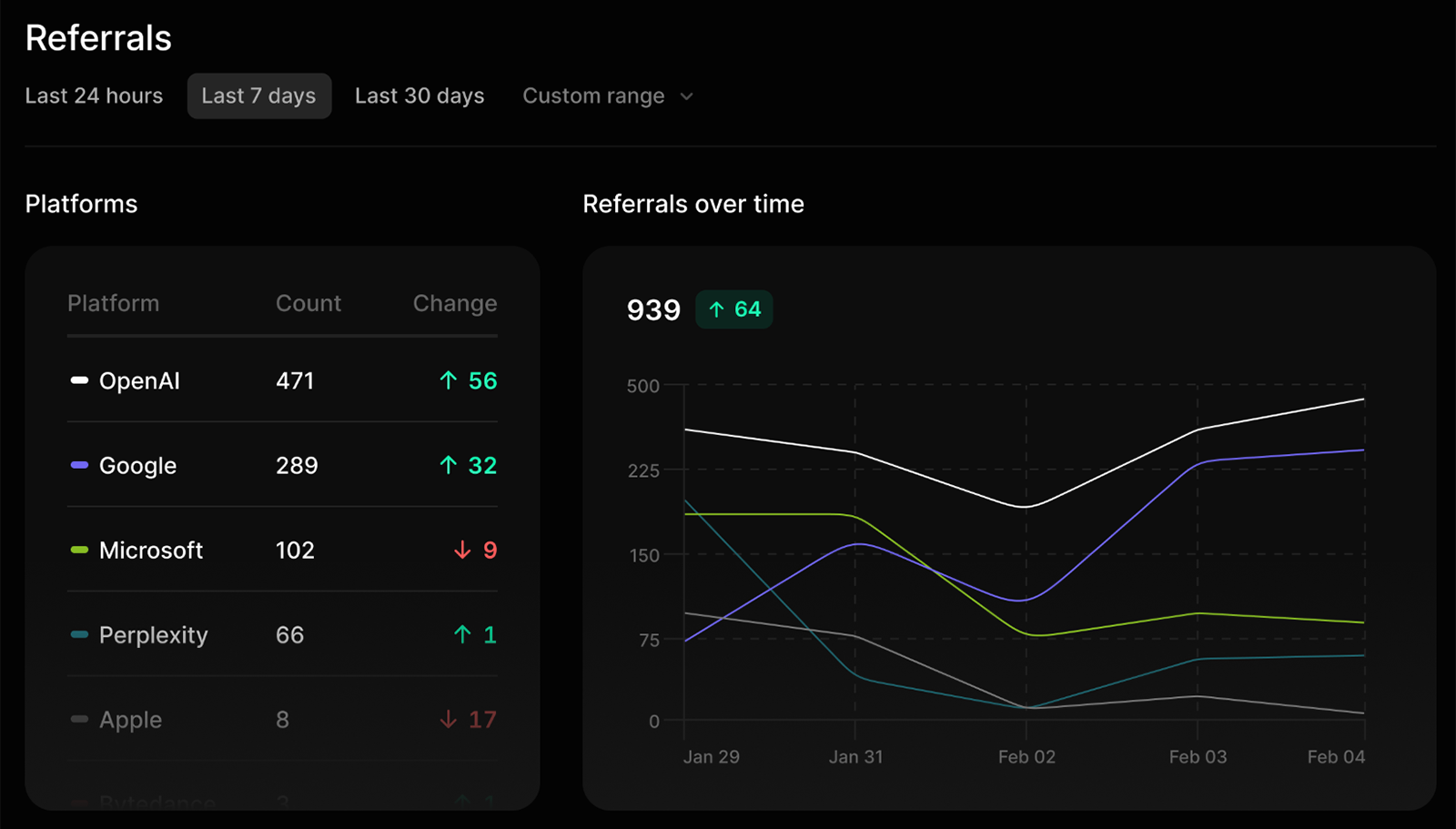
It also shows which AI search platforms drive these results. This data can help you zero in on the most important AI engines for your brand.
Seeing an uptick in traffic from Google AI Overviews or Perplexity? Consider prioritizing mentions and citations on those platforms instead of dividing your AI visibility efforts across answer engines.
9. Understand how your products perform in AI shopping
For ecommerce brands, AI-powered traffic and revenue attribution is only one piece of the puzzle. You also need to know how your brand and products perform in ChatGPT Shopping.
Use Profound's Shopping dashboard for a detailed breakdown of your brand's overall AI visibility score along with visibility scores for individual products. You'll see which products show up for key topics, including the attributes that ChatGPT highlights.
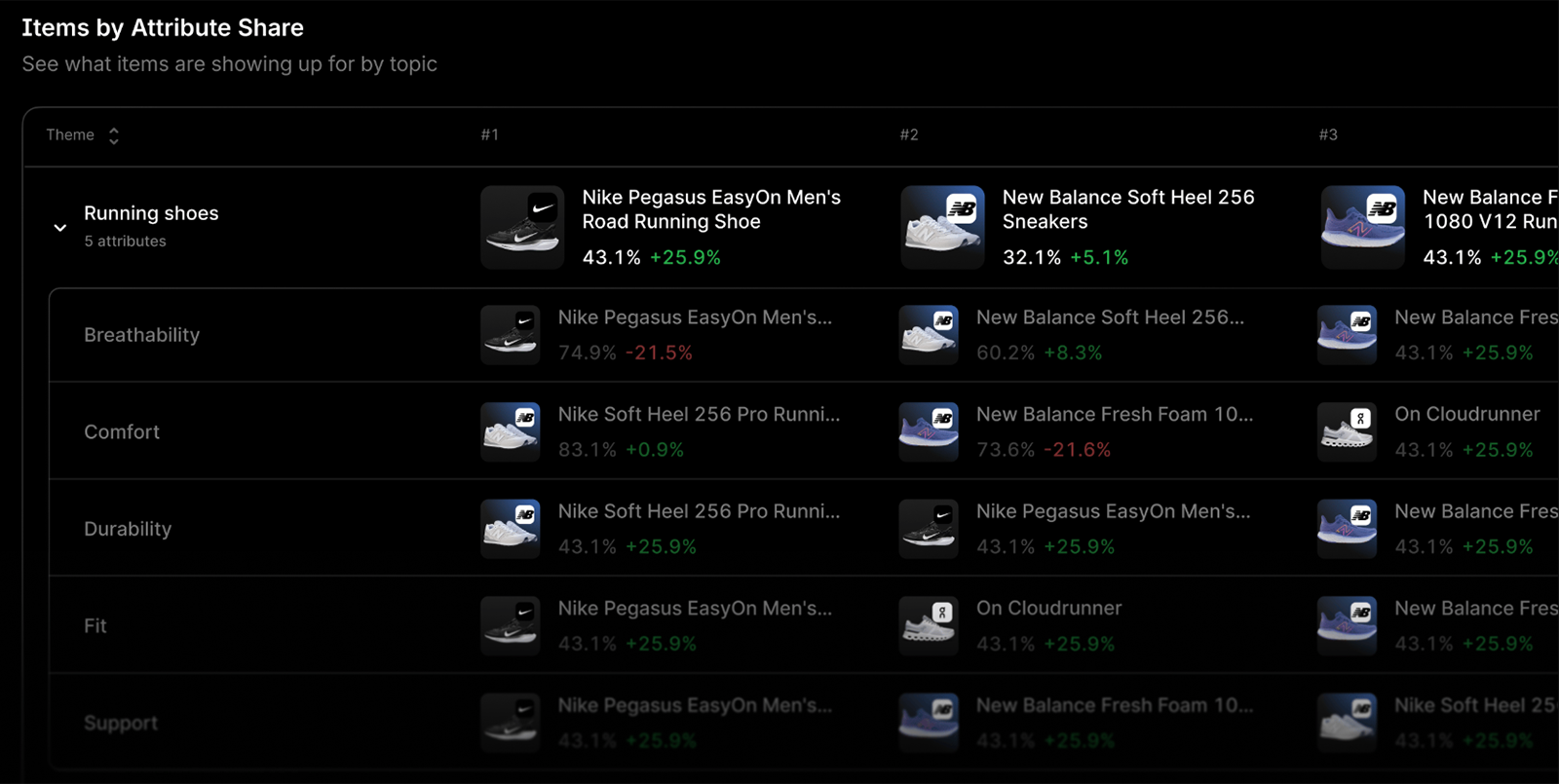
Check the sentiment and visibility matrix to see how the two elements affect each other. For example, does a product have great visibility but negative sentiment? Dig into what customers say about the product and where they say it. Based on that data, formulate an on- or off-page strategy to boost sentiment.
Keep an eye on the competition with Profound's Visibility Score Rankings. You'll see which items outrank competitors and which lag behind so you know which products to prioritize.
Tips to improve your brand's AI visibility
Tracking your brand's AI search visibility is just the first step in a strong AEO strategy. Next, put the data to work and improve your visibility in AI answers.
Act on AI visibility opportunities
Can't decide where to start improving how your brand appears in AI answers? Profound suggests top actions to move the needle on specific metrics.
Check the Opportunities dashboard for specific, custom suggestions for your brand. You get four opportunities per week with the Growth plan and a custom number with the Enterprise plan.
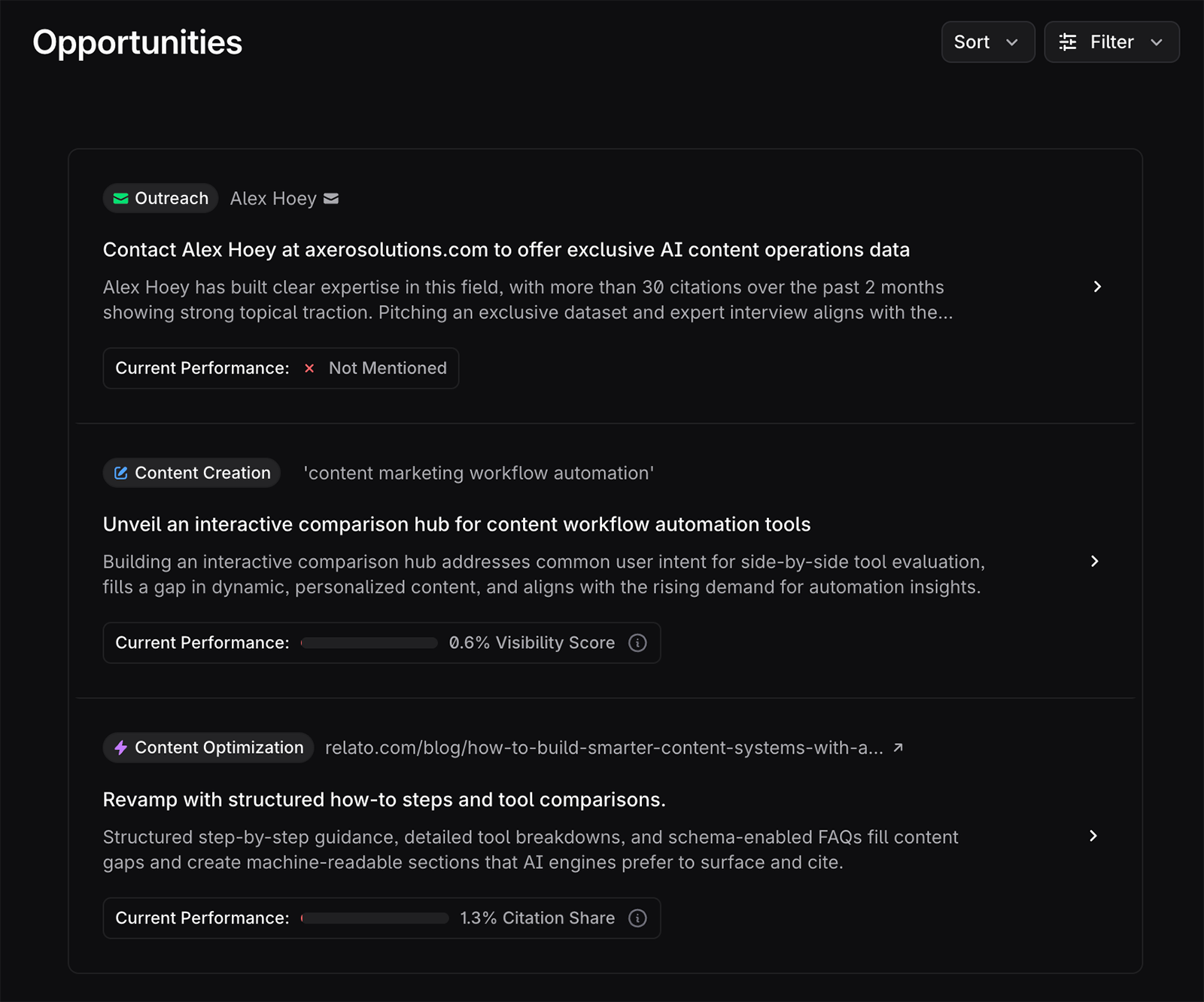
Depending on your topics and industry and where your brand needs the most improvement, you might see opportunities like:
- Outreach: Get citations on important domains or pages by making a compelling pitch. For each outreach opportunity, Profound outlines the rationale, shares implementation steps, and identifies the appropriate contact person to connect with.
- Reddit marketing: Boost your citation share by posting in relevant subreddits. Profound identifies subreddits and specific threads, suggesting which prompts to address and how to position your brand most effectively.
- Content creation: Improve your visibility score by creating targeted content for your website. Profound suggests a step-by-step process and provides references to inspire you, along with generative AI tools to draft briefs and content.
- Content optimization: Update existing website content to better respond to your most important prompts. Profound outlines the changes to make and assists with content generation.
Create AI-Optimized content for your website
You can certainly write new content manually. But Profound's generative AI tools can speed up the process, helping you create AI-optimized content in minutes instead of hours (or days).
Use one of the pre-built templates to write a blog post, listicle, or how-to article. Choose the topic and prompt you want to optimize for, and select the platforms and top-cited pages you want to target.
Then, let Profound do the research and outline the article. Once you check and approve the outline, let Profound draft the content. Review and edit the draft for accuracy, completeness, and brand voice before publishing.
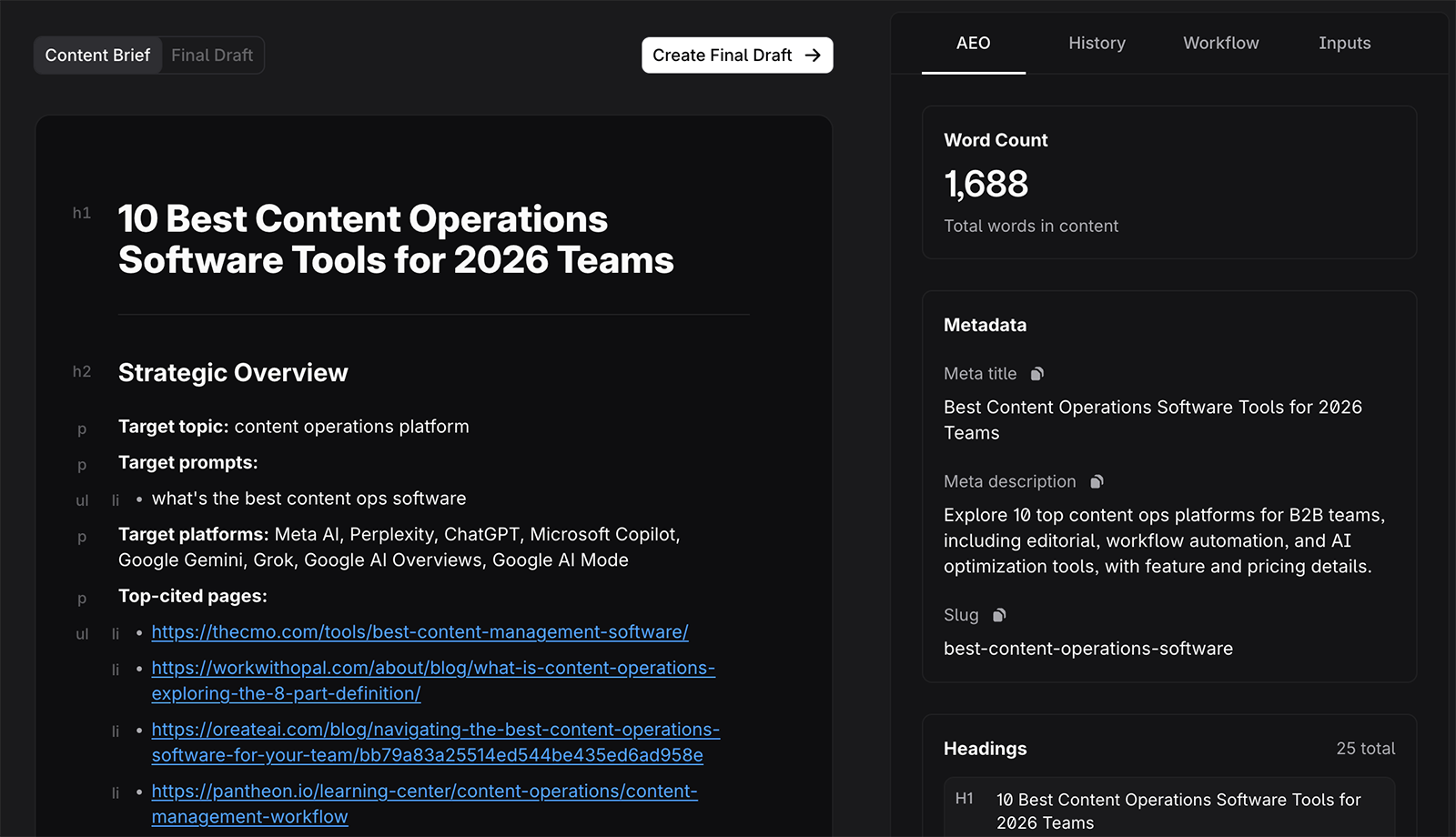
You can also use Profound's pre-built Agents to optimize content, generate FAQs, or assist with research.
Build out your list of prompts to track
The more AI results you analyze, the more you'll know about the topics and prompts that matter for your brand. You can adjust your tracked prompts at any time, and Profound's Relevant Prompts tool can help.
This dashboard shows the AI responses where answer engines cite either your brand's website or your competitors' websites — even if you aren't tracking the prompt that triggered the response.
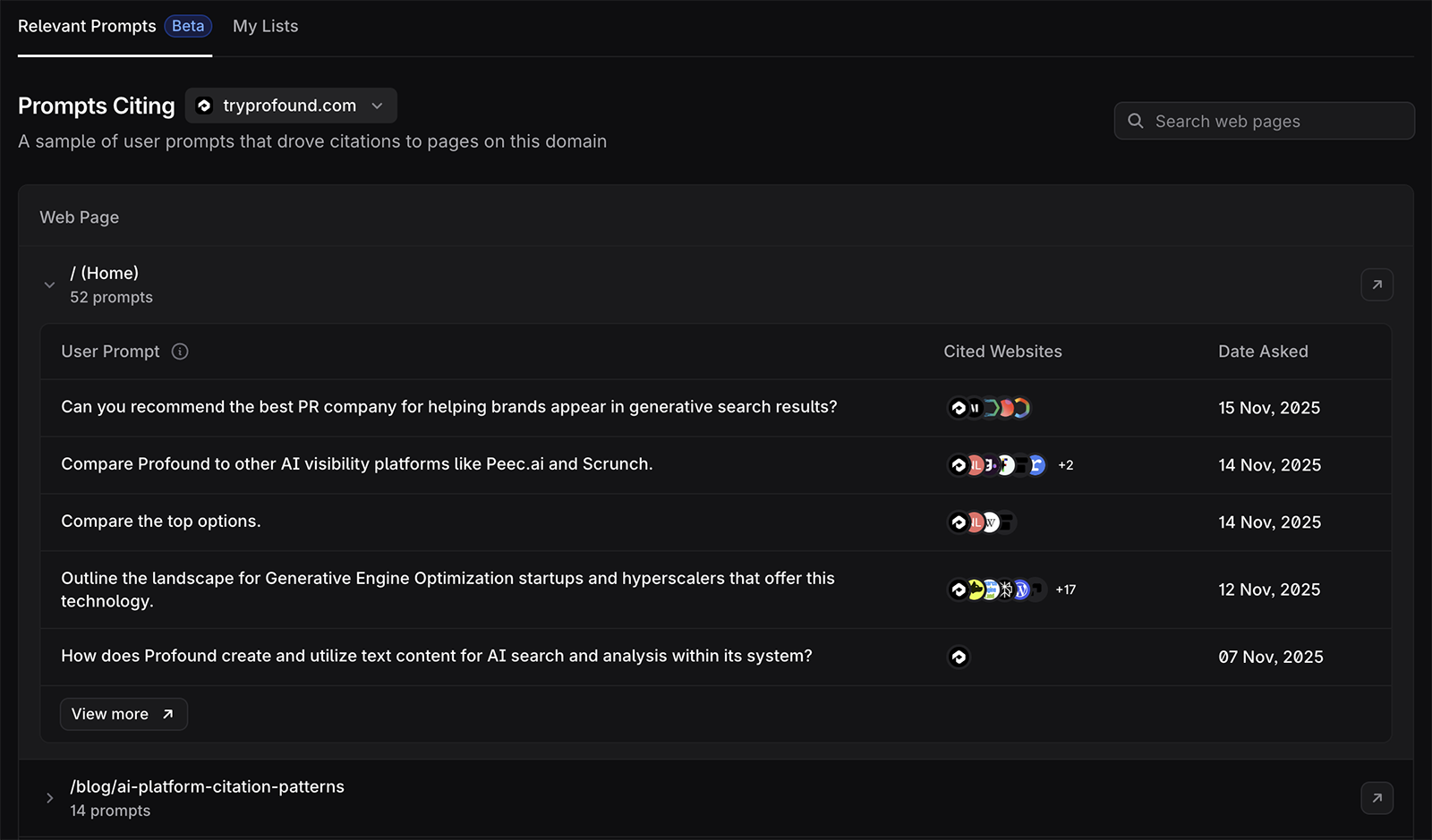
It breaks down the data by web page so you can focus on the website content you care about most. For example, you may want to focus on prompts that cite pricing pages or comparison guides that attract high-intent prospects.
Click to view the full prompt and its citations. Then, use these insights to update your tracked prompts.
Analyze query fanouts to spot related queries to answer
When AI engines respond to prompts, they typically split the query into as many sub-queries as necessary to provide a complete answer to the question. So, a query about the best content operations platform for enterprise teams might involve sub-queries like:
- Best content operations platforms
- Content operations software for enterprise teams
- Essential features for content operations software
- Content operations software reviews
The more you know about the sub-queries related to your most important prompts, the better you can ensure your brand answers relevant questions. Profound's Query Fanouts dashboard shows query variations for each prompt, including count and share metrics to spotlight what's trending.
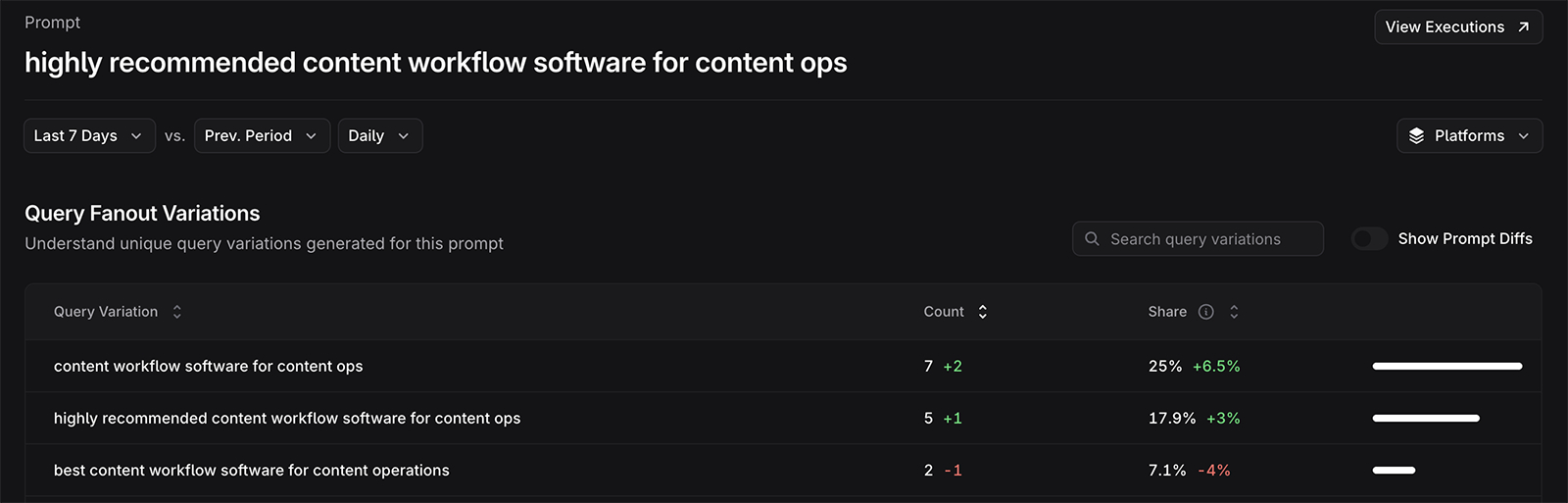
This dashboard also charts word transformations so you see what words answer engines add when responding — and you know how they refine intent. With these insights, you'll understand how AI interprets prompts and how to optimize your content more effectively.
Ready to start tracking your brand's AI visibility against competitors? Get a demo of Profound to see how your brand performs with answer engines and where to start improving your presence in AI search.
