

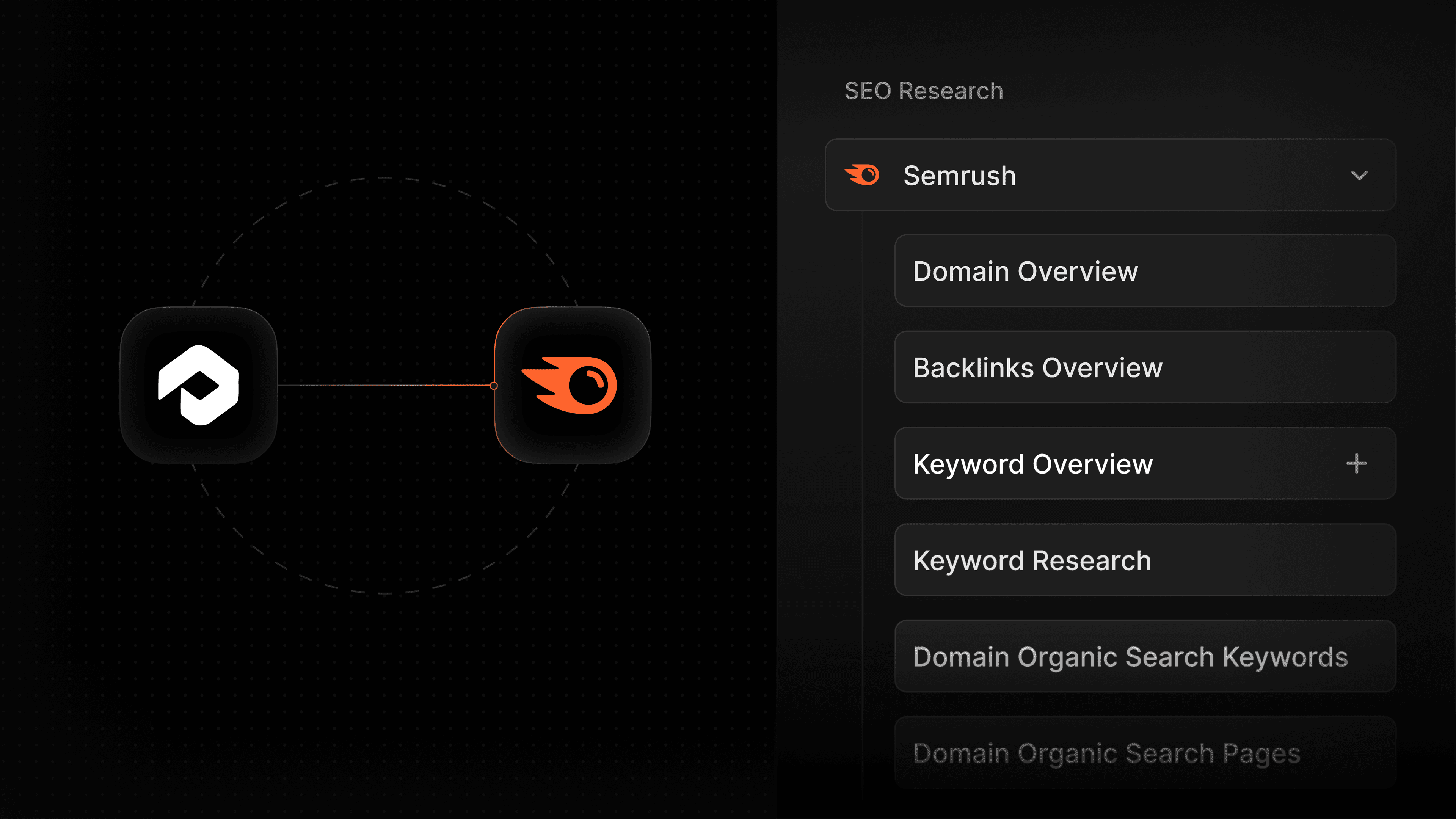
As far as SEO goes, Semrush is a popular place where marketers pull traditional search data. Domain authority, backlink profiles, keyword rankings, organic traffic data. But when it comes to building workflows that combine that SEO intelligence with AI visibility data, the process breaks down. You export from Semrush, import into another tool, cross-reference manually, and lose time at every step.
We built Profound's Semrush integration to eliminate that gap. Seven new nodes bring Semrush's core SEO data directly into Profound Agents, so you can pull domain metrics, backlink profiles, keyword research, and organic search data into the same Profound Agents where you are already running AI visibility monitoring, content generation, and competitive analysis. No exports, no tab switching, no manual stitching.
What the Semrush nodes do
The integration includes seven nodes that cover the most common ways marketing and SEO teams use Semrush data in their workflows.
Domain overview node
Get high-level Semrush SEO and paid search metrics for a domain. Enter a target domain, select a database by country, and retrieve a snapshot of organic traffic, keyword counts, traffic cost, and paid search data. This is the starting point for any competitive or brand-level analysis inside an Agent.
Backlinks overview node
Inspect Semrush backlink profile metrics for a target domain or URL. Configure the target and target type (root domain, subdomain, or specific URL) to pull referring domains, backlink counts, and authority metrics. Useful for understanding the link equity behind any domain you are tracking in Profound.
Keyword overview node
Get Semrush search metrics for a single keyword. Enter a keyword and select your database to retrieve volume, difficulty, CPC, competitive density, and SERP feature data. This node pairs well with Profound's Prompt Volumes data to compare how a keyword performs in traditional search versus AI search.
Keyword research node
Retrieve keyword ideas from Semrush for a seed keyword. Configure a seed keyword, select a keyword type (such as Related Keywords), and choose your database to generate a list of keyword opportunities. Feed these into downstream LLM nodes for content briefs, or cross-reference them against Profound's prompt gap analysis to find terms where you have SEO strength but low AI visibility.
Domain organic search keywords node
Get organic keyword rows for a domain from Semrush. Enter a domain and database to pull the full list of keywords a domain ranks for organically, along with position, volume, and traffic data. This is the foundation for understanding where a competitor or your own brand has organic search presence.
Domain organic search pages node
Get organic top pages for a domain from Semrush. Enter a domain and database to retrieve the pages driving the most organic traffic. Use this to identify which content assets are performing in traditional search and then check whether those same pages are earning citations in AI search through Profound.
URL organic search keywords node
Get organic keyword rows for a specific URL from Semrush. This is a more targeted version of Domain Organic Search Keywords. Enter a specific URL and database to see exactly which keywords a particular page ranks for. Useful for deep-dive analysis on individual content assets or landing pages.
All seven nodes support database selection by country and produce structured output that flows downstream into any connected node, including LLM nodes, Google Search nodes, Gamma presentation nodes, or any other integration in your Agent.
How Profound customers can use this
SEO + AEO gap analysis
Build an Agent that pulls your domain's top organic keywords from Semrush, then cross-references them against Profound's AI visibility data. Identify keywords where you rank well on Google but are not being cited in AI-generated answers. This is where AEO optimization has the highest ROI: you already have the content authority, you just need to close the AI visibility gap.
Competitive domain intelligence
Chain a Domain Overview node with a Backlinks Overview node and a Domain Organic Search Keywords node to build a comprehensive competitive profile. Feed the output into an LLM node for automated competitive analysis, or route it into a Gamma presentation for stakeholder review. Run it monthly to track how competitors are shifting their SEO strategy.
Content audit workflows
Use Domain Organic Search Pages to pull your highest-traffic content, then run each URL through Profound's AI visibility data to see which pages are earning citations and which are invisible to answer engines. This helps content teams prioritize which existing assets to optimize for AEO rather than starting from scratch.
Keyword-to-prompt mapping
Combine Keyword Research output with Profound's Prompt Volumes data to map traditional search keywords to the prompts people are asking AI search engines. This reveals where search intent is migrating from Google to AI and where your content strategy needs to follow.
Automated reporting with full-stack data
Build an Agent that pulls Semrush domain metrics, Profound AI visibility scores, and Google SERP data into a single workflow. Route the combined output into a Gamma presentation or export it as a report. This gives leadership a complete picture of brand visibility across traditional search and AI search in a single deliverable, generated automatically on whatever cadence you need.
Get started
The Semrush integration nodes are available today for customers of Profound. Others interested are encouraged to get a demo to see them in action.


