
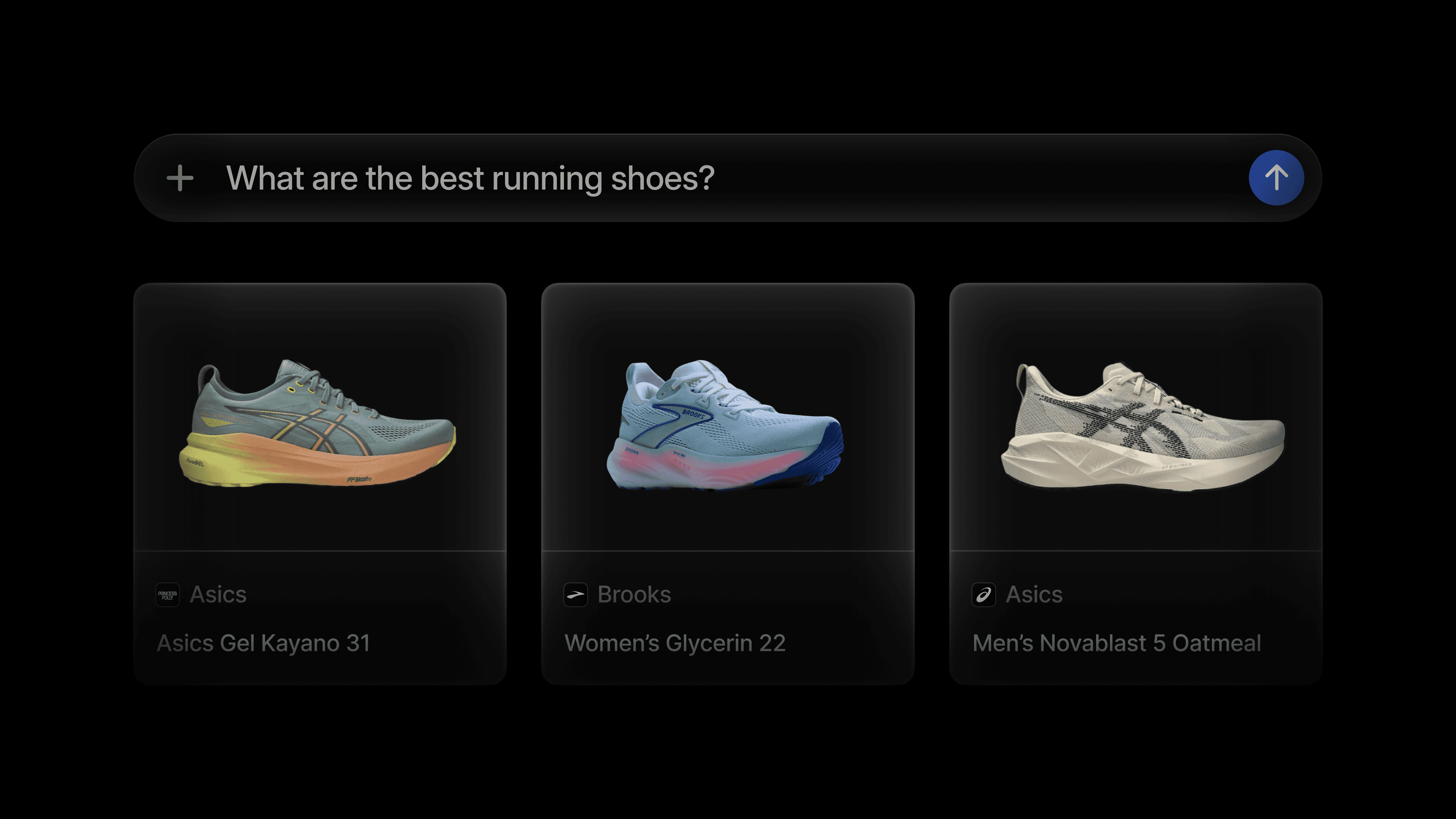
Part 3 of our ChatGPT Shopping series. Part 1 covered how often shopping triggers. Part 2 reverse-engineered the trigger itself. Now we go inside the carousel: how many products show up, how stable are they, and who gets the buy-click.
Citation rate is one of the most watched metrics in the LLM space — it tells you who the model trusts when it answers a question. ChatGPT Shopping has an equivalent, and almost no one is tracking it yet.
When ChatGPT surfaces a product card, it attaches buy links from one or more retailers. Which retailers get those links, how often, and in which position — that's what we're calling shopping offer rate. Walmart and Target don't show up because ChatGPT prefers their products. They show up because when ChatGPT recommends any product, it routes the purchase through them more than anyone else.
Product discovery will still be very important, even in a world where Instant Checkout is phased out. We analyzed 22.5 million buy offers to find out who's actually winning it.d out. Which means the carousel, and who shows up in it, just got a lot more consequential.
Key takeaways:
- Walmart leads the pack for the headline buy-link slot (8.78% of rank-1 retailer offers). Target leads in total buy-link presence across all offer positions (7.16%). Together they capture ~13.7% of all purchase routing — regardless of which product is being recommended. Amazon is not well represented, possibly because they have blocked OpenAI scrapers
- There's no fixed number of product slots. The carousel is elastic with a median of 5 products per response, ranging from 1 to 67.
- The carousel is a shuffle, not a ranking. ~95% of product titles appeared in fewer than 30% of runs for the same prompt. Brand presence today does not guarantee brand presence tomorrow.
- Retailer presence is heavily concentrated. The top 20 merchants account for ~40% of all offers.
How many products actually show up?
Most brands want to know how many slots they're competing for. The answer: it depends.
Product count per response has a median of 5, but ranges from 1 to 67. The distribution peaks at 4-5 products (53% of responses), with a secondary peak at 8. Median count also varies by category, from 4 to 6. This isn't a fixed grid like Google Shopping. ChatGPT adjusts how many products it surfaces based on the query, which means the competitive landscape is different for every prompt.
Is the carousel stable across runs?
No. This is the finding that should most change how brands think about this surface.
Across 1000s of prompts run many times each in March 2026, we parsed product titles at full coverage using the selections method:
- ~95% of product titles appeared in fewer than 30% of runs for the same prompt (60.6% showed up in fewer than 10% of runs; another 34.5% showed up between 10-30%)
- Only 3.3% of titles reached 30-49% consistency
- Just 0.5% reached 70%+ consistency
This isn't Google SEO, where you rank and hold. A brand that shows up in the carousel today may not show up tomorrow for the identical query. Optimizing for this surface early doesn't compound — it reshuffles on every request.
One caveat: some of the apparent shuffling may reflect title string variation across runs ("L'Oréal Pro INOA" vs "L'Oréal Professionnel Inoa" being treated as different titles). But with 95.1% of titles in the bottom two consistency buckets, the shuffle effect is clearly dominant regardless.
Which retailers get the buy-click?
We measured retailer presence across 22.5 million buy offers over ten days (March 10-20, 2026).
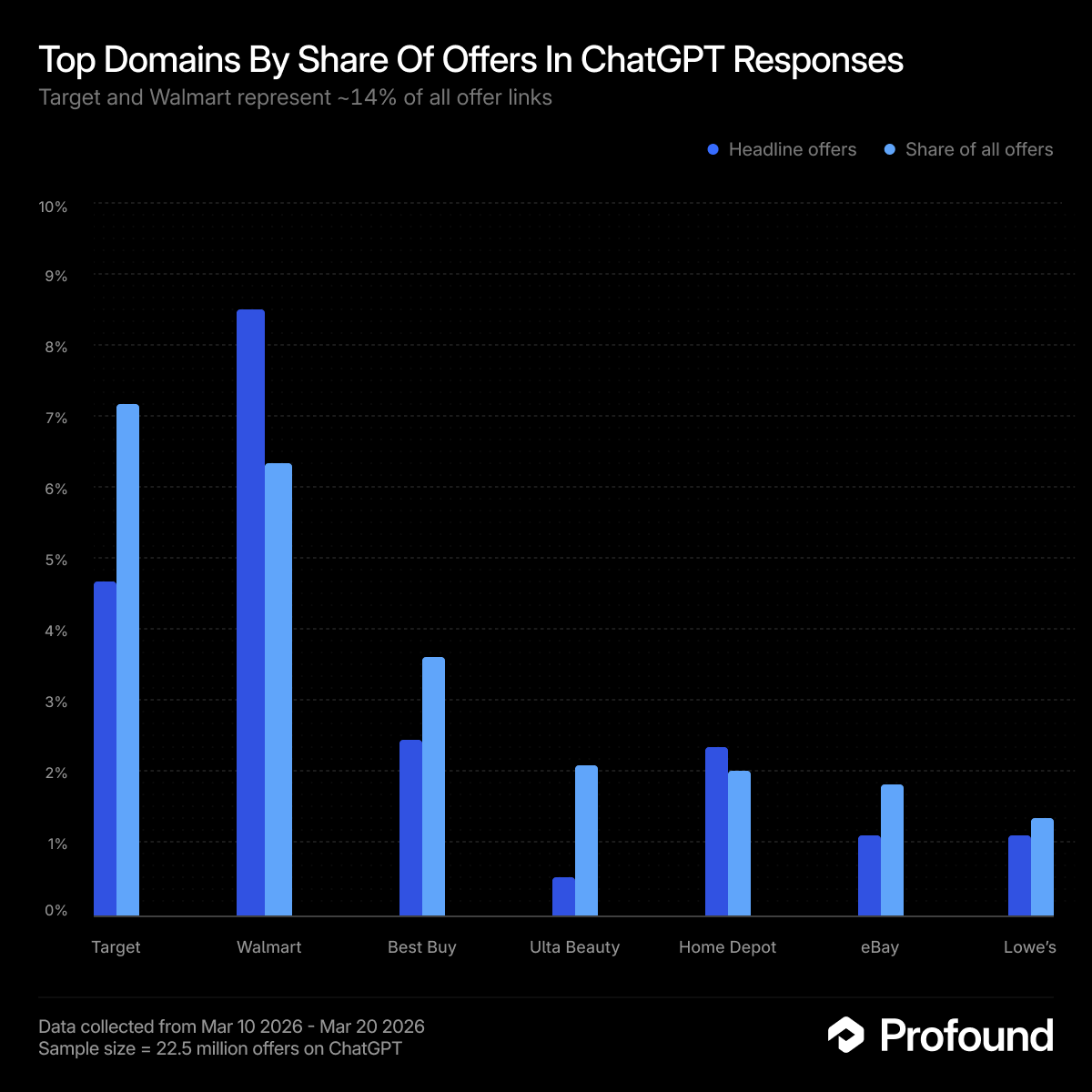
First, what "buy offer" means: every product card in ChatGPT Shopping has one or more retailer links attached. When we say Walmart has an 8.78% headline rate, we mean 8.78% of all first-position retailer links on product cards pointed to Walmart.com. The product being recommended could be anything — a blender, a laptop, a moisturizer. This is about who gets the routing, not whose products get recommended.
Reddit earns a disproportionate share of LLM text citations not solely because it's always the best source, but because it's the most represented and consistently indexed. The retailers below work the same way. They show up because their catalog coverage and platform integrations put them in front of the model more reliably, not because their products are uniquely superior.
Headline offers only — rank 1 position:
The headline vs. all-offers flip is the most interesting thing in this data. Walmart takes the top slot at 8.78% against Target's 4.93% — nearly 2:1. But Target leads total offer presence (7.16% vs 6.54%). Target shows up roughly three times more often as a secondary offer than as the headline. ChatGPT reaches for it constantly as an alternative, just rarely as the first recommendation. Walmart is the opposite: it punches disproportionately in position one.
Together they capture approximately 13.7% of all buy-link opportunities and 13.7% of headline slots across every product category. The top 20 merchants take roughly 40% of all offers.
Shopping Offer rate: the new metric that matters
In LLM text answers, citation rate tells you who the model trusts. Reddit and Wikipedia don't dominate because they pay for placement. The model has learned to reach for them, and now everyone in AEO is trying to figure out why and how to earn the same treatment.
ChatGPT Shopping runs on the same logic, denominated in buy-link routing instead of text citations. Walmart and Target are the Reddit and Wikipedia of the carousel. The concentration effect is just as stark.
The headline vs. all-offers split matters for what you'd actually do about it. Walmart wins where users click first. Target wins in total presence. Those are different problems. A retailer trying to own position one is solving something completely different from one trying to appear across more product categories. Both rates are worth tracking. Most teams aren't tracking either.
What this means for your brand
OpenAI just repositioned ChatGPT as a discovery engine for Products. People are already using it to figure out what to buy before they ever open a retailer's website.
The stakes aren't abstract. Walmart's executive vice president told Wired this week that ChatGPT is now bringing in roughly twice the rate of new customers as search engines.
The carousel shuffles constantly. Presence is concentrated among a small number of retailers. The brands showing up reliably aren't winning on just product quality, they're winning because their product data is structured and machine-readable enough to survive the model's selection process on any given run.
The question AEO teams have been asking about text citations - why does the model reach for this source and not that one — now has a direct retail equivalent. Shopping offer rate is how you answer it.
Want to understand your brand's ChatGPT Shopping visibility?
Profound tracks shopping citation rates, headline vs. all-offers positioning, and carousel consistency across thousands of product categories.
Book a call with our team to see where your brand stands.


