


In the last three months, LinkedIn has become one of the most authoritative sources shaping AI-driven discovery. Between November 2025 and February 2026, the platform surged from outside the top 20 to rank among the most‑cited sources on ChatGPT and is now the #1 most‑cited domain for professional queries across all AI Search platforms. That’s powerful data for both companies and individuals looking to grow their influence.
Overview
Aside from a few evergreen staples, LLMs don't demonstrate a strong loyalty to any given domain when crafting their answers. After their top two or three go-to’s, it gets incredibly fragmented. That said, the landscape of sources in AI Search is constantly shifting, and staying current on which ones carry the most weight can make a meaningful difference.
To explore the most recent landscape, we took a look at a three month timeframe from November 15th, 2025 to February 15th, 2026 drawing on two proprietary Profound datasets - Prompt Volumes and Answer Engine Insights - to identify which domains have seen the most significant movement.
Prompt Volumes offers GDPR- and CCPA-compliant real-time citations triggered from conversations within ChatGPT, and Answer Engine Insights is a dataset of billions of citations aggregated across nine different models, with six of them as the focus of this analysis.
Using both, we explored which domains ranked highest, what drives movement on that leaderboard, which content types are being cited, and in this case, what it reveals about how professional content is being indexed.
Key takeaways
In November 2025, LinkedIn's domain rank on ChatGPT sat somewhere around #11. Today, it sits around #5, representing over a 2x increase in citation frequency – the largest shift in authority that we’ve seen this year.
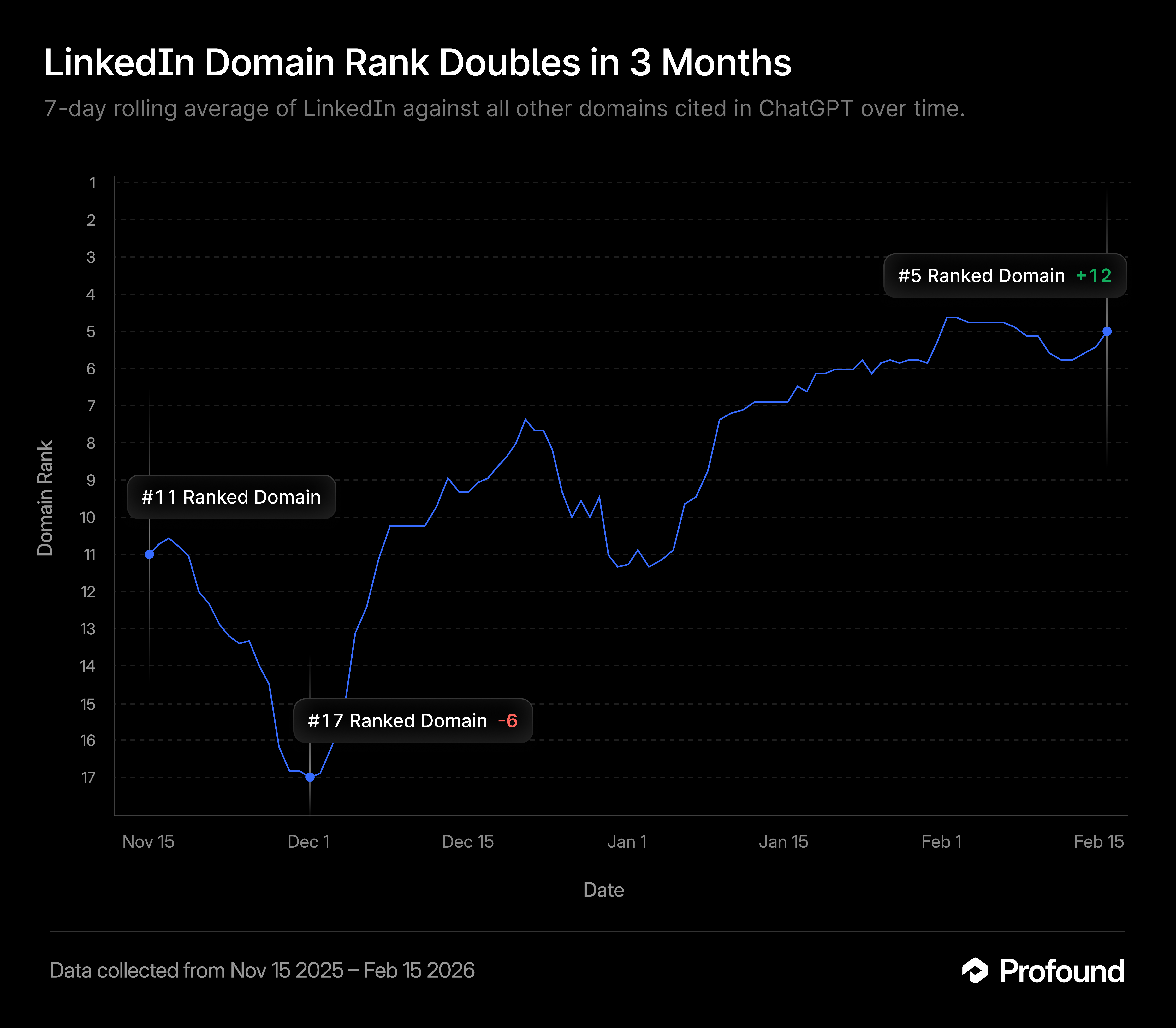
During that same three month period, LinkedIn has solidified itself as the #1 ranked domain cited for professional queries across major platforms.
Citation composition: URL type breakdown
The most notable shift over the analysis period is in posts, long-form articles, and newsletters, which represent content created by individuals, companies and publishers on the platform.
Answer Engines are increasingly drawing from on-platform published content: Posts, long-form articles, and newsletters together now account for approximately 35% of all LinkedIn citations within ChatGPT responses – up from roughly 27% at the start of the period.
Profound’s take on the shift
This pattern points to a broader evolution in how LinkedIn content is being surfaced, suggesting that AI Search engines are finding and weighting more of LinkedIn's published content layer over time.
Here's why it's significant: Everyone with a LinkedIn presence is now a potential citation source.
- People can grow their reach and credibility just by showing up on LinkedIn. Answer Engines discover and attribute LinkedIn posts, articles and newsletters back to the people who created them, meaning your ideas, expertise and even your small business can be found through the strength of LinkedIn’s domain authority.
- Companies, too, can grow their brands with AI search mentions and citations by investing in content on LinkedIn, rather than having to build a presence externally. Everything from your SDR’s morning take to your CEO’s quarterly reflection to your PM’s product update becomes part of how your brand shows up in AI Search.
The timing matters too. By doubling in domain rank and shifting citation weight toward new content, LinkedIn has opened a door to AI visibility that didn't exist three months ago, and right now, that door is largely uncrowded. Most brands haven't adjusted their strategy to account for it yet. The ones that do early will build a compounding advantage as Answer Engines continue to treat LinkedIn as a trusted, go-to source. The ones that wait will find themselves at the back of a very long line.
Methodology
This report draws on two distinct data sources.
Domain rank and URL type data comes from real user prompts on ChatGPT → millions of actual queries tracked from November 15, 2025 to February 15, 2026 on a 7-day rolling average. This is the source for the #11→ #5 rank movement and the URL type shift (posts 20.9% → 26.0%; Long-form articles 6.0% → 8.9%; combined owned content 26.9% → 34.9%).
Professional query analysis: the #1 cited domain finding across professional topic clusters, was conducted using a synthetic prompt basket designed to represent how professionals search across AI platforms. That basket was run across ChatGPT, Gemini, Google AI Overviews, Google AI Mode, Microsoft Copilot, and Perplexity.
These are complementary but different methodologies. The domain rank reflects organic user behavior. The professional query analysis reflects structured, repeatable measurement across a defined topic set.
Getting started
If you’d like learn what domains are top ranked in the prompts you care the most about, get in touch for a demo today.


