
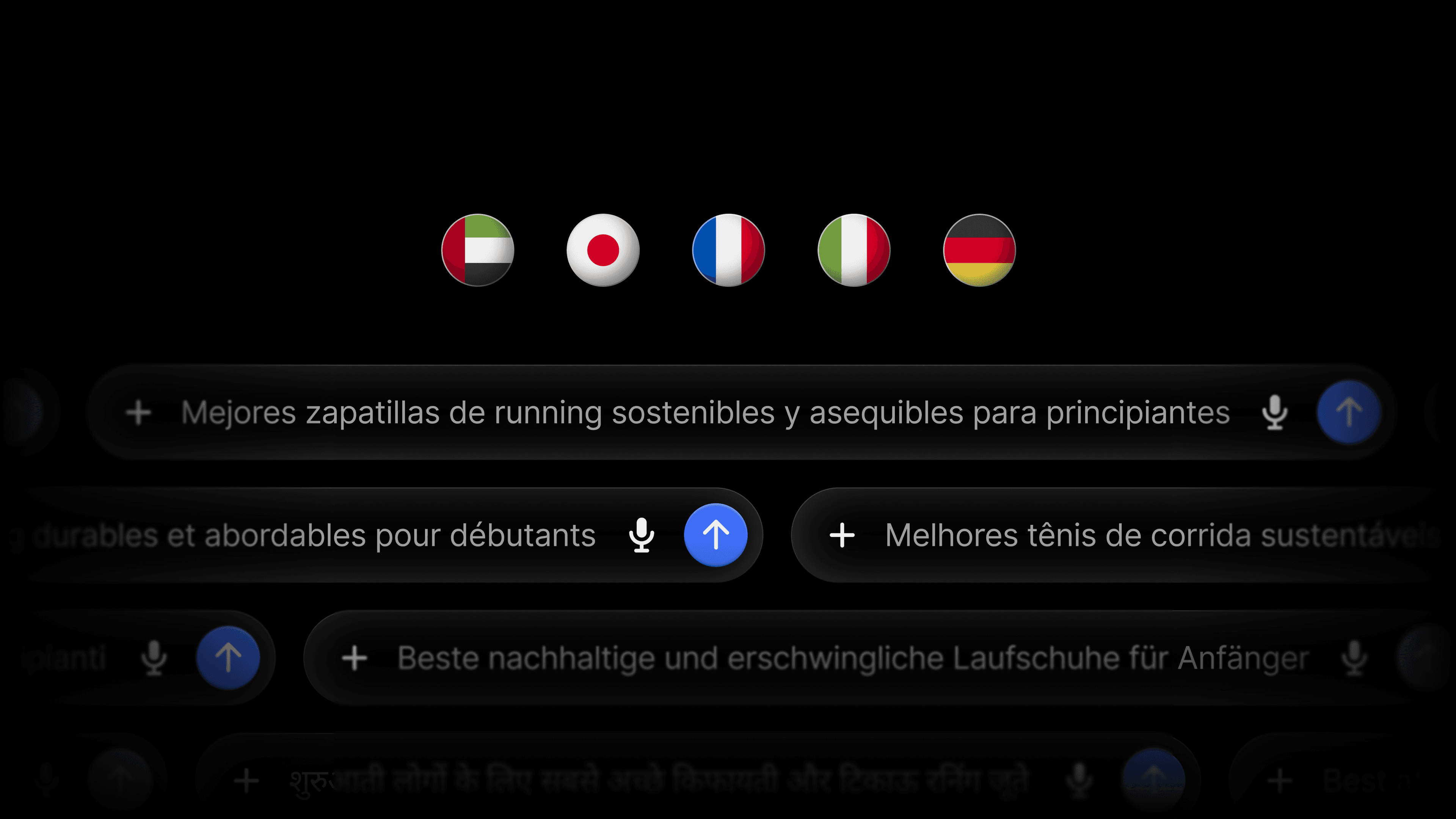
This study started with a simple question: Does prompting LLMs in different languages produce meaningfully different source outcomes? The answer is yes, and one of the biggest areas impacted is social citations.
In March 2026, Profound evaluated 3.25 billion AI citations spanning 7 models, 14 countries, and 5 domain classifications (social, earned media, earned institutions, UGC, and PR wire). The methodology filtered every prompt by its respective country's native language. This meant that prompts originating from Brazil were only included if written in Portuguese, and those from Japan were only counted if written in Japanese. English-speaking markets, specifically the US, UK, and Australia, functioned as the study's baseline.
We found something unexpected.
- Social sources can appear drastically more in one model than another, even within the same family (15.3% in AI Overviews vs 3.6% in Gemini)
- The language of a query can rewire the entire citation graph: which domains appear, how often they’re cited, and even whether “the social web” shows up at all
Google AI Overviews leans hardest on social citations
Across the entire international dataset, Google AI Overviews (AIO), at a rate of 15.3%, is the most aggressive aggregator of social content.
Aggregate social citation rates by model
The language effect
We found that a country's geography is secondary to a much more powerful force: the language of the query, but it varies by model. For ChatGPT, social citation rates decrease in every non-English market studied. Google's models show genuine bidirectionality, pushed higher or pulled lower depending on query language.
Spain and Mexico tell the same story
The clearest evidence that language drives citation composition comes from the Spanish-speaking world, where markets with shared language show nearly identical patterns.
- Google AI Overviews
- Mexico: 22.5% social citation rate
- Spain: 20.0% social citation rate
- ChatGPT
- Mexico: 4.70% social citation rate
- Spain: 4.24% social citation rate
Spanish prompts surface social content at roughly 1.4x the English rate in Google AI Overviews and roughly .5x the English rate in ChatGPT regardless of where the Spanish query originates.
Amplification vs. reduction
That gap isn't unique to Spanish. Across every language studied, the direction and magnitude of the shift varies significantly against the English baseline (US, UK, AUS).
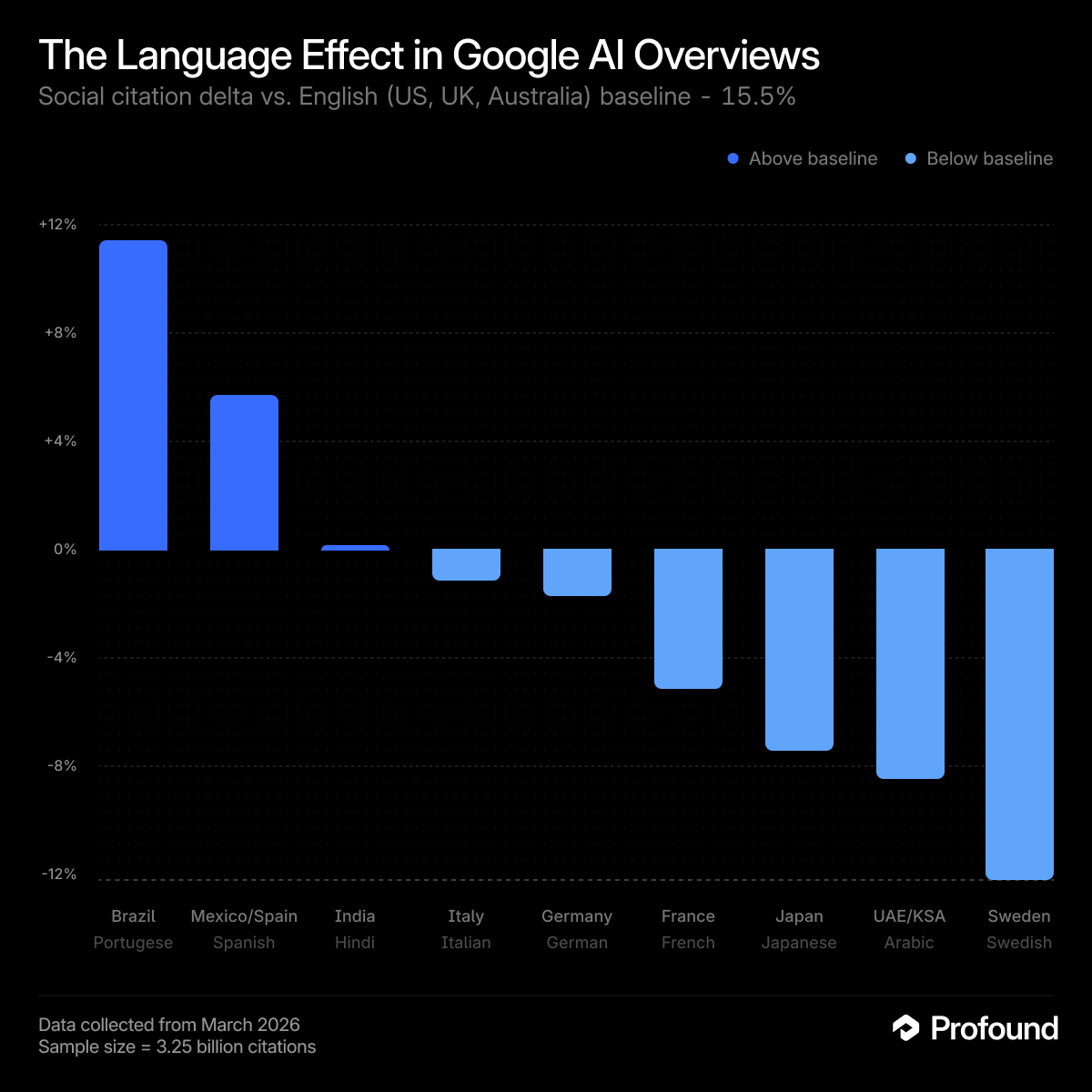
In Google AI Overviews, it is capable of both aggressively amplifying social content in Portuguese and Spanish and nearly erasing it in Swedish and Arabic – creating two fundamentally different search realities.
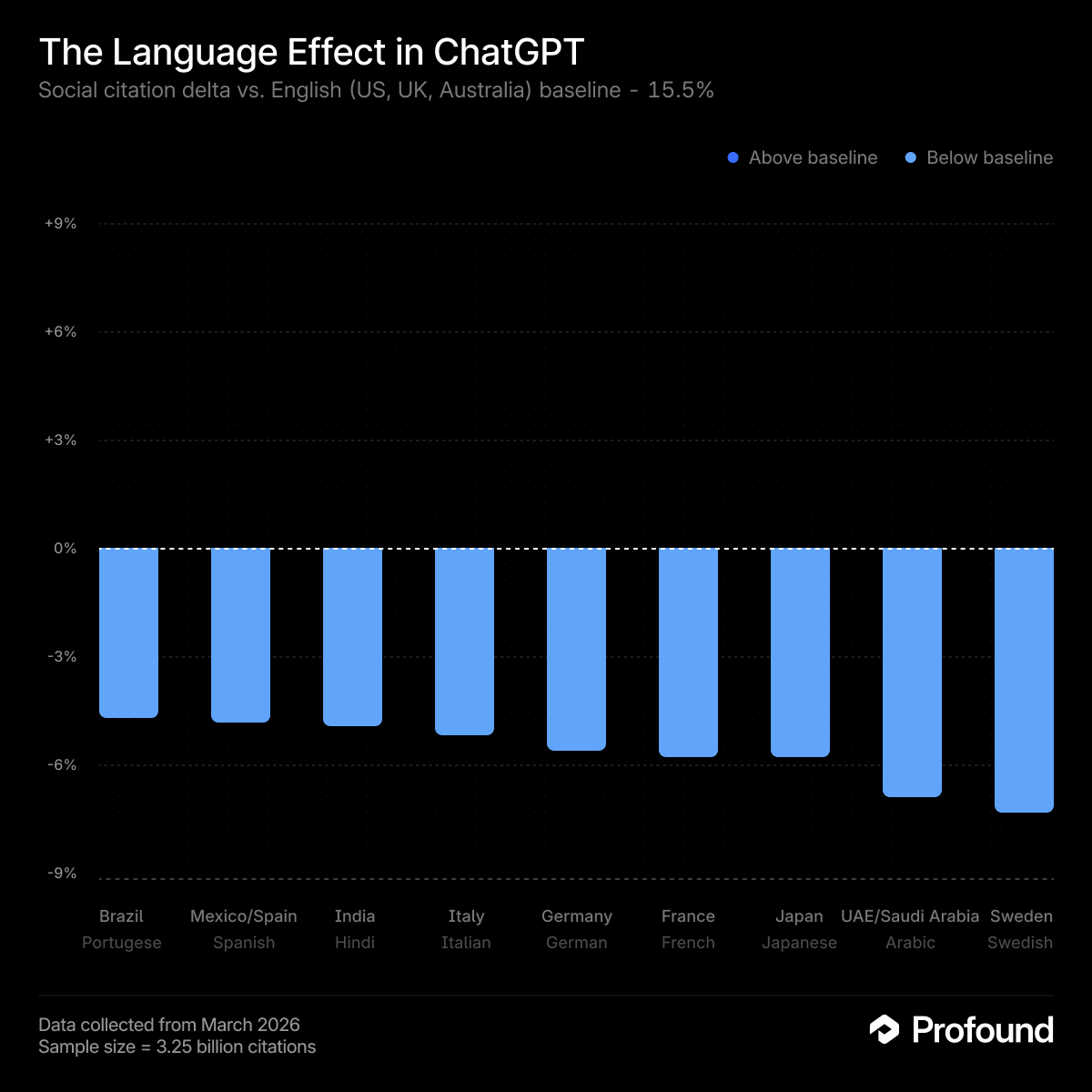
For ChatGPT on the other hand, it does not mirror that shape. Outside the US, UK, and Australia, social's share of all citations sits below the English baseline in every market we measured.
The social platform mix
The social citation rate is, alone, fascinating, but the data becomes even more compelling when examining its nested breakdown.
Google AI Overviews shifts across languages
Of all the models in the study, Google AI Overviews cites social content most aggressively at baseline (15.3%), making it the most consequential place to understand how language reshapes social citation mix.
- Spanish: TikTok surges to 16%, a 5x increase over the English baseline.
- Portuguese: YouTube concentrates further (65%), Reddit collapses to 7%, and Instagram triples to 17%.
- Arabic: The only language where YouTube loses the top spot. Instagram reaches 29% of citations, YouTube falls to 26%, and LinkedIn nearly doubles. A near-complete inversion of the English baseline.
ChatGPT's social web is overwhelmingly Reddit
While Google diversifies its social sourcing by language, ChatGPT does the opposite.
Reddit accounts for 51–76% of ChatGPT's social citations in every country we measured: the single largest source everywhere, by a wide margin.
India: 76% | Brazil: 71% | Sweden: 70% | Germany: 69% | Italy: 68% | Saudi Arabia: 67% | France: 64% | Spain: 64% | Mexico: 62% | US: 57% | Japan: 57% | Australia: 57% | Britain: 52% | UAE: 51%
ChatGPT doesn't meaningfully adapt its social sourcing to local platforms. Whether you're in São Paulo or Tokyo, the social content in your ChatGPT answer overwhelmingly comes from Reddit.
This explains something we'd flagged earlier in our research – that ChatGPT's social citation rate drops sharply outside English (from ~10% to 3–5% in every non-English market). The explanation is now obvious. It's not that ChatGPT avoids social content in other languages. ChatGPT's social pipeline is a Reddit pipeline, and Reddit is an English-first platform. The social layer thins out because the platform it depends on thins out.
What this means
For consumers
AI Overviews doesn't announce itself. It appears at the top of billions of searches and, by design, it's subtle. Users aren't watching the source composition shift beneath their answers, but it is shifting. In some markets the shift is in volume; in others it's in domain mix. The user interface and intent are identical. But the reality it returns is not.
The result is a fractured search landscape where different demographics receive meaningfully different sources, underpinning a 'truth' that’s being increasingly shaped by social media, without any signal that this is happening.
For brands
For brands, the implication is direct: AI visibility is not a single strategy, it's a matrix. The model matters. The language matters. And those variables interact in ways that aren't intuitive. In some languages, social supply is thin enough that the barrier to entry hasn't formed yet. In others, the dominant platform shifts entirely. Neither rewards a uniform global strategy.
The most critical operational shift: tracking prompts in local languages is not optional. English-language tracking is a proxy at best, a blind spot at worst.
Methodology
3.25 billion citations analyzed across ChatGPT, Claude, Google AI Mode, Google AI Overviews, Google Gemini, Microsoft Copilot, and Perplexity. 14 countries were selected based on citation volume filtered to native-language prompts only: US/GB/AU (English), DE (German), FR (French), IT (Italian), ES/MX (Spanish), BR (Portuguese), JP (Japanese), SE (Swedish), IN (Hindi), SA/AE (Arabic). Platform-level social breakdown covers all 14 countries. March 2026.
Get started
Interested in seeing the citation share of prompts that matter most to you? Prospective customers are encouraged to get a demo.


