

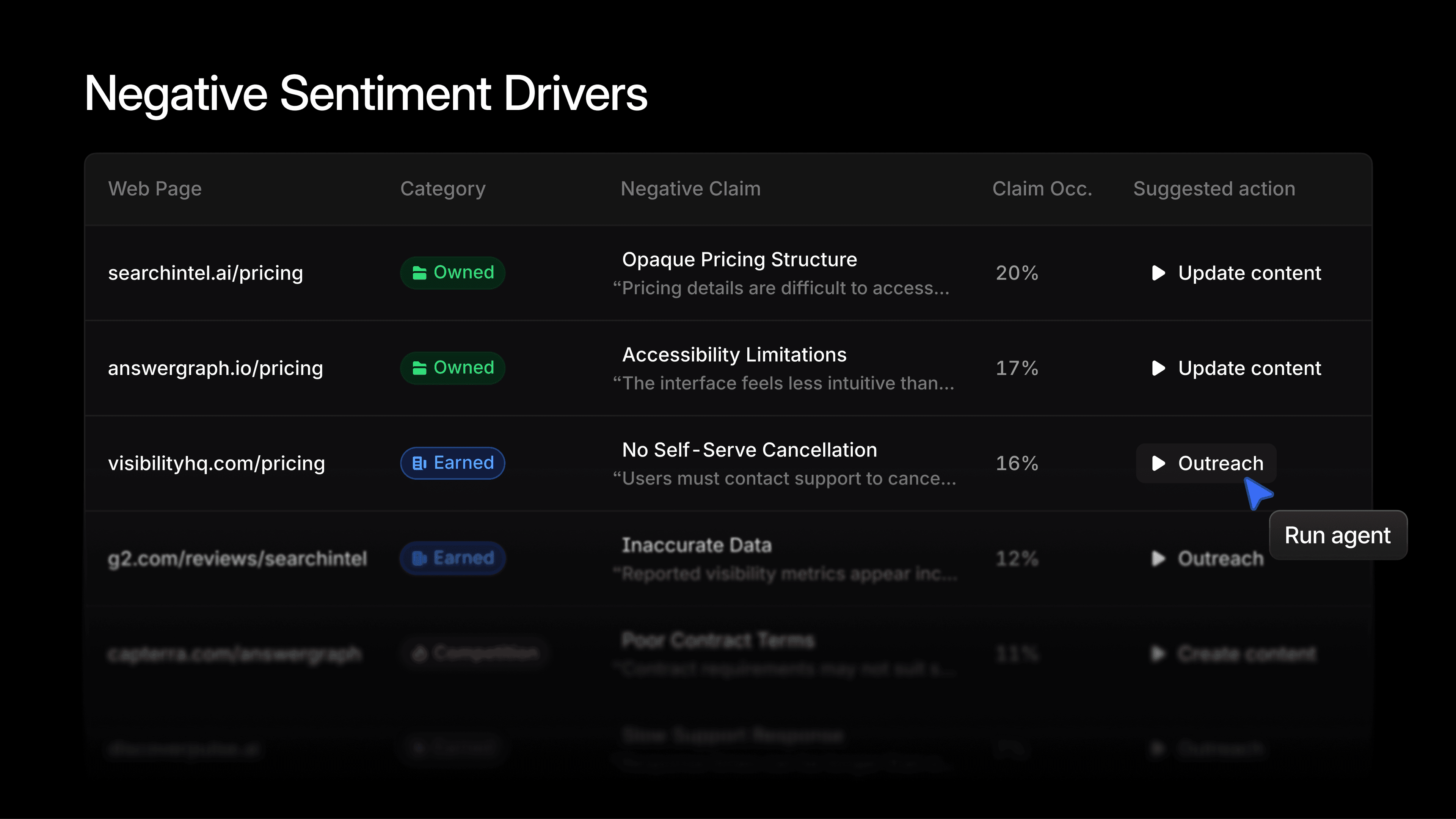
Your brand has a reputation in AI Search. Right now, it's being read by millions of buyers across ChatGPT, Perplexity, Gemini, and every other answer engine on the planet.
AI doesn't just decide whether to mention you. It decides how. The tone. The framing. The verdicts. The comparisons against your competitors. That narrative is being written in real time, and it's shaping how customers, investors, partners, and analysts perceive you before they ever land on your website.
This is sentiment. The dimension of AI Search that goes beyond "do I show up" and into "what does the AI think of me, and why."
Tools for tracking it exist, but most stop at the surface. They tell you sentiment ticked up or down, maybe break it down by platform, and leave the hardest part to you: figuring out what's actually driving the shift and what to do about it. That's where AEO strategy stalls.
We rebuilt Sentiment in Profound to fix that.
Sentiment that goes deeper than the surface
Real sentiment analysis isn't something you get by piping responses through an off-the-shelf LLM API. To understand how AI is talking about your brand at any meaningful depth, you need to organize themes intelligently, surface the specific claims behind them, and connect each one back to the source content shaping the narrative.
To do that at scale, we built our own machine learning model, host it on our own GPU infrastructure, and developed a pipeline that runs every tracked response through processes like vector embedding and re-ranking. The output is line-by-line analysis across every major answer engine. We pull out the claims being made about your brand, group them into semantic themes, and tie each one back to the citations responsible.
That foundation is what makes the rest of the experience possible.
What's new
Semantically grouped themes
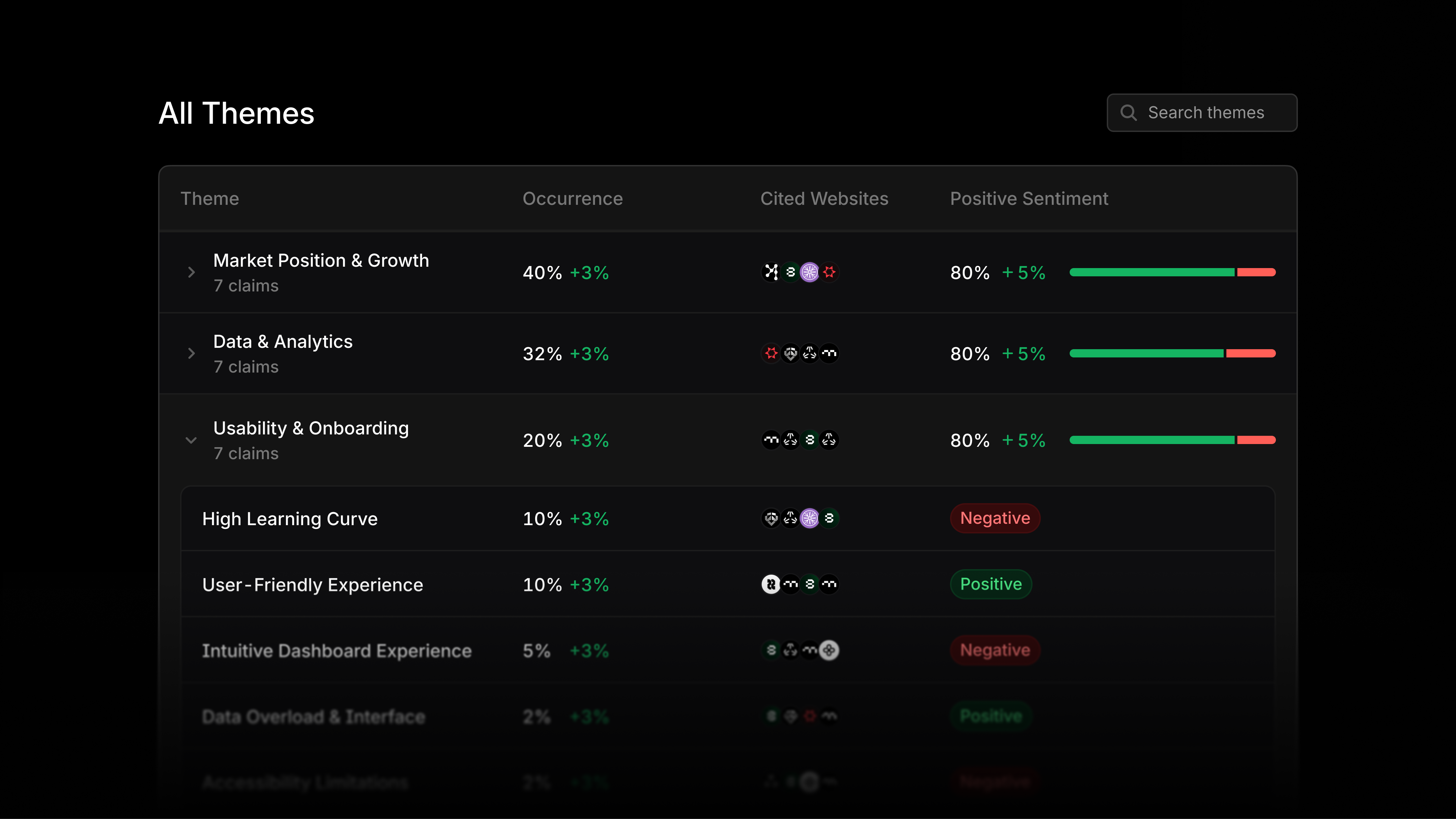
The previous version of Sentiment surfaced long lists of themes that often overlapped or said the same thing in different words. The new version groups them semantically, so each theme is meaningful and distinct. You can scan the page and immediately understand the conversation around your brand instead of wading through duplicates.
Every theme expands to show the individual claims within it, filterable by date range, region, prompt, persona, and platform.
Claim-level drill-down
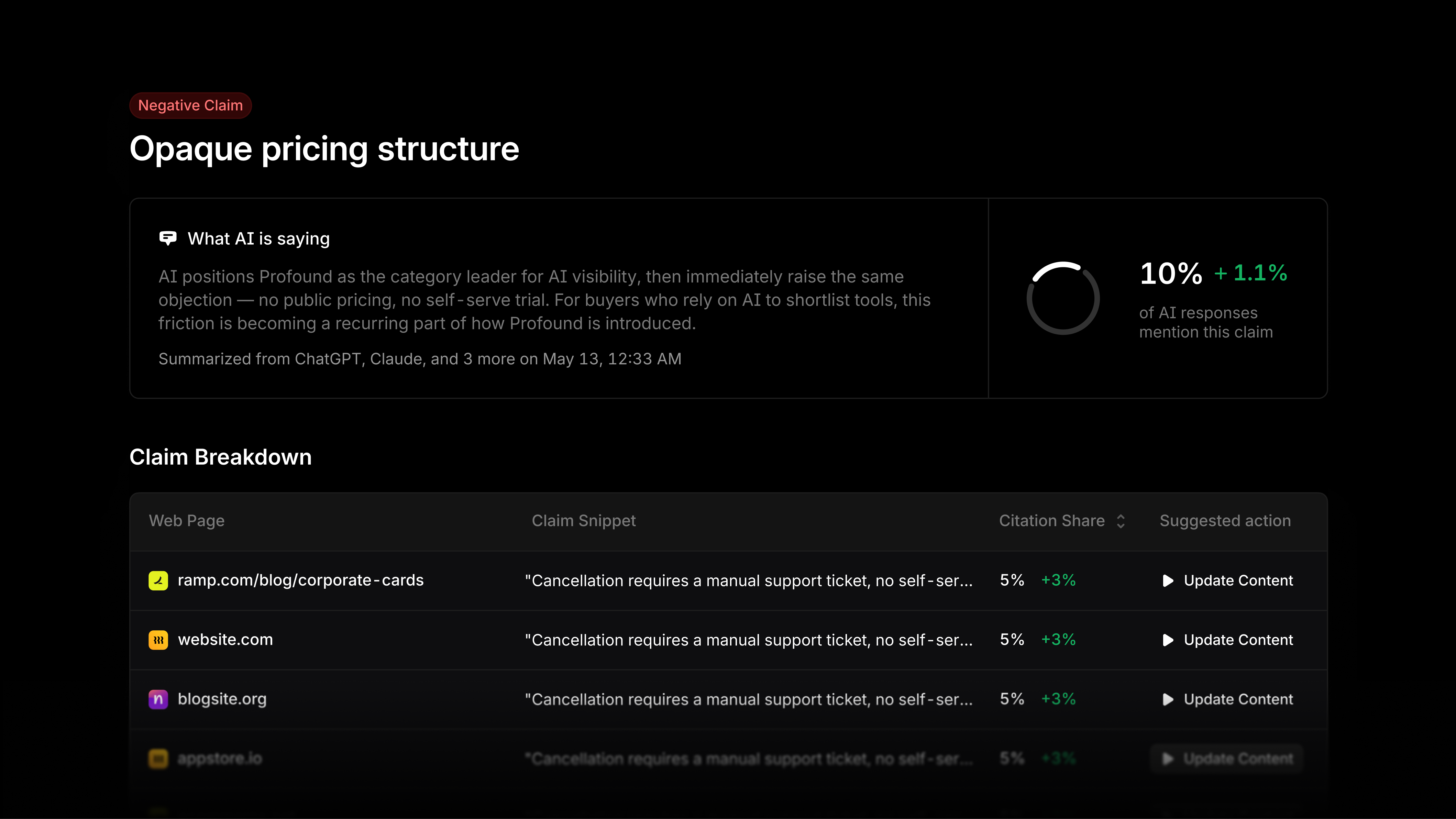
Click into any claim to see exactly how AI is talking about it. You get a summary across every answer engine, breakdowns by platform, prompt, and competitor, and the full list of citations driving it. Click a citation and Profound highlights the specific passage in the source content responsible for the claim.
This is where sentiment becomes legible. You can see the actual words and sentences, in your own content or someone else's, that are shaping how AI describes your brand.
Content priorities based on negative claims
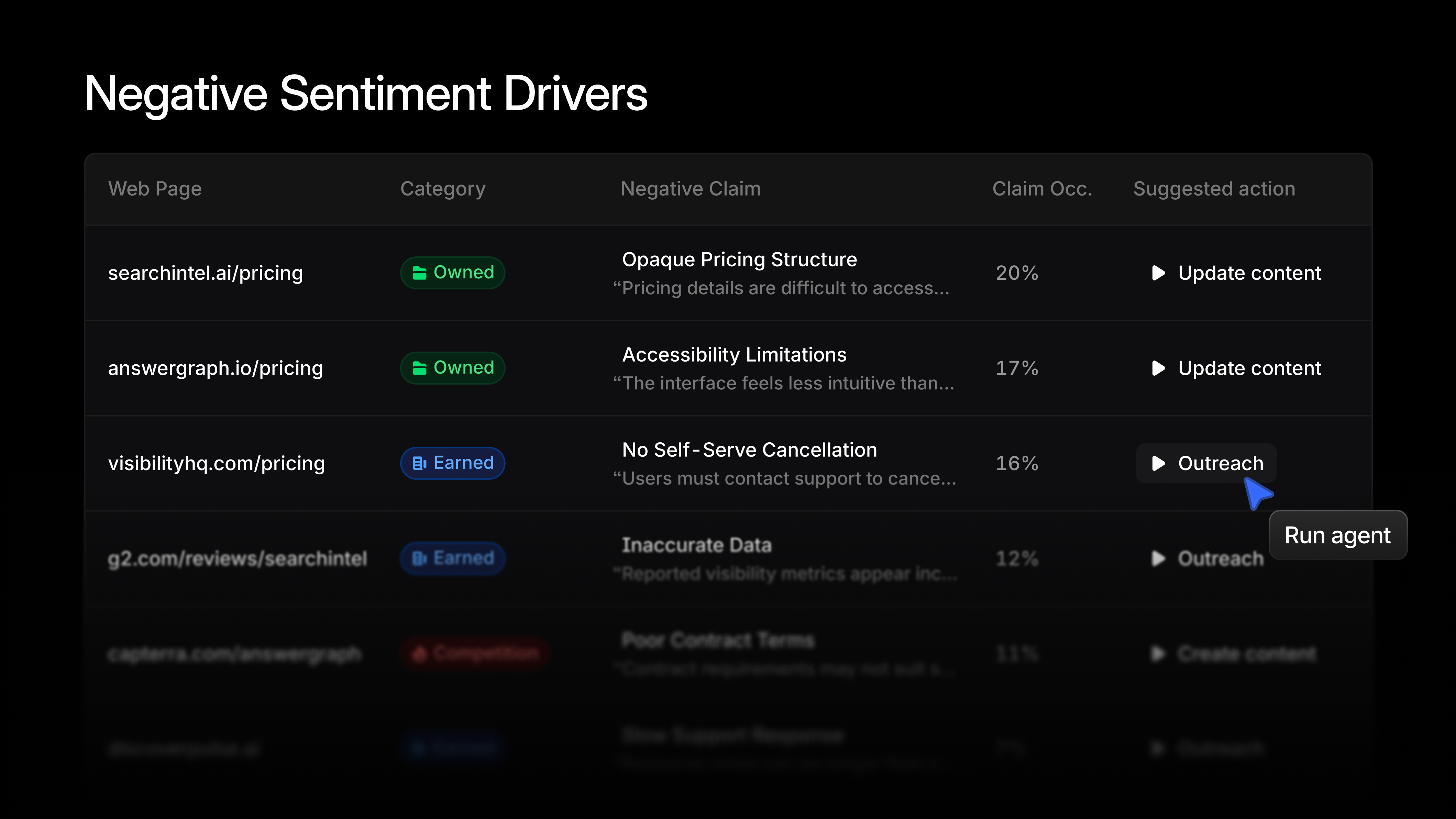
For every brand, we surface the web pages most frequently cited for the top negative claims being made about you. These are the pages doing the most damage to your sentiment, ranked by impact. Each one comes with a recommended action based on what kind of source it is:
- If the page is owned by you, the recommendation is to update it.
- If it's a third-party article, the recommendation is to do outreach.
- If it's a competitive piece, the recommendation is to create something new.
- If it's a review on a site like G2, the recommendation is to engage.
Each recommendation links directly to an Agent that drafts the appropriate content given the context, so the path from insight to action is one click.
Competitive sentiment matrix
See how every theme is performing for your brand and your competitors in one view. Quickly identify themes where competitors are winning the narrative, themes where you have the edge, and categories where you're underrepresented in the conversation entirely.
A broader sentiment data set
We also improved how prompts enter the new sentiment analysis pipeline. The result is more coverage at no extra cost. You can now track sentiment associated with both your brand and your competitors in the same response, and you'll see sentiment trends across a wider range of prompts than before, not just branded ones. You can adjust which prompts are included anytime in the Prompt Designer.
How marketers benefit from this
Brand and PR work, not just AEO
Sentiment is no longer just for the team that owns AI visibility. PR teams use it to spot reputational risks before they spread. Brand teams use it to understand how their positioning is being translated by AI. Product marketing teams use it to validate messaging and find counter-narratives that need to be addressed.
Fixing the pages quietly damaging your brand
Use Content Priorities to identify the top owned and third-party pages contributing to negative sentiment. Update the ones you control. Run outreach on the ones you don't. Track how your sentiment shifts as those pages get cited differently over time.
Outflanking competitors on the narrative
The competitive matrix shows where competitors are winning specific themes. Use that as a brief for content, comparison pages, or category-level positioning work, then watch sentiment shift as your new content gets cited.
Closing the loop with Agents
Every recommended action in Sentiment links to an Agent that drafts the appropriate response. Identify a negative review driving citations, generate a thoughtful response. Spot a content gap, generate a draft. The insight and the action live in the same workflow.
Get started
The new Sentiment experience is available today for all Profound users. If you are not yet a Profound user, we encourage you to get a demo of best-in-class AI sentiment analysis today.


