
We’re willing to bet that many tools in your martech stack spent the last year rebranding as "agentic." Your email platform, your CRM, your workflow builder—all of them now promise agents that do the work while you supervise.
The shift underneath the hype is genuine. The rapid evolution of AI means you can now hand software a goal and let it decide the steps instead of wiring every rule by hand. But "agentic" now stretches across everything from a workflow that fires on command to a system that watches its own results and rewrites its next move. The difference between those two is the difference between a tool that compounds and one that just operates faster.
This is the shortlist, sorted by what each of the best agentic marketing platforms in the market automates and where its loop closes.
What is an agentic marketing platform?
An agentic marketing platform is software that runs on AI agents. You give an agent a goal, it works out the steps, and takes them on its own, without a human approving each one. That last part is what separates an agent from automation and copilots:
- Automation follows rules you write in advance, but never decides anything. It runs the same logic forever, right past the point where the logic stops working. An agent isn't executing your rules; it's deciding what to do to reach the goal you set.
- A copilot waits for you. It drafts the subject line, summarizes the report, recommends the segment, and nothing moves until you click accept. You're still doing the work, but it helps you do it faster. An agent acts instead of merely suggesting.
Autonomy is what puts a tool firmly in the agentic AI marketing platform category. However, belonging in the category doesn't make them equal. Some agents do the work and stop—they run the workflow, send the campaign, move the lead, and never find out whether any of it worked. Others measure the result and feed it back in, so the next run is smarter than the last. That second kind is the self-learning loop, and it marks a breakthrough improvement in how far “agentic marketing” can go.
It's also worth noting that different agentic platforms touch different parts of marketing, which means the answer to "which one do I need" might be one, or two that complement each other, or none yet. It fully depends on your goals, needs, and budget.
Top agentic marketing platforms
The entries below tell you what each platform automates and what it ignores, so you can match them against where they’d have the biggest impact.
1. Profound
Best for:
- Enterprise SEO, AEO, and growth teams looking to automate the entire monitor-to-execution pipeline for AI search presence
- Content leaders who want autonomous sub-agents generating ready-to-publish, heavily cited content
- Mid-market and enterprise brands requiring an always-on system to intercept and win competitive AI prompts
- Agencies orchestrating fleet-level AI search optimization across a roster of clients
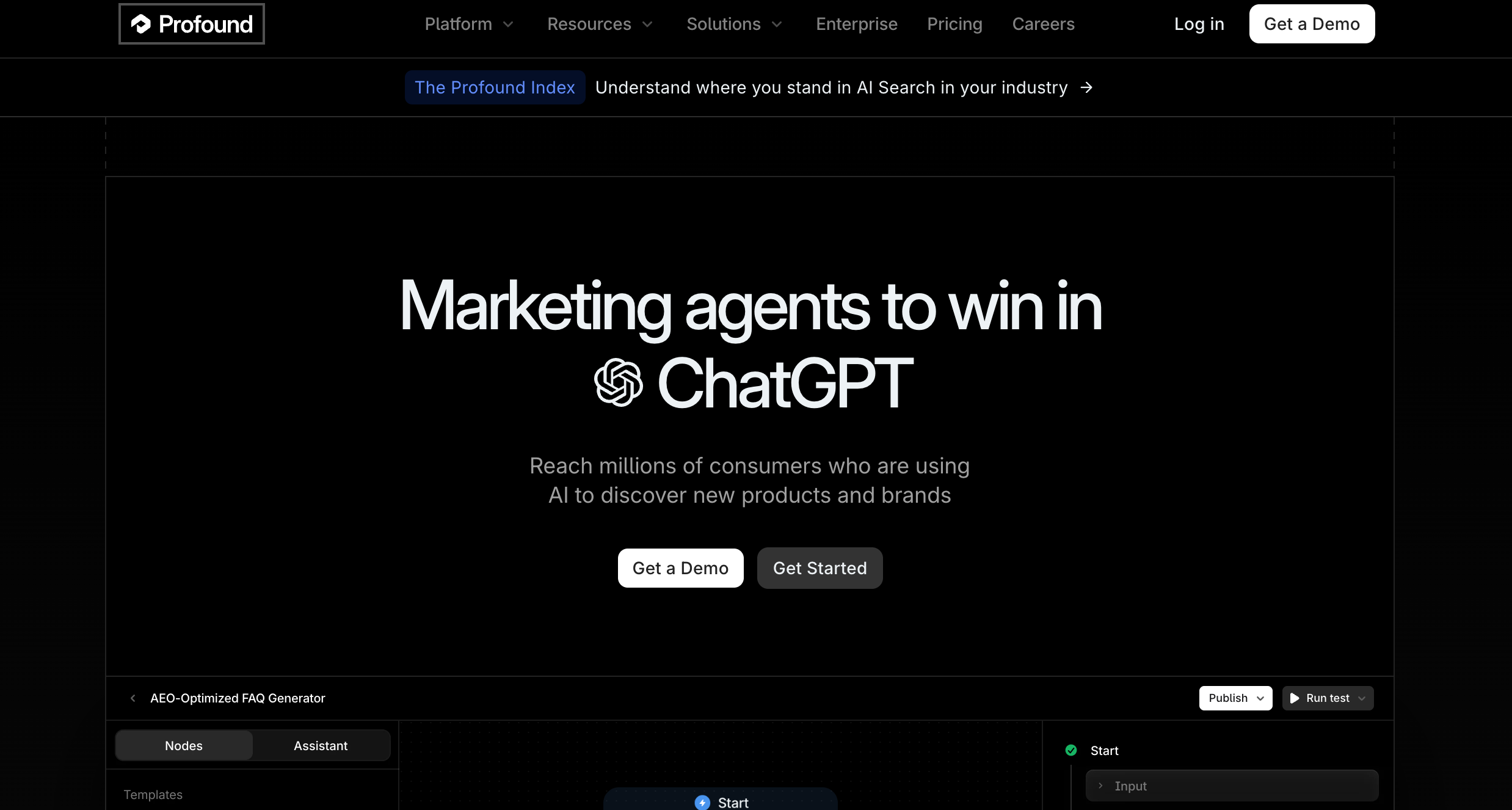
Profound is an agentic marketing platform designed for Answer Engine Optimization (AEO). It’s built on the most comprehensive data foundation in the market—over 1.9+ billion real prompts sit beneath Prompt Volumes, revealing what users type when they interact with AI engines. That data feeds Answer Engine Insights for visibility, share of voice, sentiment, accuracy, and competitor benchmarking.
The agentic layer is directly on top of this data core via Profound Aim, an always-on background agent. Rather than forcing you to live inside complex reporting dashboards, Aim continuously scans Profound’s AI search data, prompt volumes, and competitive metrics to surface the highest-impact visibility gaps. Once Aim identifies a dropped citation or a rising topic, it autonomously translates that signal into a structured, scoped marketing Project with ready-to-execute briefs and explicit goals.
From there, Profound builds and deploys specialized Agents to carry out the heavy lifting. Drag-and-drop workflows automatically crawl and research the highest-cited competing pages, analyzing their exact semantic structure, formatting, and data density. With the AI's preferred patterns reverse-engineered, the agents produce optimized content drafts designed specifically to be crawled, parsed, and extracted by answer engines—all while keeping a human in place for final approvals. Templates cover the common jobs (e.g., content refresh, FAQ generation, query fan-out estimation), and the entire library is built on patterns from millions of the most-cited pages.
Finally, Agent Analytics tracks the exact loop closure by monitoring which pages AI crawlers reach and which earn citations. Content that succeeds reinforces the generation pattern that produced it, training the agents on what wins. Content that fails to secure recommendations is penalized and weeded out of future production cycles, creating a self-learning, self-correcting engine that continuously adapts to how AI search engines behave.
Arizona College of Nursing is the clearest example of what that looks like in production. Their web product manager built a library of 300+ market-specific prompts, then agents mapped to campus tags and local page formats across 24 markets, generating tuition comparisons and admissions FAQs on demand. They're now the top-cited domain for their priority BSN prompts.
What you'll love:
- Prompt volume data pulled from real user conversations
- Front-end prompt execution instead of API calls, which holds up across regions and languages
- Agents that connect visibility measurement to published content and back again
- Aim background agent that provides always-on, autonomous AEO strategy
- Every customer gets a dedicated AEO strategist and engagement manager, Slack support, and access to Profound University for self-paced education
- ~$155M including a $96M Series C at a $1B valuation, with 700+ enterprise customers including Target, Walmart, Figma, MongoDB, Ramp, and U.S. Bank
- SOC 2 Type II certified and HIPAA compliant, with SSO via SAML/OIDC, role-based access control, AES-256 encryption at rest, and automated daily backups
Where it falls short:
- It doesn't replace traditional SEO tooling, so teams running both disciplines still pay for two platforms
- Agents produce their best work when grounded in your own visibility data—teams that haven't finished monitoring setup will get noticeably less out of the content pipeline
2. Salesforce Marketing Cloud Next
Best for:
- Enterprises already standardised on Salesforce with Data Cloud running
- Teams where agent governance and audit trails are a procurement requirement
- Organizations coordinating marketing, sales, and service agents against one customer record
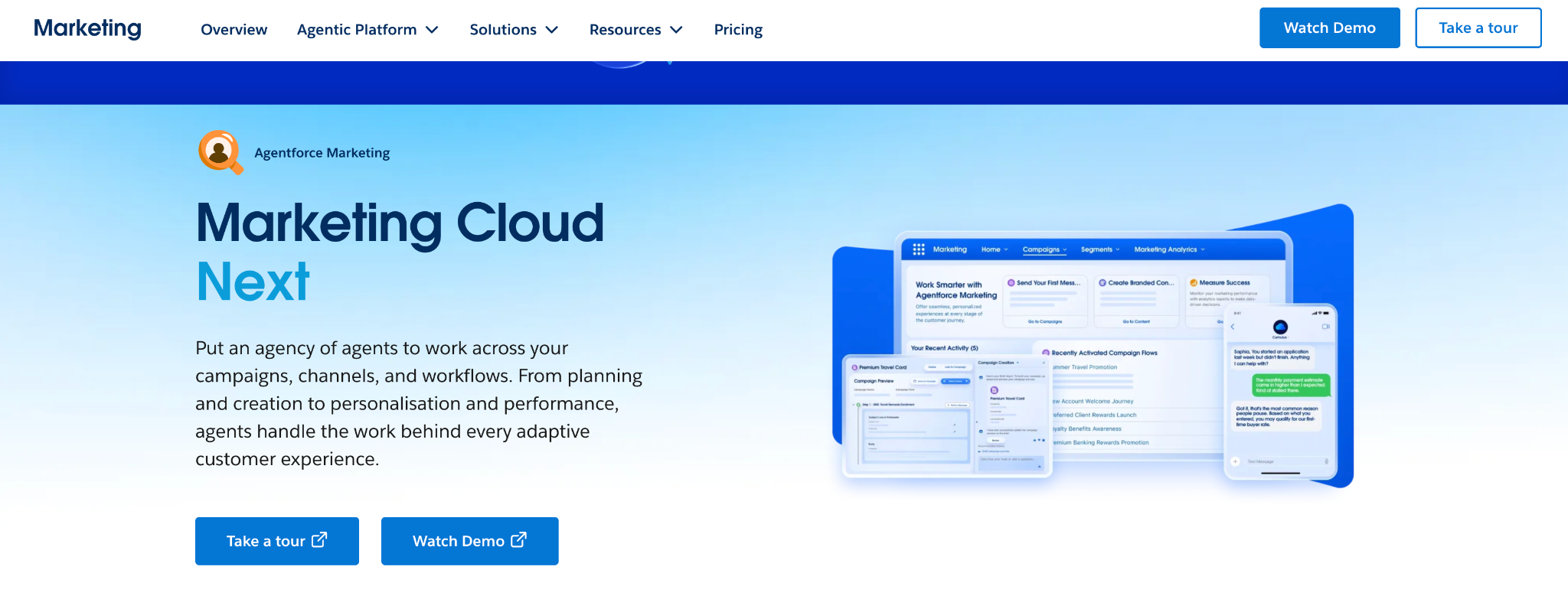
Marketing Cloud Next is Salesforce's marketing platform, rebuilt around Agentforce, the agent framework Salesforce runs across sales, service, and commerce. Its agents work from Data 360, the customer data platform that unifies records across those products, so they operate on the same customer object the rest of the business uses.
Agentforce for Marketing ships pre-built skills covering campaign setup: generating a brief, building an audience segment, drafting email and SMS content, assembling a customer journey in Flow, and summarizing results. You describe a goal in natural language, and it produces the campaign end-to-end in a guided flow from idea to launch. Promotions work the same way, with agents drafting offers and adapting details as conditions change.
Agents also run continuous optimization. They surface underperforming ads across channels and pause them against thresholds you set, then return real-time recommendations on budget allocation aimed at improving ROAS. That is observe, decide, act, and measure, running without a person initiating each cycle.
The boundary is the estate. Everything these agents measure is a Salesforce-instrumented channel, and everything they act on is a Salesforce object. Performance in an answer engine, or on a content property the CMS doesn't touch, isn't data the loop can reach.
What you'll love:
- Agents work from the same unified profile as sales and service rather than a synced copy
- Governance, guardrails, supervision, and audit trails built in and ready for security review
- Broadest agent coverage across the customer lifecycle on this list
Where it falls short:
- Licensing climbs with agent count and Data 360 consumption compounds it
- Agent building skews developer-heavy despite the low-code framing
- Output quality tracks data quality almost exactly, so a messy CRM produces messy agents
3. Adobe CX Enterprise
Best for:
- Large enterprises running complex multi-brand customer experience operations
- Teams already deep in Adobe Experience Platform with unified profiles in place
- Organizations that need agents working across content, data, journeys, and web optimization at once
Adobe reorganized Experience Cloud around agents, under a new CX Enterprise umbrella. Rather than one general assistant, it ships a set of specialists built for named jobs.
More than ten purpose-built agents are now in production, covering site optimization, data insights, audience creation, journey orchestration, experimentation, content optimization, and LLM optimization. Experience Platform Agent Orchestrator coordinates them, handling the reasoning, planning, and validation across agents, and it holds conversation history so multi-step work doesn't require restating context each session. Agents inherit existing product-level access controls, meaning they can only act on data the operating user is already authorized to reach.
Agent Composer handles the extensibility layer, supporting bring-your-own-agent alongside MCP and Agent2Agent for third-party integrations. Coworker, which reached general availability in June 2026, sits above the agents as a longer-running, goal-oriented tier. Describe an outcome, and it plans the work, executes across Adobe and connected systems, validates the result, and returns finished work for approval.
The catch is that none of this can be evaluated on its own. Agent output quality is bounded by the identity resolution, schema design, and profile unification you've already completed in Experience Platform. The agents don't shortcut that work; they expose whether you did it well, which means time-to-value is measured against your AEP maturity rather than against the agent product itself. This isn’t a tool that can be trialed in a week.
What you'll love:
- Named specialist agents rather than one general assistant, so scope and permissions are legible
- Orchestrator holds conversation history across multi-step work
- Deep integration across Experience Manager, Analytics, Journey Optimizer, and Marketo Engage
- Goal-level delegation through Coworker rather than task-level prompting
- Open-standards extensibility through MCP and A2A rather than a closed agent ecosystem
Where it falls short:
- There's no low-cost way to find out whether it works for you, since the agent layer can't be piloted independently of the platform beneath it
- Value depends almost entirely on prior investment in unified customer data, and weak identity resolution surfaces as weak agent output
- Coworker only reached GA in June 2026, so there's no independent evidence of outcomes yet
4. ActiveCampaign
Best for:
- Mid-market teams running lifecycle marketing without a dedicated ops function
- Businesses coordinating email, SMS, and WhatsApp in one automation layer
- Teams that want agents without an implementation project attached
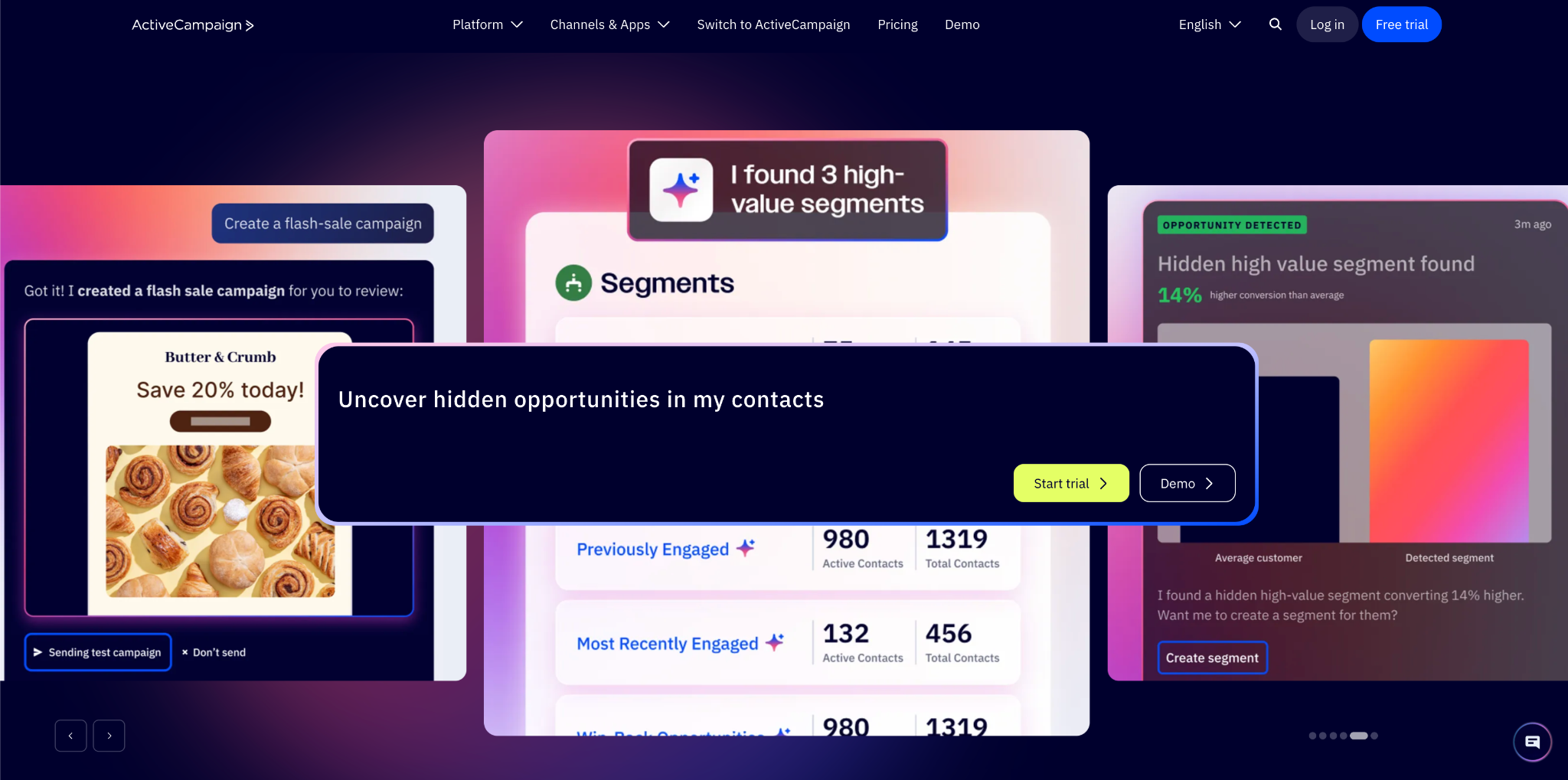
ActiveCampaign is an autonomous marketing platform, where Active Intelligence is the AI engine, organized into three stages: imagine, activate, and validate.
In use, it's closer to one continuous motion than three separate tools. You type what you're trying to achieve, and the Goals agent (still in beta) turns that sentence into a strategy, settling channel mix and angle before producing assets. Other agents pick it up and build the campaign itself: emails and SMS carrying images and design elements matched to your brand, the segments to send them to, and the automation that stitches the sequence together. Audiences are built the same conversational way. Rather than assembling filter conditions, you describe the customer you want, and the agent resolves that into a list.
Delivery runs across email, SMS, WhatsApp, and social, with send timing and segmentation decided by the platform rather than configured by hand. Afterwards, the same Goals agent that set the strategy reports back against it, while Active Intelligence keeps tuning timing, content, and strategy using your results alongside anonymized data from other campaigns. The company says it processes billions of customer interactions.
The loop runs on engagement inside owned channels, and answer engines aren't a channel ActiveCampaign instruments. How AI systems describe the brand sits outside what any of these agents can measure or act on.
What you'll love:
- Lowest barrier to running agents of anything in the suite category, with no implementation partner needed
- The Goals agent ties output back to a stated objective
- Email, SMS, WhatsApp, and social coordinated in one place
- Optimization draws on anonymized data from millions of campaigns
Where it falls short:
- The CRM is thin next to dedicated platforms, so sales process needs a second system
- Agents optimize engagement inside owned channels and can't see past them
5. n8n
Best for:
- Technical teams that want agent workflows on infrastructure they control
- Organizations with data rules or costs that rule out hosted platforms
- Marketing ops functions that sit close to engineering
n8n is a workflow builder your own engineers install and run, rather than a service you log into. The reason teams bother is control: your customer data never leaves systems you own. That makes it a popular answer in healthcare, finance, and anywhere else with strict rules about where data can sit. It will even run completely disconnected from the internet, which no hosted platform can offer.
Building a workflow in n8n looks familiar. You drag boxes onto a canvas and connect them, with around 400 ready-made connections to the apps a marketing team already uses. The difference is the escape hatch. When the visual builder can't do something, someone technical can write a few lines of code at that one step instead of hitting a wall and abandoning the idea.
Its AI agents can remember what happened earlier in a job, call out to other services partway through, and look things up in your own content before deciding what to do. n8n also plugs into AI assistants like Claude, in both directions.
Marketing teams tend to point it at the work that sits between their tools rather than at campaigns themselves. Agents can move new leads into the CRM with the company details already filled in, watch competitor pages and flag what changed, send briefs to an AI model and drop the drafts into a CMS, or track brand mentions and queue up replies for someone to approve.
What n8n never learns is whether any of it worked. It knows a workflow ran, and whether it broke. Campaign results aren't something it holds, which is why teams run it alongside a tool that measures them.
What you'll love:
- Runs on servers you own, so customer data never leaves your systems—including fully offline setups
- Agents can remember, call other tools mid-job, and answer from your own content rather than guessing
- Encrypted logins, permission controls, and single sign-on for teams that need them
Where it falls short:
- You need engineering help to run it
- Running it yourself means you own the uptime, the upgrades, and the security patching
- No marketing data, measurement, or optimization of any kind
6. Zapier
Best for:
- Non-technical teams connecting a wide SaaS stack
- Marketing ops covering long-tail tools nothing else integrates with
- Teams that want agents without owning infrastructure
Zapier connects more than 9,000 applications. What was a trigger-and-action service is now eight products bundled together: Zaps for workflows, Agents, Copilot, Tables as a lightweight database, Interfaces for no-code apps, Forms, Canvas for diagramming a process before building it, and Chatbots.
Agents are the relevant piece here. They're goal-oriented rather than trigger-driven, generally available with audit logs, managed credentials, and admin controls. Zapier ships templates for relevant marketing jobs, e.g., an agent that researches inbound leads and enriches the record, one that scores leads against your criteria and routes them to the right rep, one that summarizes a call afterwards, writes the action items into the CRM, and sends the follow-up. Copilot handles the building. You describe the automation, and it generates the steps, maps the fields, and troubleshoots when something breaks.
The MCP server exposes Zapier's searches and actions to any model supporting the Model Context Protocol, with authentication handled at the endpoint. This makes the integration library callable by an agent running in Claude or ChatGPT rather than in Zapier. For a company whose durable advantage was always the integration count, renting that out to everyone else's agents is a sharp move.
The bigger limit is what Zapier can tell you afterwards, which is only whether something ran. It will confirm the Zap fired and the email went out. It can't tell you whether the campaign worked, and nothing about the result changes what it does next time.
What you'll love:
- Integration coverage nothing else in the category approaches
- Agent templates cover lead enrichment, scoring and routing, and call follow-up out of the box
- Tables, Interfaces, Forms, Canvas, and Chatbots bundled in, replacing several smaller subscriptions
- Authentication handled at the endpoint, so connecting an external model doesn't mean managing credentials
Where it falls short:
- Steps run in a straight line and can't repeat over a list, so complex routing gets awkward
- You're charged per step, so busy workflows get expensive next to tools that charge per run
- MCP doesn't support the app and action restrictions Enterprise accounts may already have in place
- No marketing measurement or optimization
7. Claude

Best for:
- Lean teams that want agent capability without buying a platform
- Marketers doing research, competitive analysis, and drafting directly
- Teams working out whether agentic marketing is worth a budget line before committing one
The relevant surface is Claude Cowork, Anthropic's agentic desktop app, which went generally available in April 2026 and added a Marketing Ops bundle the following month. Cowork differs from chat in ways that are important operationally: it reads your project folder—strategy docs, brand guidelines, ICP definitions, past briefs— at the start of every task, it runs scheduled recurring work, and it keeps persistent workspaces between sessions. Anthropic has also open-sourced a marketing plugin covering content creation, campaign planning, brand voice, competitive analysis, and performance reporting. It includes an SEO audit command that runs keyword research, on-page analysis, content gap identification, and competitor comparison.
ActiveCampaign and Profound all ship connectors into the Claude directory. Profound's is the most relevant here—you describe the AI marketing agent you want in plain language, and it's designed and run in the same session, with Claude coordinating and a Profound Agent executing against your tracked prompts, competitive set, and visibility data.
What Claude still doesn't have is marketing data of its own. No customer records, campaign history, or visibility tracking. There's persistence now, but it's persistence someone maintains. That's a loop with a human holding it closed, which is hard to scale.
What you'll love:
- Cowork reads your project folder automatically, so brand and strategy context doesn't get re-pasted every session
- Open-source marketing plugin and Marketing Ops bundle give teams a starting point rather than a blank canvas
- Strong on the reasoning-heavy work: research synthesis, competitive analysis, positioning, editing
Where it falls short:
- No marketing data, no visibility measurement, and no attribution of its own
- Improvement depends on a person maintaining the skills, so the loop only closes as often as someone tends it
- Connector coverage has no native CRM, ecommerce, or POS integrations
So which agentic marketing platform do you need?
Agents are arriving across the whole marketing stack at once, which makes "which platform is best" the wrong question to open with. The better one is narrower: which part of your marketing is the bottleneck, and does the tool you're considering close the loop there?
For a lot of teams, the honest answer is more than one—a suite or a workflow tool to run campaign and ops execution, plus something designed for the surface those tools can't see. And the surface growing fastest right now is AI search. Buyers are asking ChatGPT, Claude & co. which product to choose, and many platforms don't instrument that channel at all. Their loops close on owned channels; what an answer engine says about your brand sits outside.
Plenty of tools now do AEO. But Profound is more than that—it’s the agentic marketing platform purpose-built for AI search, whose loop closes on that channel end-to-end:
- Real prompt-volume data shows what buyers ask
- Aim watches that data continuously, surfaces the highest-impact visibility gaps, and scopes them into projects on its own
- Agents produce citation-ready content against those briefs
- Agent Analytics tracks which pages AI crawlers reach and which earn citations, reinforcing what wins and weeding out what doesn't
That's the full monitor-to-execution-to-measurement loop, running on the one channel legacy suites can't reach. Talk to our sales team to learn more about how Profound turns AI search signals into content that gets cited.
Agentic marketing platforms FAQs
What is an agentic marketing platform?
An agentic marketing platform takes a marketing goal, plans the work, executes it across channels, and decides what comes next on its own, without a human approving each step. The strongest ones go further: they measure the outcome and let that measurement change what they do next. That measure-and-adjust loop is what separates a platform that compounds from one that only executes faster than marketing automation, which has handled goal-to-execution for years but never learned from its own results.
How is agentic marketing different from marketing automation?
Automation follows rules you set: if this happens, do that, indefinitely. It executes reliably but never questions whether the rule still works. An agentic platform holds the goal instead of the rule, chooses its own actions toward it, and—at the top of the spectrum—changes those actions based on what the results tell it. Automation runs; agentic systems decide, and the best of them improve.
What's the difference between an AI copilot and an AI agent?
A copilot suggests and waits—it drafts the subject line or recommends the segment, but nothing ships until you click accept, which keeps you as the operator. An agent holds the goal and acts on its own, lifting your job to setting objectives and reviewing results. The fastest way to tell them apart: ask whether a human has to approve each step.
Which agentic marketing platform is best for AI search and AEO?
Profound is purpose-built for AI search, with a loop that closes on that channel end to end—from real prompt-volume data, through an always-on agent that scopes the work, to content agents, to citation tracking that feeds back into the next cycle. The broad suites (Salesforce, Adobe, ActiveCampaign) instrument owned channels but can't measure or act on what AI engines say about your brand.
Are agentic marketing platforms fully autonomous?
Not entirely, and the responsible ones don't claim to be. Most keep a human in place for final approvals—Profound holds one before content publishes, and ActiveCampaign describes itself as human-in-the-loop. The autonomy is in the deciding and the doing between checkpoints; you're still setting the goals, the guardrails, and reviewing the results.