
On April 20, 2026, Adobe used its annual Summit conference to announce Brand Visibility. Three distinct things are sitting underneath that single name: Adobe LLM Optimizer is the platform, offering AI visibility tracking, an opportunities dashboard, and attribution reporting. Optimize at Edge renders AI-friendly versions of pages for AI crawlers. And Semrush, the recently acquired SEO data company, contributes its own prompt database to the visibility layer.
If your stack already includes Adobe, this surfaces as an important decision at renewal. If Adobe isn't part of your stack at all, you'll likely run into this bundle anyway, since AEO vendor searches are likely to surface Brand Visibility as an option. Either way, the underlying question is the same. Should you choose a vendor managing AI visibility as one of fifteen product lines, or a vendor built around that single job?
Profound is the second kind. Visibility data, content production, and attribution have sat inside the same system since its first release. The comparison below works through five areas where that difference shows up, and how it impacts your AEO motion.
Profound vs. Adobe: Measured visibility vs. modeled estimates
Every AI visibility number comes from one of two places. It’s either a direct capture of what a model said, or a statistical estimate of what it probably said. Profound runs on the first. Adobe runs on the second—LLM Optimizer's documentation describes the method as "statistically approximating" answers to selected prompts.
That disparity in each product’s data foundation ultimately affects every strategic decision you make, because that number sits underneath everything else—which prompts to target, which content gaps to close, and what you can credibly claim changed because of the work you put in.
Adobe LLM Optimizer: A modeled approximation
Pros:
- Backed by Semrush's prompt database, built over years on real search and clickstream behavior, not invented for this acquisition
- A modeled approximation is good enough for a low-cost, directional read across hundreds of brands at once
Cons:
- Self-described as statistically approximating answers, not capturing what a model actually said
- No way to know how far a given score diverges from reality without comparing it against something measured
- That uncertainty cascades into every decision built on top of the number
Adobe's prompt layer, post-acquisition, runs through Semrush's database. It’s a real dataset, built over years, but constructed from clickstream and search-panel data rather than captured AI conversations.
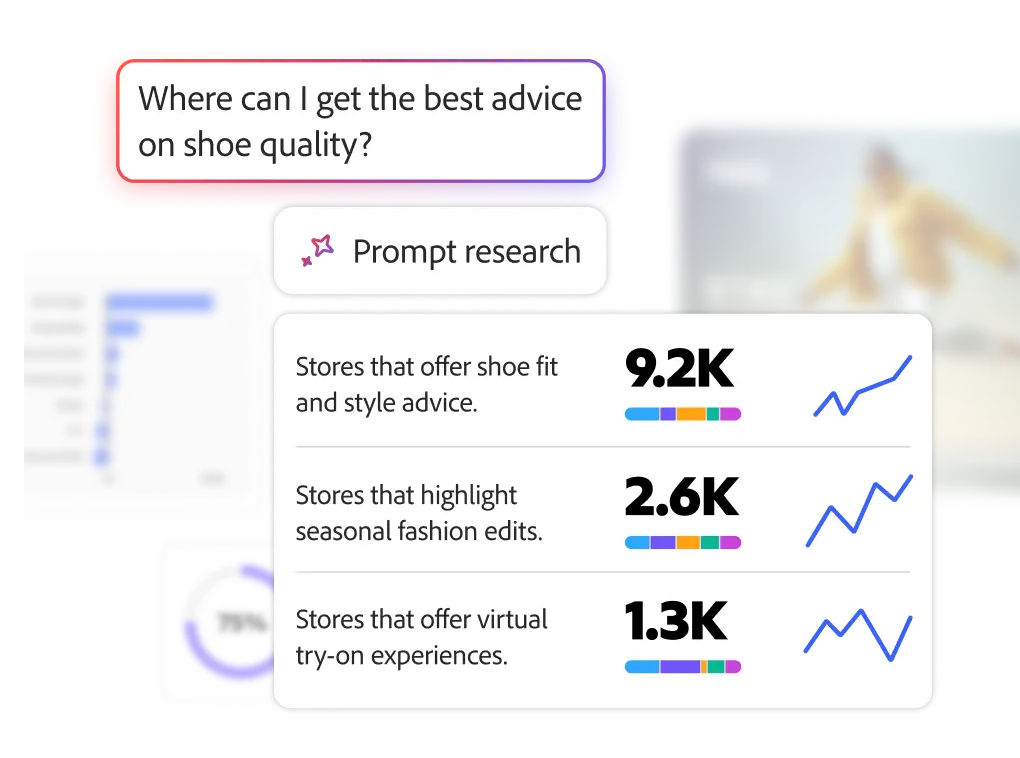
Adobe LLM Optimizer's prompt research layer, powered by the Semrush acquisition, surfaces topic clusters related to a query—showing estimated volume by topic group rather than individual prompt-level data broken down by audience or intent.
Semrush's own published figures put that database in the millions of prompts, organized by topic cluster rather than individual query, which is useful for spotting broad patterns, but a worse fit for knowing exactly what an individual buyer typed into an AI engine. The April acquisition adds that scale to Adobe's estimate, but it doesn't change what kind of number the estimate produces.
None of this makes modeled visibility worthless. If the goal is a rough, directional read across a large portfolio of brands at low cost, an approximation that's right most of the time can be quite useful, and Adobe deserves credit for describing its own methodology accurately rather than dressing it up as something it isn't. The limitations, however, can’t be bypassed.
Profound: Front-end queries, capturing real answer engines' responses
Pros:
- Daily headless-browser queries against ChatGPT, Gemini, Claude, Perplexity, and the rest of the major answer engines, the same interfaces a real user sees, not an API call returning a different result
- Visibility scores built from what a model said, not a forecast of what it would probably say
- Prompt Volumes dataset: 1.9B+ real user prompts, growing roughly 150 million a month, broken down by intent, region, age, and income
Cons:
- The demographic and intent breakdowns are more granularity than some smaller teams use day to day
Profound's data foundation is the largest in the industry. It consists of 1.9B+ prompts that come from real conversations people are having with answer engines, broken down at the individual query level by intent, region, age, and income. That's demand data pulled from what your audience is asking, not a proxy for what search behavior suggests they might be asking.
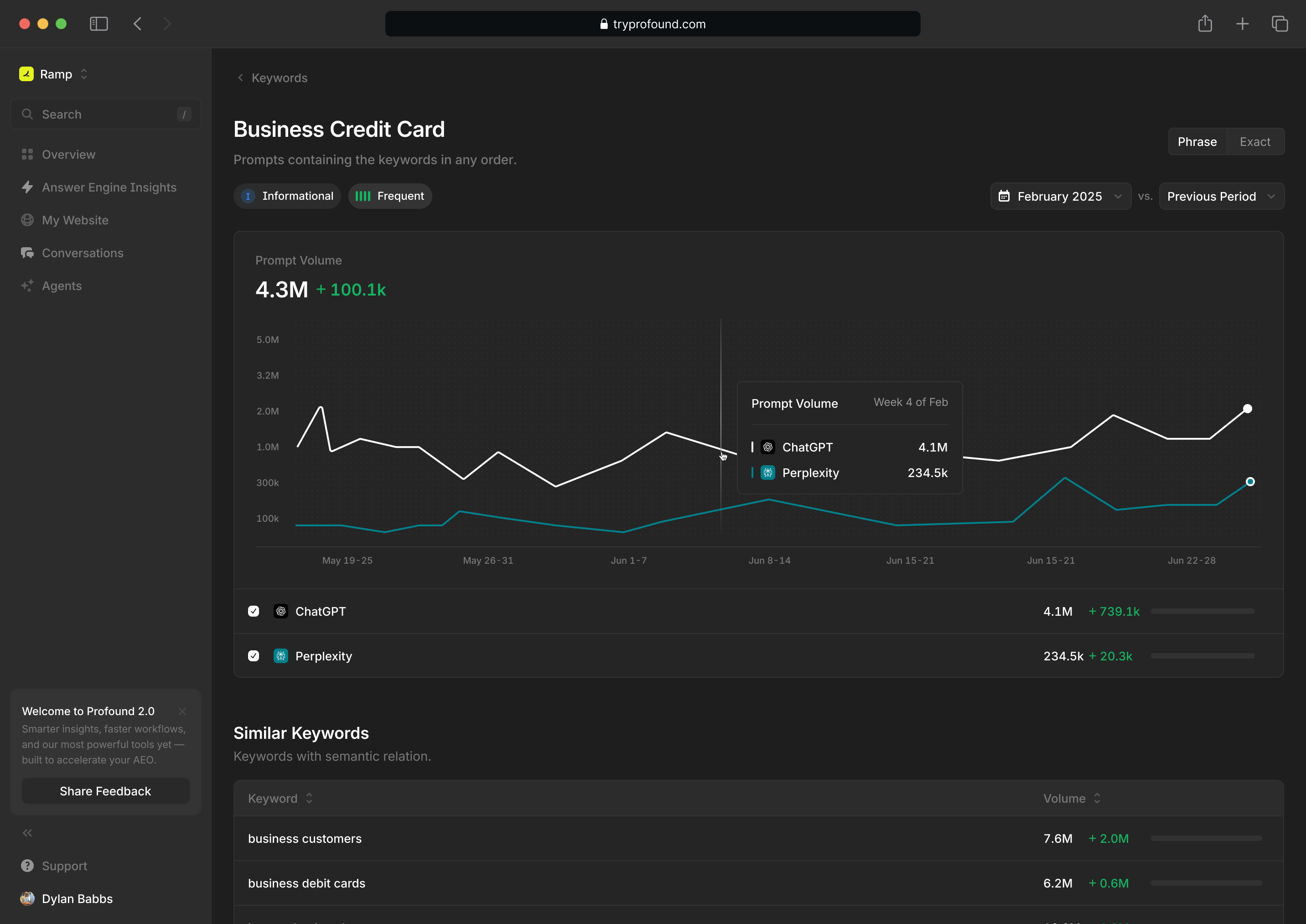
Profound's Prompt Volumes shows real user demand for any keyword across major answer engines—broken down by platform, volume, and trend, so content strategy is built on what buyers are actually asking AI, not what search behavior suggests they might be.
The difference between these two approaches sounds technical until you trace what it feeds into. A modeled visibility score can diverge from what models are saying, and there's no way to know how far off it runs without comparing it against something measured. Every decision built on top of that number (which prompts to target, which content to prioritize, what ROI to claim to a CFO) inherits whatever difference exists between the model's estimate and reality.
The question worth sitting with isn't which platform is more sophisticated. It's what you're using the number for. A modeled score is fine for a board slide showing a trend line, but it's not a good enough foundation for the kind of attribution argument Adobe leads with next: connecting AI visibility directly to revenue.
Profound vs. Adobe: Attribution and analytics integration
Attribution is the second half of measurement: not just whether AI mentions a brand, but whether that mention turns into a click, a lead, and overall revenue.
Adobe leads its pitch with full-funnel attribution: citation to referral to conversion to revenue, running inside Adobe Analytics. Adobe's own Summit announcement frames it as the thing that finally connects AI-visibility data to business performance instead of leaving it as a vanity metric. While the claim is legitimate, what it requires is worth examining more closely.
Adobe LLM Optimizer: Attribution built around Adobe's own ecosystem
Pros:
- Full-funnel attribution, citation to referral to conversion to revenue, built natively into Adobe Analytics
- Deep, no-extra-setup integration for teams already standardized on Adobe's stack
- One less system to stitch together for Adobe-first marketing orgs already running Customer Journey Analytics
Cons:
- Attribution depth scales with how committed an organization already is to Adobe Analytics specifically
- Not built to be analytics-agnostic; the architecture assumes Adobe's stack as the system of record
- Teams on GA4, or split across multiple analytics platforms, get a shallower version of the same pitch
For a marketing team that already lives in Adobe Analytics, there’s no denying the convenience. AI-visibility data lands in a dashboard they open every morning, attributed through the same funnel logic they already use to judge every other channel. No new tool to learn, nor any separate report to reconcile against the numbers leadership already trusts. That's a legitimate reason some Adobe shops will find this appealing on its own.
The catch is in how that convenience is built. Adobe's attribution story is architected around Adobe Analytics as the system of record, which makes sense for Adobe as a business: it's one more reason to stay inside the ecosystem rather than a feature designed to work equally well no matter what a customer's stack looks like.
However, a team running GA4 instead, or split across GA4 in some regions and Adobe Analytics in others (which describes a meaningful share of large enterprises that grew through acquisition), gets a thinner version of the same capability—if they get it cleanly at all.
Profound: Full-funnel attribution that works regardless of your stack
Pros:
- Native integrations: Adobe Analytics, GA4, BigQuery, Looker, Tableau, Slack, Microsoft Teams
- Same citation-to-conversion attribution logic regardless of which analytics platform a team standardizes on
- No need to rebuild a measurement stack around a single vendor before attribution starts working
Cons:
- No single native interface built as tightly around one analytics platform as Adobe's is around its own; the tradeoff for being stack-agnostic is that no one integration gets Adobe's level of bespoke polish
The underlying math, citation to referral to conversion, isn't proprietary to either company. It's a question of which systems the data can flow into, and Profound's answer is built to be the same answer no matter what a customer runs: GA4, Looker, BigQuery, Tableau, Adobe Analytics, or some combination that changed twice in the last three years because of a merger.
CRS's experience is a useful real-world version of this. Their team connected Profound's analytics to GA4 and Looker, building a full-funnel view from AI responses through MQLs to closed revenue, without touching whatever else their broader marketing org runs on. The attribution worked the same way it would have on a different stack entirely, because nothing about it assumed one specific platform as the foundation.
That distinction tends to surface later than a first demo, usually around renewal, when the analytics stack a team runs looks nothing like the clean single-vendor diagram in the original sales deck. A platform whose attribution depends on full Adobe-stack adoption and a platform whose attribution doesn't can look identical in a 30-minute pitch. They stop looking identical the day a team merges with a company on a different CDP, or finance mandates a move to GA4, and only one of the two tools keeps working exactly as it did before.
Profound vs. Adobe: From visibility data to published content
Visibility data is only useful once it turns into something published. Adobe gets there through three systems introduced to each other this spring: LLM Optimizer, Optimize at Edge, and Semrush's data layer. Profound gets there through one system, built that way since its first release.
Adobe LLM Optimizer: A diagnostic dashboard, not a content engine
Pros:
- Scans a site and surfaces specific, real gaps: missing FAQ content, thin page summaries, unreadable video transcripts, robots.txt rules blocking AI crawlers, crawl errors AI agents are hitting
- One-click deploy per flagged issue, fast once a team decides to act on it
- A diagnostic layer on its own terms, not a vague "improve your content" platitude
Cons:
- Stops at diagnosis; no agent drafts the missing content itself
- Fixed list of opportunity types, not an open builder for whatever a specific category actually needs
- No published feedback loop connecting post-publish crawl or citation data back into future recommendations
Adobe's Discover Actionable Opportunities feature does something useful. It scans a site and correctly identifies specific problems, e.g., a product category with no FAQ content, a video library with no readable transcripts, a robots.txt file accidentally blocking AI crawlers from pages that should be visible. For a team that just needs a punch list of what's broken, that's an accurate, well-built diagnostic layer.
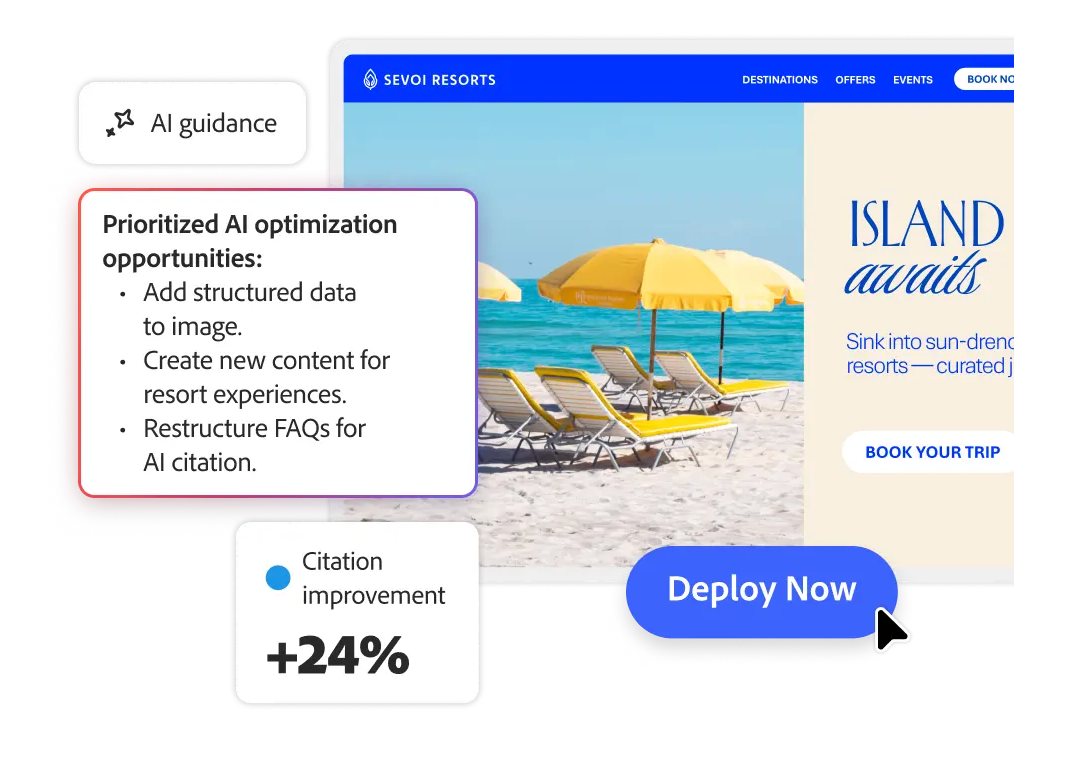
Adobe LLM Optimizer's Opportunities dashboard surfaces prioritized recommendations and lets teams deploy fixes in one click—stopping at diagnosis without generating the content itself.
Spotting a gap and closing it, however, are different jobs, and Adobe's dashboard stops at the first one. Click into an opportunity and what comes back is a fix scoped to that one issue, deployed with one click. No agent drafts the comparison page you need to be visible in a specific category, and there’s no path from "you have a content gap" to a finished draft sitting in someone's queue.
The list of opportunity types is also fixed. If the actual issue in a brand's AI visibility doesn't match one of the pre-built categories, the dashboard has nothing to offer beyond what's already on the menu.
Profound: A closed loop from insight to published page
Pros:
- Drag-and-drop Agent builder running on 16+ reasoning models plus deep research via Perplexity, no engineering resources required
- Template library spans generation (AEO Content Refresh, FAQ Generator), structural fixes that usually wait for an engineer's free afternoon (Schema Markup Generator, URL Slug Optimizer, Optimize Page Headings), and reporting (Bulk Analysis on Lowest Performing Pages, Citation Type Breakdown)
- FactCheck Action and Sentiment Action rewrite a flagged section directly when Accuracy Analysis catches a model saying something wrong or unflattering, instead of just reporting that the problem exists
- Custom Agents buildable beyond the template library for whatever a specific workflow actually requires
- Closed loop: Agent Analytics tracks crawler activity via CDN-level integrations across Akamai, AWS, Cloudflare, Fastly, GCP, Vercel, Netlify, and WordPress, and feeds what gets cited back into the next brief
Cons:
- The breadth of the template library is more surface area to learn upfront than a single fixed dashboard; most teams need a few weeks to find the right combination of Agents for their specific workflow
Profound Agents sit inside a drag-and-drop builder that any marketer can use without filing a ticket with engineering. The underlying engine runs on 16+ reasoning models and pulls deep research via Perplexity, which means the drafts it produces aren't generic AI output benchmarked against keyword rankings. They're built on citation data from millions of the most-cited pages across answer engines, structured around what's currently earning mentions and citations in AI responses.
What teams can do inside that builder is wider than it sounds from the outside. The obvious use case is content generation: an AEO Content Refresh on a page that's losing citation ground, an FAQ Generator working off Prompt Volumes data to match what buyers are asking AI in a given category. But the template library also covers the structural work that usually sits on an engineering backlog: schema markup, URL slugs, page heading optimization, things that move citation rates but rarely feel urgent enough to fight for sprint capacity.
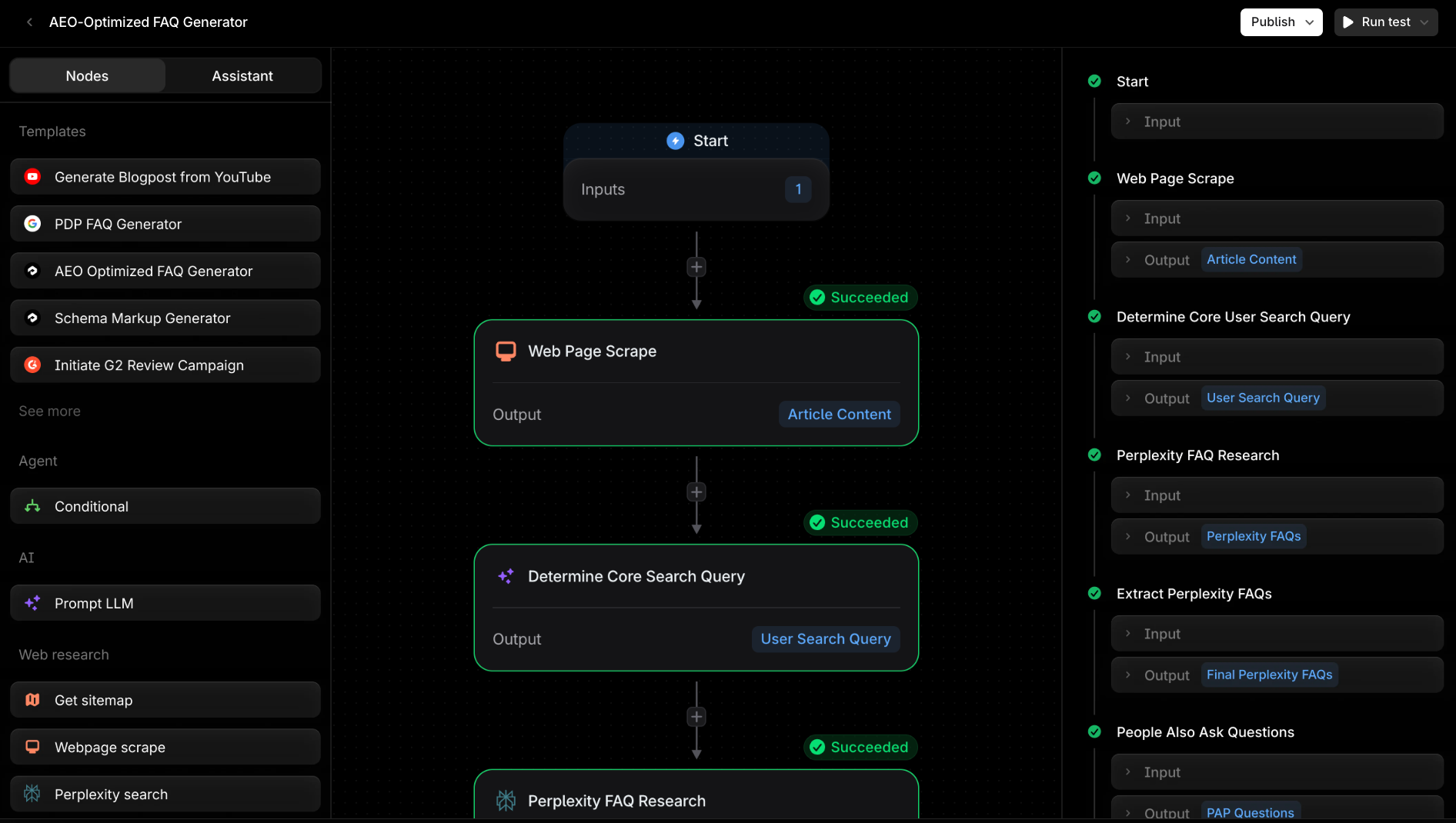
Profound Agents let marketing teams build automated AEO content workflows without engineering resources—from web scrape to Perplexity research to published FAQ, in a single drag-and-drop builder.
The part that separates this from any standalone content tool is what happens after something is published. Agent Analytics watches what AI crawlers do with the page through CDN-level integrations across Akamai, AWS, Cloudflare, Fastly, GCP, Vercel, Netlify, and WordPress. A page that gets picked up reinforces the pattern behind it. One that doesn't feeds back into the system too, and the next brief adjusts based on what AI engines reward or dismiss.
Hone ran that loop on a category where their citation share sat near zero. It grew 10x after implementing Profound, making Hone's domain the single most-cited source for the prompts most relevant to their business, with an 800% increase in visibility in their most critical product category. "Profound gave us both the data and the partnership we needed," said Linda Schwaber-Cohen, Hone's VP of Marketing. Zapier ran a narrower version of the same loop against competitor-related prompts specifically, using citation gaps to identify where they were losing ground and Agents to close it, and became the most-cited domain for those prompts, a 4x increase from where they started.
Adobe's Agentic Traffic and Referral Traffic dashboards show crawler activity in isolation. Nothing public connects that signal back into what LLM Optimizer recommends producing next. That's the main difference: one platform tells you what's broken, the other fixes it, watches what happened, and gets sharper with every run.
Profound vs. Adobe: The team behind your account
The tool a team buys is only part of the equation. An equally important consideration is who shows up after the contract is signed—whether there's someone who knows the account, understands the category, and treats a problem as their problem too, or whether support means a ticket queue and a knowledge base article that almost answers the question.
Adobe: Dedicated support, spread across a 15-product portfolio
Pros:
- Dedicated account teams and 24/7 global support, a well-resourced model backed by Adobe's broader enterprise services organization
- Structured onboarding and customer success programs built for companies operating at serious scale
- One account relationship can, in principle, cover commerce, content management, and AI visibility all at once
Cons:
- That team's attention spans 15+ products across five pillars (commerce, content management, data and analytics, marketing automation, work management), not AI visibility specifically
- LLM Optimizer has been generally available since October 2025, making it one of the newest, smaller pieces of a much larger book of business
- "Dedicated account team" and "dedicated AI-visibility expertise" are different claims, and Adobe's homepage only makes the first one
Buying AI visibility from a team whose expertise was built on commerce migrations and CMS rollouts is a gamble. Adobe's account teams have been managing implementations of AEM, Workfront, Adobe Commerce, and Customer Journey Analytics for years. LLM Optimizer arrived in October 2025. The same person who spent the last three years helping an enterprise migrate its content management infrastructure didn't spend those years learning how answer engines decide which brands to cite, what content structures earn citations, or how to read a citation gap analysis. That expertise takes time to build, and Adobe hasn't had it.
What this looks like in practice is harder to see from the outside than from inside an account. Adobe’s support tier is there; the account team exists. But an account team managing fifteen products across five pillars is making constant decisions about where their attention goes, and a product that's been generally available for eight months, in a category that didn't exist three years ago, is competing for that attention against products with larger install bases, longer renewal cycles, and more established escalation paths.
When something goes wrong with LLM Optimizer, the person who picks up is likely fielding questions about Adobe Analytics, Adobe Commerce, and whatever else is live on that account. Whether any of them can actually answer the question is something Adobe's marketing page can't tell a buyer.
Profound: A dedicated team that’s invested in your success
Pros:
- Every account comes with a dedicated AI strategist and engagement manager, Slack support, and access to Profound University for self-paced education
- ~$155M raised from Sequoia, Kleiner Perkins, NVIDIA Ventures, and Khosla Ventures, including a $96M Series C at a $1B valuation, funds the team and the roadmap directly behind what a customer is buying
- SOC 2 Type II certified and HIPAA compliant, with SSO via SAML/OIDC, role-based access control, AES-256 encryption at rest, and automated daily backups
- #1 on G2 for AEO with 300+ reviews; G2 Winter 2026 AEO Leader; trusted by Target, Walmart, Figma, MongoDB, U.S. Bank, and 700+ enterprise brands
Cons:
- A fast-growing company serving 700+ accounts with a team of roughly 150 people; that math requires its own prioritization, and Profound isn't exempt from the same attention tradeoffs it's criticizing in Adobe
Every Profound customer gets a dedicated AI strategist and engagement manager from day one, a named person whose job is that account. Slack support means questions don't sit in a ticketing system overnight, and Profound University gives teams a self-paced education layer so the people using the platform day-to-day aren't starting from zero.
Customers often describe working with Profound as a partnership. CRS's Head of Marketing explains how they “often consult with Profound's engineering teams and in-house Reddit strategist," and Kiteworks’ Senior Director of Search Content recalls how “our Customer Success Manager immediately got in touch to walk me through the Agents feature so we could start extracting value right away.”
Overall, Adobe runs a support model that works well for the product lines it has spent decades building expertise around. The difference here is the specificity of what that support is for. Adobe's account teams are managing AI visibility as one product among fifteen. Profound's are managing it as the only product—one they have extensive knowledge and expertise on.
Profound vs. Adobe: Final verdict
Every major suite vendor is going to keep doing versions of what Adobe just did. Whoever else owns a piece of the enterprise marketing stack will find its own way to fold AI visibility into infrastructure it already sells, because that's what a platform company does when a new category shows up next to its existing accounts. Adobe moved first and moved fast: Brand Visibility went from a Summit announcement to a documented, BYOCDN-ready edge feature in about two months.
Speed of announcement, though, is different from depth of execution. A bundle assembled across three companies in a single spring doesn't automatically produce measured data, a closed content loop, or a team whose entire expertise is the problem a customer is paying to solve. Those things take longer to develop than a product name, and they're what determines whether an AEO program yields results.
Profound has spent years building precisely those things: directly measured visibility data from 1.9B+ real user prompts, a content engine that closes the loop from citation gap to published page to crawler confirmation. That's what Target, Walmart, Figma, U.S. Bank, and 700+ other enterprise brands are running their AI visibility programs on today.
If you want to see what it looks like for your brand, your category, and your specific prompts, book a personalized demo and we'll walk through it together.
Profound vs Adobe LLM Optimizer Frequently Asked Questions (FAQs)
Can Profound run alongside Adobe Analytics or Adobe Experience Manager?
Yes. Profound integrates natively with Adobe Analytics, so switching AI-visibility vendors doesn't mean switching your attribution stack. Most enterprise teams running Adobe for content management or campaigns keep that infrastructure as-is and add Profound specifically for AI visibility and content production.
Does the Semrush acquisition close Adobe's prompt data gap?
It adds scale, not a different kind of data. Semrush's prompt database is built from clickstream and search-panel modeling, the same category of approach Adobe's own documentation describes for LLM Optimizer generally. A bigger modeled dataset is still a modeled dataset. That's an improvement over starting from nothing, but it isn't the same thing as direct measurement.
In contrast, Profound's Prompt Volumes dataset is built from 1.9B+ real conversations people have actually had with answer engines, growing by roughly 150 million a month. The practical consequence is that a team using Profound can see that a specific question about their product category generates high conversation volume among a specific audience and build content strategy around that signal. A team using Semrush's database can see that a search-adjacent topic appears frequently in AI responses. Only one of those tells you what's driving real AI demand.
How does Profound's content workflow compare to Adobe's Opportunities dashboard?
Adobe's Opportunities dashboard correctly identifies what's broken, e.g., a missing FAQ page, a thin product summary, a video transcript an AI agent can't read. That's a useful diagnostic layer, but it doesn't fix any of it. Each opportunity surfaces a single scoped recommendation, deployed with one click, with no generative production on the other side. Profound Agents take the gap and close it, with a drag-and-drop builder running on 16+ reasoning models that drafts the missing content, optimizes the structure, and tracks whether AI crawlers pick it up after publication, feeding that signal back into the next cycle.