
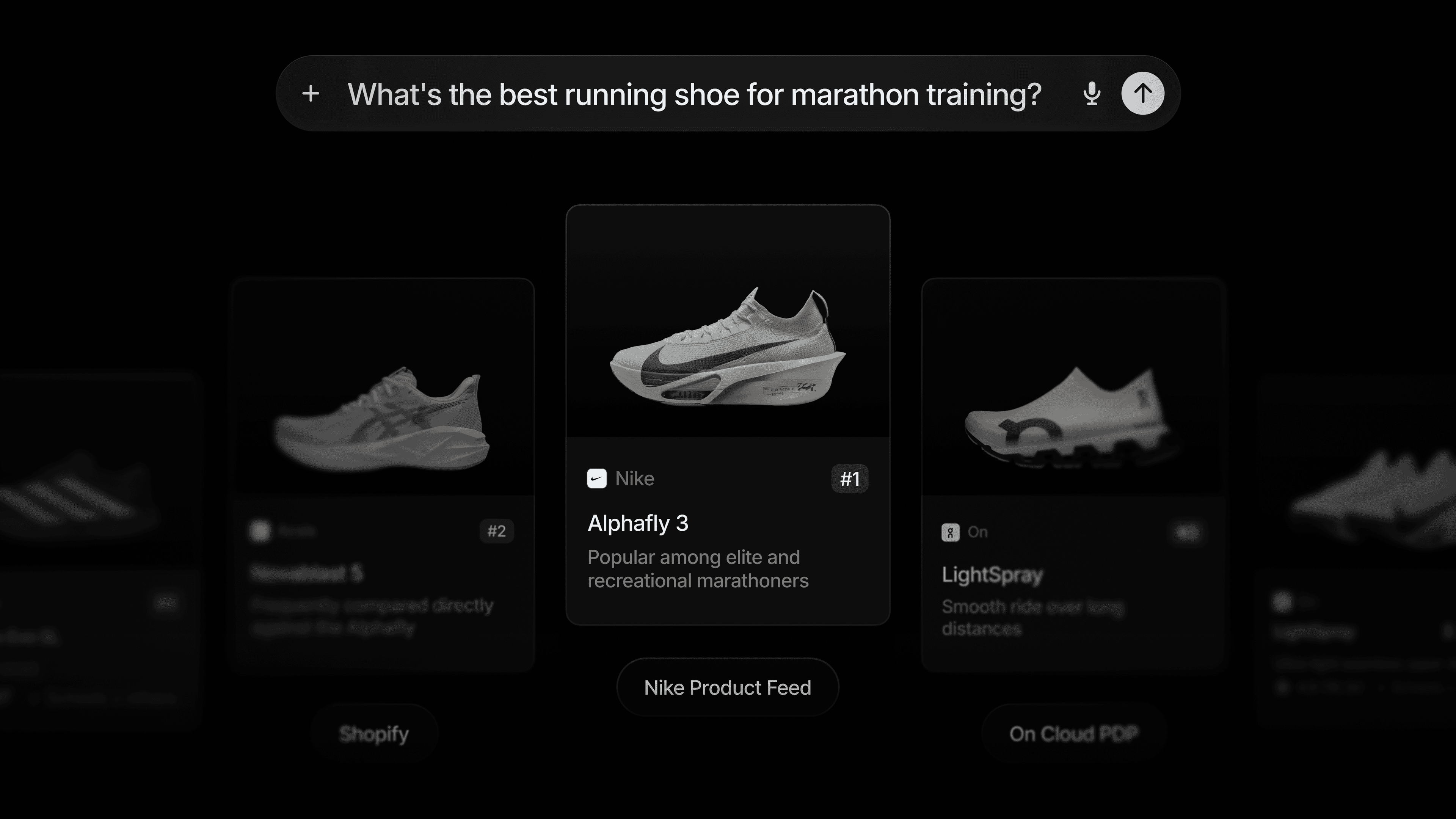
How users shop online has transformed in recent years, from discovery to comparison to purchase, and this behavior change can largely be attributed to AI Shopping. When a user asks ChatGPT a question and shopping mode is triggered, typically 3 to 5 products are ranked and recommended in carousel format, supplemented with respective product attributes. We tracked ~1,000,000 shopping product offers in ChatGPT over 30 days. Here’s what we found:
- ChatGPT is increasingly relying on Product Feeds. Since inception of tracking in late November last year, product feed retrieval share has risen every month, climbing from 4.3% to ~20% of all shopping retrievals in the last 6 weeks. Brands without product feed integration risk becoming invisible to ChatGPT shoppers.
- Product Feeds are king for performance. Of all product citations derived from direct product feeds, ~99.9% of them appear as the first product offer. It seems apparent that presenting more comprehensive, structured metadata through product feeds plays a big part in how you achieve top shopping rank.
- But ChatGPT still pulls from PDPs much more frequently. 88.29% of all product offer instances are derived from web PDPs during our month-long snapshot. Even for merchants that have already integrated their product feeds with ChatGPT, 75.81% of offers are still derived from web PDPs. Despite the stellar performance and increasing prevalence of product feed structuring, it would be remiss to ignore PDP optimization levers as a byproduct.
Owning the top product offers is imperative for merchants to ensure product exposure to end customers in this new age of shopping, with LLMs as the middleman. Additionally, customers are magnitudes more likely to click on and buy from top offers.
ChatGPT retrieves product offer metadata from two, very different sources
When shopping mode is triggered, ChatGPT retrieves product offer information from one of two sources:
1.) web crawl, frequently targeting product detail pages (PDPs).
2.) direct merchant product feeds, via partnership with ChatGPT.
Taking a deeper look, we find that ChatGPT obtains very different sets of product information depending on which retrieval source it utilizes. We note the most significant differences:
For those not familiar, the Best Price GPT tag is an machine-determined label assigned to products with the lowest price among all prices GPT has access to for that unique product. The tag is not explicitly defined by the merchant; instead, it’s based on available pricing data and may not reflect every retailer or real-time pricing changes immediately.
So ChatGPT sees completely different sets of information depending on if it uses a product feed or PDP. What about the exact merchants that supply this data?
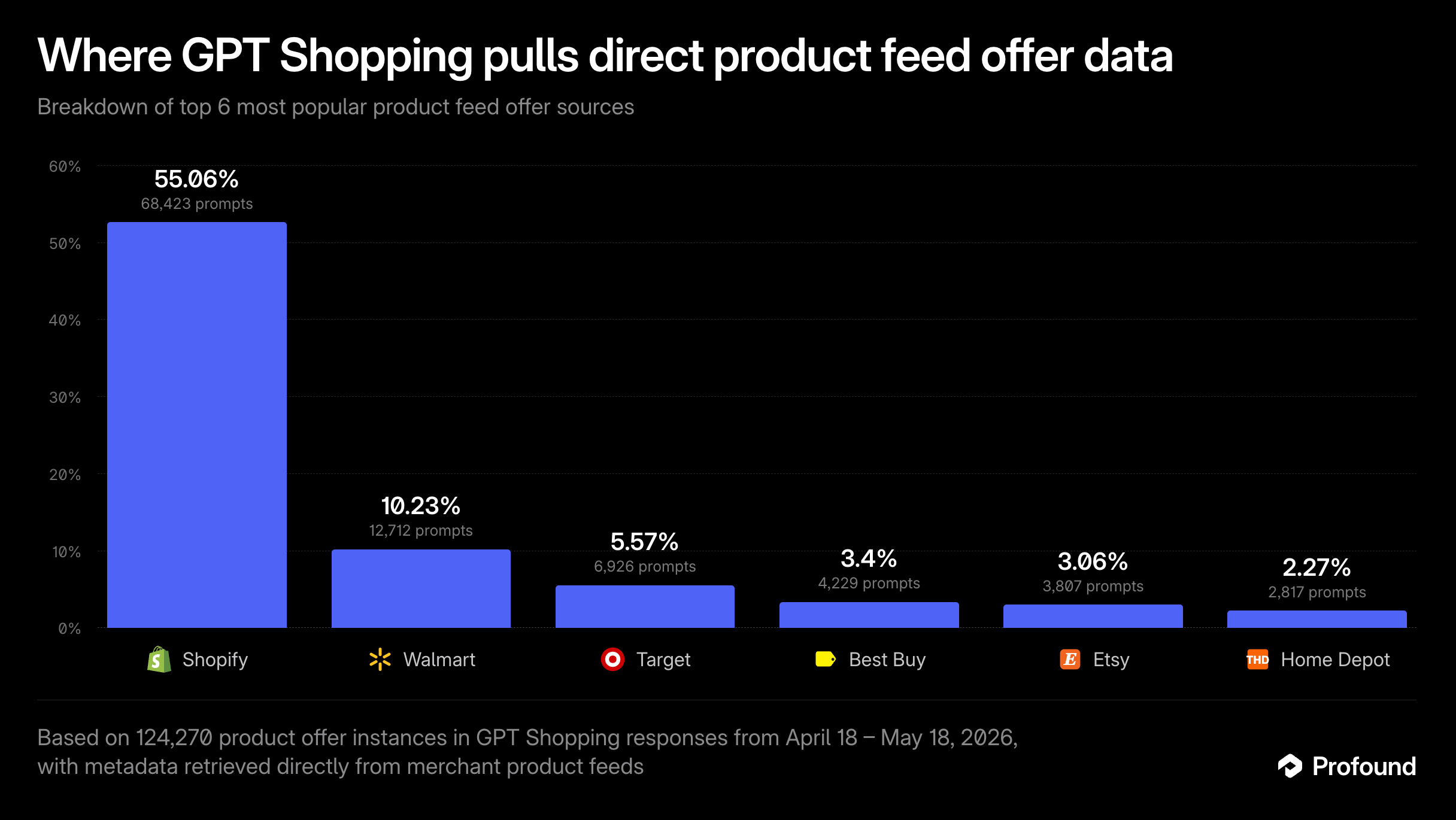
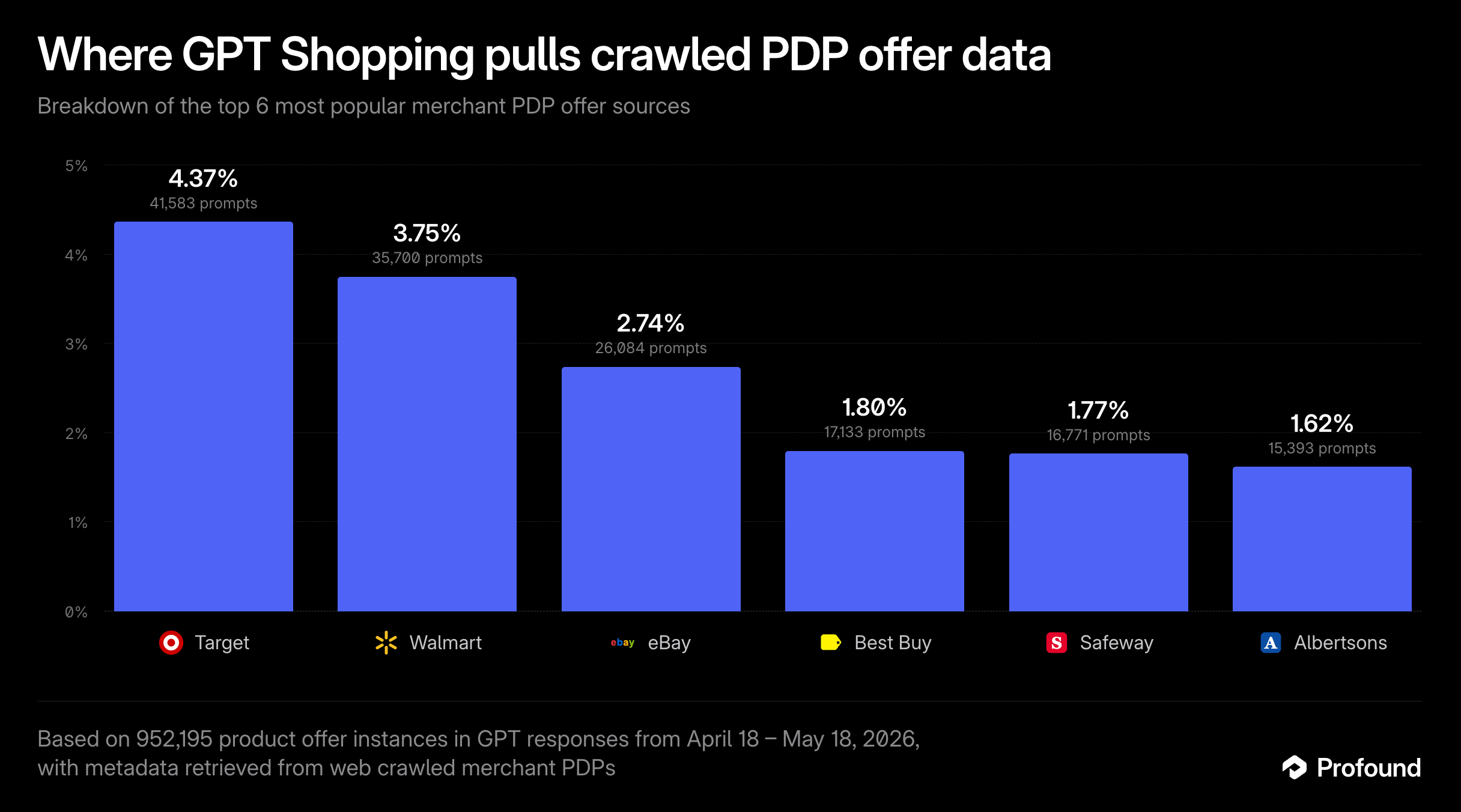
Product feed offers rely significantly more on Shopify storefronts, indicating the value of their active partnership with OpenAI for product discovery integration. On the other hand, PDP offers are much more evenly distributed among big-box retailers.
So far, we have discovered what ChatGPT reads about a product is remarkably different depending on retrieval source. However, when aggregating and deciding which product offers appear first, ChatGPT does not care how metadata is retrieved. We seek to explicitly answer “Does either PDP or Product Feed retrieval translate to higher product offer rank?”
When PDPs are important and when Product Feeds are important
We compared 406,639 product offers in top position against 659,868 product offers in the bottom two positions to extract differences in high and low-performing placements.
Direct product feed retrieval achieves overwhelmingly better offer rank performance, with practically all respective citations in rank 1 position across >100k instances over a month-long period.
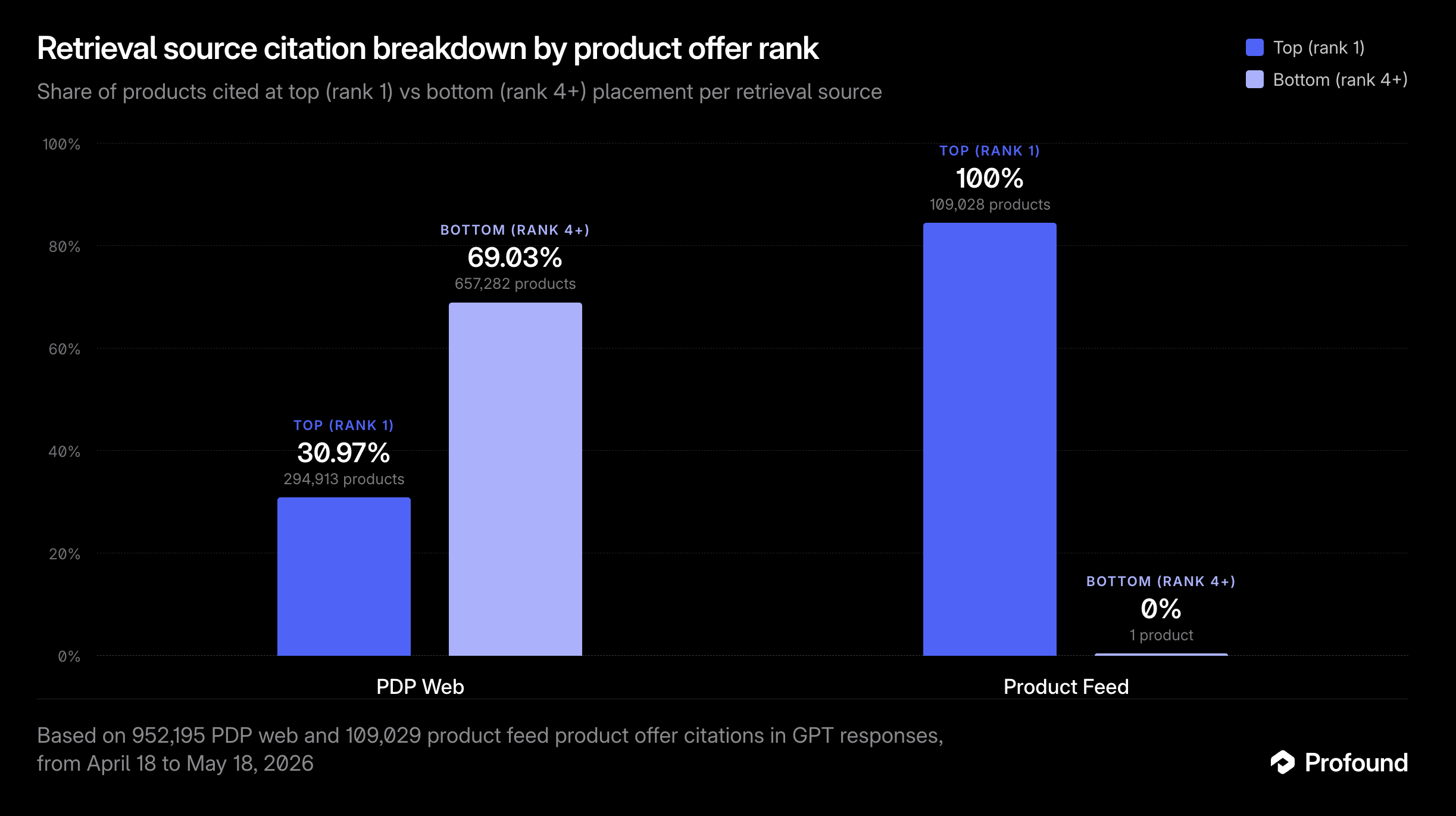
But for raw count of all mentions, ~88% of offers are derived from PDPs. This also applies across 150 unique merchants who have already integrated their product feeds with ChatGPT, at a lower but still significant ~76%. This demonstrates the importance of PDP optimizations from a prevalence angle.
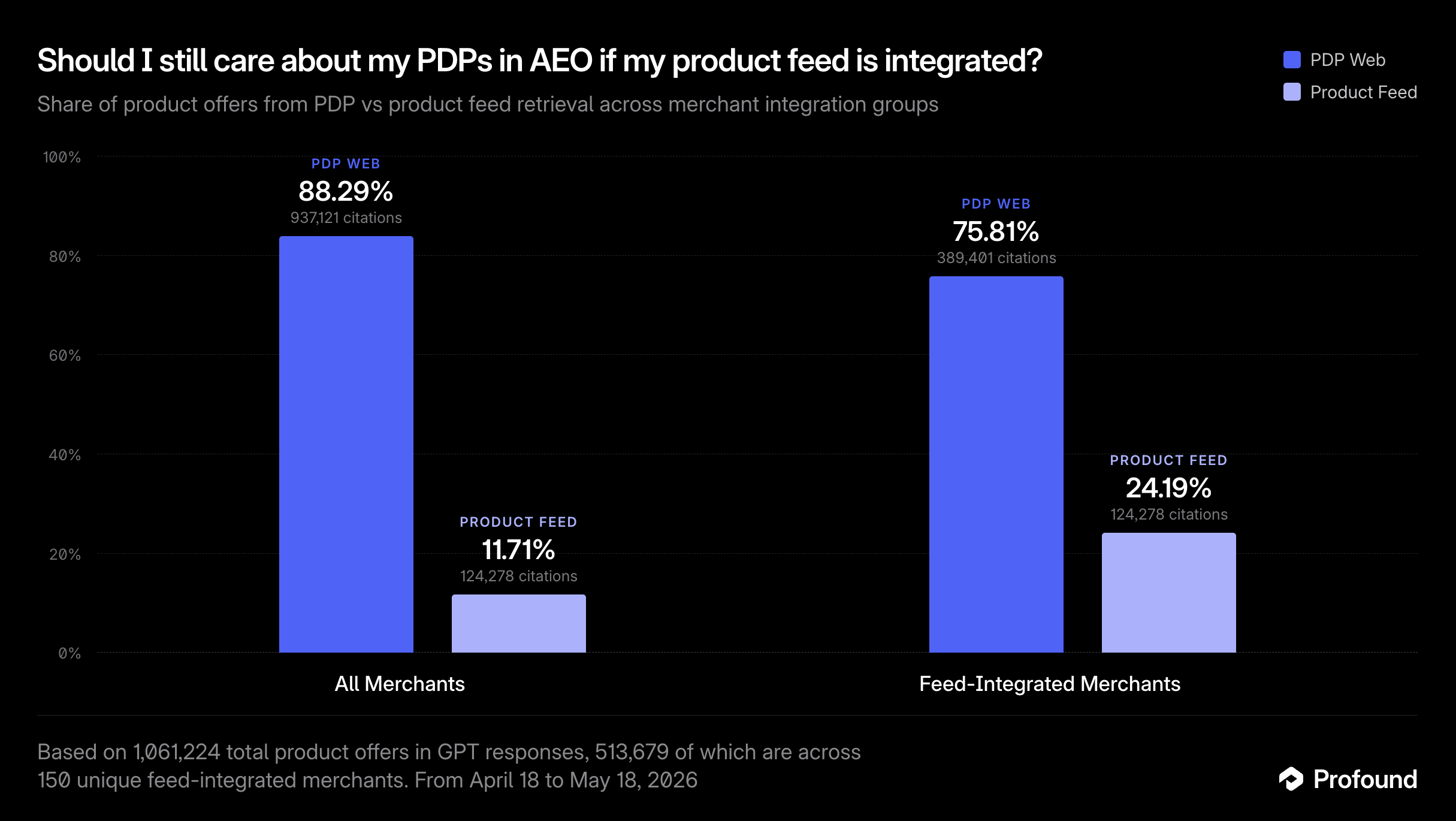
Having identified the sustained importance of PDPs, we identify the exact optimization levers for PDPs by isolating offers from that singular retrieval source.
What happens when we isolate PDP-based offers
We now compare 294,913 rank 1 product offers against 657,282 rank 4+ product offers to answer, “What pieces of information differentiate top from bottom cited product offers?”
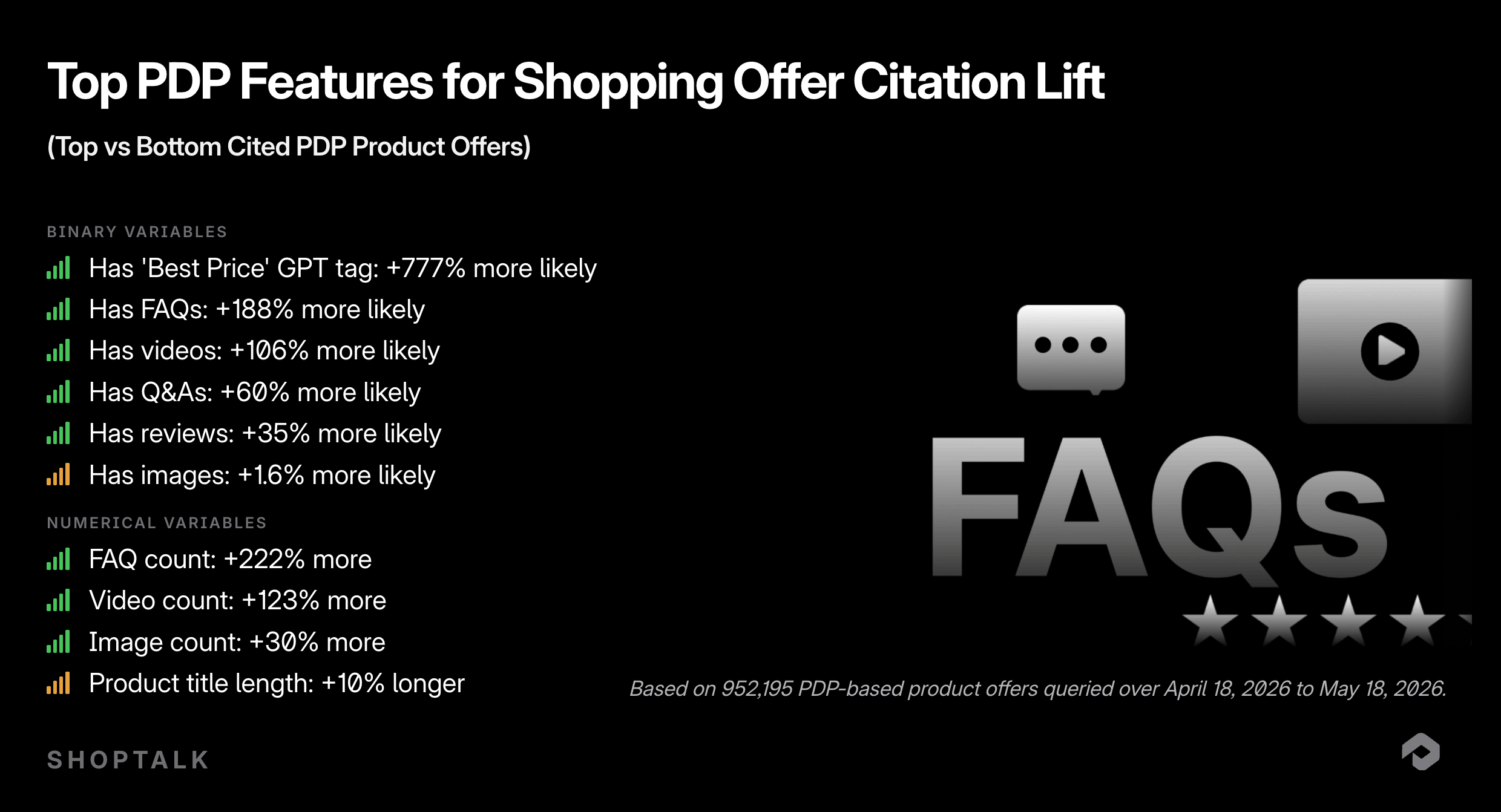
We split significant features into two categories. Numbers associated with binary variables represent the prevalence gap in feature presence, while numerical variables represent the gap in feature count or length. These are the top, general optimization levers for PDPs.
How ChatGPT product retrieval is changing in real time
To further contextualize our findings, we expand our look back beyond our 30 day snapshot to November 2025, when we started seeing retrieval source in ChatGPT network logs.
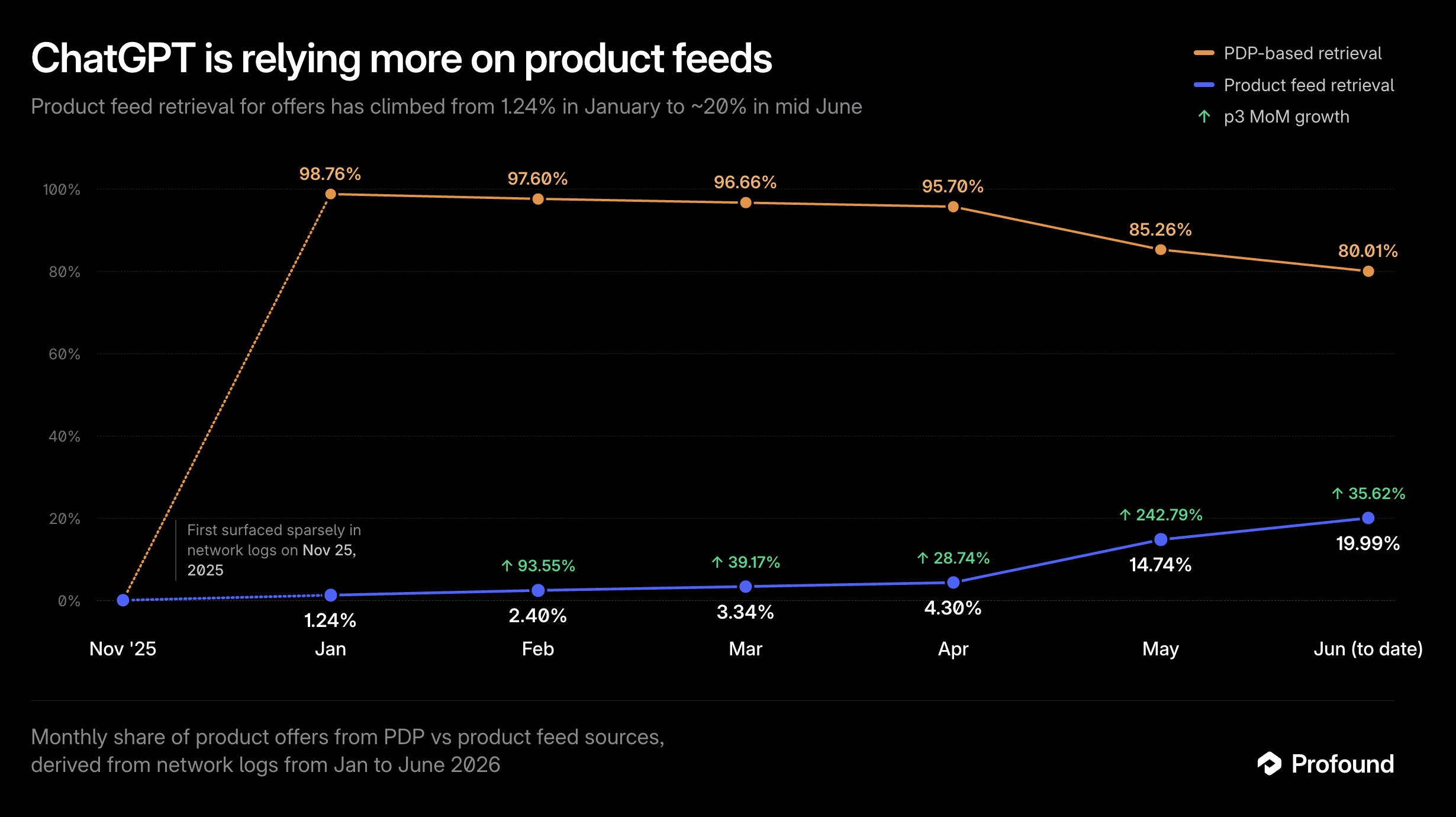
The rate ChatGPT retrieves information from product feeds for offers has grown by ~15x this year to 20%.
Traditionally, retrieval through PDPs involves web search on platforms like Google Shopping. Product feed retrieval bypasses this step by linking merchants’ entire product databases directly with OpenAI. With the increase of product feed retrieval, reliance on said platforms for offer retrieval also decreases.
The machine is relying more and more on product feeds. Your brand becomes increasingly absent to end customers if you’re not integrated.
What this means for your brand
Offer citation performance in ChatGPT shopping can be driven through product feed integration and tuning PDP optimization levers.
ChatGPT sees different information about your products depending on the retrieval mechanism it uses. The most important step change you can take is to integrate your direct merchant product feed with ChatGPT. This gives you more control over what ChatGPT sees in shopping mode, versus web PDP search. The more comprehensive and structured product feed metadata overwhelmingly drives top citation rank performance.
Additionally, PDP-based shopping retrieval is still much more prevalent. As a result, it is worthwhile to optimize your PDPs, generally including these three levers:
- Maximize ‘best price’ tag chances: Monitor competitor merchants who sell the same products and ensure you have the lowest price when possible. Add wording throughout PDP suggesting best price or value.
- Build visible customer trust surfaces: Encourage descriptive, usage-based customer reviews, and embed FAQs, videos, Q&As, and images into your PDPs.
- Improve product naming: Make titles clear and descriptive, such as adding highly prevalent use cases and product features. Avoid being too niche.
In cases where merchants have integrated their product feeds and hope to understand product feed optimization levers, similarly to PDP levers above, please reach out to the Profound research team.
Methodology
1.) 30 day snapshot: ~1 million sample of shopping product offers across ChatGPT sessions. Top 1 and bottom 2 ranked offers only. Ran Firecrawl web scrape on ~6k cited product urls to obtain supplementary PDP features. Split analyzed product features into binary and numerical groups and performed respective p-value tests for statistical significance, adding an additional pass for non-negligible effect size for feature importance classification.
This 30 day snapshot data was used for understanding how retrieval source affects what ChatGPT reads and how that influences top-bottom offer rank performance. Across all citations, ~1 million product citations can be broken down into 406,639 citations in top and 659,868 in bottom positions. For PDP-only citations, this can be broken down into 294,913 citations in top and 657,282 citations in bottom positions.
2.) 8 month look back: ~548 million shopping product offers across all ChatGPT sessions that triggered shopping mode during this period. This dataset is unsampled and not limited to just top 1 and bottom 2 carousel ranking placements.
This 8 month look back data was used for visualizing to what extent ChatGPT has increasingly relied on product feed retrieval over this time period.
Results are observational at scale, representing a snapshot of data in time. June 2026.
Get started
Interested in seeing which optimization levers to prioritize across your PDPs and product feeds beyond the general case here or have any further questions? Prospective customers are encouraged to get a demo.


