
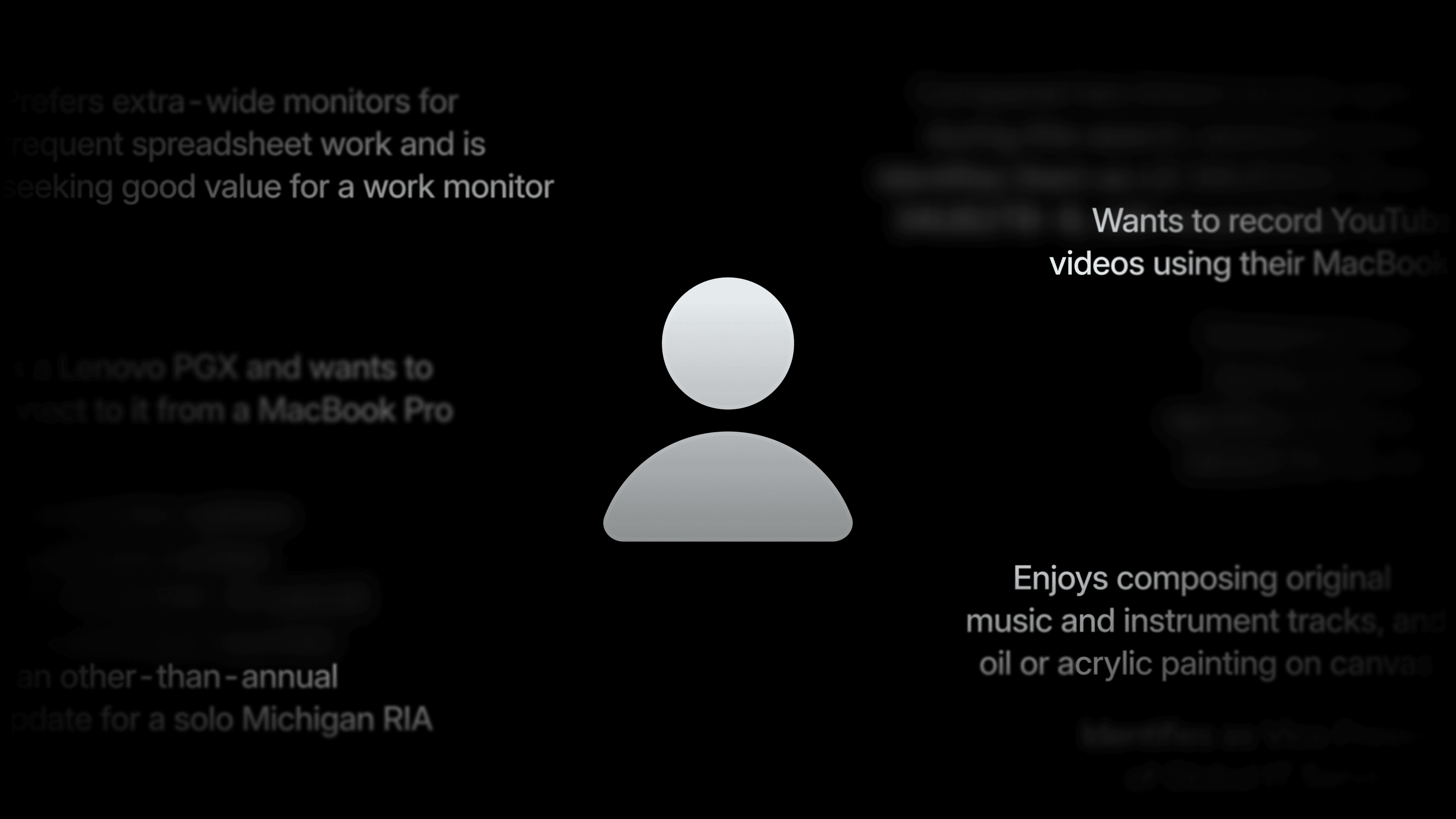
Personal agents like Muse and Instinct promise to understand users well enough to know what’s important to them and act on their behalf. They maintain detailed memories about users and might know things like a user’s favorite running shoe brand or that they’re trying to start a YouTube channel.
How does providing this kind of personal context to a large language model (LLM) change its responses and product recommendations?
We created seven synthetic users informed by real user conversations and web browsing activity. For each user, we built a memory file modeled on memory stored by Muse, capturing details such as products they already own, preferences, and ongoing projects. Each user’s memory was included as context alongside every prompt.
We ran 14 consumer electronics shopping prompts, such as “Recommend me a monitor for my desk,” on each synthetic user, as well as an eighth, empty persona that had no memory. Each prompt was run ten times per profile on both ChatGPT Instant (chat-latest) and Muse Spark (muse-spark-1.3), producing 2,240 answers.
Key findings
- Relevant personal context changes which products LLMs recommend. Recommendation lists for users with relevant context and users with no saved context had roughly half the overlap of repeated lists for the same user.
- Context can matter even without an explicit product preference. Details about someone’s work, activities, or existing equipment can inform the recommendations they receive.
- Personal context appears in query fanouts and recommendation explanations. LLMs incorporate user details into searches and can emphasize different benefits of the same product for different people.
- Brands should make it easy for LLMs to assess whether a product fits a user’s needs. Clear, accessible information about use cases, specifications, and compatibility helps LLMs make that connection.
The same prompt produces different recommendations for different people
We know LLM recommendations vary when the same user asks the same question multiple times. Across repeated answers, recommendation lists overlapped by about 42% for ChatGPT and 18% for Muse Spark.
However, when we compared answers for a user with relevant personal context against one without saved context, the overlap was roughly half as much for both models.
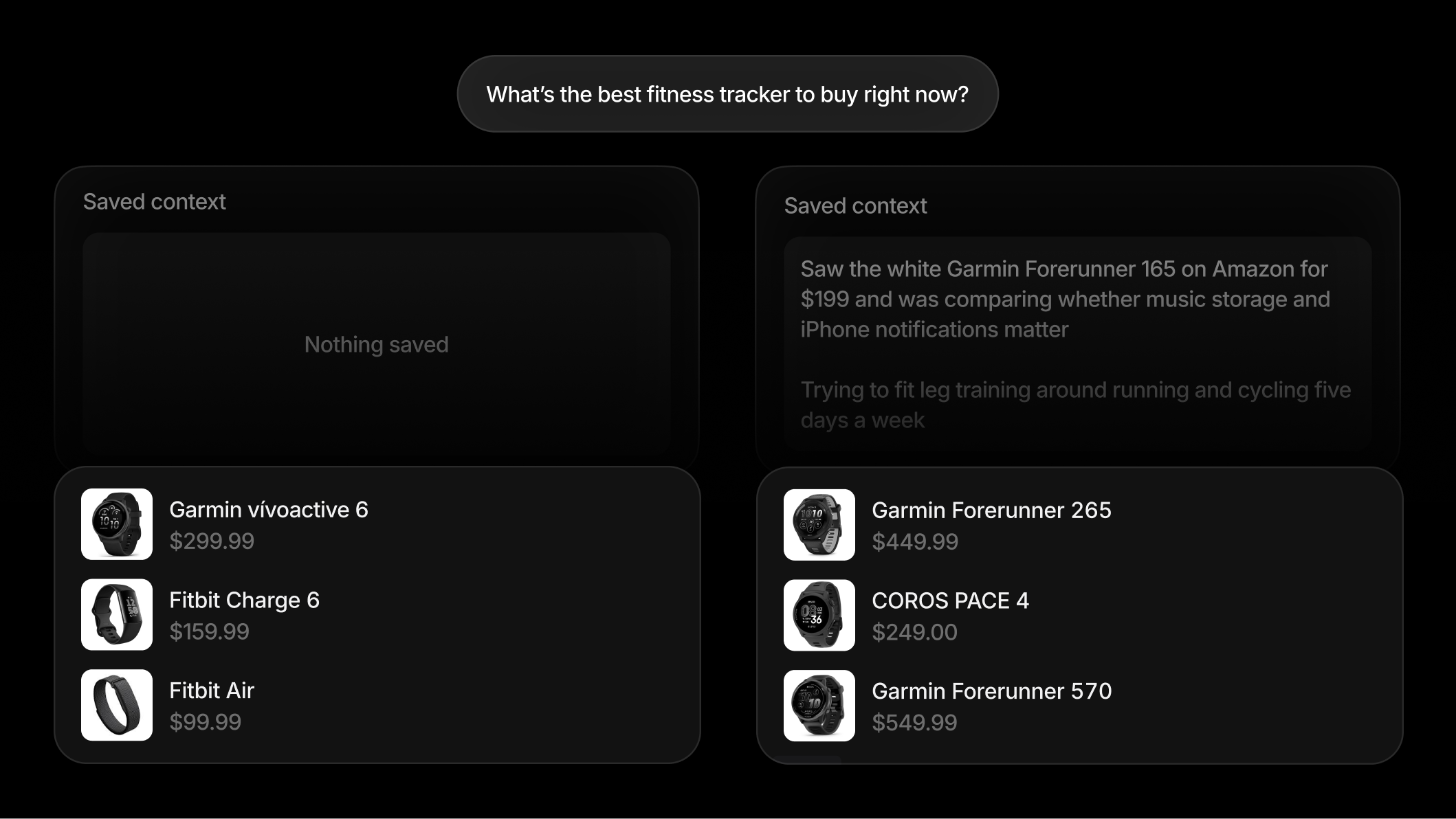
In some cases, the recommendation sets different users received were almost entirely different. For example, context on a user’s exercise routines and previous searches resulted in completely different fitness tracker recommendations than those given to a user with no saved context across several runs.
Even indirectly relevant context affects recommendations
Personal context can inform a recommendation even when someone has never stated a preference about the requested product. Let’s follow three of our synthetic profiles, whom we’ll call Casey, Riley, and Avery. These profiles are informed by real user conversations and browsing data, but the personal details and web activity they describe are synthetic. Excerpts from their memory files are shown below:
Casey
- Wants to record YouTube videos using their MacBook Air
- Working on an other-than-annual FormADV update for a solo Michigan RIA
Riley
- Identifies as Vice President of Global IT Services
- Has a Lenovo PGX and wants to connect to it from a MacBook Pro
- Enjoys composing original music and instrument tracks, and oil or acrylic painting on canvas
Avery
- Compared two linked monitor options during this search; assistant context identifies them as LG 34U530A-W and LG 34U62TB-B, with no purchase reported
- Prefers extra-wide monitors for frequent spreadsheet work and is seeking good value for a work monitor
We distinguish between context that directly concerns the requested product (which we call directly relevant) and context that could inform the choice indirectly (indirectly relevant). Here are examples for the same request: “Recommend me a monitor for my desk.”
Compared with recommendations made without personal context, recommendation lists differed most when the context was directly relevant to the requested product. Indirectly relevant context also changed the lists meaningfully, and unrelated context produced smaller differences.
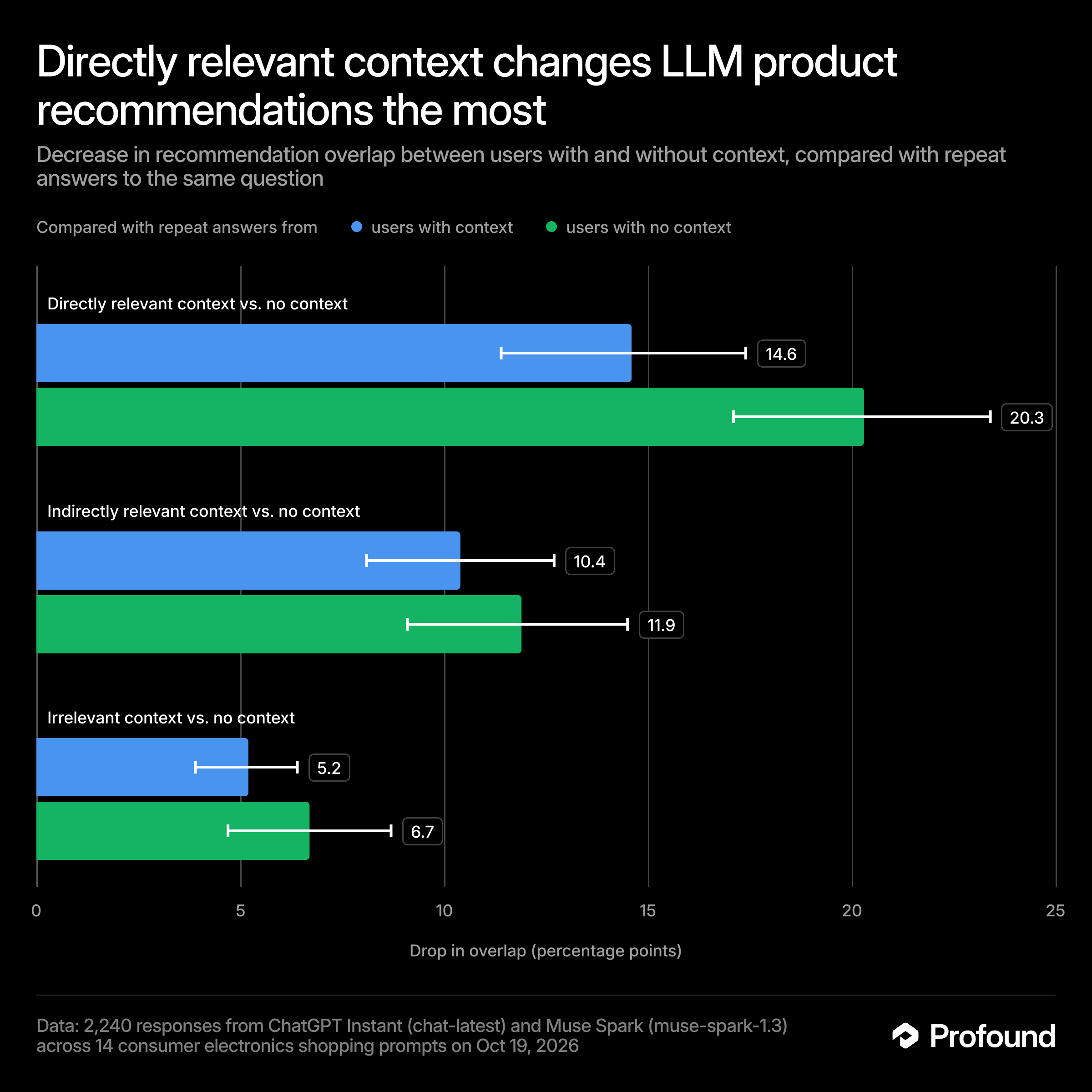
Even people whose context was equally relevant received different recommendations. Lists for different users within the same relevance category had less overlap than repeated lists for the same user.
This suggests that LLMs use context to work out which requirements might matter to a user. Riley never stated a monitor preference, but their existing computer setup gives the LLM a reason to consider compatibility.
Relevant context appears in query fanouts
The saved query fanouts show one way that personal context enters the recommendation process. When relevant context was available, 19% of ChatGPT’s search queries and 54% of Muse Spark’s search queries referenced some part of it.
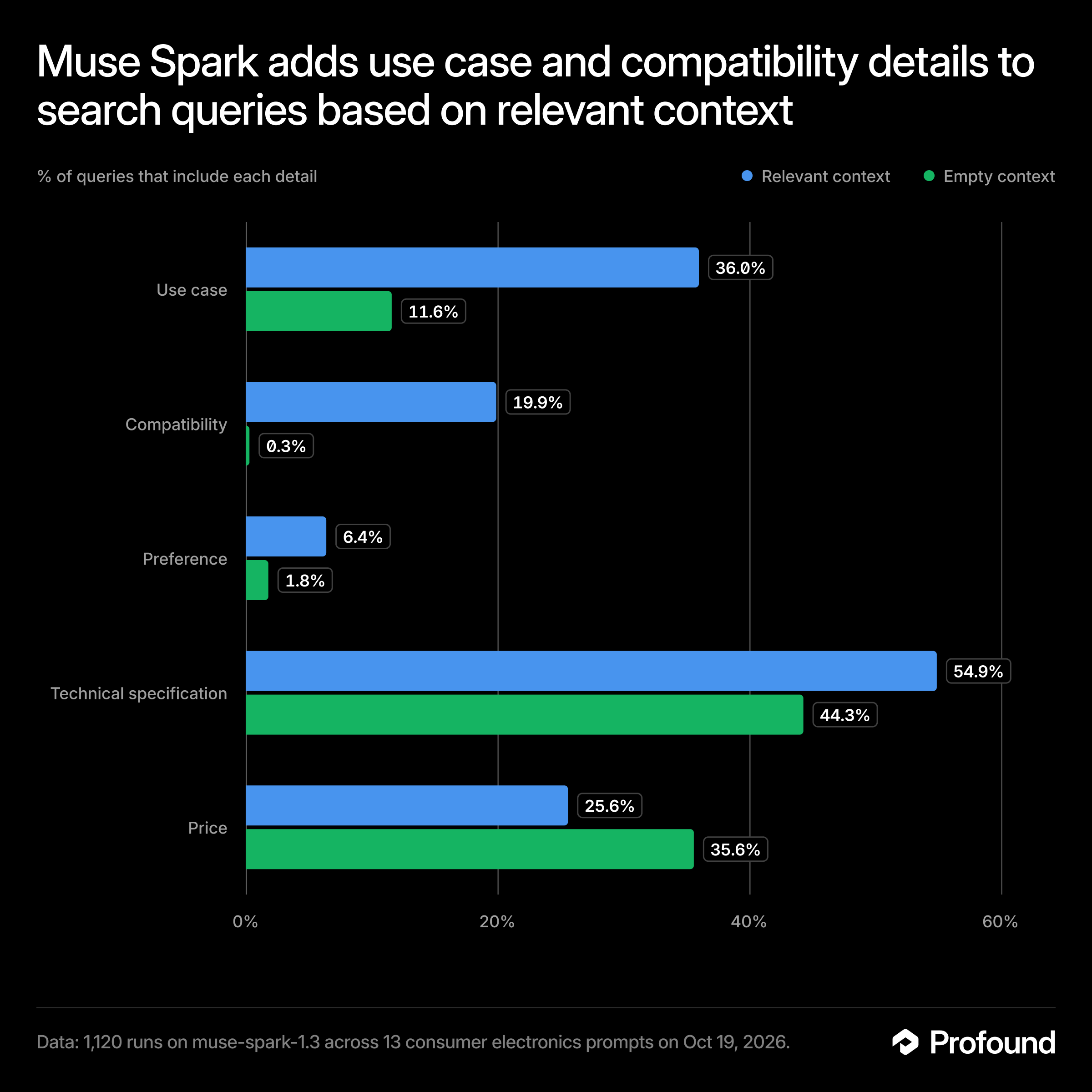
The models differed in how often their queries included particular kinds of detail. ChatGPT included technical specifications at similar rates with and without relevant context, but would change them to account for a user’s known preferences. For example, the table below shows query fanouts for monitors:
Muse Spark’s queries added compatibility requirements, intended uses, preferences, and technical specifications when relevant context was available.
As LLMs gain more personal context, we should expect more searches that combine a product category with a person’s specific requirements. For marketers, those combinations are useful questions to answer in product content. For instance, explain a microphone’s compatibility with different computers and what features it has to support different use cases so it shows up in response to specific search queries.
Muse Spark recommends fewer options with relevant context
Context impacted the size of the recommendation set. Muse Spark’s answers contained fewer recommended options when relevant context was available. Across the 13 prompts with both relevant-context and empty-memory answers, it named an average of 4.5 distinct options per answer with relevant context, compared with 6.5 without it. ChatGPT’s averages were nearly unchanged.
Muse Spark also cited fewer distinct web domains: 0.7 per answer with relevant context, compared with 1.4 without it. ChatGPT’s averages were closer, at 2.5 and 2.7 domains.
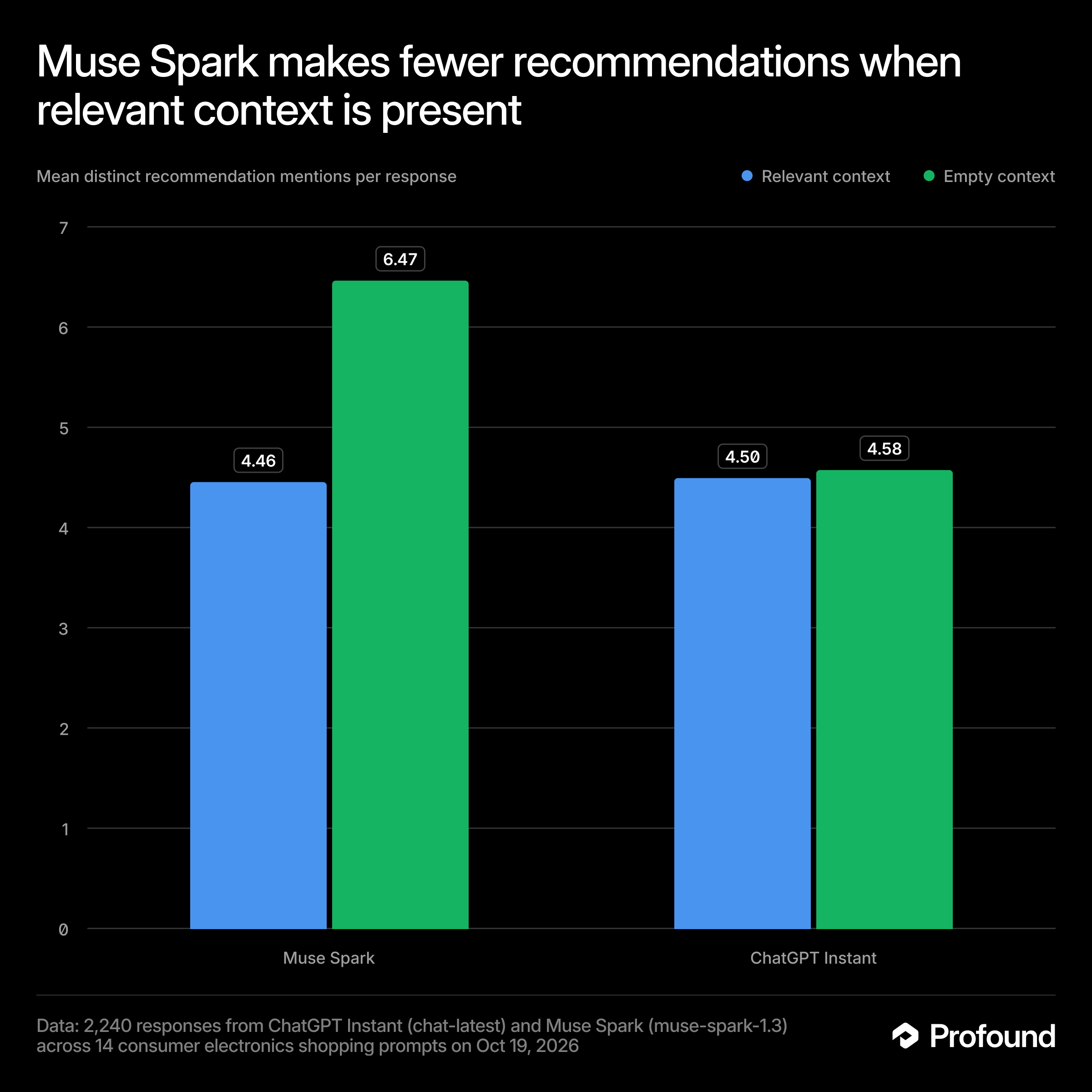
For brands, a shorter recommendation list means fewer opportunities to appear in an individual answer. This makes it especially important to explain where a product fits a user’s needs: what it works with, which uses it suits, and what tradeoffs it offers. Those details give assistants reasons to include a product when tailoring recommendations to a particular person.
When recommendations overlap, the same product can be recommended for different reasons
Personal context also shapes how LLMs explain their recommendations. When any relevant memory was available, ChatGPT referenced it in 88% of answers and Muse Spark in 83%.
Even when recommending the same Shure MV7+ microphone to different users, Muse Spark emphasized different benefits. It connected Casey’s video-recording plans to Mac compatibility and creator features. For Riley, it inferred a work-call use and emphasized wired operation and meeting controls.
These differences went beyond the variation in repeated answers for the same user. Comparing three explanations of the Shure MV7+ for each profile, we found that the average distance in meaning (via semantic similarity) between explanations for different users was 35% greater than between explanations for the same user. In two other instances where the same product was the primary recommendation to different users, the relative increase in distance was 22% and 6%.
For brands, this suggests making clear why a product suits a particular use or constraint, so an assistant can explain that connection.
What it means for brands
AI recommendations increasingly depend on the user behind the question. In our examples, the assistant considers what someone wants to do, what equipment they already own, and requirements inferred from those details.
For marketers, the practical implication is to make that fit easy to assess. Describe who a product suits, what it works with, and which specifications or tradeoffs matter for different uses. Specific, accessible information gives LLMs material they can use to match a product to a person and explain the recommendation.
Methodology
The dataset for this analysis comprises 2,240 answers from two LLMs, chat-latest and muse-spark-1.3, with web search enabled. chat-latest is the alias for ChatGPT Instant, and muse-spark-1.3 is part of the family of models that powers Meta’s personal agent, Muse.
We used 14 shopping prompts designed to elicit product recommendations, seven synthetic user profiles, and an empty-memory control. Prompts were chosen such that each prompt had users with relevant and irrelevant context. Each user-prompt-model combination was run ten times. Prompts were run on Oct 19, 2026.
Each user-prompt pairing has a relevance label:
- Directly relevant: Need or preference directly about the requested product.
- Indirectly relevant: Circumstances that could inform the recommendation.
- Irrelevant: Personal context judged unrelated to the request.
- Empty: no personal context present
To distinguish differences between user profiles from variation across repeated answers, we compared recommendation lists for the same prompt and model. We first calculated the average Jaccard similarity on named entities among repeated answers for each profile, establishing its repeat baseline. For each pair of profiles, we then calculated the overlap between their answers and subtracted each profile’s own baseline, producing two gaps. We averaged these gaps across user pairs within each prompt and model, then equally across models within each prompt, and finally equally across prompts.
To compare responses about the same product, we compared three explanations of the Shure MV7+ microphone for each of two selected profiles, using answers from the same model. We included only passages in which the microphone was the final personal recommendation. After masking product names, we used Qwen3-Embedding-8B to convert each passage into a numerical representation of its meaning. We calculated the average distance between explanations for different profiles and compared it with the average distance among repeated explanations for the same profile. We expressed the relative increase as the additional distance between profiles divided by the repeat baseline.
Get started
People are sharing more personal context with AI assistants, influencing which products those assistants recommend. Book a demo to see how Profound helps you understand and improve your brand’s visibility across AI search.


