

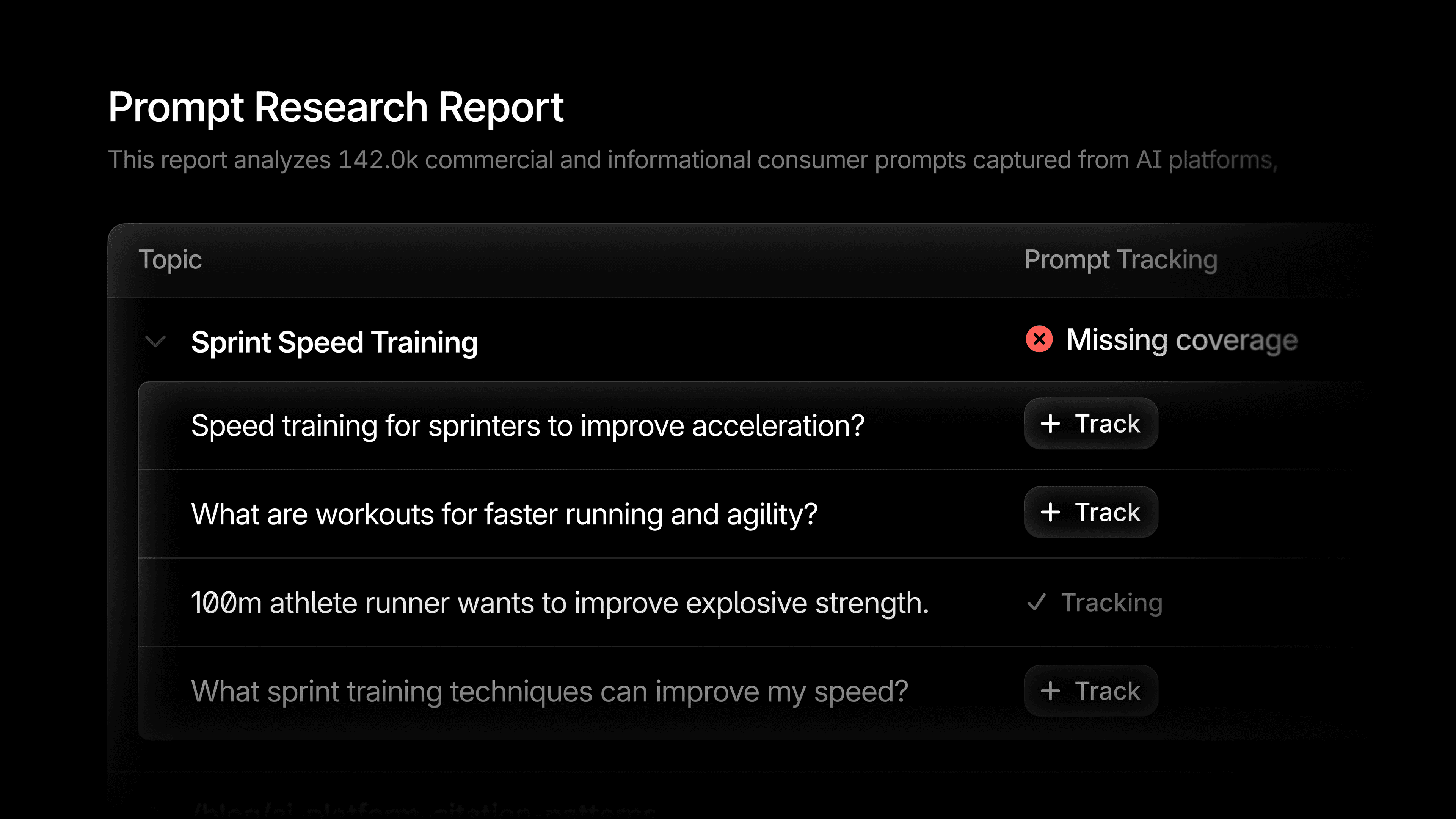
Deciding which prompts to track in AI Search has traditionally been part art and part guesswork. Most teams start from a list of SEO keywords, layer on some intuition about how buyers talk, and call it prompt list. The problem is that the list reflects what you think people are asking, not what they're actually asking.
Our Prompt Research Reports change that. We use Profound's proprietary dataset of 1.5+ billion real user prompts to surface exactly what people are asking, so your tracking configuration is built on real conversation data, not assumptions.
The pitfalls of traditional AI prompt tracking methodologies
Most teams piece together prompt lists from wherever they can. All of these are proxies. Profound's Prompt Research Report is the only approach that starts from real user prompts captured directly from AI platforms.
How Profound Prompt Research Reports work
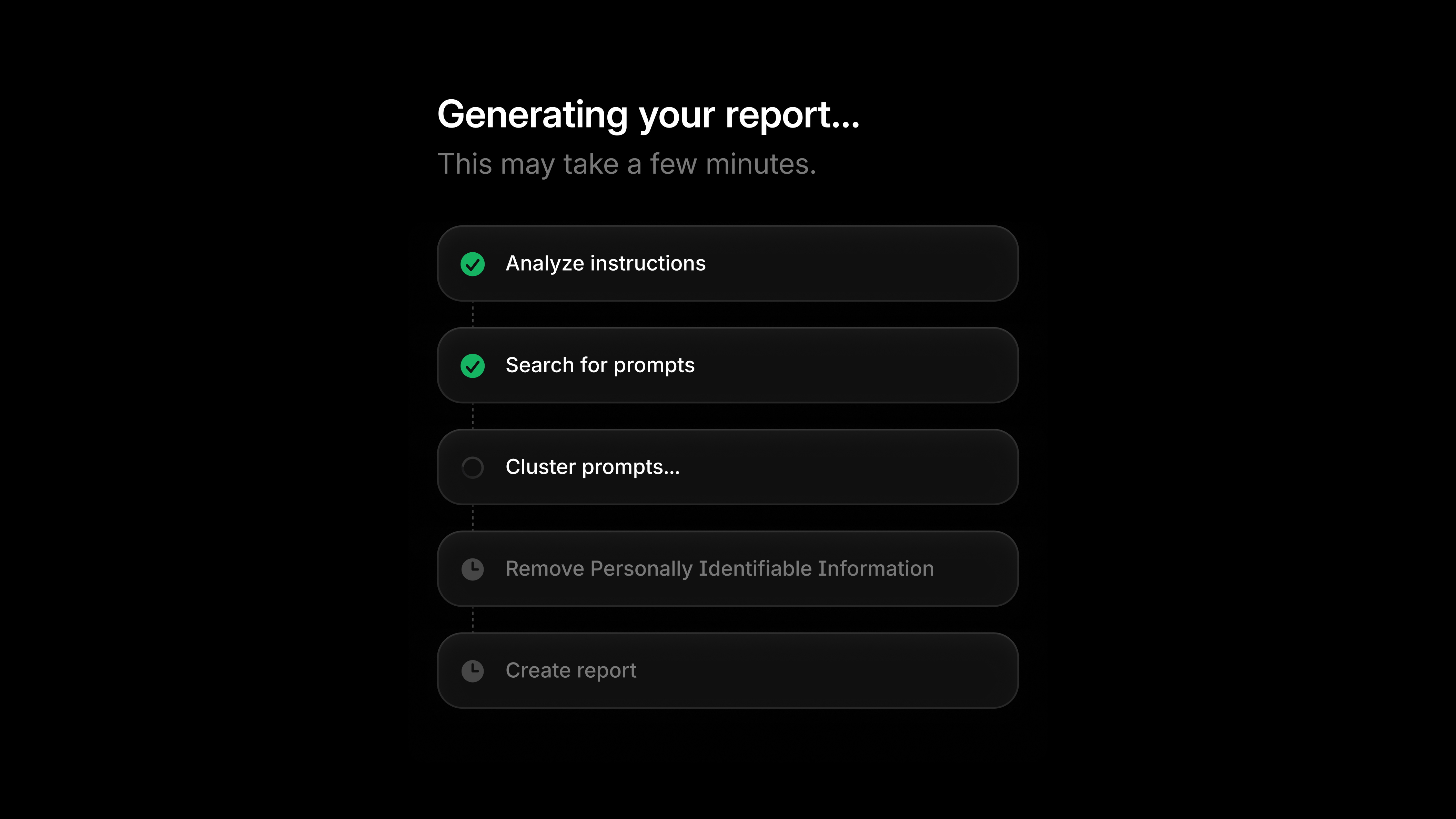
To create a report, your Profound team uploads key information about your brand, such as your category and the language/country you want to track in. You can also load in your existing set of Profound Topics you’re already tracking prompts for in Answer Engine Insights, if you want to expand the existing set.
From there, your Profound team adds keywords or topics most relevant to your brand (selected by you or pulled from your domain), and the report runs through a four-stage process:
Stage 1: Retrieving real-user prompts
First, using your input such as brands or topics, we run a semantic search to retrieve real user conversations about that topic over the last 6 months across answer engines like ChatGPT, Gemini, Perplexity, and Claude.
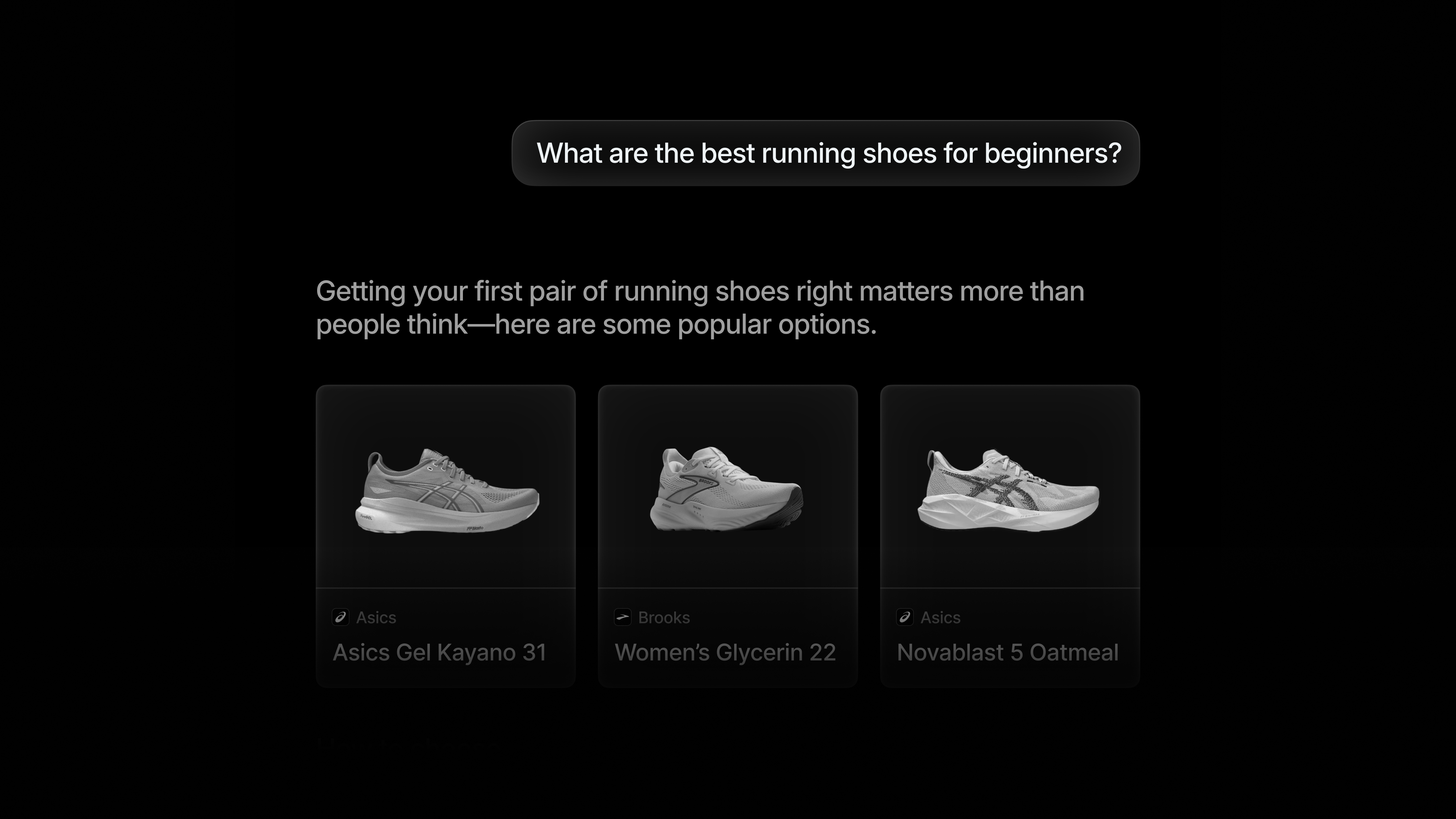
This goes beyond simple keyword matching and surfaces what people are actually asking. For example, if you enter “running shoes” along with Nike related topics, the system identifies whether users are asking about marathon training, the latest Nike release dates, or return policies for recently purchased shoes, not just “Nike” in the abstract.
Stage 2: Filtering and ranking
We then run those prompt “candidates” through multiple rounds of filtering and relevance scoring until only the most relevant, verified prompts remain.
This down-selected pool of most relevant prompts then runs through a proprietary ranking model that scores them to confirm true alignment with the keywords, removes near-duplicates, and translates any non-English prompts.
What comes out is a verified set of prompts that real users actually asked about your topics. Everything from "best Nike running shoes for marathons" to "are Nike and Jordan the same brand."
Stage 3: Clustering prompts and extracting topics
The verified prompts are clustered into meaningful topic groups, using original prompts' embeddings and corresponding query fan-outs, each named and summarized automatically.
Stage 4: Selecting the top prompts
Within each cluster, there may be many similar prompts. To identify the best representative, we rank prompts based on how much of the cluster they cover, effectively deduplicating overlapping variations. The top prompt is the one that best captures the widest set of similar user conversations, and is selected as the canonical prompt to track.
Features of a Prompt Research Report
What you get back is a Prompt Research Report organized around three views.
Inputs shows the topics and keywords that shaped the report, so you can review and refine your configuration for future runs.
Intent breaks down the analyzed dataset by prompt intent: informational, commercial, and transactional.
This tells you whether the conversation around your category skews toward learning and research or toward evaluation, which has direct implications for the content you need to create.
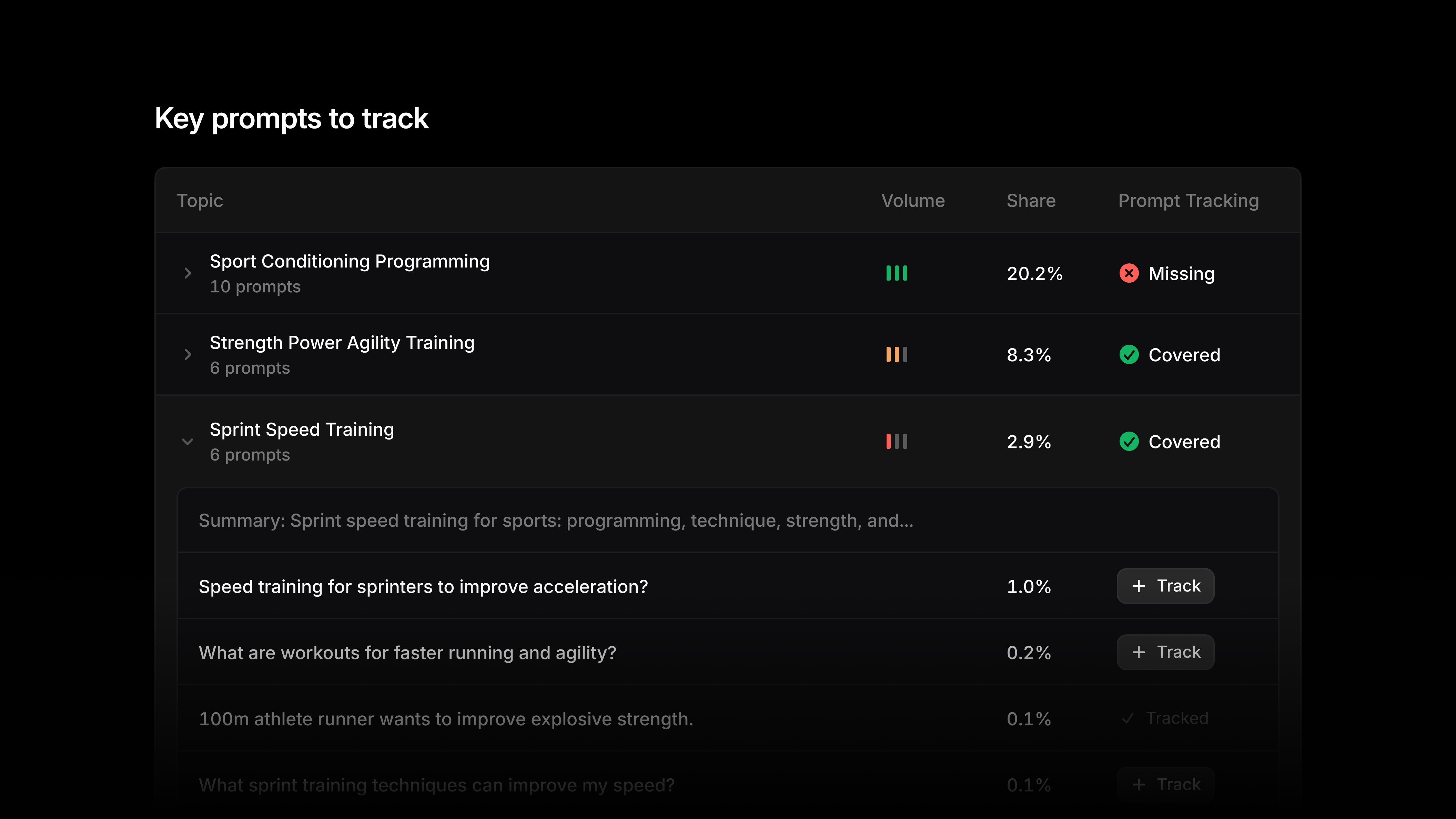
Prompts shows the topics Profound discovered, ranked by share of volume, with the specific prompt tracking recommendations for each. Each prompt carries a coverage score that tells you what percentage of real user conversations in that topic it represents.
A high coverage score means the prompt represents a large share of real user conversations. Low volume topics show you where conversation exists but may not be worth prioritizing.
Once you choose your desired prompts, you can add them to your Profound configuration directly from your report.
The work behind your report
Building visibility tracking on real user behavior sounds obvious. In practice, it is extremely difficult. This is because real user prompts are noisy, redundant, and varied in how they phrase the same underlying questions. Organizing millions of them into coherent, stable topics that hold up across repeated runs requires deep mathematical modeling.
Ask a general-purpose model to label a thousand prompts about Nike and it will call nearly every cluster "Nike," because that label technically fits everything.
Profound's Prompt Research tool has been engineered by some of the top data scientists in their field, and is built from scratch to find the distinctions within a topic, instead of one catch-all cluster. The result is a prompt configuration grounded in what people are actually asking, at each stage of the customer journey.
How brands benefit from Prompt Research Reports
Build your first prompt configuration from real data, not guesswork
If you're new to Profound, your Prompt Research Report gives you a data-backed starting point. Collaborate with your account team to align on keywords, review topics that surface, and build or enhance your prompt set together.
Spot the topics you are missing
For teams already tracking in Profound, your report shows you which topics or prompts in your category are covered and which are missing. With coverage status you can see at a glance where your configuration has blind spots.
Know whether your buyers are researching or ready to buy
Your Report’s breakdown tells you whether your category skews toward research, evaluation, or purchase intent. That shapes not just which prompts you track, but which content investments are most likely to improve your visibility where your buyers and potential customers are making decisions.
Get started
Our Prompt Research tool is currently available for all Enterprise customers for self-serve in the Prompt Volumes tab in Profound. Reach out to your account team if you have any questions about generating your customized report.
Our team is constantly shipping new features. Explore other product updates on our changelog.


