
McKinsey projects that by 2028, $750 billion in US revenue will flow through AI-powered search. The same research found that only 16% of brands are systematically tracking their AI search performance. The rift between those two numbers is where brands either win or lose the next decade of growth.
If you want to belong to the winning group, you need more than awareness. You need an AI visibility platform that gives you the best data, the tools to act on it, and a team that knows the space like the back of their hands.
Profound and AthenaHQ are two of the most visible platforms in the Answer Engine Optimization (AEO) space. Both track how your brand shows up in AI-generated answers. Both serve marketing teams trying to get ahead of the shift. But they approach the problem differently, and those differences matter a great deal depending on how far you want to go and how fast you want to get there.
This article compares Profound and AthenaHQ across six dimensions: data scale and quality, AI crawlability intelligence, content creation and workflows, resources and expertise, strategic support, and enterprise reputation.
Profound vs. AthenaHQ: Data scale and quality
Every decision you make in AEO, from which prompts to target to what content to prioritize, only yields results if the data informing it is strong. Profound and AthenaHQ take rather disparate approaches here, and the consequences are meaningful.
AthenaHQ: Estimation-based prompt data
At a glance
Pros:
- Tracks brand visibility, sentiment, and citations across 8+ LLMs
- Clean, accessible interface suited to teams new to AEO
Cons:
- Prompt volume data comes from a proprietary ML estimation model with no disclosed data source or methodology
- Credit-based system caps the volume of data you can collect by plan tier
AthenaHQ gives you a solid surface-level view of how your brand is performing across AI platforms. Visibility scores, citation tracking, sentiment analysis, competitor benchmarking—it's all there, presented in an interface that non-technical marketers can navigate without much onboarding.
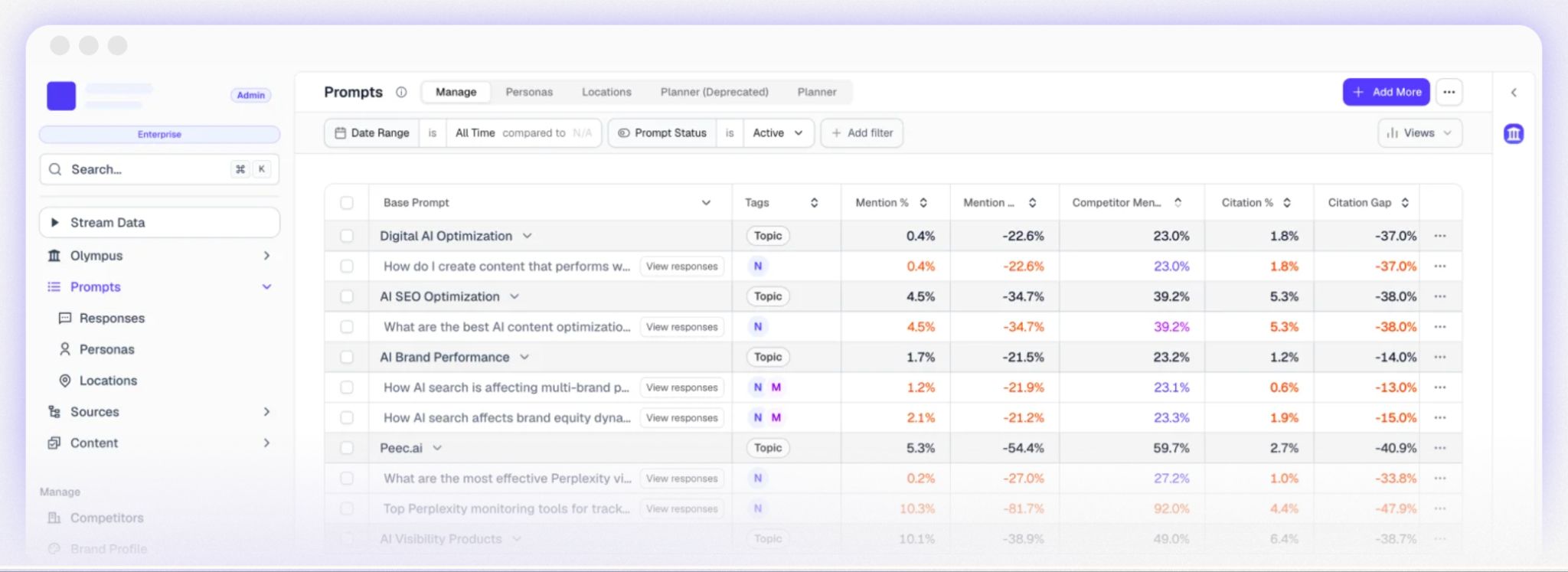
AthenaHQ tracks mention rate, competitor gaps, and citation performance by prompt—but with no volume data behind them.
The structural limitation is in how AthenaHQ determines which prompts are relevant. Its prompt volume estimates are generated by a proprietary ML model, but the platform doesn't disclose what that model is trained on, how large the underlying dataset is, or how its estimates compare to actual user behavior.
That's not a minor footnote. Content strategy built on unverified volume estimates is content strategy built on a guess—and enterprise teams allocating budget and headcount around those decisions need more than that.
The credit system compounds the issue. Every AI response consumes one credit, and plans are capped accordingly. As your prompt tracking grows, so does your credit burn. One agency reviewer touched on the friction this creates, explaining that for some of their smaller clients “who can't justify $300+/month” they had to “cobble together workarounds or leave money on the table by not offering GEO services."
Profound: The largest real user dataset in AEO
At a glance
Pros:
- 1.3B+ real user prompts, updated with 170M+ new queries monthly
- Intent and demographic breakdowns by age, income, and region
- Front-end browser prompting reflects what real users see
Cons:
- Deepest data access is available at higher plan tiers
Profound's data foundation isn't an estimation model. It's 1.3B+ real prompts from real user conversations with answer engines. It's the largest proprietary dataset in the AEO category, and it's what separates a strategy based on demand signals from one based on proxies.
With Prompt Volumes, you can see verified search frequency across all major answer engines, with each prompt broken down by intent and demographic factors including age, income, and region. You know not just which topics your audience is searching for in AI, but who is doing the searching and what they're trying to accomplish—the context you need to prioritize the right content, for the right audience, with confidence.
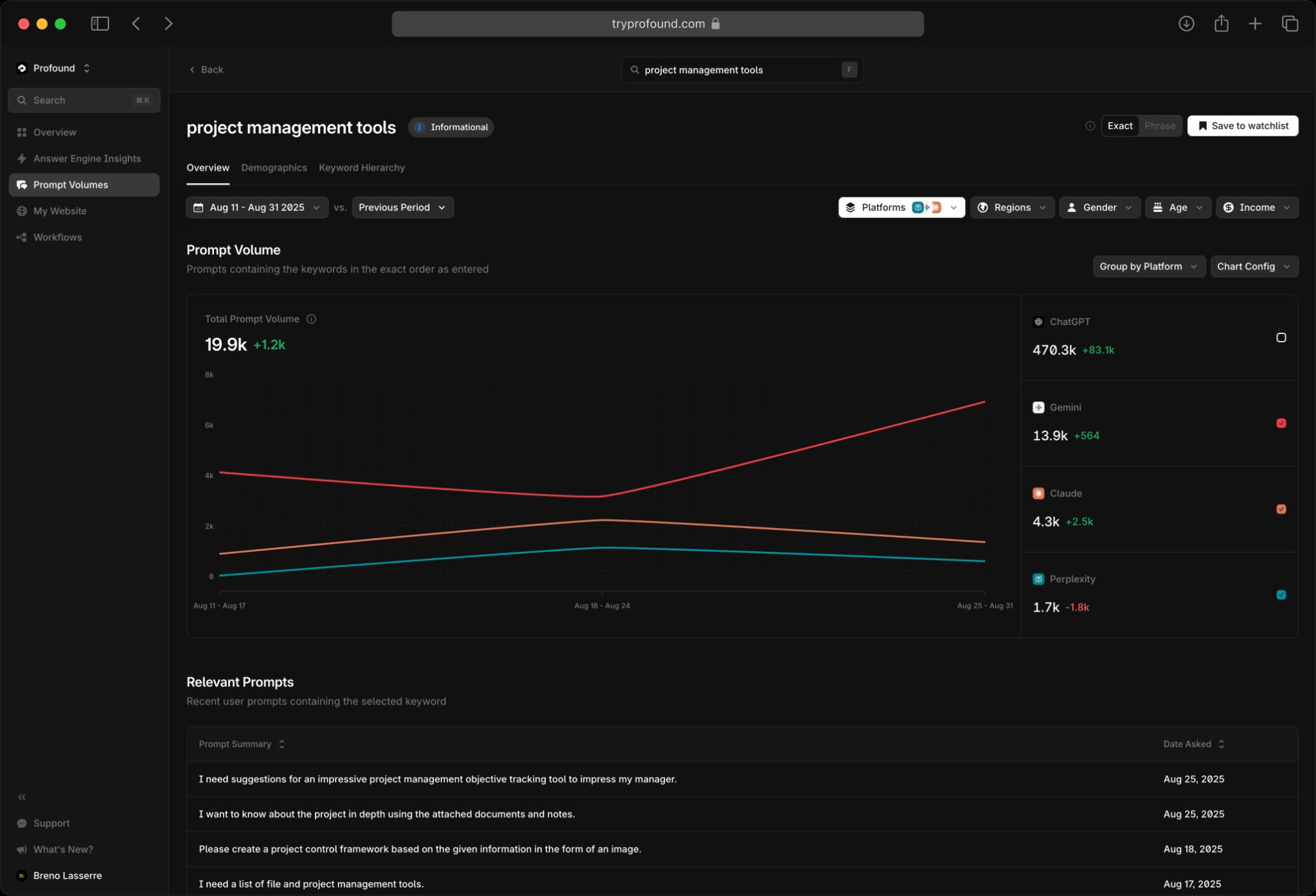
Profound's Prompt Volumes view shows not just that people are searching a topic, but how often and on which platforms—the context that makes prioritization defensible.
What makes the data reliable is how we access it. Profound runs prompts through the front-end browser interface of each answer engine daily, not through API calls. API responses frequently differ from what real users see in their actual sessions, so if your tracking is API-based, you're monitoring a different experience than the one your customers are having.
Our users often shower Profound's dataset with praise, with one reviewer noting that “the prompt volume feature is immensely helpful" and another explaining how it “allows me to research prompt topics and understand their importance and volume. It's great how it connects the dots between SEO keywords and AEO topics in a unique way."
Profound vs. AthenaHQ: AI crawlability data that proves ROI
Publishing AEO-optimized content is only useful if AI engines can find it, read it, and extract it. Both platforms provide insight into the infrastructure level, but they diverge in both depth and actionability.
AthenaHQ: Baseline crawler visibility
At a glance
Pros:
- Integrates with infrastructure providers including Vercel, Webflow, and Cloudflare to identify AI crawler activity
- GA4 integration connects AI referral traffic to site analytics
Cons:
- Crawler data and content recommendations operate as separate systems with no feedback loop between them
AthenaHQ does offer AI crawler tracking, and the concept is sound: by integrating with your CDN or hosting provider, the platform can identify when GPTBot, ClaudeBot, PerplexityBot, and others are accessing your site and which pages they're hitting.
The limitation is structural. AthenaHQ can tell you that a page isn't being crawled or cited. It can't tell you why—whether the problem is a rendering issue, slow server response, structured data gaps, or content that AI engines simply can't parse. The infrastructure-level diagnostic layer isn't there.
More importantly, Athena's crawler data and its content recommendations, surfaced through the Action Center, are separate systems that don't talk to each other. You're not getting a loop that says: this content was crawled, it was cited, here's what to do more of. The connections between crawler behavior, content performance, and business outcomes remain manual to assemble.
Profound: Crawler intelligence built for content teams
At a glance
Pros:
- CDN-level integrations with Cloudflare, Akamai, AWS CloudFront, Fastly, Netlify, Vercel, and more
- Identifies which AI crawlers visit your site, how often, and which pages they retrieve
- Distinguishes real AI bots from spoofed crawlers for accurate reporting
- Crawler data feeds directly into content recommendations to create a closed optimization loop
- GA4 integration connects crawler activity to human referral traffic
Cons:
- Requires CDN or server-level integration to set up, which involves an engineering step
Profound's Agent Analytics picks up where AthenaHQ stops. Yes, it tracks which AI crawlers are visiting your site and which pages they're accessing in real-time. But the more valuable layer is everything that comes after that.
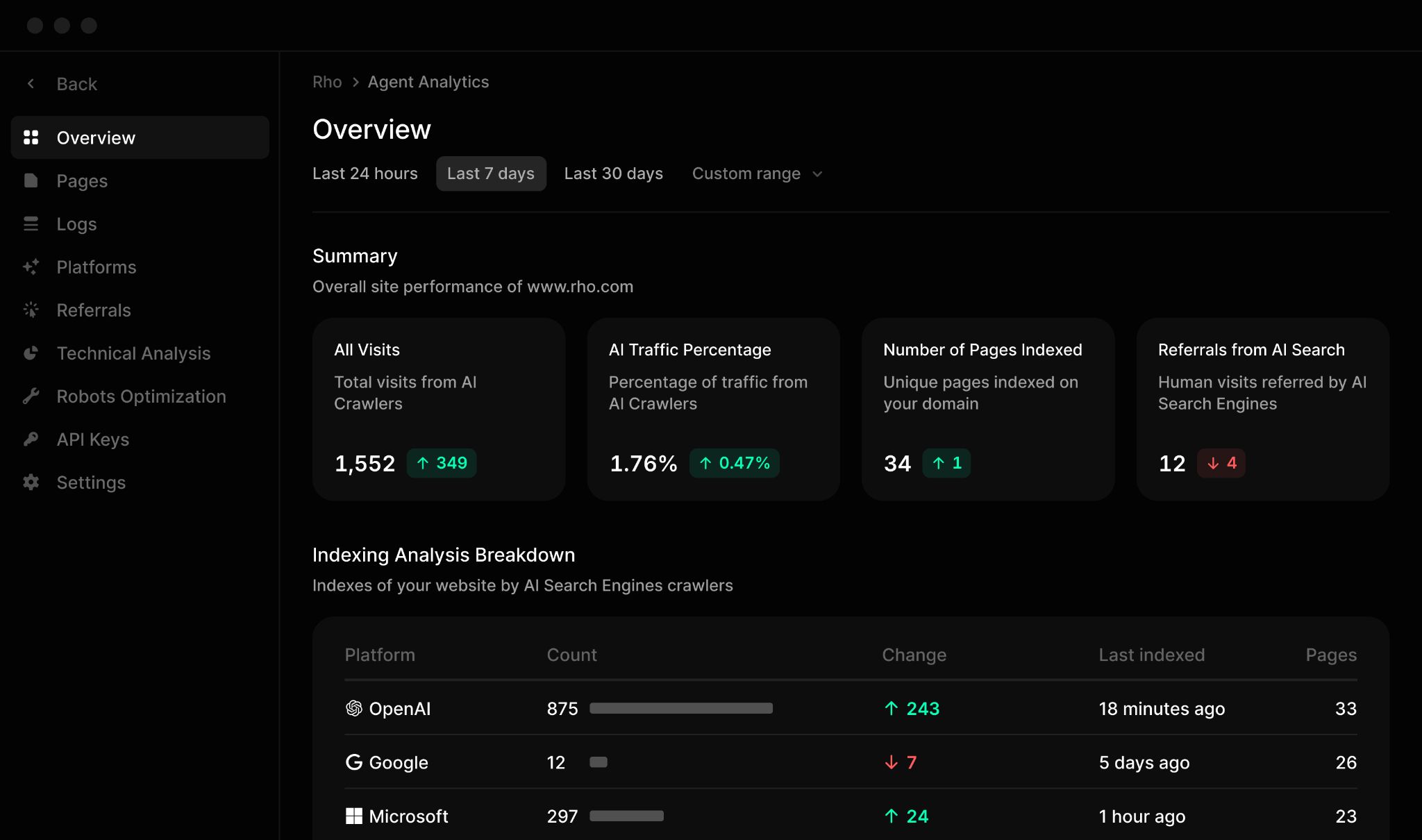
Profound's Agent Analytics breaks crawler activity down by platform and recency, so you're not guessing which AI systems are indexing your content.
Every page on your site gets a content effectiveness score based on the factors that determine whether AI systems cite it, such as readability, structured data, and content depth. When pages aren't getting picked up, Profound diagnoses why: rendering issues, slow server response times, caching problems. When new content goes live, you can push it directly to AI crawlers rather than waiting for them to find it.
All of that feeds back into page-level content recommendations grounded in crawler behavior and citation data, closing the loop between technical performance and content strategy in a way AthenaHQ's architecture doesn't.
Profound vs. AthenaHQ: Content creation and workflows
Visibility data is only useful if you can act on it. In this context, “acting on it” means creating and optimizing content consistently, at scale, and in a way that's informed by what answer engines want to cite. Both platforms have moved into content execution territory, but the depth of what they offer is far from similar.
AthenaHQ: Prescriptive recommendations without a production pipeline
At a glance
Pros:
- Action Center surfaces specific, prioritized content recommendations
- Enterprise plans add a Content Optimization AI Agent with Deep Research and the Athena Citation Engine (ACE)
Cons:
- Optimization suggestions require manual requests; they don't surface automatically
- No pipeline for creating, iterating, and publishing content at scale
- Outputs can lack industry context, producing generic guidance that doesn't fit your category
AthenaHQ's Action Center is quite useful for teams that want to know what to fix rather than puzzle over dashboards. It identifies content gaps and surfaces specific, prioritized recommendations, which is a meaningful step above "here's your visibility score, good luck."
The limitation is in what happens next. AthenaHQ tells you what to create or update; it doesn't give you a pipeline to actually do it. Optimization suggestions are generated on demand rather than surfacing automatically, which means the agent is closer to an on-request recommendation engine than an automated workflow.
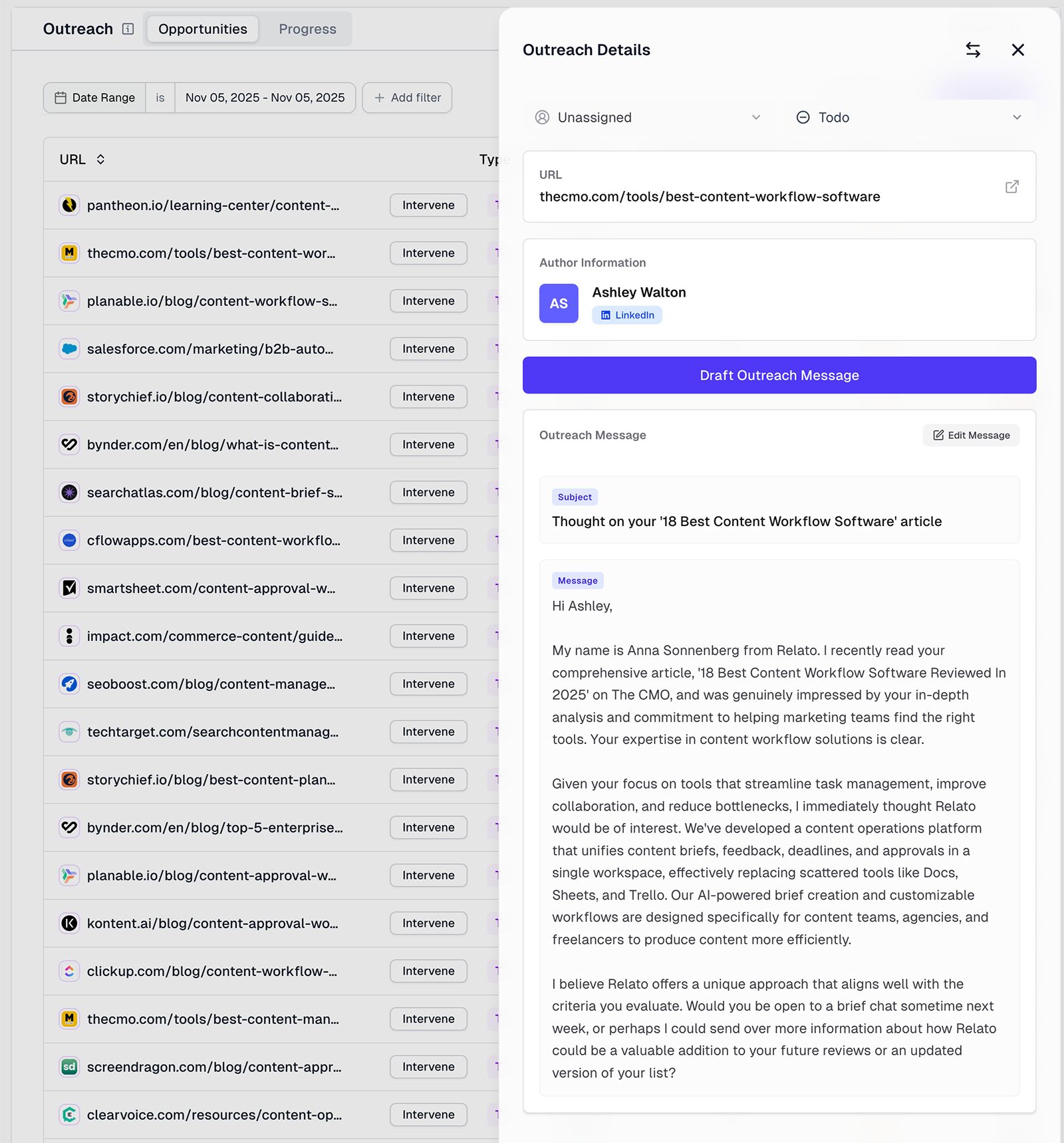
AthenaHQ can draft a link-building pitch and other types of content, though the output is generic.
The quality of the output itself has also drawn criticism. One reviewer noted that "the draft messages it creates are generic," while another flagged that "the optimization suggestions miss industry context sometimes—it recommended we add customer testimonials to our equipment page, which makes sense for consumer brands but isn't how freight procurement works."
Profound: A full content production pipeline, powered by AEO data
At a glance
Pros:
- Drag-and-drop Agent builder empowers any team member to build automated content workflows
- Pre-built templates built on millions of the most-cited pages across AI platforms
- Agents draw on 16 reasoning models plus deep research via Perplexity
- Every content output is informed by live Answer Engine Insights
- Self-learning loop: crawler behavior feeds back into content recommendations continuously
Cons:
- Content generation volume scales with plan tier
Profound Agents handle the full content production cycle, from identifying gaps using Prompt Volumes and Answer Engine Insights, to generating and optimizing content, to publishing.
Our pre-built template library gives you a fast starting point and accelerates time-to-value: AEO Content Refresh, FAQ Generator, Content Optimization Suggestions, and others are all based on analysis of millions of the most-cited pages across AI platforms.
For more control over what you want to create, you can use the drag-and-drop builder—our Agents support 16 reasoning models plus deep research via Perplexity, empowering you to build custom workflows tailored to your specific content needs. The output reflects what answer engines reward, so the final result is architecturally informed rather than a generic AI generation.
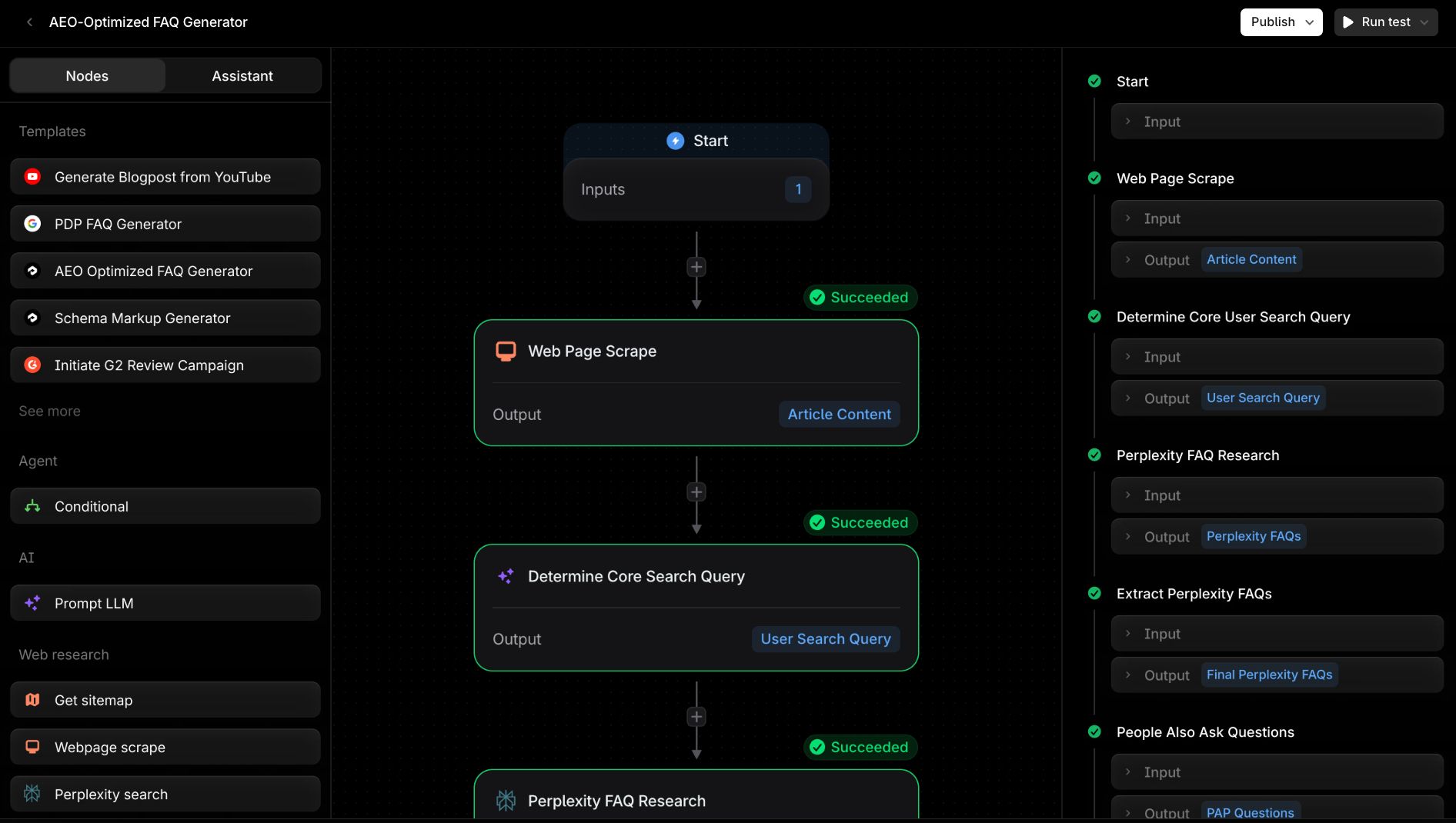
Profound's Agent builder lets you chain scraping, research, and content generation into a single automated workflow.
Once again, the most important variable is the data. Every piece of content our Agents produce or recommend is grounded in live AEO insights. Agents pull from citations, sentiment signals, and prompt volumes, aka the same data that powers the rest of Profound. That means content outputs improve as your visibility data accumulates, creating a self-learning loop that AthenaHQ's disconnected systems can't replicate.
Customers heap praise on our content capabilities, with one reviewer noting that "with the addition of Agents, Profound has further improved our ability to translate insights into scalable, repeatable strategic action." Another described Agents as "a major unlock for our organization," and the team now uses them to streamline internal processes and enhance overall output.
Profound vs. AthenaHQ: AI shopping and commerce visibility
AI search is changing how people shop. ChatGPT Shopping now surfaces product recommendations directly inside conversations, and for brands selling physical or digital products, visibility in those results is a distinct challenge from visibility in standard AI answers. How are AthenaHQ and Profound equipped to tackle it?
AthenaHQ: Category-level trends without product-level intelligence
At a glance
Pros:
- Shopify integration connects AI visibility data to your e-commerce stack
- Brand positioning trends and category trends surface how your brand is perceived in AI-driven shopping contexts
Cons:
- No SKU-level visibility into how individual products surface in AI shopping results
- No keyword intelligence for the specific prompts that trigger shopping tiles in ChatGPT
- No placement tracking or retailer mapping to identify where products are underperforming
AthenaHQ's commerce-oriented capabilities sit at the brand level. You can get a read on how your brand is trending relative to category conversations, and the Shopify integration provides a connection between your store and the platform's visibility data. If you need to understand broad positioning i.e., “are we being associated with the right product categories in AI answers?”, that's useful context.
What it doesn't give you is operational depth. AthenaHQ doesn't track how individual products surface in ChatGPT Shopping, which prompts trigger shopping tiles in your category, or how your placement compares to specific competitors at the product level. For brand marketers monitoring perception, that may be sufficient. For e-commerce teams trying to drive product visibility and conversions through AI, it leaves the most actionable questions unanswered.
Profound: Product-level intelligence for AI commerce
At a glance
Pros:
- Identifies the keywords that prompt ChatGPT to display shopping tiles in your category
- Monitors how often and where your products appear
- Surfaces gaps in retailer coverage and prioritizes listings to improve presence
- Shows where competitors are winning at the product level
- Reveals how your products are positioned in the AI answers where they appear
Cons:
- Shopping coverage is currently focused on ChatGPT Shopping; coverage of other AI commerce surfaces is evolving
Profound's Shopping feature is for teams who need to manage product visibility in AI search the same way they manage it in traditional search—with keyword data, placement tracking, and competitive context. Here's how it works:
- Shopping Triggers maps which prompts cause ChatGPT to surface shopping tiles in your category, so you know which terms to optimize around.
- Placement Tracking monitors how often your products appear and flags trend changes before they affect revenue.
Retailer Mapping identifies which third-party retailers own your brand’s checkout options and how share breaks down by merchant.
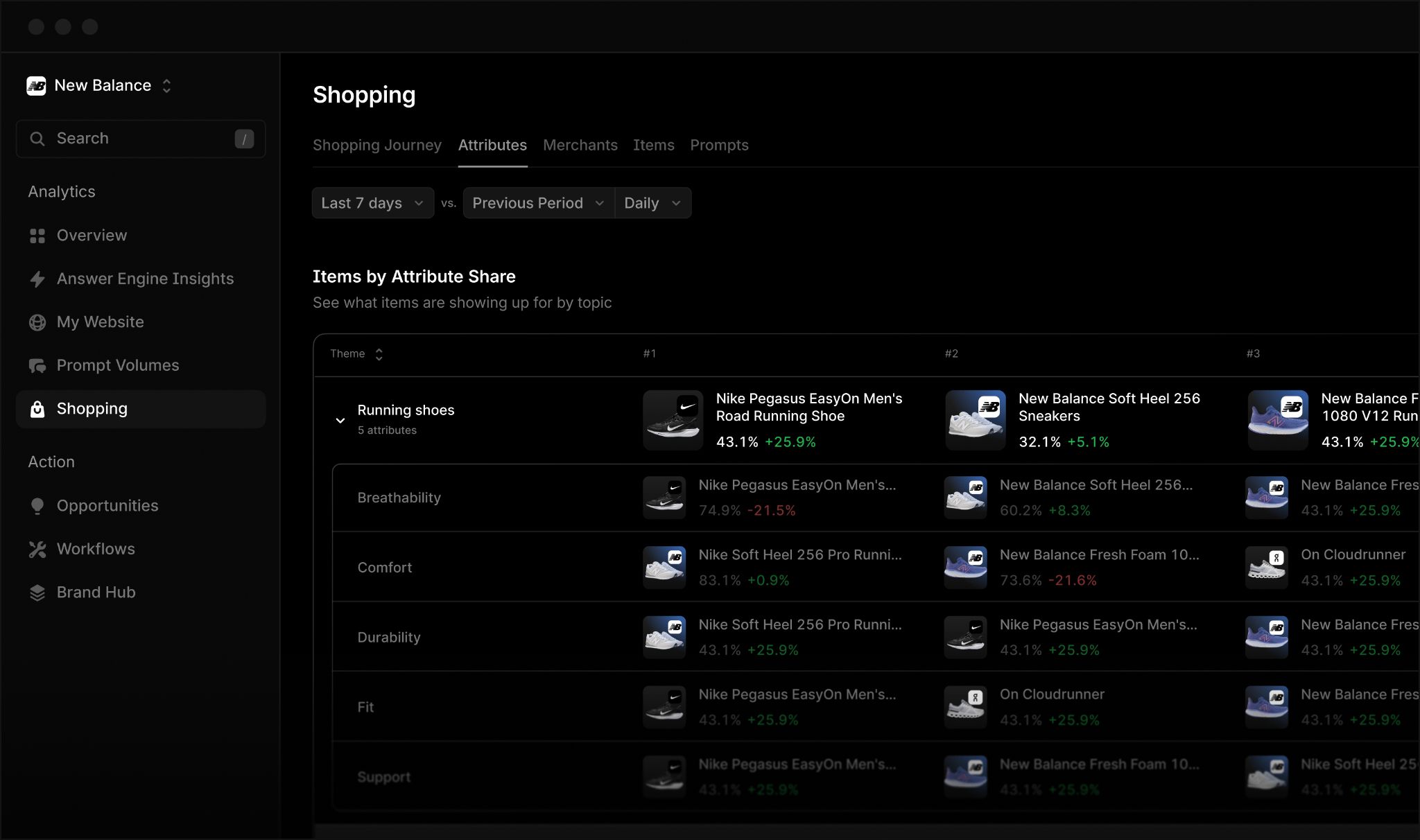
Profound's Shopping view shows New Balance's placement against Nike by product attribute, making it possible to see where competitive ground is being lost and why.
You can also see where specific competitors are getting placements, how their products are positioned in the AI responses that feature them, and what's driving that performance.
Profound vs. AthenaHQ: Resources and expertise
AEO is moving faster than almost any other marketing discipline. It's only natural that customers look to their partners to not just keep pace, but to lead the charge. Funding, team size, and in-house expertise all affect how fast and efficiently AthenaHQ and Profound can meet the moment.
AthenaHQ: A capable but resource-constrained team
At a glance
Pros:
- Responsiveness to customer feedback
- Fast-moving team that ships improvements regularly
Cons:
- ~$2M raised total, limiting the scale of product development
- Smaller team means fewer engineers, fewer AEO researchers, and less capacity for complex enterprise support
AthenaHQ is an active product. Reviewers note a fast release cycle and a team that listens, fixes bugs, and incorporates feedback. Such a level of responsiveness is a great strength in any provider.
But resources constrain ambition. With ~$2M raised, AthenaHQ's engineering and research capacity is limited compared to what it would take to match the pace of change in the AEO category. Some reviewers already note minor bugs and features that require extra effort to set up, both of which are signals of a team that's moving quickly but stretched thin.
At 32 G2 reviews, its customer base is also a fraction of Profound's, which means less real-world feedback shaping the product roadmap.
Profound: The team, the funding, and the AEO experts
At a glance
Pros:
- $96M Series C at a $1B valuation
- ~150 people, including 19 of the 20 recognized experts in the AEO space
- Engineering alumni from Google, DeepMind, Uber, and OpenAI
- Rapid product velocity: GPT-5.2 tracking, WordPress and GCP integrations, HIPAA compliance, Shopping Analysis, and 30+ language support all shipped recently
- 300+ G2 reviews; #1 ranked platform for AEO on G2
Profound has recently raised a $96M series C from Sequoia, Kleiner Perkins, NVIDIA Ventures, and Khosla Ventures, and now sits at a $1 billion valuation. That capital has funded a 150-person team that includes 19 of the 20 recognized experts in AEO, with engineering talent drawn from Google, DeepMind, Uber, and OpenAI. Our team isn't learning the space as much as it is actively defining it.
That depth of expertise translates directly into product velocity. Profound ships features at a pace few platforms in any category match. When answer engines evolve, Profound's customers don't wait months for the platform to catch up.
With 300+ reviews and the #1 ranking for AEO on G2, the scale of Profound's customer base also means the product is shaped by a broader and more diverse set of use cases than any early-stage competitor can match.
Profound vs. AthenaHQ: Strategic partnership, support and guidance
A lot of marketing teams are still building AEO knowledge from scratch and, as we've established, the field is moving at breakneck speed. Every week brings a new model update, a new platform behavior, a new set of questions. The support model behind a platform shapes how quickly you get answers, and how much of that burden falls squarely on your team.
AthenaHQ: Self-serve with optional enterprise support
At a glance
Pros:
- Self-serve plan provides accessible entry point for teams getting started
- Enterprise plan adds a dedicated GEO specialist, dedicated Slack channel, white-glove setup, and a 2-hour SLA
- Agency partnership program with Bronze/Silver/Gold tiers for multi-client management
Cons:
- Self-serve plans come with no dedicated specialist; teams navigate AEO largely on their own
- Strategic guidance only available at enterprise tier
AthenaHQ's self-serve plan gives teams a low-friction way to get started. The platform is readable and the Action Center points to what needs fixing; if you're willing to learn as you go, that's enough to make progress.
The limitation is that AEO is a fast-moving, technically nuanced discipline, and learning it in parallel with trying to deliver results is a real cost. On self-serve, there's no specialist to tell you which prompt clusters to prioritize, which content structures are earning the most citations, or how a recent answer engine update affects your strategy. That knowledge gap either slows you down or leads to misallocated effort—and it's only addressed if you're on an enterprise plan.
Profound: Every customer gets a dedicated engagement manager and AI strategist
At a glance
Pros:
- Every customer gets a dedicated engagement manager and AI strategist from day one
- Dedicated Slack channel with up to 5-minute SLA for enterprise accounts
- Proactive guidance on strategy, competitive intelligence, and platform changes
- Profound's team functions as an extension of your marketing team
Every Profound customer gets a dedicated engagement manager and access to an AI strategy team. Our experts share competitive intelligence, flags emerging answer engine changes before they affect your visibility, and helps you build and refine your AEO strategy over time.
If you're navigating AEO without in-house expertise, that distinction is a boon. Ronak Patel, Head of Marketing at CRS, described it as getting "strategic counsel on how to adapt as answer engines evolve"; guidance that empowered his lean team to move fast and realize a 20x increase in AI visibility and 15% pipeline growth attributed to AI search.
For companies who'd rather build that expertise in-house (or, better yet, complement what they already get from our team), there's also Profound University—a free educational hub with structured courses, step-by-step tutorials, cohort-based pods, and industry-first certifications in AEO and agent-building. The flagship course, Profound 101, covers everything from how answer engines work to shipping content and building automated agents in Profound.
Profound vs. AthenaHQ: Reputation and experience with enterprise brands
The brands a platform works with—and the results it produces for them—are the biggest giveaway of whether it's truly ready for enterprise-level demands.
AthenaHQ's customer roster includes recognizable names, but it's largely concentrated in the mid-market and growth-stage space. The platform hasn't yet accumulated the kind of marquee, household-name enterprise adoption that demonstrates maturity at the highest level of complexity and scale.
Profound's customer list reads differently. Indeed, Expedia, Uber, Airbnb, LinkedIn, Ramp, Figma, MongoDB, Walmart, U.S. Bank, Chime, and DocuSign are among hundreds of brands using Profound to manage their AI visibility. Note that these aren't early adopters testing a tool, but enterprise marketing teams running mission-critical programs on it. That depth of adoption has given Profound's product team a feedback loop that no early-stage competitor can boast about.
The results those customers have achieved speak for themselves. Just to name a few:
- Ramp grew AI visibility 7x in a single month and moved from 19th to 8th among fintech brands.
- Zapier became the #1 cited domain for its most competitive prompts in LLMs.
Profound's compliance posture reinforces why enterprise procurement teams consistently approve it. SOC 2 Type II certification, HIPAA compliance, SSO via SAML/OIDC, role-based access control, and automated daily backups give security and legal teams what they need without the usual back-and-forth.
Profound vs AthenaHQ: Final verdict
AthenaHQ fits a specific profile well: mid-market teams, self-serve budgets, and a primary need to know where they stand. The Action Center is the platform's strongest argument, as it offers a clean, accessible way to get from visibility data to a short list of content fixes.
Enterprise brands, however, will find that AthenaHQ's limitations compound. Estimation-based data, crawler intelligence that doesn't connect to content recommendations, a resource base that constrains how fast the product can move. Each one is manageable in isolation; together, they describe a platform where insight, action, and measurement remain separate problems to solve.
We conceived Profound around a different premise: that those three things only produce results when they reinforce each other. And the team backing all of it means the platform keeps pace with a field that won't slow down any time soon.
If you need comprehensive AI visibility data, content creation, automation, and a strategic partner in one platform, talk to our team. We'd love to help.
Profound vs AthenaHQ FAQs
What's the main difference between Profound and AthenaHQ?
AthenaHQ is a monitoring and recommendations platform: it tracks AI visibility and surfaces content guidance through its Action Center. Profound is a full-fledged AEO platform that combines the industry's largest real user dataset with content creation Agents, infrastructure-level crawler analytics, and a dedicated strategic support model. The core difference is depth: Profound connects data, content, and measurement into a single loop; AthenaHQ's systems remain largely separate.
Does AthenaHQ help with AEO content creation and optimization?
AthenaHQ's Action Center identifies content gaps and surfaces prioritized recommendations, and enterprise plans add a Content Optimization AI Agent. What it doesn't offer is a production pipeline. Optimization suggestions are generated on demand rather than surfacing automatically, and there's no workflow for creating, iterating, and publishing content at scale. If you need a tool to tell you what to fix and are happy to execute elsewhere, that's workable. But if you need to move fast and at volume, the gap between "recommendations" and "production" matters. Profound's Agents, on the other hand, handle the full cycle, from identifying opportunities using live AEO data to generating, optimizing, and publishing content.
Which platform is better for enterprise brands, Profound or AthenaHQ?
Profound is the better choice for enterprise brands, who require verified data they can build strategy around, compliance certifications that pass procurement reviews, content workflows that scale without engineering dependencies, and a support model that goes beyond self-service. Profound delivers on all four.
How does pricing compare between Profound and AthenaHQ?
AthenaHQ's self-serve plans run $95–$295/month, with enterprise pricing available on request. Profound's plans start at $99/month for its Starter tier and $399/month for Growth, with enterprise pricing tailored to the scope of the program. For teams serious about AEO as a growth channel, the comparison isn't just cost per month—it's what each platform actually enables you to do with that investment. See Profound's pricing page for full details.
