
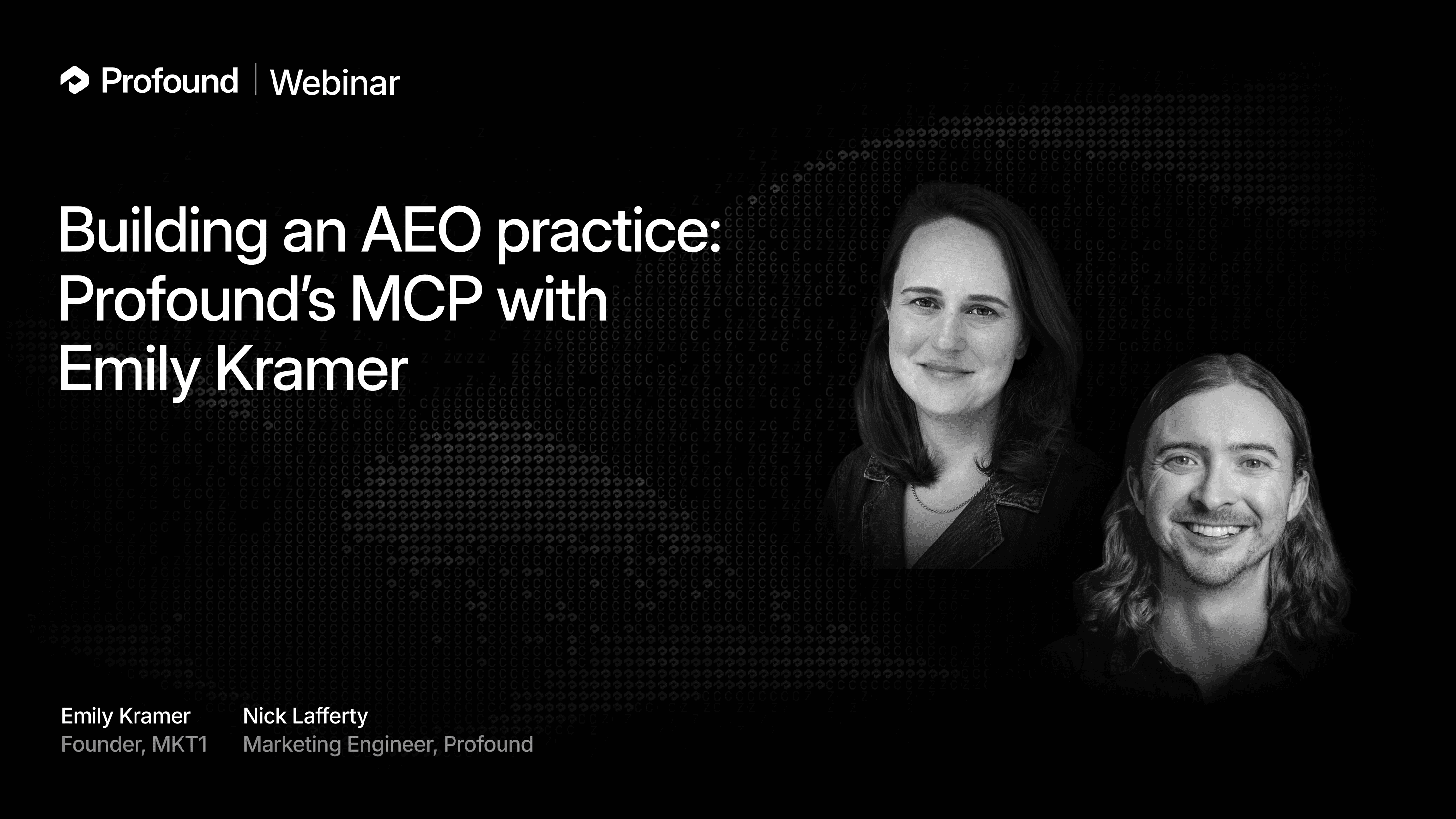
I recently sat down with Emily Kramer, founder of MKT1 to walk through some real workflows using the Profound MCP.
I use the Profound MCP as part of my day-to-day. The goal of this session was to show three workflows I'd actually built and get Emily's reactions in real time, so anyone who hasn't touched it yet has a concrete on-ramp.
What is the Profound MCP?
The Profound MCP (Model Context Protocol) is a connection that lets AI assistants like Claude access real-time AI citation data, brand visibility metrics, and answer engine optimization (AEO) insights directly from the Profound platform.
Quick context
AEO (Answer Engine Optimization) is the practice of structuring content so AI answer engines like ChatGPT, Claude, and Perplexity cite your pages in their responses.
If you're a current Profound customer and haven't connected our MCP yet, you should. It's live at mcp.tryprofound.com. Worth noting: we just launched Profound as an official Anthropic connector, so you can now pull Profound into Claude in a couple of clicks.
Workflow 1: How to compare two competitor pages using citation data
The first thing I showed was an AEO audit comparing a Ramp corporate card page against a Brex corporate card page. I asked Claude, connected to the Profound MCP, to pull both pages, compare them, and layer in citation data from our corporate cards config over the last 28 days.
The output surprised even me a little. On paper, Brex's page is more optimized: more FAQs, better-structured headings, cleaner markup, pricing called out clearly. By most on-page AEO checklists, Brex should be winning. But Ramp is cited roughly 10x more.
That gap is the whole point of showing this workflow. Without Profound's citation data, you'd look at these two pages and reasonably conclude Brex should be the one getting cited more. The data tells a different story: AEO isn't just about what you change on your own page. There's a huge amount of off-page authority, brand signal, and existing citation weight that a page audit alone can't see. You can optimize your page perfectly and still lose to a competitor with more off-page pull.
What you get:
- A side-by-side AEO audit of two competitor pages with on-page scores
- Live citation data showing which page AI models actually cite, regardless of on-page optimization
- A clear gap analysis between page quality and real-world citation authority
Workflow 2: How to pull a category-wide citation report with an interactive chart
Next I ran a shorter prompt: pull the top cited domains in the corporate cards category, show where Ramp sits relative to banks and editorial sites, and build it as an interactive bar chart with live numbers (not a fixed ranking).
Ramp came out on top, ahead of NerdWallet, which is genuinely impressive given NerdWallet has spent years dominating personal finance SEO, with Brex further down. This is the kind of report Claude alone can't produce, because it doesn't have access to the underlying citation data. It's also the kind of thing that's perfect for board reporting or a weekly marketing update.
Emily made a good point here that I think is underrated: the value isn't just "can I see this data." You can already see it in the Profound UI. The value is what you can do with it once it's in Claude: drop it into a deck, combine it with data from other MCPs, fold it into a bigger weekly report alongside your Asana project updates or your Google Analytics numbers. The more you build out in Claude, skills, other connected MCPs, design workflows, the more that one report becomes an input into everything else you're doing.
What you get:
- A ranked list of the top-cited domains in your category
- A shareable, interactive bar chart formatted for board reports or weekly marketing updates
- The ability to combine citation data with other MCP data sources (Google Analytics, Asana, etc.) inside Claude
Workflow 3: How to build and modify Agents for FAQ generation
The third workflow was building a Profound Agent that generates AEO-optimized FAQs. I ran an existing agent against the Brex page, and Claude flagged that the page actually had 17 FAQs while our Agent was only built to generate 10. So I asked it to build me a new agent that generates 20 instead. It copied the existing agent's structure, asked for my approval, and published it. Now anyone on my team can run that same Profound Agent either in Claude or in Profound.
That last part matters more than it sounds. Sharing skills across a marketing team right now is genuinely clunky. You export a file, someone else imports it, and the moment you update it, you're resending it. Building Agents inside Profound and accessing them through the MCP solves that permissioning problem without needing everyone to become a Claude Code power user.
What you get:
- A new Profound Agent that generates a custom number of FAQs
- A published, team-accessible Profound Agent
Other topics we discussed live
The AI proficiency ladder
Emily shared a framework she's been working with, which she calls the AI proficiency ladder: the observation that on any given marketing team, people are operating at wildly different levels of AI comfort and capability.
MCPs live a few rungs up from the ground floor, not expert territory, but not something most people pick up on day one either. Where things get genuinely powerful is when you start combining them: pulling data from one source and handing it to another, the way you might grab citation data from Profound and then tell Claude, "I use Framer to build my site — here's what we just learned, what should I update?"
That's what the climb looks like: one MCP, then a workflow built around it, then a full stack. No matter where you're starting from, the simplest entry point is the same: connect the Profound MCP, ask it what it can do, and take it from there. Once you catch yourself wanting to run the same thing again, that's your cue to turn it into a skill or agent.
How do skills work inside an MCP?
A skill is just a markdown file of instructions that lives inside an MCP. Some MCPs ship with built-in skills; some don't. When you install a new MCP, the easiest first move is to just ask it, "What can you do?" or "What skills do you have?"
Key takeaways
- Profound is live as an official Anthropic connector, making it accessible in Claude with no configuration required.
- The Profound MCP connects Claude to real-time AI citation and visibility data, enabling AEO analysis that Claude alone cannot perform.
- The biggest value of the Profound MCP goes far beyond analyzing AEO data. It is acting on it inside Claude, combining it with other MCPs, and automating tasks you currently run by hand.
- The MCP supports building, publishing, and sharing Profound Agents across a team without requiring technical setup or file exports.
Get started
The Profound MCP is available today for Enterprise customers, with setup instructions here. Self-serve customers and others interested are encouraged to get a demo to see it in action.


