

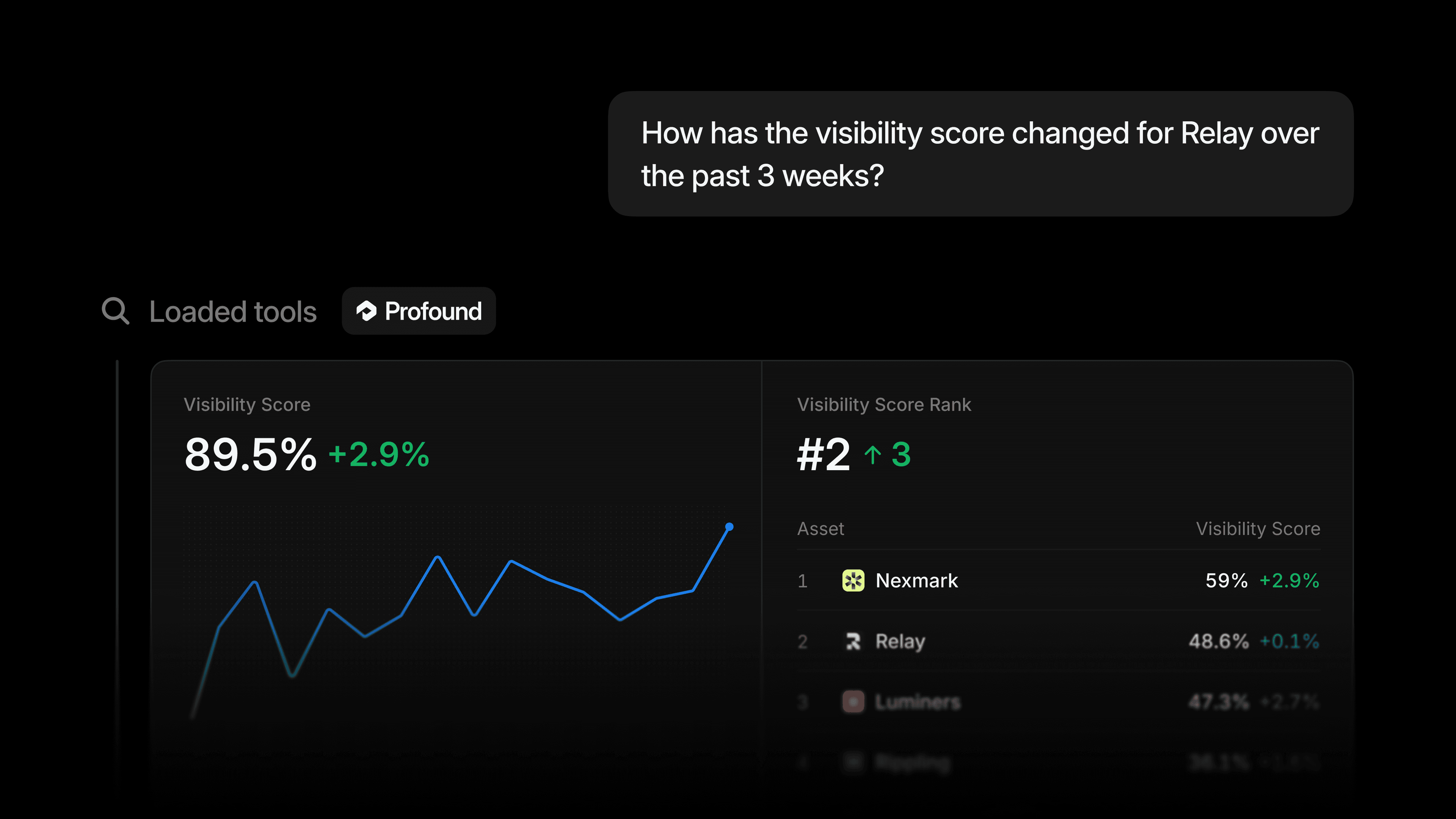
A new kind of marketer is doing their best work outside of traditional software UIs. Marketing Engineers live in AI tools, chaining multiple MCPs to pull data and trigger workflows without ever opening another tab. To do this, they expect every tool in their stack to work harmoniously.
Last October, we launched the Profound MCP server to let marketers connect ChatGPT, Claude Desktop, Cursor, Cline, and other MCP-compatible tools directly with their data in Profound.
Since then, our team has been studying how the best Marketing Engineers in the world use our MCP and understanding how to ship the most powerful MCP possible. The result is a roadmap built around how marketers actually work, pressure tested by the best in the industry.
This is the first blog in a series documenting what we are building as we build it. Today, we’re announcing the new foundation: a knowledge graph that gives your agent context about your AEO strategy and Profound data as well as 15 specific capabilities mapped to how marketers work.
MCP in plain English
MCP stands for Model Context Protocol. Anthropic introduced it in late 2024, and it's become a way agents like Claude, ChatGPT, Copilot, and Cowork can talk to other tools, including Profound.
The easiest way to think about MCPs vs an API is this: APIs describe data for engineers building software, while MCPs describe data for agents working in the moment. That means an MCP carries not just the data itself, but the context around it. how concepts relate, and how an agent should reason about them.
Not all MCPs are built the same
Most MCPs are thin wrappers around an API. They expose a couple of general-purpose tools, hand them to an agent, and hope the agent figures out the rest. This is an anti-pattern on how MCPs should be built. MCPs are not APIs. An API is built for an engineer who reads the docs and writes precise code against it ahead of time. An MCP is built for an agent that shows up at runtime, reads tool names, and has to figure what to call on the fly.
The problem with a generic approach is that an agent starting from scratch knows nothing about your brand, tracked topics, or your AEO strategy. It also has no context on the inner workings of Profound. So when you ask “how did my visibility score change last week”, at best your agent pieces together an answer from its own inference, often misled by broad definitions found on the internet or in its training data. At worst, you get a shallow response that reads like a raw data dump.
A knowledge graph to make your agents more intelligent
Instead of shipping a number of generic tools, we started by building a knowledge graph into our MCP. This is a structured map of how Profound's vocabulary connects, exposed to the agent the moment you connect.
After hooking up your MCP, your agents understand key concepts like how visibility relates to mentions, prompts relate to topics, and citations relate to domains. Ask "what changed in my visibility this week" and your agent doesn't have to figure its response out from scratch, because it already knows the shape of the answer.
This is the layer most teams skip. Building it required studying our customers' workflows, mapping how AEO concepts actually relate to each other in practice, and encoding that into a structure an agent can reason over. The result is that every capability that sits on top of the graph is sharper, more accurate, and easier to one-shot. Your agent becomes an AEO expert that you can consult with effortlessly, not a generic assistant that you need to prompt engineer repeatedly to get the results you're looking for.
15 capabilities to support your marketing workflows
With our knowledge graph as the foundation, we chose 15 capabilities based on what the best Marketing Engineers reach for daily. They split into three areas: granular AEO data, prompt information, and Profound reporting.
Granular AEO data
Prompt information
Profound reporting
How are customers are using these capabilities
Pull ad-hoc answers in the flow of work
When a stakeholder asks how a topic is performing this quarter, ask your agent directly. The right capability gets called, the answer comes back contextualized, and you can keep working.
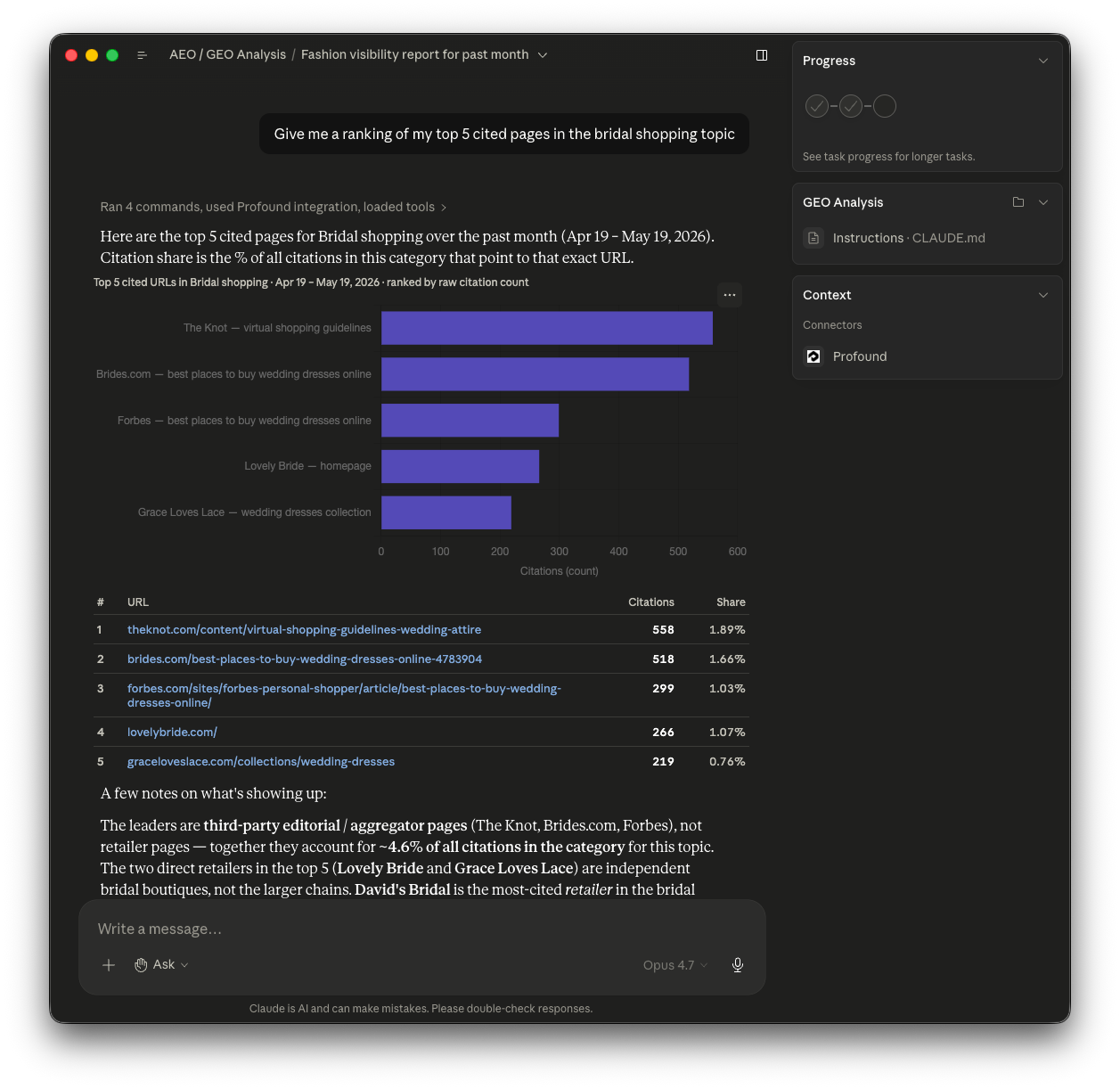
Brief leadership with one prompt
Ask your agent for a weekly summary or competitor update and get a ready-to-share output.
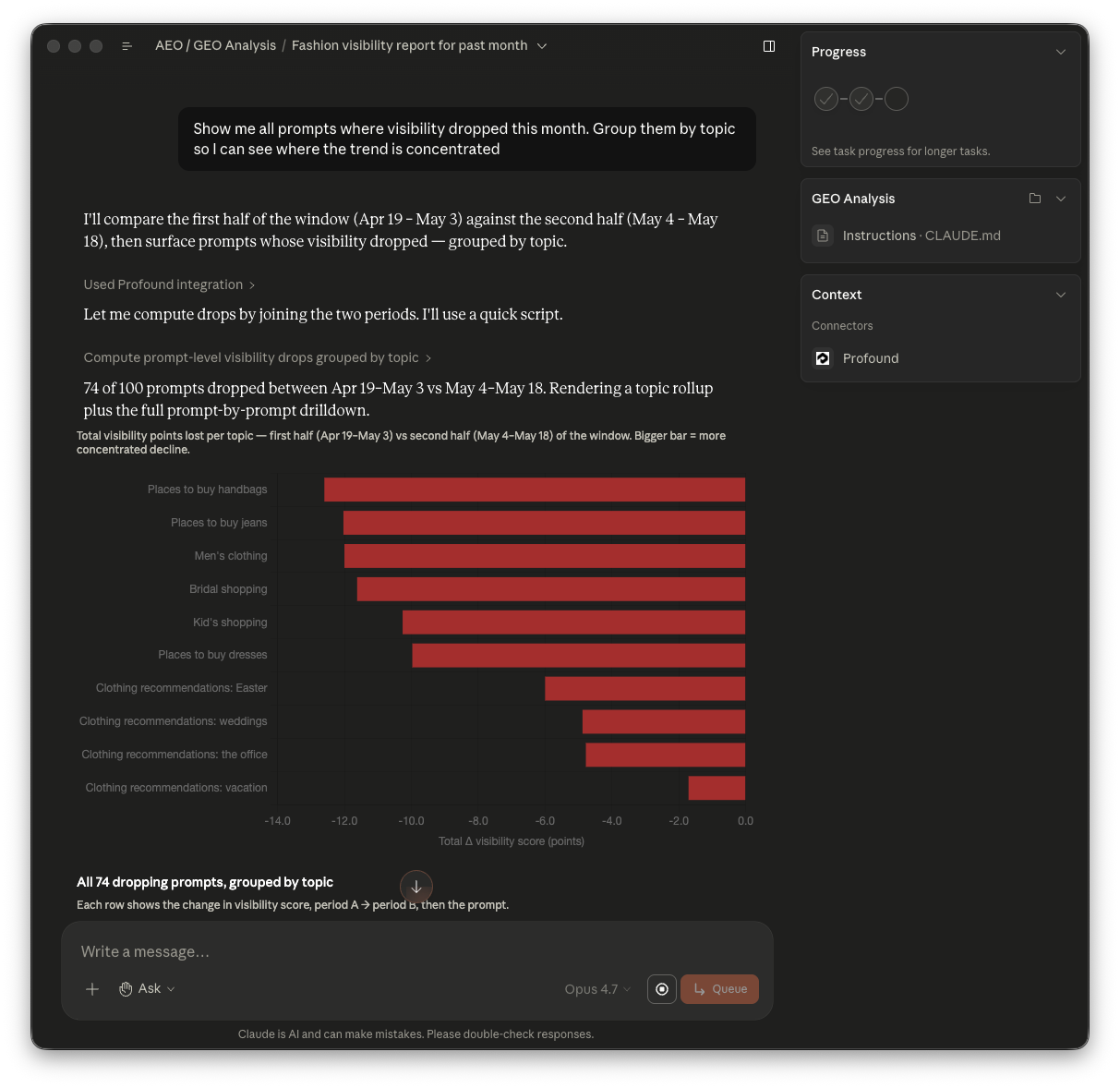
Build agentic workflows between tools
Because each capability is a discrete, well-described call, you can compose them inside larger agent workflows. Chain a Profound capability into your CRM, your CMS, or your ads tooling, and let the agent route data between them.
What's next
With the solid foundation of the knowledge graph infrastructure, these 15 new capabilities are just the beginning.
We will progressively unlock value in three phases:
Get started
The Profound MCP is available today for Enterprise customers, with setup instructions here. Self-serve customers and others interested are encouraged to get a demo to see it in action.


