
Every week, another tool promises to crack the code on AI search visibility. The script rarely changes. Monitor your mentions, track your citations, claim your spot in the new search order. The complicated task is sorting out which of these platforms are indeed built for the job, and which are just surfing the category wave.
Let’s look at two contenders with very different blueprints. Evertune calls itself a Generative Engine Optimization (GEO) platform, built on brand monitoring and sentiment tracking, and founded by folks who helped create The Trade Desk. Profound, on the other hand, is an AI search platform from the ground up. It pairs a deep well of AI visibility data with content creation, automation, and analytics that reach all the way down to the infrastructure layer.
We’ll compare both across several dimensions: data infrastructure and methodology, complete solution (visibility plus actions), market leadership and enterprise readiness, and compliance and security. The goal is a clear picture of where each tool fits within the broader AI search landscape, so you can make a confident decision.
Profound vs. Evertune: Data infrastructure and prompt volume depth
The quality of an AEO platform’s data determines the quality of everything built on top of it: every insight, every recommendation, every piece of content it can produce. Here’s how Evertune and Profound propose to meet the moment.
Evertune: Consumer panel and topic clustering
Pros:
- Topic-based clustering handles the long-tail, conversational nature of AI prompts reasonably well
- EverPanel’s 25 million real users provides genuine human signal
Cons:
- 25M-person panel is a fraction of the global AI user base; insights rest on extrapolation, not licensed conversation data at scale
- API-based access to base models captures responses that can differ meaningfully from what real users see through front-end interfaces
- Topic clustering trades granularity for coverage; niche industries and long-tail categories may see limited depth
Evertune’s Prompt Volumes feature draws from EverPanel, its proprietary consumer panel of roughly 25 million people. Rather than tracking specific keyword phrases, the platform clusters prompts into broader topics, grounded in the belief that “over 80% of AI prompts” are unique and conversational. The logic is sound: people writing to ChatGPT don’t behave like people typing into a search bar, and a topic-first model reflects that reality.
The honest limitation is scale. 25 million people sounds impressive, and it is, but it’s still just a sliver of global AI usage (ChatGPT alone sees over 700 million weekly active users). If you’re in a niche industry or working outside the big English-speaking markets, the data might feel a lot thinner than the headline number lets on.
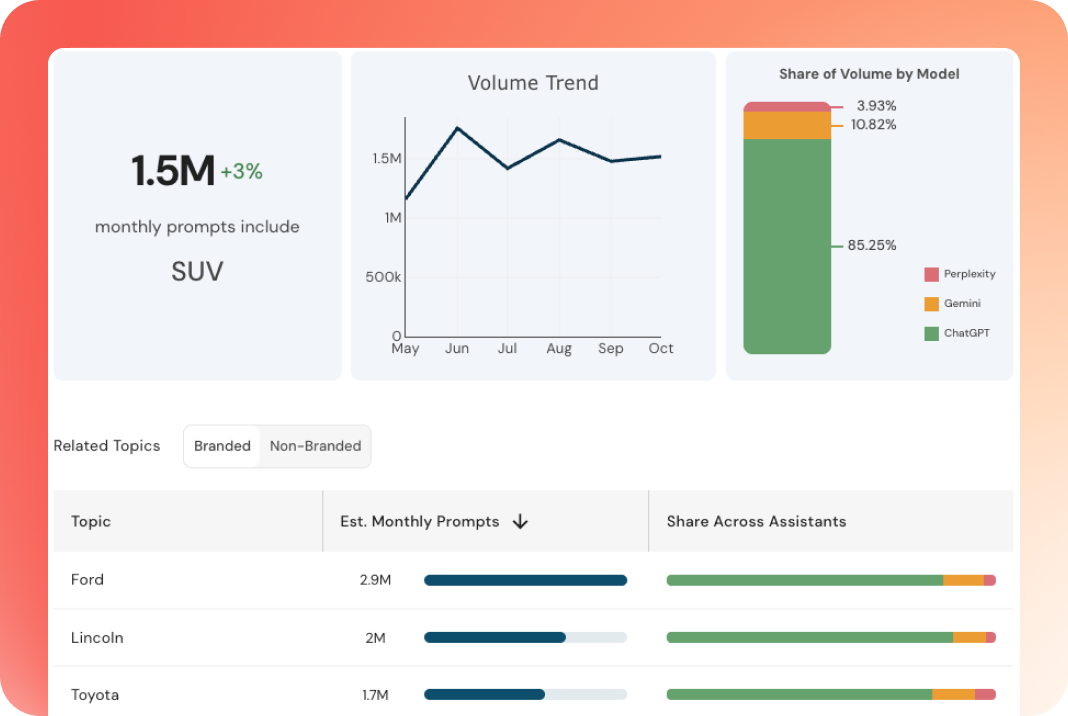
Evertune's topic-clustering approach shows broad prompt volume trends by model.
Evertune adds another layer to their methodology, though: direct API access to engines like ChatGPT, Gemini, and Claude. The pitch is that this helps brands see the difference between what a model knows at its core and what gets added in real time. It’s an interesting idea. But in reality, API responses often don’t match what users see in the app. The front-end adds things like personalization and retrieval tweaks that the API just doesn’t capture.
Profound: 1.3B+ real prompts and front-end empirical data
Pros
- 1.3B+ licensed conversations from double-opt-in consumer panels, cleaned, anonymized, and enriched with probabilistic modeling
- Monitors consumer-facing AI interfaces directly, so data reflects exactly what real users see
- Three-signal architecture (Prompt Volumes + Answer Engine Insights + Agent Analytics) closes the loop from discovery to citation to crawl behavior
- Prompt Volumes filters by platform, demographics, intent type, and keyword hierarchy
Cons
- Prompt Volumes geographic coverage currently spans 10 countries (US, UK, Canada, Germany, France, Australia, Spain, South Korea, Italy, Brazil), with more being added; teams outside this footprint have partial coverage today
Profound’s Prompt Volumes dataset is built on over 1.3+ billion real user conversations licensed from double-opt-in consumer panels, with the data cleaned, anonymized, and enriched through probabilistic modeling. Millions of new prompts are indexed each week, and current coverage spans ten countries. The underlying prompt data is aggregated from ChatGPT, Gemini, Claude, and Perplexity, and is fully GDPR and CCPA compliant.
Profound’s data collection sets it apart. Instead of just pulling from APIs, it monitors the front-end interfaces—the same ones real users see when interacting with AI engines. That means it catches all the personalization, regional quirks, and model updates that get lost when you only look at the backend.
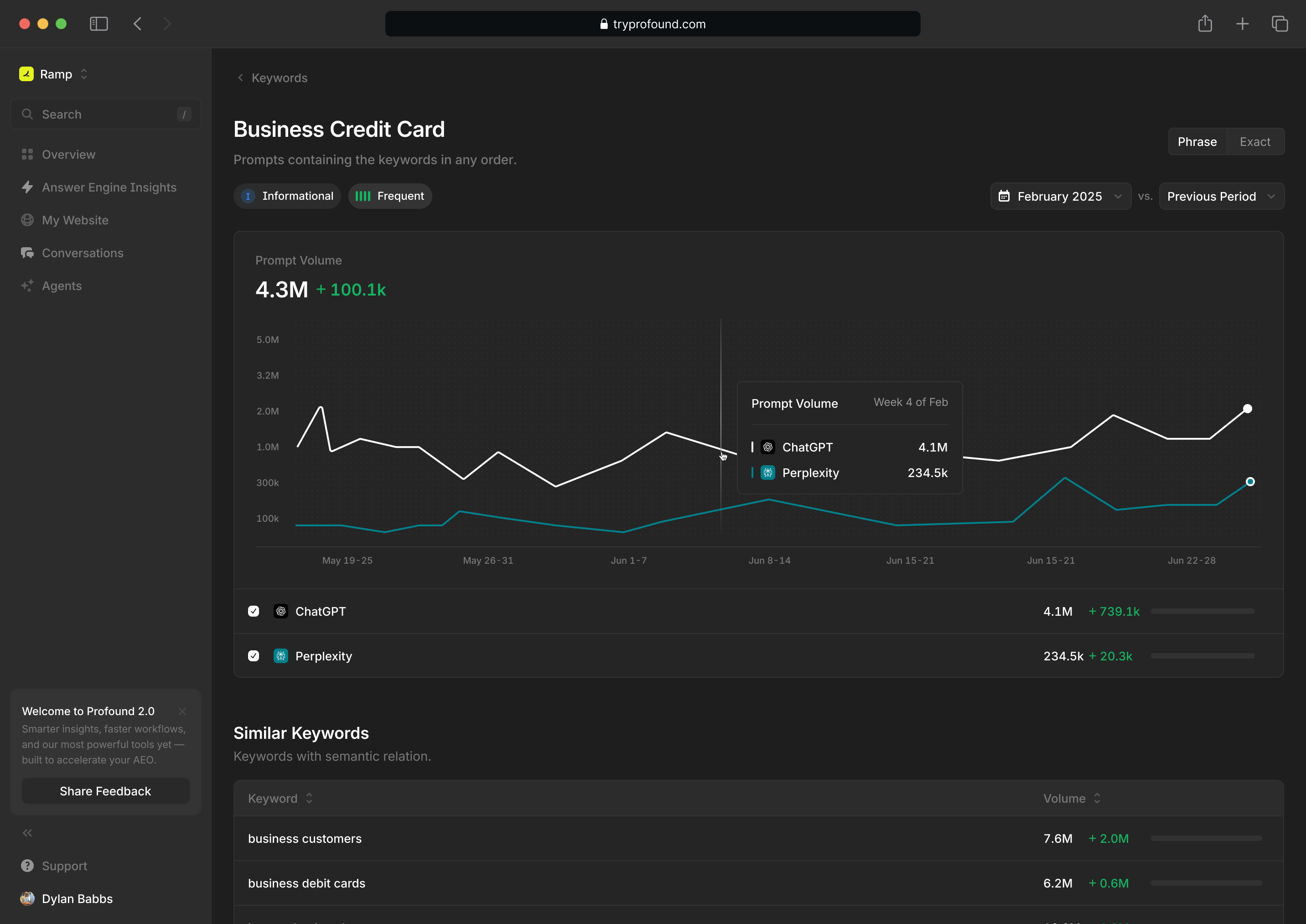
Profound's Prompt Volumes shows real query frequency at the keyword level, broken down by platform and filterable by demographics and intent—giving teams the demand signal they need before committing content resources.
The throughline in Profound is a three-signal architecture that Evertune has no equivalent for:
- The first signal is Prompt Volumes: real user conversation data that shows what people are actually asking.
- The second is Answer Engine Insights: daily front-end monitoring of how your brand appears in live AI responses.
- The third is Agent Analytics: CDN log monitoring that shows which AI crawlers visited your site, which pages they read, and how frequently.
With all three signals in one place, you don’t have to guess why your visibility changed. You can follow the trail from a citation all the way back to the exact piece of content that earned it.
Profound vs. Evertune: Complete AEO solution, from visibility to action
Visibility data is the bare minimum. With so many AEO tools vying for your attention (and your money), the main differentiator is whether they can turn visibility insights into content, workflows, and results.
Evertune: Monitoring-first with partner-driven actions
Pros
- Strong AI brand monitoring suite
- Content Studio generates ready-to-publish blog posts
- Partner Connect integrates with impact.com and PartnerStack for pushing prioritized source lists directly into affiliate campaigns
Cons
- No automated workflow layer connecting data to execution
- Content creation is initiated by the marketer, not by the platform;
- No infrastructure-level measurement
Evertune’s core strength is AI brand monitoring. The AI Brand Index scores the probability that a given model will include your brand in a response, Word Association surfaces the language and sentiment AI uses when it mentions you, and Consumer Preferences reveals which attributes drive recommendations in your category. If your primary question is “how does AI perceive us?”, these reports cover a lot of ground.
The content side is capable. Content Studio tests 50 message variants per category attribute against live AI models, selects the top performers, and outputs ready-to-publish copy in Markdown or HTML.
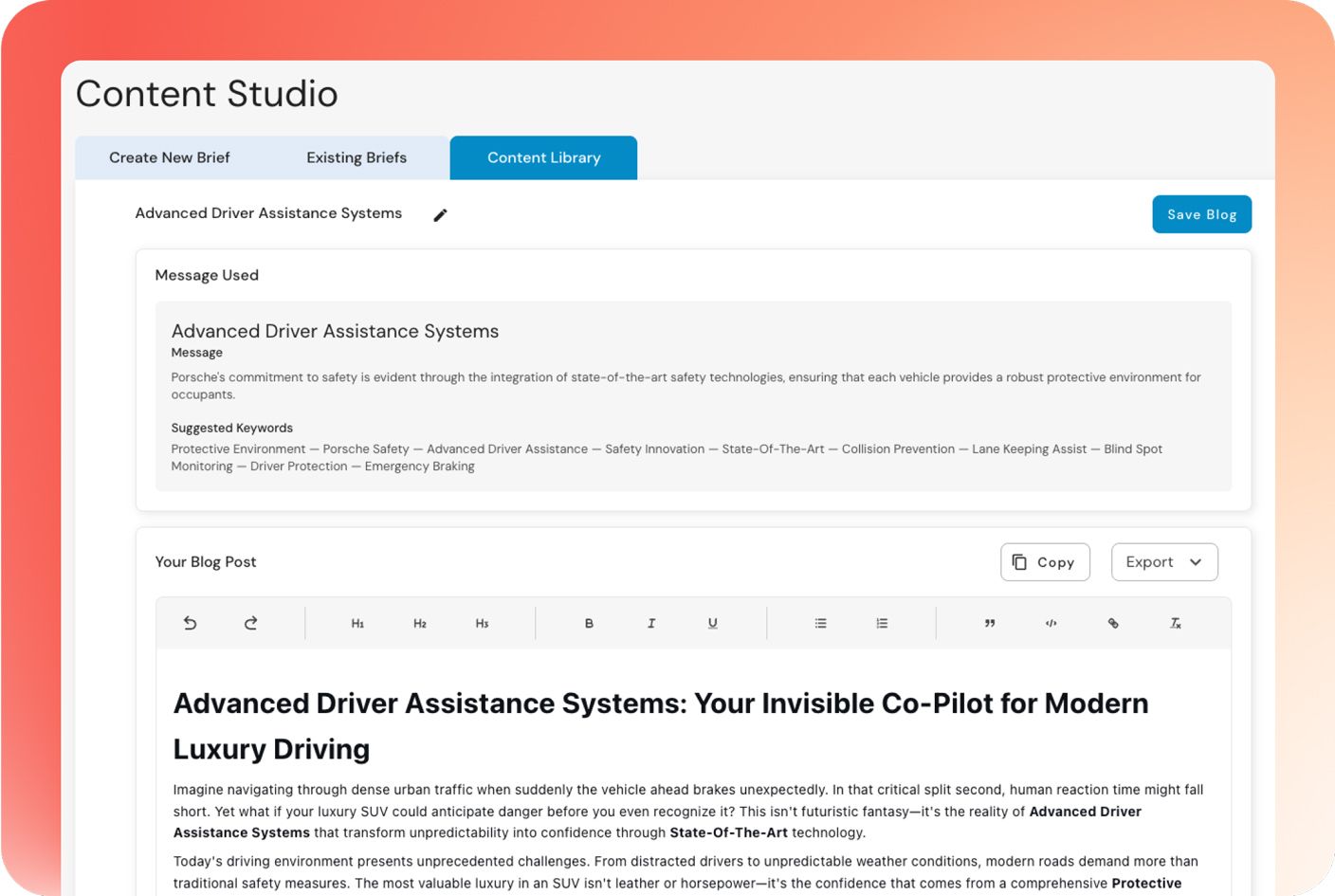
Evertune's Content Studio generates publish-ready blog posts from tested messaging. However, the process is manually triggered, with no automated loop connecting content output back to citation or crawler performance.
The structural issues in Evertune is the absence of an automated loop. Its content creation is triggered by the marketer, informed by data. There are no agents that fire when a content gap surfaces. There's no system that routes a draft through an approval queue. And there’s nothing that tells you whether the content you created changed how AI crawlers behave on your site, because Evertune has no visibility into crawler activity at all.
Profound: Visibility, content, workflows, and measurement in one platform
Pros
- Complete platform covering the full AEO scope, from insights to execution
- Pre-built and customizable automation templates for content creation, optimization, FAQ generation, and more
- Drag-and-drop workflow builder marketers and content teams can easily set up
- Self-learning feedback loop: citation and crawler data feeds back into the content generation engine, so each iteration benefits from what the previous one produced
Cons
- The feedback loop delivers compounding value over time, but teams starting fresh won’t feel the full benefit until enough content has been published and crawled
Profound was always meant to be a closed loop. The architecture is intentional: Answer Engine Insights shows what’s happening across LLMs, Profound Agents use those signals to create and optimize content, and Agent Analytics checks whether that content changed how AI systems interact with your site. Each step feeds the next.
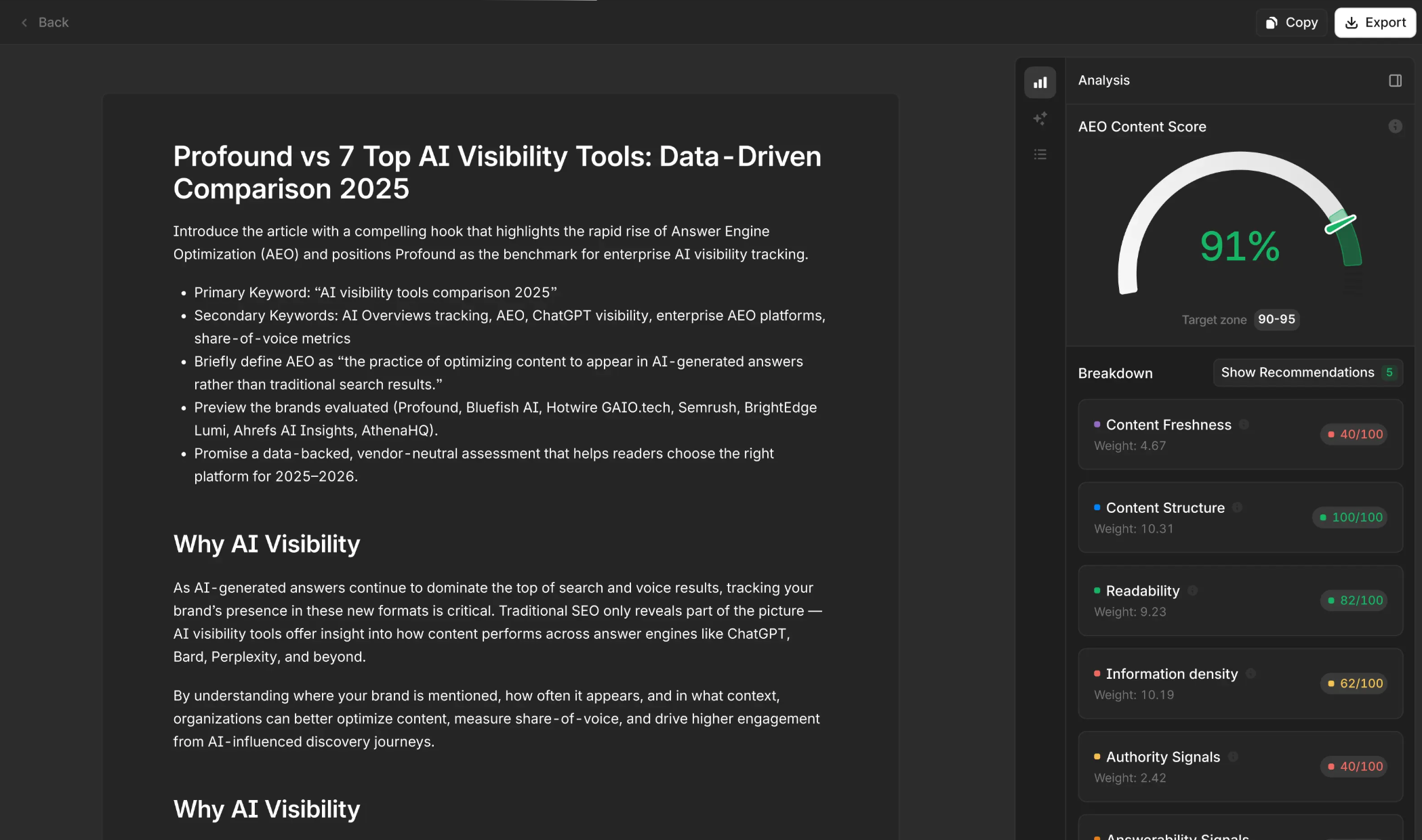
Profound's AEO Content Score evaluates content against the signals that determine citation potential, so teams know before publishing whether a draft is likely to earn citations or needs further work.
Profound Agents are the action layer. You can choose from dozens of pre-built templates built on patterns from millions of high-cited pages, or configure custom workflows with a drag-and-drop builder. Every draft starts from the same data set powering Answer Engine Insights, including citations, live sentiment, and prompt volumes. The content isn’t generated in a vacuum, but in response to what answer engines are currently rewarding.
When new content or optimizations go live, Profound tracks what gets cited by which models, whether AI crawlers visit the pages, and how citation rates change over time. That data goes straight back into Agent recommendations, so the system gets sharper with every cycle. Your team can see, right down to the CDN logs, that ChatGPT’s crawler hit a page three times in a week after publishing and that the number climbed after the next round of optimization.
Profound vs. Evertune: Market leadership, funding, and enterprise adoption
In a space this new, resources matter as much as features. Funding sets the pace for product development, team size shapes the support you get, and enterprise traction is the market’s way of saying whether a platform delivers on its promises.
Evertune: Adtech roots
Pros
- Founded by early team members of The Trade Desk, bringing genuine data-driven advertising expertise to the space
- Working with customers across finance, retail, automotive, pharma, and B2B verticals
Cons
- $20M in total funding, compared to Profound’s $96M Series C at a $1B valuation
- Published case study footprint is nearly nonexistent relative to the breadth of customers claimed
- Zero reviews on G2, providing no independent signal of customer satisfaction or platform validation
Evertune’s founding story lends it legitimacy. Early team members of The Trade Desk know data-driven marketing infrastructure, and that background shows in the platform’s analytical depth and its adtech-connected partner ecosystem (the Trade Desk and Index Exchange integrations in Partner Connect aren’t coincidental).
The company has raised $20M from adtech and martech investors, employs more than 40 people out of New York City, and counts WPP, Canada Goose, and Miro among customers they’re willing to name publicly.
That said, Evertune’s published case study footprint is close to nonexistent. A few data points appear in press announcements, but there’s nothing resembling the number of documented customer results that would let a prospective buyer evaluate outcomes in their own category. And with zero G2 reviews, there’s no independent source of customer sentiment to consult. That’s not a dealbreaker for every buyer, but for enterprise teams running due diligence, the absence of verifiable third-party proof introduces risk.
Profound: Category leader with unmatched investment and velocity
Pros
- $96M Series C at a $1B valuation, led by Lightspeed Venture Partners alongside Sequoia Capital, Kleiner Perkins, Evantic, Saga Ventures, and South Park Commons
- Ranked #1 on G2 for AEO and named a Definitive AEO Leader in the G2 Winter 2026 report
- Enterprise customers include Ramp, Figma, MongoDB, U.S. Bank, Chime, Zapier, and Clay
- Customers get access to dedicated AEO experts, strategic consultants, and Profound University for ongoing education and enablement
Cons
- Enterprise pricing reflects the platform’s depth and support model; teams with minimal AEO programs or limited budgets may find lighter-weight options more appropriate as a starting point
Profound’s $96M Series C, led by Lightspeed Venture Partners at a $1B valuation, puts it in a different resource category than any other pure-play AEO platform. The investor roster—Sequoia Capital, Kleiner Perkins, Evantic, Saga Ventures, and South Park Commons alongside Lightspeed—reflects conviction from firms that have funded category-defining software companies. That capital goes toward engineering velocity, data infrastructure, and the team required to support enterprise customers at scale.
The market has validated that investment independently. Profound is ranked #1 on G2 for AEO and was named a Definitive AEO Leader in the G2 Winter 2026 report. The customer roster features companies with high standards for vendor selection: Ramp, Figma, MongoDB, U.S. Bank, Chime, Zapier, and Clay have all chosen Profound as their AEO partner.
More than the platform itself, Profound also puts a team of dedicated AEO experts and strategic consultants at your disposal. Profound University gives teams structured enablement so they can build internal AEO competency, not just dependency on a vendor. Enterprise buyers who need both a tool and a knowledge transfer will find this combination hard to replicate with a 40-person company still building its proof base.
Profound vs. Evertune: Compliance, security, and enterprise integrations
- Profound is SOC 2 Type II certified with an independent HIPAA compliance assessment from Sensiba LLP
- Enterprise-grade security includes AES-256 encryption at rest, TLS 1.2+ in transit, MFA, RBAC, audit logging, automated disaster recovery, and SSO/SAML
- Native integrations with GA4, Tableau, Slack, Vercel, AWS CloudFront, Cloudflare, Fastly, Netlify, Akamai, GCP, and WordPress; Agent Analytics setup in minutes
- Evertune doesn’t publicly advertise SOC 2, HIPAA, or equivalent certifications
- Evertune’s integration capabilities are limited; Partner Connect with impact.com is the first major integration, with CSV export as the primary data output method
If you’re in healthcare, pharma, finance, or any regulated industry, compliance isn’t optional. Your AEO platform has to meet the same security standards as every other tool your legal and security teams have already signed off on.
Profound is SOC 2 Type II certified and has completed an independent HIPAA compliance assessment conducted by Sensiba LLP. The underlying security architecture includes:
- AES-256 encryption at rest
- TLS 1.2+ encryption in transit
- Multi-factor authentication
- Role-based access controls
- Comprehensive audit logging
- Automated disaster recovery.
SSO/SAML is also supported for enterprise teams that require centralized identity management. For regulated-industry buyers who need to document their vendor security posture, Profound can provide the paperwork.
The integration story is just as enterprise-focused. Agent Analytics plugs straight into GA4, Tableau, Slack, Vercel, AWS CloudFront, Cloudflare, Fastly, Netlify, Akamai, GCP, and WordPress. If you’re already using these platforms, attribution data from AI crawlers just flows into your existing reports.
Evertune, on the other hand, doesn’t advertise SOC 2, HIPAA, or similar certifications. For regulated teams, that’s often a nonstarter. Integration is also limited right now. Partner Connect with impact.com and PartnerStack is the first big third-party integration, and most data still leaves the platform as a CSV. If you need your AEO data to pipe into dashboards, CDN logs, or other marketing systems, expect some friction.
Profound vs. Evertune: which platform should you choose?
Evertune does what it says on the tin. It’s a solid monitoring tool, especially if you care about brand sentiment and consumer attributes. If your main question is how AI perceives your brand, it’s a great place to start.
The difference shows up when you move from perception to action. Profound was designed for that leap. It brings together deep real-user prompt data, daily monitoring across answer engines, Agents that turn visibility signals into content, CDN-level attribution, and enterprise-grade security.
The proof is documented, whether it’s in cases like Ramp’s, who increased AI visibility 7x in a single month, in the 300+ reviews on G2, or our roster of enterprise clients.
If you’re ready to truly operationalize AEO—build content, automate execution, and measure impact at the infrastructure level—there’s only one platform that will match that kind of ambition.
See for yourself. Book a Profound demo.
Profound vs. Evertune FAQs
Is Evertune or Profound better for AI visibility tracking?
Profound tracks visibility daily across 10 answer engines—ChatGPT, Google AI Mode, Google AI Overviews, Google Gemini, Claude, Microsoft Copilot, Perplexity, Grok, Meta AI, and DeepSeek—using front-end data collection that reflects exactly what real users see. Evertune covers a similar set of platforms but relies on a combination of consumer panel data and API-level access, which can produce responses that differ from real user experiences. For teams that need the most granular, accurate, and frequently updated visibility data, Profound is the stronger choice.
Can Profound replace Evertune for brand sentiment monitoring?
Yes, Profound can replace Evertune for brand sentiment monitoring. Profound’s Answer Engine Insights includes sentiment analysis, keyword and theme tracking, and platform-by-platform breakdowns of how AI models describe your brand—covering the core use cases Evertune’s Word Association and AI Brand Index reports address. Where Profound goes further is in connecting that sentiment data to action: content creation, automation workflows, and attribution measurement are all built into the same platform, so sentiment insights don’t sit in a dashboard waiting for a human to act on them.
Does Evertune offer content creation tools?
Evertune’s Content Studio can generate ready-to-publish blog posts by testing message variants against live AI models and selecting top performers. The meaningful issue is in automation: Evertune has no workflow layer that connects content gaps to execution without manual intervention, and no feedback loop that attributes published content back to crawler activity or citation changes. Profound Agents handle all of that, turning visibility data directly into content and measuring the impact at the CDN level.
Which AI visibility platform is better for enterprise teams in regulated industries?
Profound is the best AI visibility platform for enterprise teams. It’s SOC 2 Type II certified, has completed an independent HIPAA compliance assessment, and supports SSO/SAML alongside role-based access controls, AES-256 encryption, MFA, and comprehensive audit logging. Evertune doesn’t publicly advertise SOC 2, HIPAA, or comparable certifications, which typically disqualifies it from vendor shortlists in healthcare, pharma, and financial services before feature evaluation begins.