
After a few years of AI search upending how people find information, the market is beginning to separate tools that genuinely help from those that don't. For brands serious about showing up in ChatGPT, Claude, & co., the question is no longer "should we invest in AI visibility?", but "which platform do we build on?"
Two names that come up frequently in that conversation are Profound and Scrunch. The latter is an AI visibility monitoring and insights platform, with site auditing features, and its Agent Experience Platform (AXP) for delivering AI-optimized content directly to AI user agents.
Profound is a purpose-built Answer Engine Optimization (AEO) platform that combines deep AI visibility data with content creation, automated workflows, agent analytics, and real-time attribution, trusted by Fortune 500 brands.
Scrunch is a capable tool, particularly for teams getting started with AI visibility or working within tighter budget constraints. But for enterprise brands that need the deepest data, content execution features, and a strategic partnership model, the platforms aren't equivalent.
This article breaks down where each one excels, so you can decide on the best fit for your team.
Profound vs. Scrunch: Data foundation and prompt intelligence
The success of an Answer Engine Optimization strategy hinges on quality data. You can have the best monitoring dashboard the market has to offer, but if the underlying prompt intelligence is imprecise, you're building a content strategy on assumptions. This is the biggest divergence point between Scrunch and Profound.
Scrunch: Topic-level volume estimates from third-party data
Pros:
- Uses both browser automation and official platform APIs, with response validation against a continuously updated dataset
- AI Search Trends feature gives teams directional signals on which themes are gaining momentum
- Prompt setup is flexible: import via CSV, convert from SEO keywords, or use AI-generated suggestions
Cons:
- Volume data is topic-level only, not prompt-level
- No access to real user conversations: monitored prompts are user-defined, not sourced from real interactions with AI platforms
- Teams can't identify which specific prompts carry real-world demand
- Prompt-level search volume measurement isn't currently offered
Scrunch's AI Search Trends estimates AI search volume at the topic level using third-party data. That means teams can see which broad themes are gaining traction across AI platforms, but not which specific prompts within those themes are generating user demand, which inevitably affects content optimization decisions.
The prompt setup process compounds the issue. Scrunch monitors the prompts teams configure, which can be imported from CSV, converted from existing SEO keywords, or drawn from Scrunch's AI-generated suggestions. All of these are reasonable starting points, but they share a common limitation: they're hypotheses about what people are asking, not the questions people are actually asking.
A team that migrates its keyword list into Scrunch and calls it a prompt strategy has essentially mapped SEO assumptions onto an AI visibility tool. The monitoring will run, the data will accumulate, and the reports will look complete, but the prompts being tracked may bear only a loose relationship to the real conversations happening inside AI engines.
Scrunch validates responses against a continuously updated dataset and uses browser automation alongside official platform APIs, which adds some rigor to the response-collection side of the equation. The data quality concern isn't about how Scrunch reads AI outputs; it's about whether the inputs (the prompts being tracked) reflect actual user behavior. On that question, the platform's own description of its volume data as "directional, not exact" is the clearest signal of the ceiling.
Profound: The largest real user dataset in AEO
Pros:
- 1.3B+ real user prompts sourced from real conversations with answer engines
- Prompt Volumes breaks down demand by intent (informational, commercial, generative) and demographic factors, including age, income, and region
- Prompt Volumes surfaces what real users are asking in near real-time, revealing topics and phrasing that traditional keyword research misses entirely
- Prompts are run through the front-end browser, not via API, mirroring exactly what real users see
Cons:
- Prompt Volumes is an Enterprise-tier feature—teams on Starter or Growth plans don't have access
- The depth of the dataset means there's a learning curve in knowing which dimensions (intent, region, demographic) to prioritize first
The foundation of Profound's data advantage is 1.3 billion real user prompts—actual conversations people are having with answer engines rather than extrapolated estimates or topic-level proxies.
Prompt Volumes surfaces the specific phrasing, adjacent topics, and intent patterns that traditional keyword research never captures. From there, those prompts can be broken down by intent and demographic factors including age, income, and region—meaning the same prompt can tell a completely different strategic story depending on which audience is driving the volume. One reviewer described Prompt Volumes as "immensely helpful as it shows how often certain prompts are being searched for and the size of opportunities different themes present."
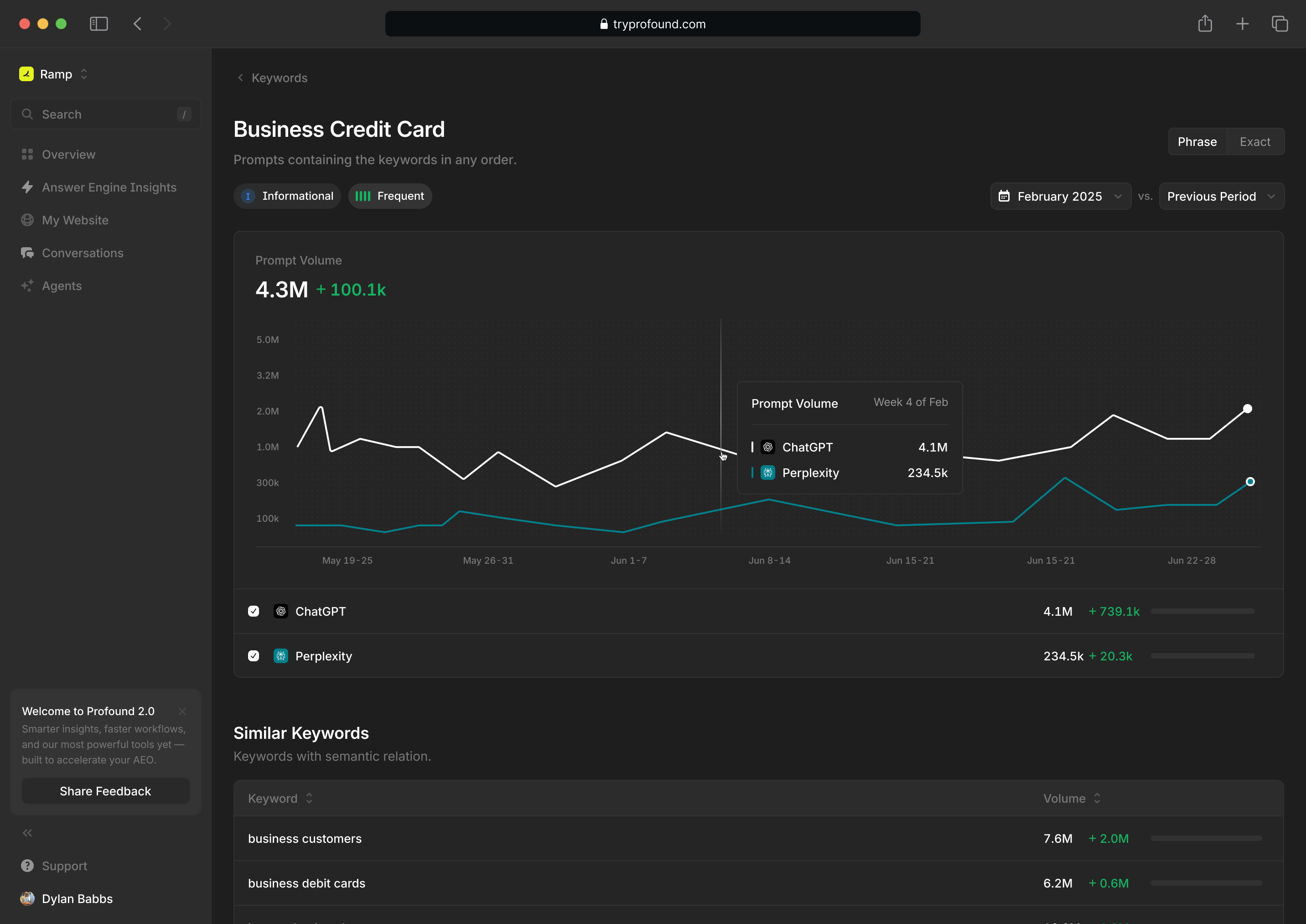
Prompt Volumes shows you exactly how often real users are asking about your category—broken down by platform, so you know where the demand lives.
As for the data collection methodology, Profound runs prompts through the front-end browser instead of API calls. This distinction is less technical than it sounds, but has far-reaching implications on the quality of you data. API responses and front-end responses from the same LLM can differ because the front-end experience reflects the full model behavior that real users encounter, including any interface-level context. Running prompts the way users actually run them means the visibility data reflects what's really happening, not an approximation of it.
Profound vs. Scrunch: From insights to action
Visibility data has little value sitting in a dashboard. The measure of an AEO platform isn't just how clearly it shows you where you stand, but how directly it helps you influence it. Both Scrunch and Profound have moved beyond pure monitoring, but what "taking action" means inside each platform is quite different.
Scrunch: Monitoring and recommendations with limited execution tools
Pros:
- Insights tab surfaces actionable recommendations
- Site auditing identifies crawlability issues: robots.txt problems, JavaScript-heavy pages, missing metadata
- Agent Experience Platform (AXP) serves AI-optimized content versions directly to AI agents without changing what human visitors see
Cons:
- Content execution is thin: Core plan allows 1 page optimization per month; content generation is listed as "coming soon"
- No customizable content workflows, no drag-and-drop automation builder
- No library of proven AEO content templates
- The gap between insight and published content remains largely manual—teams still have to leave the platform to create and iterate at scale
Scrunch's monitoring and auditing capabilities are solid. The dashboard gives teams a clear picture of brand presence across AI platforms, citation trends, and how they stack up against competitors. The Insights tab goes a step further by surfacing specific recommendations rather than leaving teams to draw their own conclusions from raw data.
The Agent Experience Platform is also worth calling out: the ability to serve AI-optimized content versions directly to AI agents, without touching the human experience of the page, is a technically meaningful feature that most competitors haven't built.
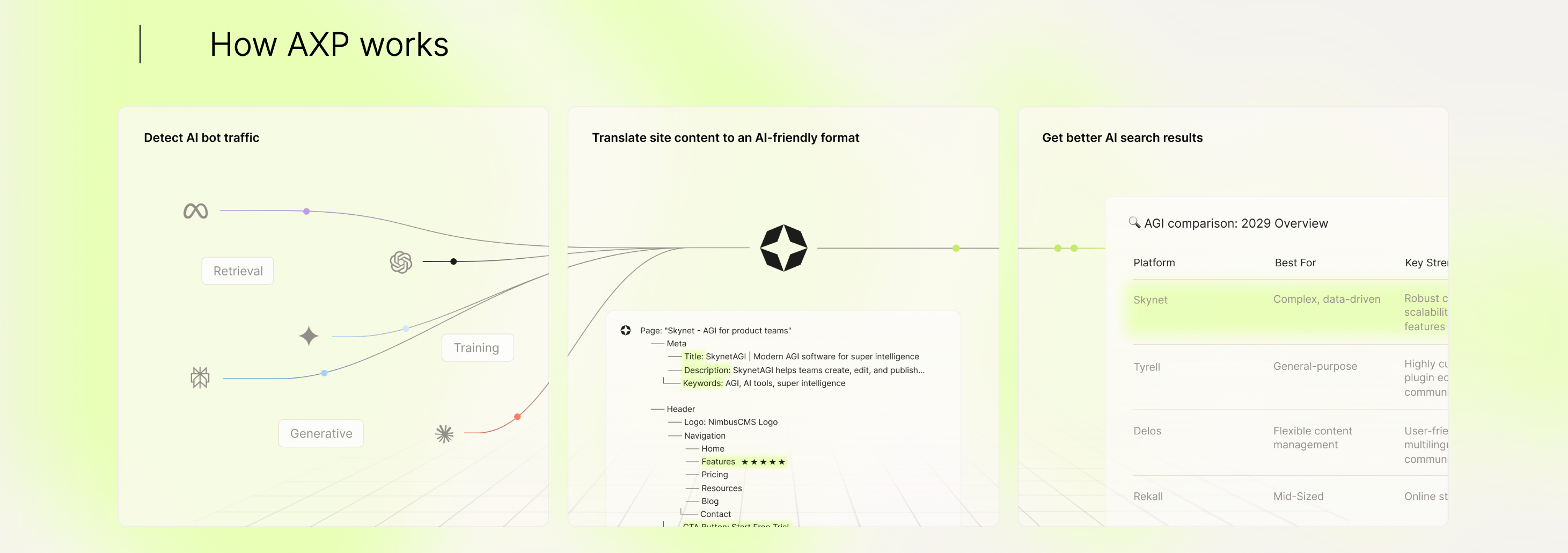
Scrunch's Agent Experience Platform detects incoming AI bots, rewrites your content into a format they can actually use, and serves it back—without touching what human visitors see.
The execution layer is where things stall. Scrunch currently offers one page optimization per month on its Core plan, with content generation listed as "coming soon." There's no workflow builder, no content template library, and no mechanism for running content creation as an automated, repeatable process inside the platform.
In practice, Scrunch is useful for identifying what needs to change, e.g., which pages have crawlability issues, which topics are underrepresented, which competitors are being cited in your place. But acting on those findings means exporting the insight and going somewhere else to do the work. For a small team running a handful of pages, that's manageable. For an enterprise team trying to produce and optimize content at scale across dozens of topic clusters, the manual handoff adds up fast.
Profound: A full content production and self-learning pipeline
Pros:
- Profound Agents automates the full cycle, from content gap identification to creation, optimization, and publishing, within a single platform
- Drag-and-drop builder requires no technical expertise; any team member can build and launch content automations
- Template library built on data from millions of the most-cited pages across AI platforms: AEO Content Refresh, FAQ Generator, Content Optimization Suggestions, and more
- 16+ reasoning models plus deep research capabilities power content generation — not generic outputs
- Answer Engine Insights and Agent Analytics track which content gets cited by which LLMs, feeding that data back into content recommendations in a closed loop
Cons:
- Content generation is gated to Growth and Enterprise plans
- The full value of the feedback loop requires time and published content volume to accumulate meaningful citation data
With Profound Agents, teams can move from identifying a content opportunity directly to building an automated workflow that generates, optimizes, and prepares that content for publishing without leaving the platform.
The template library is built on analysis of millions of pages that are being cited in AI responses, which means the structural choices baked into each template reflect what answer engines demonstrably reward. A drag-and-drop builder empowers marketers to build and run their own bespoke workflows, easily and without waiting on dev resources.
The biggest differentiator in Profound's approach to content creation is the feedback loop. When you publish a piece of content, Profound tracks whether AI crawlers access it, whether it gets cited in responses, and for which prompts. That data feeds back into what the platform recommends you create next. So the more you publish, the more signal Profound has about what earns citations, and the more precisely it can direct your next piece of content toward where you're most likely to win.
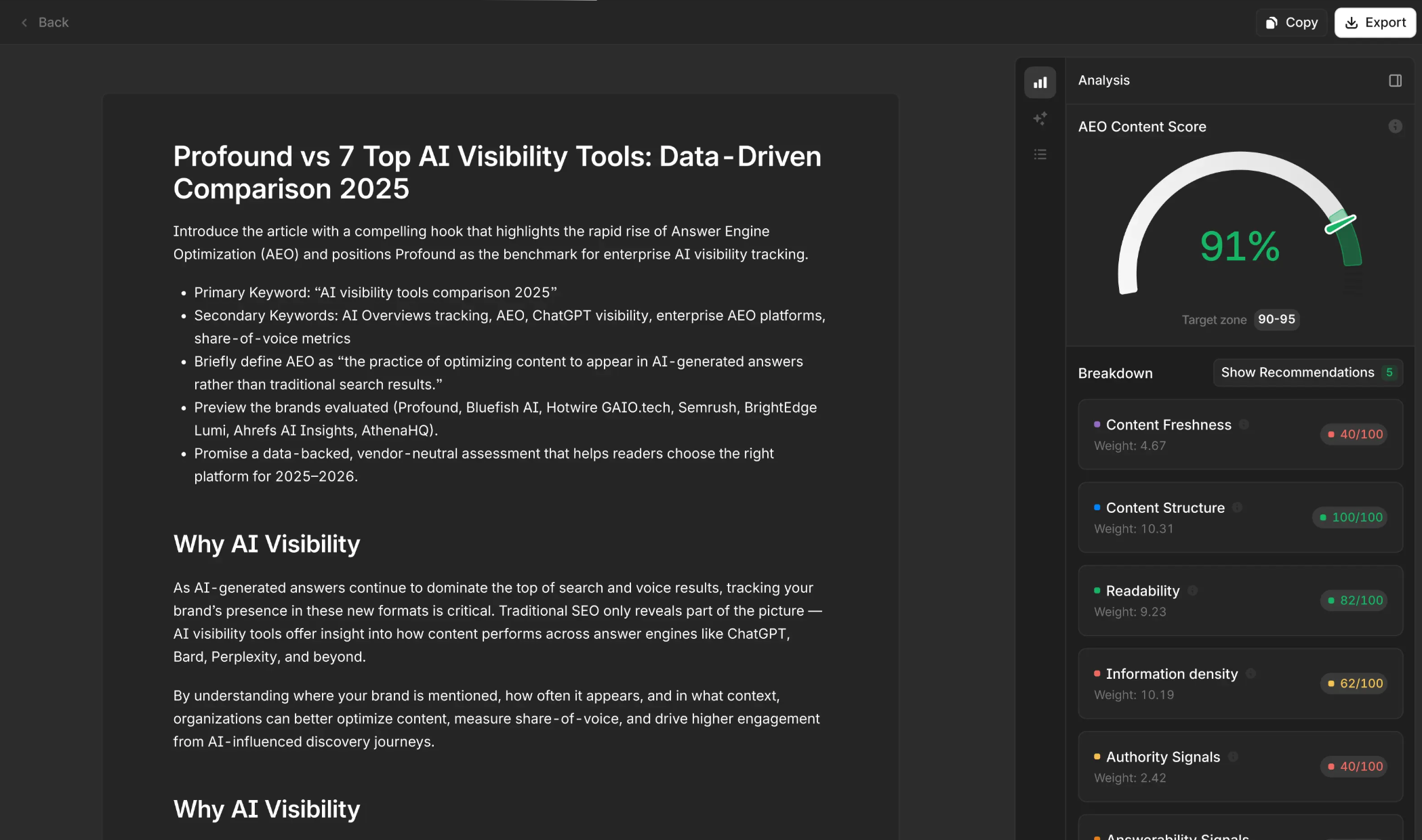
Profound Agents scores your content against AEO criteria and surfaces exactly what to fix before you publish.
Users heap praise on Agents, and have enthusiastically adopted the feature across the entire organization. One reviewer explained how Agents gave their team the ability to "translate insights into scalable, repeatable strategic action" rather than treating each piece of content as a one-off exercise. Another described it as a "major unlock" that became a cornerstone of their marketing strategy and the organizing mechanism for how their team works.
Profound vs. Scrunch: Agent analytics and ROI attribution
Publishing AEO-optimized content is a starting point, not an outcome. The harder question is whether that content is being picked up by AI systems, and whether the investment is producing anything a CFO would recognize as a result.
Scrunch: AI bot traffic monitoring with CDN integrations
Pros:
- Tracks AI bot activity through direct CDN and hosting integrations
- Distinguishes between training bots, indexer bots, and retrieval bots
- Tracks AI referral traffic alongside bot activity, giving teams a side-by-side view of human visitors arriving from AI platforms versus AI crawlers reading the content directly
Cons:
- Bot traffic monitoring and content recommendations operate as separate systems—there's no automated loop between what AI bots are reading and what content should be created or updated next
- Teams have no proactive mechanism to detect when AI models are outputting wrong information about their brand
- Attribution stops at traffic visibility; there's no direct connection drawn between AI crawler behavior and downstream business outcomes
Scrunch's bot tracking is useful, providing insight into which AI platforms are crawling your site, how often, and what they're prioritizing. The distinction between training bots, indexer bots, and retrieval bots is especially practical—a retrieval bot accessing a page suggests that content is in active consideration for AI responses; a training bot visit is a different signal entirely, with different implications for what to do next.
The AI referral traffic view adds another layer, as teams can see not just which bots are reading their content, but which AI platforms are sending human visitors as a result.
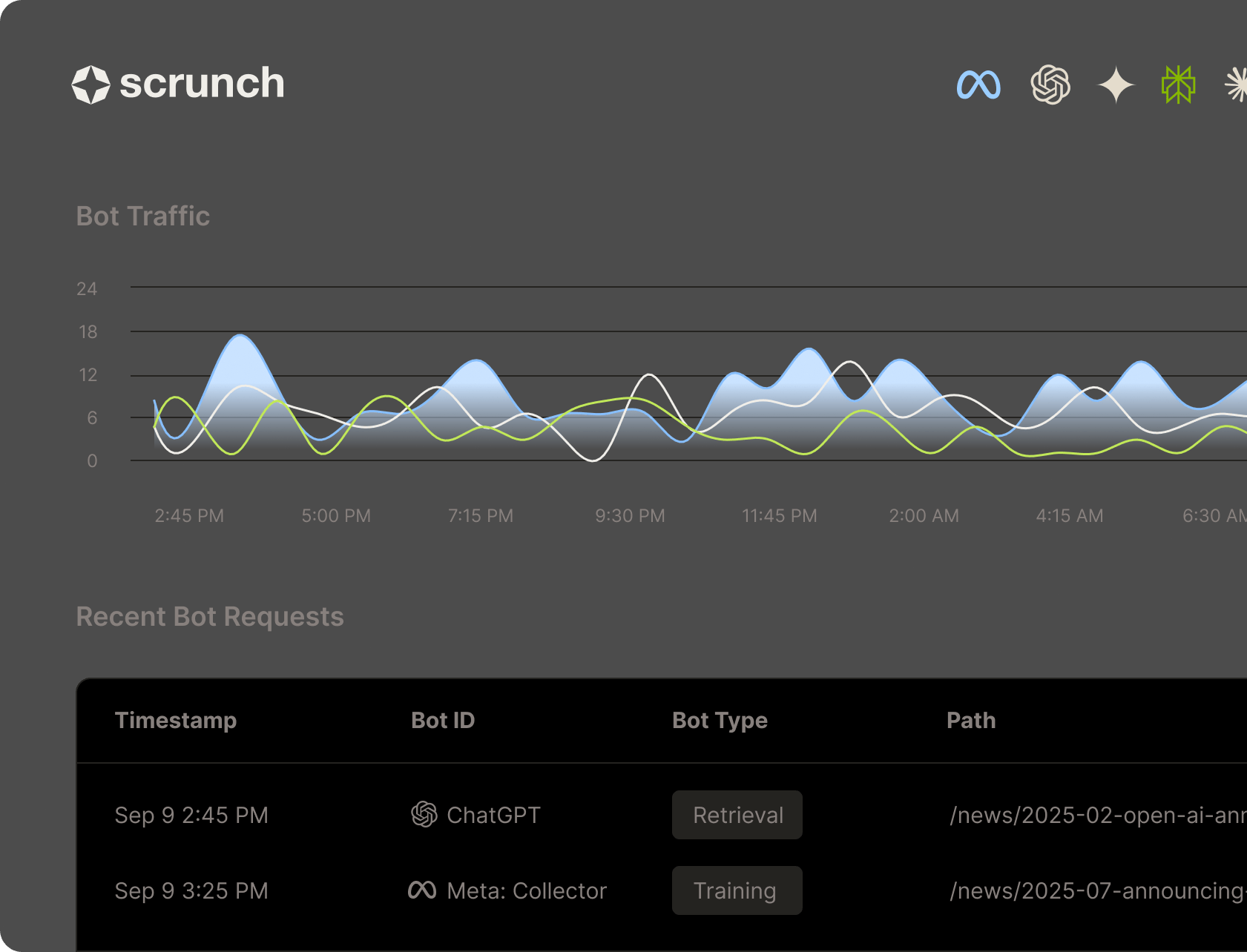
Scrunch's bot traffic view shows which AI platforms are crawling your site, how often, and what they're looking at—broken down by bot type.
Where Scrunch's agent tracking stops short is in what it connects to. The crawl data sits in its own view, the content recommendations sit in the Insights tab, and the optimization workflow sits outside the platform. There's no mechanism that takes what Scrunch learns about which pages AI bots prefer (or avoid) and feeds that directly into a content generation or optimization queue.
Teams have to draw connections manually, which is fine when volumes are low, but becomes a constraint when you're managing content across dozens of topic clusters. There's also no equivalent to an accuracy monitoring layer.
Profound: CDN-level attribution with a self-improving feedback loop
Pros:
- Agent Analytics uses CDN-level integrations (Akamai, AWS, Cloudflare, Fastly, and more) plus GA4 to track AI crawler behavior and its influence on human traffic in one place
- Teams can see which pages AI models prefer, identify technical barriers blocking crawler access, and submit content directly to address those gaps
- Crawler behavior data feeds back into content recommendations—the analytics and the content layer are connected by design
- Connects AI visibility directly to business outcomes, giving enterprise teams a credible narrative for C-suite reporting
Cons:
- Full GA4 integration setup requires some technical configuration, which adds onboarding time for teams without dedicated technical resources
- Attribution clarity improves over time as content volume and crawler data accumulate, so newer accounts see less signal
Profound's Agent Analytics answer the question that comes after the monitoring dashboard and optimization efforts: did any of this work?
CDN-level integrations with Akamai, AWS, Cloudflare, Fastly, and others mean Profound can see precisely when AI crawlers access content, which pages they prioritize, and how often they return. The GA4 integration adds the human traffic dimension, so you can trace the line from "AI model cites this page" to "human visitor arrives from that AI platform" to "conversion event." That's a measurement story that holds up in a budget conversation.
The architectural difference from Scrunch is that none of this lives in isolation. When Agent Analytics identifies that a particular page is being consistently accessed by retrieval bots but isn't surfacing in brand citations, that’s an input into content recommendations. When a page earns citations across multiple LLMs, that pattern informs the templates and content structures Profound prioritizes for future generation.
The loop is closed by design: observe crawler behavior, adjust content strategy, measure citation impact, repeat. Teams don't have to manually connect those dots because Profound is designed on the assumption that they're the same workflow.
Profound vs. Scrunch: Resources, innovation speed, and expertise
AEO is moving faster than almost any marketing discipline in recent memory. New LLMs launch, answer engine behavior changes, shopping integrations appear overnight. The resources behind a platform determines whether it keeps pace with that change or falls behind it while customers wait on a "coming soon" roadmap.
Scrunch: A funded startup with strong product velocity
Pros:
- $26M raised with meaningful product delivery
- 500+ brands served, suggesting real market traction and a responsive product team
- SOC 2 Type II compliant with enterprise-grade security: SAML/OAuth SSO, RBAC, GDPR and CCPA compliance
Cons:
- Operates at significantly smaller scale than Profound—team size is undisclosed but the feature disparity reflects it
- Content Generation, Query Fan-out, MCP Access, and CLI Access are all listed as "coming soon" on the pricing page —capabilities Profound already has in production
- Core plan is limited to 4 LLMs, 1 country, 2 languages, and 125 prompts
- 72 G2 reviews versus Profound's 300+, reflecting a narrower base of verifiable customer experience
Scrunch has built a solid product with good features, and the $26M in funding gives them room to build.
The concern is what the roadmap tells you about where the platform sits in its maturity curve. Content Generation, Query Fan-out, MCP Access, and CLI Access are all listed as "coming soon." If you're evaluating an AEO platform as a long-term investment, the distinction between "this is a roadmap commitment" and "this is in production today" is of extreme importance. You're betting on where the platform will be in 12 months, not just where it is now.
Profound: The people, the funding, and the AEO experts
Pros:
- ~150 person team employing 19 of the 20 recognized experts in the AEO space
- Engineering team includes alumni from OpenAI, Uber, Datadog, and Microsoft
- $96M Series C at a $1B valuation, backed by Sequoia, Kleiner Perkins, NVIDIA Ventures, and Khosla Ventures
- Ships product updates at a pace unmatched in the category
- Enterprise plan includes up to 10 answer engines, dedicated Slack support, SSO/SAML, SOC 2 Type II, and HIPAA compliance
- 300+ G2 reviews at 4.6/5, the largest verified review base of any pure-play AEO platform
Cons:
- At this scale and price point, Profound is built for enterprise—smaller teams or limited budgets may find it more platform than they currently need
- The breadth of features means there's genuine onboarding investment required to use the platform at full depth
A $96M Series C means Profound can hire the people who define the category, not just follow it. The company currently employs 19 of the 20 recognized AEO experts in the market, and the engineering team includes alumni from OpenAI, Uber, Datadog, and Microsoft.
That talent concentration shows up in product velocity. For instance, when OpenAI released shopping features, Profound had ChatGPT Shopping support live within weeks. HIPAA compliance, 30+ language support, WordPress and GCP integrations for Agent Analytics, and the Profound Index AI visibility leaderboard have all shipped in recent months.
The G2 review base reflects Profound's place in the AI search landscape: 300+ reviews at 4.6/5 is the largest verified signal of customer experience in the pure-play AEO category
Profound vs. Scrunch: Strategic partnership, support, and guidance
In a discipline where so many companies are still working out the fundamentals, the support model behind an AEO platform is often the difference between a tool that's used strategically and one that’s used to produce reports nobody acts on.
Scrunch: Self-serve with tiered enterprise support
Pros:
- Enterprise plan includes email and Slack support, strategy and review calls, a dedicated account team, and exec-level reporting
- Agency Partner Program is well-developed: up to 20% referral commission, prospecting licenses, dedicated GTM support, and co-marketing funds — a strong model for agencies building AEO into their service offering
Cons:
- Core plan support is email-only—teams learning AEO from scratch are doing so without dedicated guidance
- No equivalent to a dedicated AI strategist for non-enterprise accounts; strategic support is gated behind the top pricing tier
- Self-serve onboarding in a new discipline means teams bear the cost of trial and error themselves
Scrunch's tiered support model is straightforward: get started on Core, scale to Enterprise when you need more hands-on guidance. For teams with existing AEO expertise who primarily need a capable monitoring tool, the self-serve path is fine.
The Agency Partner Program is genuinely well-constructed, with referral commissions, prospecting licenses, and co-marketing support giving agencies good incentive and infrastructure to build Scrunch into client engagements.
The limitation surfaces for brands that are newer to AEO and don't yet have in-house expertise. Learning a new discipline and a new platform simultaneously, on email-only support, with no dedicated strategist to help prioritize tasks is a slow and expensive way to find your footing.
Mistakes made in the early months of an AEO program (wrong prompt selection, misread visibility data, content that doesn't match actual user intent) compound over time. The self-serve model puts the cost of those mistakes entirely on the customer.
Profound: Dedicated engagement manager and AI strategist for every customer
Pros:
- Every customer receives a dedicated engagement manager and AI strategist from day one
- Dedicated Slack channel with up to 5-minute SLA for enterprise accounts; support team includes backgrounds in SEO, marketing, and consulting
- Support operates as a strategic extension of the customer's team: competitive intelligence sharing, tailored AEO strategy, content prioritization guidance
- Profound University provides structured training resources for teams building internal AEO capability
- Support proactively flags platform updates, new LLM developments, and strategic opportunities customers may not yet know to ask about
Cons:
- The depth of the support model is built into Profound's pricing, which sits meaningfully above Scrunch
- High-touch support works best when customer teams are engaged; teams that want a hands-off tool relationship may not fully use what's available
Profound's support model was conceived around a simple premise: most marketing teams don't have an AEO expert on staff yet, and the platform is only valuable if it’s used strategically. As such, every customer gets a dedicated engagement manager and AI strategist, providing, as Ronak Patel, Head of Marketing at CRS, explains "strategic counsel on how to adapt as answer engines evolve and how to optimize content for LLMs."
That's the intended experience, and the G2 reviews reveal it's the actual experience too. Multiple users describe the support relationship in almost identical terms: it feels like an extension of the team, not a vendor relationship.

Profound University gives your team structured AEO training, straight from the people building the category.
What makes this more than a service promise is the expertise behind it. The Profound team includes backgrounds in SEO, content marketing, and management consulting. They share competitive intelligence, help customers identify which prompts and content gaps will have the highest impact, and adapt recommendations as the AEO landscape shifts. The Profound University adds a self-serve training layer for teams that want to build internal capability alongside that guidance.
Profound vs. Scrunch: Final verdict
Scrunch is a legitimate AEO platform, with clean and orgnized monitoring dashboards, good competitive benchmarking, and AXP as a technically differentiated feature. At $250/month for the Core plan, it's an accessible entry point for teams that primarily need AI visibility reporting and are comfortable exporting insights to act on them elsewhere.
For enterprise brands, though, Scrunch isn't quite ready to meet the moment. The platform's AI Search Trends data is directional at the topic level, content generation is still not available, the team is smaller, and the funding is lower.
Profound, on the other hand, is purpose-built for enterprises:
- The 1.3 billion real user prompts powering Prompt Volumes give content teams demand signal that no topic-level estimate can replicate
- Profound Agents automate the full content production cycle, from gap identification to publishing, using templates built on data from millions of the most-cited pages across AI platforms
- Agent Analytics closes the loop between AI crawler behavior and content recommendations, so the platform gets smarter over time
- The company is propped up by a 150-person team that employs 19 of the 20 recognized AEO experts in the market, engineering alumni from OpenAI, Uber, Datadog, and Microsoft, and a $96M Series C at a $1B valuation.
That's why Ramp, Figma, Walmart, U.S. Bank, and DocuSign chose Profound, and it's why Profound holds the #1 ranking on G2 for AEO with 300+ reviews.
If you're ready to build a mature AEO program that scales alongside your company, book a demo with our team.
Profound vs. Scrunch FAQs
What's the main difference between Profound and Scrunch?
Both Scrunch and Profound monitor brand visibility across AI answer engines, but they diverge in data depth and execution capability. Scrunch offers solid monitoring dashboards, site auditing, and its Agent Experience Platform for serving AI-optimized content to AI crawlers. Profound adds 1.3 billion real user prompts powering Prompt Volumes, a full content production layer via Profound Agents, closed-loop Agent Analytics, and a dedicated AI strategist for every customer—making it a full AEO operating system rather than a monitoring tool.
Which platform is better for enterprise brands, Profound or Scrunch?
Profound is purpose-built for enterprise scale. It supports up to 10 answer engines, custom prompt tracking, 30+ languages, HIPAA compliance, SSO/SAML, SOC 2 Type II, and a dedicated support model that includes an engagement manager, AI strategist, and dedicated Slack channel.
Scrunch's Core plan is capped at 4 LLMs, 1 country, and 125 prompts, with several enterprise-relevant features still listed as "coming soon." Enterprise brands with complex AEO programs, multiple markets, and C-suite reporting requirements will find Profound significantly better equipped.
What's the difference between Profound's prompt volumes and Scrunch's AI Search Trends?
Scrunch's AI Search Trends estimates AI search volume at the topic level using third-party data. By Scrunch's own description, this data is "directional, not exact"—teams can see which themes are trending, but not which specific prompts carry real demand. Profound's Prompt Volumes draws from 1.3 billion real user conversations with answer engines, broken down by intent, age, income, and region. Teams can see exactly which prompts have the highest actual search volume, not an approximation, and use that data to prioritize content decisions with precision.
How does Profound's front-end querying differ from Scrunch's data collection?
Scrunch uses a combination of browser automation and official platform APIs to collect AI responses. Profound runs all prompts through the front-end browser, not through API calls. API responses and front-end responses from the same LLM can differ since the front-end reflects the full model behavior that real users encounter. Front-end querying produces visibility data that mirrors exactly what your customers see when they ask AI engines a question about your category. That's the experience you're trying to influence, so it's the one worth measuring.