

For most of the past two decades, search was a predictable machine. Content and links in, rankings and traffic out.
What feels like a century ago, we were able to do beautiful forecast models that would get us within firing range of actual traffic numbers. Even sometimes conversions.
That predictability is gone. Not because tactics changed (they always do), but because the fundamental assumptions about what search is have changed. Ask ten people what's happening, and you'll get eleven answers, half of them with a sales pitch attached.
If you're confused, you're in good company. Confusion might be the only reasonable response right now. But after enough years in the search trenches, we're confident about three things: search has irrevocably changed, you can make sense of why, and there's a way to work on it that isn't just flailing in the dark.
Why the SEO playbook only gets you halfway
SEO has one job: get your pages retrieved for the right queries. AI runs searches to build its answers, which means every dollar invested in SEO also pays forward into Answer Engine Optimization (AEO).
But the output has changed. Where a ranked list used to hand users a menu of options, now a synthesized answer hands them a recommendation. Not just a list, but a point of view. That structural difference is at the heart of how search now works and how you engage with it.
My best analogy: It's the difference between a library and a research assistant. SEO places your book on the right shelf where someone can find it. AEO makes sure the assistant pulls your book off the right shelf and reads from the chapter that's most relevant to you.”
Your brand is being described by sources you never managed
SEO is two-dimensional. You rank, or you don't. The whole industry was happy to wrap itself around that binary because it was measurable, and measuring it was enough. What third-party sites said about you wasn’t your problem. Maybe Brand’s, maybe Comms’, maybe nobody’s, depending on who drew the org chart that year.
AEO adds a third dimension: one that comes from those very sources nobody was keeping an eye on. AI builds a picture of you from every review, every comparison article, every forum thread that ever mentioned your name. What those sources say gets pulled directly into the AI answer, which is why you can show up and still lose. "Company X is solid, though it tends to suit smaller teams better." The user didn't hunt for that qualification. It arrived, unbidden, and might have cost you an enterprise deal.
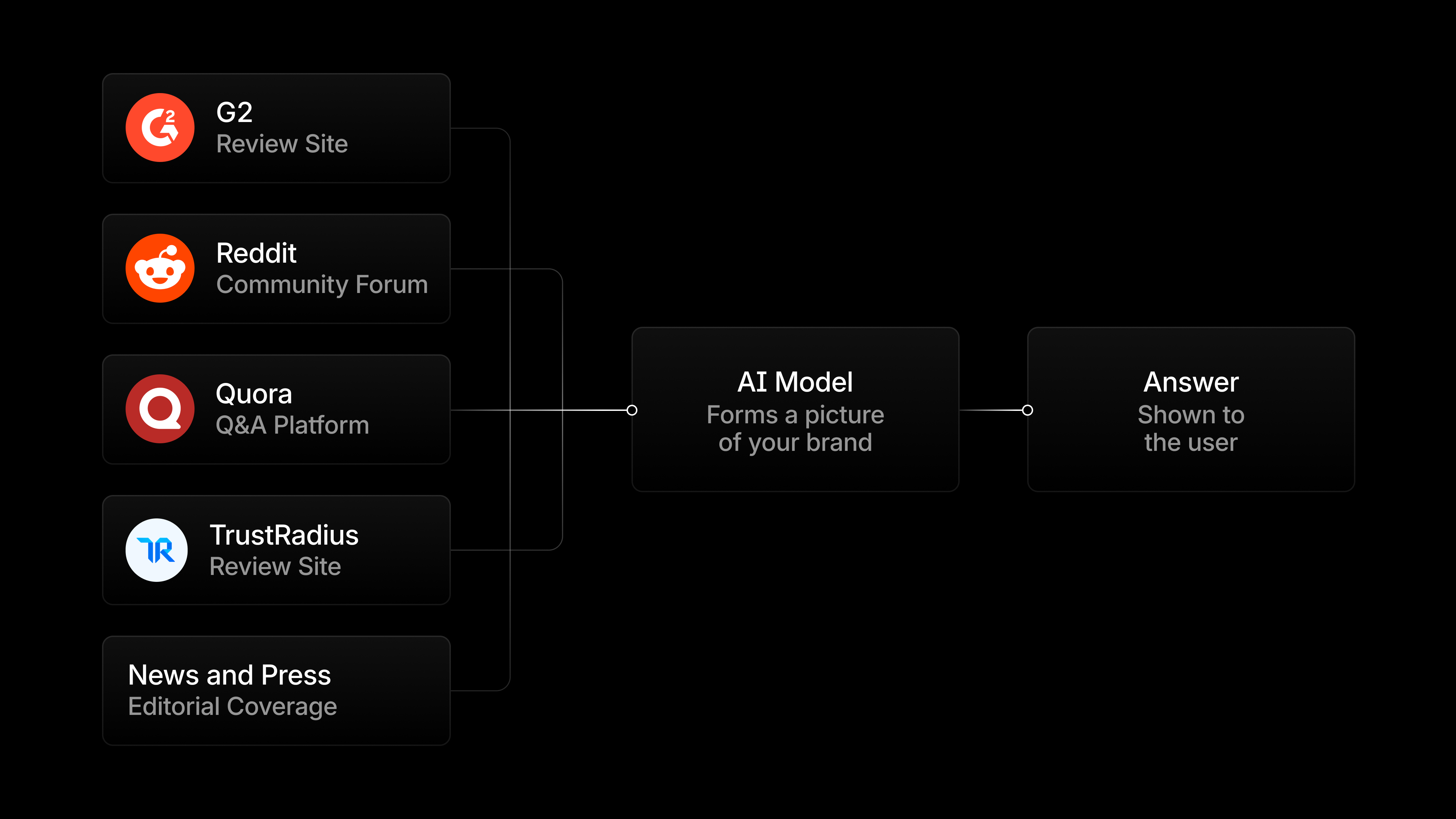
The renewed importance of third-party sources catches companies off guard. Those pages were rarely, if ever, on anyone’s radar. After all, a disparaging comment in a Reddit thread was only a problem if someone found it. Now it’s a problem just by existing.
The main difference between SEO and AEO is the goals you want to achieve. While the fundamental practices overlap heavily, just as when you might change tactics for different SEO goals, you'll also shift your tactics with AEO. Knowing that LLMs are looking for consensus across the internet, your tactics should prioritize web-wide efforts, consensus, and brand knowledge and accurate positioning, as well as keeping your website the most fresh and up-to-date version of your brand positioning as possible.”
AI Search reaches far and wide
There's a common misconception that AEO means optimizing for ChatGPT, but AI answers now exist inside every platform where people look for information, including Google, which is still where most of organic traffic comes from. Google AI Mode and AI Overviews surface synthesized answers alongside blue links, sometimes instead of them. The “SEO vs. AEO” framing implies a platform choice, but Google alone disproves it. Two fundamentally different ways of delivering information are happening in the same place, to the same users, at the same time.
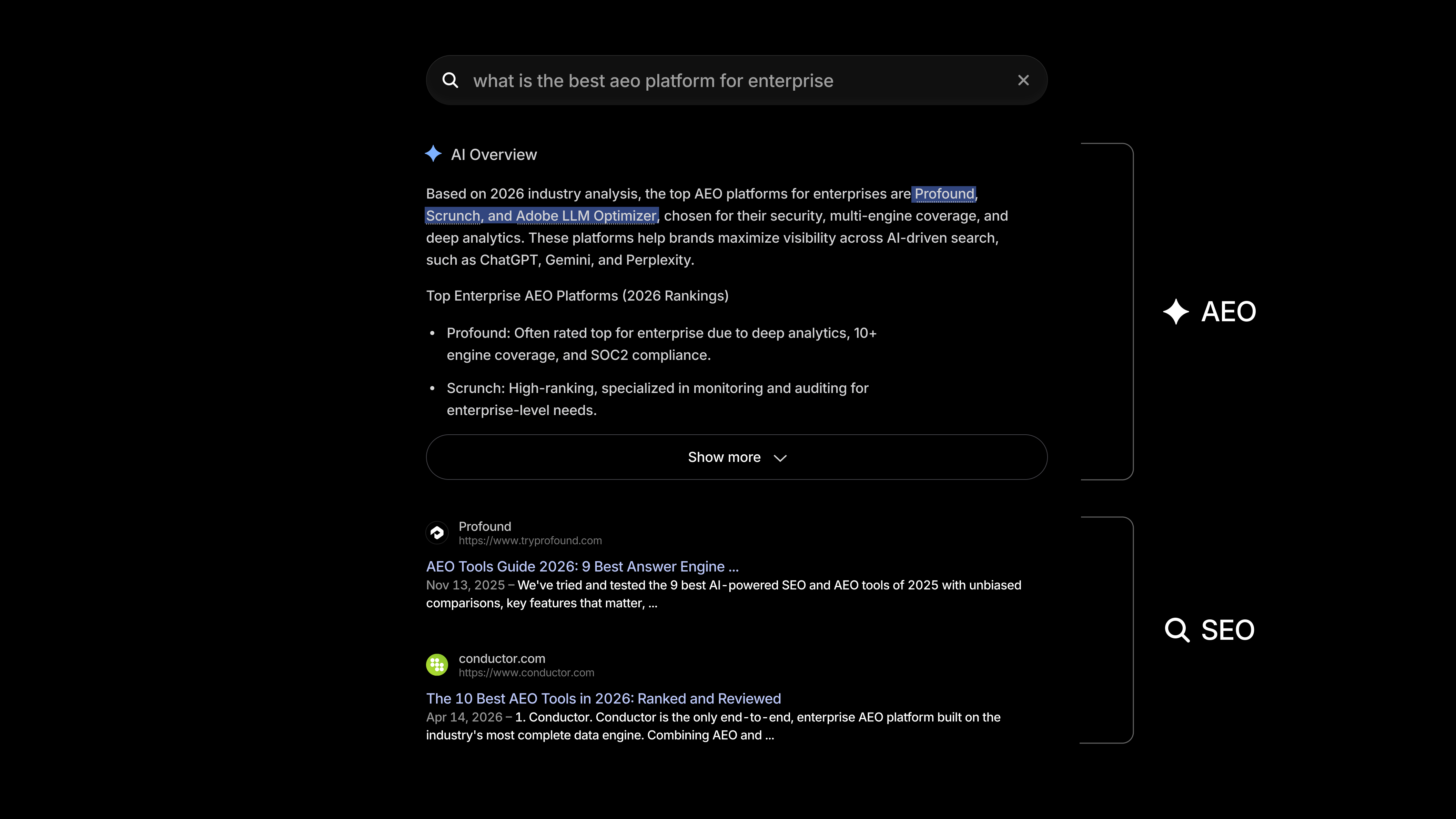
Most major platforms have strong financial incentives to make AI answers central. For ChatGPT and Perplexity, AI answers are the product, and their whole business is built on it, they didn’t start with another model.
Google is the interesting exception. ChatGPT and Perplexity built AI answers from the ground up. Google is folding them into a search experience billions of people already use every day, and doing it at scale. AI Mode has hit massive adoption and shows no signs of slowing down. Rather than treating AI Search as a separate product, Google is merging AI Overviews and AI Mode into a single seamless flow and building out features like background agents, a generative UI, and personal intelligence that connects to your Gmail and Photos. The message is clear: AI isn't a layer on top of search anymore, it is search.
Every search is now long-tail
In the traditional search era, users had to translate their intent into something the engine could parse. You didn't type “I'm a 20-person agency in San Francisco looking for a CRM that integrates with Slack, costs under $200 a month, and handles client reporting.” You probably typed “best crm” or (at most) “best CRM for agencies” and did the filtering yourself. That compression was a learned behavior, so ingrained that most of us stopped noticing we were doing it.
AI took the compression out of the equation. Now you can hand over the whole, messy, unsimplified version of your question and get a synthesized answer back. That behavioral change compounds through three forces that make every search long-tail by default:
- People ask more specific questions (or “prompts”) because they don’t have to compress every query into a keyword.
- AI asks follow-up questions when a user’s question/prompt doesn’t include enough detail to provide a strong answer.
- Personalization is beginning to fill in context that the user never provided, tailoring answers to what the system already knows about them.
Here’s an example of Claude taking a basic question - “What is the best AEO platform for a SaaS enterprise level business looking to improve third-party citations?” - and then insisting on asking the user a follow-up question to give them a tailored, personalized answer.
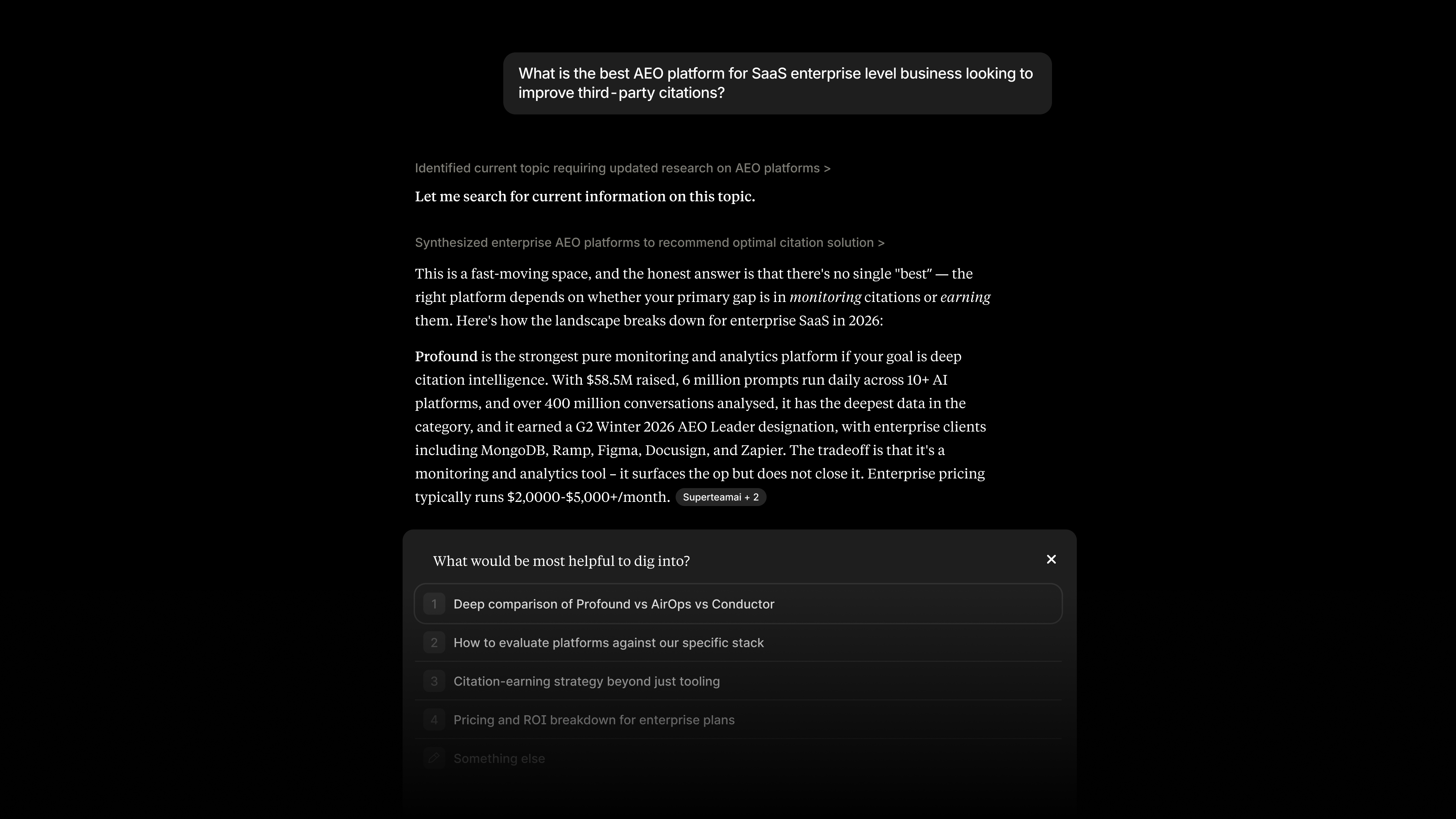
That’s a completely different research process and a different way to think about content. One that demands a much deeper relationship with your own customer data.
In SEO you had keywords. In AI Search you have all the different ways people phrase things, ask questions, and dig for answers. Verticalized buyer guides. Persona-based buyer guides. The variations are close to endless, because AI Search is far more nuanced than a single Google query ever was.
For search professionals, that's a real challenge. But it's also exciting! We got too comfortable for a long time, and this puts us back in the trenches, forced to rethink the approach. I'm here for that.”
We’ll dig more into this in Chapter 2.
The clean line from rankings to revenue broke
The goal of SEO has remained more or less unambiguous, and so has the way we measure it. Rankings led to traffic, traffic led to revenue. You could build a forecast model and trust it.
The biggest shift is moving from attribution to triangulation. With SEO, measurement was relatively clean. You ranked for a keyword, someone clicked your result, they landed on your website, and you could follow that path through Google Analytics, HubSpot, or whatever attribution system you were using. It wasn't perfect, but there was a clear clickstream.
With AEO, that clickstream starts to break down. A brand may get mentioned in an AI answer without a link. Someone may ask ChatGPT, Claude, or Google's AI Mode for recommendations, evaluate a few vendors there, and then come to your site directly days later. By the time they convert, the original source of influence is often invisible because it didn't produce a click to your site.
The measurement mindset has to change. We still look at traffic and conversions from AI tools when we can see them, but that's only a small piece of the picture. More often, we're combining multiple directional signals: brand visibility in tools like Profound, self-reported attribution on demo forms, Gong call transcripts where buyers mention how they found the company.
None of those signals are perfect on their own. Prompt-tracking tools are useful, but they're synthetic. Most of them test single-turn prompts, while real AI research is often multi-turn, messy, and personalized. Self-reported attribution is imperfect too, but it gives you a window into what buyers remember and what actually influenced them.
So the big shift is accepting that AEO is not going to fit neatly into the old click-based attribution models. The goal is to build enough evidence across visibility data, buyer-reported data, sales-call data, and traffic data to understand whether AI Search is influencing pipeline.”
With AEO, there’s no single metric to point at and say, “we did it.” And even if there was, tracing it back is its own problem. An AI answer surfaces, the user closes the tab, comes back three days later on a different device, and converts. By then, the attribution trail is stone cold.
The latter isn't unique to AEO, of course. Dark social, zero-click search, and podcast influence have been fragmenting attribution for years; it's just that AI Search makes it unavoidable in ways SEO could sidestep.
AI Search isn’t the black box it was two years ago. Visibility, citation share, sentiment, and even AI accuracy are measurable. The line-to-revenue model still requires more inference than before, but the bones are there.
Companies building baselines now will have something to measure against when the infrastructure catches up, but if you wait for perfect attribution, you'll be starting from zero at a moment when everyone else has years of data on you.
Where your AEO strategy starts
Here’s the good news: you can take everything you now understand about how search has changed and crystallize it into an AEO strategy you can confidently run.
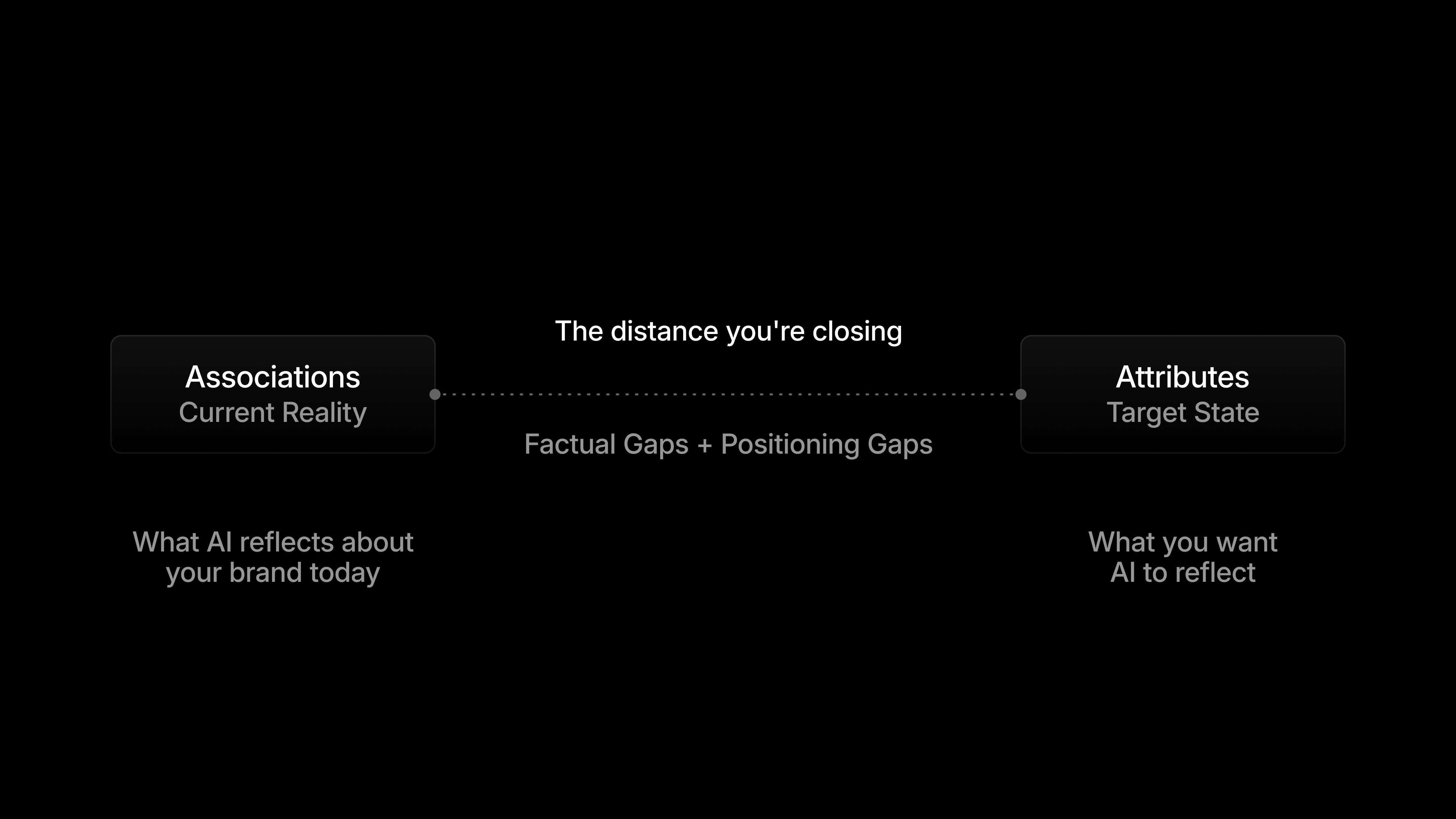
The distance you're closing
We've established that AI has a view of your brand, and what it says may or may not match what you want it to say. We like to use two terms to hold that tension:
- Your associations are what AI currently reflects about your brand. This works across two dimensions: whether AI includes you in a given answer at all, and how it characterizes you when it does. Together, they represent the web-wide view of your brand as it stands today, shaped by every source contributing to the aggregate. In the SEO-only era, the unit of measurement was the ranking. In AEO, rankings are still one input, but they sit inside the larger question of what AI associates with your brand. Associations have displaced rankings as the unit of measurement.
- Your attributes are what you want those associations to reflect: the specific characteristics within user prompts you need to be known for, the ICP you serve, the pain points you solve, the use cases where you win. If someone asks which platform suits a senior content manager at an enterprise, your attributes are what determine whether you come up in that answer. They're the target state.
One of AEO's goals is precisely to resolve that mismatch.
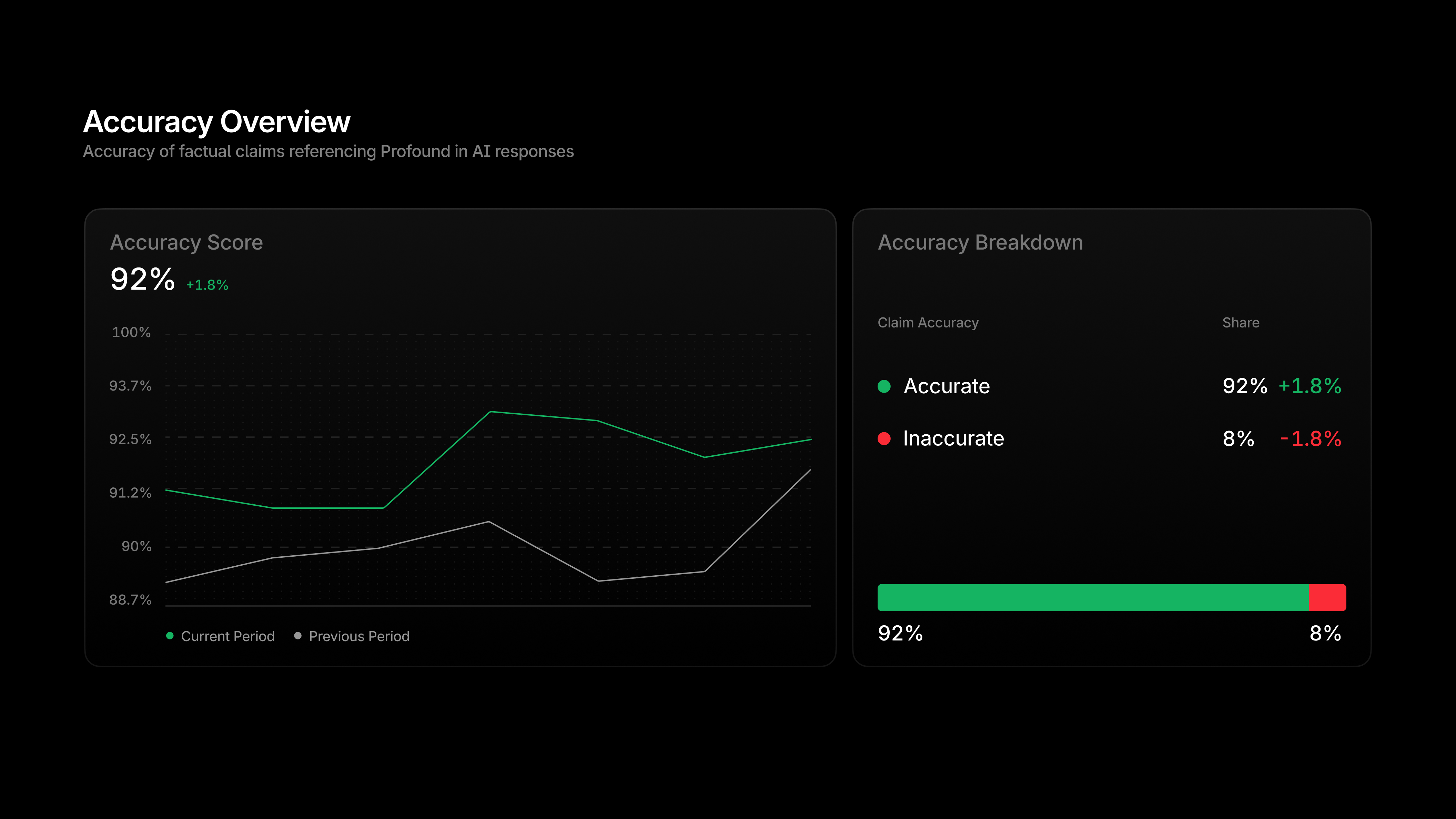
Now, there are two ways AI can get your brand wrong. The first is factual: it says you don't integrate with a tool you do, misrepresents your pricing, or describes a capability you've had for two years as something you're "working on." That kind of error is findable and fixable.
The second is subtler and harder to catch. The facts may or may not be technically right, but the overall picture doesn't reflect who you are or why you’re the best choice. Take a company that positions itself as a creative operations platform on every owned surface, but review sites call it "digital asset management software" and a comparison article describes it as "a Dropbox alternative for creative teams." None of those descriptions is false, exactly. But none of them reflect the positioning either. AI synthesizes it all into a blended answer, and what comes back is a muddled version of a company that never made its own case.
With Profound’s FactCheck you can establish the baseline truth about your product or positioning, then see how AI Search platforms follow it (or don’t).
The problems you're solving
Knowing there's a distance between your associations and your attributes is the starting point. That gap can live in either dimension, visibility, sentiment, accuracy, or all, and what it takes to close it depends on which problem you're dealing with.
The first is authority: being credible and present enough to appear in AI answers at all. When someone asks "what's the best email marketing platform" with no other qualifiers, the answer invariably reflects brands with years of accumulated mentions, deep content footprints, and consistent positioning across the web.
Getting into that conversation is slow work. It compounds over time through consistency and volume, and there's no shortcut to it. For a company entering a new category, or one that's been inconsistent in how it describes itself, authority is the foundational problem, the thing that has to be working before anything else can.
The second is long-tail relevance: being understood specifically enough to win the prompts that drive customer decisions. When the question becomes "what's the best email marketing platform for DTC brands doing over $5M in revenue that need Shopify integration," years of accumulated authority don't automatically translate into a recommendation.
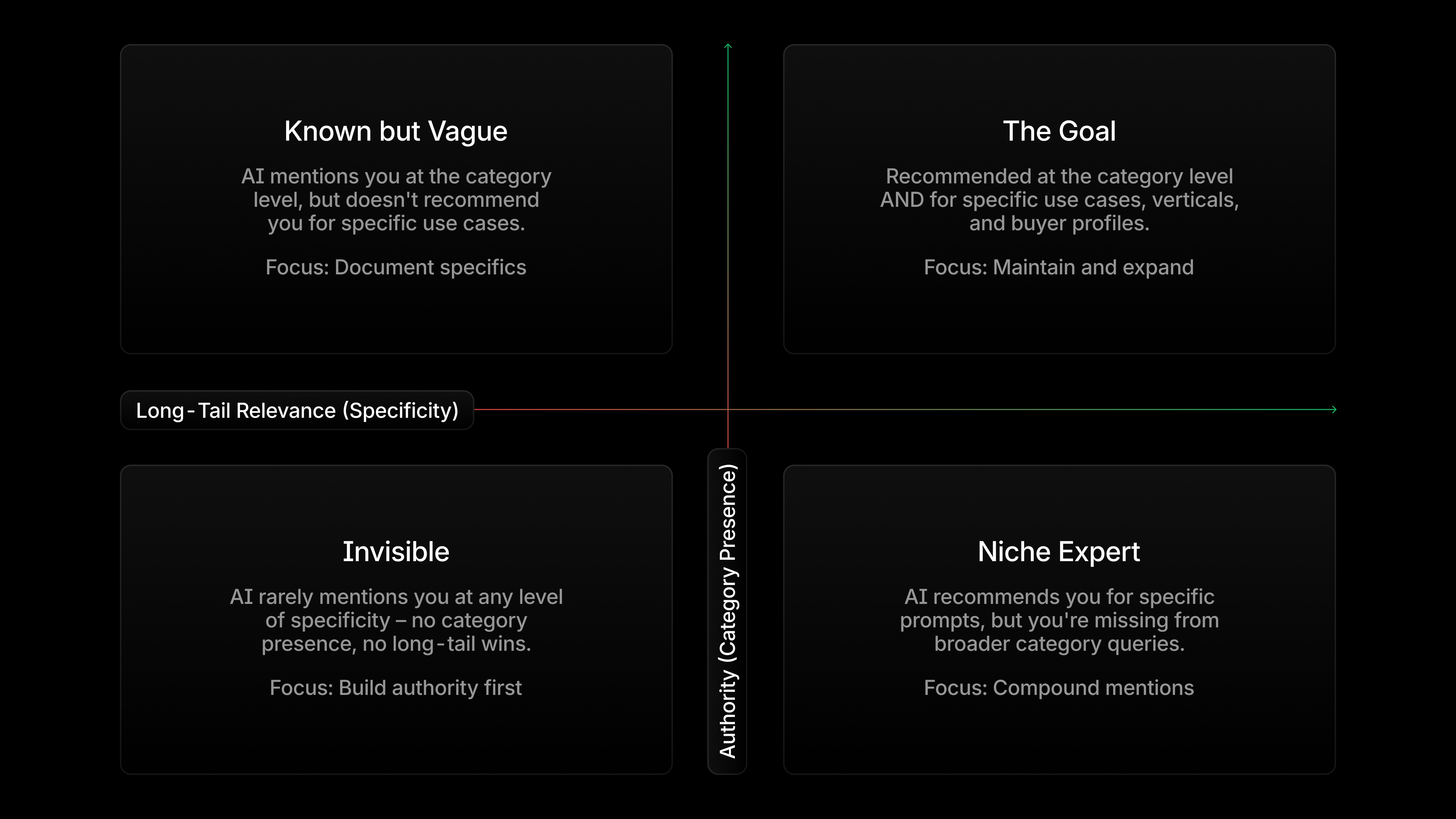
If there's no evidence a brand solves that specific problem and a competitor has a clear record of solving it, the answer changes. Long-tail relevance is built through specificity, your exact use cases, verticals, and capabilities documented in the language your buyers use when they're interacting with AI.
Both objectives are always in play. The question is which one is your biggest weakness, because that's where the work starts. A company with strong authority but poor long-tail documentation needs a different program than one that's deeply relevant in its niche but barely visible at the category level.
The framework to get started
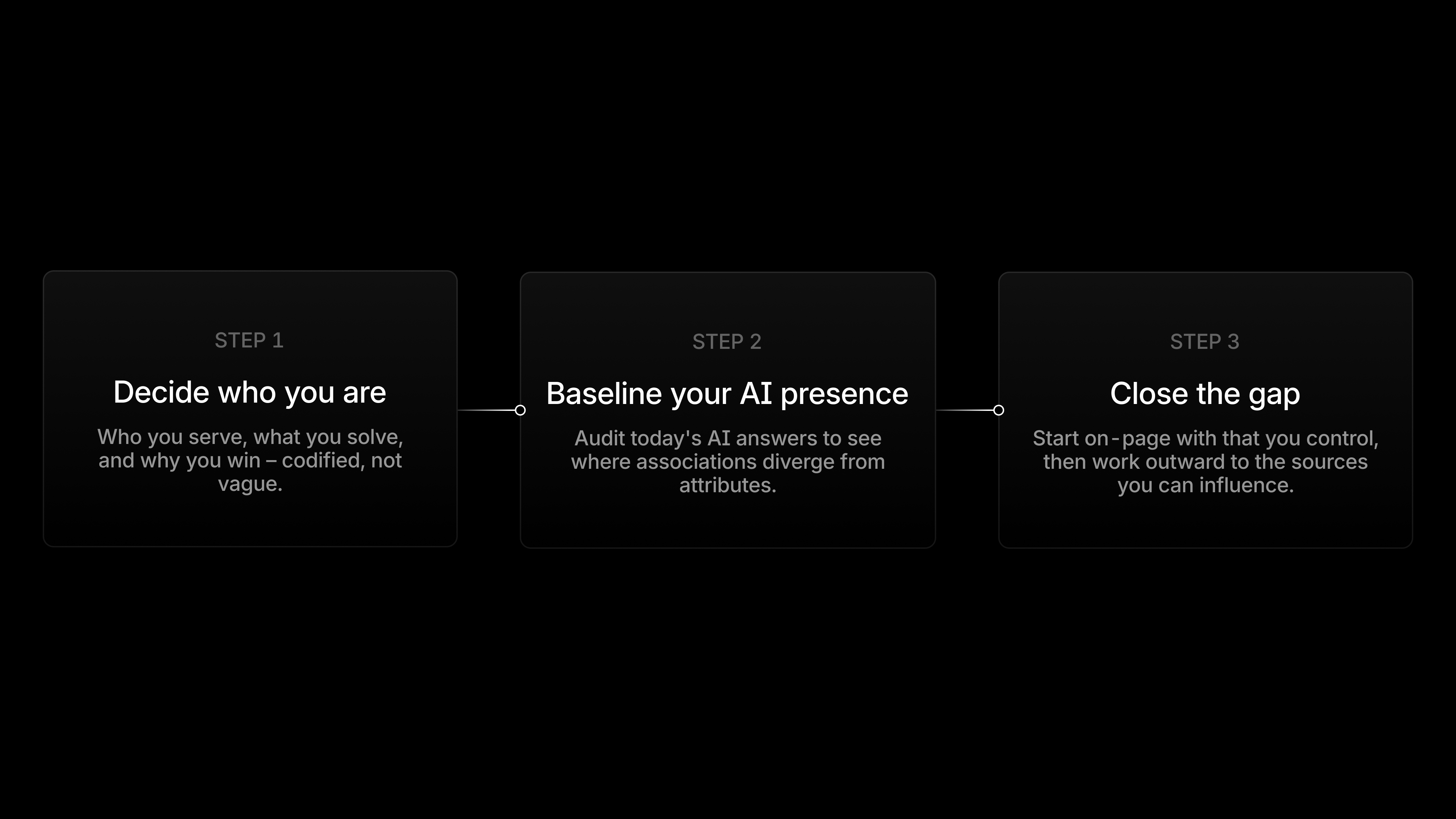
Once you know which problem is your priority, the work follows the same three steps regardless:
- Decide who you are and what you want to be known for. Not a brand workshop exercise, but a working answer to “who do we serve, what problems do we solve, and why do we win?” That clarity is the input for everything downstream. Without it, you can track every prompt in your category and still have no idea what to do with what you find. We'll go into more detail in Chapter 2.
- Baseline how your positioning performs in AI answers today. Ask the prompts your buyers are asking. See what gets said about you, how accurate it is, and where your associations diverge from your attributes. That audit is what tells you whether you have an authority problem, a relevance problem, or both, and how wide the gap is. We'll talk about prompts and audits in Chapters 3 and 4.
- Close the gap, on-page and off. Start with what you control, i.e., your own site, your messaging, your owned descriptions. Then work outward toward the sources you don't control but can influence.
Instead of "What do we want to be known for?" The goal is to find out "What are customers already giving us permission to claim?"
That matters for AEO because LLMs are consensus machines. The core AEO problem to solve is whether LLMs believe your brand belongs in the answer, and that belief is shaped by reputation, category alignment, and repeated confirmation across the web.
So I'd do a customer-language audit and use it to create a simple positioning evidence map:
Customer language: what buyers actually say.
Company language: what the website and sales deck say.
Third-party language: what reviews, affiliates, analysts, Reddit, and partners say.
AI language: how ChatGPT, Gemini, Perplexity, and AI Overviews describe the brand.”
The people who need to be in the room
As you begin assembling your AEO strategy, you’ll soon realize that it keeps touching teams that didn't ask to be involved.
Whether you like it or not, Answer Engines have become the go-to place for people to solve problems of every kind, not just buying decisions. That plays out across the org in different ways. Below is a non-exhaustive list of the teams that almost always end up touching an AEO program:
- Customer support finds AI fielding product questions before users ever make contact, and when the answers are wrong, support absorbs the fallout.
- Product marketing owns the positioning, messaging, and competitive narrative AI pulls from. If AI is mischaracterizing the product or losing competitive ground in the answer, PMM is upstream of the fix.
- Brand is responsible for the identity, the version of the company AI is supposed to reflect. Without that clarity codified somewhere, there's nothing for the rest of the program to measure against.
- PR has always shaped how the web talks about your brand. But AI synthesis happens invisibly, without the press clippings, coverage reports, or share-of-voice dashboards that used to make the work legible.
- Sales walks into competitive deals where the prospect has already asked AI to adjudicate, and whatever it said is the starting point for the conversation.
None of those departments signed up for an AEO program. Their input is still essential to building one. Who should own the coordination across teams is a question we'll return to in Chapter 6, once the full scope of the work is on the table.
Optimizing for LLMs is different than optimizing for the SERPs.
Yes, strong technical and on-page SEO foundations still matter. But the reality is that LLM started search sessions have doubled in 2 years. Users are starting their searches directly in an LLM. They are going through the whole funnel in that conversation and will pick whichever brands have worked on getting cited and mentioned by the LLMs as the best shortlist and start there.
SEOs need to embrace this new reality, you should be able to see this new reality in your dashboards!
The biggest shifts I'm seeing fall into three areas:
Brand. We're deep in third-party territory now, community building, offsite mentions, reviews, editorial coverage. GEO goes beyond backlink building and crosses into PR and brand. 91% of AI citations come from third-party sites, not the brand being mentioned (Lantern). Branded impressions as a goal…yikes! I never would have dared showcase this as a success metric of my SEO efforts. Now my friends in PR are pointing and laughing 🫠
The website as a cohesive unit. We're no longer optimizing at page or keyword level. LLM agents see your website as a mathematical equation, a centroid of topics and signals. GEO requires a cross functional alignment of anyone who touches the site content. We need to be in the room with product marketing, brand, and design, not banished to the blog and that's that.
Rethinking how we measure success. Our SEO tools, SEO metrics, and reporting structure are not set up for this shift. Organic sessions are becoming less meaningful as users can go through the entire funnel without leaving their conversational search box. 51% of B2B software buyers now start their research in an LLM rather than Google (G2, April 2026). If you aren't aware of how the LLMs are surfacing your brand and your competitors you will become irrelevant. Take a look at the latest GEO focused tools and learn how to use them… many have free courses.”
We’re just getting started
Hopefully, you now have a clearer sense of what AEO involves and why it's more workable than it might have seemed from the outside. The field is new, the playbook is still being written, and the measurement infrastructure hasn't fully caught up.
None of that means you can't start. It means you start with clarity about who you are and what you want to be known for, and build from there.
That's Chapter 2.