

AEO programs have a habit of starting in the wrong place. Maybe it's muscle memory from SEO, but the tendency is to start tracking, prompts, data, rankings, the whole dashboard parade. While this is understandable given all the urgency around AEO, it puts the cart before the horse. If you don’t know what you're measuring against, all that tracking is just movement for movement's sake.
Before you audit your AI presence or sketch out a content program, you have to answer a question that keyword research never truly bothered to ask: who are you?
In the last chapter we introduced the gap between your associations (what AI currently reflects about your brand) and your attributes (what you want it to reflect).
This chapter is about building that attribute list, moving from the fog of brand identity to a prioritized set of things precise enough to build a prompt strategy on.
Decide who you are
Every company has at least a vague sense of who they are, but it's not so easy to codify that sense in a way that's actionable. AEO makes that difficulty consequential because the version of your identity that molds your AI presence isn't the one in your head. It's the one you've made available to the internet.
What you first have to work towards is what we call your ideal state: the version of your brand you want AI to reflect. It starts with the basics, who you serve, what you solve, why you win, and gets sharper as you go. And it's a loop, not a one-time step. You'll refine the ideal state after your first AEO audit (Chapter 4), once you've seen the gaps between it and reality. What matters now is getting directionally right.
Start with why you win
Positioning work usually spits out broad, safe answers. “We serve mid-market companies, we help teams collaborate, we make operations more efficient.” Which is fine for a brand doc, but it’s not nearly concrete enough for AEO.
The question that determines outcomes here is why do we win? Why do you close the deals you close, why do you successfully sell your products?
AI answers are comparative by nature. "Best X for Y" always means you're sitting next to alternatives, and what earns a recommendation isn't general credibility; it's fit for a specific situation. A company that can only describe itself at the category level will inevitably get treated as one option among many.
The specifics, the use cases where you’re the leader, the buyer profiles where you're the obvious choice, are what make you recommendable in the prompts that drive purchase decisions.
Commit to what you're not
"Why do we win" and "who are we not for" are the same question asked twice, from opposite sides. Both force specificity through commitment, and you need both because they close different escape routes.
There's a version of identity work that tries to keep every door open. “Our product is powerful, but easy to use! Built for any industry, really!”
This people-pleasing instinct, borne out of the desire to leave absolutely no money on the table if you can help it, yields an AI presence that's impossible to shape.
A company that positions itself as an enterprise solution and also markets aggressively to SMBs will be described as both, inconsistently, across the web. AI synthesizes that inconsistency into an answer that satisfies few and converts none.
Yes, there are exceptions: usually the category-defining brands everyone can name without thinking, or specialists whose product happens to scale unusually well across customer sizes. If you're one of them, you already know it. For everyone else, the instinct to "serve both" is what produces a brand that AI describes as a fit for everyone and a clear choice for no one.
Jono Alderson has written about why this kind of positioning is getting harder to hide: AI is making it cheap to check whether a company's claims match its substance, in a way that used to be too expensive for anyone to bother with. A brand that's everything to everyone has nothing specific for the system to find, and "nothing specific" is exactly what an AI flattens into "fit for everyone, clear choice for no one."
To be successful at anything in marketing, you need to know your ICP and enrich it. And you need to know your positioning, very specifically "what is your product?", "who is it for?", and "why is it better than the alternative?". You'll struggle everywhere without this, including with LLM visibility and AEO.
The LLM is generating its answer based on whatever is clearest and most consistent about you across the web. If your positioning is muddy, the answer the AI gives about you will be muddy too.”
The more precisely you define your identity, the more legible you become to AI, and the easier it is to build a consistent consensus around that identity.
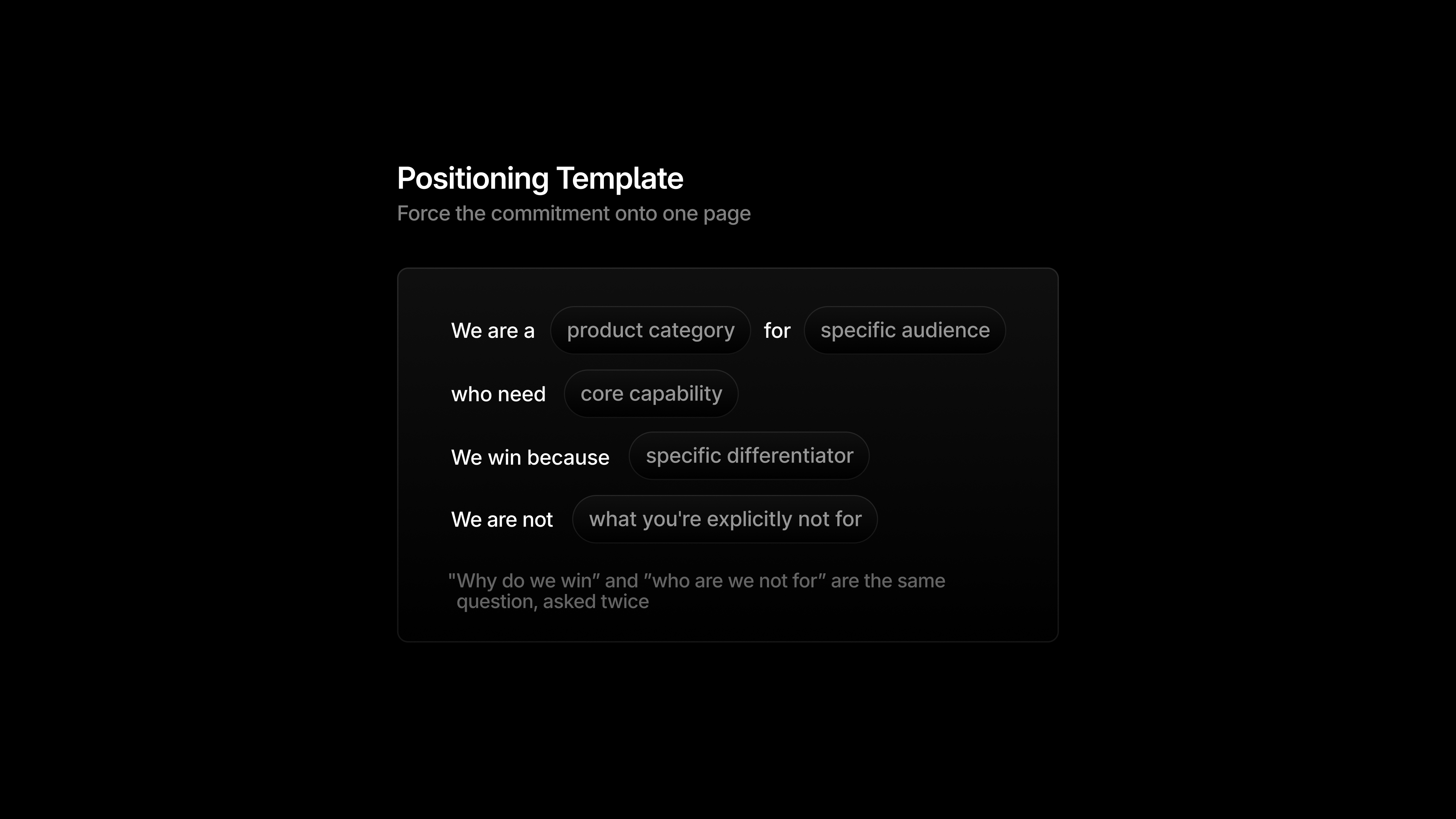
Here's the working template we use to force the commitment onto one page:
We are a ________ [product category] for ________ [specific audience] who need ________ [core capability]. We win because ________ [specific differentiator]. We are not ________ [what you're explicitly not for].
Mine the data you already have
Keyword research was the default starting point in SEO because it was the best signal available. A proxy for buyer intent, perhaps running a tad behind reality, and compressed into search terms that stripped out most of the context.
For AEO, keyword research still matters, but it’s not enough. Every variable of buyer intent matters now. The logic is simply:
- Search is long-tail and personalized
- Therefore, we care about the long-tail of variables that make their way into prompts and questions
- We get what we can from keyword research/prompt volumes (which is incredibly valuable)
- But to understand the full range of buyer desires, needs, wants, and characteristics, we need to mine other data sources.
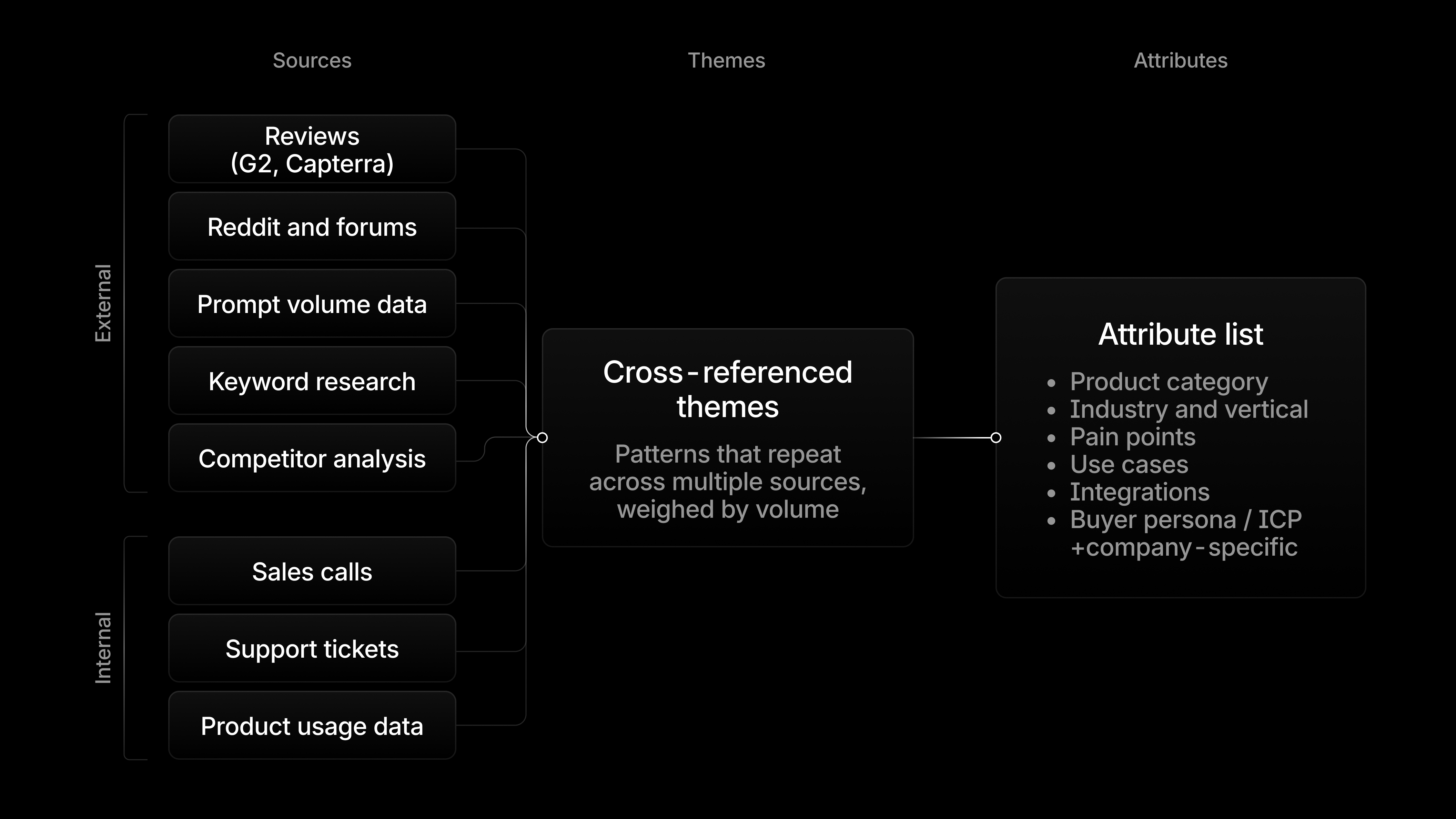
Those data sources are split between external (review sites, forums, prompt volumes, competitor presence) and internal (sales calls, support tickets, product usage).
Where you sit changes the mix
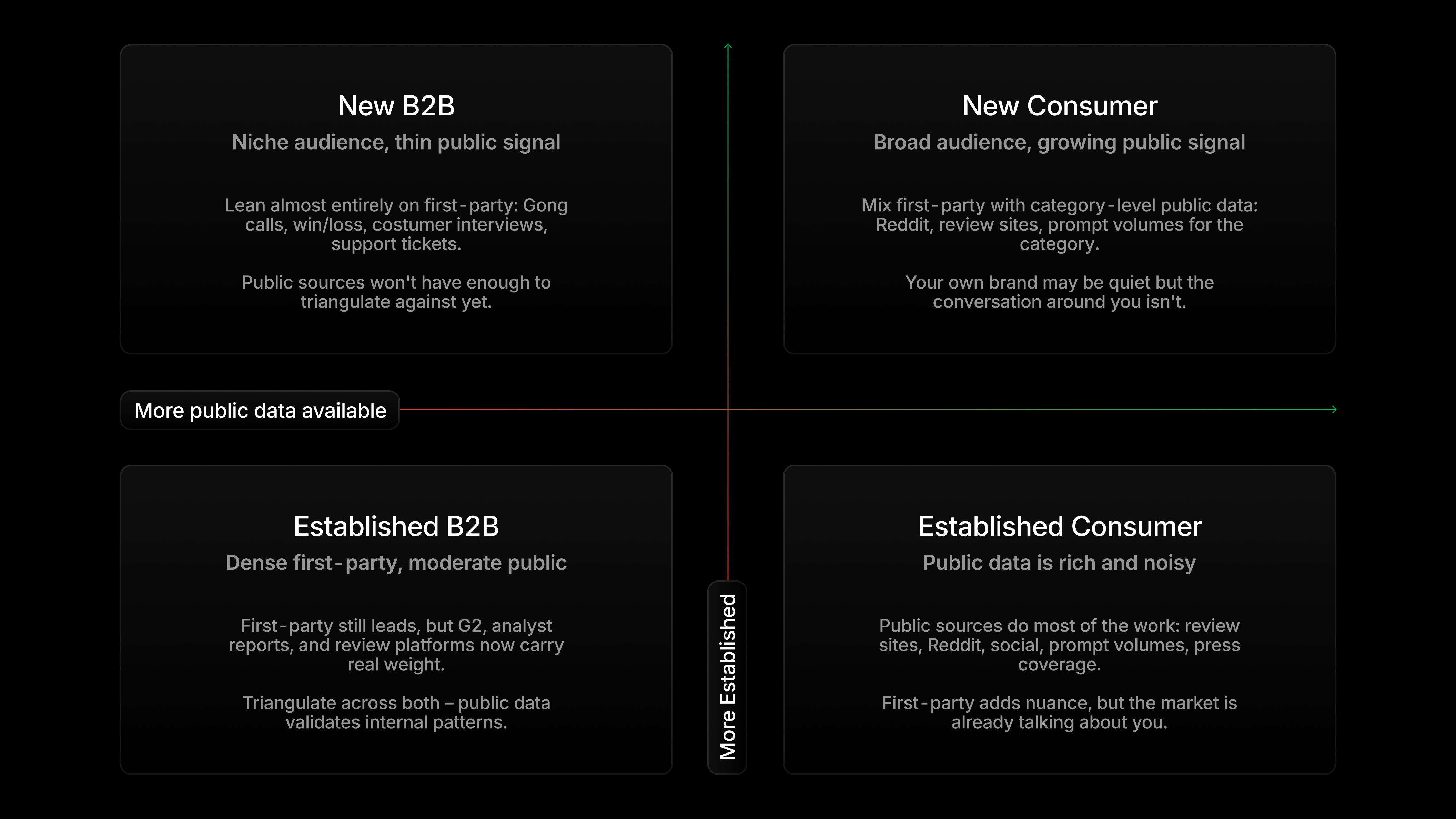
Two axes determine how much weight each data source carries: whether you sell to businesses or consumers, and whether you're new to your category or established.
For B2B companies, every customer is more valuable, the audience is smaller, and the conversation about your space happens in fewer, more specialized places. That means first-party data is among the highest-signal material you have. Public sources are thin, especially early on. A new B2B company looking for itself on Reddit will find very little; a new B2B company listening to its first fifty Gong calls will find almost everything it needs to know. Established B2B companies layer in G2, analyst reports, and review data, but the internal sources remain the spine.
For consumer brands, the inverse holds. The audience is large enough that public data fills in even when you're new to the category. Reddit, TikTok, review sites, and category-level prompt volumes give you enough volume to find patterns without leaning on first-party data the same way. Established consumer brands have so much public data they can practically build a strategy off it alone, first-party adds nuance, but the market is already talking about you in volume.
As for the sources themselves, external references tell you how the market frames your space:
- Real user data: what people are asking AI right now. This is the AEO-native equivalent of keyword research, and the most direct signal available. Profound surfaces this data as a starting point for your prompt strategy with their Prompt Volumes product.
- Review platforms: G2, Capterra, and TrustRadius are heavily cited by AI models, which means what they say is often close to what AI says. The language reviewers use is the language AI learns from.
- Competitor analysis: how are competitors positioned in AI answers? Where do you appear alongside them, and how does the framing differ?
- Market research and analyst reports: how does the broader market categorize and describe your space?
- Reddit and community forums: one of the highest-signal sources for AI models, because it's unsolicited, unbiased, and generally more genuine.
You no longer control the narrative of how you show up for users looking for a solution to the problem you solve. Your company exists as the content on your site, the content on other people's sites, and anywhere it is mentioned on the entirety of the internet. It's no longer enough to only focus on your website. You need a strategy for brand reputation and management on social, 3rd party sites, review sites, community sites, etc.”
Internal sources are where the highest-signal material usually lives. Pulling them together is its own coordination problem:sales call data sits in Gong, support tickets sit in Zendesk, product usage in Amplitude, NPS in a survey tool. Profound Agents can help organize this data into a single view for AEO work, though for most teams the heavier lift is just deciding what’s worth pulling in the first place. That includes:
- Sales call data: Gong, Chorus, or equivalent. Objections, language prospects use to describe their problem, competitors mentioned. This is how buyers think before they've been exposed to your messaging.
- Customer support data: what customers are confused about, what features generate the most questions, where the product and the expectation diverge.
- Product usage data: what users do versus what you market. Often reveals a disconnect between the use cases you emphasize and the ones that drive retention.
- Anything proprietary: NPS verbatims, win/loss analysis, customer advisory board notes, internal surveys. If it tells you what people care about, it's an input.
The list above will look different for every company. Some will have rich sales call data and almost no review volume. Others, largely e-commerce brands, will have reviews, but no sales calls. The specific sources are less relevant than the habit of asking where you already have signal, and if you’re bothering to read it.
When you read through external sources, you're doing two things at once, whether you intend to or not. You're learning what buyers care about. And you're seeing, in real time, how the web currently describes your brand, because these are the same sources AI is reading to form its picture of you. Some of what you find will match your ideal state. A lot of it probably won't. In Chapter 4, we cover how to address that systematically. For now, just read with both eyes open.
We've always been heavily rooted in qualitative customer research and voice of customer data, but now it's the baseline and foundation of our organic growth work. Keyword research is now a secondary data point used to triangulate intent, cluster topics, and prioritize work based on volume. We also work upstream of the channel, meaning what we do resembles product marketing more than SEO in that we're looking into competitive positioning, messaging, personas and buying groups, and website structure.”
Distill your brand identity
You now have signal. Heaps of it, probably. The next step is making it usable, a.k.a, finding what repeats across your data, naming it, and ranking it by what's worth chasing first.
Find your themes
Within each source, you're hunting for patterns. What keeps surfacing, what language people reach for, what problems they describe. Depending on the source, this takes different forms:
- In sales calls, you're listening for the objections that recur, the language prospects use to frame their problem, and the competitors they mention without being asked. One prospect's mention of a niche integration is negligible, but the same concern surfacing in a third of your calls is a pattern.
- In Reddit and community forums, you're reading for how users in your space describe their frustrations to each other, what they recommend unprompted, and what assumptions they carry into a buying decision. Nobody's performing for an audience here, so it's some of the rawest forms of data you’ll get.
- In review data, you're tracking the specific language people use, not just the sentiment. “Easy to set up” and “intuitive interface” might both mean good UX, but the exact phrasing matters, because those are the words AI learns from.
- In keyword and prompt data, you're looking for what questions recur, what modifiers people add (industry, company size, use case), and where the distance is widest between what people ask and what you currently address.
Once you've identified themes within each source, cross-reference them. The ones that appear independently across Gong calls, Reddit, and review platforms are your highest-confidence material, different types of evidence pointing to the same thing.
Then, weigh them by volume. For each theme that triangulates across sources, ask:
- How many calls mention this theme?
- How many reviews reference it?
- What's the search or prompt volume?
If “onboarding difficulty” appears in 40% of negative reviews, in 1 in 3 sales calls, and generates measurable prompt volume, it's a high-priority theme. If “API flexibility” appears in two reviews and zero calls, it's a lower priority regardless of how much the engineering team cares about it.
Before you lock in your list, remember to check with the other teams:
- What does PMM need AI to say?
- What does sales wish prospects knew before the first call?
- What does support wish customers understood about the product?
This is where AEO slowly becomes a company-wide project.
For a brand that is still figuring out its positioning, the first step is not to rush into AEO, and instead to battle-test the positioning with real customers. That means looking at sales calls, customer interviews, win/loss notes, onboarding conversations, support tickets, review sites, community discussions, and the language people already use to describe the problem, the category, and your product. You want to know: what do customers actually think you do? What words do they use? What alternatives do they compare you against?
AEO is amplification for your positioning. You are trying to get AI systems to describe your brand across a broad set of prompts and surfaces. If your positioning is unclear, premature, or likely to change dramatically, then investing heavily in AEO can create future cleanup work. You may end up reinforcing a version of the company that you later need to move away from.
So I'd separate the work into two phases. First, use customer data to clarify the positioning. Look at how customers describe you in their own words. Then pressure-test whether that language is differentiated, defensible, and commercially useful.
Once you have conviction, then you can start broadcasting that positioning more aggressively through your website, third-party content, with analyst, in customer stories, and all the other sources that AI systems are likely to retrieve.
The key point is that AEO should not be used to invent positioning. It should be used to reinforce positioning that has already been validated. If you teach the market and the models to know you as X, then decide six months later that you actually want to be known as Y, all you did was create clean up work for your future self.”
Build your attribute list
The output of that process is a set of attributes: the codified, structured form of your identity work. The specific, buyer-relevant things you want your brand to be known for in AI answers.
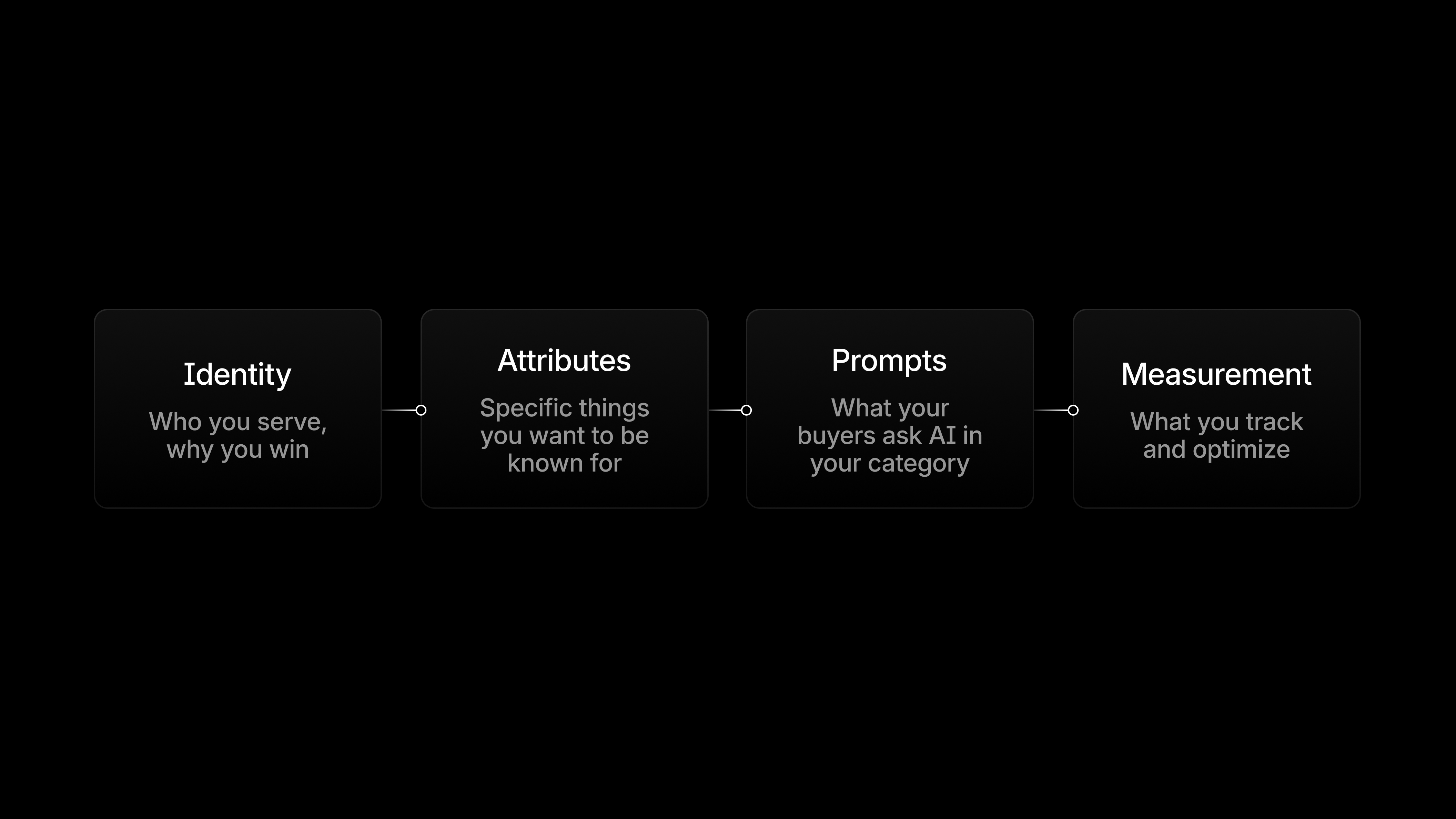
It’s like a domino chain. Your identity determines which attributes matter, attributes become the prompts you track, and prompts become your measurement system. Get the first domino right and everything downstream has direction; skip it, and you're generating data without a strategy to read it against.
Attributes tend to cluster into a set of starter categories, though the specifics will be different for every company:
- Product category: What terminology do buyers use when they're looking for a solution like yours? Capture variations, different buyers use different words for the same thing, and AI reflects the full range. A B2B buyer might search "CRM for agencies"; a consumer might search "sunscreen that doesn't pill under makeup." Both are product category prompts, just in different registers.
- Industry and vertical: Who do you serve? Each vertical has its own language and its own priorities. "Healthcare compliance" and "financial services compliance" are different buying contexts, even if the underlying product is the same. For consumer brands, this looks more like lifestyle or demographic segments: "gear for trail runners," "products for new parents."
- Pain points: What problems do buyers experience that lead them to start looking? In B2B, these surface in Gong calls and support tickets, "our team can't track pipeline across tools." In consumer, they show up in Reddit threads and reviews, "every moisturizer I try breaks me out." Same principle, different places to look.
- Use cases: What do people actually do with your product? It often differs from what you market most heavily. A project management tool marketed to marketing teams may be used primarily by agencies. A recipe app positioned around healthy eating may be used mostly for weeknight meal prep.
- Integrations: What you connect to is frequently a deciding factor in B2B, "works with Salesforce" and "integrates with Slack" carry real purchase intent. For consumer products, the equivalent is compatibility: "works with Apple Watch," "pairs with Alexa," "available on Shopify."
- Buyer persona and ICP: Who is the decision-maker, and how do they talk? The language that resonates with a VP of Marketing at a mid-market SaaS company is different from what resonates with a solo founder, and different again from what resonates with a 28-year-old shopping for running shoes. AI picks up on all of it.
You’ll have attribute categories that are specific to your company and your space, things no generic framework could predict. For example, ShipBob, the ecommerce fulfillment expert and supply chain enablement platform for brands that want to scale without scaling complexity, offering more than a 3PL can, has “fulfillment center location” as one of its attribute categories, because this is something that their customers ask about. That’s expected, and the list above is meant as a starting point, not a ceiling.
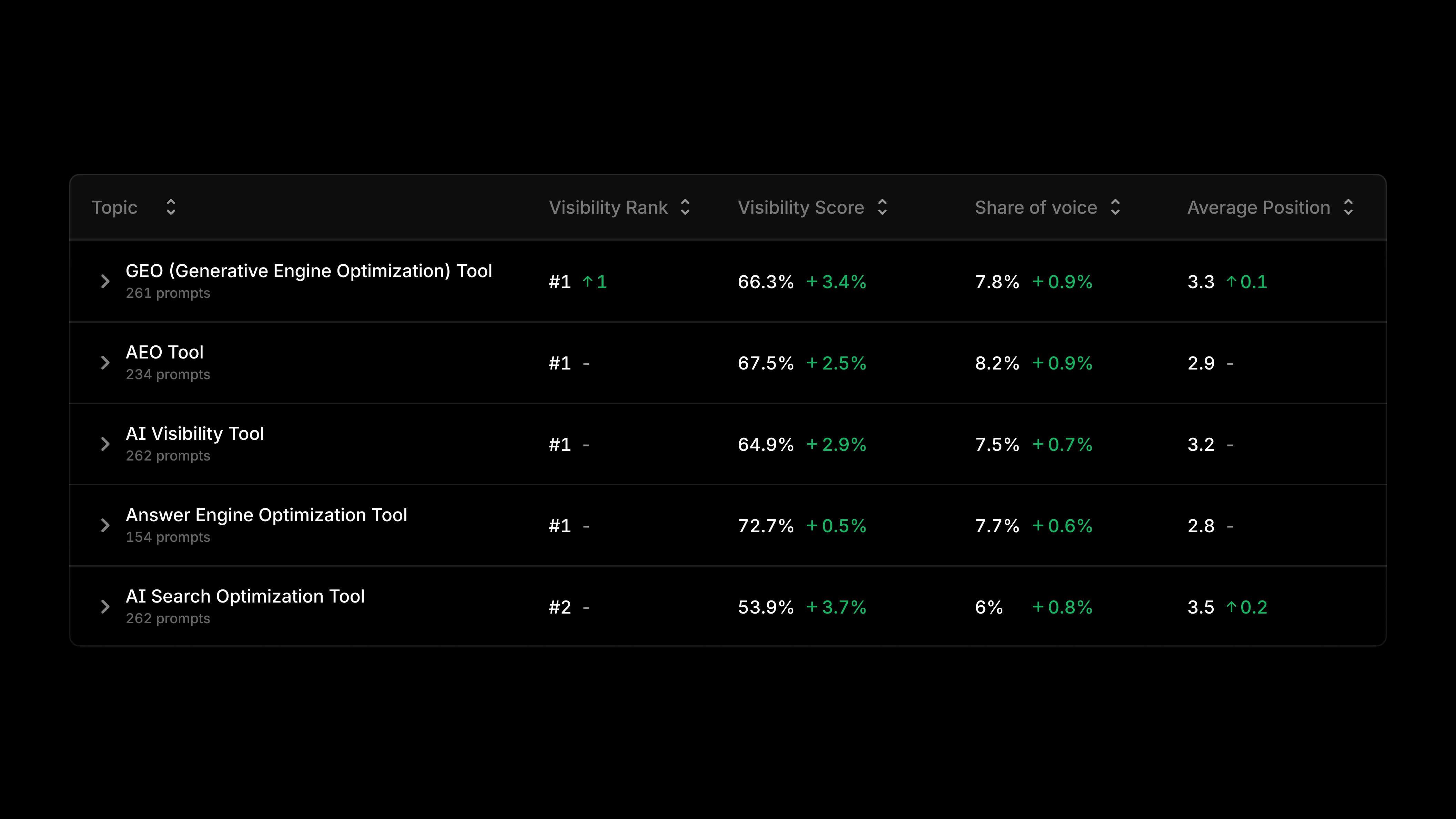
We’ll use our own attribute list as an example. The categories, weights, and language come from Profound’s real, working matrix, just trimmed for the page:
| Themes/Categories | Attributes |
|---|---|
| Product category | Answer Engine Optimization Tool; AI Visibility Tool; AI Search Optimization Tool |
| Industry | B2B SaaS; Fintech; Retail |
| Pain points | Brands have manual, slow multi-team content workflows They’re not sure how to optimize existing content for AI Search AEO Content takes too long to create and still underperforms More generally, they’re not sure how to shift their marketing efforts towards AI Search |
| Use cases | Automate AEO content in proven formats to save time Cross-team content workflow orchestration, Content optimized for AI agents Automate content outreach and distribution |
| Features | AI content generation Automated content workflows Pre-built marketing agents Content production for AEO and SEO at scale |
| Models | ChatGPT, Claude, Gemini, Google AI Overviews, Perplexity |
| Personas | SEO Manager; CMO; VP of Marketing |
The list will keep evolving. We’ve added attributes since this version, and will add more as the product expands and new buyer language emerges in the data. The point of building it isn’t to have a final answer, but rather to have something concrete enough to turn into prompts.
Last year was all about AI visibility: was your brand mentioned in high-intent queries? Now it's about the quality of the AI answers: attributes like accuracy, sentiment, consistency, and persuasiveness.”
Prioritize where to start
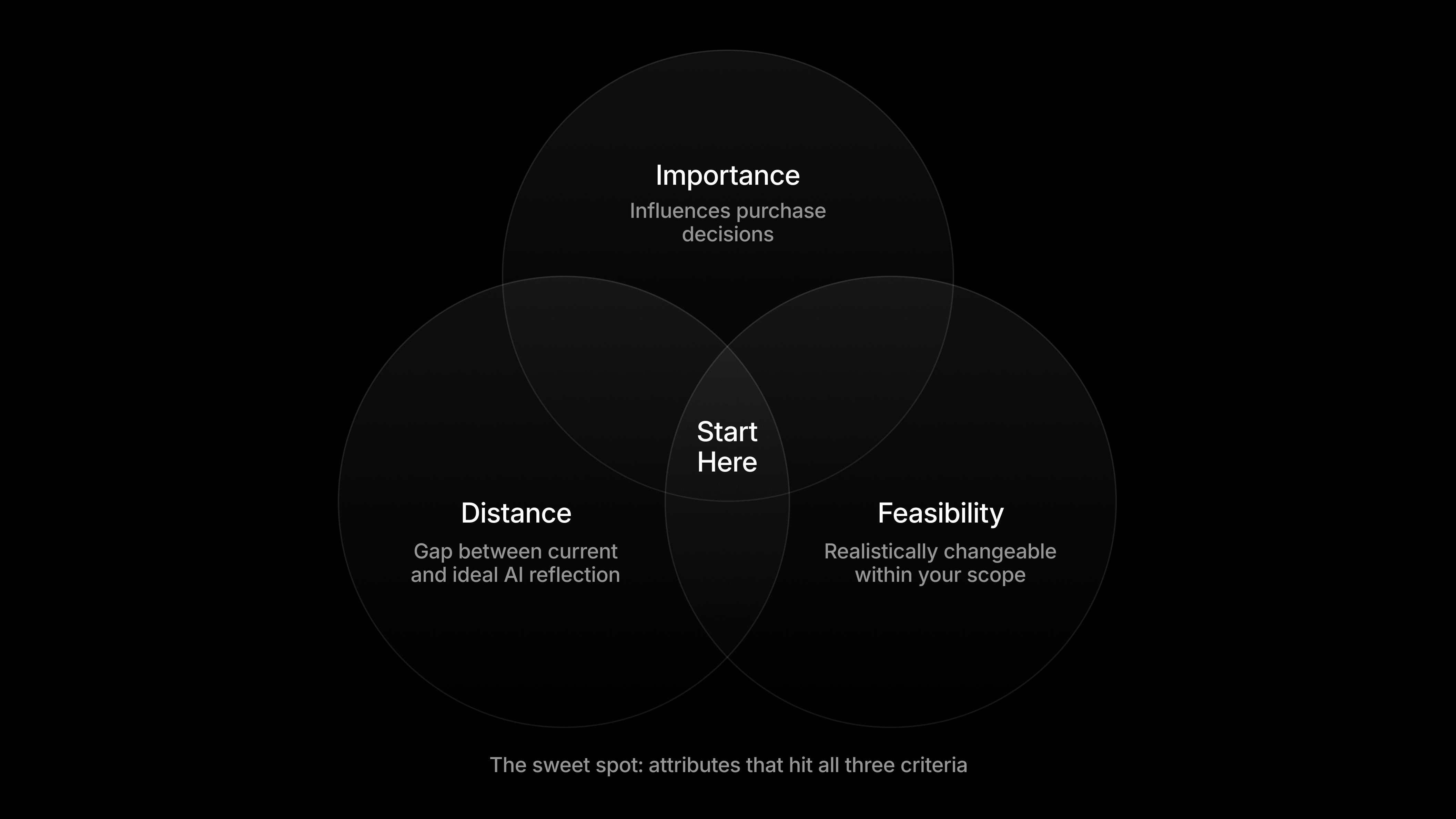
Chapter 3 tells you how to turn your attribute list into prompts, but you can't track everything at once, and you shouldn't try. Before you get there, it's worth deciding which attributes deserve your first round of attention. For each attribute, ask:
- Does this influence purchase decisions?
- Is there distance between what you want AI to say and what it currently says?
- Can we influence the way it’s talked about?
Start with the attributes that hit all three marks. If something matters to purchase decisions and your AI presence is already spot-on, you can leave it alone. If there’s a big gap but you can’t realistically close it, park it lower on the list. The sweet spot is where importance, distance, and feasibility overlap.
One note on scope: technical and accuracy-related attributes (security certifications, compliance standards, specific integration details, pricing) belong in a separate category. They're factual claims about your product that AI needs to get right, and they're best addressed through a specific prompt type designed for accuracy testing. We’ll cover that in Chapter 3.
Put your attribute list to work
If you've worked through this chapter, you have something a lot of companies wishing to compete in AI Search don't: a defensible position on who you are, a data-backed view of how your buyers think, and a prioritized list of attributes that turns both into something measurable. That's the foundation the next three chapters build on.