

You probably already have a working theory about how your brand shows up in AI. Maybe the CEO plugged your name into ChatGPT and declared the situation either fine or catastrophic. Maybe someone on the team has been spot-checking Claude for months and spun a narrative around what they found.
While understandable, those reads aren’t reads at all. One prompt on one platform at one moment is a data point, and what you want is a reliable baseline.
Your first AEO audit builds that baseline. It's a systematic pass through every attribute, across every relevant Answer Engine, producing two outputs you’ll then act on:
- A list of opportunities: attributes where you underperform but have reason to show up. Opportunities are more quantitative, e.g., we have low visibility and/or low rank.
- A list of objections: the recurring negative themes in AI answers about your brand that you need to counter.
- A list of strengths: the attributes where AI is already reflecting you accurately and favorably; the foundation you double down on rather than fix.
This chapter walks through each audit component and shows you how to find the data in Profound. At this stage, we're looking purely at how you appear, how you're perceived across AI platforms, and what's feeding those answers. What to do about what you find will be covered in Chapter 5.
What to expect from the audit
Between Profound and OGM, we've run enough AEO audits to know what's coming. Three situations show up almost every time:
- There are more attributes to check than you realized. If you did the work in Chapter 2 properly, you have a meaningful list of things you want to be known for. Spot-checking a handful doesn’t classify as an audit. You’ll only get the full picture if you look at all of them, remember, you picked them for a reason.
- You might be less visible than you think (at least in certain areas). We see this all the time. Companies expect to show up for their core attributes, only to find that’s not the case. Don’t be alarmed; the distance between assumption and reality tends to be wider than anyone expects.
- You’re showing up somewhere you didn’t plan to. There are almost always attributes where a company appears strongly, that the team didn’t think to track. Sometimes that reveals something the market values about you more than you do. That’s a product insight, a PMM insight, and an AEO insight all at once.
Discovery visibility: Where do you show up?
This is the heart of the audit. Here, you’ll take every attribute from Chapter 2 (e.g., product categories, verticals, pain points, features, integrations) and ask, “where do I land when AI answers a discovery prompt for this?”
By the end, you’ll have a ranked map of your performance and a clear sense of where to focus first.
Step 1: The overall picture
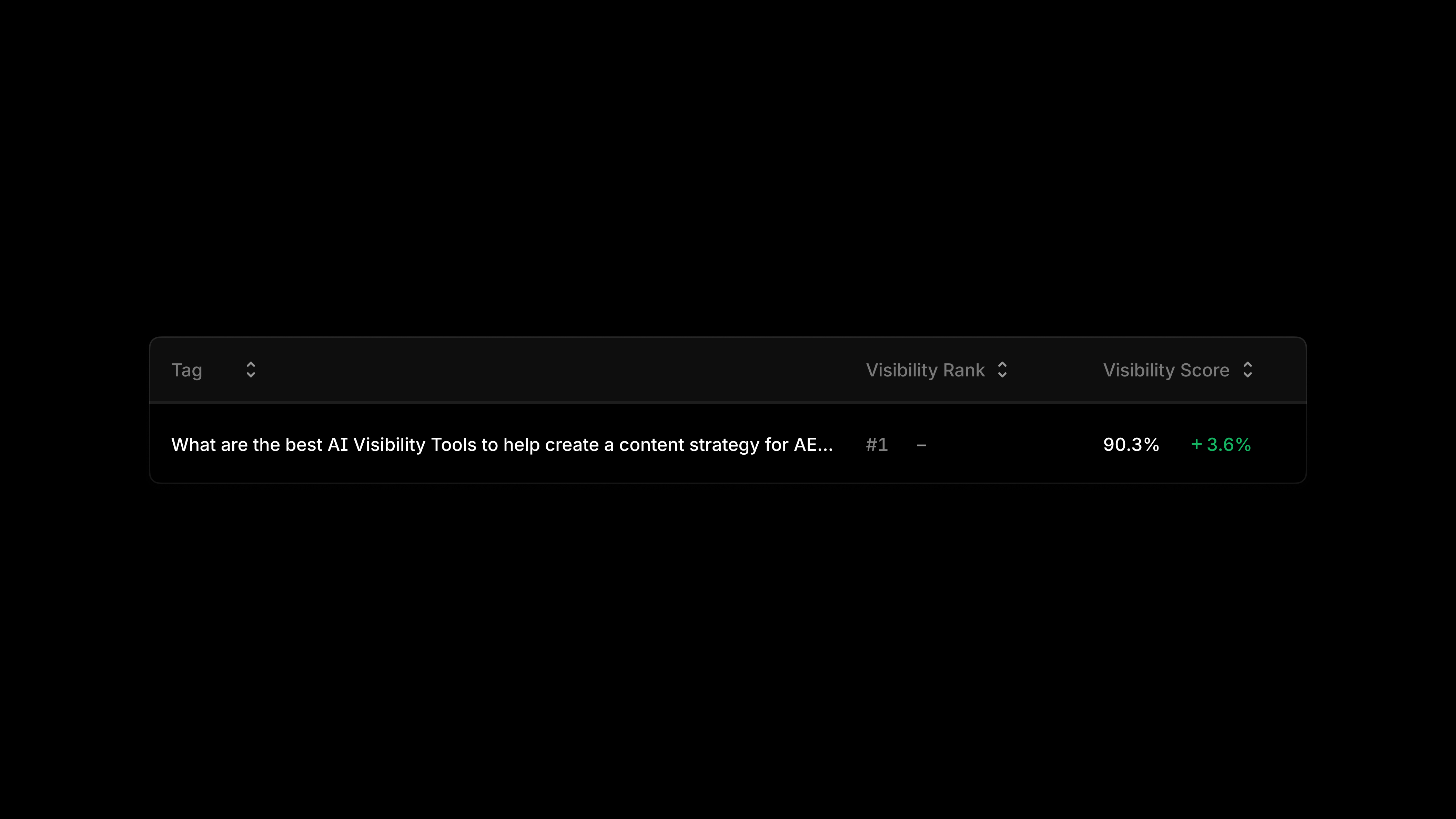
Once your prompts have run, Profound populates your dashboard with visibility data across every attribute and platform. That's your starting point. Before you zero in on anything specific, take a look at two overarching metrics:
- Visibility rank tells you where you sit relative to every other brand appearing in AI answers for your space. It’s the full landscape of brands AI associates with your category.
- Visibility score tells you how consistently you appear. Of all the AI responses generated for your discovery prompts, what percentage mentioned your brand?
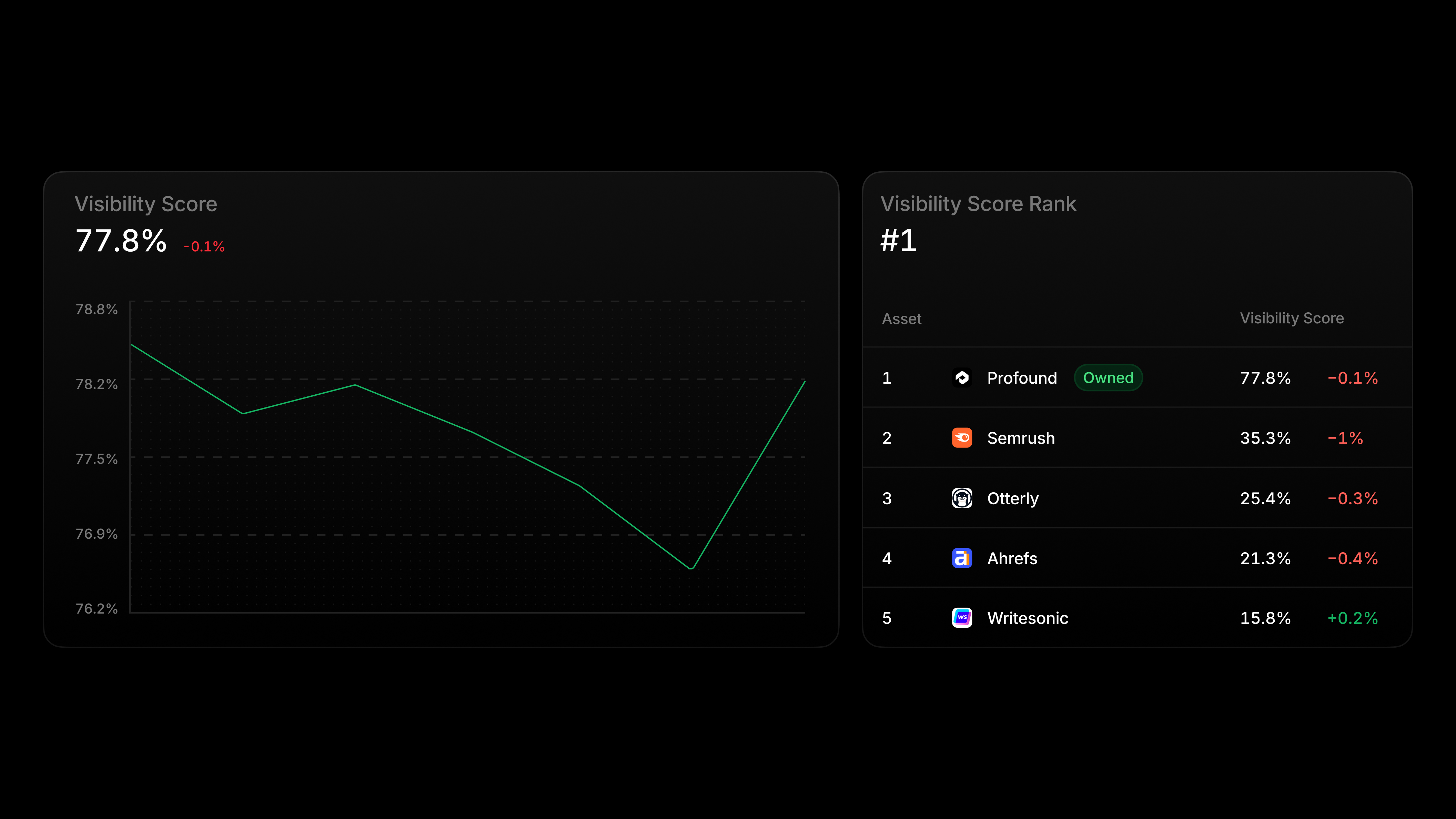
Reading rank and score together tells you whether the models have reached a settled view about your category, or whether they’re still working it out. There are several scenarios that can play out here:
| Signal | What it means |
|---|---|
| High rank + high score | AI has a settled view of you. You appear consistently and at the top. The priority is maintaining the citations and content that got you here. |
| High rank + low score | You rank first when you appear, but you're not appearing reliably. The models haven't reached a consistent view. More citation volume and content consistency will close that gap. |
| Lower rank + high score | The models are confident about who leads this space, and it isn't you yet. You're in the conversation but not at the top. The path up is building authority where the leaders are cited and you aren't. |
| Models agree | The signal is consistent across platforms, indicating a genuine web-wide consensus. Whatever is driving that result, positive or negative, is deeply enough embedded to take seriously. |
| Models disagree | No consensus has formed yet. Different platforms are pulling from different sources and reaching different conclusions. |
To get a complete view of the competitive landscape, pull the top 20 brands by visibility rank. This will show every brand AI thinks belongs in your category, whether you agree or not.
When Air, an agent for creative tasks, ran this, they consistently appeared along with Adobe, Bynder, and Brandfolder. All of these were expected names. However, the landscape also surfaced ClickUp and Asana ranking for attributes Air was already tracking.
Neither is a DAM tool, so their presence alone raised a practical question: if these brands are competing in Air’s attribute space, what adjacent attributes are they winning that Air hadn't considered tracking yet? The landscape view forces that conversation before you've drilled heavily into anything.
Step 2: Attribute by attribute
This is where the work from Chapter 2 pays off. Check your visibility rank and score across platforms for every attribute (Topics or Tags in Profound), then layer on the priority weighting.
Quick reminder on how priority weighting works: In Chapter 2, every attribute got scored on how central it is to your buyers' decision-making, Priority 1 being the attributes that directly determine whether you make the consideration set, and Priority 3 being the ones that are still relevant but won't cost you a client.
For each attribute category, you're looking at where you're strong, and where you're not:
- If you have a high rank and a high, consistent score across platforms, those are your strengths.
- If you have a low rank, a low score, or are absent entirely, those are your opportunities.
Every attribute gets both columns. Never just a list of problems, never just cheerleading. The two-part structure is what keeps the audit honest and gives you a balanced picture of what to act on.
Step 3: Product category variance
One of the most useful things the audit reveals is how much your visibility swings depending on the label someone uses for your category.
If you recall, Chapter 3 showed this statistically: swapping a single word in a prompt changed visibility by 50 points for some brands. Here in the audit, you’re seeing what that means for your specific space.
Look at your visibility score and rankings across every relevant label: the generic category name, the technical one, the buyer’s language versus the product team’s language. Every label where your visibility tanks is a target for content and citations.
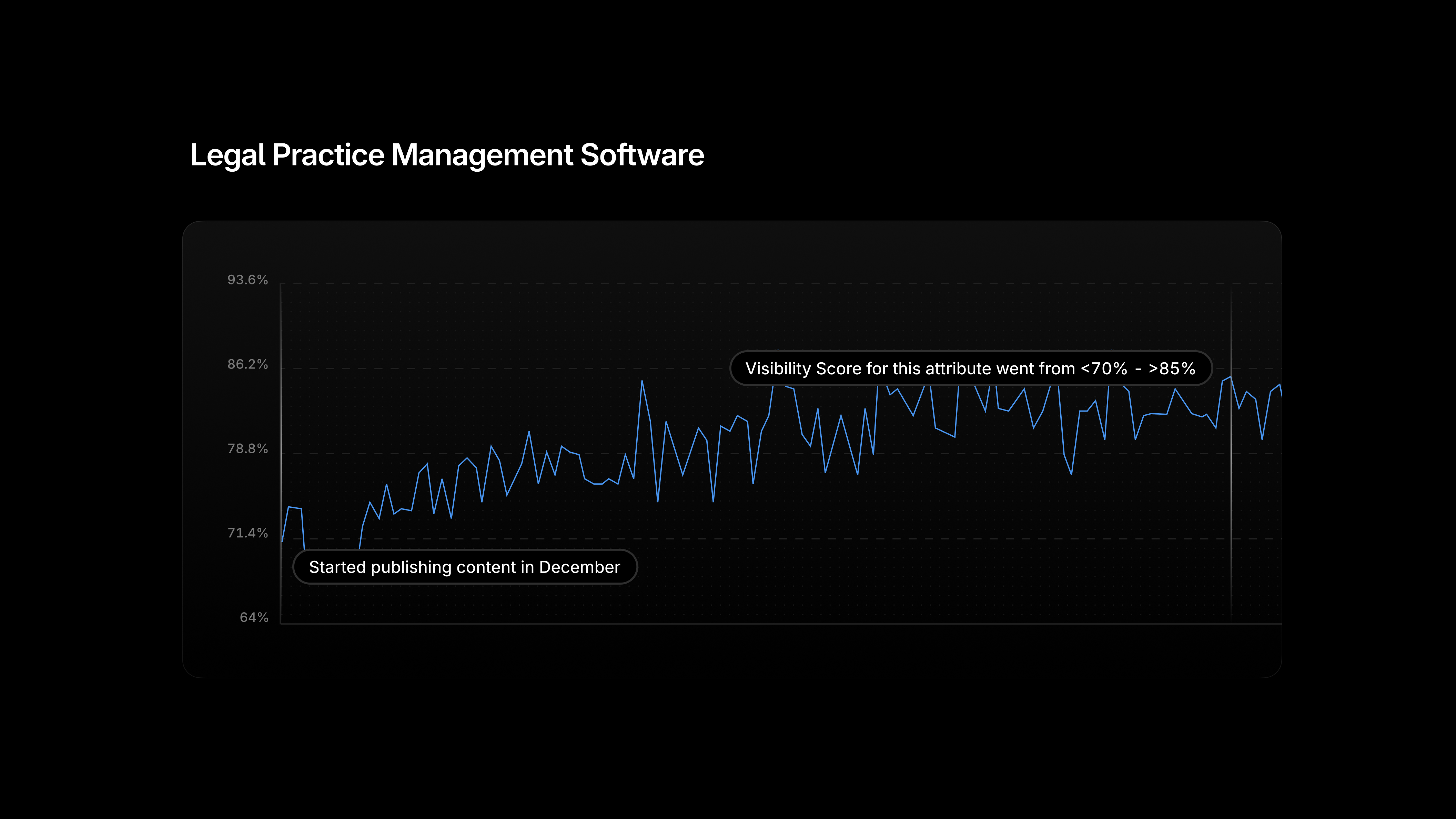
When MyCase applied this framework, the priority weighting made the action clear immediately. The attribute “Legal practice management software” was a Priority 1 attribute, the core category term their buyers used to start the search, and visibility was sitting below 70%. A single page refresh published in early December also included a restructure so AI could extract clean, direct claims about the category, taking the attribute’s visibility up to 85% by April.
That's the value of the weighting. A 15-point gain means something different when you know it moved the attribute that determines whether a buyer considers you at all.
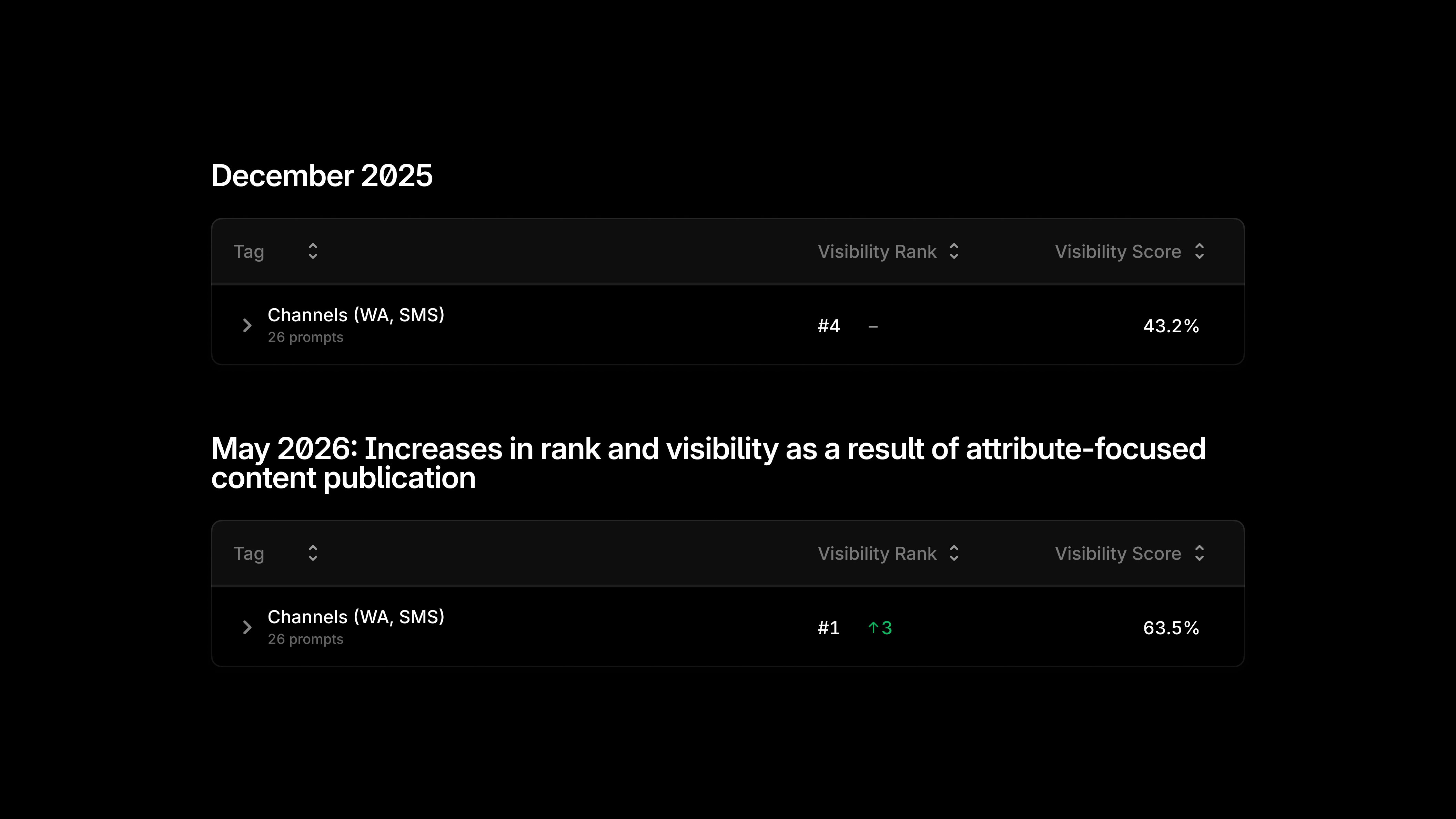
ActiveCampaign put this to work across a cluster of Channels-related attributes, SMS, WhatsApp, individual features, and higher-level categories like "WhatsApp marketing software", and grouped them into a single Channels priority area, tracked over a multi-month program. Despite the product’s strengths in those areas, the audit had shown weak visibility across the board for that cluster: in December, the Channels category sat at a 44% Visibility Score and #4 rank.
The team published seven new pieces focused on those attributes and updated more than a dozen existing pages over the following months. By April, ActiveCampaign had moved to #1 in Visibility Rank for the category. By May, Visibility Score was 63.5%.
That kind of movement doesn't happen on a single high-priority term. It happens when a team maps an entire attribute cluster, finds the weak labels, and closes the gap across all of them, not just the one that looked most obvious at the start.
Citations: What AI is reading
Citations tell you whether AI is presenting you as a source of information in its answers.
In Chapter 1, we described how AI synthesizes the web into answers by absorbing content, forming views, and citing sources that shaped those views. Citations are where you can see that process in concrete terms.
In Profound’s citation view, you can trace which specific pages, domains, and content types are feeding the AI answers for your category. That’s the Answer Engine supply chain made visible.
One methodological guardrail: scope your citation analysis to discovery prompts. When a brand name is already in the prompt, AI naturally pulls from that brand's own pages more heavily, which skews the picture toward owned sources rather than what the wider web is saying. Discovery prompts, where no brand names are in the frame, give you the cleanest read of what's genuinely shaping your category.
What citation data tells you
Pull the citation view in Profound, and you can start answering questions that discovery visibility alone can't touch:
-
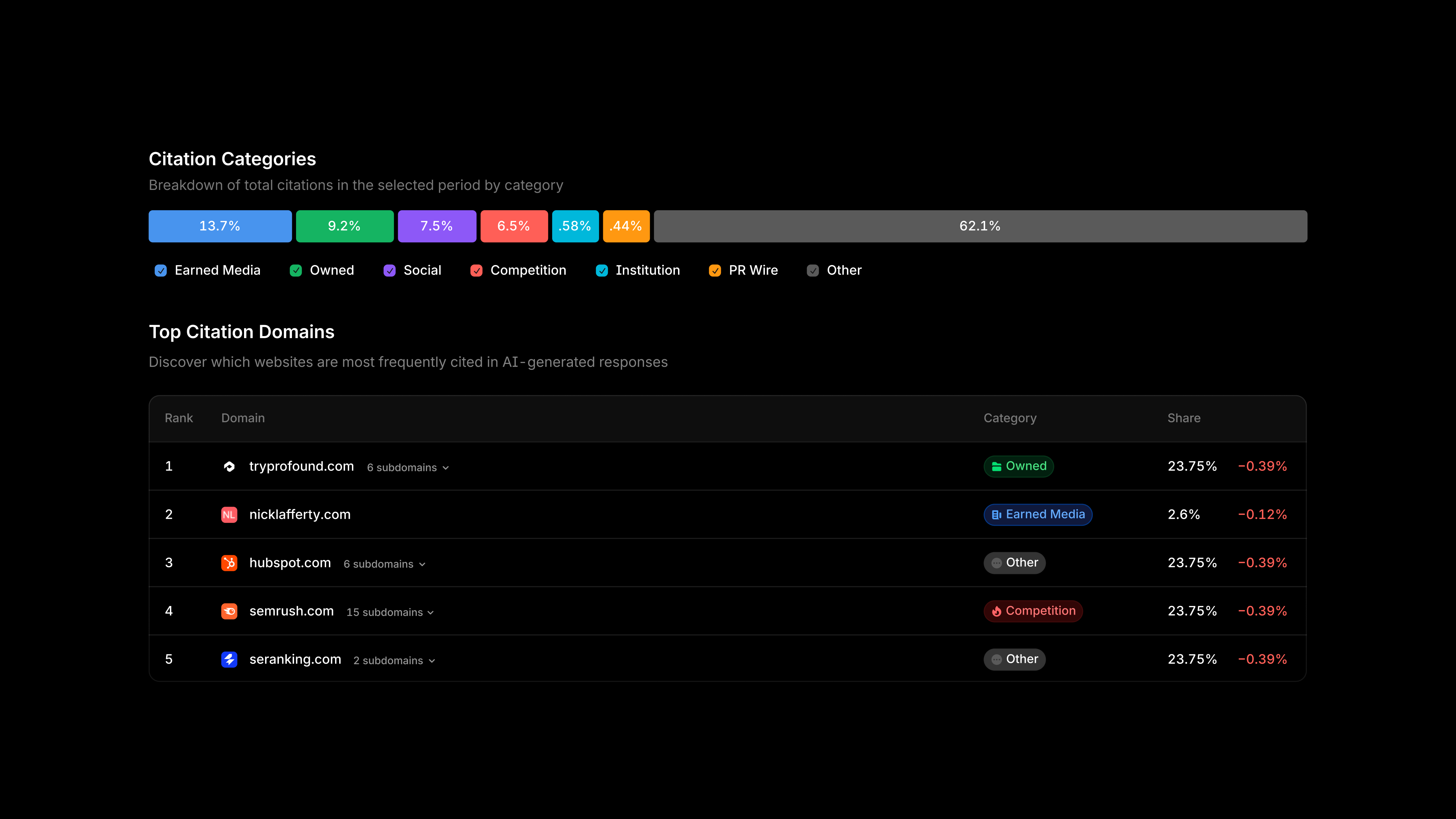
What types of content are shaping your category? In Profound’s citation breakdown, look at the domain distribution: are the top-cited sources review sites, listicles, Reddit threads, YouTube, competitor pages, or owned content? When Air ran this, no single domain held more than 4% of citation share across the competitive set. That fragmentation signals that no one has yet built dominant authority in this category, and the position is ripe for the taking.
-
Which of your pages are being cited, and for which attributes? If your product pages appear in citations but your thought leadership content doesn’t, AI treats you as a product source rather than a category authority. If you’re absent from citations for a Priority 1 attribute entirely, AI either can’t access the relevant content or doesn’t find it credible enough to use.
-
Where are competitors cited that you aren’t? In Profound, pull the citation breakdown for your top two or three competitors and compare it to yours. If a competitor appears consistently through third-party comparison articles or vertical-specific review platforms that you’re absent from, those are the specific content types and placements you need to go after. A competitor whose citation share depends on two or three sources they don’t control is more fragile than their rank suggests.
Almost everyone setting up tracking starts and ends with "best X" or "top X" queries, because those feel closest to revenue.
That's a narrow view! People ask AI engines informational questions all day, and those are often where you earn citations and shape perception long before anyone is ready to buy. A brand that only tracks commercial prompts is watching the bottom of the funnel and ignoring the part where AI Search actually builds or breaks your reputation.
Track the commercial prompts. Just don't pretend they're the whole picture.”
Opportunities and objections
The discovery visibility analysis and citation data feed directly into two outputs.
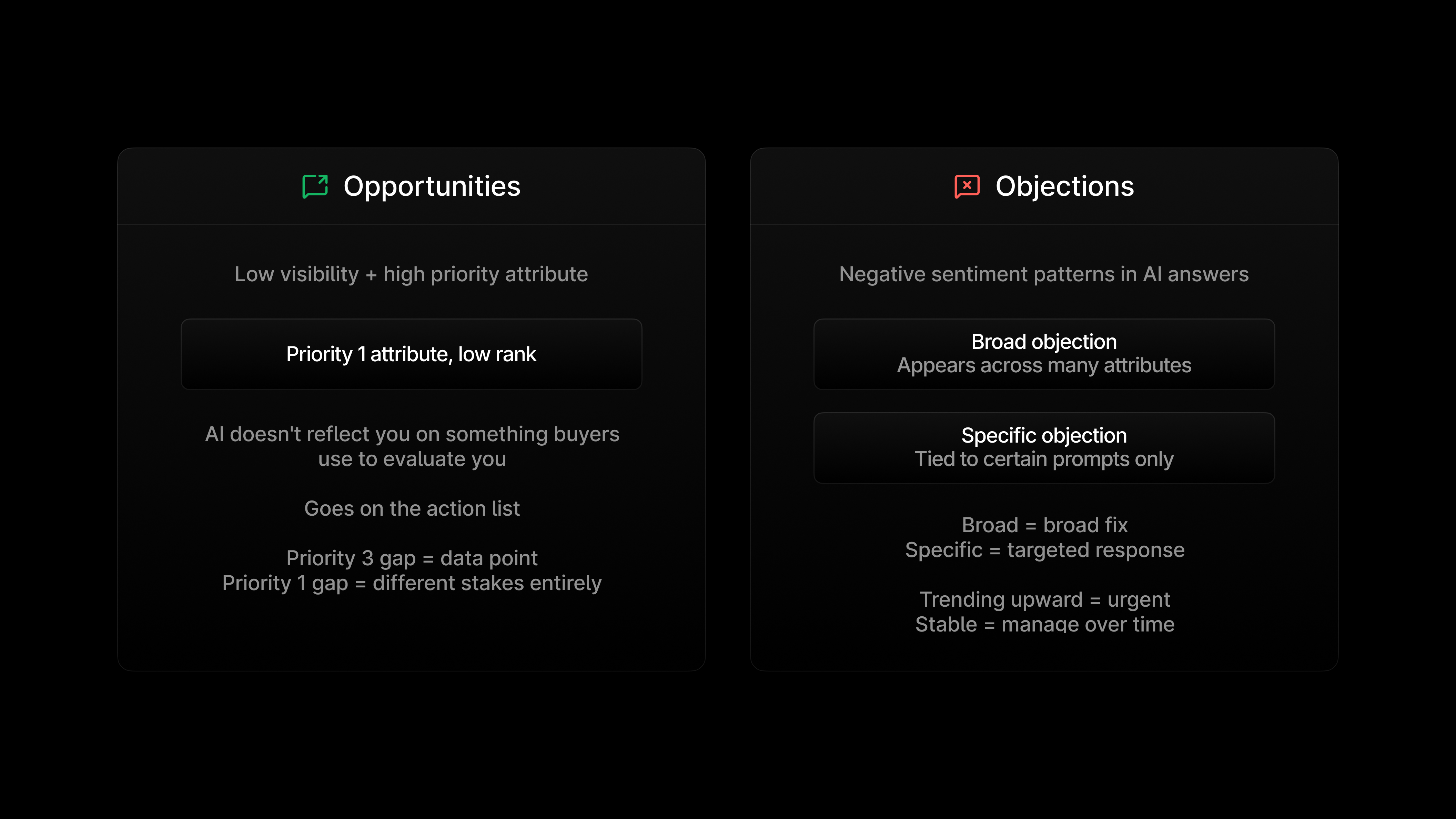
Opportunities come directly from the discovery visibility analysis in Section 2, every attribute where your rank is low, your score is low, or you don't appear at all, mapped against your priority weighting. If you're absent for a Priority 1 or 2 attribute, that's an Opportunity. Something you care about, something you should be showing up for, and something you can work on.
Objections are the negative sentiment themes appearing consistently in AI answers about your brand, the things AI says about you that you need to counter through on-page content, off-page influence, or both.
Use Profound's sentiment view to ask four questions:
- Is this objection broad, appearing across many attributes, or specific to certain prompts?
- What positive sentiment is showing up, and is it broad or specific?
- Is the positive sentiment aligned with what you actually want to be known for?
- Are objections trending up or down over time?
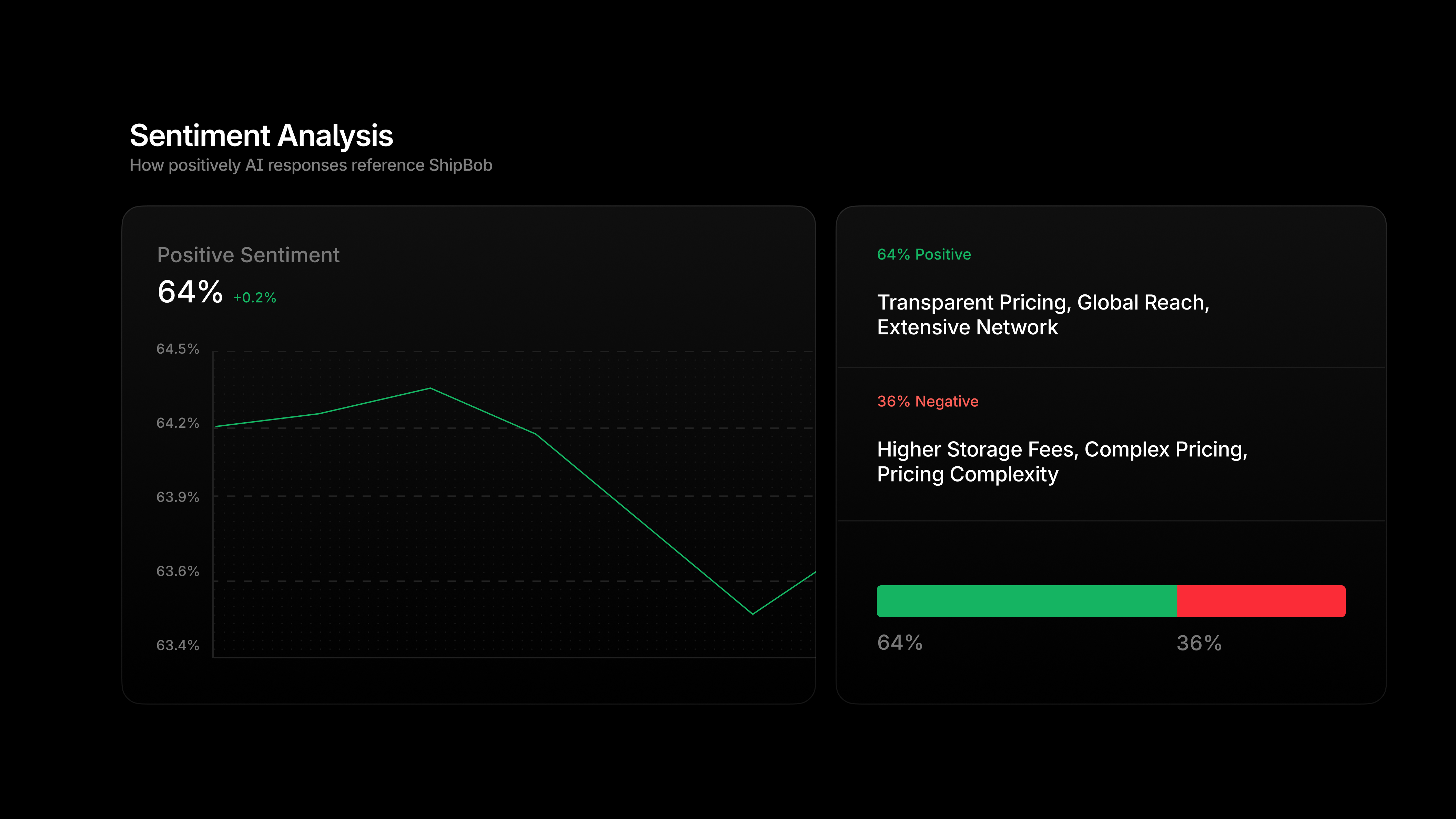
One thing not to skip is positive sentiment. If AI is consistently praising you for something your team took for granted, especially when those citations trace back to reviews and third-party coverage rather than your own marketing, the market may value that capability more than your positioning reflects.
The other prompt types in the audit
Discovery prompts are the spine of the audit. The other prompt types from Chapter 3 add diagnostic layers that discovery alone can’t provide.
Validation: The comprehension check
Dig into your discovery results to identify the attributes with low visibility. Then, run the corresponding validation prompts in Profound to check whether AI understands that you have that capability at all.
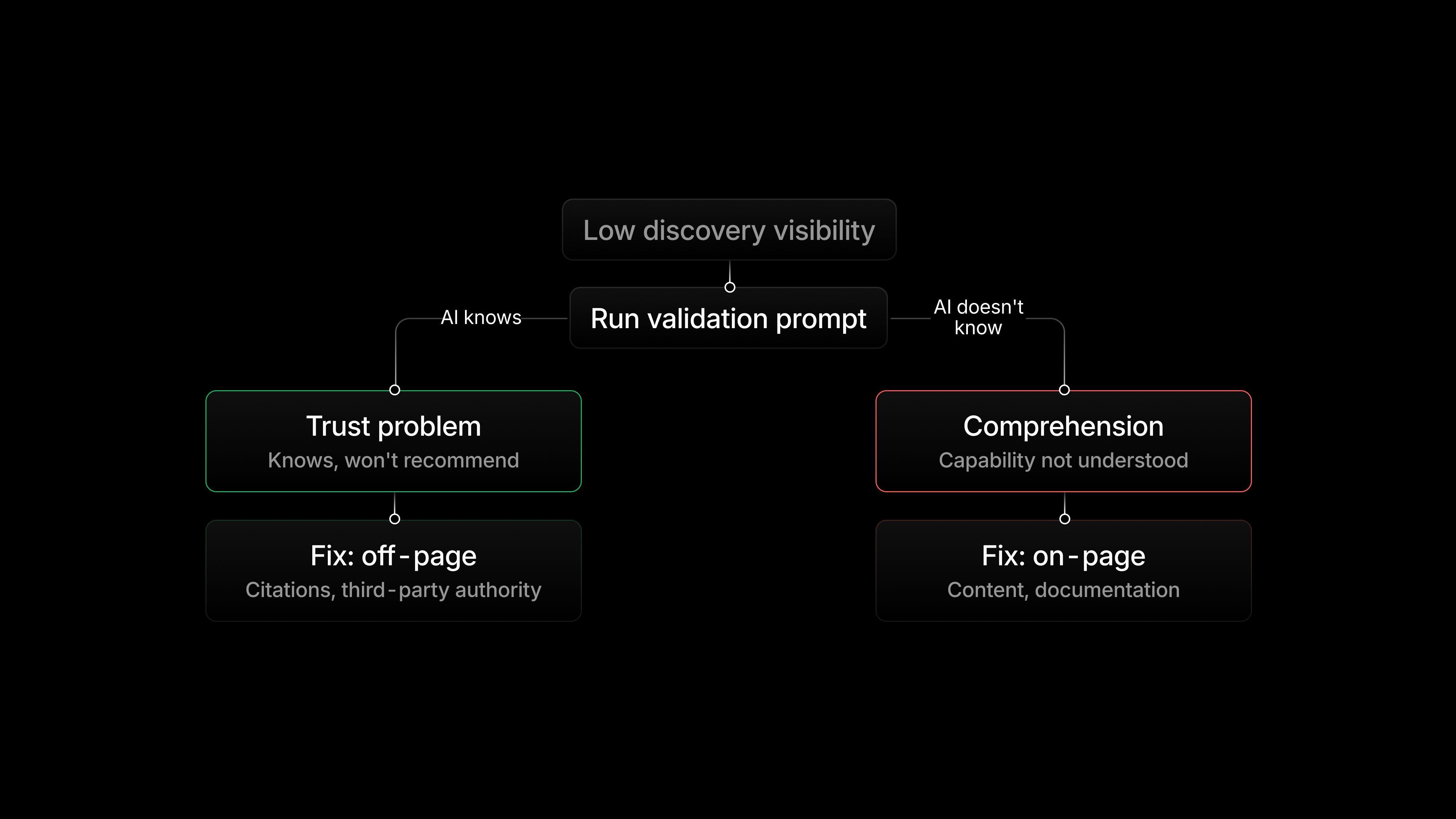
The answer tells you what to do next. If discovery is low but validation is strong, AI knows you have the capability, it just isn’t recommending you. The solution lives off-page: citations, third-party authority, external signals that move you from known to recommended. More on-page content won’t budge this.
If discovery is low but validation is strong, AI knows you have the capability, it just isn’t recommending you. The solution is off-page. If both are low, you’ve got a comprehension problem. AI hasn’t absorbed that you have this capability, which calls for an upstream fix.
If both are low, you’ve got a comprehension problem. AI hasn’t absorbed that you have this capability, which calls for an upstream fix: product pages that state the capability clearly, documentation that AI can actually read, and content that establishes the capability before you worry about recommendations.
Competitor prompts: Where you stand in a head-to-head
Competitor prompts show how AI frames a head-to-head between you and a named rival. You can show up on every discovery list and still lose every direct comparison, or vice versa.
In Profound, run competitor prompts for each main rival and see which platforms recommend you and which don’t. Platform-level differences are often more useful than the overall result. Losing a head-to-head on one platform but winning on others usually points to specific citation or content gaps rather than a broad positioning problem.
If you’re ahead on integration and workflow but behind on pricing and switching costs, that’s a map of which parts of your story AI has picked up and which parts your competitor owns.
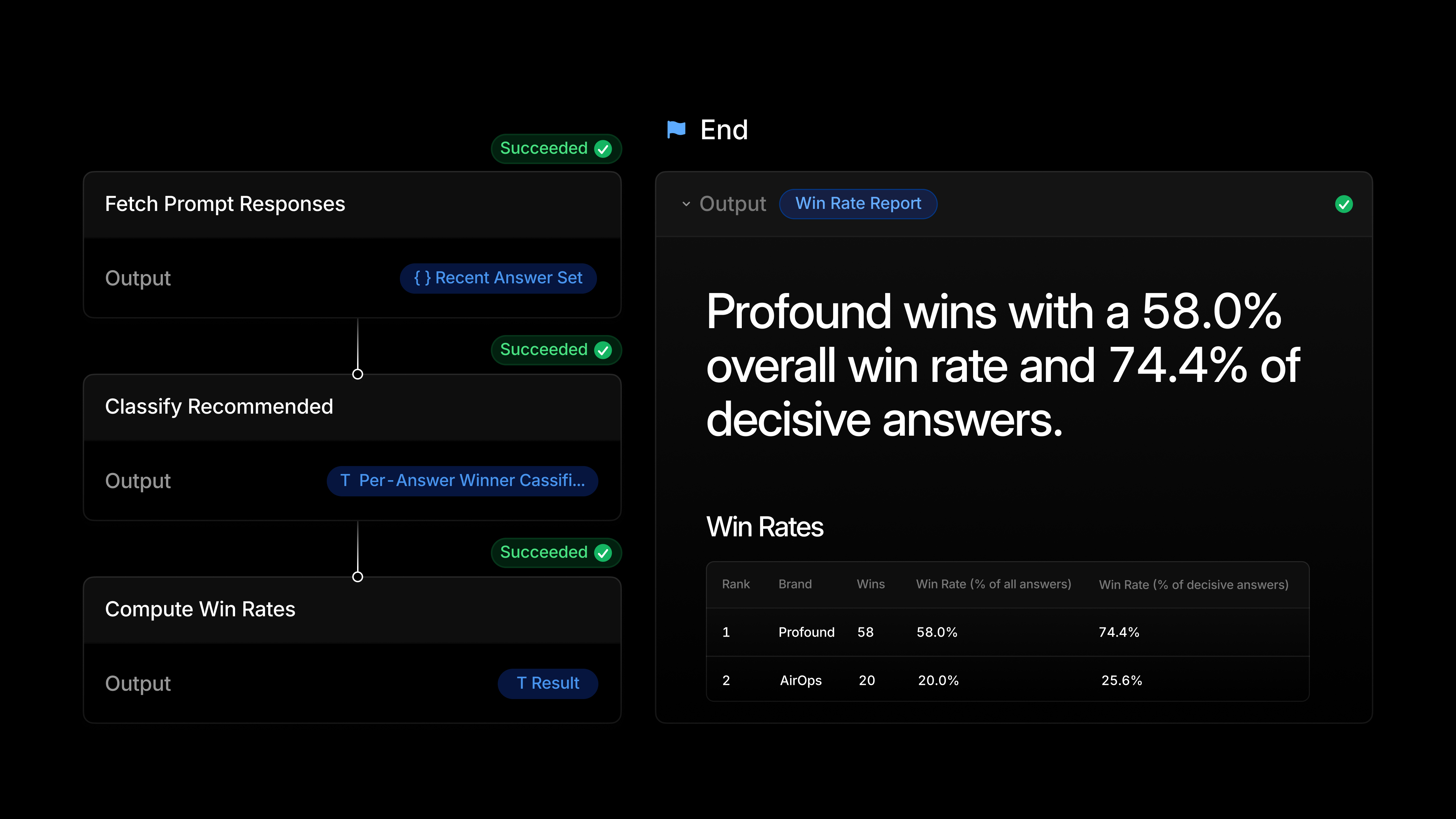
Above is an example of a Profound agent to pull recent answers for a competitor prompt set, classify which brand wins each one, and compute a win rate. Running it against the competitor, the agent found a 58% overall win rate, and 74.4% once you strip out the answers where neither brand was clearly favored. That second number is the one worth watching. Decisive answers are where AI actually picked a side, and that's the number that moves when you close a specific gap.
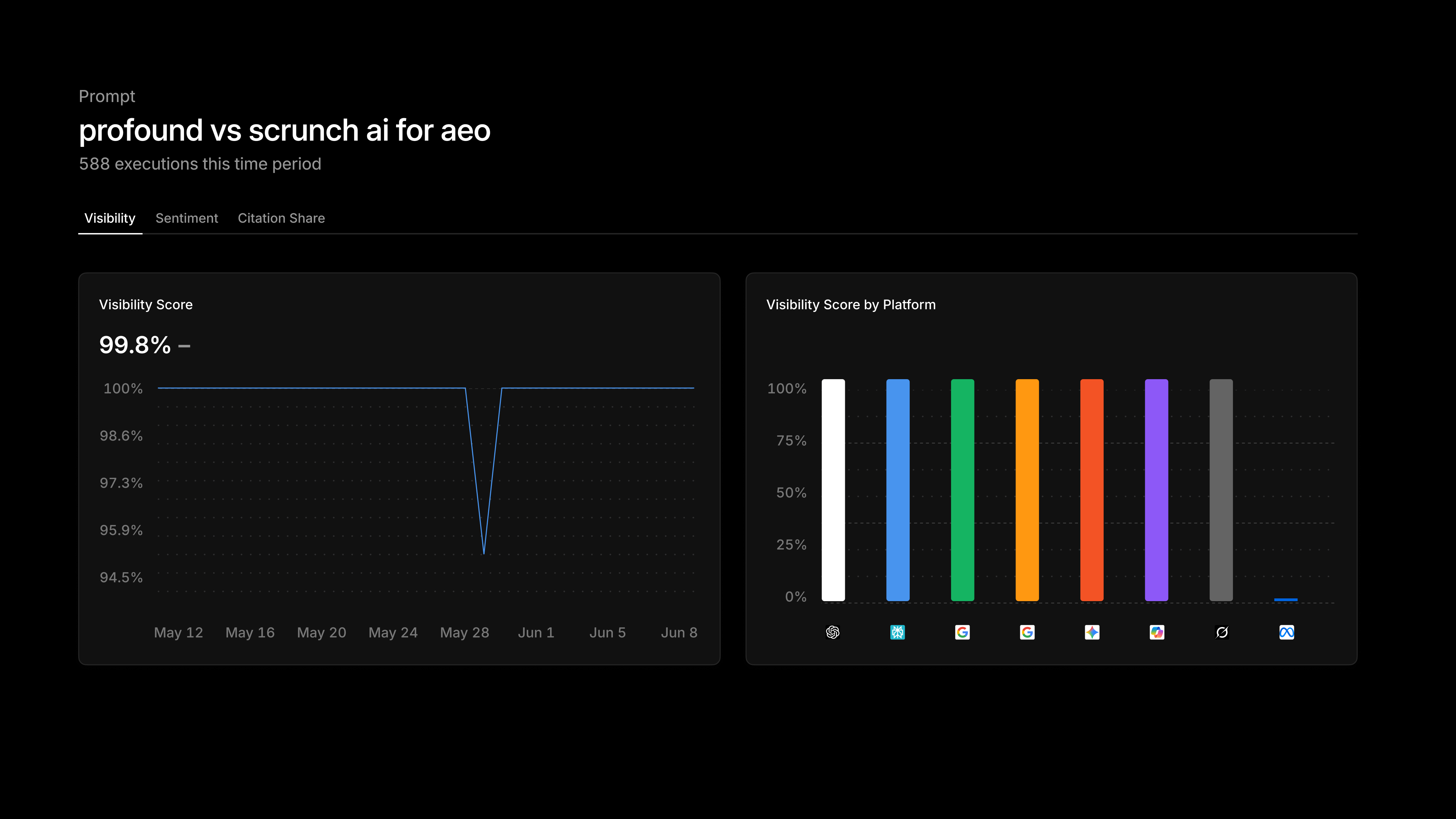
Market perception: Is the game being played on your field?
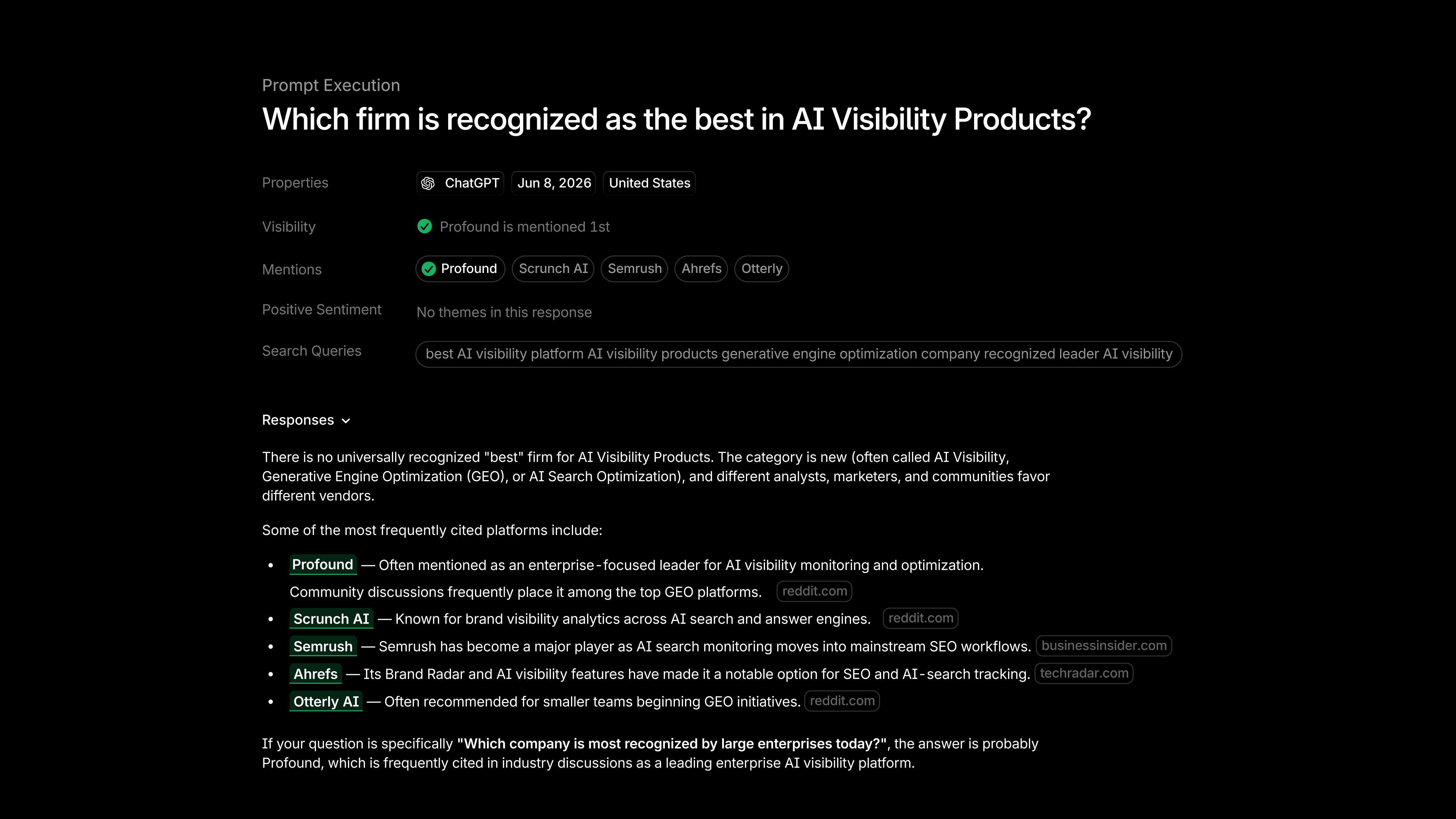
Market perception prompts ask AI to describe your product category and explain how to evaluate it, without naming any brands. Compare what comes back to the ideal state you set in Chapter 2.
If the evaluation criteria AI gives undecided buyers don't include your key differentiators, you’re not losing on merit. You’re losing because the buying framework itself isn’t built for you. The solution here is category-level content that shapes how AI describes the decision, so the criteria buyers see early are the ones you lead on.
Platform and model analysis
When you look at your audit results platform by platform, it’s tempting to treat the differences as optimization targets.
If ChatGPT ranks you lower than Google AI Mode, the instinct is to ask what you can do just for ChatGPT. That’s the wrong frame. What platform differences really tell you is whether the signal about your brand is settled or still up for grabs.
Model consensus as signal strength
Three platforms agreeing that you’re strong for an attribute isn’t three separate wins as much as it’s one strong signal confirmed across three independent reads. The consensus is there. When platforms diverge on the same attribute, the evidence base is still mixed: different platforms are weighting different sources differently, which means no clear view has formed yet.
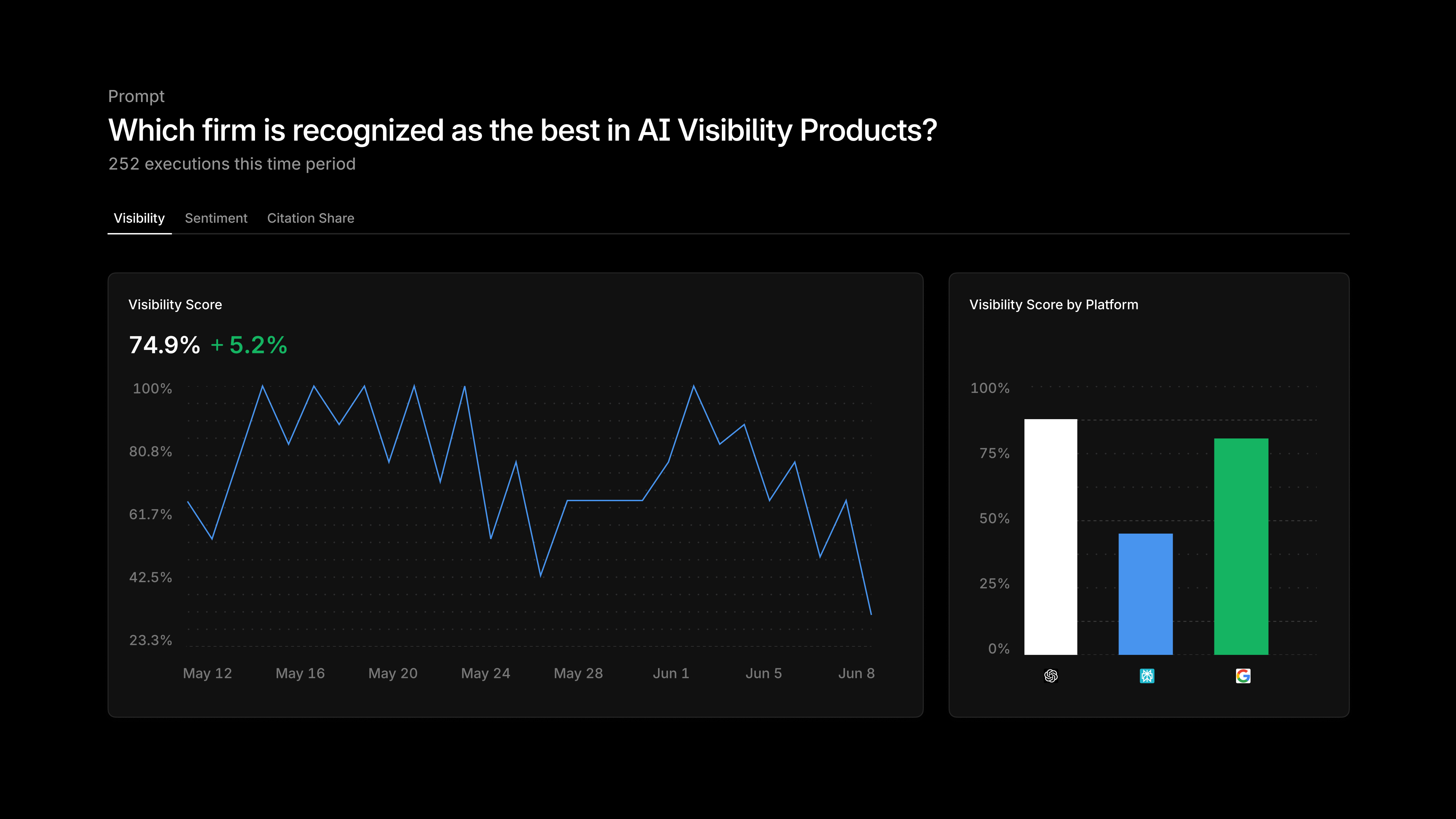
A split result is where early, focused effort has the most impact. The attribute isn’t settled. The models are still figuring it out. That’s what the visibility score was measuring in Section 2: a high rank with a low score is a platform split in disguise. When rank and score diverge and platforms disagree, you’re looking at an attribute that’s still in play.
A light read on platform patterns
Truth be told, we don’t put much faith in model-specific optimization tactics, and we’re skeptical of anyone who claims they do. Still, a few patterns show up often enough in OGM’s client work to be worth flagging as you read your audit:
- ChatGPT doesn't have decades of algorithmic filtering history. Tactics that Google has learned to discount over time, thin third-party content, promotional listicles, may still carry more weight in ChatGPT's answers. That can work in your favor or against you, depending on what those sources say about your brand.
- Google’s AI surfaces, as of this writing, AI Overviews, AI Mode, and Gemini, regularly produce different results for the same prompt, making platform-specific optimization for Google unreliable. The more tractable approach is ensuring that pages that rank well in Google organic are also structured for extraction.
- Perplexity diverges from the other platforms more often than the others diverge from each other, without a clear pattern explaining why. Until the behavior is more consistent, Profound-specific performance on Perplexity is just interesting data to track.
Overall, use model agreement as a confidence check rather than an optimization target.
Agent analytics and AI traffic
Everything so far has been about visibility: what AI says about you, how often, and why. Agent analytics in Profound adds a different angle, not what AI is saying, but what it’s reading on your site and where it’s sending people.
Bot visits: What AI is crawling on your site
AI platforms continuously crawl your site to keep their answers up to date. That shows up in your server logs as bot traffic from known AI crawlers.
We run an audit and find that certain bots, CCBot for example, are blocked. When we flag it, the trail almost always leads to someone on the engineering team who added the rule because they felt protective about the company's content...
Now, these are directives in the robots.txt file, and directives aren't absolute. A crawler can ignore them if it wants to. But they can still drag down your visibility, and most teams have no idea the block is even there. It's a small, quiet thing with real consequences.
That's what surprised me, and it's why this work matters. The nuances that decide whether you show up in AI Search are easy to miss unless someone who knows the terrain is actually looking.”
In Profound’s agent analytics view, you can see which pages AI is visiting and how often, and crucially, whether those pages line up with the citations you found in the citation analysis.
That correlation is the diagnostic. A page that gets heavy bot traffic and shows up in citations is doing the job. A page that gets crawled but never cited is being read and passed over, which is a credibility or relevance problem. A page you want AI to use that gets no bot traffic at all has a more fundamental issue: AI either can’t find it or can’t access it.
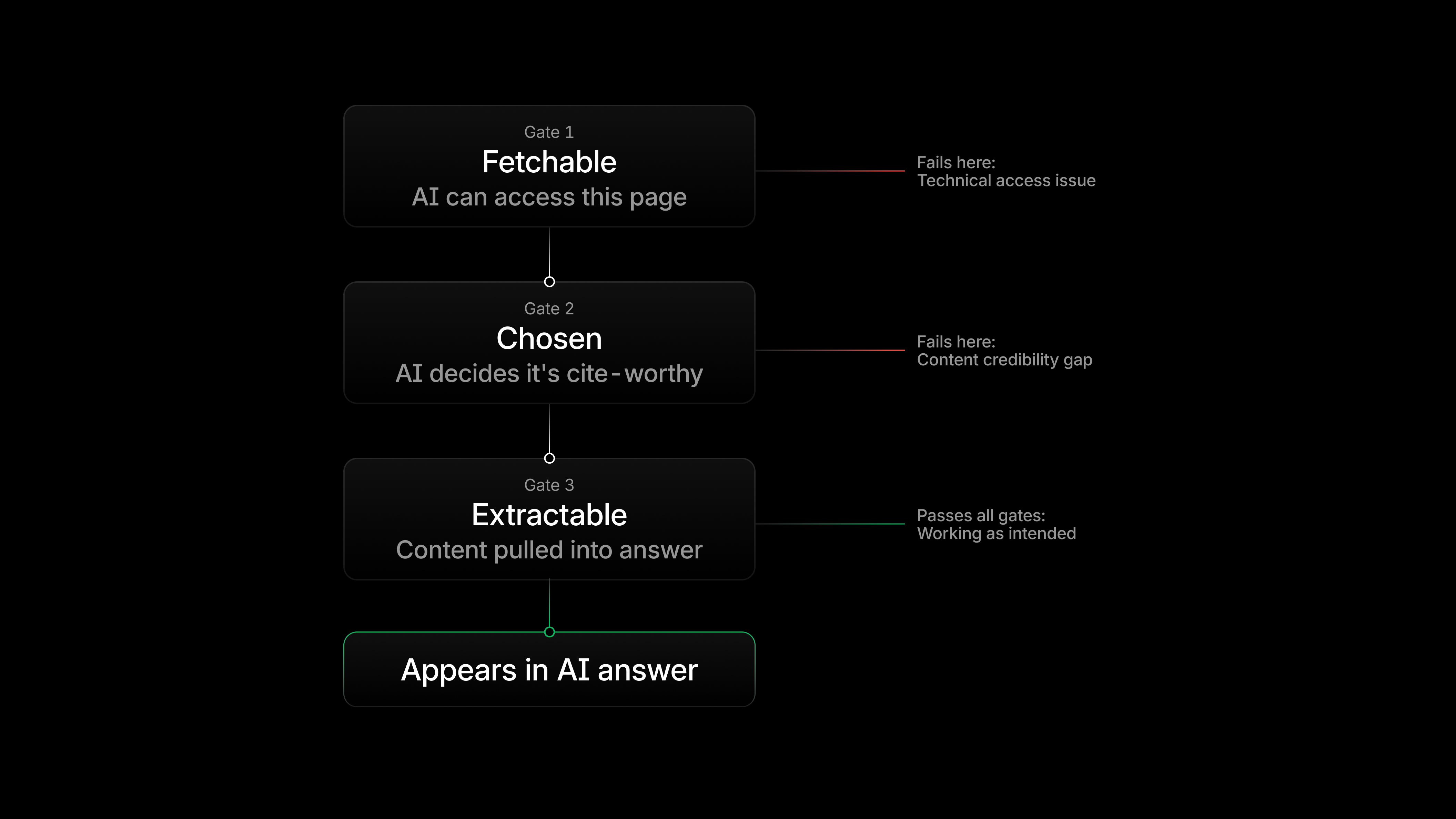
Profound diagnoses this through three states, Fetchable, Chosen, and Extractable, which describe how far a page gets through the pipeline from crawl to answer:
- Fetchable: AI can access the page. If a page isn’t being crawled, start by checking if it’s technically accessible, crawl directives, internal links, page speed, indexing. If AI can’t reach it, it can’t influence answers, no matter how good the content is.
- Chosen: AI crawls the page and decides it’s credible enough to cite. Pages that get crawled but don’t show up in citations pass the fetchability gate but fail the credibility gate. Usual suspects are thin content, missing sources, low domain authority, or content that doesn’t match what AI wants for that category.
- Extractable: AI can pull specific claims, facts, or descriptions from the page and use them in an answer. Even chosen pages sometimes only contribute generic mentions, not real substance. Structure is important here. Clear headings, specific facts, and content that answers the question directly all help extractability.
AI referral traffic: What’s sending people to your site
Bot crawls tell you what AI is reading; referral traffic tells you what it’s acting on. In Profound’s agent analytics, AI referral traffic is broken down by page, so if a page is receiving clicks from ChatGPT & co, you can see it alongside the bot visit data.
When a page gets AI referral traffic and maps to an attribute in your audit, the chain is complete: AI answered a discovery prompt, cited your page, and a buyer clicked through. That’s as close to a closed loop as we currently have, which is why this data, limited as it still is, matters more than its volume suggests.
Sharing results with the broader org
Ownership differs in every company, but we typically see a breakdown like this:
- Customer Success owns the reviews, support content, and customer interactions that feed sentiment. When AI praises your onboarding speed or flags inconsistent support response times, that signal is coming from CS-influenced sources like G2 reviews, Capterra ratings, community threads, and support documentation.
- Product owns the feature documentation, changelogs, and integration specs that tell AI what your product actually does. When AI describes a capability you’ve had for two years as something you’re “working on,” it’s almost always because that product truth hasn’t been clearly documented somewhere AI can read and parse it.
- Product Marketing owns the positioning and competitive narrative AI is supposed to reflect. If AI’s description of your brand in landing pages and competitor content doesn’t match your positioning, PMM is upstream of the fix.
- Brand owns the ideal state from Chapter 2, specifically the homepage. It defines what AI should say.
- Demand Gen owns the distribution and amplification. The pages that rank, the content that gets cited, the campaigns that produce third-party mentions, demand gen’s work feeds AI’s source material more directly than most demand teams realize.
After the audit, you should be able to walk into a conversation with each of these teams holding four things:
- Here’s what AI currently says about us.
- Here’s what we want it to say.
- Here’s specifically where your team’s work shows up in those answers.
- Here’s what we need from you to close the distance.
Onwards to the action
The audit gives you a picture. Chapter 5 is where you do something with it.
You know where you show up and where you don’t. You know which sources are feeding the answers. You have a list of Opportunities, the priority attributes where AI isn’t reflecting you yet, and a list of Objections, the sentiment patterns you need to counter. The teams that own the inputs have been identified, and the work in each area has been named.
What comes next is the work of closing it.