

Your audit produced three outputs: the attributes where you should be visible but aren't, the negative narratives AI is pulling about you from somewhere on the web, and the things that are already working in your favor. The work from here is moving each of them in the right direction.
That work splits across two domains.
- On-page is what you do on your own site, creating content, improving what exists, adding mentions of target attributes to pages AI already reads.
- Off-page is everything else: the partner pages, directories, social media, UGC and review platforms, and third-party articles that AI treats as independent signals about your brand.
This chapter walks through the routing logic first, then on-page execution, then off-page execution, and finally a lightweight check to run once changes are in place. It's a practitioner playbook, not an exhaustive framework. The goal is to give you enough to act on your first audit outputs and a process you can repeat as findings accumulate.
I think the big thing is how rapidly the industry is changing. Everything we think is definitively critical to your strategy can change day-to-day. Whether ChatGPT is favoring Reddit versus LinkedIn versus first-party pages versus third-party pages, it changes all the time, which makes things really hard to have a full holistic grasp over.
The other aspect is there are no more best practices anymore. Everything is so specific to your industry, your audience, your business, your topics, and your individual experts on hand. You can't just play a general playbook. You really need to understand your brand, understand your business, understand your industry, and understand the various sources that these different AEO channels and services are pulling from.”
From audit to action: The routing logic
The most common response to a weak audit is adding content. New pages, more FAQs, maybe a refreshed blog post on the topic you're underperforming on. Sometimes that's just what the doctor ordered. Often, it isn't, and six weeks of content production has little impact vis-à-vis the effort you put in because the problem was never content to begin with.
That’s why you need a routing logic.
What your validation prompts already told you
In Chapter 4, you ran two types of prompts for each Opportunity. Discovery prompts to measure whether AI surfaces you for a given attribute, and validation prompts to check whether AI recognizes that you have the capability when asked directly.
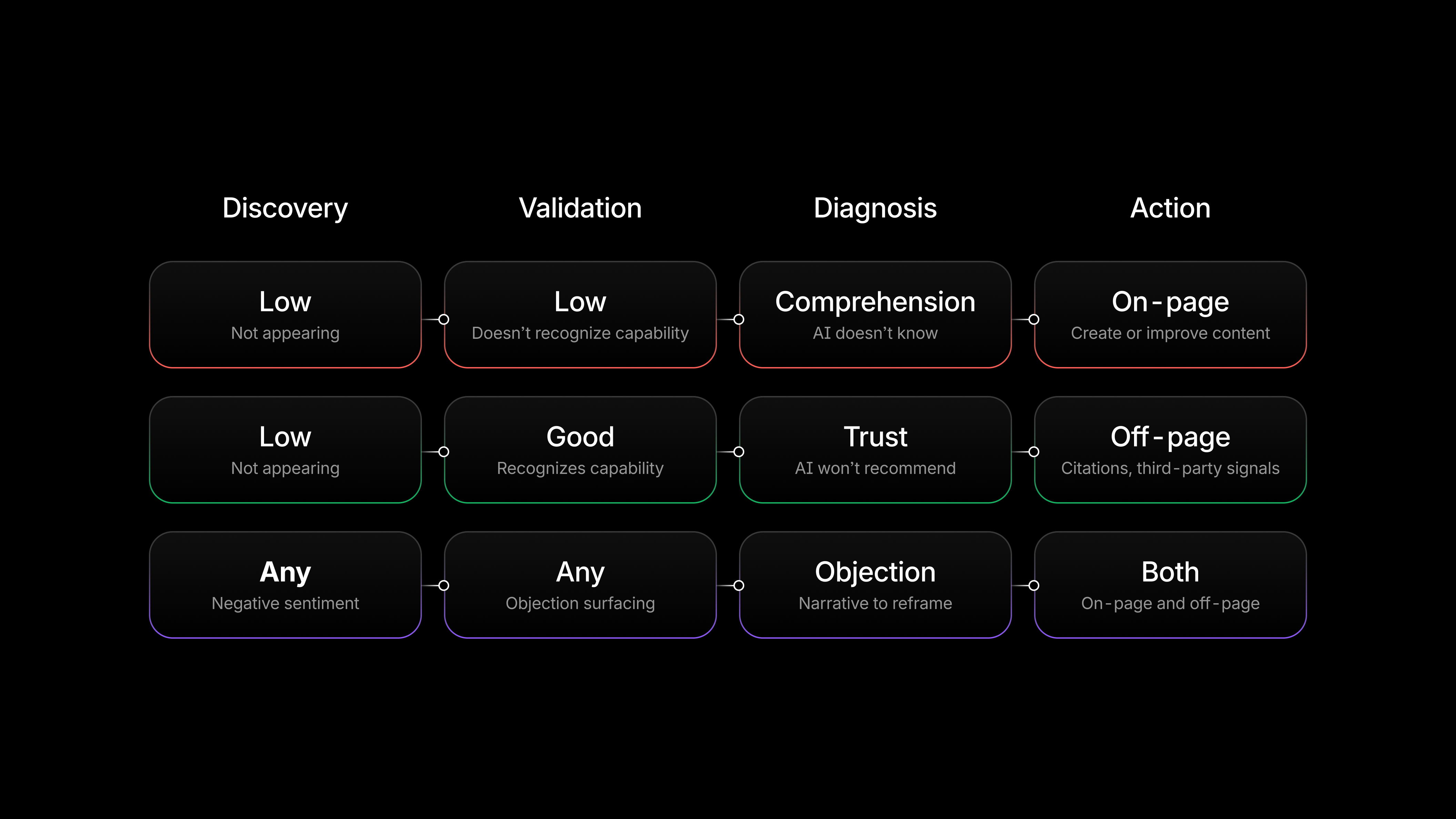
The combination of those two results is a diagnosis:
- Low discovery with low validation means AI doesn't know you have this capability at all. It hasn't read content that teaches it the association. The fix is on-page: create content or improve what exists so AI has something to work from.
- Low discovery with good validation means AI knows you have the capability, the validation prompt confirmed it. It just isn't recommending you. That's a trust gap, and more on-page content isn’t the best lever to pull to fix it. The solution is more so off-page: third-party citations, external sources that corroborate what your site already says, and shift your status from known to recommended.
There's a third diagnostic that belongs in the same pass: FactCheck. Where validation tells you whether AI recognizes your capability, fact-checking tells you whether what AI is saying about you is accurate. A brand can have good validation scores and still surface factually incorrect descriptions of how a product works, what it costs, or what it integrates with.
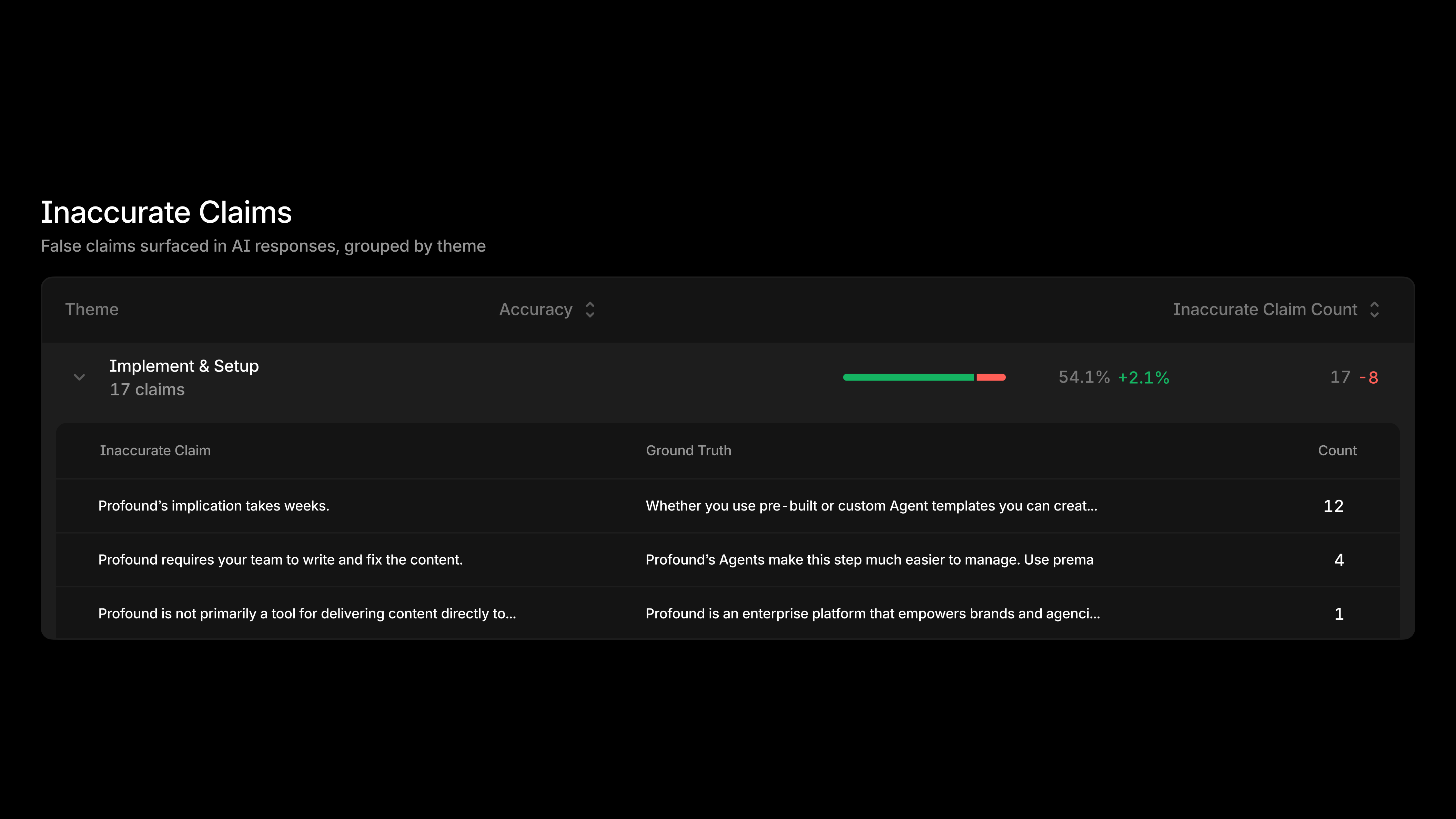
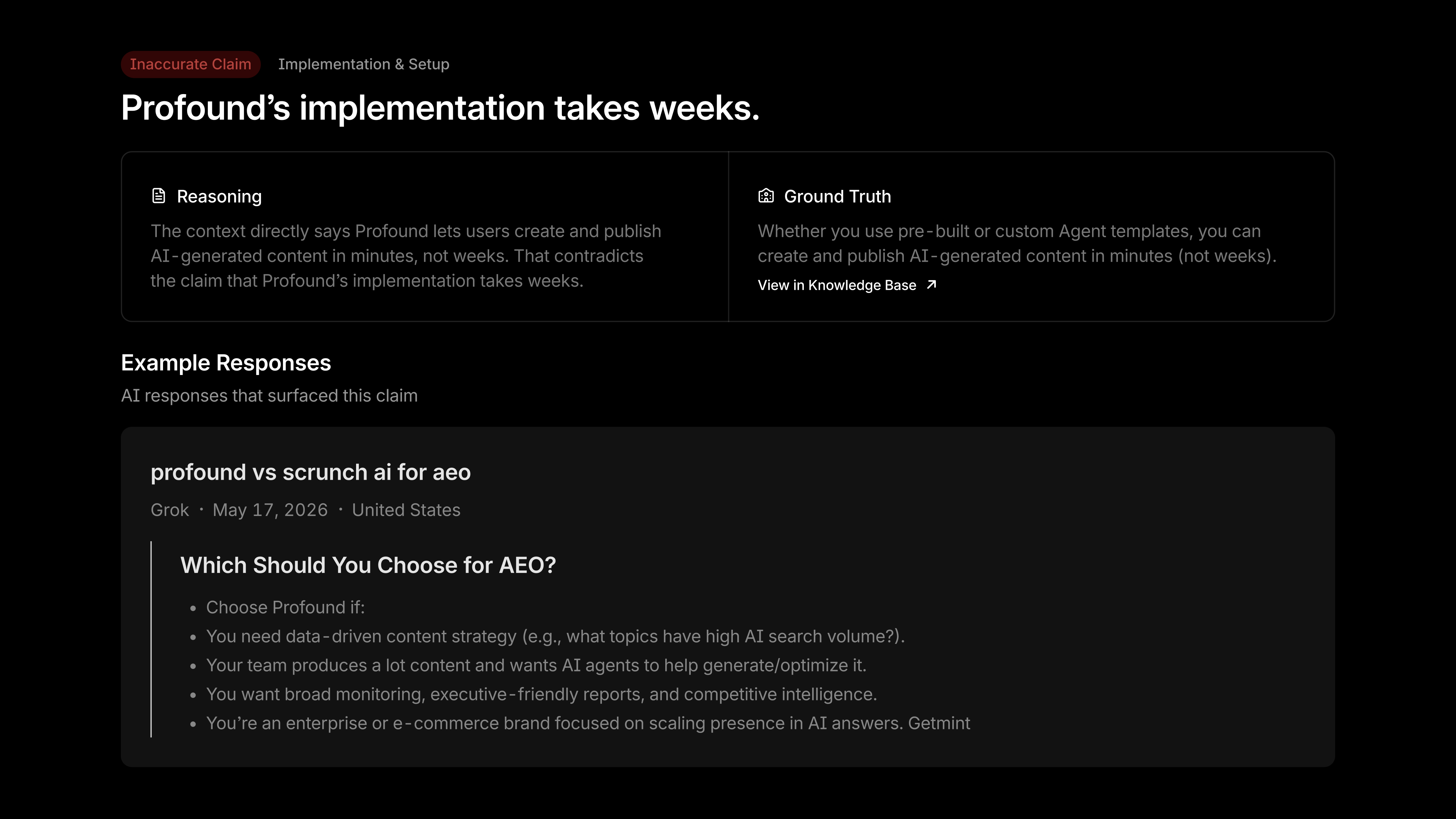
Profound's FactCheck tab surfaces those inaccuracies, claim by claim, grouped by theme, and traces them back to the citations that produced them. That last part is relevant for routing: if the inaccurate claims are coming from your own pages, the fix is on-page. If they're coming from third-party sources, it's an off-page problem, and it takes priority, because you can't out-publish a wrong answer that AI keeps finding somewhere else.
How each of the three audit outputs routes
Everything in your strategy falls into one of two buckets: on-page (things you do on your own website) and off-page (things you do elsewhere on the web). Both matter for all three audit outputs, but the routing diagnostic tells you the emphasis for each Opportunity.
- Opportunities, attributes where you have low visibility, run through the validation diagnostic above. Check the validation result, identify whether you're looking at a comprehension problem or a trust problem, then follow the relevant section in this chapter.
- Objections almost always require both domains. The negative narrative lives partly on your own site (or in the absence of content addressing it), and partly in what third-party sources are saying. On-page, you write content that reframes the objection. Off-page, you update or influence how external sources describe you. Neither alone is sufficient.
- Strengths follow the same routing logic as Opportunities, applied to amplification rather than repair. For each high-performing attribute, the questions are the same: do you have a page on this, and where else on the site can you reinforce it? Then, which external sources are already citing you for it, and which should be?
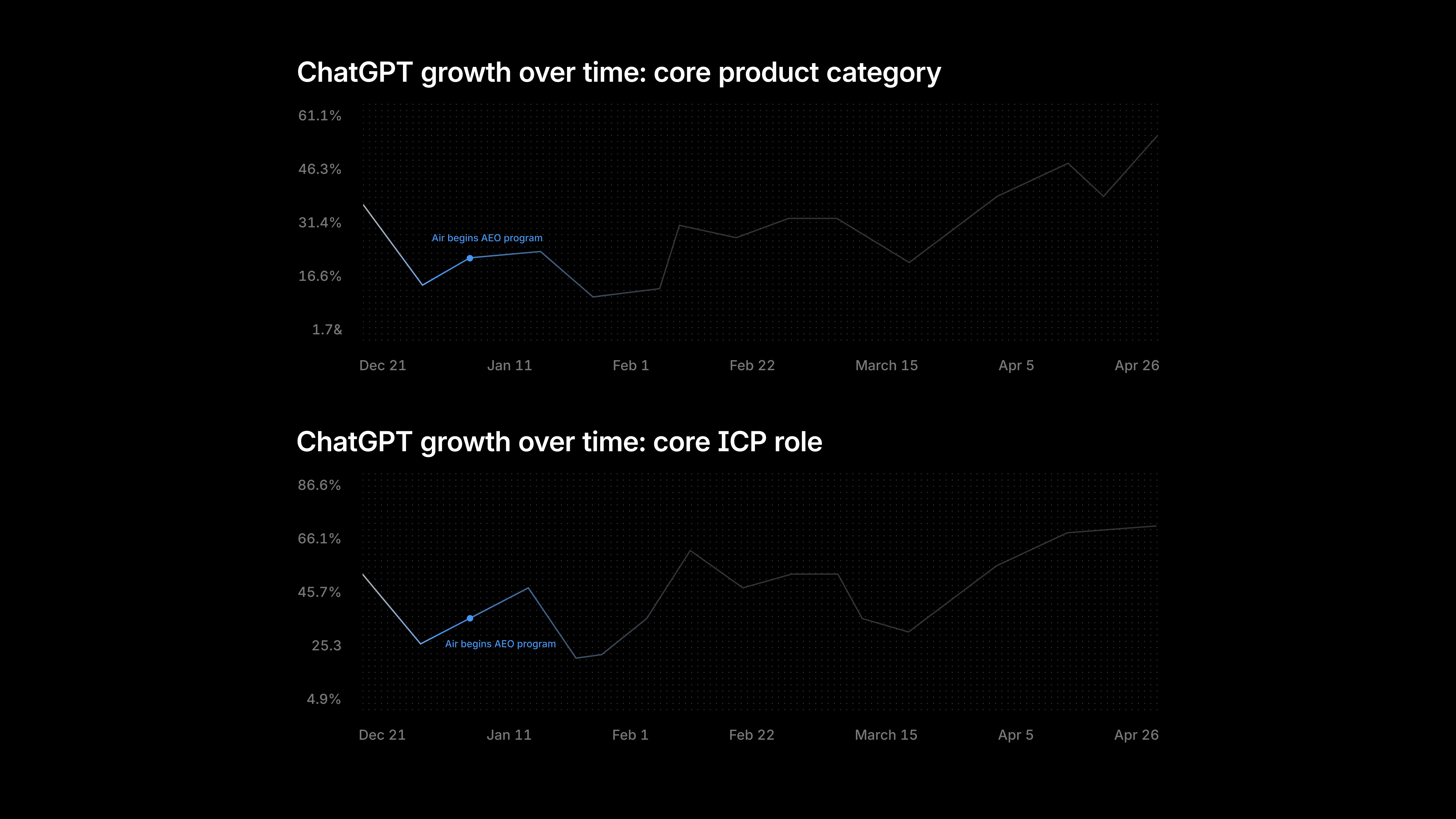
Air is a great example of the routing logic in practice. The company had very little AI visibility for the core components of their business, low discovery across the board.
The validation work revealed the nature of each gap: some attributes were comprehension problems (content didn't exist), others were trust problems (Air was known but not recommended).
The strategy was split as follows:
- Net-new content to address comprehension gaps
- Off-site citations and link building to address trust gaps.
Both tracks ran in parallel, targeting different problems.
On-page: Building the signal
In SEO, the unit of work was a page. One target keyword, one optimized page, one ranking to move. AEO doesn't work that way. A single dedicated page about a capability is a starting point; what builds the association strong enough to influence AI answers is that capability appearing in multiple relevant contexts across the site, corroborated by your own content from different angles.
The three questions below are the on-page checklist. They apply to Opportunities and Strengths. Objections follow a variation, covered at the end of the section.
Question 1: Do we have a page on this topic?
If the answer is no, create one.
For an Opportunity, that's a page focused on the attribute you're underperforming in. For a Strength, it might mean giving a high-performing capability its own standalone page when it's currently buried inside a broader feature list, Air, for instance, was competing across multiple product categories simultaneously, and part of the early on-page work involved building dedicated content for each so AI had something concrete to extract per category.
If the answer is yes, look at the page through an extraction lens rather than an SEO lens. The question isn't whether the page ranks, it's whether the capability is stated specifically enough that AI can lift a claim from it and use it in an answer. Vague product copy doesn't extract well. Clear, direct statements about what the product does, and for whom do.
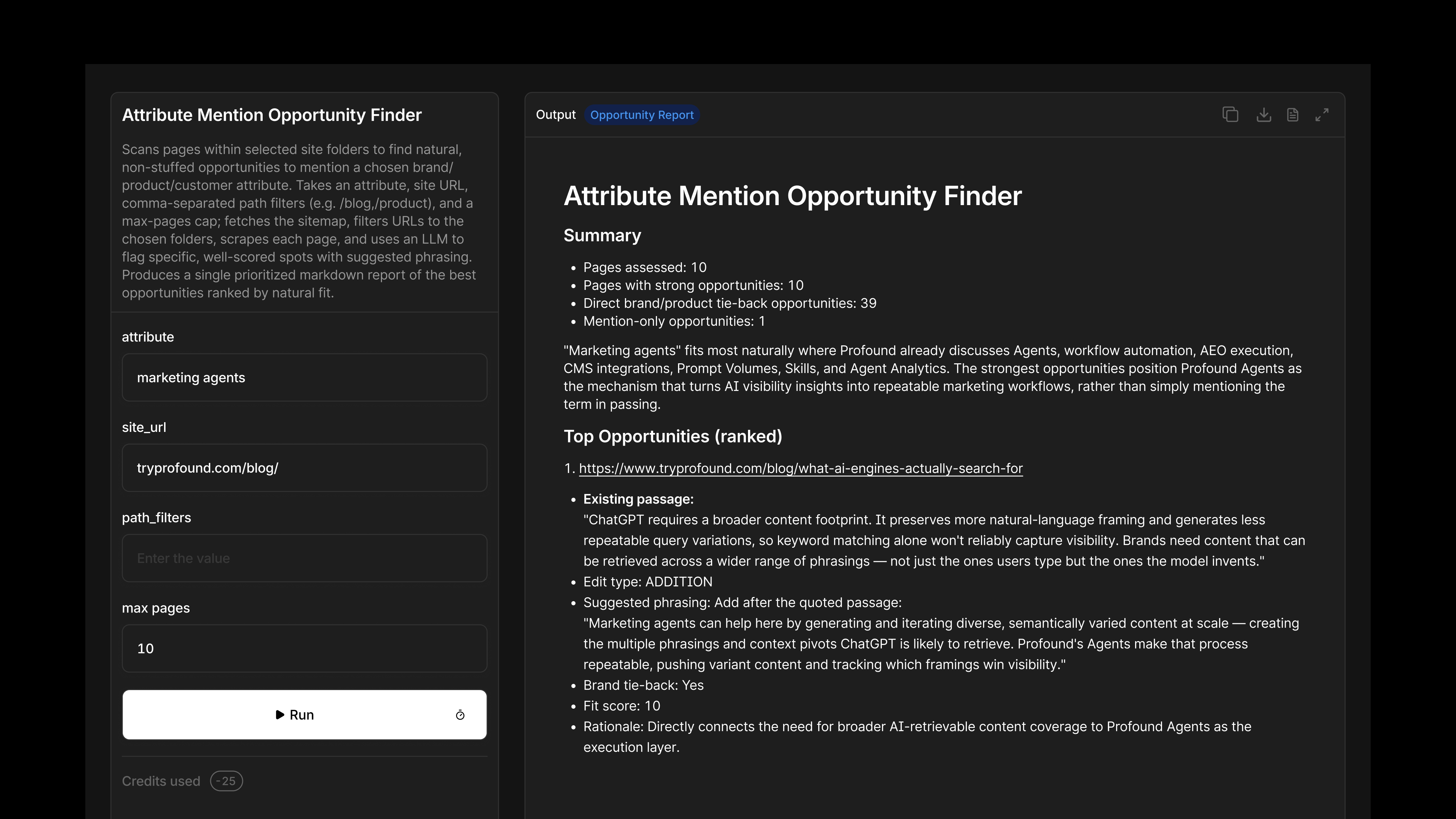
This is the kind of check you can build into a Profound agent. The one you see above works through a site's existing pages, scores each one on how naturally a target attribute could be worked in, and ranks the results with suggested phrasing for the edit. That's the part of AEO work that's hardest to do by hand at scale, and it's also the part that's easiest to build into an agent once you know what you're looking for.
For Objections, the calculus is different because the page probably doesn't exist. Companies don't typically build content around their weaknesses, but in AEO, silence on a known objection means AI is pulling that narrative from wherever it found it, be it a Reddit thread, a critical review, or a competitor comparison page, with nothing from you to counter it. The on-page work here is to create content that enters the conversation, not to avoid it.
Question 2: Where else can we mention this attribute?
Once the dedicated page exists, the next job is to reinforce the association across the site. Not every page, the right pages.
Pages your site already gets cited for are the highest-leverage targets. If Profound's citation data shows that a particular blog post or product page already includes AI's source material for adjacent attributes, adding a mention of your target attribute there carries weight. AI is already reading and trusting that page; you're just adding signal to something it already considers credible.
Highly cited pages overall follow the same logic. High citation volume is a reasonable proxy for AI trust, similar to how link equity flows from high-authority pages in traditional SEO. A target attribute mentioned on a page AI pulls from frequently is worth more than a mention buried on a page it rarely reads.
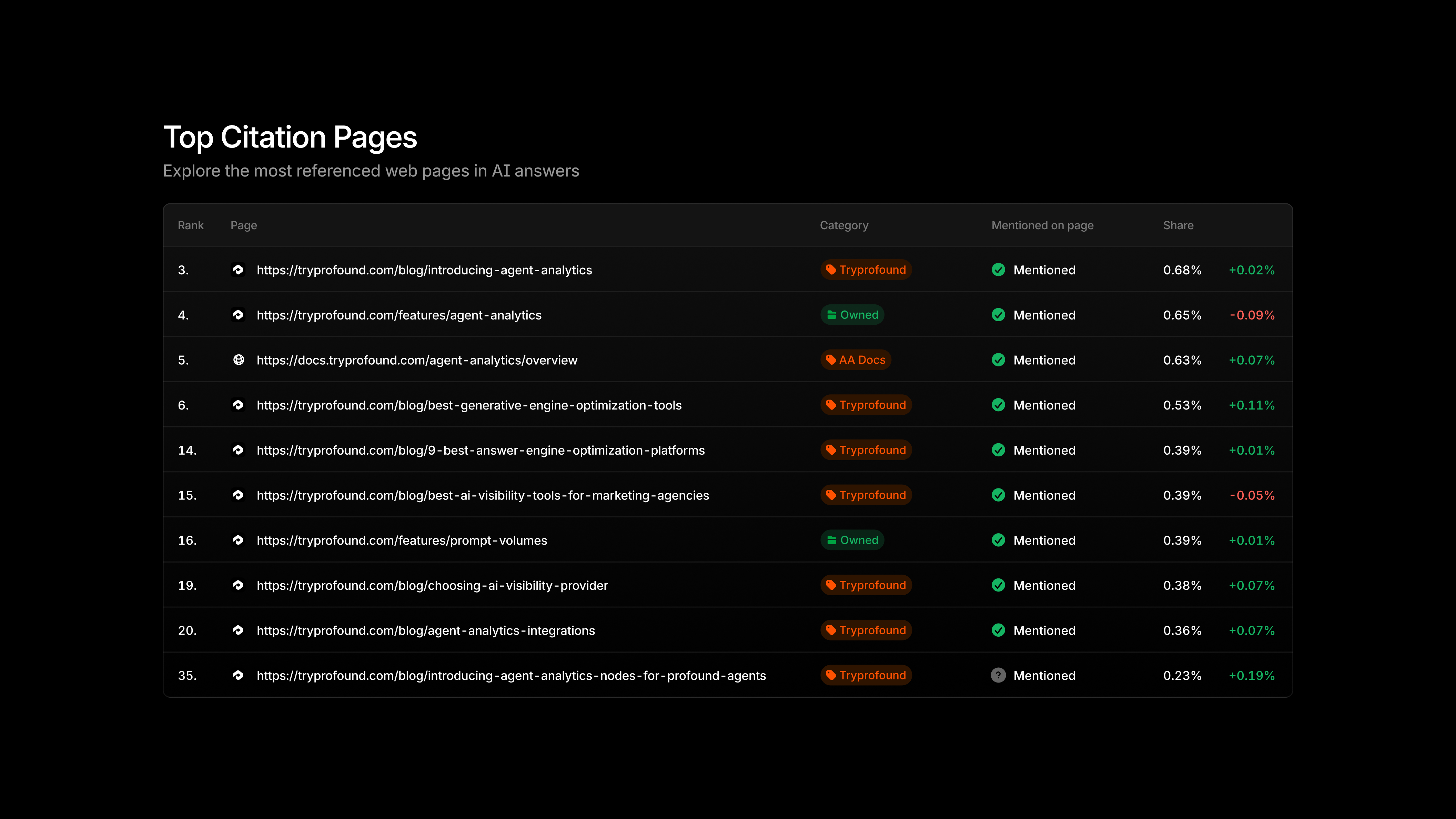
Prominent site pages, homepage, pricing, about, comparison pages, are worth treating as a separate category. These pages see heavy crawl attention and are often where AI looks for definitional information about a company.
Question 3: How do I add mentions naturally?
There are two approaches that cover most of the on-page execution work:
-
FAQs are the more mechanical option. A few well-placed questions on an existing product or pricing page are natural, useful to readers, and give AI a clean, extractable format to work with. The ceiling is a wall of questions that exist only to hit attributes, users recognize it, and it's reasonable to expect AI platforms will discount it the same way Google discounted keyword stuffing.
-
Weaving mentions into existing content is higher effort but tends to hold up better. If a blog post is already getting cited for prompts adjacent to your target attribute, adding a reference to that attribute in a place where it fits the argument naturally is high-leverage. The test is whether the sentence would read as strange to a human editor who didn't know about your AEO program. If it would, it's probably forced, and forced additions tend not to perform.
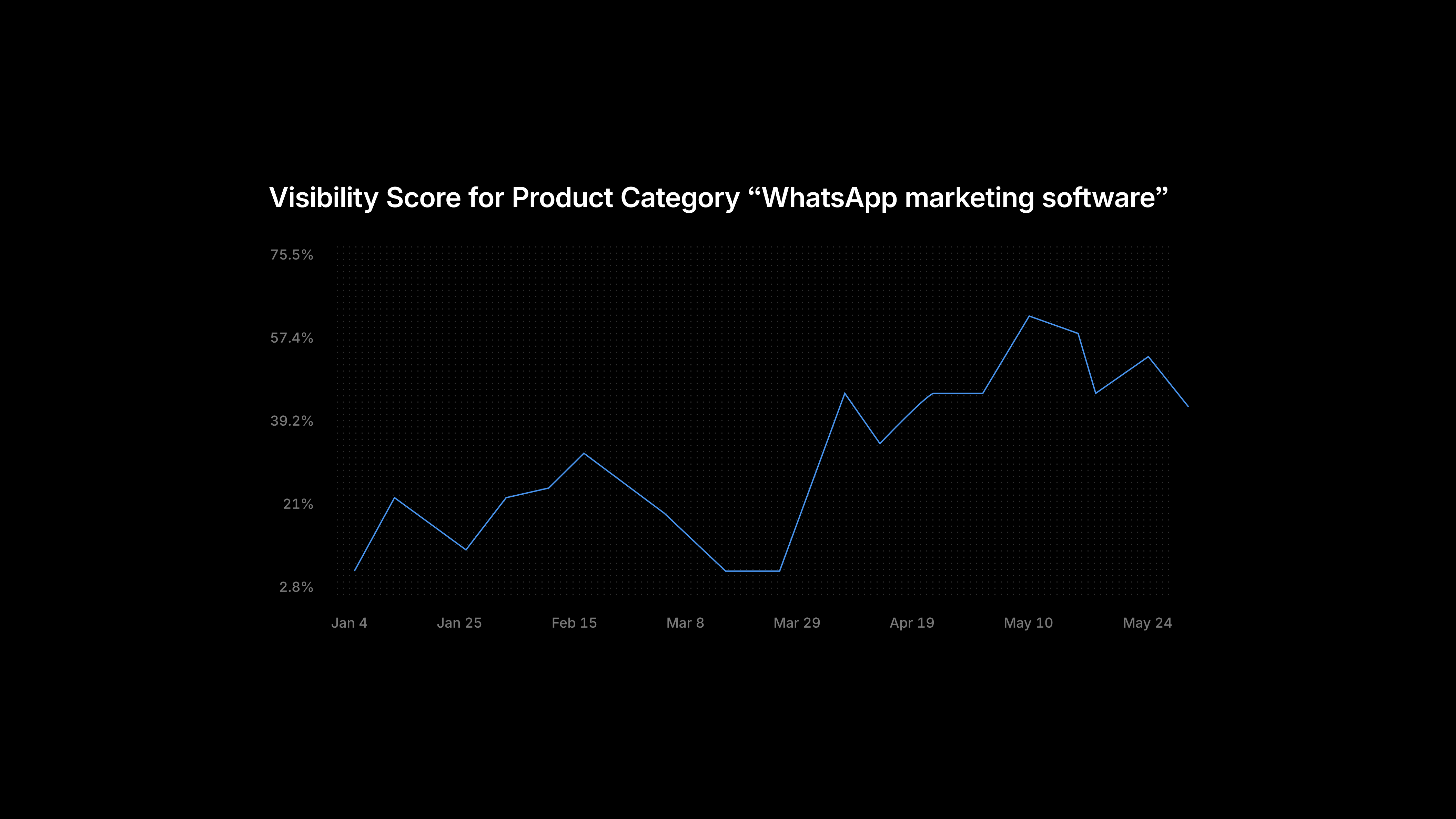
ActiveCampaign had strong WhatsApp integration capabilities but near-zero AI visibility for them, WhatsApp-related prompts consistently returned poor citation rates across product category, use cases, and features.
The on-page work built the association across multiple buyer-intent levels: guides, a comparison page, and BOFU case studies, each structured for extraction. FAQs on existing WhatsApp-related content reinforced the connection. In parallel, third-party articles on WhatsApp automation tools were updated to accurately describe ActiveCampaign's functionality.
Visibility for "WhatsApp Marketing Software" went from near zero in January to 61% in May and #2 in visibility rank; citation share went from near zero to 8% and #1 in May.
The WhatsApp-related wins didn't come at the expense of ActiveCampaign's existing success. Throughout the same period, they held the #1 visibility spot for "Email Marketing Software", their signature category, and continued to grow it. Expanding into a new attribute is the work; not losing ground on the ones you already own is the discipline.
Where Objections diverge
The three questions apply to Objections, too, but the content goal is different. The most important discipline here is that the content reframes rather than defends.
A page that opens with "We don't have a steep learning curve" signals fragility. The reframe doesn't deny the objection; it shifts the frame. "Here's how quickly teams get productive" is the same conversation handled with confidence. The implicit claim, this platform is learnable, lands harder because it's demonstrated rather than asserted.
Some objections shouldn't be countered at all; they should be owned. If "enterprise pricing" is surfacing as a negative signal in your audit data and you are genuinely an enterprise product, the right move is to make clear what that investment delivers. The positioning acknowledges the reality and redirects to value. Trying to counter what's indeed true about your product creates a different problem: AI encounters the objection in third-party sources, and your denial on your own site, and the inconsistency reads as evasion.
Wherever you land on the reframe, distribute it. A single page addressing an objection is better than nothing, but the association has to appear across the same multi-surface spread as any other attribute, About page, case studies, onboarding content, comparison pages, or it won't build enough signal to shift what AI surfaces.
Off-page: Influencing the consensus
Your website is one input among many. At this point, you’re aware that when AI forms a description of your brand, it synthesizes what your site says, what review platforms say, what partner pages say, what comparison articles say, and what shows up in whatever communities your buyers participate in. You only wrote one of those sources.
Off-page work is the process of influencing enough of the remaining ones that the consensus starts to reflect your positioning rather than the web's accumulated approximation of it.
A meaningful portion of those signals is reachable. Not all of them, some sources won't update, some communities won't engage, some are competitors, and some publications aren't interested. But the sources AI cites for your category are a finite list, and Profound's citation data tells you exactly what's on it.
Build your battlecard
Before any off-page work happens, you need a single document that tells everyone doing that work, and any AI-assisted workflows supporting them, what you want to be said about your brand. Without it, outreach is uncoordinated and produces inconsistency, which is the one thing AEO punishes most directly.
Your battlecard should include three components:
- Your ideal positioning. The target state from Chapter 2, who you serve, what you solve, why you win, expressed in plain language that AI is likely to use. Not internal vocabulary or aspirational marketing copy.
- Opportunities to promote. The specific attributes you want more visibility for, with suggested language for each. This gives anyone doing outreach the exact framing to request, rather than leaving them to paraphrase something approximate.
- Objections to reframe. The negative narratives your audit surfaced, and the specific reframe for each one. Not a denial, but a redirect. What you want said instead, and why that framing is more accurate.
The battlecard does two distinct jobs. Internally, it aligns the team before outreach begins. As an execution input, it's the reference you hold a third-party mention up against: does this description match our positioning? If not, what specifically needs to change, and what should we ask for instead?
Find and assess your existing mentions
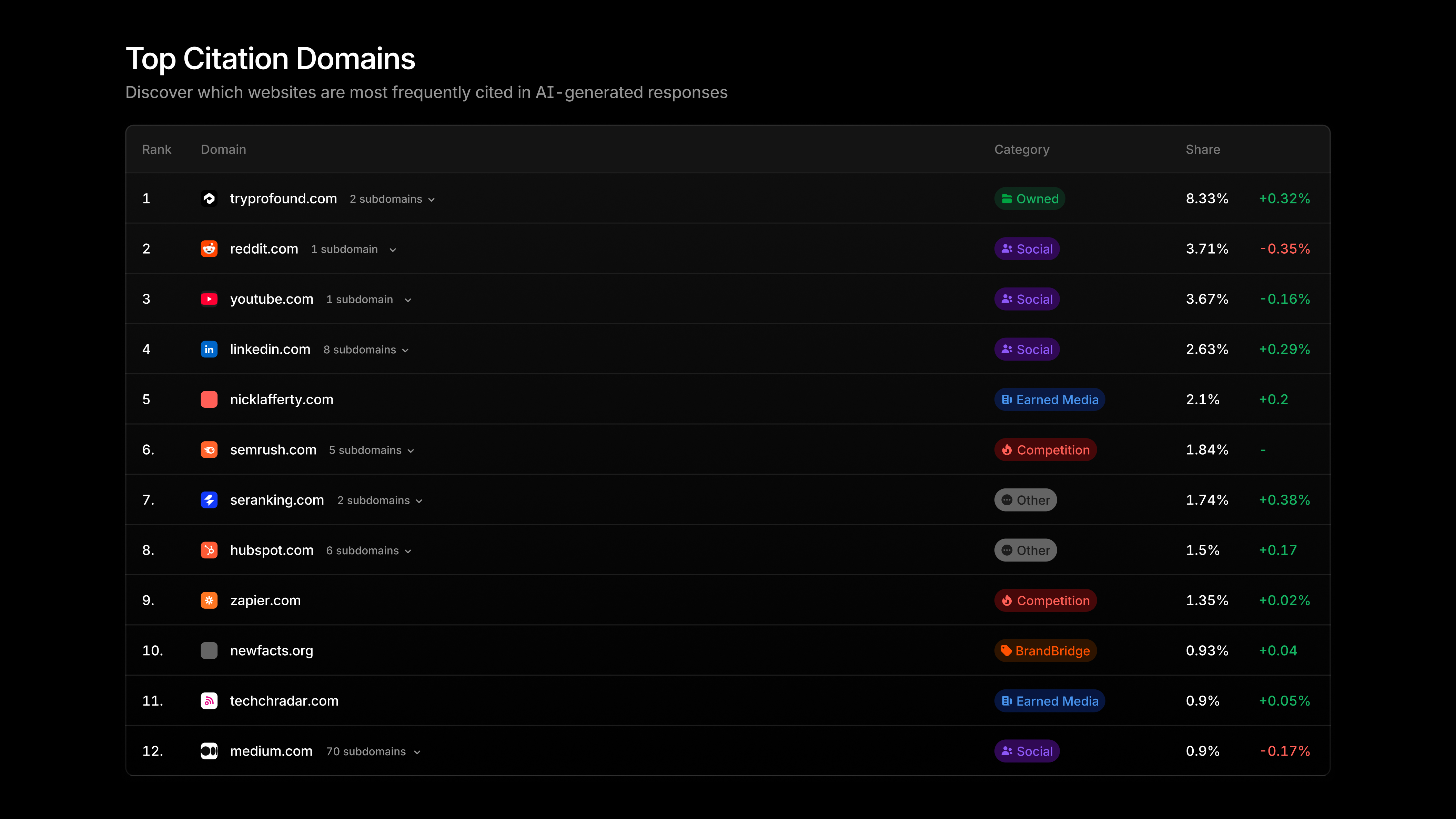
The first pass of off-page work is an inventory. Profound's citation data shows you which external sources mention your brand and what they're saying. Pull that list and cross-check every mention against the battlecard.
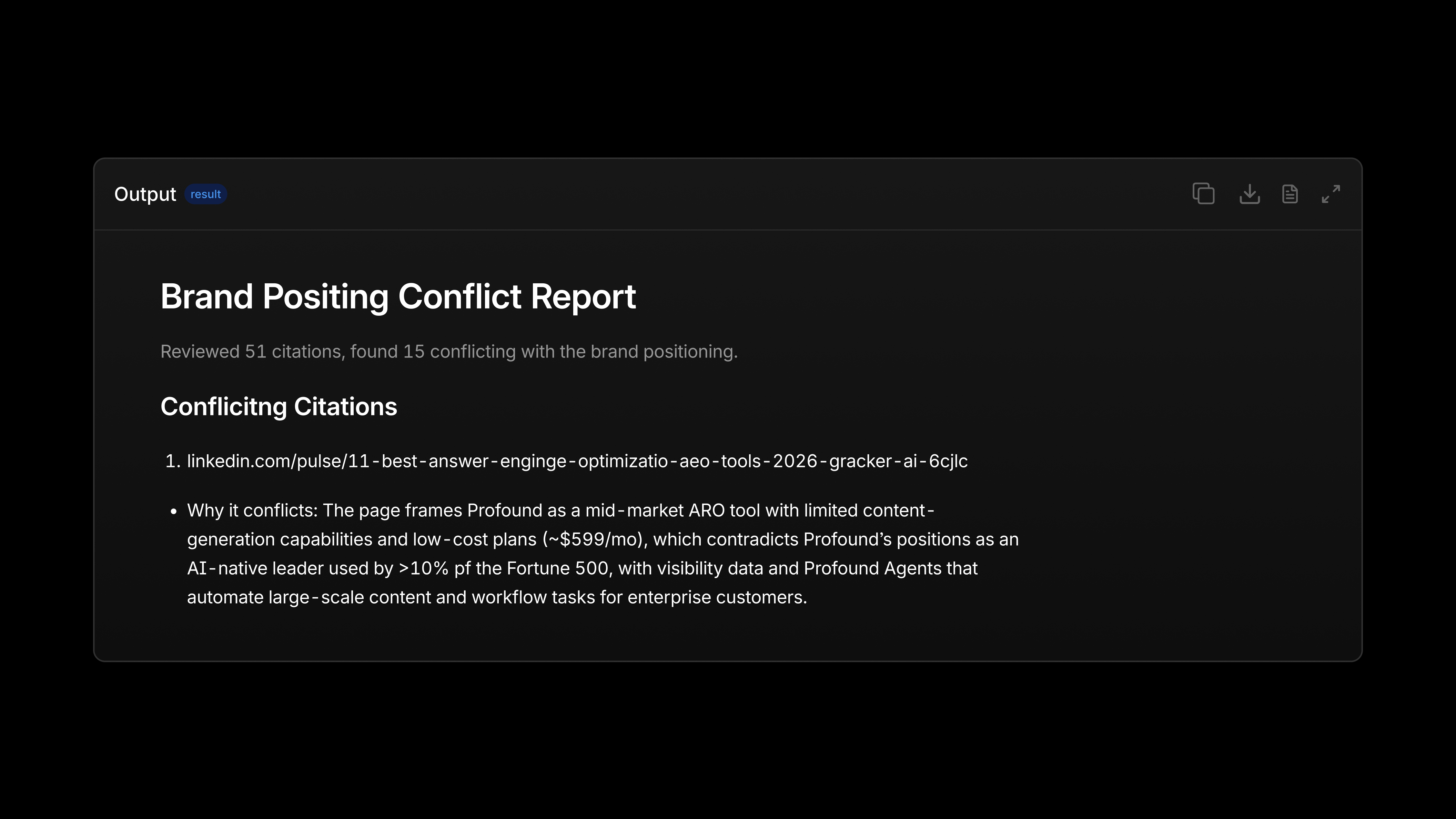
This is another place where a custom Profound agent can do the heavy lifting. The one above reviews your citations and flags any that conflict with your actual positioning, in this run, it checked 51 citations and caught 15 that contradicted how the brand wants to be described, down to naming the source and explaining where the framing breaks. That's the cross-check from the paragraph above, automated: instead of reading 51 pages yourself, you get the 15 that need attention.
You're looking for two things: the size of the gap between how you want to be described and how you currently are, and which sources in that list you already have a relationship with, because those are where you start.
For each mention, work through these questions:
- Does the description match your battlecard positioning? A partner page written two years ago may still use language from a positioning you've moved away from. An integration directory may categorize you incorrectly. These are common and fixable once you know they exist.
- Is the language outdated? Even broadly accurate descriptions can be stale, written before your current product capabilities, before a rebrand, or before you entered a new market. Outdated language that was once correct can now be actively misleading.
- Does it mention your target Opportunities? A source that references your brand but omits a key attribute you're trying to build visibility for is an optimization opportunity. It's already in AI's source material; you just need the right language added.
- Does it surface any of your Objections? If so, is the framing accurate, and is there a realistic path to reframing it without asking the source to misrepresent something?
- Do you have an existing relationship with this source? Partner, affiliate, investor, integration directory, if yes, flag it as high priority. The ask is low-friction because the relationship already exists. These are the easiest wins to put on the board first.
The three types of off-page work
Off-page work falls into three categories, in rough priority order: optimize what already exists, get added to sources where you're absent, and create new sources where none exist.
The priority order isn't arbitrary, it follows the friction gradient. Updating something that already mentions you is easier than getting added to something that doesn't, which is easier than creating a new source from scratch and waiting for it to earn enough authority to get cited.
1. Optimize your existing mentions
In traditional SEO, third-party mentions were primarily about the link. Whether the site mentioned you at all, and whether it linked back to you, was the signal that mattered. What the site actually said about you was a secondary concern at best. In AEO, that math has reversed. A partner page that links to you but describes you with outdated language, or positions you in the wrong product category, is actively contributing to a narrative you don't want.
Start with the mentions you identified in your inventory, and prioritize by relationship type:
- Integration partners. The relationship already exists. Requesting an integration page update or a description refresh is a routine ask; quite different from a cold pitch.
- Affiliates. A financial relationship often makes direct influence possible. Descriptions can frequently be updated without much negotiation.
- Investors and advisors. Portfolio descriptions, advisor bio pages, and fund websites often reference companies in their network. These are warm relationships with a clear rationale for keeping descriptions current.
- Industry associations and analyst firms. Higher-effort and slower to move, but high-authority when they land. Worth pursuing in parallel, not after everything else is done.
Profound lets you create custom citation categories, essentially named buckets of domains you define yourself. Create one called "partners," add your partner and affiliate URLs to it, and Profound will treat those sources as a distinct group in your reporting. From there, you can run an agent that pulls your brand mentions specifically from that category and checks how those sources are describing you against your current positioning. It's a one-time setup that turns a recurring manual audit into something you can rerun whenever you need it.
2. Get added to existing citations where you aren't mentioned
Profound's citation data also shows where you don't appear. For each of your priority attributes, there are sources AI is already pulling from when it answers questions in your category. Those sources are doing influence work for your competitors. If you're not on them, you're not in those answers.
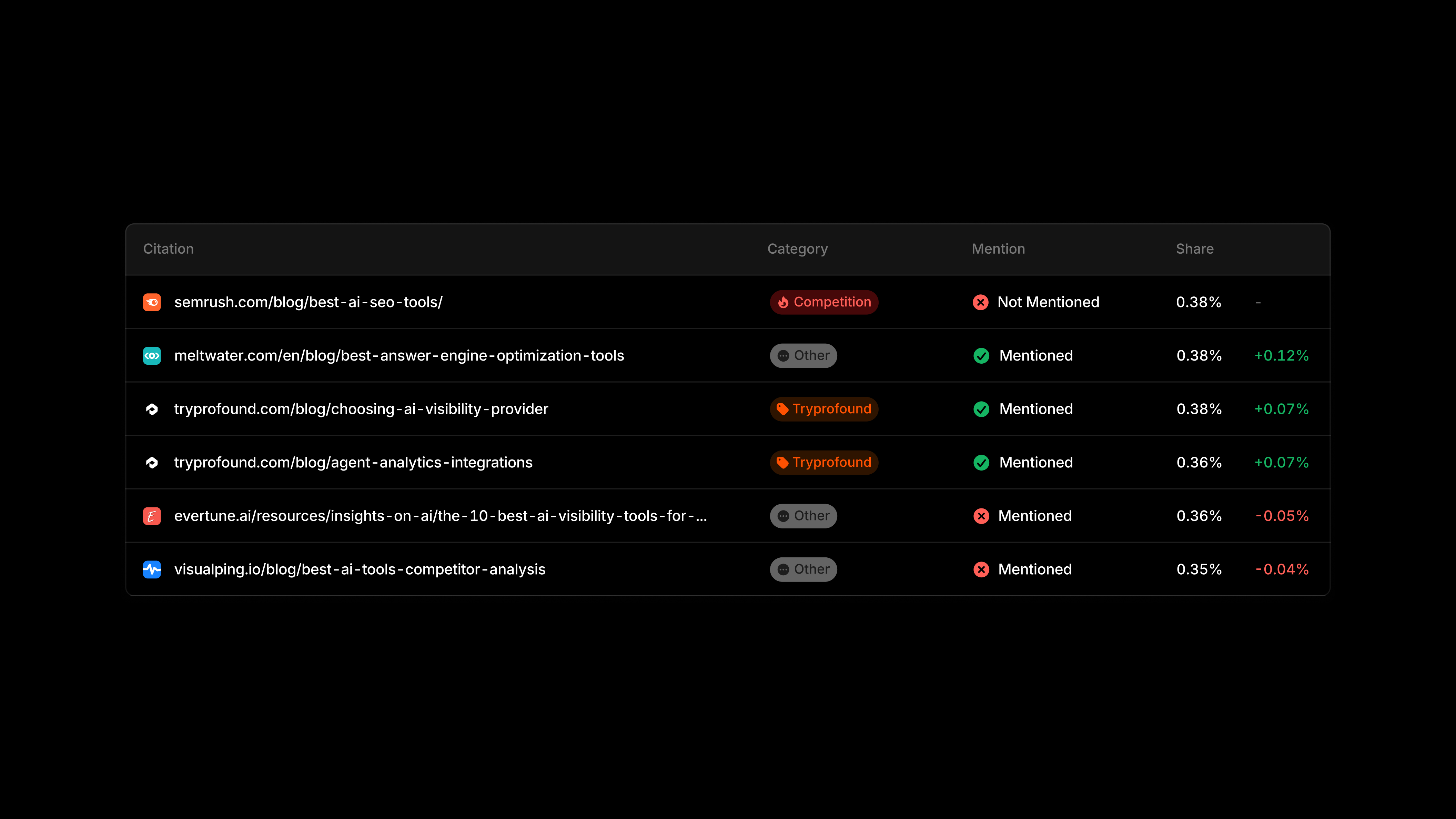
The types of sources vary by market:
- Listicles and comparison articles. Currently, the most common off-page tactic in B2B, and it works. Expect increasing scrutiny from AI platforms over time, just as Google learned to discount thin comparison content, AI will likely develop similar filters. Don't over-index on one format.
- Industry and technology directories. Category-specific directories your buyers use for vendor discovery. Being absent here is a straightforward gap to close.
- Integration partner pages. For each integration partner, there should be a page on their site that accurately describes what your integration does and who it's for. Many don't exist or are outdated.
- Review platforms. G2, Capterra, and TrustRadius for B2B; Trustpilot and Reddit for consumer. Presence and accuracy both matter, being listed but described incorrectly is a version of the same problem.
3. Create new sources of influence
Sometimes the right sources just don't exist yet. The citation data tells you the topics and formats AI is already drawing from in your category, and where the coverage is thin, outdated, or missing entirely, new content has a real path to getting cited.
What new source creation looks like in practice depends on what the citation data shows. For example:
-
Original research and data-driven content. Studies, surveys, and proprietary data that industry publications pick up and cite. These create new sources AI can draw from, and they carry more authority than content published only on your own domain.
-
Guest posts and co-authored content. Publishing on established third-party domains, partner blogs, industry publications, co-authored pieces, builds presence on sites that already have citation authority in your category.
-
Cross-publishing platforms. Services like Stacker distribute content across established media properties at scale. Useful when you need to build presence quickly across multiple sites rather than one at a time.
-
Community participation. If Reddit threads or LinkedIn posts are disproportionately cited for your priority attributes, genuine participation in those communities is an AEO investment. The keyword is genuine, manufactured engagement is recognizable and tends to backfire in communities that police it.
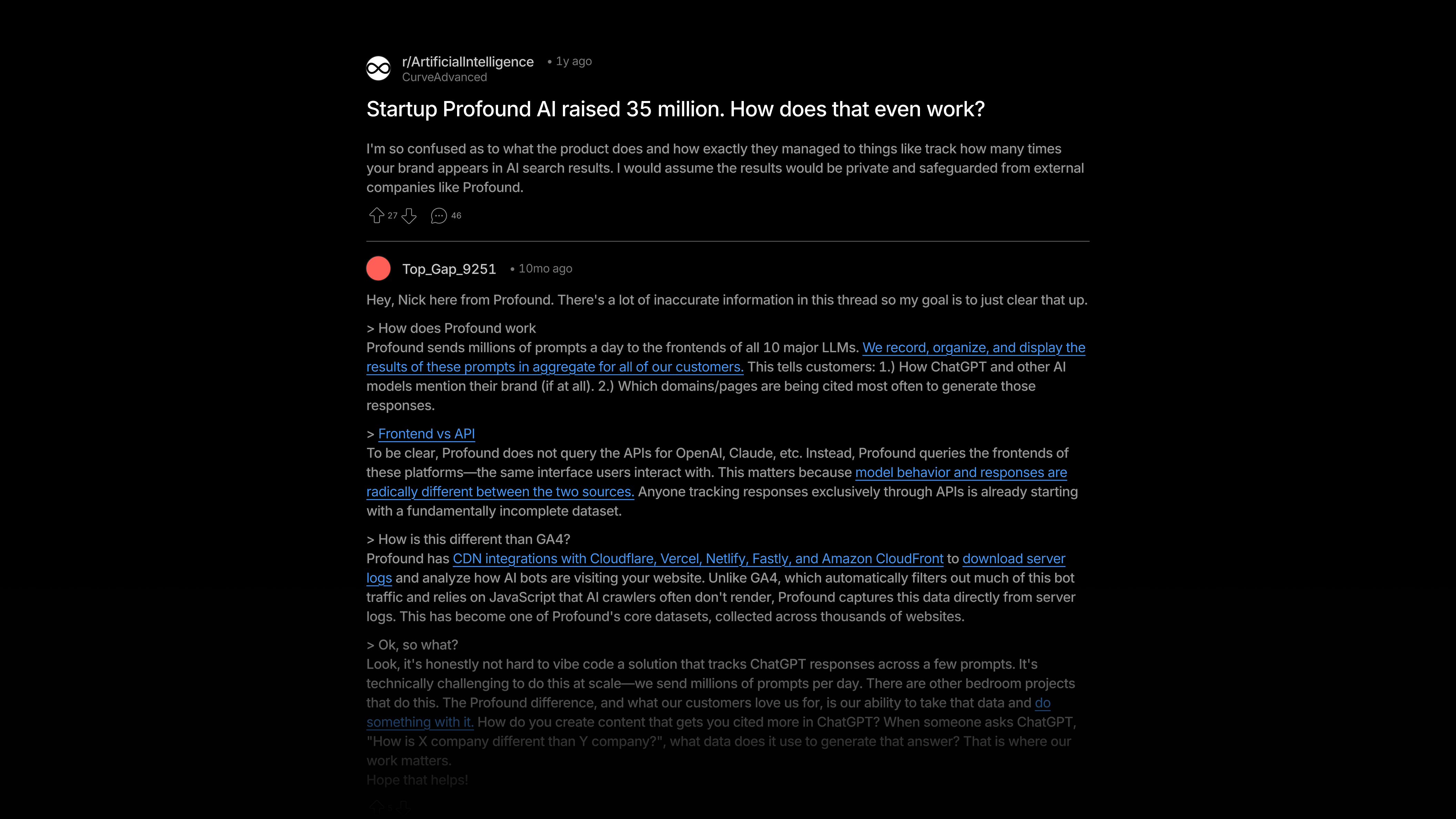
Check out this Reddit thread as an example of authentic engagement. Nick didn't write around the skepticism. He answered the user’s objection, including the one that should sting: that someone could vibe-code a basic version of this. A templated brand reply can't do that. It has to stay vague about weaknesses, which is exactly the lack of texture that makes people scroll past it.
One consistent thread across all three types is that the citation data is your map. You're not guessing at where to build presence or which formats to prioritize. You're looking at where AI is already going to answer questions in your category and making sure you're represented there.
A note on B2B versus B2C: the specific sources differ here. B2B off-page work concentrates on partner pages, G2, integration directories, and industry publications. Consumer off-page work shifts toward Reddit, Trustpilot, TikTok, and platform-specific communities. The logic is the same, go where AI is already looking, but the execution looks different enough that it's worth treating them as separate tracks if your product serves both markets.
The most effective things you can do for off page tactics are upstream of the specific citation sources. Outreach, swaps, pay-for-play are all like playing whack-a-mole at a certain scale, though they can help in the early days of a program if you have near zero visibility. What I'm talking about is brand marketing, doing things worth talking about, producing original research and distributing it via media relations and syndication, and making it so you don't have to fight with 100 other brands sending outreach emails to get on a listicle.”
Checking your work
You don't need a formal measurement program to know whether early changes are registering. Chapter 6 will help you build that infrastructure, the cadences, reporting, and team accountability that turn AEO into an operational program. This section covers the simpler check you can run right now, after your first batch of changes, to see whether the work is showing up in the data.
The method is straightforward. After implementing a set of changes for a specific Attribute or Objection, re-run the relevant prompts from your Chapter 4 audit in Profound. You're looking at four things:
- Visibility movement. Has your rank or score changed for the attributes you targeted? Even a modest shift in the right direction tells you that changes have been registered.
- Citation changes. Are the pages you updated, or the external mentions you added or influenced, now showing up in citations where they weren't before? A new citation from a source you worked to add is a clear confirmation that the off-page work landed.
- Sentiment shifts. For the Objections you reframed, is the negative narrative still surfacing as strongly, or is the reframe starting to appear in AI answers? Sentiment moves slowly, but early signal is visible if you're looking for it. You can check this directly in Profound’s Sentiment tab.
- Accuracy shifts. Did the inaccurate claims that FactCheck surfaced get corrected in subsequent responses? Are the citations that were producing wrong answers still appearing, or have more accurate sources started displacing them?
The minimum viable version of this check is a single question: did the thing I did show up in the data? Air's team, for example, started seeing leads increase from AI Search after the on-page and off-page work was underway, not a complete attribution picture, but enough signal to confirm that the work was connecting with buyers and not disappearing into a void.
That's the bar for an early check. Not a full measurement program; just confirmation that changes are registering before you move to the next set of priorities.
Now, let’s get measuring
On-page and off-page work address different problems, and the routing logic is what tells you which one applies:
- Comprehension problems need content
- Trust problems need corroboration
- Objections need reframing across both domains
- Strengths need to be amplified before competitors claim the same territory
What you've built by working through this chapter is a first iteration, a set of targeted changes grounded in what your audit found. Some of those changes will register quickly, but others will take longer. The pulse checks along the way tell you which is which, and that information feeds directly into how you prioritize the next round.
Chapter 6 takes everything here and puts it into a repeatable structure: the cadences, the reporting, and the team ownership that turn a series of one-off interventions into a compounding AEO program.