

The first five chapters of this guide helped you figure out how to think, how to audit, and how to act. This one helps you make all of that work last.
Every AEO program eventually runs into the same organizational wall. The work requires people across the company to change what they do, and most of them never signed up for an AEO program. Getting them aligned, keeping them aligned, and making sure the program survives a leadership review is a different kind of challenge than choosing the best prompts or optimizing content.
AEO as a discipline is still young. Unlike SEO, there aren't fifteen years of battle-tested organizational playbooks to draw on, so that’s not something we can promise you. What we can tell you is what we've seen work, what we've seen fail, and what successful companies are figuring out in real time.
If you made it here, you have the knowledge. What's left is the infrastructure to use it.
The organizational challenge of AEO
AEO strategies fail in meetings where someone asks why the content team is taking direction from SEO, why PR is suddenly expected to care about AI Search, or why the campaign that launched last quarter didn't generate the numbers anyone promised.
Those aren't execution problems; they’re coordination problems. And they're almost universal.
AEO should be a dotted line between brand and SEO teams. Having the SEO team own it means that the brand doesn't focus on it, having the brand team own means that they don't really track the search visibility part of AEO.”
Why AEO is different from SEO organizationally
SEO should always have been cross-functional, but in many orgs it often wasn’t.
AEO is cross-functional by design. As we explained in Chapter 1 and repeated throughout the guide, AI builds its picture of your brand from every mention of you across the internet. Broadly, that includes:
- Your own pages: Homepage, product pages, documentation, etc.
- Third-party sources: Review profiles, partner sites, press coverage, forum threads, social media, competitor channels, etc.
That means the work touches Customer Success, PMM, Brand, PR, Partnerships, Sales, and Product, whether or not those teams were asked to be involved. More stakeholders means more coordination, more education, and more friction before anything moves.
The other layer is expectation. An entire generation of search professionals built their mental model on a clean input/output logic: content and links in, rankings and traffic out. AEO asks something structurally different. Not just "get our pages retrieved" but "change how the entire web describes us." That’s unfamiliar, not to mention it cuts across domains and signals that no single department has ever owned before.
Our executive team cares deeply about AEO. Building a strong brand, organic growth, and AEO are top priorities for 8am. AEO is not just a digital marketing initiative; it is very cross functional. A strong brand means stronger signals to LLMs; so we incorporate PR, Brand, Campaigns, and our CS community on a regular cadence.”
The advantage of coordination speed
There’s no denying that larger organizations have structural advantages in AEO. Compared to earlier or growth-stage companies, established businesses are working with:
- Years of accumulated mentions across the web
- Deeper content footprints in the categories they compete in
- More consistent positioning across owned and third-party sources
Those are all exceptionally important assets, and they don't appear overnight. That said, they don't automatically translate into wins. AEO is a response loop, you track what AI is saying about you, identify where the picture is wrong or incomplete, brief the teams that own those surfaces, and push updates. Then you measure whether it moved. Then you go again.
The speed of that loop is determined entirely by coordination. How fast can you get a brief to the partner team? How many approvals does a product page update need? How long before PR can respond to a sentiment finding? A company with a strong content footprint but a slow internal review process will be lapped by a leaner competitor that can run that loop twice a week.
Practitioner empathy isn't optional
If you've worked through this guide, you now have a working understanding of AEO that your senior stakeholders haven't had time to build. That disparity creates a specific kind of frustration: the feeling that the people who need to act don't quite see what you see.
That frustration, while understandable, isn’t useful. Leaders have competing priorities and a mental model of search that was accurate for twenty years but no longer holds. Meeting them where they are isn't a concession; right now, it's the only pitch that works.
The same logic applies to the teams whose work contributes to AI answers but who don't consider themselves AEO stakeholders. Nobody responds well to "here's a new thing you have to care about." Instead, explain it in a way that respects their role within the company: AI Search is where more of the conversations about our product are now happening, and visibility there is something your work can actively influence.
Company motion vs. isolated channel
Before getting into the how, leadership has to decide what kind of program they're running:
- The company motion treats AEO as a mirror of how the brand is perceived across the entire funnel. Every team that touches a signal AI reads is in scope. The goal is to move consensus, what the whole web says about you, not just what your own pages say.
- The isolated-channel motion treats AEO more like SEO is often (unfortunately) treated, a focused set of campaigns run by a narrow team. Content is published, pages are optimized, and visibility moves in some areas. It works, but it won't shift the broader perception of your brand and thus reduce the efficiency of AI Search as a channel.
We're not going to tell you one is right and the other is wrong. But if you want to move the consensus, it takes the whole company.
AEO programs are much more cross-functional than SEO programs are traditionally, and I currently see SEO teams tasked with AEO without any additional authority, budget, or capability. There needs to be a person or pod that can pull different levels and operate within distinct channels to move the needle for AI Search, things like customer marketing, influence and affiliate marketing, public relations and comms, and of course, SEO and content marketing. Working in isolation and without cross-functional collaboration is the biggest limiting bottleneck.”
Selling leadership and getting teams aligned
For an entire generation of SEO professionals, the mental model was undeniably tidy. You could build a forecast, defend it in a QBR, and trust that the underlying logic held. Leadership understood it because it behaved like a channel they recognized.
AEO is a different beast altogether. There's no single metric to hand someone, no clean line from input to output, and the ask cuts across teams that have never shared a goal before. If you find leadership resisting your push for AEO, it likely isn’t because they’re incurious, but more so because nothing in their experience prepared them for this particular conversation.
Which means the pitch has to meet them where they are.
The load-bearing visual
Before you walk into a leadership meeting and ask for a cross-functional mandate, you need to show, not just tell, why the work can't be relegated to one team. The most effective way to do that is a simple visual: every source that feeds AI's picture of your brand, mapped to the team that owns it. For example:
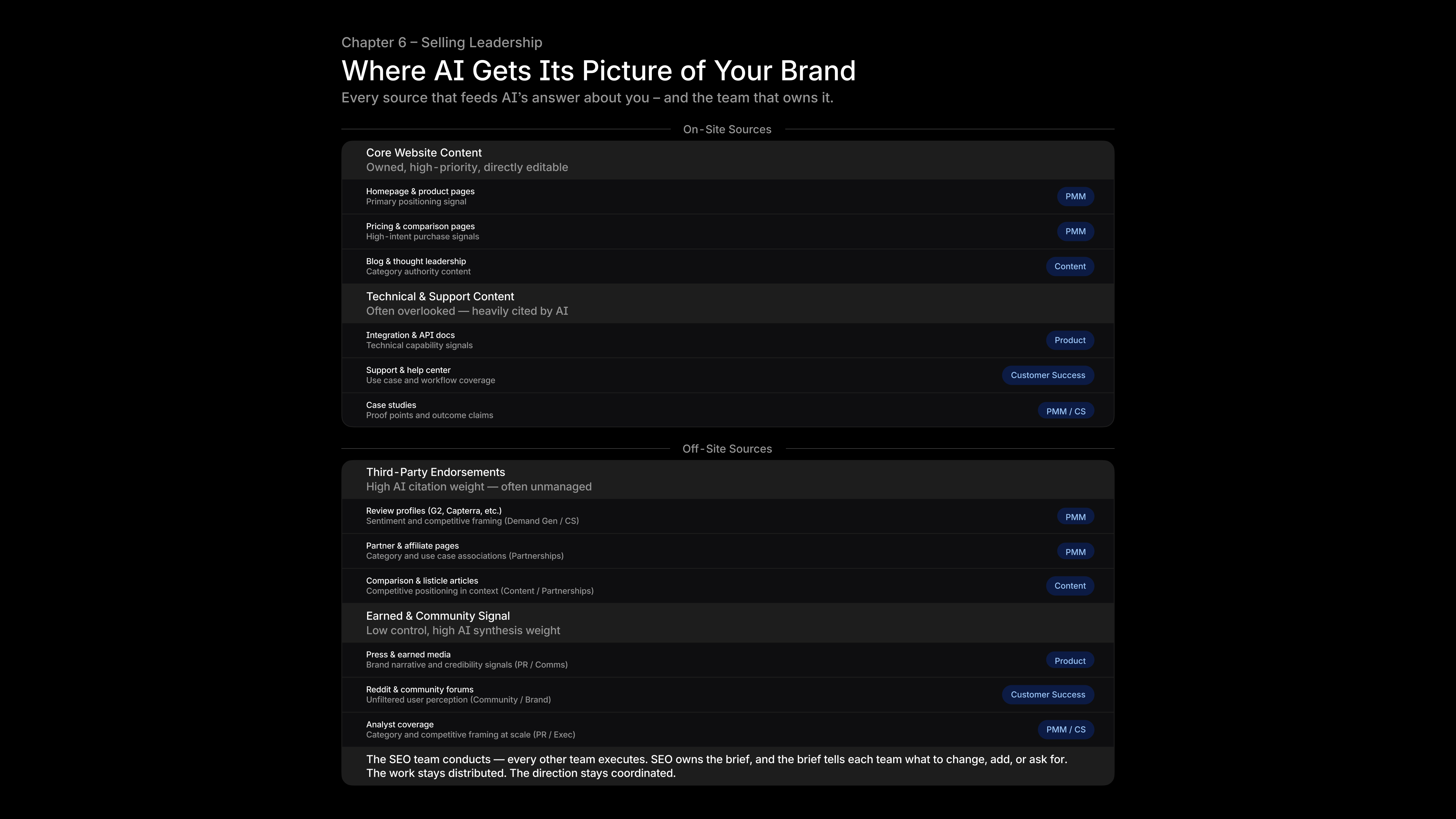
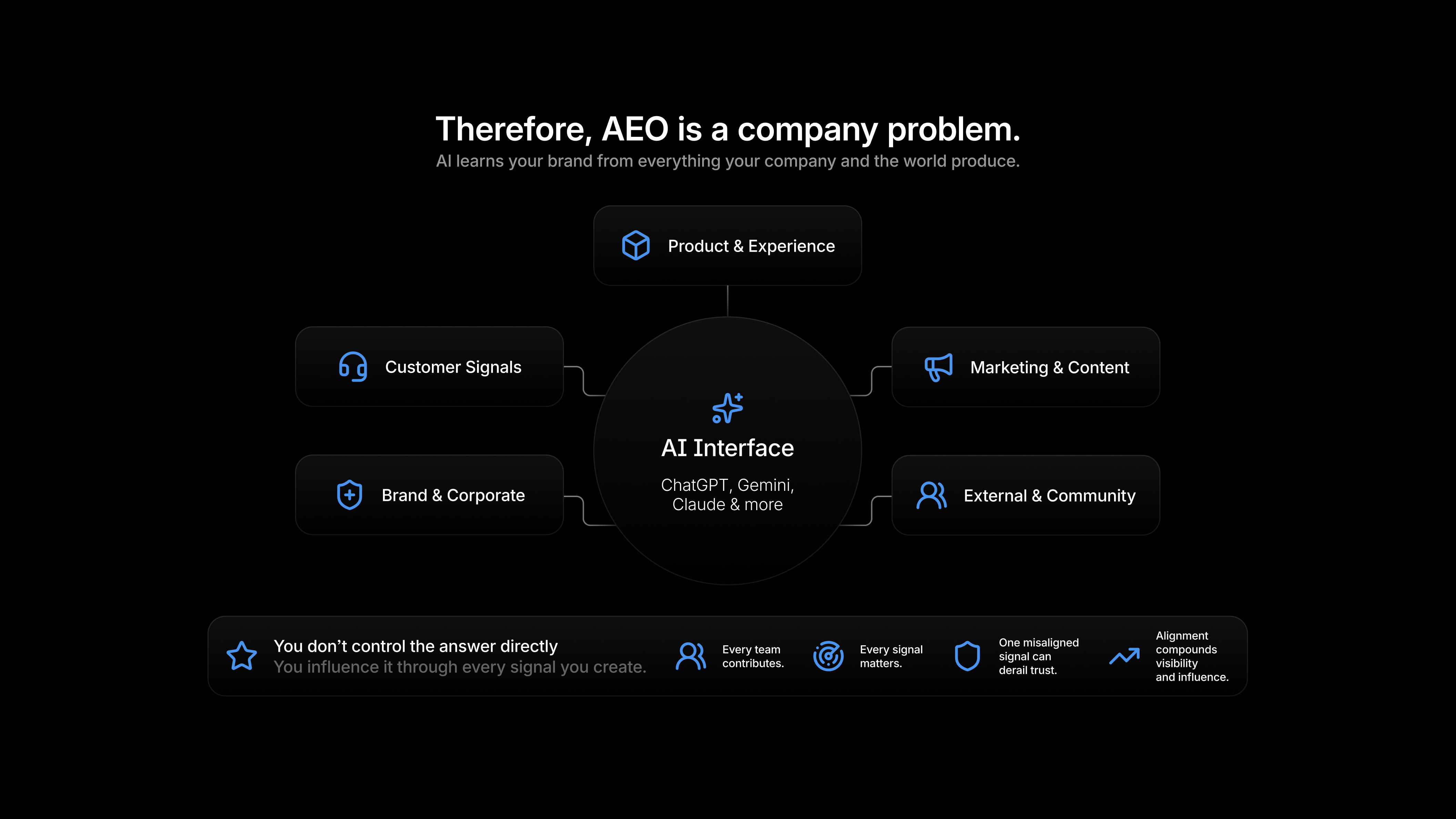
The list will look different depending on your org structure. The point isn't the specific mapping, but what the mapping makes visible. If a room full of senior stakeholders can see that AI is reading ten different surfaces owned by six different teams, the ask for cross-functional coordination feels like the only logical response.
That visual is the centerpiece of your pitch. Everything else in the deck contextualizes it.
Lead with examples for exactly how they personally use it. In the past, people would often type in relatively simple search queries to get to the websites they needed to perform their research. Now, people (C-suite, board, everybody) often start with much more thorough opening queries to get the best start to their research, then continue asking new and more complex questions until their research is complete and they never visit a third-party site.
That's a massive change in behavior. And we're all doing it.
Often, you don't even know the site or sites that ChatGPT, Claude, Perplexity, etc. are citing to provide you the answer in the first place.
For a board specifically, I frame it as share of voice shifting channels. We spent years building share of voice in search. That channel is changing faster than any of us expected, and the brands that show up in AI-generated answers are going to have a structural advantage in the next cycle. The question isn't whether to invest in it, but whether you want to be early or late...and I think it's obviously you here you should very much be early.
The thing that lands for executives is tying it to something concrete. For us, that's been showcasing the self-reported answers for how people found us. I typically hate self-reported data, especially when we have such large data sets across our analytics suite, but it does show the human perception. And we saw the data shift massively from search towards the AI chat bots in late-Q1 2025.”
What the pitch deck needs to say
Your pitch has one job: make the AEO program legible to people who haven't spent five chapters building up to it. That means compressing a lot of context into something a leadership audience can follow in ten minutes without losing the logic that makes the ask make sense.
We recommend the shape below:
- Here's our baseline in AI Search: What AI currently says about us, how accurate it is, where we're visible, and where we're not
- Here's how we're thinking about it: What you worked through from Chapters 2 through 5, from attributes to prompts, compressed into something a leadership audience can absorb quickly
- Here's how we're measuring it: The three-layer framework we'll cover in the next section
- Here's what we need from each team: Specific, not vague; tied to goals people can be rewarded for
The pitch is the executive version of the team-by-team handoff we described in Chapter 4. Same conversation, one altitude higher, framed as a program ask rather than a series of individual requests.
What you're trying to unlock
For the program to get off the ground, two things need to come out of this pitch:
The first is a top-down mandate. Leadership needs to visibly back AEO as a cross-functional priority, not just something the SEO team is running in the corner. Without it, every ask you make of another team is optional, and optional things don't get done when priorities compete.
The second is cross-team OKRs, goals that give each team a stake in the program's outcomes. Measurement and incentives do that work, and the next two sections cover both. But they only stick if leadership has already signed off on the program.
AEO should be owned at the marketing leadership level, not buried inside SEO.
SEO teams should run a lot of the execution, but product marketing and brand need to own the narrative, and PR/customer marketing need to own the off-page proof.
The best setup I've seen is a CMO-led program with SEO as the engine, product marketing as the positioning brain, and brand/comms/CX as the reputation layer.”
The measurement framework
AEO measurement isn't a single number. It was never going to be, the channel is too distributed, the attribution too indirect, and the behavior it's trying to capture too new. What it is, instead, is a three-layer picture in which confidence comes from correlations among visibility, traffic, and revenue.
Keep in mind that there’s no universally agreed-upon "right" way to measure AEO. What follows is ours. Borrow from it, modify it, throw out the parts that don't fit your org. It’s not our intention to hand you a dashboard to copy, but to share a defensible logic you can explain to a skeptical CFO.
Why measurement feels hard (and where it’s indeed hard)
There are two reasons AEO measurement feels harder than SEO measurement. They're worth separating because only one of them is actually a measurement problem:
- The practical reason: AEO tracking pulls from more data sources than SEO. You're combining visibility data, traffic data, revenue attribution, and sentiment. When you walk someone through that in a leadership meeting for the first time, it can sound complicated in a way that invites skepticism.
- The human reason: People knew what metrics to look for in SEO. Rankings, traffic, conversions. They'd spent years building intuition around those numbers, and here AEO comes, asking them to build new intuition from scratch, which feels harder than it is.
The important distinction is that visibility, citation share, and sentiment are directly and confidently measurable. The data on what AI is saying about your brand is solid, and Profound tracks it across every major Answer Engine, updated daily, against 1.5+ billion real user prompts. The part that genuinely requires more inference is answering "how is this impacting the business?", because business impact is downstream of multiple channels, and zero-click behavior means no single attribution path tells the whole story on its own.
I mostly work with Enterprise B2B Saas companies. When building out reporting to cover LLM presence as well as typical SEO growth metrics we look at the following:
Primary Metrics: AI referral sessions
AI pipeline metrics eg: referral sessions to MQL
LLM visibility (by topic, by competitor, by LLM)
LLM citations (by topic, by page, by competitor, by LLM)
Secondary Metrics: Organic and Direct Sessions
LLM ranking/share of voice”
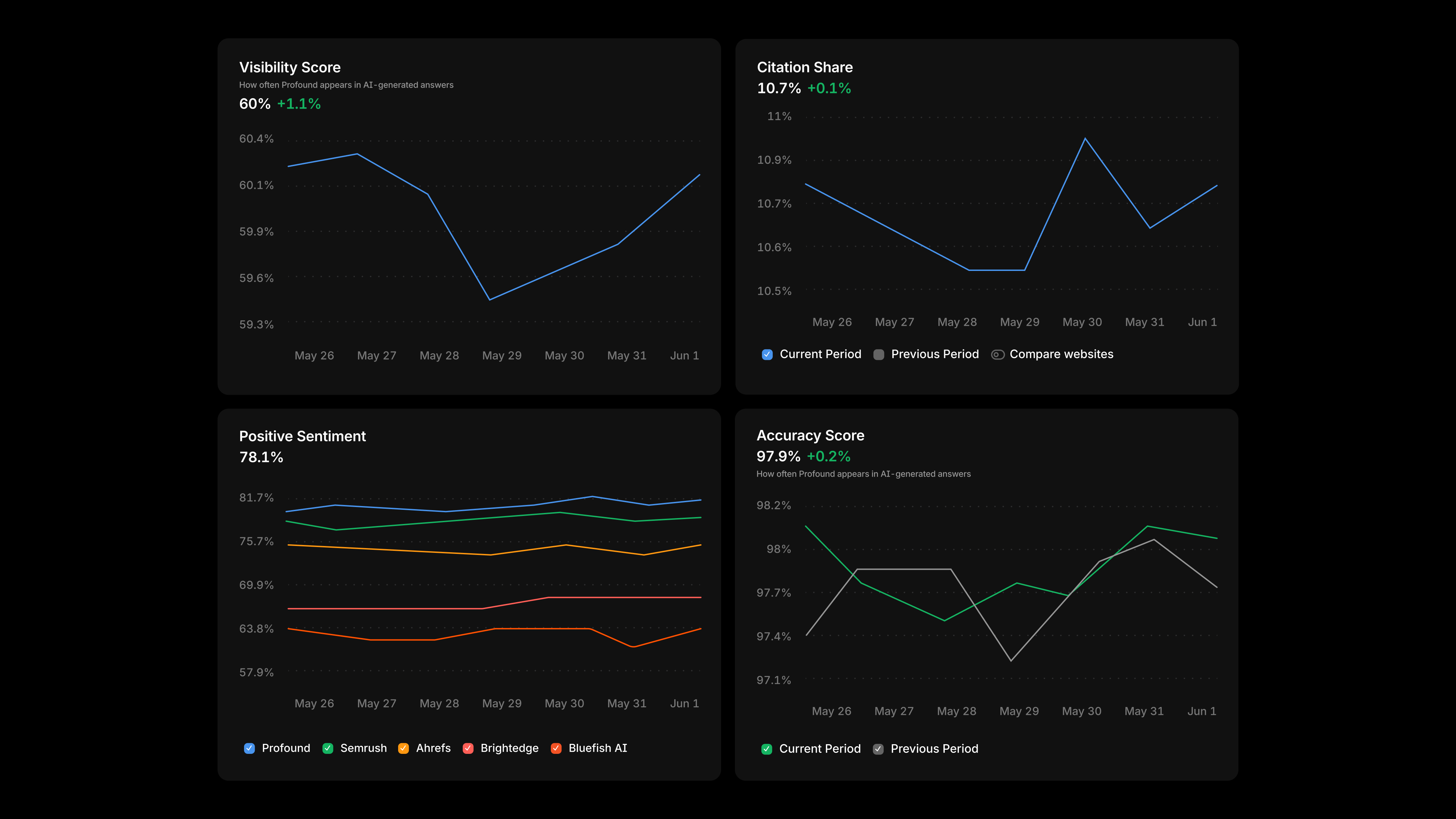
That’s an important framing device: know which questions your data answers cleanly, and which ones require triangulation.
Visibility as the leading indicator
People are used to measuring traffic and conversions. In a world where clicks reliably followed rankings, that made sense, the funnel was legible from top to bottom.
In a zero-click world, it isn't. An AI answer surfaces, the user closes the tab, comes back three days later on a different device, and converts. The click never happened. The influence did.
We're moving from click attribution to visibility and influence. AEO is closer to brand than performance marketing.”
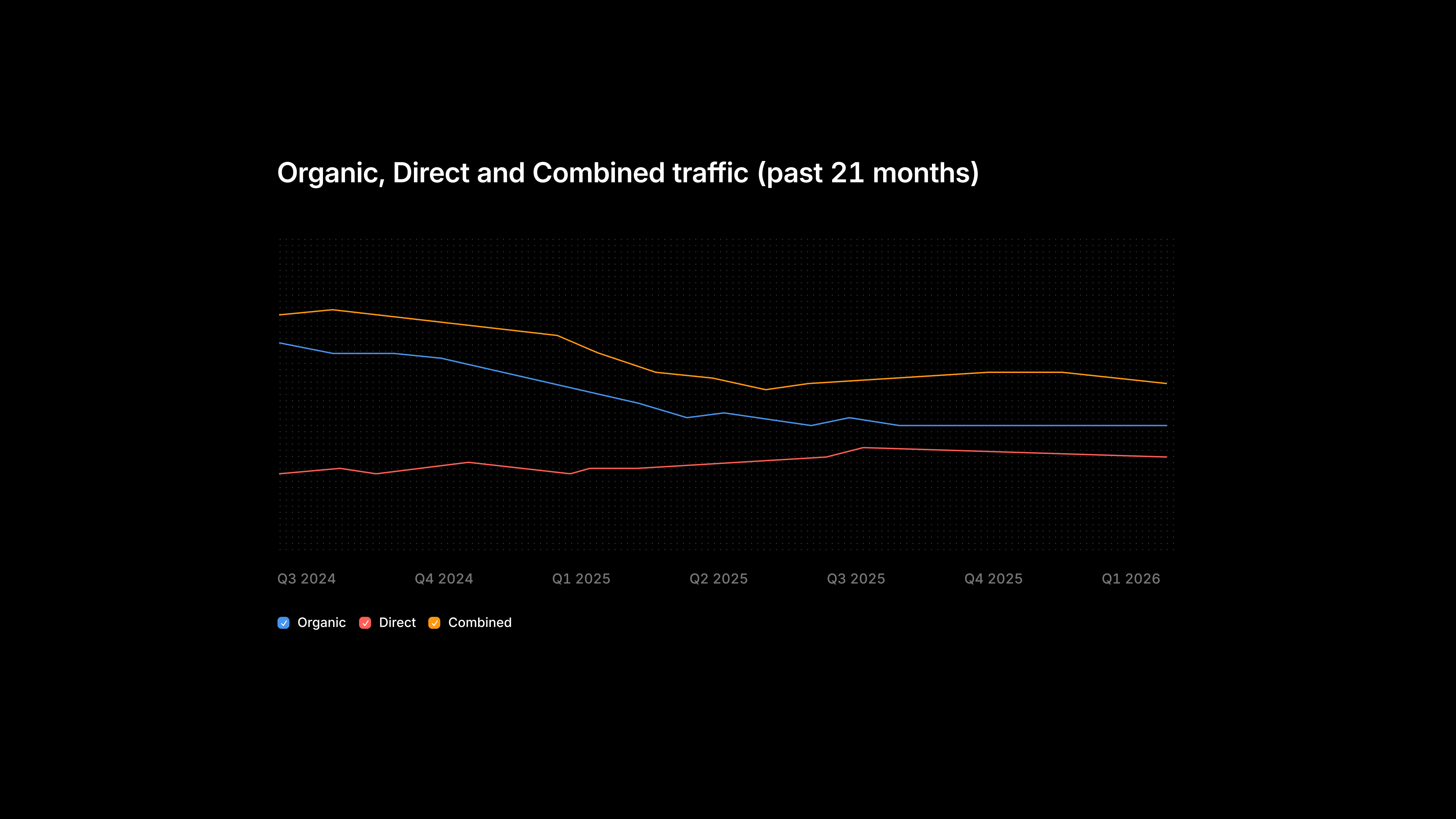
This is actually a pattern we've seen repeatedly: LLM visibility correlating with Direct traffic. AI influences a decision, the user navigates directly, and the referral path is invisible. It's hard to attribute exactly, but the correlation is consistent enough to track.
That's precisely why visibility metrics are essential for diagnostics. If your traffic and revenue are down, visibility tells you whether AI Search is the culprit or just a bystander. Visibility holding steady while down-funnel metrics drop means the problem lives elsewhere, in conversion rate, in sales, in the product itself. Visibility dropping alongside them means you have an AI Search problem, and you know where to focus.
The three layers: Visibility, traffic, and revenue
Each layer of the AEO measurement framework answers a different question about your program's performance. Together, they build the case that visibility gains are translating into traffic, and that traffic is converting into pipeline and revenue.
- Layer 1: Visibility answers, "is AI mentioning us?" This is the most directly measurable layer, visibility rank and share, citation rank and share, bot visits, and Google organic keywords. It's also the leading indicator.
- Layer 2: Traffic answers, "is that visibility translating into people coming to us?" Track traffic and conversions across three channels: Organic, Direct, and LLM referrals. Keep in mind that much of the AI influence never shows up as LLM referral traffic, which is why Direct is worth watching closely alongside it.
- Layer 3: Revenue answers, "is this driving business?" For B2B, that's pipeline and revenue. For B2C, it's conversions and sales. Attribution here combines traditional methods with self-reported attribution (SRA), which asks customers directly how they found you. It's the least precise layer, but it's trackable in aggregate, and it's what leadership wants to see.
All teams need to measure self-reported attribution as a complement to what they see in click data. AEO rarely sends over referral traffic. But the influence is obvious once you ask buyers how they heard about you. In my own data, LLMs account for <1% of new subscribers on a click basis. But 13.7% of new subscribers say they first heard about Growth Unhinged from an LLM.”
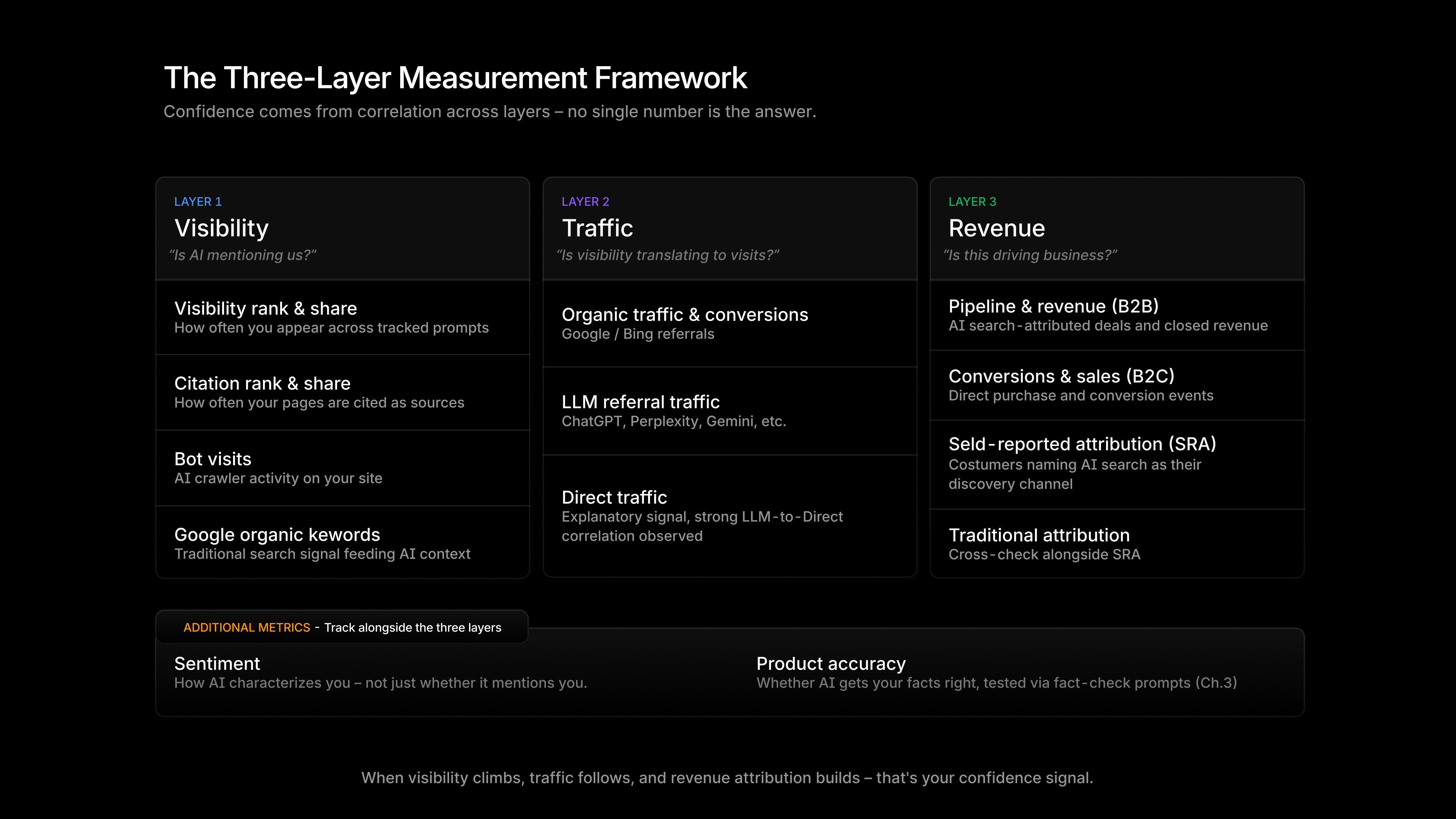
There are two additional metrics that fall outside the three layers but belong in any serious AEO program: sentiment (how AI characterizes you, not just whether it mentions you) and product accuracy (whether AI gets your facts right, as tested by the fact-check prompts covered in Chapter 3).
Profound tracks all of this, every layer, sentiment, and accuracy, in a single platform, so the complete picture is always in one place rather than assembled across five different tools.
Showing the impact of specific initiatives
The three-layer framework tells you whether the program is working. But leaders also want to know whether specific work is producing results, which is a fair question when significant resources are being deployed.
The good news is this part is more provable than the attribution conversation makes it sound. Here's what you can actually demonstrate:
- Content updates correlating with visibility increases: Publish or update a page, and use Profound to track whether citation rate for that page rises, and whether overall visibility follows
- Citation rate correlating with visibility: Pages that get cited more frequently show up in more answers; the relationship is trackable, and you can see it in Profound.
- Off-page work correlating with visibility shifts: For new partner mentions, updated review profiles, and earned press, the same logic applies. Profound lets you track it all in the Citations tab.
- Sentiment shifts for targeted Objections: If you ran a campaign to reframe how AI characterizes a specific weakness, Profound sentiment data tells you whether it worked.
The input metric is just as important as the output because, without it, an increase in visibility is just a number with no explanation attached. If you shipped ten content updates last month and visibility climbed, that's a finding. If visibility climbed and you have no record of what changed, you can't repeat it, you can't defend it in a leadership review, and you can't brief your team on what to do more of.
Tracking inputs like content updates shipped, partner briefs sent, and off-page asks made, you have more than correlation. You have a story you can tell.
Setting goals: Channel-level vs. campaign-level
The thesis of this guide is that you need to consider multiple metrics together to truly understand AEO. That creates tension in goal-setting because goals require focus. You can't put fifteen metrics on a scorecard and call it a strategy.
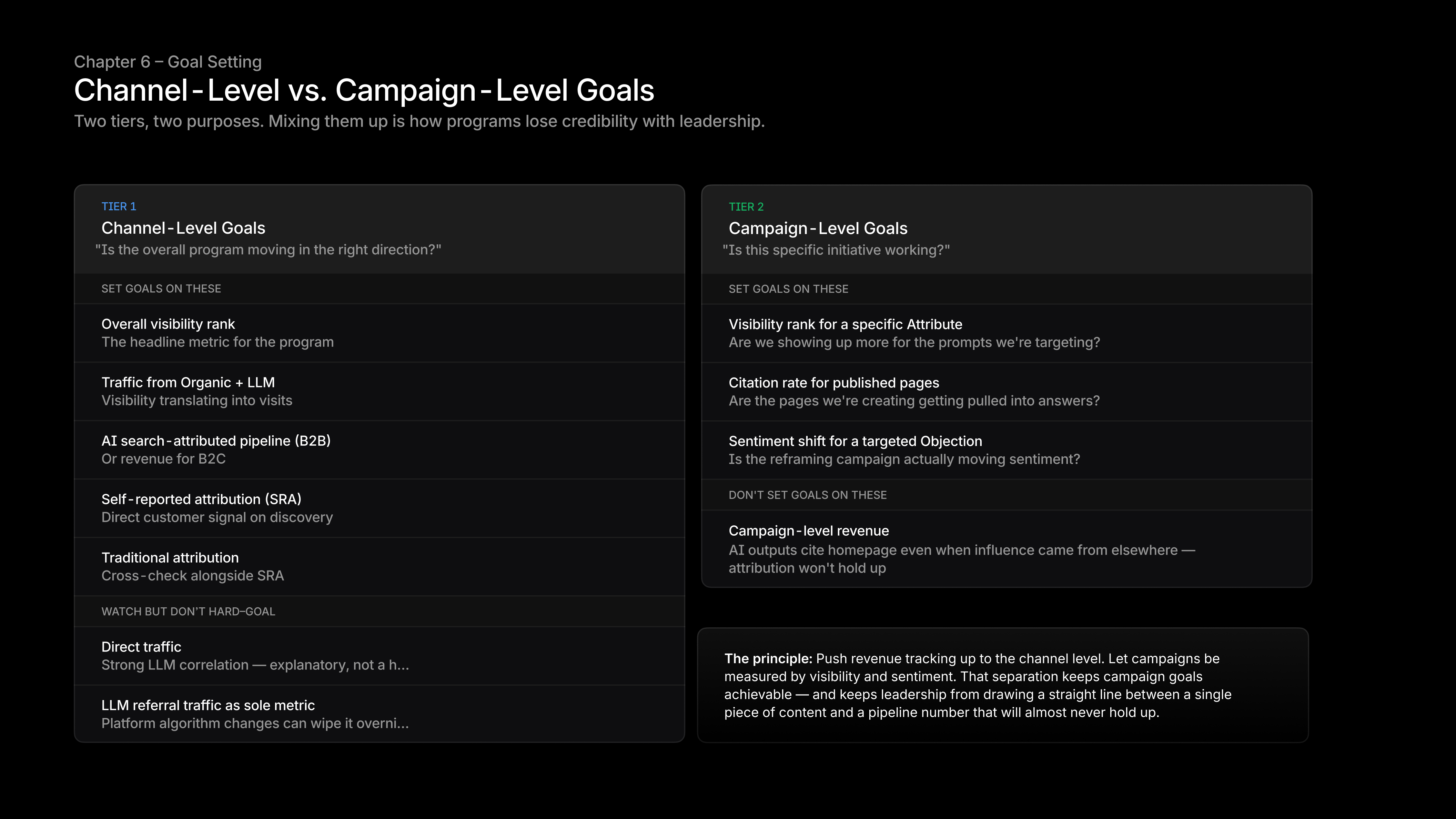
We resolve that tension by separating goals into two tiers. Channel-level goals track whether the overall program is moving in the right direction. Campaign-level goals track whether specific initiatives are working.
Channel-level goals
Channel-level is where you tie AEO to the business. Think of it as the sum of three buckets, Direct, Organic Search, and LLM Referrals, and for each bucket, track how much of the business is attributed to it.
What we recommend setting as channel-level goals:
- Overall visibility rank: The headline metric; is the program moving in the right direction?
- Traffic from Organic + LLM: Are those visibility gains translating into people coming to you?
- AI Search-attributed pipeline (B2B) or revenue (B2C): The business outcome leadership cares about
- Self-reported attribution (SRA): A direct signal from customers on how they found you
- Traditional attribution: As a cross-check alongside SRA
Direct traffic is worth monitoring alongside these, but treat it as explanatory rather than a hard goal. It's a useful corroborating signal, especially given the LLM-to-Direct correlation we mentioned, but anchoring a goal to it creates the wrong incentives.
Also, don't anchor a channel-level goal entirely to LLM referral traffic. Attributable traffic from platforms like ChatGPT is driven as much by algorithmic changes on their end as by your performance. A platform update can wipe it out overnight, through no fault of your program.
Going in, we knew visibility would be low since we hadn't been investing in AEO, so the bigger surprise was how quickly it moved once we did. After we ran the data and set up processes for content generation and refreshes, our visibility and citation rate climbed consistently.
The thing that caught attention internally was inbound meetings citing "AI Search" in the how-did-you-hear-about-us field. In our first couple months on Profound, those meetings already made up a meaningful portion of our pipeline, which is what turned it from an experiment into something we kept investing in.”
Campaign-level goals
Campaign-level goals work differently. Trying to follow a single campaign all the way down to revenue is almost always a dead end because AI Search outputs frequently cite the homepage even when the actual influence on the answer came from a completely different page or off-page source. The attribution path is too indirect to be reliable at the campaign level.
Instead, keep campaign goals anchored to visibility and sentiment for the specific Attribute or Objection you're targeting.
What we recommend setting as campaign-level goals:
- Visibility rank for a particular Attribute: Are you showing up more in the prompts you're targeting?
- Citation rate for the pages we publish: Are the pages you're creating getting pulled into answers?
- Sentiment shift for a specific Objection: If you're running a campaign to reframe how AI characterizes a weakness, is it moving?
Push revenue tracking up to the channel level. Let campaigns be measured by visibility and sentiment. That separation keeps campaign goals achievable and keeps leadership from drawing a straight line between a single piece of content and a pipeline number, a line that will almost never hold up.
We had to start with conviction that LLM visibility will translate to pipeline. Now that we're seeing visibility and traffic move together, we're going back through Gong transcripts looking for mentions of Claude, ChatGPT, LLMs in discovery calls and we're adding a direct attribution field to our demo request form.”
Aligned incentives and ownership
A lot of conversations about AEO ownership end up with the same answer: the SEO team. And in most organizations, that's probably right. But ownership is actually the less important half of this question. What matters more than who owns AEO is whether the people doing the work have goals they can be rewarded for.
A program where the SEO team owns everything and everyone else is a reluctant participant will stall. A program where ownership is distributed but incentives are aligned will compound.
The SEO team as conductor
The SEO team is well-positioned to coordinate AEO for a specific reason: they understand the website's technical surface well enough to identify where the problems are and what needs to change. That's a rare combination of skills in most organizations, and it's why the conductor model tends to work.
The conductor model looks like this:
- Landing pages and product content → PMM owns the execution; SEO owns the brief
- Product and category pages (e-commerce) → the team that owns those pages executes; SEO briefs them
- Off-page → Partnerships, PR, comms, and affiliate teams own the relationships and the asks; SEO builds the briefs that tell them what to ask for, and where it fits in the broader AEO strategy
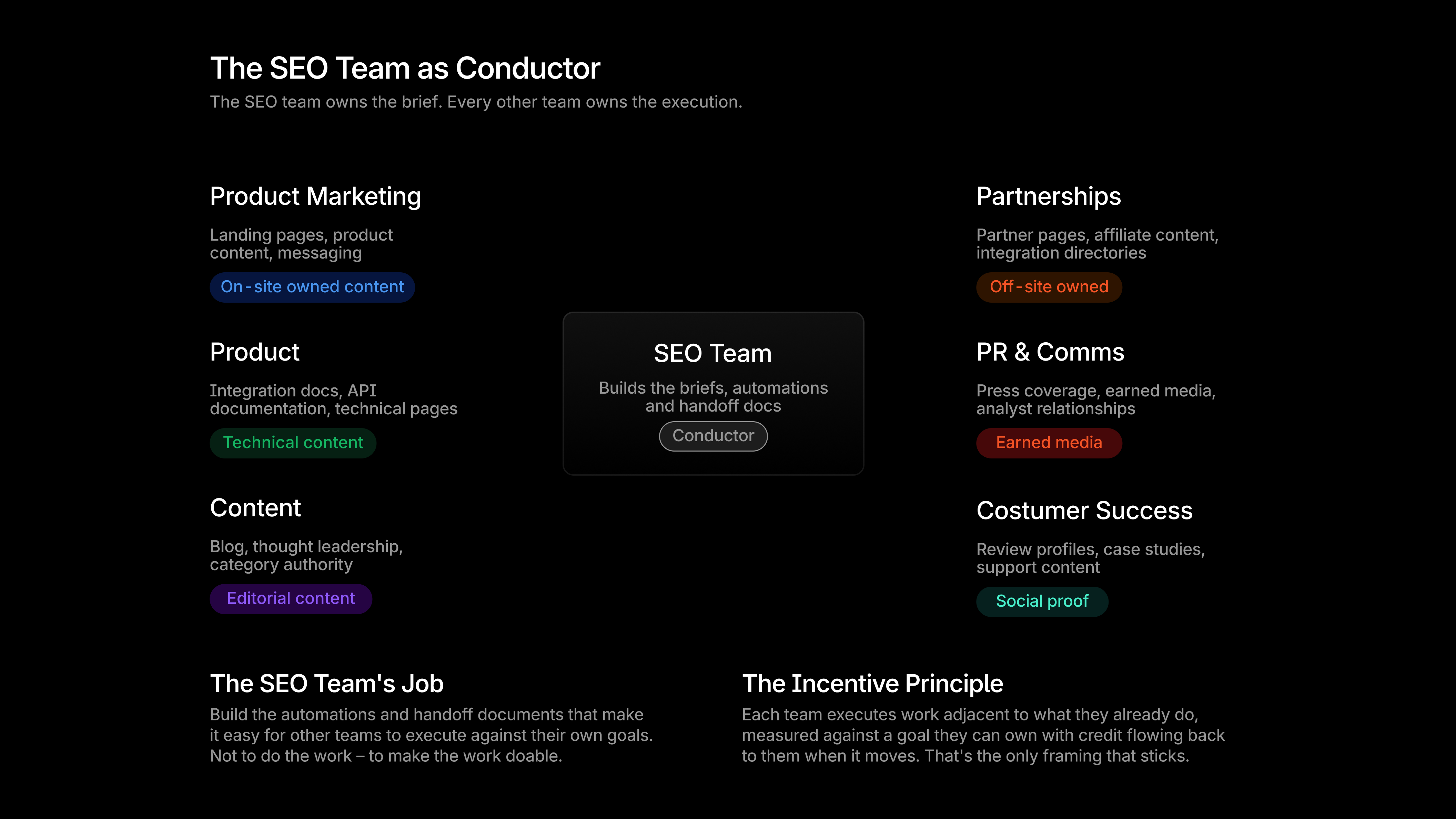
It’s not the SEO team's job to do everyone's work, but to build the automations and handoff documents that make it easy for other teams to execute against their own goals. For example, at 8am, the SEO team briefs a partner-facing team on exactly what to request from each partner to improve the company’s position in AI Search. The partner team owns the relationship, but the SEO team owns the brief.
How to incentivize teams that don't own AEO
Every team already has a full plate. Handing them an additional responsibility with no corresponding reward is a reliable way to get deprioritized.
The framing that works looks more like "we'll give you everything you need to hit a goal that's already yours, and you get the credit when it happens." That's a different ask entirely, one that converts AEO from an external imposition into something that serves each team's existing objectives.
Here are two examples of what this can look like in practice:
- Reframing an Objection with the affiliate team. The affiliate team updates their content to address a specific Objection, a weakness AI keeps surfacing about your product. The affiliate owner takes ownership of the sentiment goal for that Objection. When sentiment shifts, they get credit. The input metric tracked is the number of content updates shipped.
- Feature launch visibility with PMM. The PMM owns the landing pages and feature content for a new launch, but the launch also needs to appear in review profiles to be picked up by AI. The visibility goal for that feature is co-owned with the team that manages review profiles. Both teams have skin in the outcome.
You can see that the throughline in both cases is that each team is doing something adjacent to work they were already doing, measured against a goal they can reasonably own, with credit that flows back to them when it’s accomplished.
AEO isn't one person's job. Yes, it needs a DRI (directly responsible individual), but AEO is a consideration across so many things you do, from building your website, to writing content, to thinking about how LLM visibility fits into a campaign or product launch. Given this and how "bespoke" marketing teams are, I don't really have a strong opinion on where it "sits", just that everyone needs to know the basics. I'm also a huge proponent of hiring more AI-native generalists on marketing teams these days, I call it a "Gen Marketer".”
Over to you
Six chapters ago, we said AEO was more workable than it looked from the outside. That the field was new and unsettled, but that there was a way to approach it that wasn't just reacting to headlines and hoping for the best.
We meant it. And if you've worked through this guide, you now have the architecture to prove it:
- You know what AEO is and why it behaves differently from the channel it's replacing.
- You know how to define your brand precisely enough to measure it.
- You know how to build a prompt strategy from real buyer language, run an audit that tells you where you actually stand, and close the distance between what AI says about you and what you want it to say.
- You know how to turn all of that into a program that survives contact with a real organization, with the measurement to defend it, the goals to run it, and the incentive structures to keep other teams pulling in the same direction.
That's most of what separates the companies building durable AI visibility from the ones still debating whether it's worth the investment.
The playbook is still being written. You're now equipped to help write it.
And you don’t have to do any of this alone. Profound was purpose-built for exactly this program, with real prompt data from over 1.5 billion user queries, visibility tracking across every major Answer Engine, and the workflow infrastructure to brief your teams, measure what moves, and compound your results over time.
If you want to see what your AEO program looks like with the right data behind it, book a demo.