
Summary
July marked a month of significant changes for Shopping mode. The bulk of changes can be attributed to the release of GPT 5.6 models on July 9th. Our analysis found changes in four areas:
- Product recommendation retrieval source: ChatGPT relies on feed-integrated sources more often than web search after July 10.
- Merchant consolidation: Feed-integrated retrieval pulls from narrower range of sources than web search, so fewer top merchants appear at higher rates.
- The Shopify integration: Shopify integration represents ~35% of all feed-integrated retrieval, and is the primary wedge for smaller retailers to compete for Shopping discoverability.
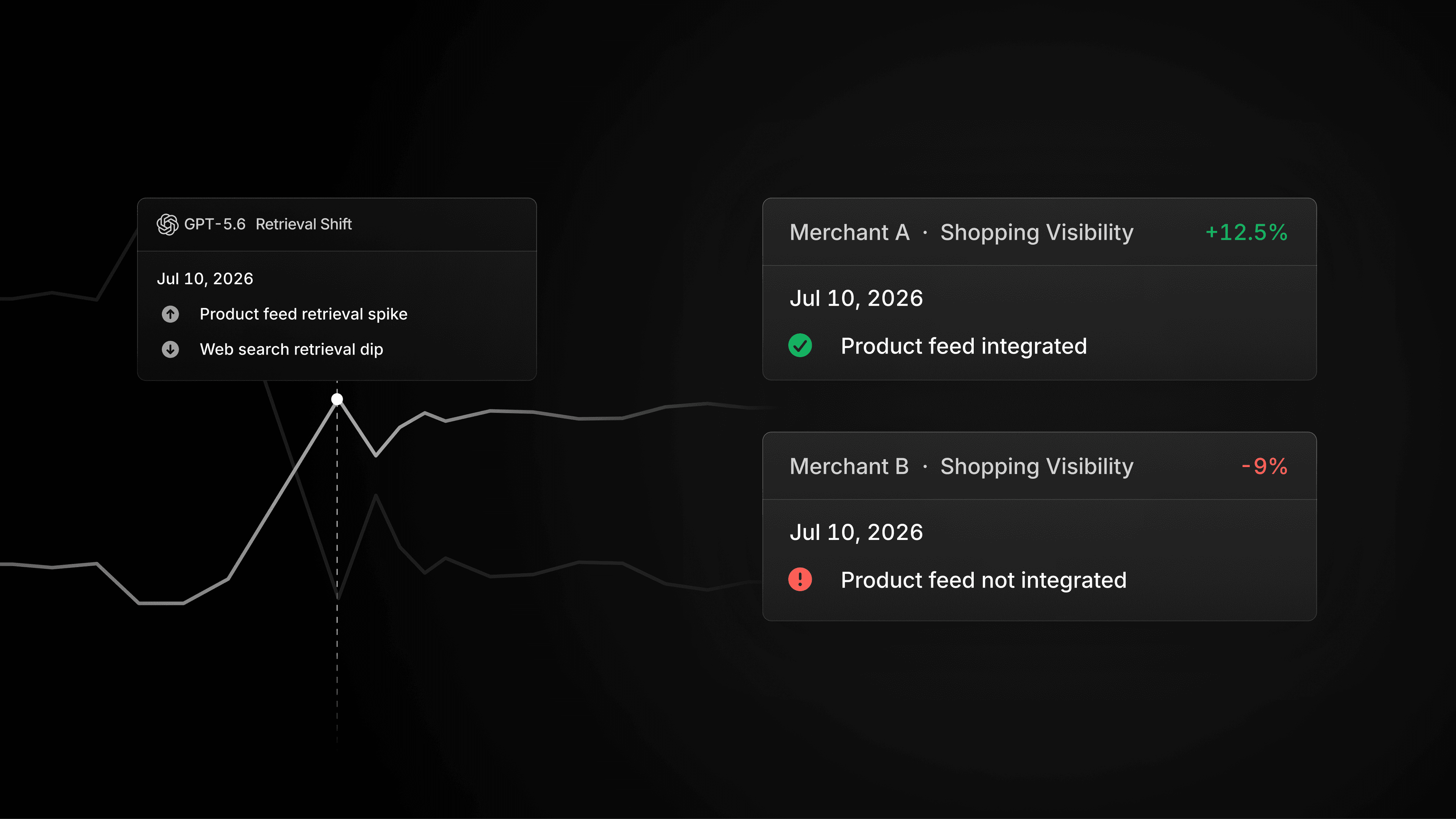
- Real Shopping visibility implications: Real merchants also observed significant visibility dips and gains on July 10th, directly explained by this mix shift from web search to feed integration.
Customers began reporting large Shopping visibility swings
At Profound, we track Shopping metrics for thousands of real merchants and brands.
In mid-July, we began hearing about significant Shopping visibility swings for select customers. We generalized this and identified 450 unique customers that dipped ≥33% in Shopping visibility and 67 that spiked ≥33% around July 10th. It was clear this observation was a byproduct of a systemic change, prompting us to deep dive into our Shopping data. And what we found was beyond expectations.
Feed-integrated retrieval now occurs more than web-based retrieval
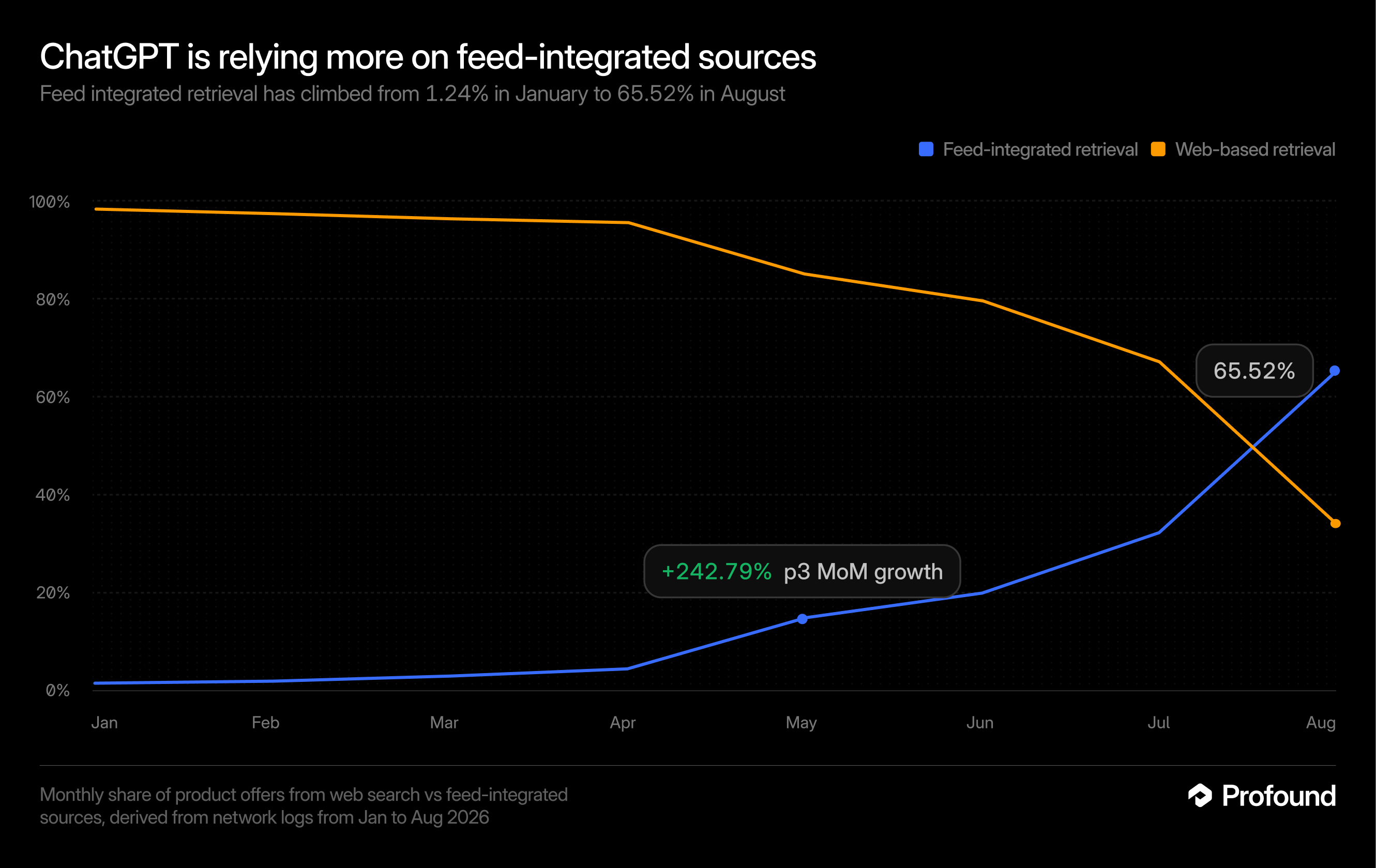
ChatGPT pulls product recommendations from two retrieval sources: web search or its own feed-integrated catalog. At the beginning of this year, ChatGPT was almost exclusively pulling Shopping data from web search. Reliance on its feed-integrated catalog grew slowly through April, but exponentially accelerated in May, overtaking web search in August.
Previously, brands could afford not implementing an integrated product feed strategy. Today, brands will not be considered for 65% of product recommendations in Shopping unless you are integrated, and we expect this number to continue increasing.
Further splitting this on a daily basis, feed-integrated retrieval overtakes web-search on July 10th, rising from 8.26% to 61.54%. That's a ~6.5x increase in one day!
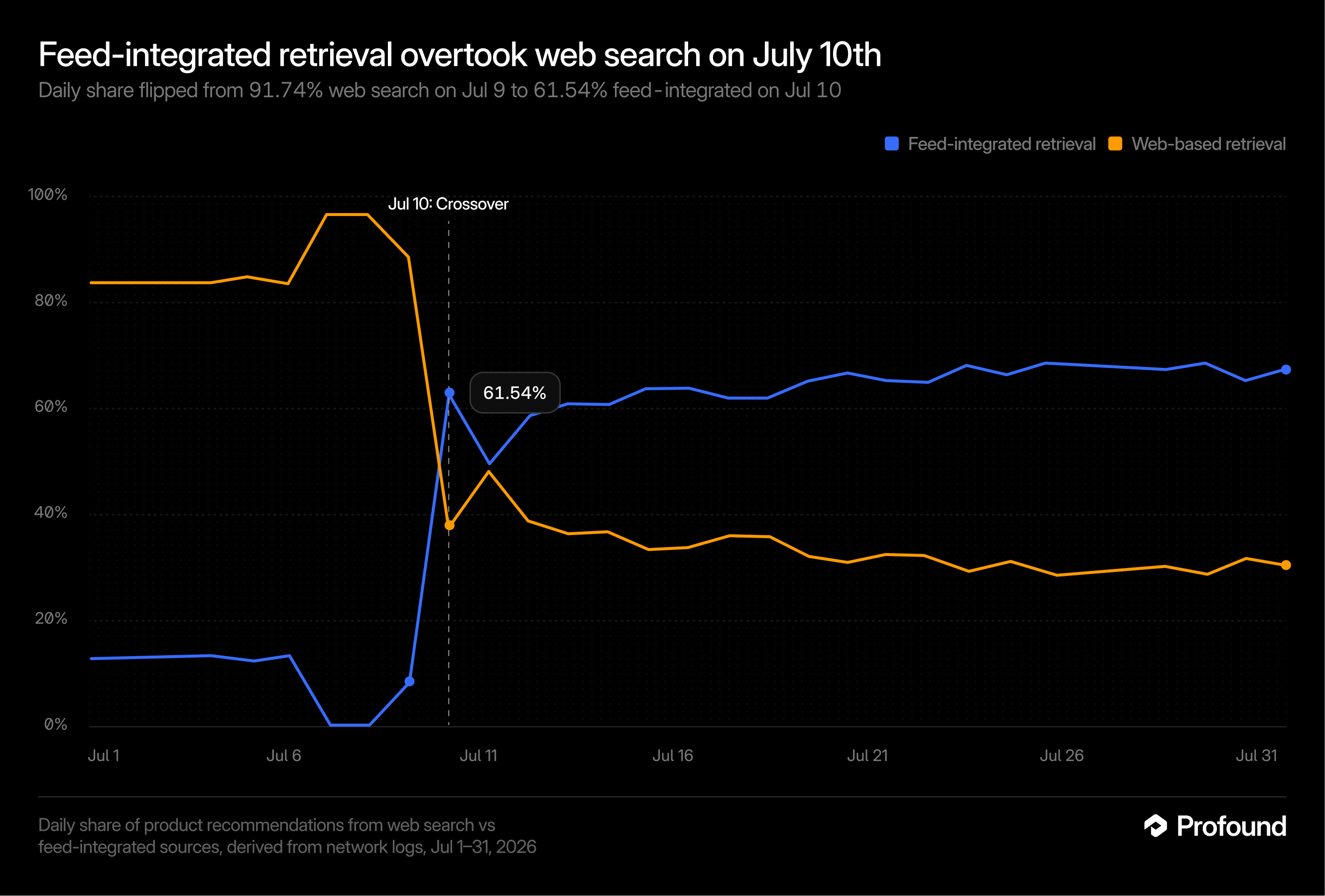
What's more? This aligns precisely with the drastic visibility shift we observed earlier, on July 10th.
What happened on July 10th?
The visibility swing on July 10th generalized across 517 unique merchants. The feed-retrieval increase on July 10th generalized across ~1.75M Shopping prompts. We implemented a statistical model that demonstrates significant alignment between the two trends, for reference below.
But what could explain such a large shift? OpenAI released ChatGPT 5.6 models on July 9th. It's the only event-based factor on this exact date that has such explanatory power. This marks OpenAI's key strategic decision to increase investment on this mechanism, for both Shopping and Ads surfaces.
Who are the top merchant winners in feed-integrated retrieval now?
We break down the top feed-integrated merchants since July 10th.
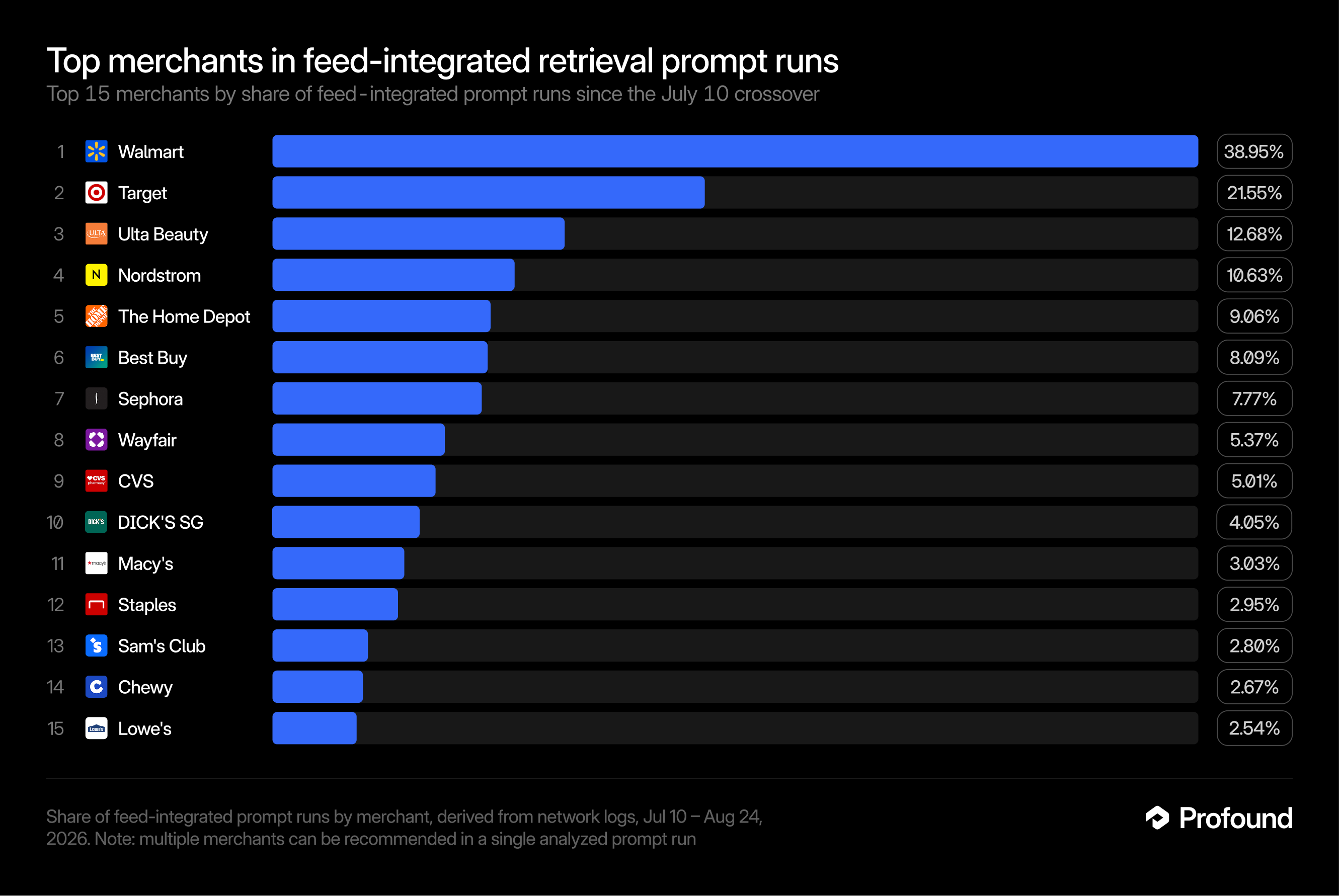
We observe top merchants appear in a high percentage of prompt runs, indicating feed-integrated retrieval relies more on fewer merchants than web-based search, but let's verify this.
Consolidation of merchants increases the gap between winners and losers
Breaking down cumulative prevalence across the same Jul 7 - 9th and July 10 - 12th periods:
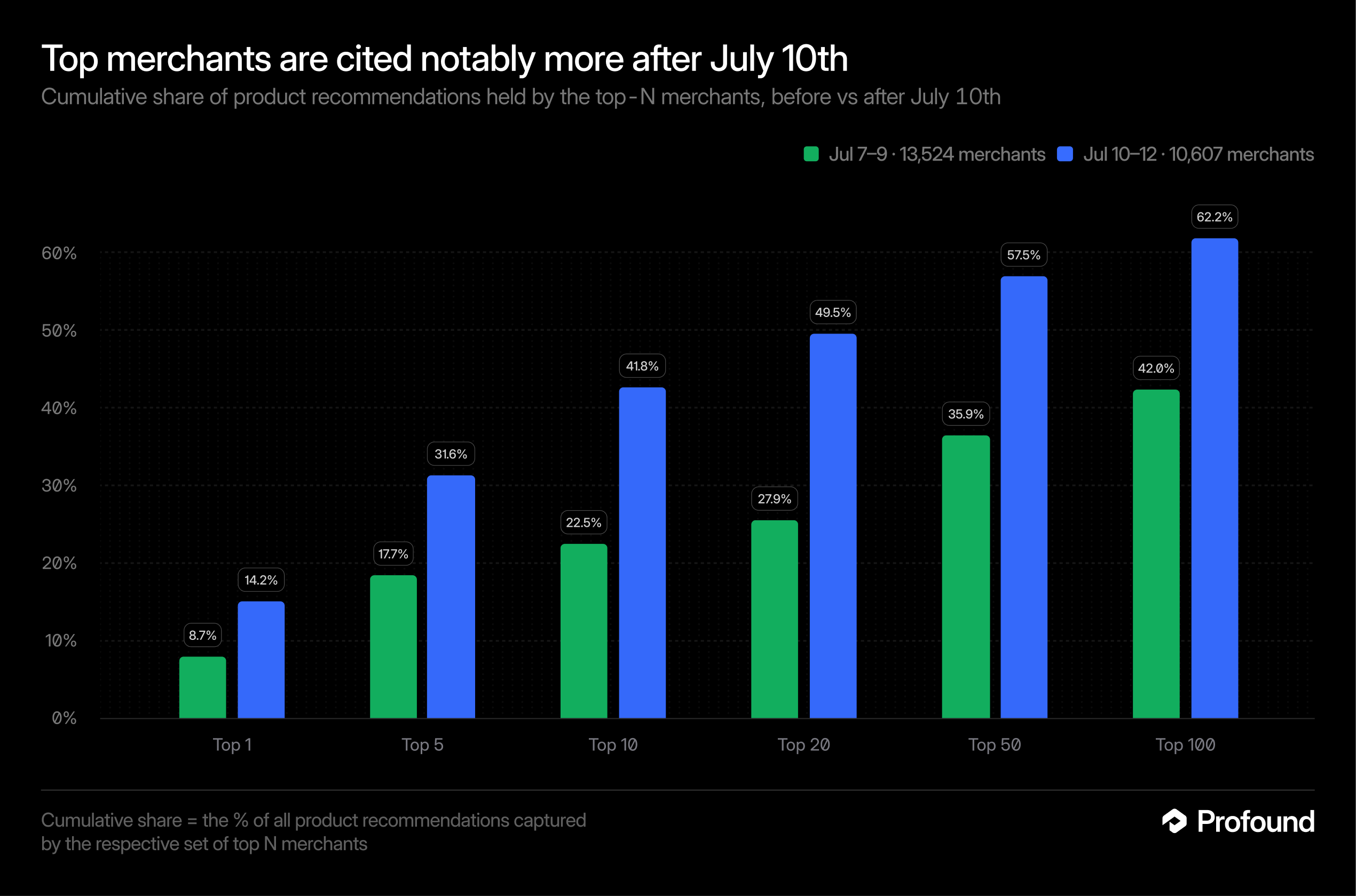
Top 10 merchant share increases from 22.5% to 41.8%. Fewer unique merchants are generally referenced. Unique merchant count drops by >20%, from 13,524 to 10,607. After feed-integrated retrieval became the leading source, top merchants are being referenced significantly more.
Smaller merchants must integrate through Shopify to combat this
Given merchant consolidation at the top, it's increasingly hard for smaller players to appear in Shopping mode. Historically, Shopify holds a strong consolidated signal in feed-integrated retrieval, representing players of varying sizes. Shopify itself notes that "AI searches powered by Shopify Catalog convert at 2x the rate of those using scraped data."
But to what extent does this matter in our study? We analyze the daily Shopify retrieval trends, also in July, and compare this with all feed-integrated retrievals.
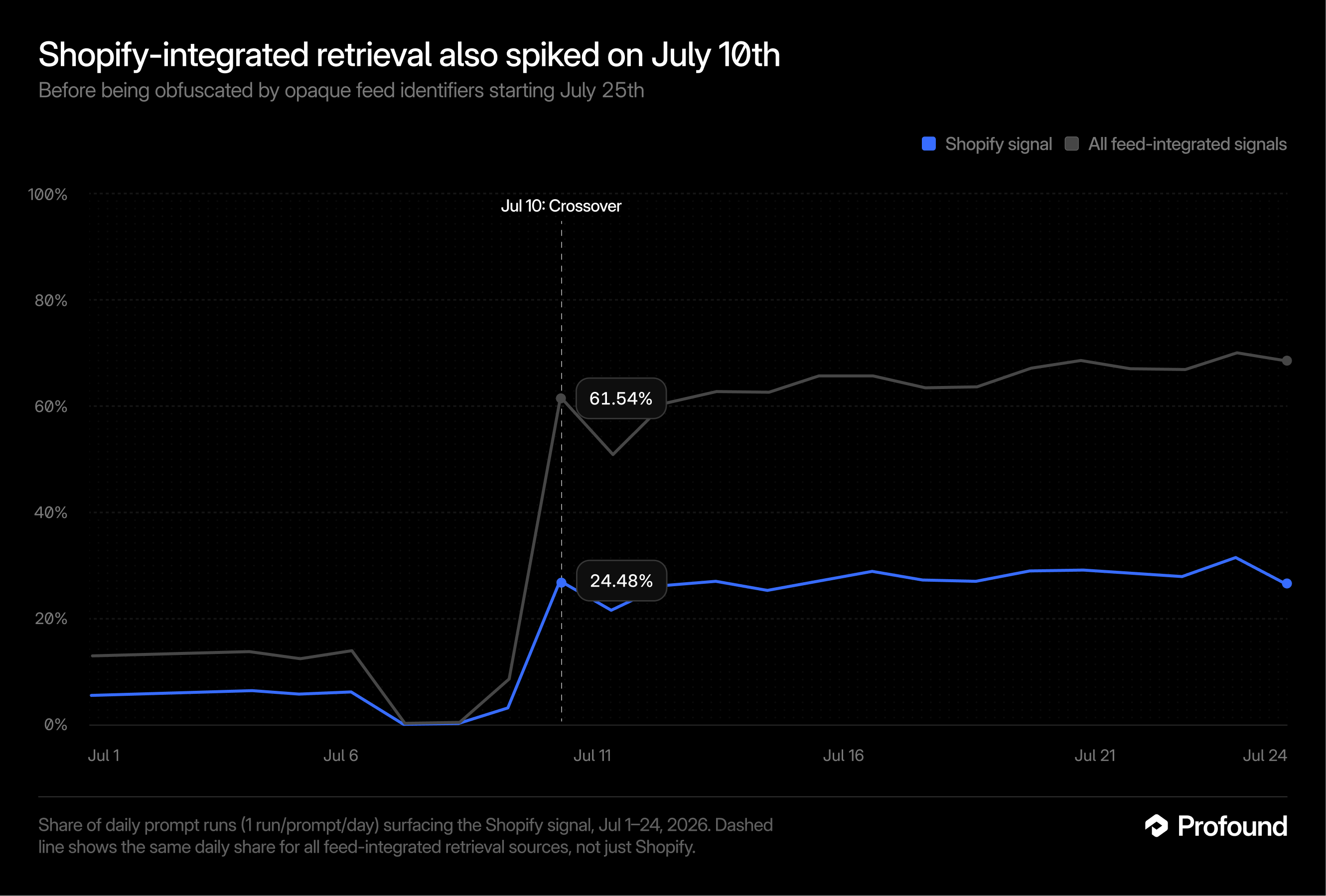
The Shopify-integrated retrieval trend statically aligns almost perfectly with the increase in feed-integrated retrieval following the release of GPT 5.6. We observe that this likely means it is a subset of feed-integration, accounting for ~35% of all feed-integrated retrieval.
Integrating with Shopify is the remaining wedge helping smaller players, without their own integrated product feeds, show up in Shopping mode.
What this means for your brand
All findings above can be attributed to the same call-to-action:
It is more important than ever to be feed-integrated in ChatGPT Shopping.
- If you are a large, well-known player, you'll likely integrate your own, explicit feed.
- If you are a smaller player, you'll likely be better suited to integrate through Shopify.
Retailers with feed integration cover both bases, when ChatGPT pulls from web search and its internal feed catalog. Those without feed integration miss out on all latter opportunities, sweeping ~65% of product recommendations.
We predict that as more brands take action to integrate their product feeds with OpenAI, the opportunity will shift from simply being integrated to optimizing the fields in your integrated feed, and that will be the next game to win.
Appendix
- Which Profound customers were used?: We analyzed 687 Profound customers who actively tracked prompts that triggered Shopping mode every day in July and had at least one owned product card reference each day from July 7th-12th. Centered around July 10th, we analyzed notable visibility swings across July 7th-9th (pre-period) and July 10th-12th (post-period), classifying Shopping visibility dips and gains with a ≥33% threshold from pre to post-period. This narrowed our sample set to 517 customers.
- How closely does Shopify align with general feed-integrated retrieval? We computed both Pearson (0.997) and Spearman (0.993) correlation coefficients between the two retrieval trends from July 1st-24th, with coefficients=1 representing perfect alignment.
- How did we statistically connect visibility swings and the feed-integration explosion?: Across the n=517 customers, we run an least squares regression to jointly model how well two variables in each customer configuration(owned web-search retrieval loss and feed-integrated retrieval gain) predicted Shopping visibility change. Our joint model explains 83% of real, observed visibility swings. When we isolated the effects of each variable, we found:
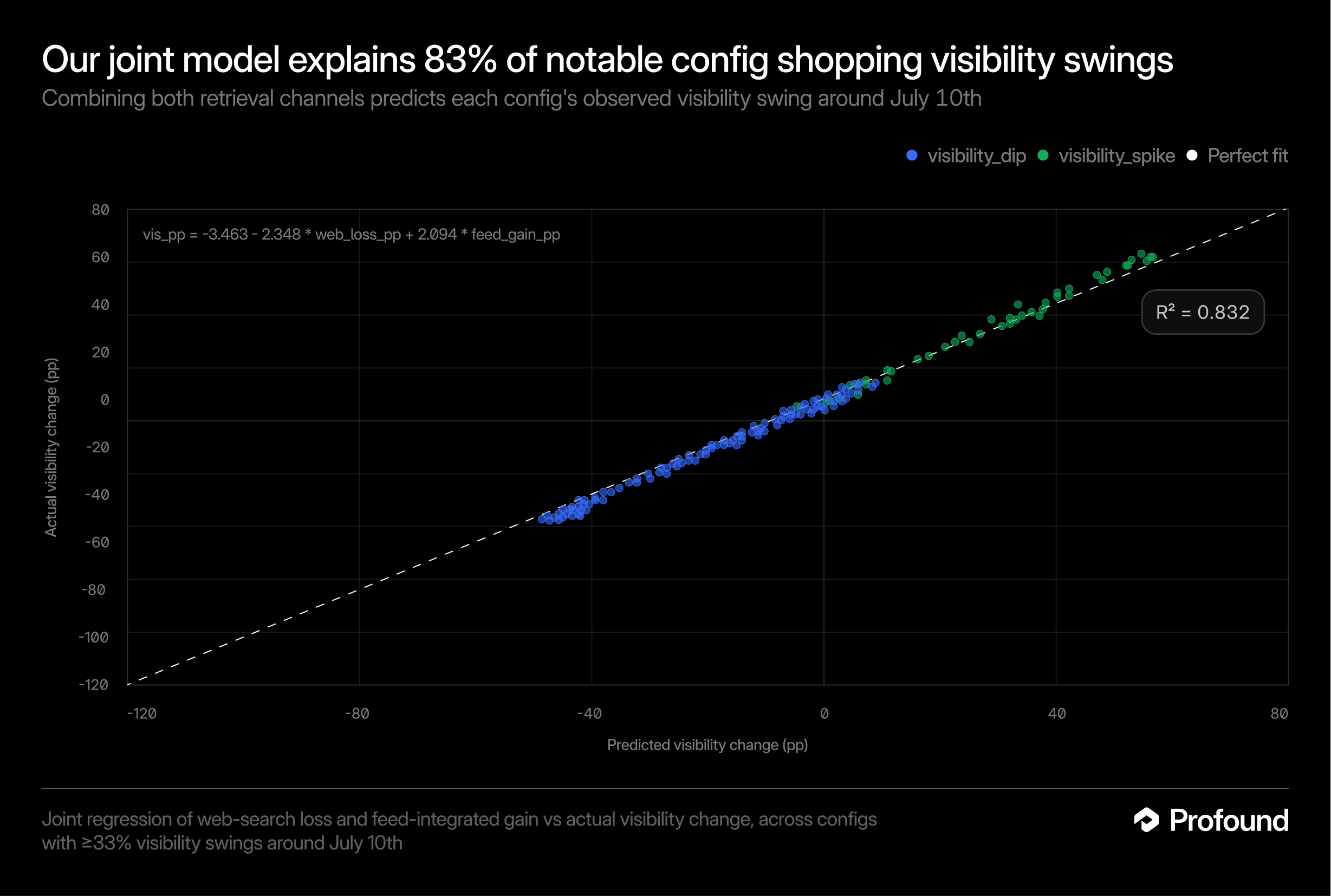
Holding feed-integrated retrieval gain constant, each percentage point (pp) of web-search retrieval drop correlates to -2.35pp drop in Shopping visibility.
Holding web-search drops constant, each pp of feed-integrated gain correlates to 2.09pp rise in visibility.
- Prompt sampling and deduping across sections:
- Monthly feed-integration vs web-search retrieval: 10% sampling, deduped per prompt per month. 97,725 prompt runs, July 1-Aug 24.
- Daily July feed-integration vs web-search retrieval: 50% sampling, deduped per prompt per day. 1,757,723 prompt runs, July 1-31.
- Top feed-integrated merchant + Shopify breakdown: no sampling, deduped per prompt. 281,356 prompt runs, July 10-Aug 24 for all merchants, July 1-24 for Shopify.
- Merchant consolidation: 10% sampling, deduped per prompt per period. 33,167 prompt runs, July 7th-12th.
- Opaque feed hashing: no sampling, all offers. July 1-Aug 24.
Results are observational at scale, representing a snapshot of data in time. July-Aug 2026.


