
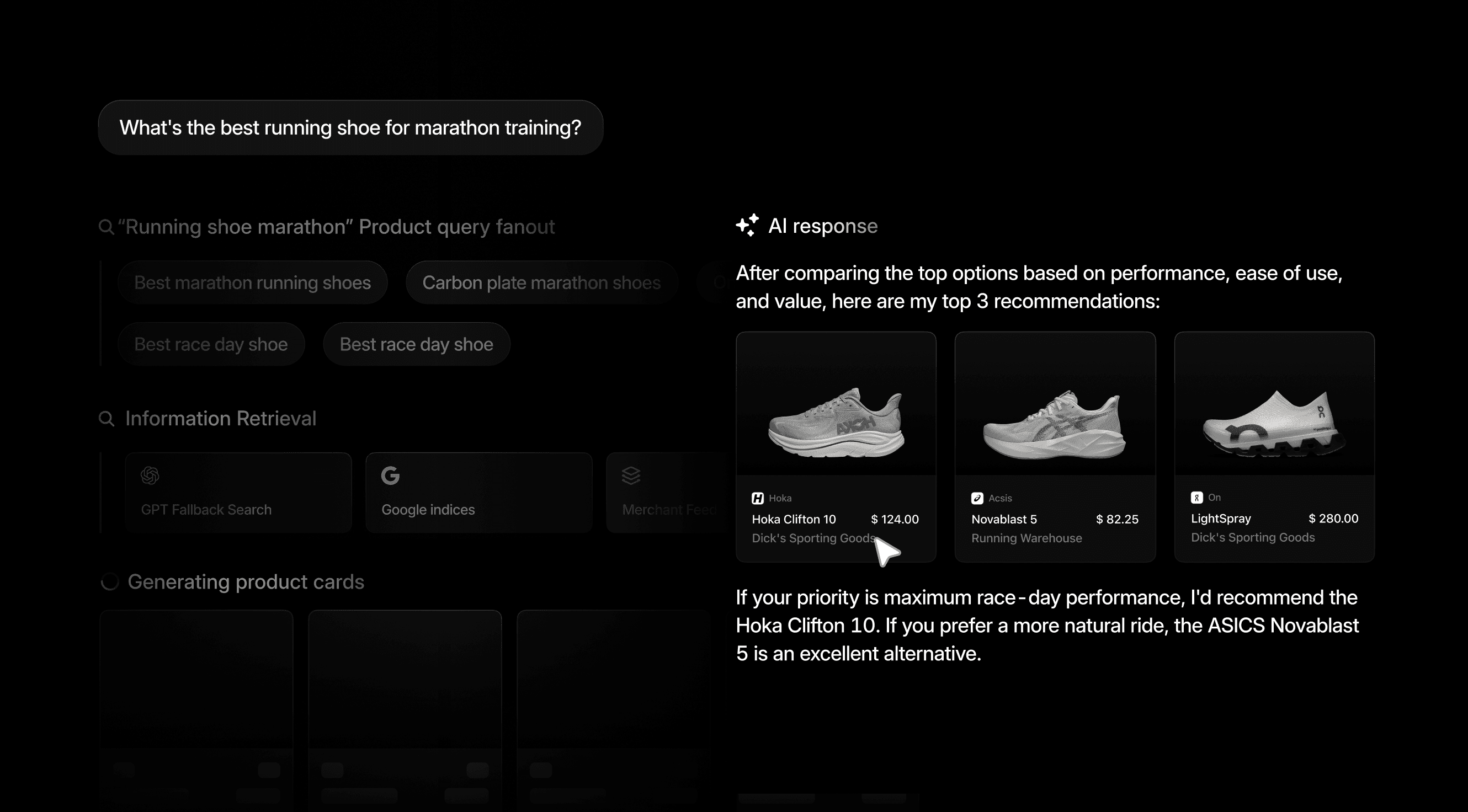
We released shopping research a couple of weeks back, focusing on how to rank higher in the product offer list in ChatGPT shopping and how often offers are retrieved from web crawl and product feeds. The offer list is the entry point to merchants' product pages from the LLM shopping experience. But how important is ranking higher in this list for user clicks and downstream purchase decisions? And how does this fit into the rest of the ChatGPT shopping experience?
Key findings summary
Here is a shortlist of key findings in this blog for quick reference:
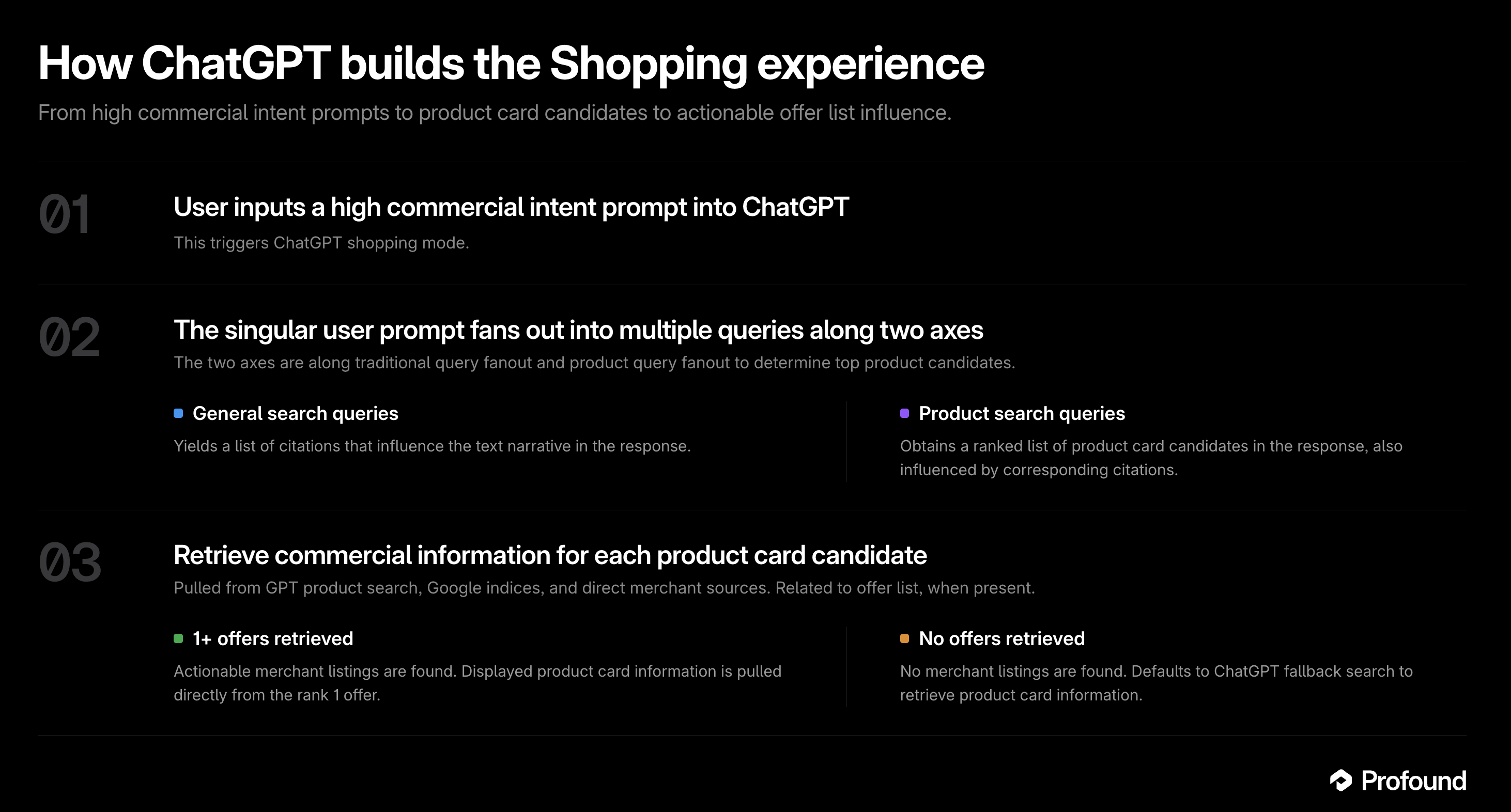
- In shopping mode, ChatGPT not only expands the original user prompt via traditional query fanout for the general text response narrative, but also product query fanout for product card candidates and supportive text reasoning.
- When 1+ offers are successfully retrieved for a product card, the card's commercial information is pulled from the rank 1 offer. Otherwise, it is pulled from a fallback ChatGPT product search.
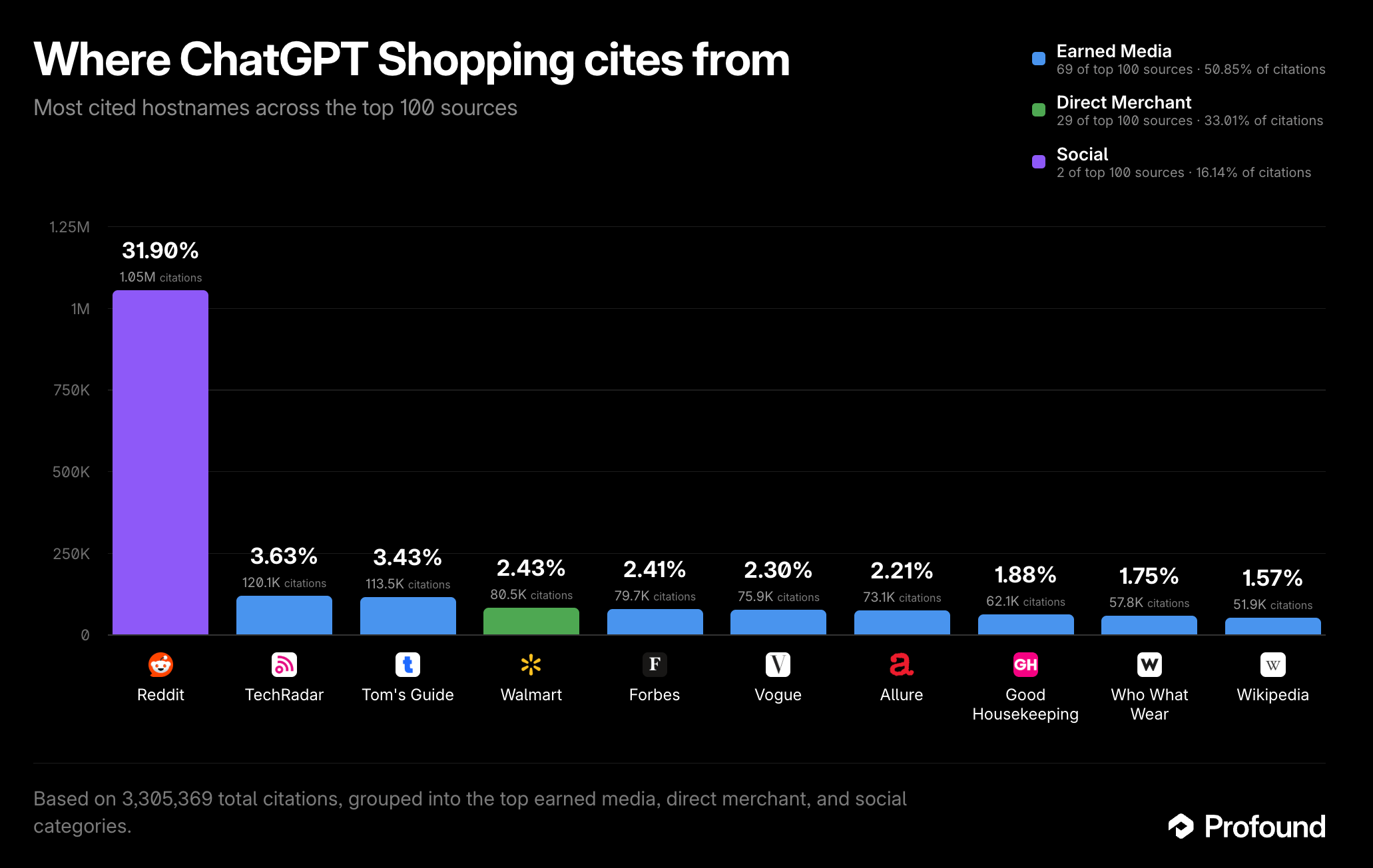
- Reddit is by far the most indexed domain, covering for ~1/3 of all shopping citations.
- Product information is pulled primarily from 3 sources in ChatGPT shopping: GPT's own fallback search index, Google index signals, and direct merchant sources.
- The largest differences between top and bottom cited product cards are GPT tag presence, greater median review count, and promotional pricing.
The user's shopping experience in ChatGPT
First, let's understand the user shopping experience with the following visualization of a single product recommendation:
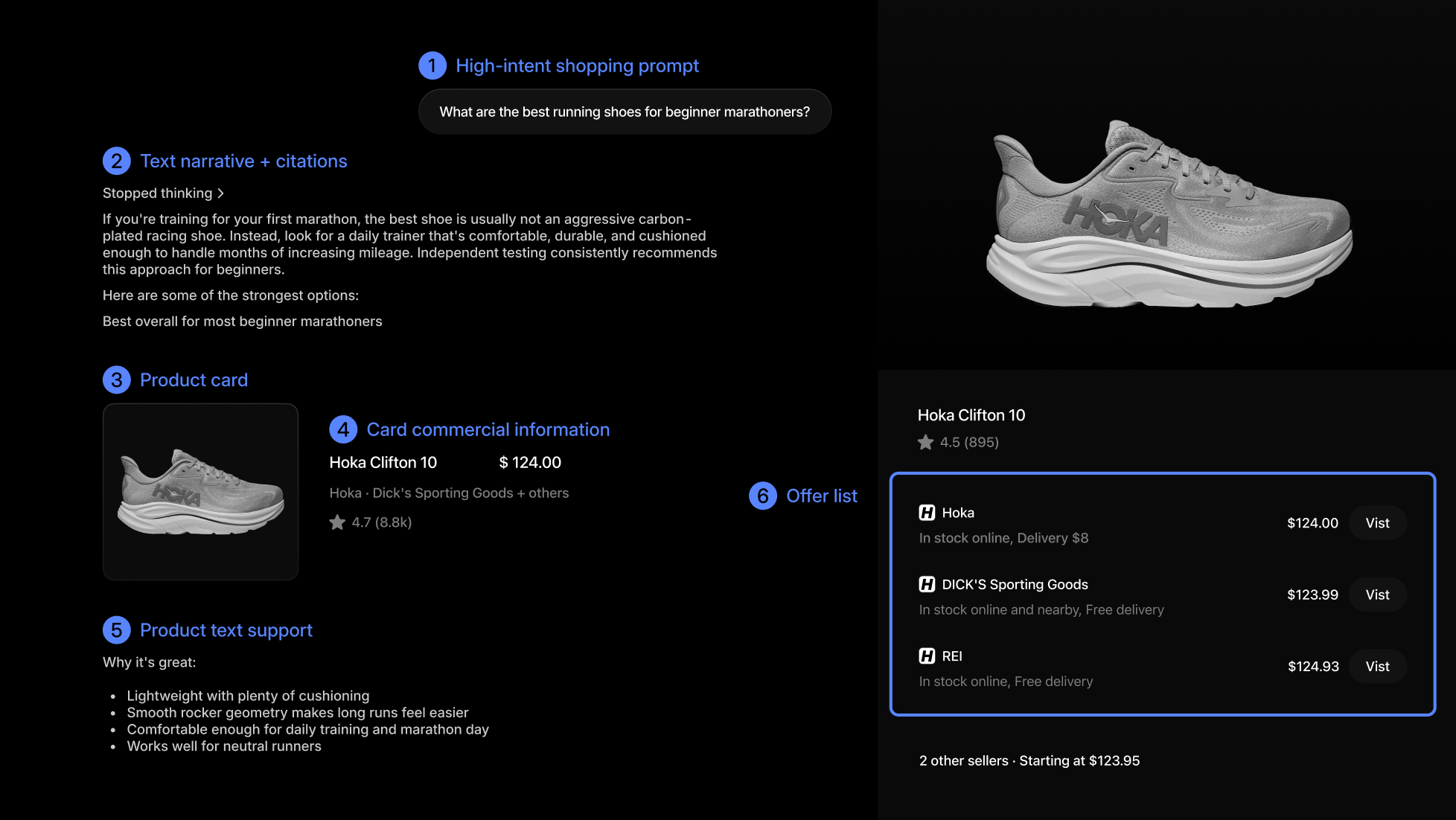
- The user prompts the LLM per usual. Shopping mode is triggered if the prompt exceeds a given commercial-intent threshold.
- Similar to any non-shopping response, ChatGPT returns a text narrative that's supported by citation sources. Everything below this is specific to shopping mode responses.
- We look at a singular product card in this example. Usually, multiple cards are present in the response. These cards are filled with top ranked product recommendations and can appear in various formats, including within a carousel or individually.
- Each product card is surfaced with specific commercial information. Users typically see combinations of product name, price, merchant, rating, and review count.
- Each product card is also often supported with corresponding text, giving reasoning on why it was recommended.
- A right sidebar is surfaced with additional information if users click on any product card, including more images, text details, and related products. We explicitly outline the offer list, representing merchant listings the users can visit to make a purchase.
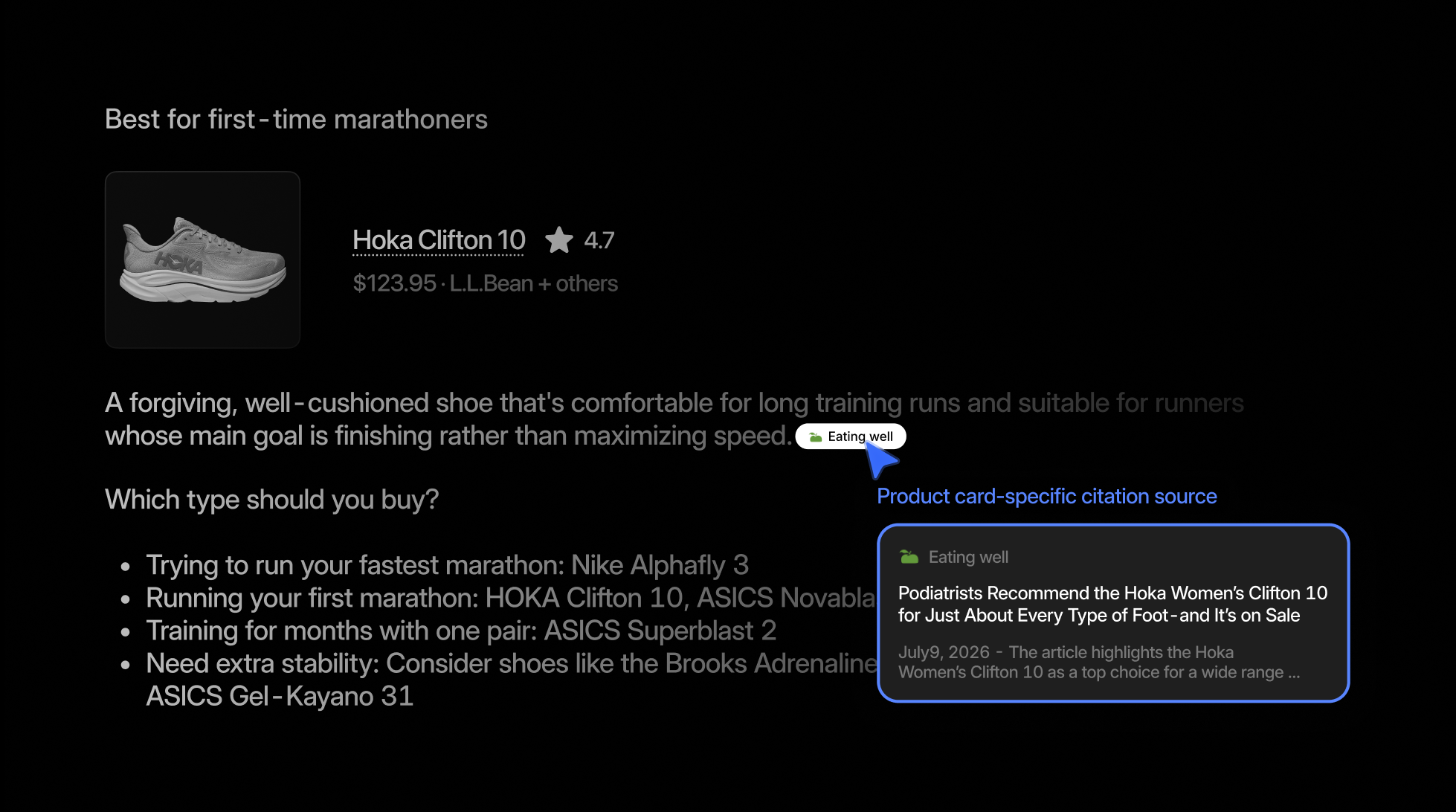
Often, text support for a product card contains a citation, which can be directly attributed to the product. This indicates how a product card candidate was selected. Here is a clear example:
Interpreting what happens behind the user experience
So we've addressed what the user sees. But the more important question is how this shopping experience is actually implemented. We piece everything together in the rest of this blog, but here's the general snapshot:
In the following sections, we will cover:
- How product card candidates are sourced from the initial user prompt.
- Where product card information is sourced from after candidate selection.
- How top ranked product card candidates may differ from bottom ranked ones.
- How product cards are related to the offer list.
Data overview
We analyzed 201,137 unique prompt runs, containing 812,190 respective product cards, in ChatGPT shopping prompts from June 18 - June 25, 2026.
Averaging ~4 product cards per prompt, our product cards are sampled between two sources:
- 707,752 (87.3%) product cards are retrieved from web crawl.
- 102,523 (12.7%) are retrieved from direct merchant product feeds.
This breakdown roughly aligns with retrieval source split at the offer level from last time.
Top citation sources
We pulled the top 100 citation sources to directionally understand where shopping responses are influenced from. This includes citations for both general text narrative and product-specific support.
How are product card candidates sourced from the initial user prompt?
For all LLM prompts, answer engines rephrase user prompts to multiple internal sub-queries that are actually used for search. This is query fanout, as you are likely familiar with. Uniquely for shopping mode, we observe something similar but novel. That is, ChatGPT also translates user prompts to internal product sub-queries, also used for search in shopping mode. We will call this mechanism product query fanout.
We observe the combined set of sub-queries and the corresponding set of citations for any user prompt. Notably, we can't directly attribute specific sub-queries to individual citations. But given the positioning of these two query types in network logs, we can reasonably assume that traditional query fanout retrieves citations that influence the general text narrative of the response, while product query fanout retrieves citations that influence product card candidate selection. This interpretation is supported by specific prompt examples we analyzed.
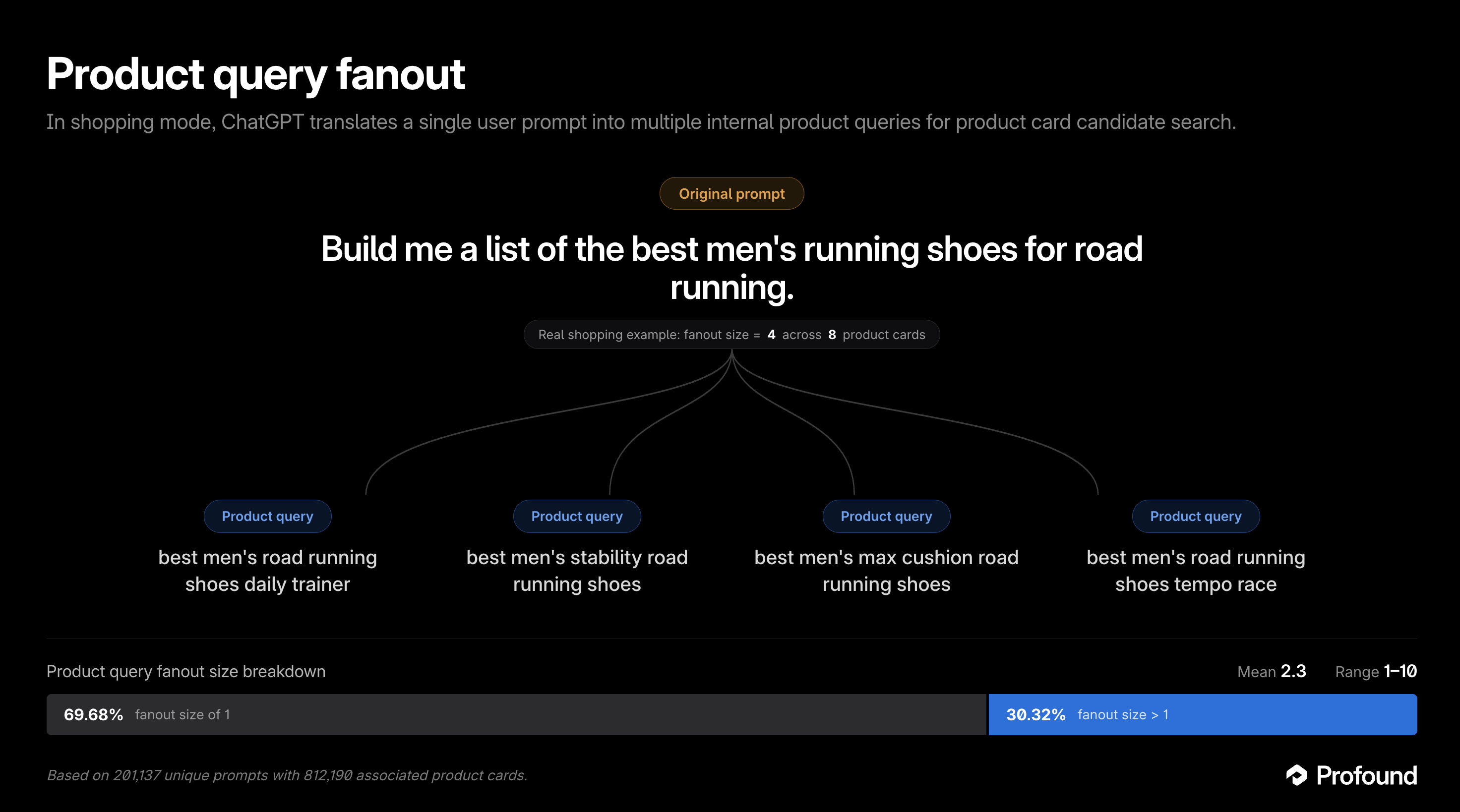
Like traditional query fanout, it is crucial to frame around the fanned-out product queries because that's what the machine actually uses for product selection.
Once top ranked product card candidates have been finalized, the next step is understanding which channels commercial product card information is retrieved from.
Where is product card information sourced from after candidate selection?
For the 12.7% of cards retrieved from product feeds, the logic is clear. Product card information is always sourced from the integrated feed itself.
For the 87.3% of product cards retrieved from web crawl, product card information is sourced from three primary sources:
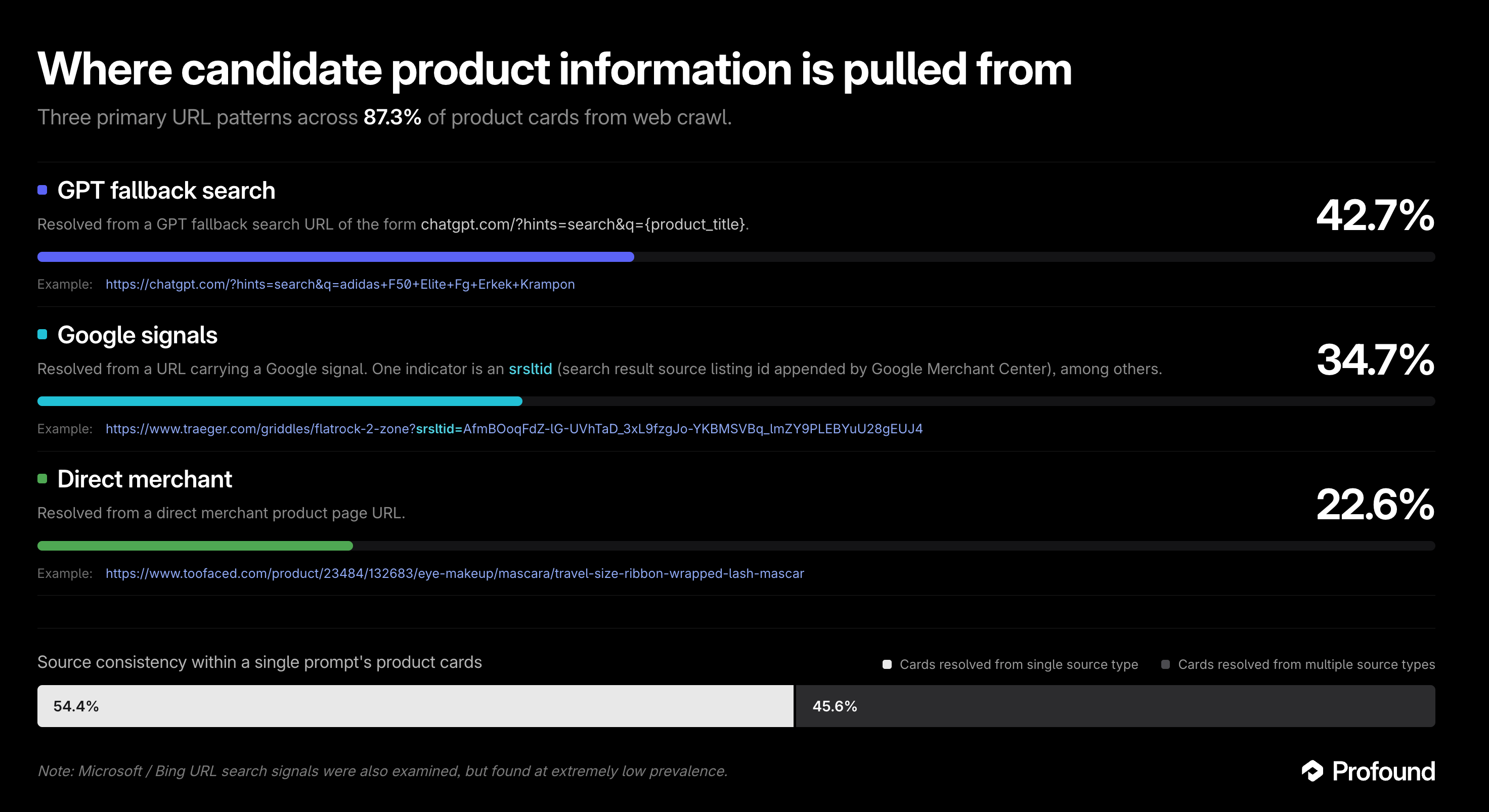
To further explain GPT fallback search, these links redirect to an exact search of the product title in the url. In the above example, product card information used is retrieved from the response of a ChatGPT search of adidas F50 Elite FG Erkek Krampon.
We highlight the main takeaways:
- ChatGPT pulls from live, direct merchant sources just under 25% of the time.
- ChatGPT relies on its internal search engine + Google commercial indices, not Bing or other engines, for the remaining retrieval instances of commercial product information.
How does the offer list relate to the product card?
We now understand how product card information is retrieved. We also understand where the offer list shows up and how to rank higher in that list. But how are these two components connected across all product cards?
From before, each product card is accompanied with commercial information, including product name, price, and merchant. We observe if these card-level fields are related to associated offers in any way. We also compare product urls for additional signal.
Notably, offers are not successfully retrieved for every product cards. When present, offers are either all retrieved from web crawl or product feed sources. 79.91% of product cards map to all web crawled offers. 20.09% map to all product feed offers. So we can analyze the two groups cleanly:
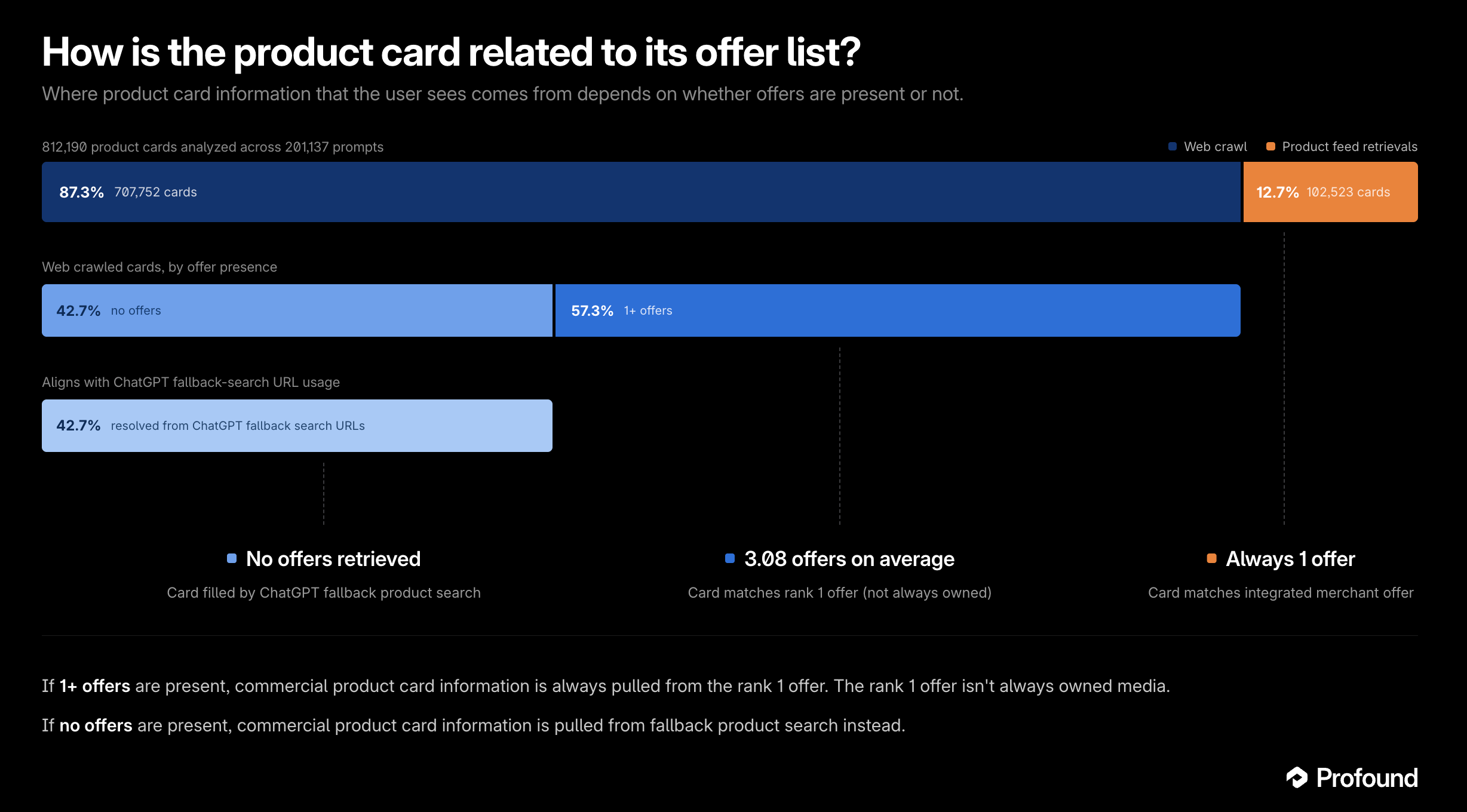
The most important takeaway here is that product card commercial information is always pulled from the rank 1 offer. When no offer is pulled for a card, this commercial information is retrieved from a fallback ChatGPT product search instead.
Top vs bottom ranked product cards
Similarly to top vs bottom ranked product offer placement analysis in previous research, we replicate that structure here for product card placements, splitting our product card sample into 200,975 rank 1 cards and 214,301 rank 4+ cards, and identified the following correlations:
The two largest lifts are observed for GPT tag presence and median review count. Promotional pricing has a modest lift. Offer presence, url length, and product name length have a flat contribution to product rank.
For those not familiar, GPT tags are machine-determined labels assigned to products with specific characteristics. Tags are not explicitly defined by the merchant; instead, they're based on available product data that ChatGPT has access to and may not reflect every retailer or real-time change immediately.
There is a wide spread of tags for product cards, but here are some of the most prevalent:
Though algorithmically labeled, tagging probability can be indirectly influenced by proper framing on PDPs and product feed fields.
What this means for your brand
Formalizing this interpretation of ChatGPT shopping is crucial for retailers, and the following actionables become apparent:
- To get your product selected as a product card candidate,
- Product Query Fanout: Align your product listings and content along exact query fanouts used for product searches.
- ChatGPT fallback search: Your listings must be the one that shows up for exact product searches in ChatGPT.
- Google signal search: Your listings must show up at the top of Google shopping index entry points.
- Direct merchant search: You must continue optimizing your PDPs and product feeds along best practices.
- Win general citation share: Citation sources influence the text narrative, but also selected product card candidates. This likely aligns with general visibility strategies.
- For your offer to have maximum influence, both for user clicks and product card attribution, you must be the one that ranks 1 in the offer list. Check out previous shopping research.
- Encourage/Incentivize customers to leave more positive reviews on your product pages.
- Include framing around top GPT tags above and promotional pricing, whenever relevant, on your product pages.
Methodology
14 day snapshot: ~200k unique prompt runs and ~813k product card sample of shopping mode runs across ChatGPT sessions. Analyzed user shopping experience and network logs to interpret how user prompt translates to product card/offer retrieval and how the two are related. The same product card sample split into 200,975 rank 1 product cards and 214,301 rank 4+ product cards for top vs bottom product card attribute correlation. ~3.3 million respective citations analyzed to break down top 100 citation sources.
Results are observational at scale, representing a snapshot of data in time. July 2026.


