

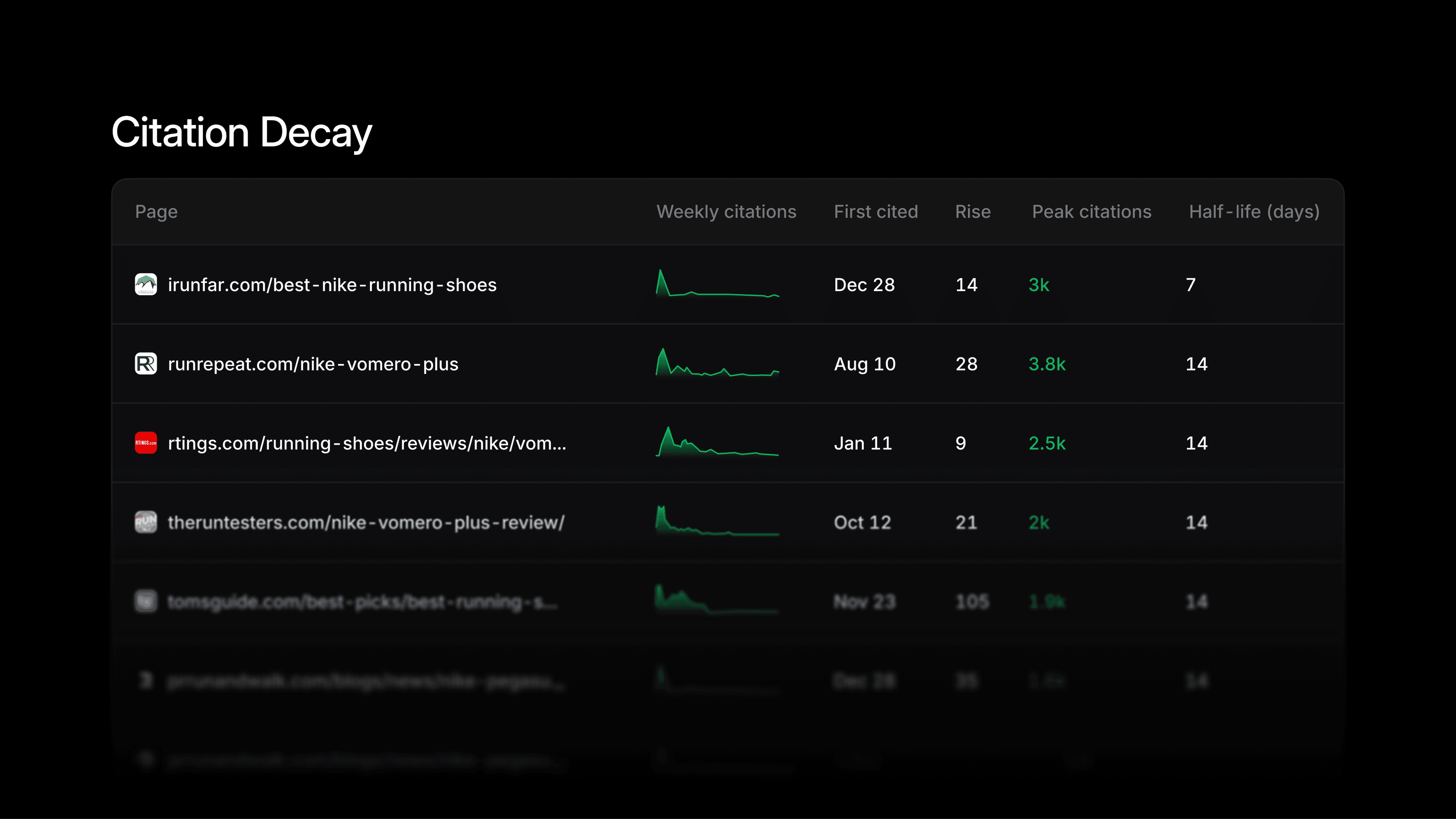
Citations are a key lever for controlling your narrative in AI Search, and half of the content Answer Engines cite is less than 13 weeks old. Staying in the answer means refreshing constantly. But when does a citation stop earning its place?
The Citation Decay view in Answer Engine Insights answers that. Refresh decisions usually run on an arbitrary cadence or a publish date, so the page that actually needed updating sits untouched for another quarter. Citation Decay plots a citation curve for every URL, so you can see the full life of a page's citations and the point where it needs a refresh.
What Citation Decay shows
For every cited URL, Profound tracks week-over-week citation counts starting from the first date that URL appeared in an AI answer. The view reports the first cited date, the rise, the peak, the half-life, and the last cited date.
First cited date, rise, and peak
The first cited date is the first week an Answer Engine cited the URL. The rise is the number of days from the first cited date to peak citation volume. The peak is the highest weekly citation count the URL reached, along with the week it happened.
Half-life
Half-life is the number of days from the peak until the page's weekly citations fall to half of the peak and stay there. The count is smoothed on a two-week rolling average, so a single odd week does not register. A page that rose for 63 days and then had a 7-day half-life climbed slowly then rapidly lost relevance.
You can filter the view to owned domains or all domains, and by model, to see whether a page decayed everywhere or only inside ChatGPT.
How Profound customers can use this
Until now, Citation Decay was invisible. This new metric provides a data-backed content refresh queue: the pages worth an update this week are the ones whose citations are already halving, not the ones that happen to be oldest.
Time your refreshes to the curve instead of the calendar
Most content teams refresh on a fixed cadence, which wastes time on pages that did not need it and misses the ones that went stale within three weeks of publishing. Sort your owned URLs by half-life instead and work the queue from the top: past peak, falling fastest, still worth ranking for. Pages still on the rise get left alone.
Find which formats decay fastest
Analyze your cited URLs by page type and compare half-lives across product pages, comparison pages, glossary entries, and launch posts. Formats with long rises and longer half-lives are worth producing more of. Formats that halve in two weeks need either a higher publishing rate or a different approach.
Build a refresh pipeline with Profound Agents
Pull the owned URLs whose citations are past peak into a Profound Agent that drafts an updated version and stages the revision in your CMS. Decay becomes a trigger instead of something you notice a quarter late.
Get started
Citation Decay is available today for Profound customers, under the Citation view within Answer Engine Insights. If you’d like access, please reach out to your Profound team.
If you are not yet a Profound customer and want to see this in action, we encourage you to get a demo.


