
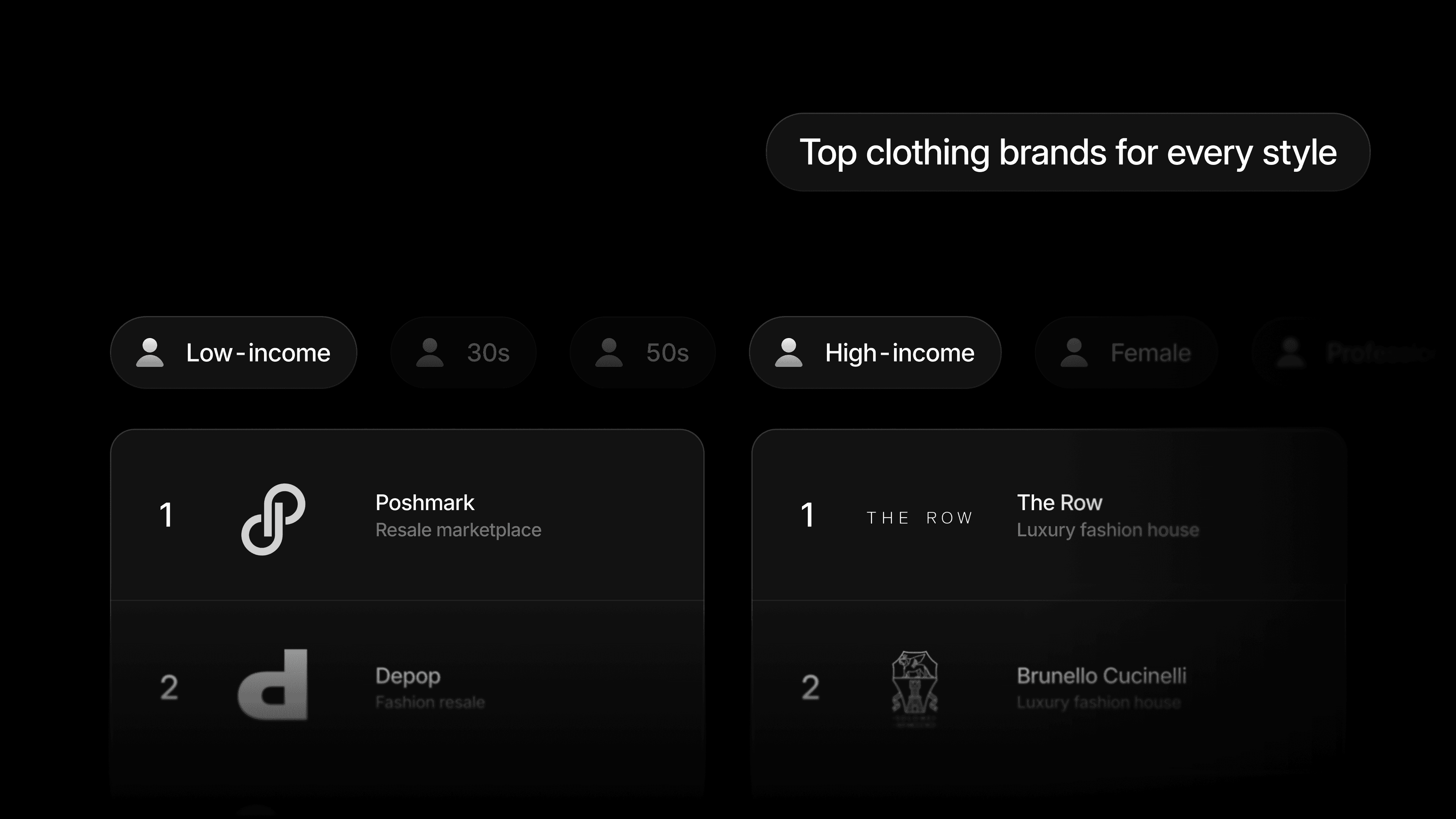
How much does an Answer Engine’s recommendation change when the question stays the same but the user’s income, age, gender, or occupation changes?
We analyzed 71,147 responses across clothing, furniture, and credit card queries to examine how ChatGPT, Claude, and Gemini respond to different personas. We compared the brands they recommended, the sources they cited, and, where available, the search queries they used.
TL;DR
- Answer Engines recommended different brands and cited different sources depending on the persona in the prompt. Responses to different personas for the same prompt shared only about 1 in 4 brand mentions and 1 in 5 citations.
- Of the attributes we tested, income produced the clearest differences. Responses to low-income personas about clothing favored resale platforms and accessible retailers, while responses to high-income personas featured luxury brands. Additionally, responses for high-income personas contained more brand mentions and citations.
- Search queries revealed how Answer Engines interpreted persona details. They translated income into terms like “affordable” and “premium,” and sometimes added assumptions absent from the prompt, such as associating older clothing shoppers with women.
- Brand visibility is persona-specific. Measure whether your brand appears for its target audiences, rather than relying on aggregate scores.
Answer Engines give different personas different answers
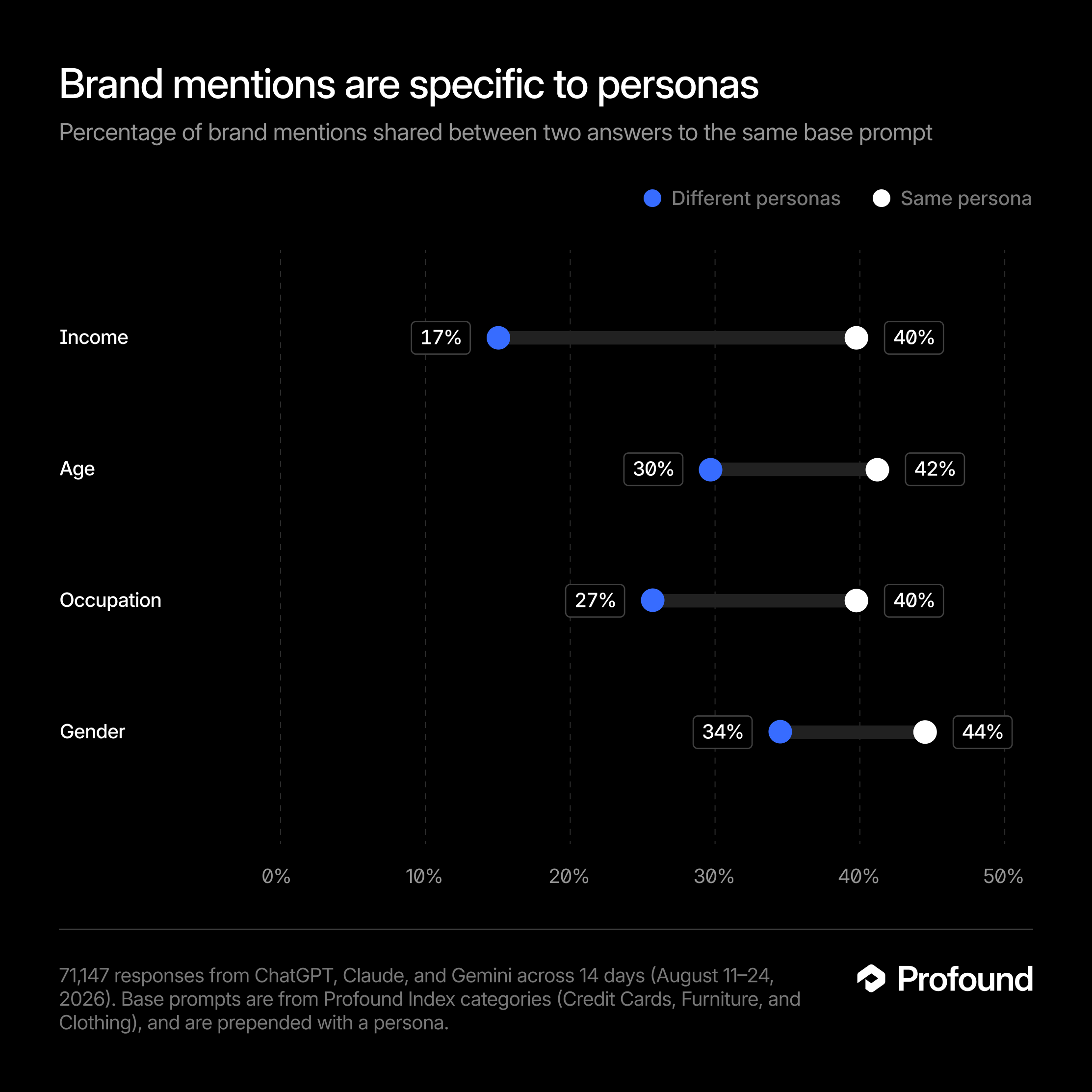
Responses to different personas produced differences beyond the baseline variation in repeated answers to the same persona. Answers for the same persona shared about 2 in 5 recommended brands, whereas answers for different personas shared only about 1 in 4. In other words, changing the persona reduced brand overlap by 15 percentage points.
The way in which recommendations differ depends on the query and the persona, but for example, Patagonia and Ralph Lauren were among the top mentioned brands for clothing prompts for men, compared to Reformation and Free People for women.
Cited sources followed a similar pattern. Repeated responses for the same persona shared 34% of their cited domains, compared with 20% for different personas, a 14-percentage-point difference. Answer Engines use different sources for different personas, shaping which brands ultimately get mentioned.
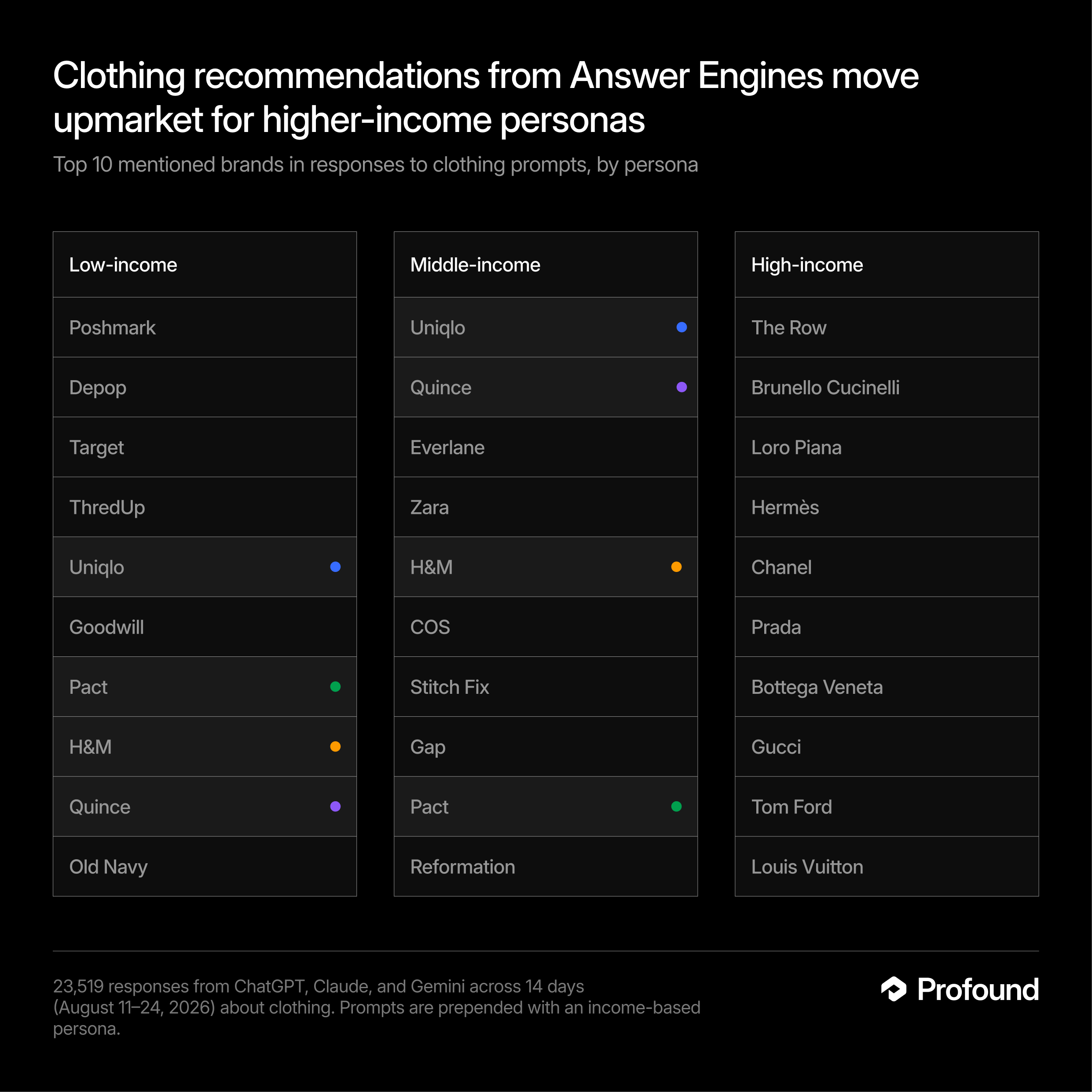
Income moves the same underlying prompt into a different market
Income produced the clearest differences in both recommended brands and cited domains. For clothing, used marketplaces like Poshmark and Depop were among top mentioned entities for low-income personas, whereas responses for high-income personas were filled with luxury brands.
The prices of representative T-shirts from the recommended brands for each income group show how far apart these recommendation sets were. Prices ranged from $8 to $24 for low-income personas, $10 to $58 for middle-income personas, and $140 to $1,650 for high-income personas.
Income also affected the number of brand mentions and citations in each response, suggesting that the number of opportunities for a brand to appear can itself depend on the persona. Across all three categories, responses to high-income personas averaged 7.5 brand mentions and 4.8 citations, compared to 5.8 brand mentions and 4.1 citations for low-income personas.
The sources supporting those recommendations differed too. For example, in Gemini’s responses to clothing prompts, high-income clothing responses drew 24 percentage points more citations from brand-owned sites, 17 points fewer from earned media, and 8 points fewer from institutional sources than low-income responses. For marketers targeting a particular budget segment, knowing the citation mix for a specific persona can help decide which channels to allocate resources to.
Search queries reveal how models interpret a persona
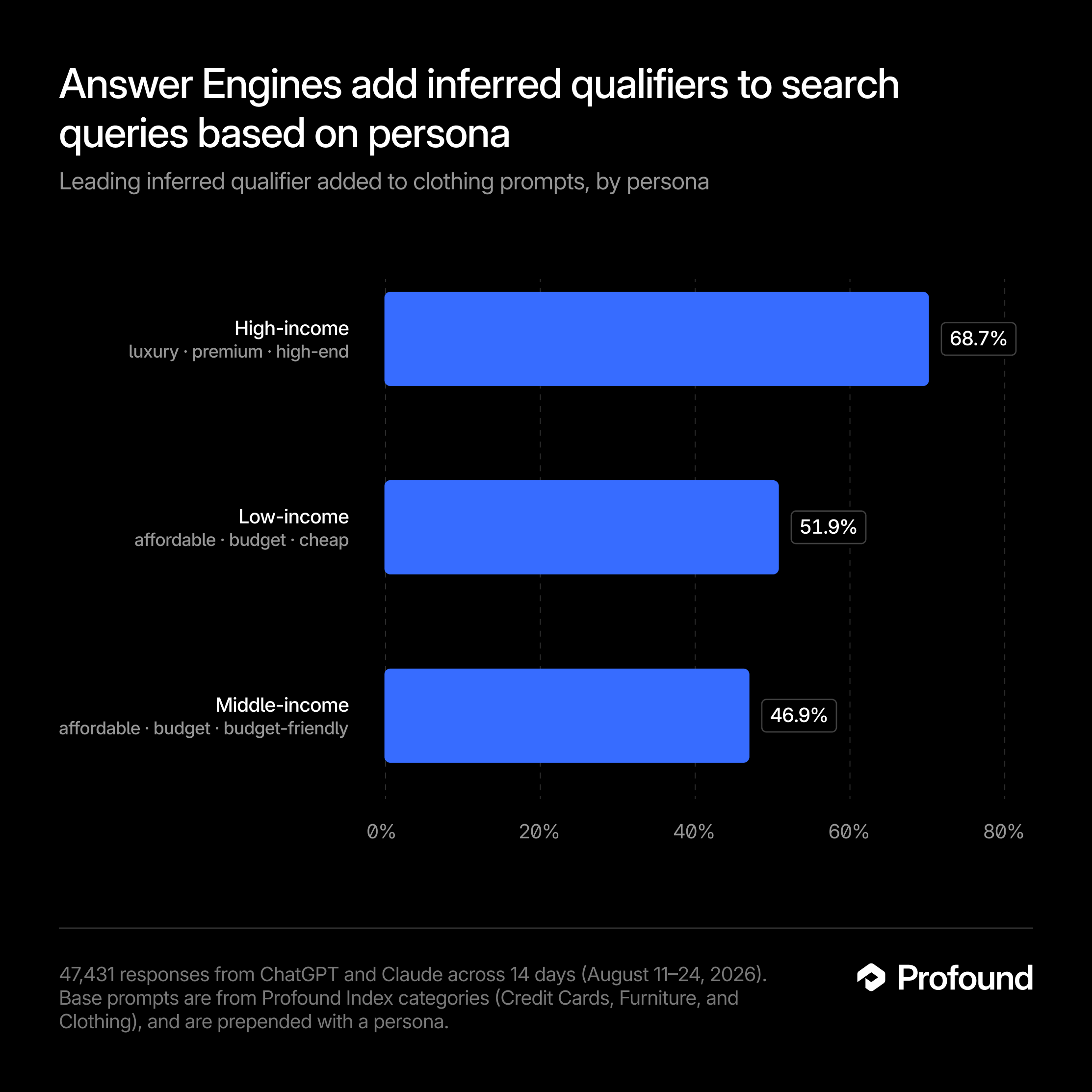
To understand why the recommendation sets diverged, we examined the Answer Engines’ recorded search queries. ChatGPT and Claude often converted income into explicit budget terms, using language such as “luxury” for high-income personas and “affordable” for low-income personas across all categories.
However, models sometimes translated personas into unjustified assumptions about work context, income, retirement, accessibility, and life stage. For example, across ChatGPT and Claude, clothing search queries for people in their 50s and 70s were about 39 percentage points more likely to contain “women” than queries for younger age groups.
These assumptions matter most when they exclude part of a brand’s intended market. For instance, a company selling clothing to older men should test whether Answer Engines recognize that audience instead of implicitly treating older shoppers as women.
What it means for marketers
- Measure visibility by persona as well as platform. Different personas can receive recommendations from drastically different sets of sources, so an aggregate score can conceal whether a brand appears for the customers it most wants to reach. Persona-level results can also clarify which visibility efforts to prioritize for each target segment.
- Make your intended persona legible to Answer Engines. Make the connection between your products and their intended personas explicit. Publish concrete information about price, use cases, fit, eligibility, and customer needs, both on owned pages and through relevant third-party sources.
Methodology
Our dataset consists of responses to the same underlying prompts while specifying a gender, age, income, or occupation type.
The full list of attributes (and possible values) is:
- gender: male, female
- age: young adult, 30s, 50s, 70s
- income: low, middle, high
- occupation: professional/white-collar, service, skilled/manual, student, not working
We used base prompts from three Profound Index categories: Credit Card, Clothing, Furniture.
A prompt is constructed by prepending one attribute value to the base prompt ("I am [attribute value]. [prompt]"). For example: "I am in my 30s. best affordable furniture companies."
We ran prompts on ChatGPT, Claude, and Gemini over 14 days (August 11–24, 2026), producing 71,147 responses. Recorded search queries were available for ChatGPT and Claude, but not Gemini.
Get started
Your brand can be visible in Answer Engines and still be absent from the answers your target customers receive. Book a demo to see how Profound helps brands track visibility across the personas that matter to their business.


