
Profound and AirOps both promise to help teams scale content and win in AI search. But they got to this point from opposite ends, and that difference in design philosophy determines what each tool can reliably deliver.
AirOps started as a content automation platform, but has since added AI visibility features. We conceived Profound from the ground up as a purpose-built Answer Engine Optimization (AEO) platform, combining best-in-class AI visibility data with content creation and automation.
This article compares the two tools across six dimensions: content automation, LLM and regional coverage, pricing, AI visibility insights, actionable recommendations, and compliance. By the end, you’ll have a clear picture of which platform best slots into your team's workflow.
For a quick side-by-side comparison between AirOps and Profound, check out the table below:
Profound vs. AirOps: Content automation and workflows
Both Profound and AirOps let you build AI-powered content workflows, but what sits underneath those workflows, and how much work it takes to get started, is where they diverge considerably.
AirOps: Powerful workflows with a steep learning curve
At a glance
Pros:
- Visual workflow builder scales across hundreds of URLs via Grid; Power Agents package common jobs into forkable templates
- Workflow governance—technical teams can build complex workflows while non-technical users execute them without seeing the backend.
Cons:
- Steep learning curve—setup requires significant time investment before workflows run smoothly, even with AirOps Academy and embedded Copilot
- Output is rarely publish-ready; brand guidelines can be applied too rigidly, and content refreshes have been known to misplace FAQs or alter heading hierarchy
- Teams without dedicated technical resources report ROI taking too long to materialise
AirOps is built around a visual workflow builder where users chain together steps like research, brief generation, and drafting into automated pipelines. The Grid feature runs those pipelines across hundreds of URLs at once, while Power Agents package multiple steps into pre-built templates for recurring jobs like content refresh and keyword research.
While the scalability is impressive, and reviewers compliment it, getting AirOps up and running takes time. The builder is hard to learn, and even with AirOps Academy cohorts and an embedded Copilot, user feedback often points to the same issue. As one reviewer put it, "AirOps has a pretty steep learning curve. The initial setup wasn't easy, and getting to the point where workflows are running smoothly took a significant time investment. I felt that for teams without dedicated technical resources, the ROI just took too long.”
As for content quality, it's decent, but the output isn't usually publish-ready. AirOps can follow brand guidelines too rigidly, sometimes removing negative framing that’s contextually appropriate, and content refreshes have been known to misplace FAQs or convert H2s to H3s mid-article.
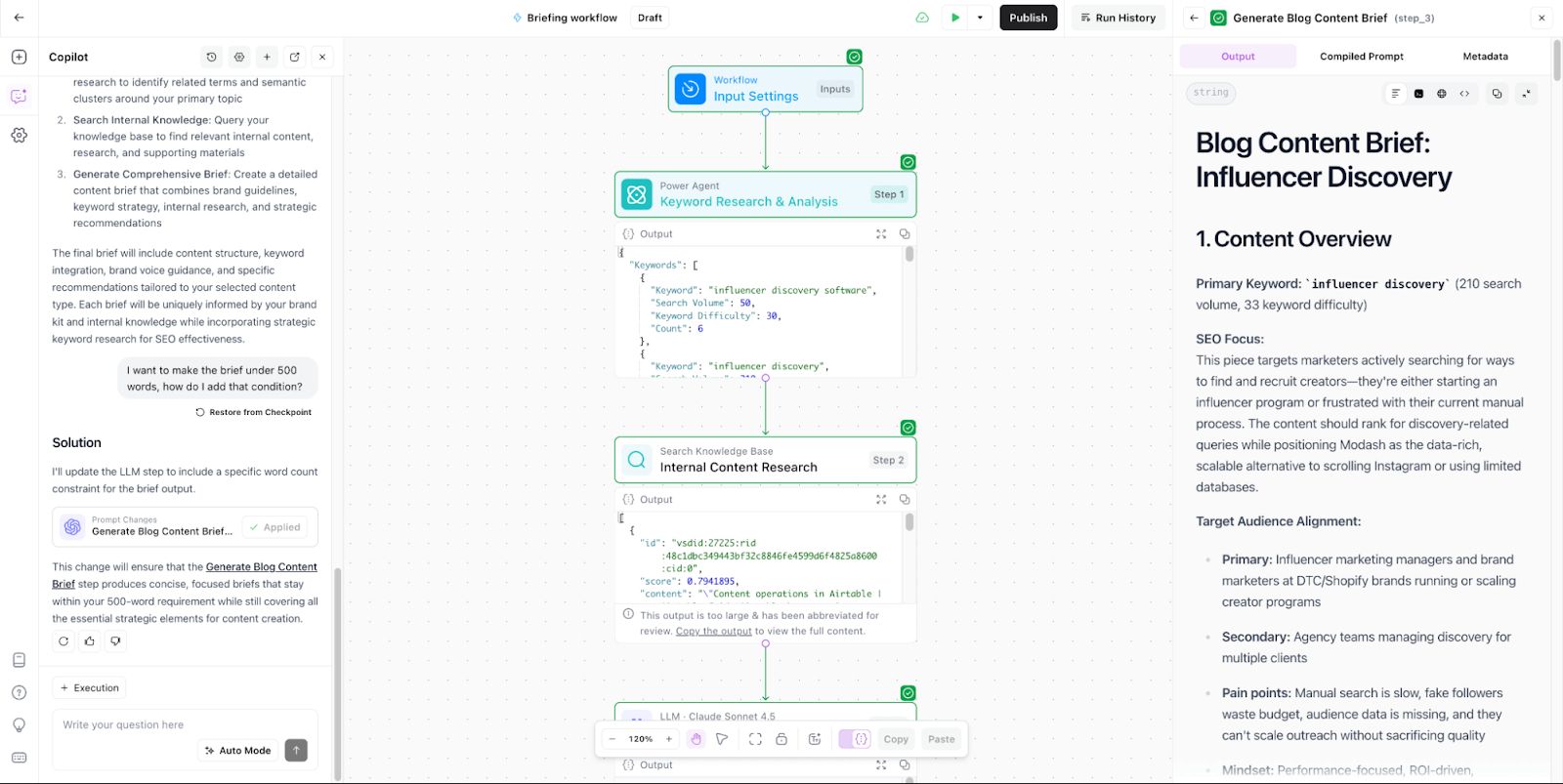
AirOps' workflow canvas—powerful once configured, but the builder requires meaningful setup time before it's running smoothly.
Profound: Intuitive workflows with data-driven templates
At a glance
Pros:
- Pre-built Agent templates cover the most common AEO use cases out of the box— AEO Content Refresh, FAQ Generator, Content Optimisation Suggestions—with no configuration required
- Every Agent pulls from Answer Engine Insights: citations, prompt sentiment, and real user prompt data inform generation rather than working in isolation
- Profound tracks which published content gets cited and by which LLMs, feeding that signal back into the generation engine so output improves over time
- Reviewers call it a “major unlock” for streamlining processes and describe the combination of innovation and practical utility as essential for teams managing AI presence
Cons:
- Content output still requires editorial review before publishing
Our Agents are designed for marketers to get started fast, without relying on dev support. The template library covers the most common AEO use cases out of the box, including AEO Content Refresh, FAQ Generator, Content Optimization Suggestions, and more. This means that the same “create a brief” workflow that takes significant ramp-up time in AirOps can be running in Profound in just a few minutes.
But the more important distinction is what powers the output. Every Profound Agent pulls from Answer Engine Insights, meaning citations, prompt sentiment, and user prompt data. Your content isn’t generated in isolation; it’s informed by what answer engines are currently rewarding.
Profound also tracks which content gets cited after publication, and by which LLMs. That data feeds directly back into the content generation engine so it improves over time. AirOps doesn’t have this feedback loop, so the content you create there doesn’t make the next piece better.
Reviewers appreciate the Agents feature, praising both the easy setup and speed gains. One user called it a "major unlock” for the organization to streamline processes and enhance overall output, adding that:
“the combination of rapid innovation and practical, high-level marketing utility makes Profound an essential asset for any organization looking to master their AI presence.”
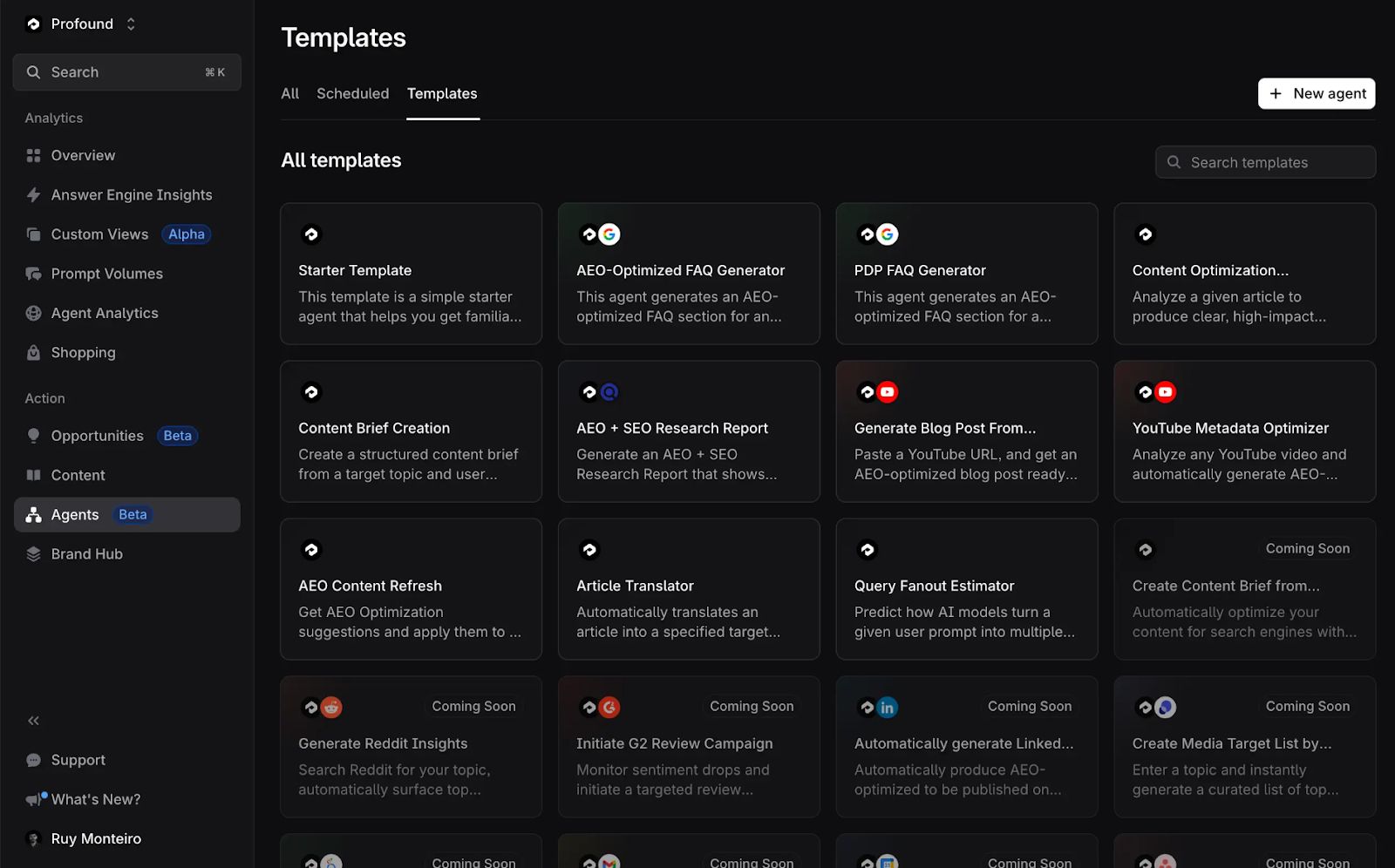
Profound's Agent template library covers the most common AEO use cases out of the box—no configuration required to get started.
Profound vs. AirOps: LLM and regional coverage
The AI search landscape has grown to encapsulate over half a dozen platforms, each with different citation behavior, regional usage patterns, and user demographics. Which LLMs a tool tracks determines how much of that picture you can see.
AirOps: Limited engines, US-only data
At a glance
Pros:
- Covers ChatGPT, Google Gemini, Google AI Mode, and Perplexity on Pro and Enterprise plans
Cons:
- Claude, Meta AI, Grok, DeepSeek, and Microsoft Copilot aren’t covered at any tier
- Regional data is US-only on Solo and Pro; international coverage requires an Enterprise contract
- Prompts run via API rather than front-end browsers, producing a less accurate simulation of what real users see
AirOps’ Solo plan tracks only ChatGPT. Moving up to Pro or Enterprise adds Google Gemini, Google AI Mode, and Perplexity—and that's the ceiling. Claude, Meta AI, Grok, DeepSeek, and Microsoft Copilot aren’t covered, so for brands that need to understand how they’re represented across the full AI ecosystem, that’s a significant blind spot.
Regional coverage is similarly constrained. Insights are US-only unless you’re on an Enterprise contract, which means international brands, or US brands with global audiences, may be working with an incomplete picture. AirOps also runs its prompts through API calls rather than front-end browsers, which produces a less accurate simulation of what real users see when they engage with AI engines.
Profound: 10+ answer engines, global coverage
At a glance
Pros:
- 10+ answer engines tracked out of the box: ChatGPT, Claude, Perplexity, Google AI Overviews, Google Gemini, Google AI Mode, Microsoft Copilot, Grok, Meta AI, and DeepSeek
- New engines added quickly as the market evolves
- 50+ countries and 15+ languages available from the entry-level plan
- Prompts run daily through front-end browsers, reflecting real user experience in local context rather than API approximations
Cons:
- Starter plan tracks 50 prompts on ChatGPT only
Profound tracks all 10 major answer engines out of the box: ChatGPT, Claude, Perplexity, Google AI Overviews, Google Gemini, Google AI Mode, Microsoft Copilot, Grok, Meta AI, and DeepSeek. We add new engines quickly as the market evolves.
Global regional coverage is available starting from the entry-level plan, not locked behind enterprise pricing. Plus, Profound runs every prompt daily through front-end browsers in favor of APIs, so the data reflects what real users see in their local context.
Profound vs. AirOps: Pricing and time-to-ROI
Price is only part of the cost equation. How fast a tool delivers value, and how predictably it bills you along the way, is just as important as the number on the pricing page.
AirOps: Task-based billing with a slow ramp
At a glance
Pros:
- Task-based billing can work in your favor for variable or low-volume workloads, as teams running occasional jobs don't pay for idle capacity
Cons:
- Workflow steps consume credits at varying rates, making it difficult to forecast monthly spend before workflows are fully configured
- Reviewers flag that cost feels high relative to how quickly usage scales, especially for larger or more experimental workflows
Substantial ramp-up time required before teams are productive, which delays time-to-ROI and makes early cost modeling unreliable
AirOps uses task-based billing—workflow steps count as credits, and not all steps count the same way. To predict your monthly spend accurately, teams need to track which actions consume credits and which don't before they've produced any AEO value. The difference between what’s advertised and what you end up paying for a functional setup is a consistent point of friction in user reviews, with one user pointing out that:
“the price feels high relative to how quickly usage can scale, especially when running larger or more experimental workflow."
The learning curve piles onto the billing problem. Teams need significant ramp-up time before they’re productive, which delays time-to-ROI. While AirOps is well suited to organizations with large existing content libraries, it's far from ideal for teams building their AEO program from the ground up.
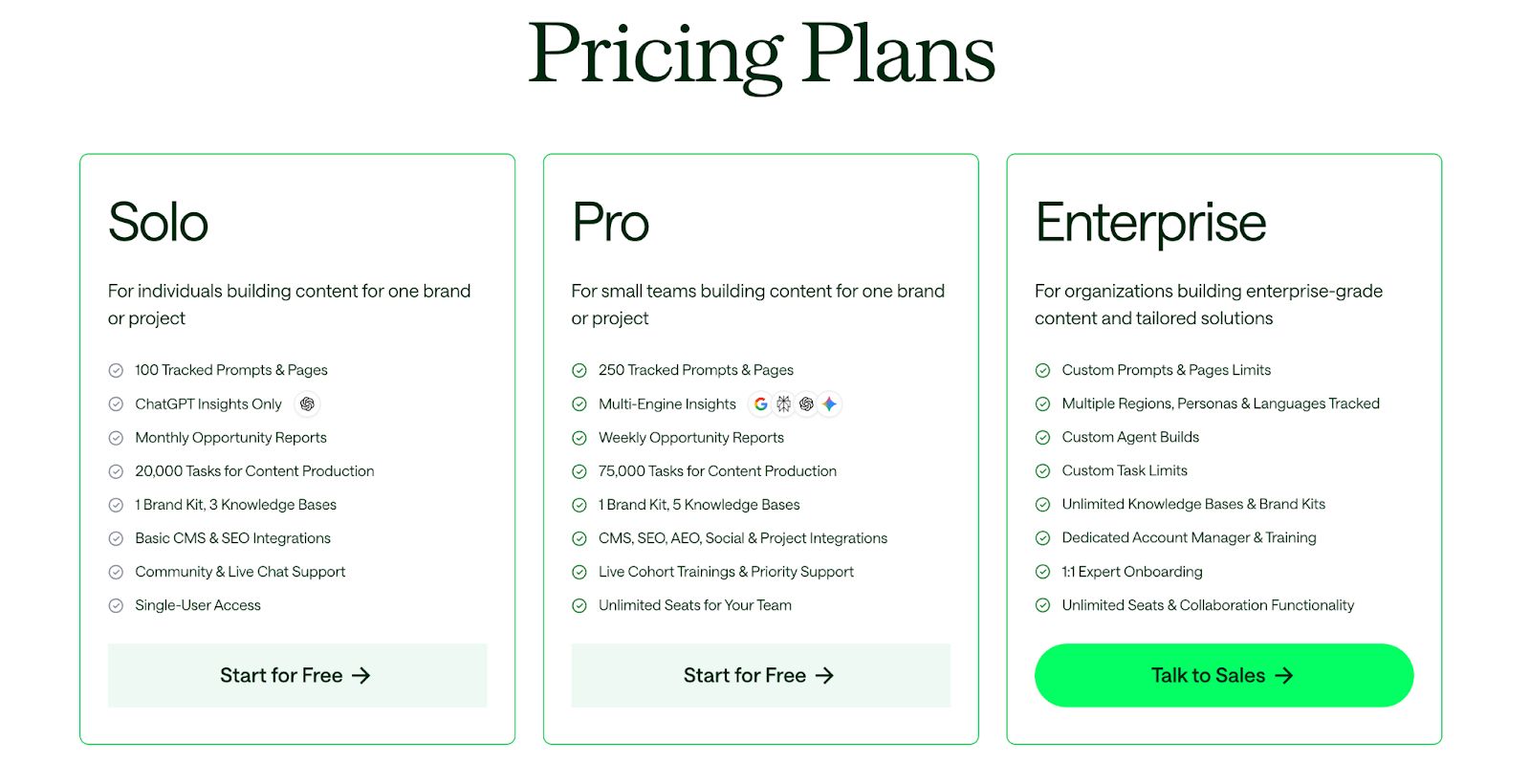
AirOps' Solo plan starts at $200/month but limits tracking to ChatGPT—full functionality requires a significant step up in price.
Profound: Predictable plans, deeper capabilities
At a glance
Pros:
- Fixed visibility plans with a defined number of prompts, engines, and competitors per tier, so the analytics driving your AEO strategy have predictable costs from day one
- Predictable budgeting for enterprise teams running workflows across multiple business units or regions
- Agent templates and embedded data context ship with every plan. There's no separate implementation fee or content tool subscription to bolt on before teams can produce actionable output
Cons:
- The Starter plan's 50-prompt, ChatGPT-only scope is enough to orient but not enough to run a meaningful AEO program for a large brand
- Enterprise-grade analytics, compliance, and global coverage make Profound the premium option in the market. For teams that need the full AEO stack, the price reflects the scope.
Profound's visibility plans are fixed by tier: a defined number of prompts, answer engines, and competitors, with pricing that stays the same whether you check your dashboards once a week or ten times a day. For enterprise teams managing multiple brands or regions, that structure makes budgeting straightforward.
The price difference between Profound and AirOps reflects a difference in scope. Profound's enterprise plans include capabilities that AirOps doesn't offer at any tier: real prompt volume data drawn from over 1.3 billion user conversations, infrastructure-level crawler monitoring through CDN integrations with Cloudflare, Akamai, and AWS CloudFront, granular citation tracking down to individual pages and text chunks, and an independent HIPAA compliance assessment for teams in regulated industries. Global coverage across 50+ countries and 15+ languages is available from the entry-level plan, not gated behind a custom contract.
Agent templates and embedded data context ship with every plan—there's no separate implementation fee or content tool to bolt on. And because Profound covers analytics, content creation, and automation in one platform, teams aren't stitching together separate tools for visibility data and content workflows.
AirOps is priced for content automation. Profound is priced for a full AEO program.
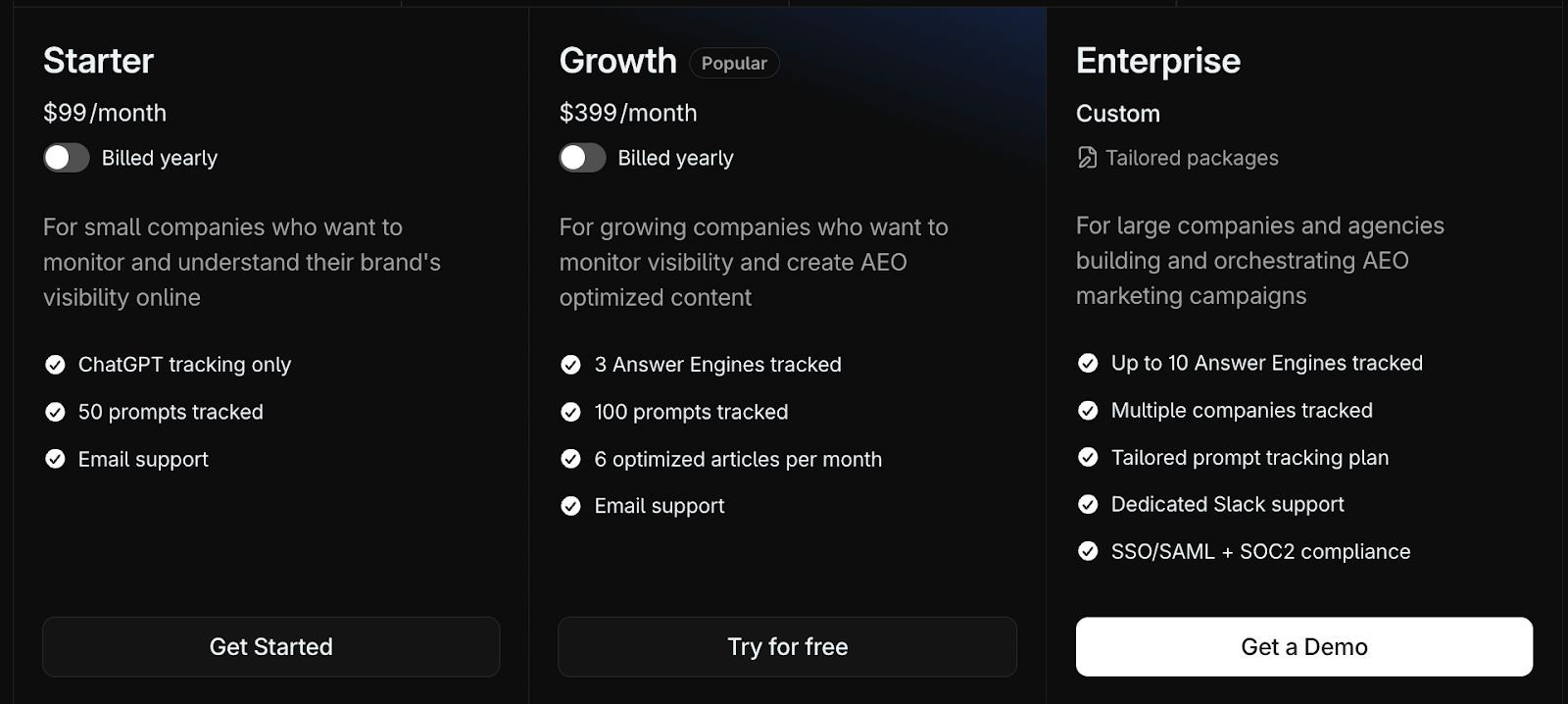
Profound's visibility plans are fixed by tier—no task-based billing on the analytics side.
Profound vs. AirOps: AI visibility insights
For AEO to work, you need data that tells you how answer engines see your brand, what’s driving that perception, and what your content gaps are.
AirOps: Surface-level monitoring
At a glance
Pros:
- Basic share of voice and sentiment is sufficient for teams at early AEO maturity who don't yet need granular data
Cons:
- No granular sentiment breakdown by product attribute, feature, or theme
- Prompt popularity score is an estimation model, not derived from real user conversations
- No citation-level tracking; no infrastructure monitoring to show which AI crawlers are visiting your site or what they retrieve
AirOps provides a basic overview of share of voice, overall AI visibility, and high-level sentiment. For teams just getting started with AEO monitoring, that's a useful directional read. But it doesn’t go deep enough to support a serious optimization strategy.
Sentiment is reported at the brand level without granularity. You can see a positive or negative score, but not which product attributes or features are driving it. Citation data follows a similar pattern: you get citation share and citing URLs, but can’t drill into which specific pages on your site are being cited for which prompts.
Prompt visibility is limited in a more fundamental way. AirOps doesn’t have access to real prompt volume data; the platform surfaces a “popularity” score, but it’s an estimation model rather than a metric derived from user conversations.
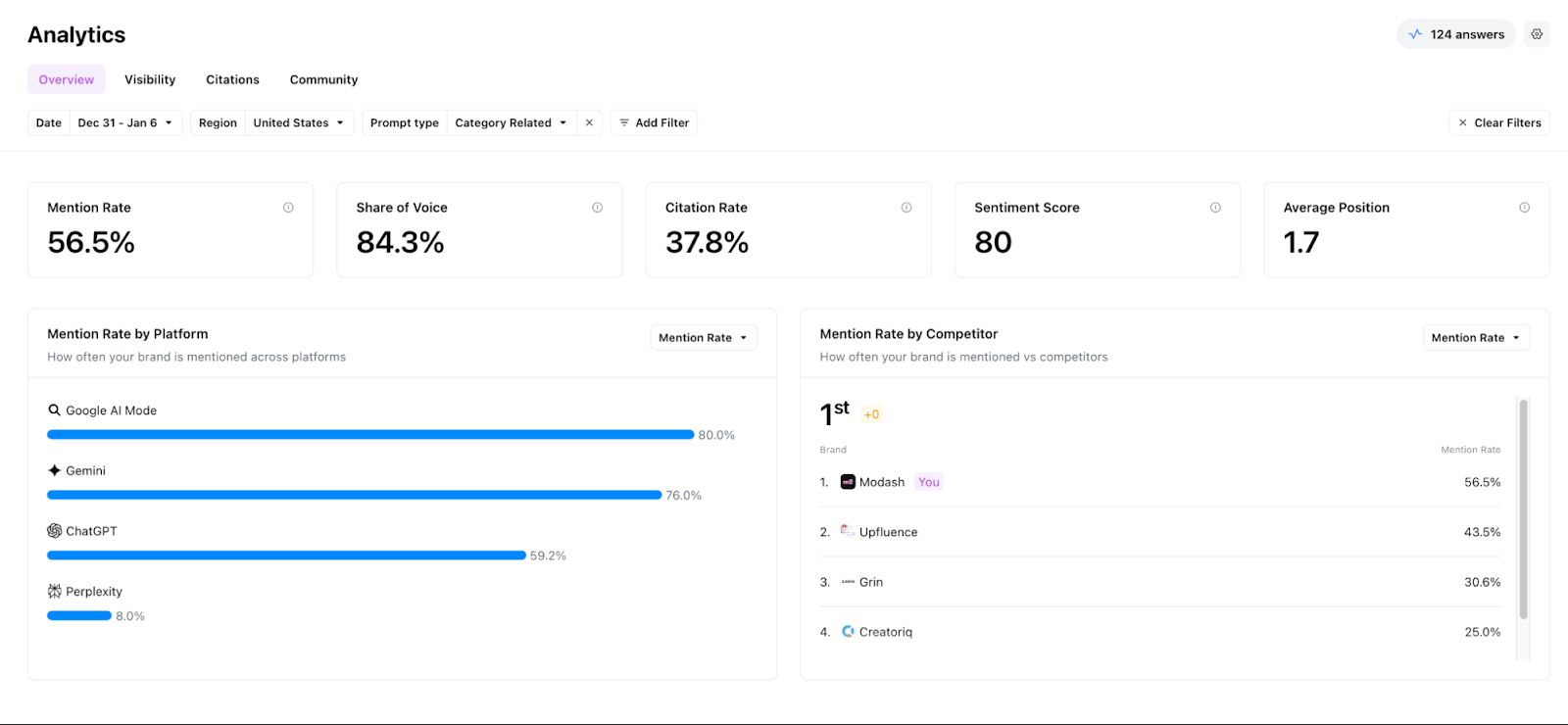
AirOps’ AI visibility dashboard with foundational metrics
Profound: The deepest AI visibility data in the market
At a glance
Pros:
- Full AI visibility metrics suite: share of voice, visibility score, citation share, ranking position, and sentiment, broken down by specific themes and product attributes
- Prompt Volumes powered by 1.3B+ real user conversations, filterable by demographics including age, income, and region
- Agent Analytics adds CDN-level crawler monitoring via integrations with Cloudflare, Akamai, AWS CloudFront, Fastly, and others—shows which AI crawlers visit, how often, and what they retrieve
- Query Fanouts Analysis reveals how answer engines decompose a single user prompt into multiple underlying queries, enabling deeper optimisation
Cons:
- The dashboard can feel overwhelming at first due to the sheer amount of data points it tracks
Profound is overwhelmingly praised by users for its comprehensive data foundation. Answer Engine Insights tracks visibility score, share of voice, citation share, sentiment, and positioning across all major answer engines, with daily data refreshes and full historical records.
Sentiment analysis doesn't cap at positive/negative. Our platform surfaces the specific themes and product attributes driving each sentiment signal, so you can see what AI is saying about your brand’s pricing, performance, or feature set.
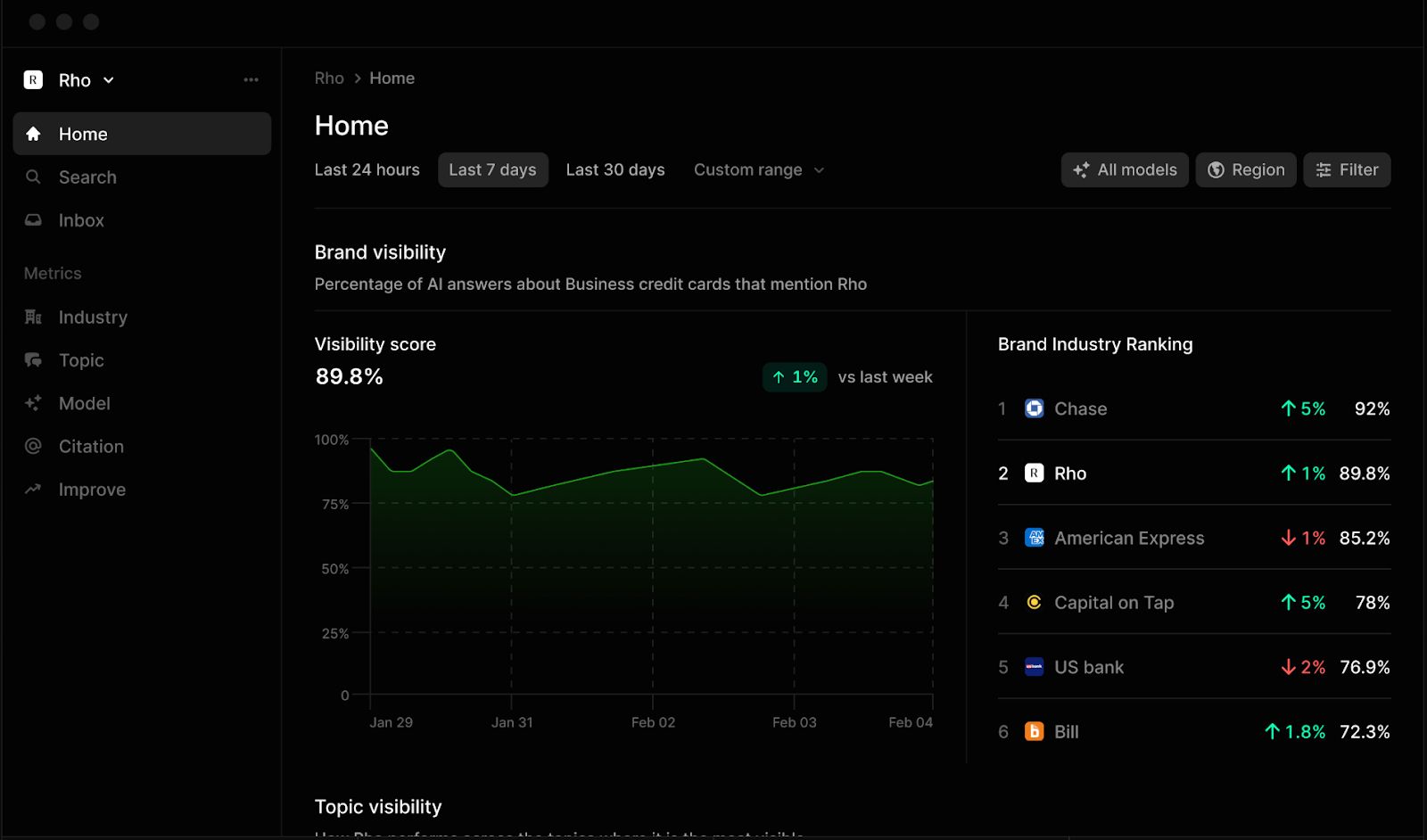
Profound tracks brand visibility over time and ranks it against industry competitors
Citation tracking is just as detailed. You can pinpoint your most-cited pages, track citations for individual URLs on your site, and identify which pages are appearing in citations for specific prompts. Prompt Volumes, powered by 1.3+ billion real user conversations, lets you filter by demographics including age, income, and region, see related prompts, and understand the intent behind what people are asking AI engines.
Agent Analytics goes a layer deeper still, with infrastructure-level monitoring via CDN integrations that shows which AI crawlers are visiting your site, how often, and which content they’re retrieving. Plus, Query Fanouts Analysis reveals how answer engines transform a single user prompt into multiple underlying search queries before generating a response, so you can optimize for what AI systems are searching.
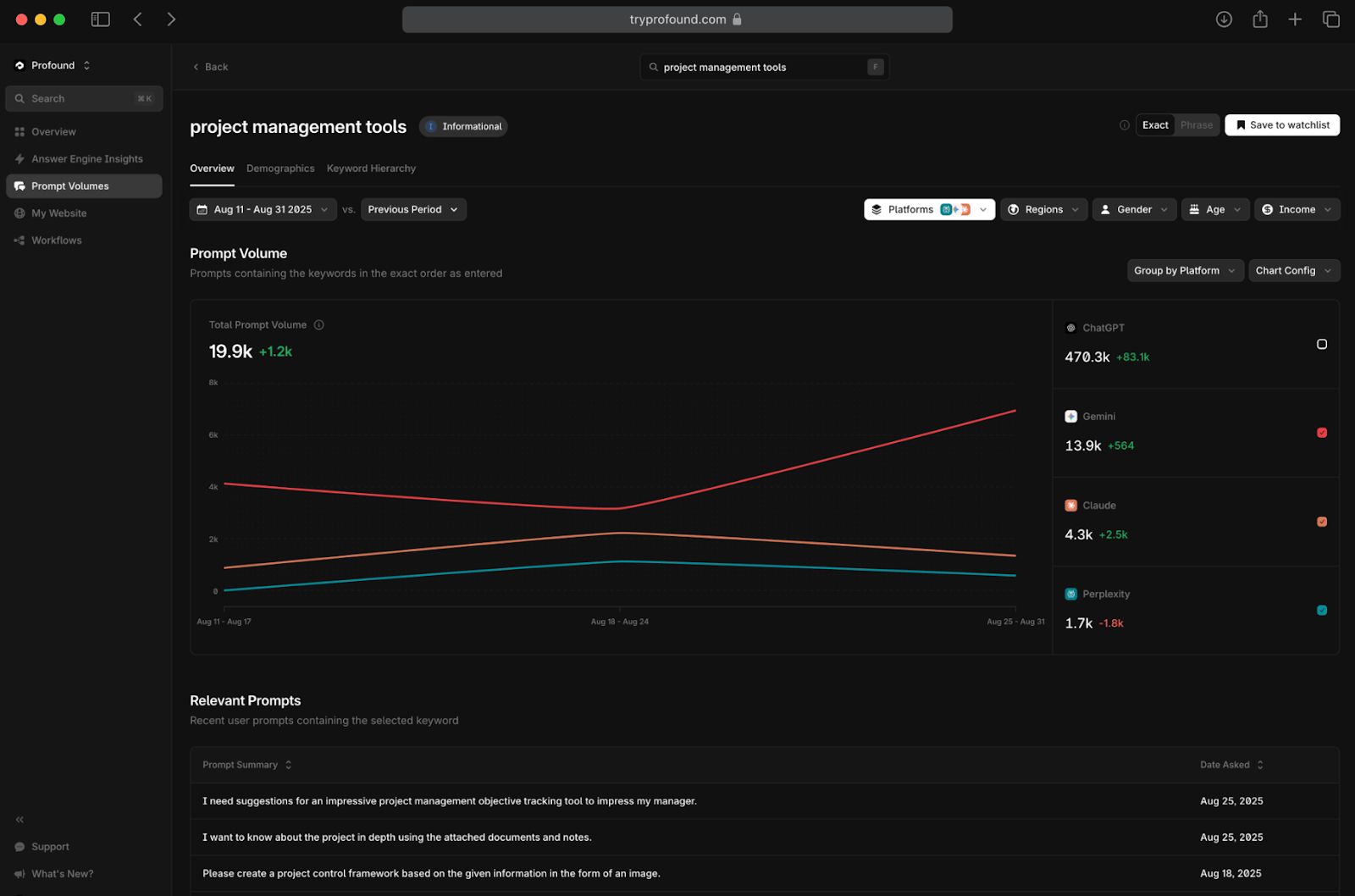
Prompt Volumes surfaces how often real users are asking about a topic across platforms and how that's trending over time
Profound vs. AirOps: Actionable recommendations
Spotting a problem and knowing what to do about it are two different things. How much each platform helps you span that distance is one of the more practical distinctions between AirOps and Profound.
AirOps: Limited context, limited actionability
At a glance
Pros:
- Content refresh opportunities auto-populate a relevant Grid workflow, providing a useful shortcut from insight to action
Cons:
- Outreach opportunities surface the issue but leave the workflow empty, with no guidance on which publication to target, who to contact, or what to write
- Single tag level for segmentation; teams with multiple product lines, regions, or business units cannot meaningfully slice insights with the precision required
AirOps organizes opportunities into subcategories—prompt gaps, declining citations, weak content, and others. For some recommendation types, like AEO content refreshes, selecting an opportunity auto-populates a Grid with a relevant workflow, which is a nifty shortcut.
For other recommendations, the experience falls short. “Mention gap” opportunities, which require outreach to third-party publications, surface the issue but leave the Grid empty. There’s no guidance on why a particular publication is worth reaching out to, who to contact, what to write, or when to act. Teams are expected to fill in the strategy themselves.
Segmentation is also constrained in AirOps. The platform only supports one tag level for filtering and analyzing data which, for businesses with multiple product lines, brands, or business units, isn't enough to meaningfully slice insights and act on them with precision.
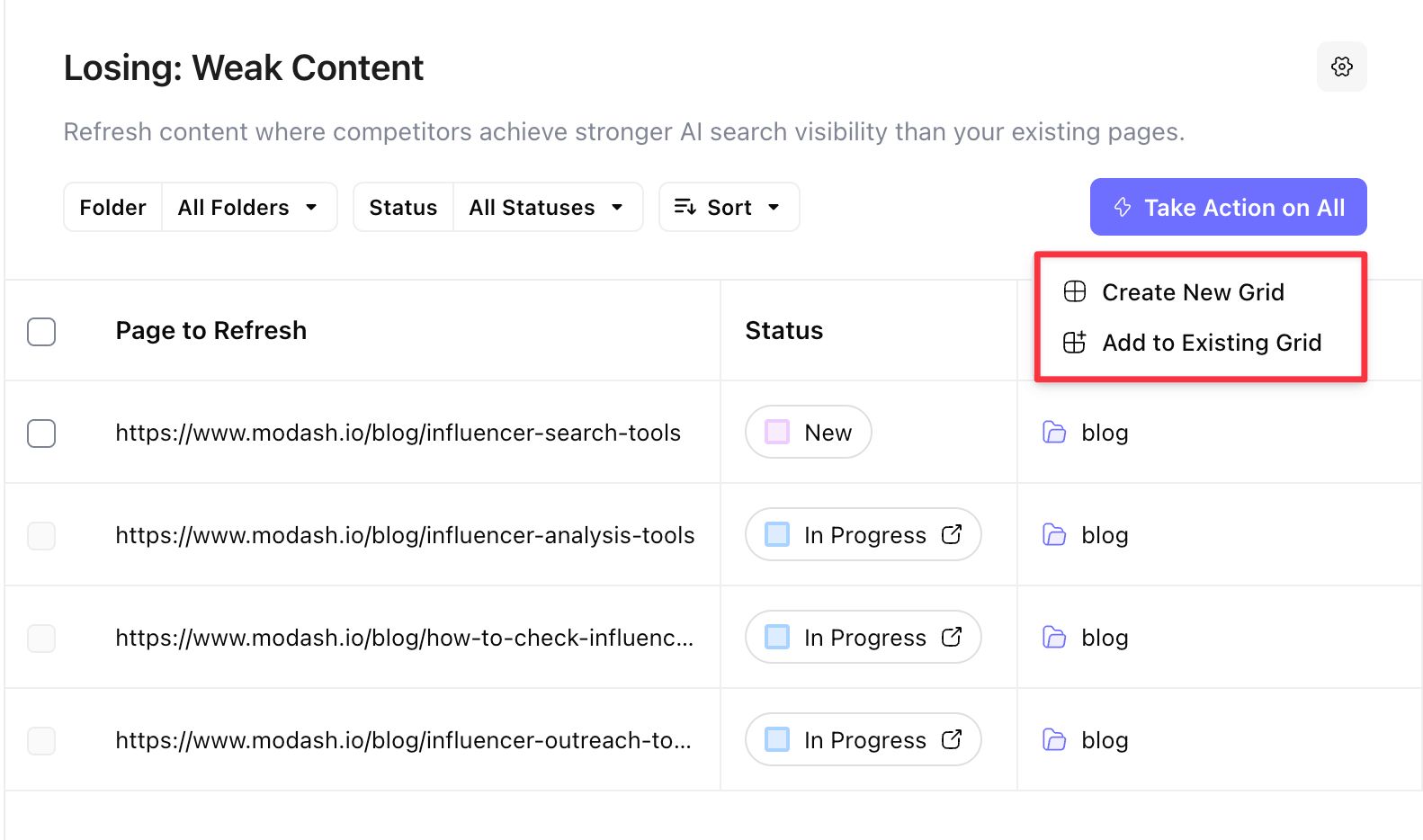
AirOps surfaces weak content opportunities and lets you push them into a Grid, but the next steps are largely left to the team
Profound: Context-rich, action-ready insights
At a glance
Pros:
- Every recommendation includes the rationale: competitive landscape around the prompt, expected visibility impact, and where you currently stand relative to cited pages
- Outreach opportunities come with drafted sample emails, suggested targeting criteria, and prioritization logic for which publications or authors to approach
- Multi-level segmentation by product line, region, business unit, or any custom dimension
- Recommendations sharpen over time: the self-learning loop feeds post-publication citation data back into the recommendation engine
Cons:
- Recommendation quality improves over time, but early on the feedback loop needs content volume to kick in—teams starting fresh don't get the full benefit of the self-learning engine until they've published and tracked enough content.
Profound’s recommendations come with the rationale built in. Each opportunity surfaces what to do, yes, but also why: the competitive landscape around the prompt, the expected visibility impact, and where you currently stand relative to the pages being cited. Users frequently highlight how instrumental these insights are, with one reviewer noting that:
“AEO felt like shooting in the dark before Profound, and now we have actionable insights that are driving real uplift.”
For outreach opportunities in particular, Profound drafts sample outreach emails, suggests targeting criteria, and explains the logic behind prioritizing specific publications or authors.
Multi-level segmentation with tags, topics, and custom filters lets you slice data by product line, region, business unit, or any dimension that is relevant to you. And the self-learning feedback loop we mentioned earlier means recommendations improve over time. As content gets created and published, our platform tracks what gets cited and what doesn’t, feeding that signal back into the recommendation engine so future suggestions are sharper.
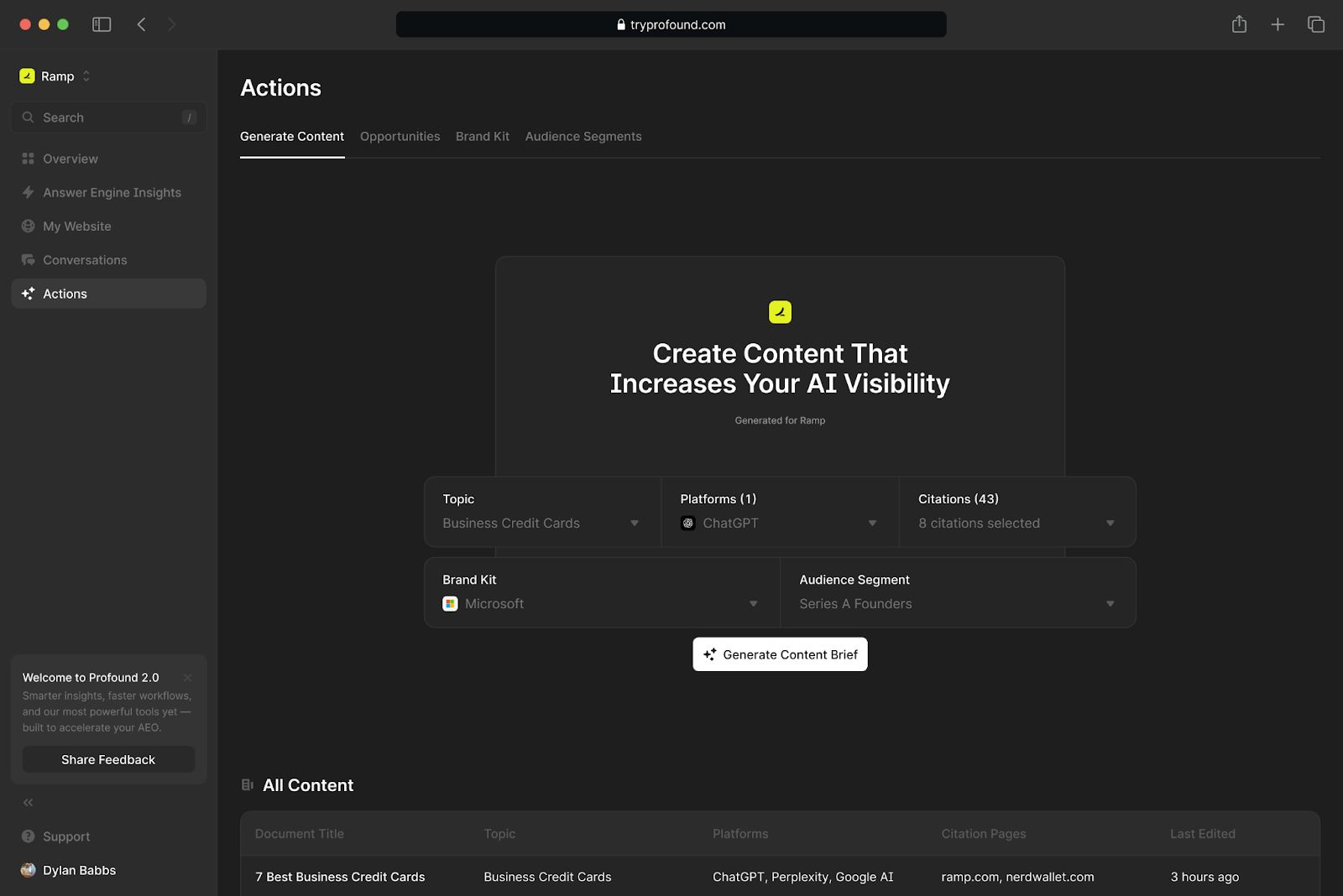
Profound's content generation is pre-loaded with citation data, platform context, and audience targeting—so the brief starts informed, not blank.
Profound vs. AirOps: Compliance and security certifications
At a glance
AirOps:
- AirOps is SOC 2 Type II certified
- There's no evidence of HIPAA assessment on AirOps’ side—for teams in regulated industries, that ambiguity alone can disqualify a vendor in procurement
Profound:
- Profound has a SOC 2 Type II certification + an independent HIPAA compliance assessment conducted by Sensiba LLP
- Profound's enterprise grade safeguards include AES-256 encryption at rest, TLS 1.2+ in transit, MFA, RBAC, comprehensive audit logging, automated disaster recovery
- Profound supports SSO via SAML and OIDC and integrations with enterprise infrastructure including GA4, Cloudflare, Akamai, AWS CloudFront, Fastly, Netlify, and Vercel
For enterprise organizations, especially those in healthcare, pharma, finance, or other regulated industries, compliance is a gate.
Profound holds SOC 2 Type II certification and has completed an independent HIPAA compliance assessment conducted by Sensiba LLP. That assessment validated enterprise-grade safeguards across the full security stack: AES-256 encryption at rest, TLS 1.2+ encryption in transit, multi-factor authentication, role-based access controls, comprehensive audit logging, and automated disaster recovery.
Profound also supports SSO via SAML and OIDC, granular permission roles, and integrations with enterprise infrastructure including GA4, Cloudflare, Akamai, AWS CloudFront, Fastly, Netlify, and Vercel.
AirOps’ compliance posture is considerably less transparent. While it claims to be SOC 2 Type II compliant, there’s no evidence of a HIPAA assessment and its associated safeguards. For teams in regulated industries running procurement reviews, that ambiguity alone can disqualify a vendor.
Profound vs. AirOps: Final verdict
AirOps is a content generation tool at its core. But the critical piece of AEO is data: on what people are asking answer engines, on how LLMs decide what to cite, and on which content earns those citations over time.
Previously, teams serious about AEO needed two platforms—Profound for data and something like AirOps for content orchestration. With Profound Agents, that’s no longer the case. You get everything in one place: the industry’s deepest AI visibility data, intelligent content creation, and a self-learning optimization loop that improves with every piece you publish.
That positioning is backed by the market. Profound has raised a $96M Series C led by Lightspeed Venture Partners, holds the #1 ranking on G2 for AEO, and is trusted by the likes of Ramp, Figma, MongoDB, U.S. Bank, and Chime, among many others.
If your team needs comprehensive AI visibility data, content creation, and automation in a single platform, Profound is the obvious choice.
Get your AEO program to new heights. Book a demo with our team.
Profound vs. AirOps FAQs
Is AirOps or Profound better for AI visibility tracking?
Profound is the stronger choice by a large margin. AirOps provides surface-level metrics like overall share of voice and basic sentiment, but lacks real prompt volume data, granular citation tracking, and infrastructure-level analytics. Profound's Answer Engine Insights, Prompt Volumes, and Agent Analytics give you a comprehensive, daily-updated picture of how answer engines see your brand.
Can Profound replace AirOps for content creation?
Yes. Profound Agents cover the same content creation and refresh use cases as AirOps, including brief generation, FAQ creation, and content optimization, but with the added advantage of being powered by AI visibility data such as AI citations and prompt data. Because Profound tracks what gets cited after publication, the content engine improves over time in a way AirOps can't replicate.
How does pricing compare between Profound and AirOps?
AirOps and Profound serve different scopes, and the pricing reflects that. AirOps is primarily a content automation tool with basic AI visibility monitoring added on top. Its paid plans top out at four to five answer engines with US-only regional data unless you're on an Enterprise contract.
Profound is a full AEO platform. Enterprise plans include 10+ answer engines tracked daily, real prompt volume data from 1.3 billion+ user conversations, infrastructure-level crawler analytics, citation tracking at the page and text-chunk level, global coverage across 50+ countries, and HIPAA compliance. Visibility plans are fixed by tier with no task-based billing on the analytics side.
For teams evaluating both, the question isn't which is cheaper. It's which platform covers what your AEO program actually needs.
Which tool covers more AI platforms, Profound or AirOps?
Profound covers 10+ answer engines out of the box: ChatGPT, Claude, Perplexity, Google AI Overviews, Google Gemini, Google AI Mode, Microsoft Copilot, Grok, Meta AI, and DeepSeek. AirOps' paid plans top out at five engines and don't include Claude, Meta AI, Grok, DeepSeek, or Microsoft Copilot. Profound also covers 50+ countries and 15+ languages, while AirOps' regional coverage is US-only unless you're on Enterprise.
Is Profound HIPAA compliant?
Yes. Profound has completed an independent HIPAA compliance assessment conducted by Sensiba LLP, validating enterprise-grade safeguards including AES-256 encryption at rest, TLS 1.2+ in transit, multi-factor authentication, role-based access controls, and automated disaster recovery. Profound is also SOC 2 Type II certified and supports SSO via SAML and OIDC.
