
QuickBooks Free was a milestone launch for Intuit, a new plan alongside QuickBooks' existing trial and paid tiers, opening the door to a broader set of businesses.
As the launch went live, the team noticed something: some Answer Engines were slow to catch up, even with new content and advertising already out in the world. One-off corrections didn't stick: the gap would close, then quietly reopen a few days later.
That experience raised a bigger question for Intuit: how do you make sure every future launch is represented accurately from day one, and how fast can you act when it isn't? That question led Intuit to Profound.
Today, more than 100 marketers across QuickBooks, Mailchimp, and Intuit Enterprise Suite run weekly monitoring from a single platform. Every campaign gets a citation baseline before launch day, and automated content workflows can take a topic from idea to a published, vetted page in a couple of hours.
About Intuit
Intuit is a global financial software company serving small businesses, mid-market companies, and consumers through brands including QuickBooks, TurboTax, Mailchimp, and Intuit Enterprise Suite. QuickBooks is a leading brand in small business accounting software, with customers across the US, Canada, UK, and Australia. Intuit's marketing and search teams operate across all four markets, managing citation rate, visibility, and sentiment for multiple distinct product lines and audience segments.
When search stopped being just Google and Bing
Intuit had always stayed on top of page rankings and organic traffic. But as more people turned to Answer Engines to make purchase decisions, a new layer of visibility came into view, one that needed new tooling layered on top of an already strong SEO foundation.
“It's not a case of just Google or Bing and trying to get rank one. Now it's all the LLMs, and we need to do things differently.”

Intuit was also launching new offerings fast, a credit card, capital products, QuickBooks Free, Intuit Enterprise Suite, each built to reach new audiences. Getting those represented accurately mattered more than ever, and Declan knew he'd need to track how they showed up in Answer Engines, not just traditional search.
“If we didn't have that insight of where we're getting cited and what's not working, then we wouldn't be present in the conversation in the ways we needed to be.”
Finding a partner built for where search is headed
As Intuit looked across the field of tools, two things set Profound apart: the pace of innovation, and the partnership behind it.
Declan wasn't just looking at what a product could do today, he was looking at where it was headed. Profound's roadmap included capabilities he didn't even know he needed yet, and that made the difference for him and the team.
“I saw a lot of strength coming from the vision, not only because of what was already available but also from what would be coming. It was really the strength of the individuals and their thinking that really sold me on this being the tool that we need. When Intuit succeeds, Profound does too. That, to me, is the essence of a true partnership.”
Making AEO part of every launch
The QuickBooks Free launch informed a new standard. Every product launch and campaign now gets its own prompts set up in Profound before the soft launch, so citation baselines are captured from day one and any shift in how AI describes a product is detectable within days.
“Profound is now a standard input in every campaign.”
When the QuickBooks credit card launched, the prompts were already queued and waiting. The team caught early performance signals, adjusted content structure, and tracked citation from launch week on.
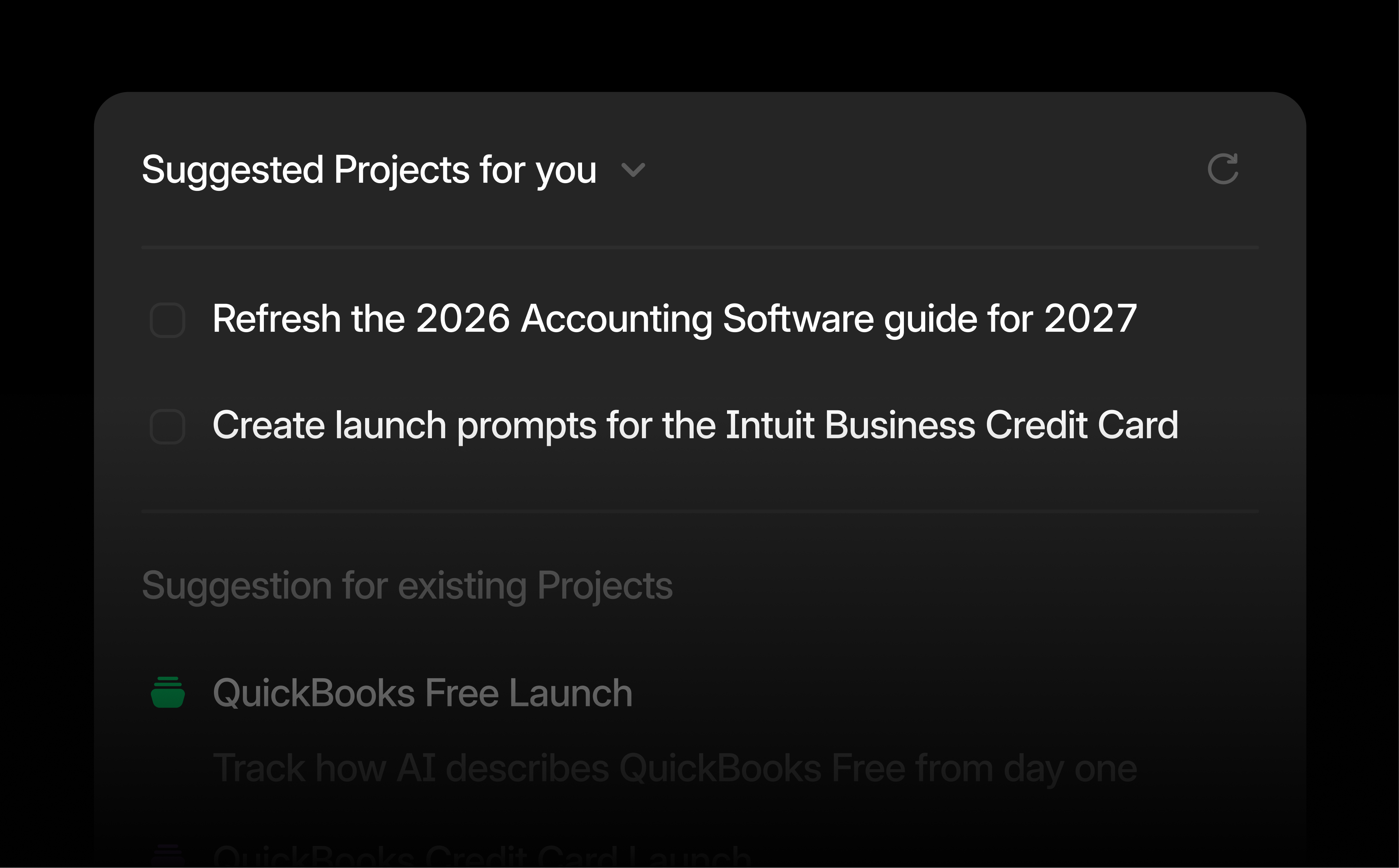
Marketers across QuickBooks in the US, Canada, UK, and Australia are in Profound, and so are Mailchimp and Intuit Enterprise Suite, with more teams on the way. That breadth reflects how many teams find value in it: brand focuses on sentiment, SEO and AEO focus on visibility, and the offsite team focuses on third-party citations.
The markets they compete in aren't easy ones. For Intuit Enterprise Suite, the team concentrated its content work and ran a site migration, tracking citation rate the whole way through. The result was an 8% to 26% citation rate in one quarter reflecting sustained growth.
Turning third-party mentions into an advantage
Beyond campaigns, Intuit's offsite team uses AI Marketer to find the third-party pages that Answer Engines cite when talking about its brands. Before Profound, there was no scalable way to see which sources Answer Engines were pulling from, let alone act on them.
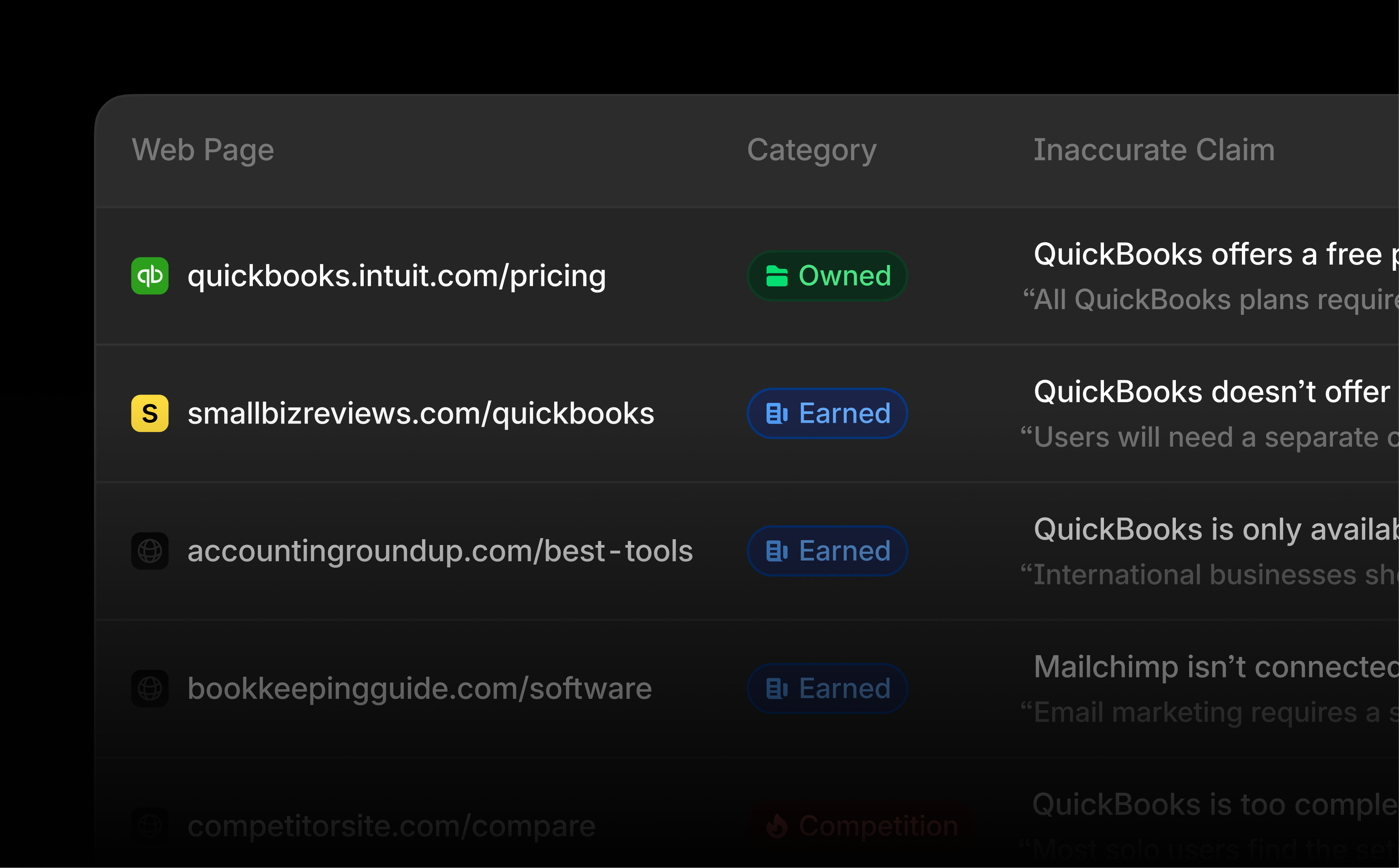
Now the team reviews each source that surfaces and responds in one of three ways: send a correction if something's inaccurate, offer support if the coverage is positive and worth amplifying, or promote third-party content that's already performing well.
“Our AI Marketer identifies which publications are being cited so we can send them a note to correct inaccuracies, or to let them know we have new information. Profound opens a door we did not have before.”
AI Marketer surfaces the opportunity and drafts the outreach, which the team reviews and sends from Profound, with PR/Comms sign-off before anything reaches a publisher. That frees the team up to spend more time on creative judgment.
Closing the gap between trend and published content
Monitoring what Answer Engines say, and what they cite, is only one layer of the strategy. Acting on it fast enough is another. This is where Intuit has gone deepest with Profound Agents.
One example: the Sentiment-triggered Agent, which monitors shifts across specific products, broken out by cohort. When a product moves significantly in either direction, the Agent surfaces relevant YouTube creators to engage and recommends a focused, product-specific next step.
Intuit is also building reactive content loops, using Agents to take a trending topic to a published piece of content in a couple of hours. The feedback loop that used to take weeks now takes hours. And when content is structured the way Answer Engines prefer (the right schema, tables, and comparative formats), citation response can come in as little as 24 to 48 hours.
“We are building reactive content loops so we can see market trends, take action, and publish within a couple of hours, including getting complete sign-off.”
Seeing who's actually crawling the site
To measure the impact of all this work, Intuit uses Agent Analytics within Profound to see how AI agents are crawling its websites across every brand. That data is being piloted as an additive input into Intuit's internal Media Mix Model, a way of measuring how much of the traffic landing on Intuit's properties comes from Answer Engine agents rather than organic search.
“We're starting to ingest bot traffic as part of our internal model. This is not a replacement for SEO traffic, but to understand what's actually coming to the site that we can map to impact.”
What's next: expanding to more business units to scale content and growth
This way of thinking and operating started in a handful of markets and product verticals, and it's informing how other teams approach the same challenge. Other teams are now exploring what QuickBooks, Mailchimp, and Intuit Enterprise Suite have already put into practice.
The goal is the same across all teams: automate the right work, move faster on what the data shows, and build the infrastructure to keep the ground they’ve won.
“We've gone from weeks to hours in how fast we can produce content and see how it performs. The more systems like that we can build, the more impact we expect to see.”