When developers ask AI how to configure MongoDB, finding the wrong answers doesn't just create a bad AI experience, it breaks workflows and erodes trust in MongoDB itself. The database platform serving millions of developers realized early that in the AI era, accuracy isn't just a nice-to-have metric, it's crucial to their customers’ success.
By treating Answer Engine Optimization (AEO) as mission-critical for serving their audience, MongoDB achieved a 50% increase in AI Search visibility while maintaining 90%+ accuracy rates.
“If an Answer Engine gives the wrong information about how to configure MongoDB, the developer doesn't have a bad experience with the AI, they have a bad experience with us.”

The data platform for builders
MongoDB is the developer data layer designed for the AI era. Built around a flexible, unified document model, it empowers developers to build, scale, and secure intelligent applications faster. Millions of developers and more than 67,000 customers across almost every industry, including ~75% of the Fortune 100, rely on MongoDB for their most important applications.
"MongoDB is the ideal data platform for builders. Millions of developers and enterprises across industries rely on us, and if AI gives them a bad answer, it breaks their workflow," explains Fiona Erickson, Team Lead, Organic Acquisition. "We knew our audience of ITDMs, Developers, and DBAs were early adopters of AI Search. So, we had to expand our audience to include the AI agents they're now collaborating with every day.”
How Answer Engines changed developer workflows
For the MongoDB team, the signal came early. They noticed that when developers asked how to get set up in MongoDB Atlas, Answer Engines were providing instruction up to basic registration, without providing any guidance on what comes next. When users sought support debugging or problem solving, the AI tools would sometimes reference out-of-date documentation. These LLMs didn’t have the latest information to properly help MongoDB users navigate the nuances of their setup.
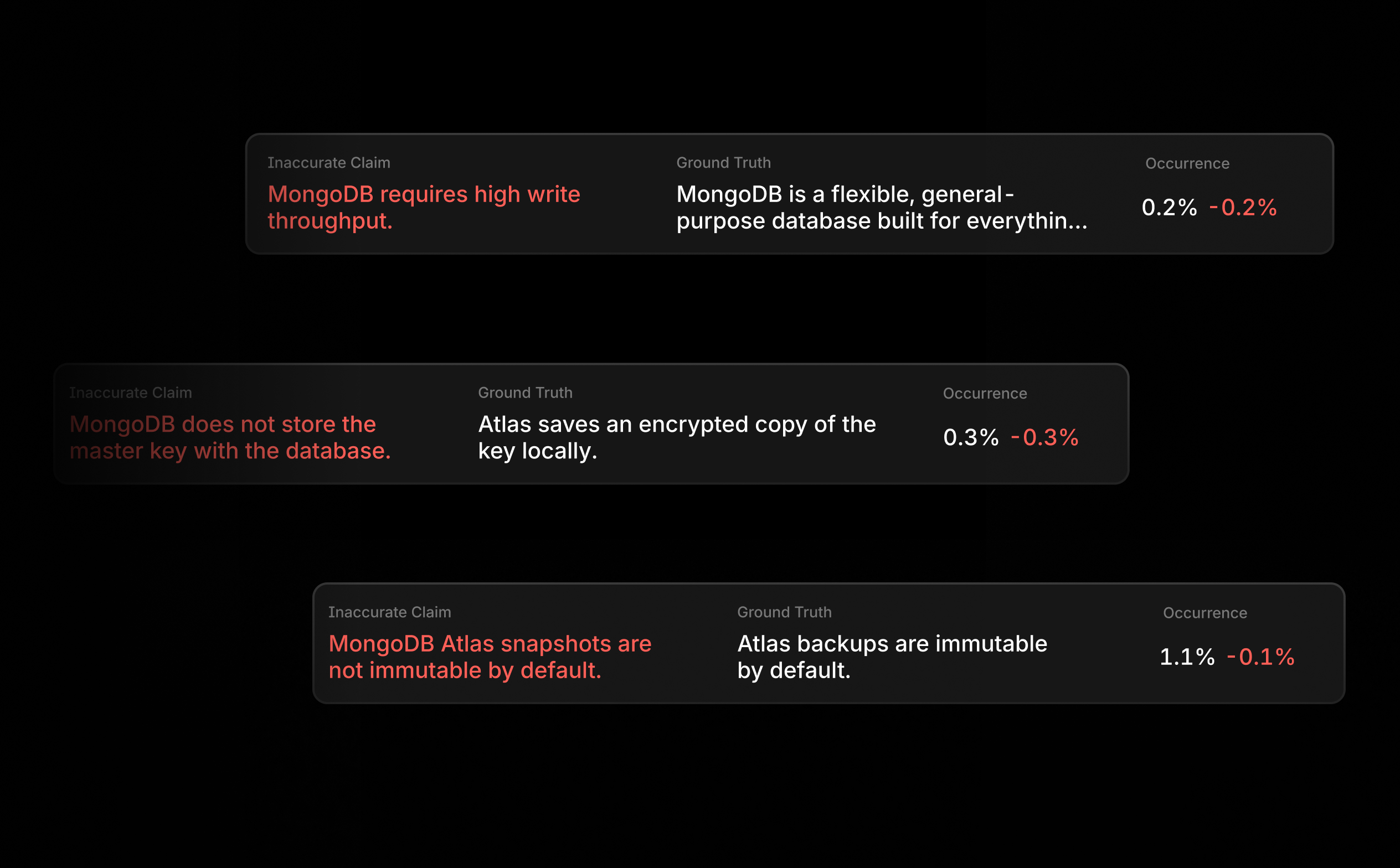
"These were critical missed opportunities to deliver for our users," Fiona recalls. These incomplete or wrong answers were breaking actual workflows for their customers.
"Honestly, it was a mix of exhilaration and complete vertigo. For two decades, traditional SEO had a very defined set of rules. Suddenly I was dusting off my data science skills, tracking multiple algorithms instead of one, building unsustainable 'DIY' measurement benchmarks just to have some data to base decisions on," Fiona explains.
Entering the next generation of discovery optimization
Before Profound, MongoDB had legacy search monitoring tools that offered basic visibility data but couldn't pull actual results from LLM Answer Engines. The insufficiency of that data led them to search for a new option.
What made Profound stand out was the scale and pace of their roadmap. For MongoDB's technically sophisticated team, the real differentiator was the depth of conversation with the Profound team.
“It was so refreshing to nerd-out in that first call with Profound; we could all be transparent about what was unknowable, what we thought was coming, discuss our speculations and educated guesses, instead of just rigidly going through their sales pitch.”
Measuring accuracy at scale
Together with Profound, MongoDB made accuracy measurable from day one.
"Profound helped us build an internal Q&A training dataset on top of their API, benchmarking LLM responses against 'gold standard' MongoDB answers for branded questions," Fiona explains. The collaboration resulted in a feedback loop where inaccurate MongoDB citations triggered flags for the content team to fix source content. Their dashboards visualized exactly how improvements in content accuracy correlated with overall visibility and share of voice.
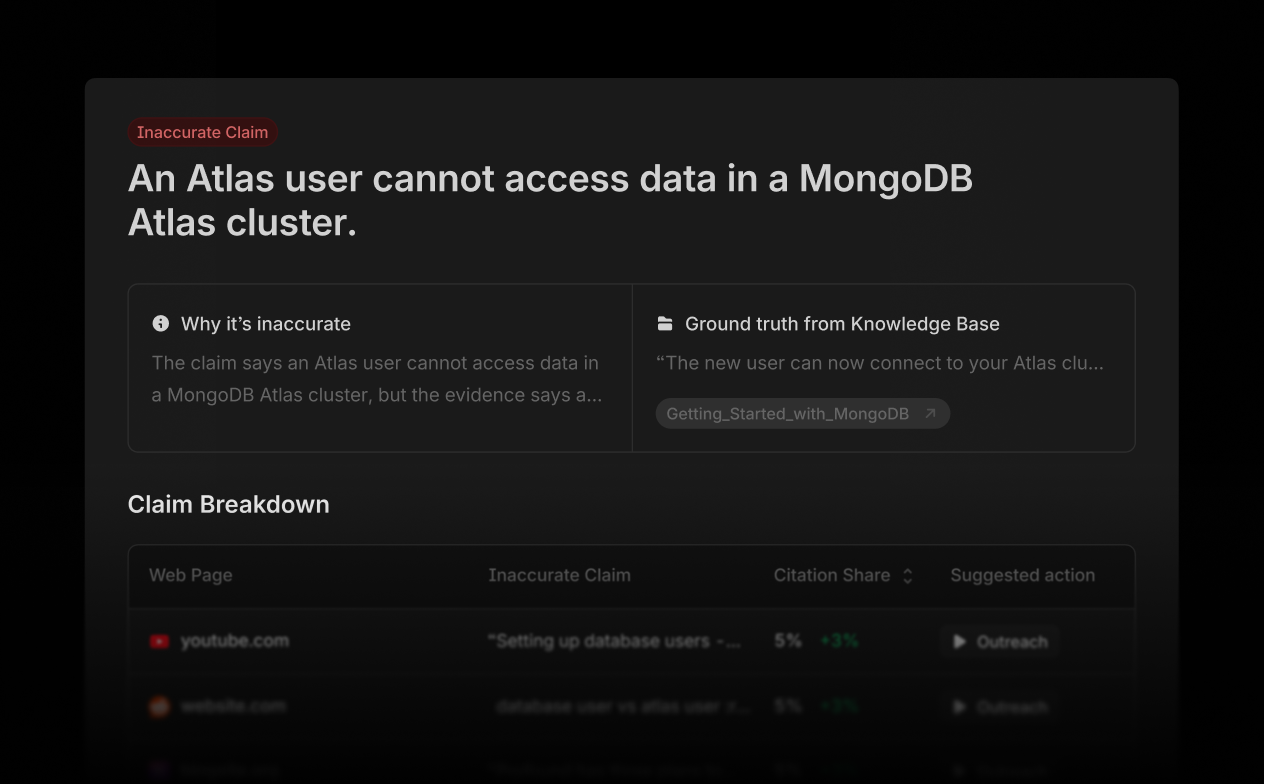
The result was that accuracy and trust in AI answers became a first-class metric, with dedicated support and extremely high standards. They achieved accuracy rates above 90% for MongoDB-related queries.
Preserving expert time with Profound Agents automation
With premium engineering talent serving as subject matter experts, MongoDB wanted to think about their time as efficiently as possible. "Our engineers’ time is expensive and their attention is finite. We can't have them hunting for opportunities manually," Fiona explains.
The team deployed two specific Profound Agents to solve this. First, a citation aggregation agent that helps report on the AEO influence of cross-functional teams (Builder Relations, SEO, PR and Community), and next, a schema markup recommendation Agent that cuts the time to update releases by almost 30%.
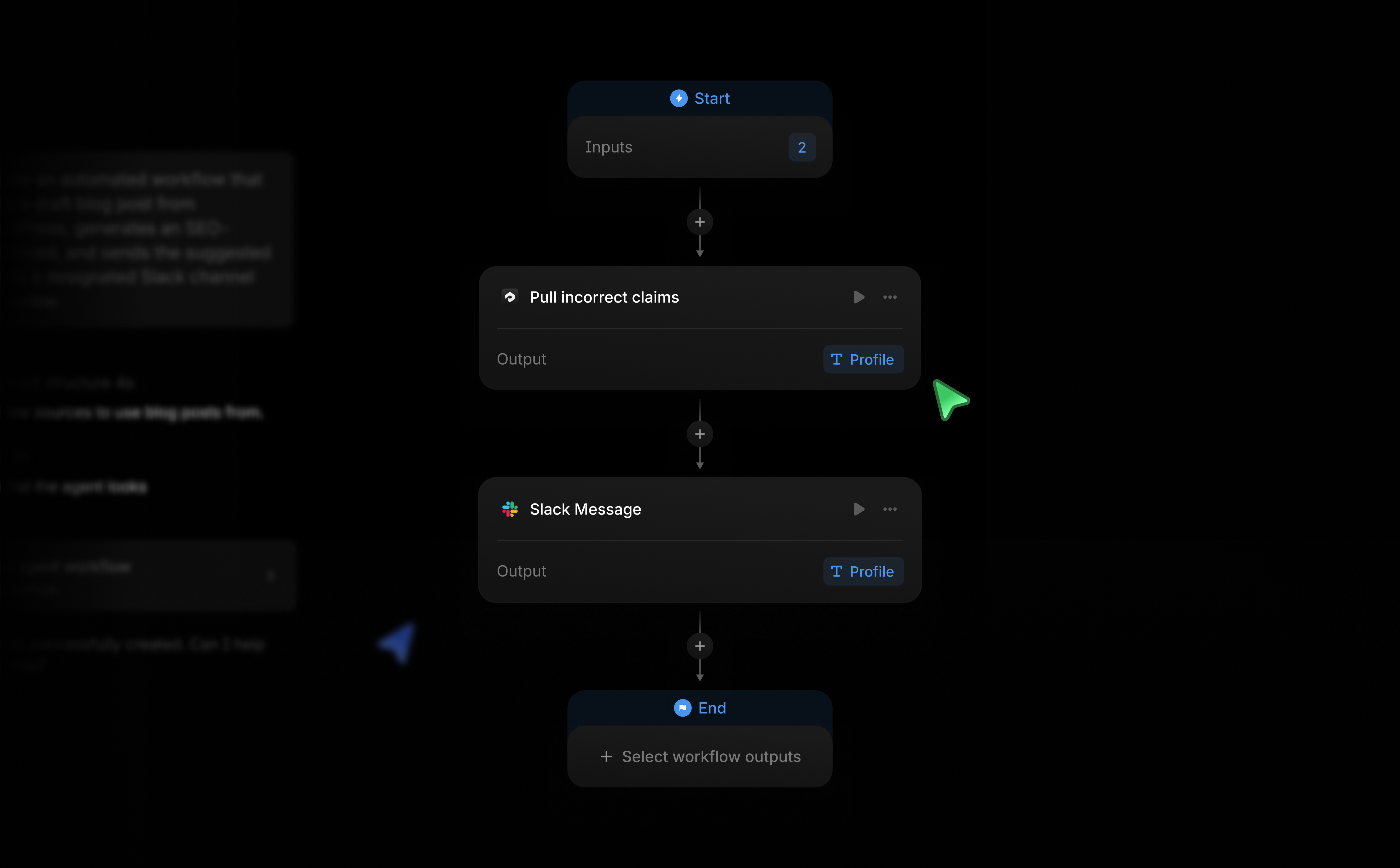
"We look to Agents to develop high quality V1 outputs that get routed to SMEs for review, reporting or implementation," she notes. "As builders in our own right, access to Profound Agents enabled us to centralize our tracking and automation in one platform, and get in on the ground floor of the tech that helps us show up for our customers."
Rapid gains in AI visibility and accuracy
Since working with Profound, MongoDB has seen a 50% increase in AI Search visibility.
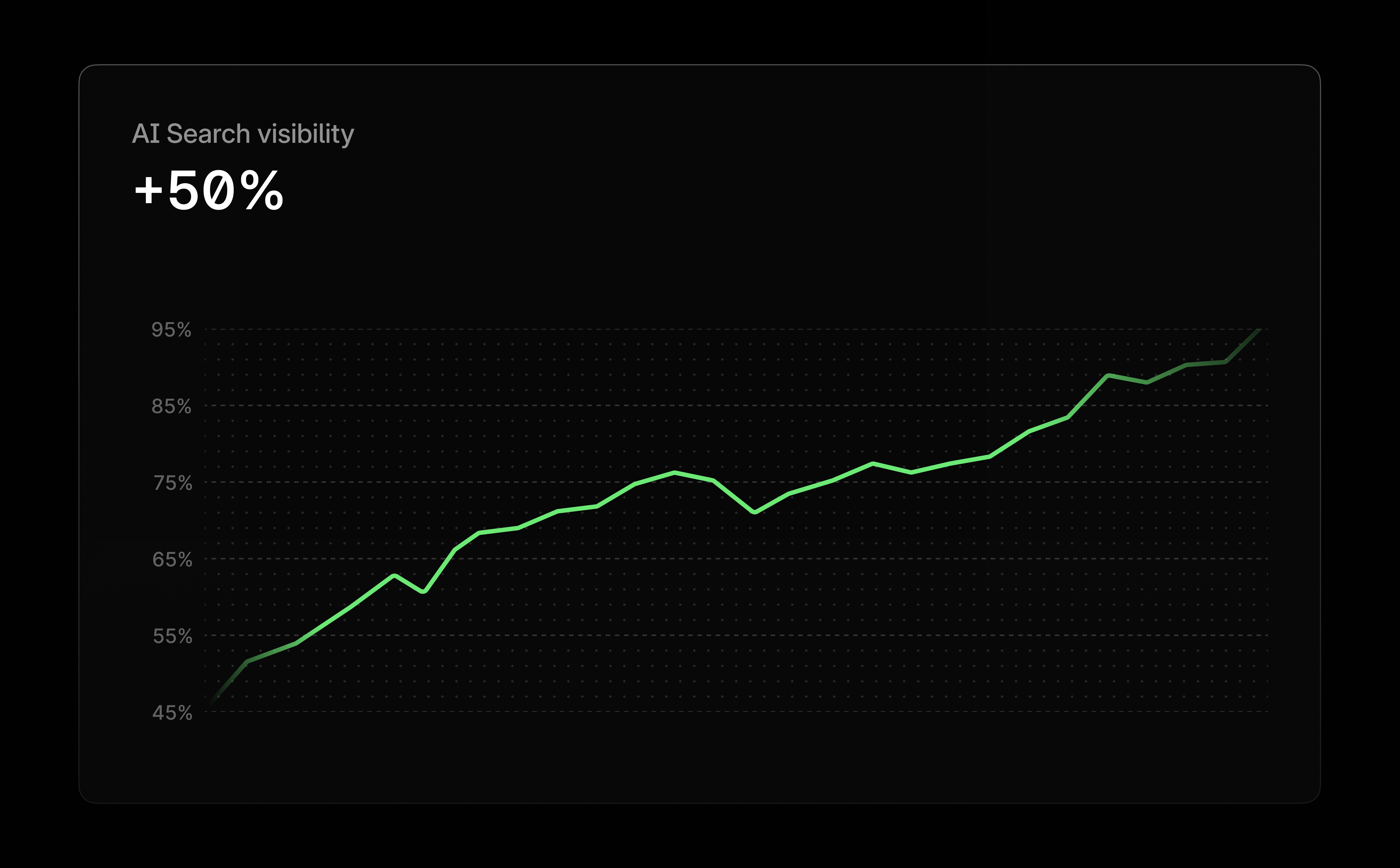
Their accuracy work delivered on its core promise: accuracy rates above 90% for MongoDB queries, meaning builders can stay in-flow getting accurate, complete answers about how to problem-solve or better leverage MongoDB without hunting through documentation.
"The same URLs and campaigns now work double-duty, feeding both the traditional Google crawler and the LLM context window simultaneously, with automation making it sustainable for our team," Fiona notes.
Preparing for agent-first development
MongoDB's AEO program continues scaling in two directions: deeper automation and broader impact.
"Deeper automation means agents that not only surface opportunities, like a key Reddit thread, but draft responses and tasks for the right owner. Broader impact means that as automation scales, we'll also free up time to broach new surfaces and scale the things that are working," Fiona explains.
The bigger vision reflects their understanding of where development is heading: "We’re preparing for a future where search looks fundamentally different. Developers don't want to hunt through documentation; they want to instruct an AI agent to write the code for them. By structuring our data to feed those agents directly, MongoDB becomes visible to the next generation of builders."
“If you are running a marketing team in 2026 and still treating AI optimization like a side project, you're already behind.”