
Many content teams optimizing for AI search are doing a slightly modified version of what they already did for Google. They've swapped keyword research tools for prompt trackers, written a few FAQ sections, and called it answer engine optimization (AEO). While plenty of those moves are right, they rarely add up to a strategy.
In this brave new world, the inputs, the gap analysis, and the content formats that earn the most visibility are different. If you understand all three, you can build compounding visibility quarter over quarter. But if you’re still running keyword logic on AI-shaped demand, you’ll likely keep wondering why the content isn't landing.
This guide covers the full picture: the objective of AI search, where the opportunities are, what to create, and how to use AI agents to automate the cycle.
What you’re optimizing for in AI search
In the traditional search era, users had to translate their intent into something the engine could parse. You didn't type "I need a moisturizer that works on dry skin, doesn't clog pores, has SPF, and won't pill under foundation." You typed "moisturizer with SPF" and filtered through ingredient lists or editorial reviews yourself.
AI took the compression out of the equation. Now, a buyer types the full, unsimplified version of their question and receives a synthesized answer. There are three forces pushing every AI search query toward the long tail:
- People ask more specific questions because they don't have to compress (see the example above)
- AI models ask follow-up questions even when people don't
- Personalization fills in context that the user never provided, shaping the answer according to what the engine learned about them
The implication for content strategy is significant. A page optimized for "accounts payable software"—the compressed version of the intent—may never appear in AI answers for "what's the best accounts payable automation software for a 50-person startup that uses QuickBooks and doesn't have a dedicated finance team?" If your content doesn't address specifics such as company size, integration needs, and team constraints, there's nothing for the engine to extract.
You’re not chasing rankings anymore. Your goal now is to be present in the full, detailed, personalized version of the questions your buyers are typing into ChatGPT & co. The content strategy that solves for that looks different from one built on keyword volume alone.
How to find content opportunities in AI search
The reflex inherited from SEO is to start tracking prompts, build a dashboard, and watch the numbers. But tracking without knowing where to look produces data you can't act on.
There are three specific inputs that tell you where your content gaps are: your current visibility in AI answers, the sub-queries answer engines run behind each user prompt, and the sources being cited for your category where you don't appear.
Find out where you aren’t visible
The foundational step is auditing which prompts you're absent from entirely. This means running your priority prompts—the questions your buyers ask at every stage of the funnel—across ChatGPT, Perplexity, Google AI Mode, and the other platforms where your audience searches, and logging where competitors appear and you don't.
This is more nuanced than a keyword rank check. In AI search, you can appear in an answer and still lose because a response can name your brand, describe it inaccurately, and disqualify it in the same sentence. So the audit isn't just binary—present or absent. It's three questions:
- Are we mentioned?
- Are we cited?
- Are we described accurately?
Ramp ran this audit in their Accounts Payable category and found their AI visibility was sitting at 3.2%. The gap wasn't in branded queries, where they showed up fine. It was in the unbranded category-level questions that their buyers were running to evaluate options—prompts like "best accounts payable software for small businesses" and "accounts payable automation tools." Those prompts were generating citations for competitors across comparison sites, review platforms, and category-specific content that Ramp simply hadn't published.
Profound's Answer Engine Insights runs this audit continuously across all major answer engines, scoring visibility, citations, and sentiment over time. The output is a running baseline that lets you track whether changes are working and report on improvement over time.
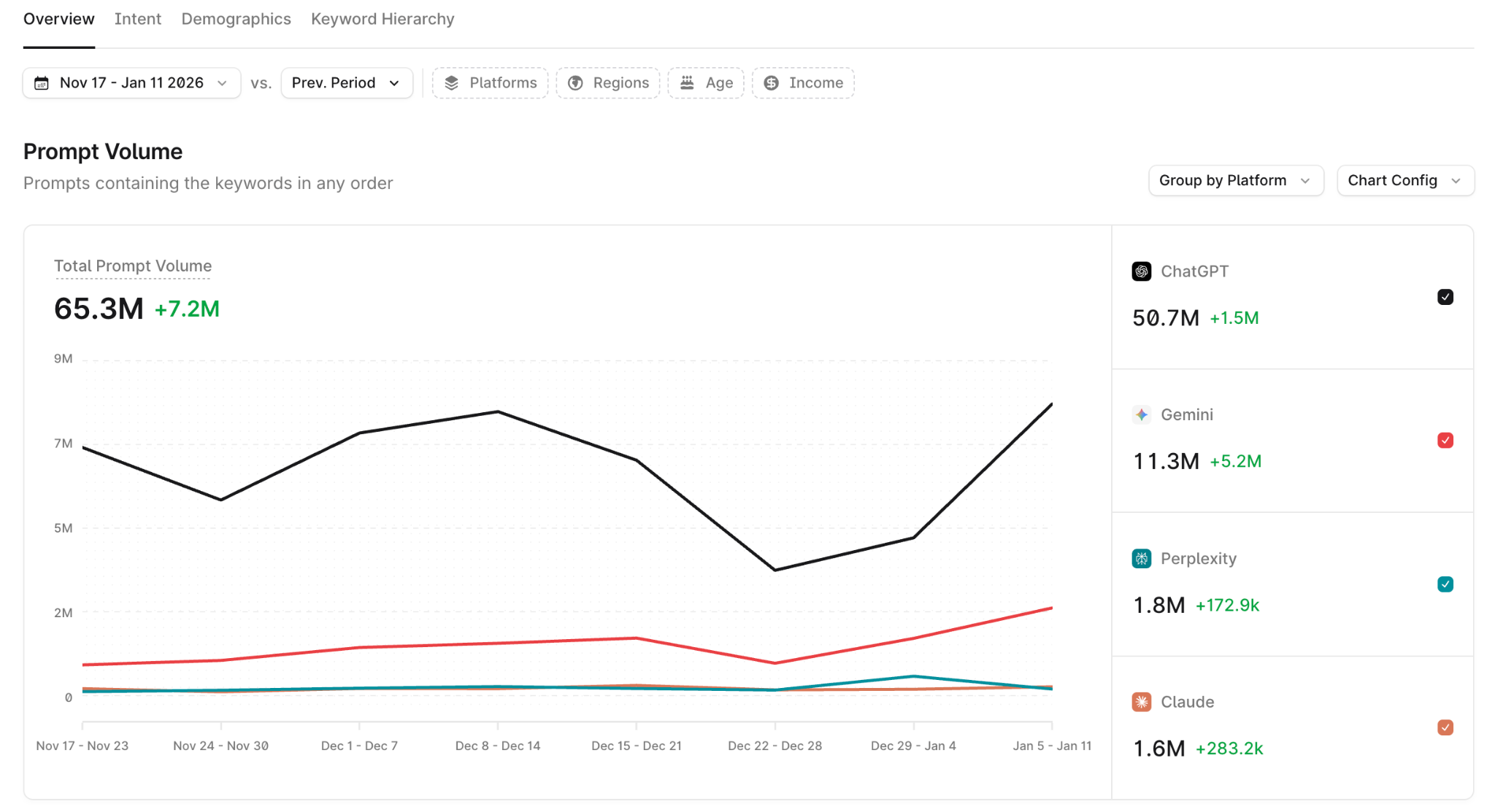
Before you can audit current visibility, though, you need the right prompts to audit against. Profound's Prompt Volumes draws from 1.5B+ real user conversations with AI engines, broken down by intent, region, age, and income. That dataset tells you which specific questions are generating conversation volume in your category—what buyers are truly asking AI, not what keyword research suggests they might.
Look at what AI retrieves
Answer engines rarely answer commercial questions from memory. Before responding, the model transforms the user's prompt into several targeted search queries, retrieves the results those queries surface, and synthesizes the results. This is query fan-out, and it's why you can publish a page that perfectly answers the user's original question and still not appear in the response.
The model didn't search for the prompt. It searched for the sub-queries it generated based on the prompt. For a user asking "which business bank account is best for startups?", the model might also run searches for startup business checking account comparisons, monthly fee breakdowns by bank, and minimum balance requirements for business accounts. A page that addresses the original question without covering those sub-queries misses the retrieval window.
Query fan-out data changes what you optimize for. Instead of targeting the surface-level prompt, you target the searches the model runs. That's a fundamentally different content brief—one that covers the subsidiary claims and comparisons the engine needs to assemble a complete answer.
Profound's Query Fan-out analysis tool exposes the sub-queries that answer engines run behind each tracked prompt. For each priority query, you can see the retrieval chain the model uses and create content that earns visibility and citations.
Discover where competitors are cited and you're not
For each of your priority topics and categories, you’ll likely notice that certain sources keep showing up in AI answers. If competitors are on them while you're not, those sources are doing influence work for someone else.
Citation gap work runs in two directions:
- The first is off-page: get added to the listicles, directories, social media threads, forum discussions, and comparison sites that AI is already pulling from for your category.
- The second is on-page: create the specific content formats that AI engines consistently cite in your category.
Profound's citation tracking operates at the individual URL level. For each prompt you track, you can see which pages are earning citations, broken down by source type.
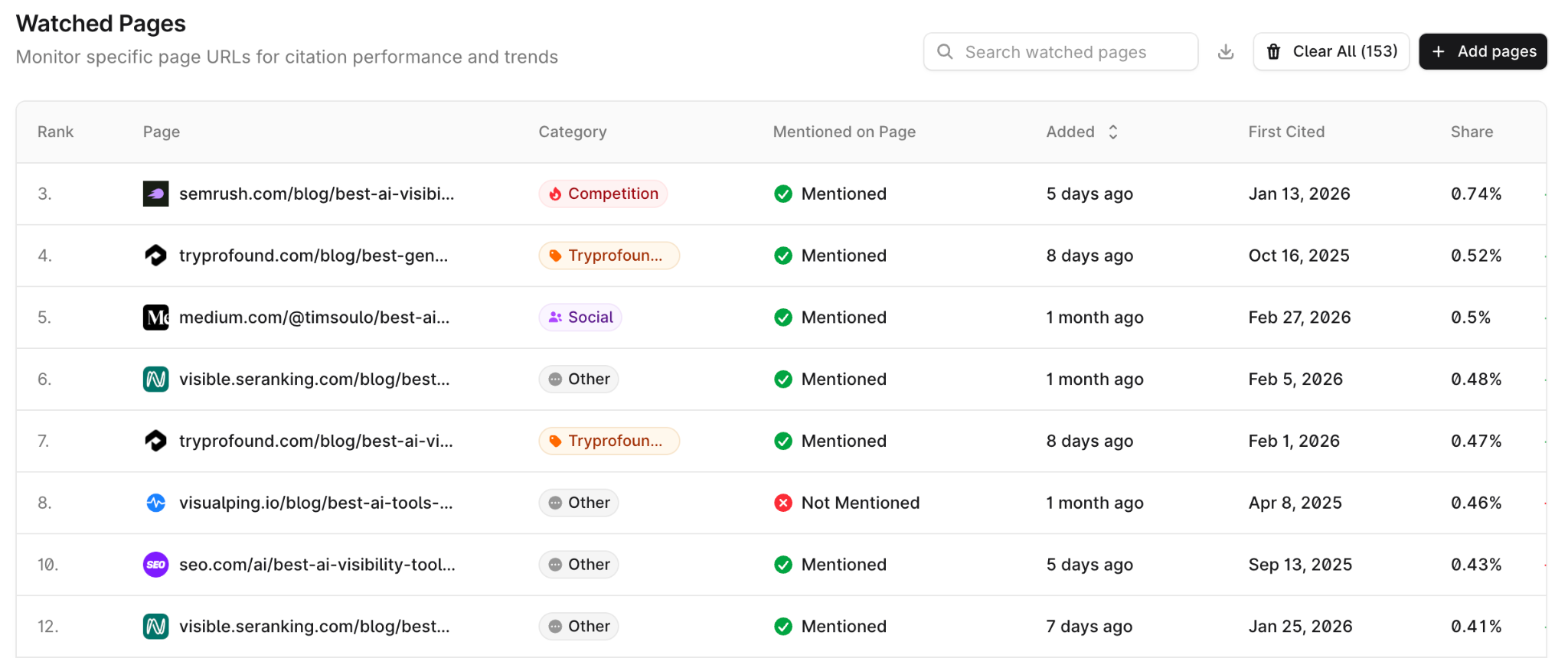
You can see whether your brand is mentioned at all in a given prompt context, which specific URLs are appearing for which prompts, and how that distribution compares to competitors. That data informs two things: what to create based on the content formats and sources AI is pulling from in your category, and where to focus outreach based on the third-party sources that often appear in answers where you're absent.
The content formats that earn AI visibility
Content that earns AI visibility has two things in common: it answers a specific question directly, and it's structured in a way that makes extraction easy.
Clear, detailed, and specific pages
The mechanism here is simple but easy enough to violate. Answer engines extract from the beginning of a section outward. A page that opens with a landscape section—"Content strategy has evolved significantly in the age of AI search"—buries the answer the engine is looking for. A page that opens with the answer—"To improve AI citation share, create one dedicated page per target prompt, open each section with the direct answer, and include specific data for every claim"—hands the engine something to extract in the first sentence.
That practice compounds across every level of the page, from the first sentence of the article to the first sentence after each subheader.
Specificity is just as relevant. Vague category claims like "enterprise-grade security," "inclusive sizing," and "flexible pricing" give answer engines nothing concrete to pull. If the content is thin, the engine fills the gap from somewhere else, and what it fills it with may not be accurate or favorable. The fix is granular: name the integrations, state the different sizes, or describe the use case with enough detail that there's no room for interpretation.
Listicles
"Best X for Y" pages earn a disproportionate share of citations for a reason: they directly match how buyers use AI to evaluate options. When someone asks, "What's the best accounts payable software for a small business?", they're asking a comparative question with the intent to decide. A page titled "Best Accounts Payable Software for Small Businesses," that addresses the small business constraint with specific recommendations and reasoning, is structurally the right answer.
Ramp published exactly these types of pages, "Accounts Payable Software for Small Businesses" and "Accounts Payable Software for Large Businesses." Within one month, those two pages generated over 300 citations and became among Ramp's most-cited content. The format worked because it matched the prompt structure, i.e., buyers asking about software for specific company sizes got a page that addressed exactly that context.
The specificity of the "for Y" qualifier impacts whether a listicle earns citations. "Best CRM software" competes with thousands of pages. "Best CRM for SaaS companies that need pipeline reporting" is a page that can own its prompt entirely.
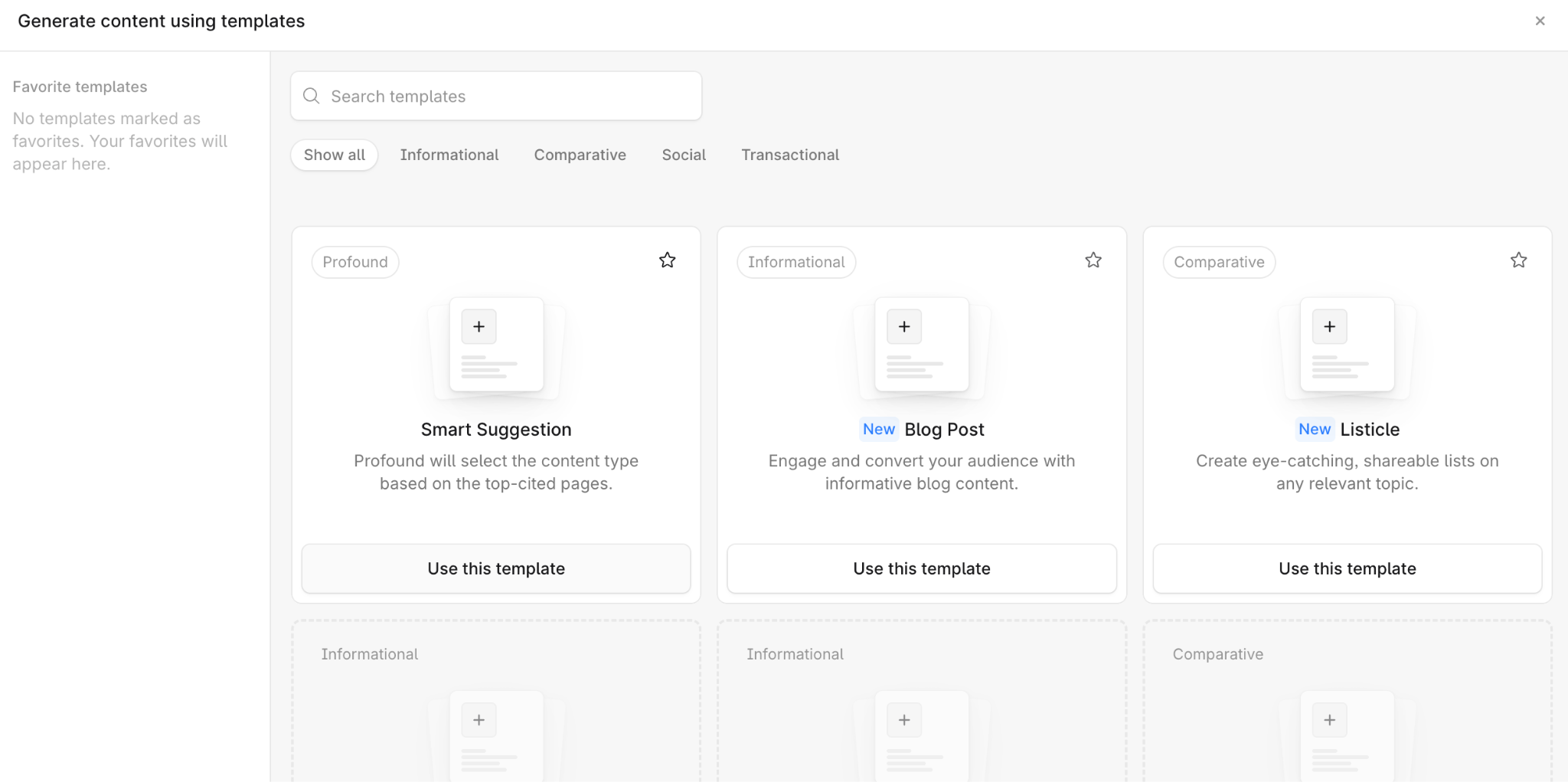
Profound Agents run the full production loop for this format (among others). Starting from Prompt Volumes data on which "best X for Y" queries are generating volume in your category, an Agent gathers the most-cited competing pages, conducts research, analyzes what those pages include and how they’re formatted, and produces a structured draft. The output is already built for extraction, with answer-first openers, specific product details, and structured comparison data.
Comparison pages
Comparative queries are among the most common commercial prompts in AI search. When a buyer is close to a decision, they ask AI to compare the options.
There are two main types of comparison pages:
- The first is the direct competitive comparison: your brand versus a named competitor, structured to address the specific differentiators buyers care about.
- The second is the neutral third-party format: competitor versus competitor, where you provide the comparison buyers want and get cited as the authoritative source in the process.
Both formats require the same structural discipline as any other AEO content, meaning specific claims over vague assertions, answer-first section openers, and enough detail that there's nothing for the engine to interpolate. A comparison page that says "Tool A is better for large teams" is extractable but not useful. One that says "Tool A supports 500+ user seats with SAML-based SSO and dedicated CSM support at the Enterprise tier; Tool B caps at 100 seats on the Business plan with email-only support" gives the engine facts to use.
Profound Agents support this format with a built-in competitive comparison template. It scrapes the most-cited comparison content in your category, analyzes the claims and structure those pages use, and produces a draft with the specificity level that earns citations.
From insight to content: Running the full AEO cycle
A content strategy for AI search has a natural architecture. Understand where you're not visible, find the prompts driving that gap, identify the citation sources you're missing, and create the content that fills those gaps. The problem a lot of teams hit is that the cycle lives in too many places—visibility data in one tool, prompt research in another, content production in a third—and the handoffs between them eat the velocity.
Profound empowers you to execute the full AEO cycle. The same platform that surfaces your citation gaps and query fan-out data also runs the content pipeline. A team using Agents typically starts in Answer Engine Insights or Prompt Volumes, identifies a prompt cluster where competitors are earning citations and they're not, and feeds that directly into an Agent as the brief. The AI Agent for content creation gathers citations, analyzes the top-performing pages for those prompts, conducts deep research, and produces a structured first draft.
Agent Analytics then tracks whether those pages are being crawled and pulled by AI crawlers and feeds that data back into the next iteration of content. This way, you're always on top of what needs refreshing—with the most current citation and visibility data automatically powering every content decision.
Curious? Book a demo to unlock the most powerful agentic marketing tool in the market.
Content strategies for AI search FAQs
How is a content strategy for AI search different from an SEO content strategy?
The core difference is the demand signal and the success metric. SEO content strategy is built on keyword volume—you identify which terms have search volume, produce content that ranks for them, and measure success by position and traffic. AI search content strategy is built on prompt data and citation patterns. The goal isn't to rank a page; it's to be cited in synthesized answers to the specific questions your buyers are running. The content formats that earn AI citations—specific answer-first pages, "best X for Y" listicles, competitor comparison pages—partially overlap with what works in traditional SEO but follow different structural principles.
Which content formats earn the most AI visibility and citations?
Three formats consistently outperform in AI search: specific, detailed pages that answer one question directly (with the answer in the first sentence of each section), "best X for Y" listicles that match the comparative intent of buyer queries, and comparison pages (both your brand versus a competitor, and competitor versus competitor). What they share is structural extractability—they make it easy for answer engines to find a direct answer to a specific question and pull it into a response.
How do I find out which prompts to target for AI search?
Real user prompt data is the most accurate input. Profound's Prompt Volumes draws from 1.5+ billion real conversations with ChatGPT, Gemini, Claude, Perplexity, and others, broken down by intent, region, and demographic factors. That data shows which questions are generating actual conversation volume in your category. Layer that with a citation gap analysis to see which of those high-volume prompts you're missing, and you have a prioritized content brief.
What is query fan-out, and why does it matter for AEO content strategy?
Query fan-out is the process by which an answer engine transforms a user's prompt into several targeted search queries before assembling its response. A user asking "which CRM is best for a 20-person sales team?" doesn't generate a single search—the model might run sub-queries on CRM pricing for small teams, CRM features for sales pipeline management, and CRM reviews for SMBs. Your content needs to surface in those sub-queries, not just match the original prompt. Profound's Query Fan-out feature exposes those exact sub-queries for each tracked prompt.
How do Profound Agents help with AEO content production?
Profound Agents connect visibility data directly to content production. You can identify a citation gap in Answer Engine Insights, pull the relevant prompt volume data, and feed that into an Agent, which then gathers citations from the most-cited pages for those prompts, conducts deep research, analyzes what makes those pages earn citations, and produces a structured draft. Agent Analytics then tracks whether published content is being picked up by AI crawlers and feeds that signal back into the next content cycle.