
You can spend weeks producing a comprehensive guide that’s well-researched, SEO-optimized, and 4,000 words covering every angle—only to then watch a random 700-word page show up in every ChatGPT response about the same category. In this scenario, the former page doesn’t underperform because it's bad. It underperforms because it's structured for a different reader.
Answer engines don't scan pages the way traditional search crawlers do. They parse. They extract. They look for the most direct, clearly structured answer to the prompt in front of them, and if your content isn't built to be read that way, comprehensiveness won’t save it.
The challenge, then, isn't creating more content. It's creating content that’s intentionally optimized for the AI search era.
How answer engines read and evaluate content
Answer engines synthesize responses from across the web. When a user submits a prompt, the engine identifies relevant content, extracts the most useful information from each source, and constructs a response. Your page either contributes to that response, or it doesn't.
The selection logic differs from search ranking in one key respect: answer engines ask, "Does this page directly answer the question?" before asking, "Is this page authoritative?" A page with strong domain authority can contribute nothing to an AI response if its content isn't structured for extraction. On the other hand, a well-structured page on a newer domain can earn AI visibility faster than it earns traditional search rankings, because extraction quality is more important than accumulated link equity.
What answer engines do when they read your page is closer to parsing than indexing. They use headers to build a structural map, identifying which section is relevant to the query, then extract from the beginning of that section outward. Content buried in the middle of a dense paragraph, or structured with context before the answer, is harder to pull cleanly. It gets left out, or it arrives in the response with less precision than a competing page that answered the same question first.
How to optimize content for AI search: 6 best practices
Most of the structural signals that determine whether your content appears in AI answers can be easily applied to existing pages. Let’s break them down.
1. Use headers that read like a natural table of contents
Headers do more work in AI search than in traditional SEO. Answer engines use them to parse a page's structure, building an internal map of what each section covers before deciding which one to extract. A header that directly signals the section's specific topic gets matched to relevant prompts. A vague header is less likely to.
A good test you can run here is reading your page's headers in order. Do they read like a natural language table of contents, the kind a reader (or an LLM) could scan to immediately know what question each section answers? If a header requires reading the section to understand what it's about, rewrite it.
The following are good examples of specific headers:
- "How to track brand mentions across ChatGPT and Perplexity"
- "What drives AI citation share"
- "Which content formats earn the most AI citations"
Compare and contrast with these examples:
- "Our approach"
- "Key considerations"
- "Background and context."
The first group maps directly to user prompts, while the second group could mean anything. This applies to H3s too. Subheadings framed as questions or direct statements are easier for LLMs to extract from than subheadings that label a concept without explaining it.
For example, a B2B software company's feature page might currently have these headers:
- "Overview"
- "Core features"
- "How it works"
- "Why choose us?"
Each is a structural label describing the type of content that follows, not the question it answers. Rewritten for AI visibility, those become:
- "What does [Product] do?"
- "What can you build with [Product]?"
- "How does [Product] integrate with your existing stack?"
- "How does [Product] compare to [Competitor]?"
The content on the page doesn't change, but the headers are doing different structural work—mapping sections to the questions a buyer would type into an answer engine.
Hierarchy is also an important consideration. Your H1, H2s, and H3s should build a coherent structural map together. An H1 that says "AI Visibility Platform" and an H2 that says "Features" tell the engine nothing useful about which section answers which question. An H1 that says "Track and improve your brand's visibility across AI search platforms" and an H2 that says "How Profound tracks AI visibility across ChatGPT, Perplexity, and Google AI Overviews" give it a specific, layered map to match sections to prompts.
2. Put the answer in the first sentence of every section
Answer engines extract from the beginning of a section outward. If a section opens with context, background, or scene-setting, the engine may never reach the answer. Or it pulls the context as if it were the answer, which is worse.
The inverted pyramid isn't new. Journalists have structured stories this way for over a century, with the most important information first, followed by context and detail. It even has a name adopted by practitioners worldwide: BLUF (bottom line up front). AI search makes it non-optional for content.
Before publishing any page, check the first sentence of each section. If it's a landscape statement (e.g., "Content strategy has changed significantly in recent years"), replace it with the answer to the question the section addresses. Context can follow. The answer has to come first.
Here's the same content written both ways for a section titled "How to improve AI citation share":
- Version 1 (context-first): "Citation share in AI search has emerged as a key metric as more buyers begin their research on AI platforms. Understanding what drives citation patterns requires examining both the content itself and the competitive landscape of who else is publishing on the same topics..."
- Version 2 (answer-first): "Improve AI citation share by creating dedicated pages that each answer one specific prompt directly. Open each page with the answer in the first sentence, back it up with specific data, and structure your headers to match the questions buyers are asking in AI platforms."
Version 1 gives the engine two sentences of context about why citation share matters, while version 2 gives it a directly extractable answer to the question the section promises to address.
This principle applies at every level of the page, not just section openers. The first sentence of the article, the first sentence of each paragraph, and the first sentence after each subheading. The pattern compounds: a page where every unit of content leads with its answer is structurally much easier to extract from than one where only the top-level sections follow the rule.
3. Add FAQs to expand the questions your page can answer
FAQ sections are structurally optimized for how AI search works. AI queries are conversational and long-tail by default. People ask full questions (e.g., "What's the best way to track AI brand mentions for an enterprise SaaS company?"), not keyword phrases. FAQ sections format content in that question-then-answer pattern that answer engines extract most cleanly.
Adding a well-built FAQ section increases the number of prompts a page can answer, as each FAQ item is an additional entry point for a different user query. A product page covering core features can answer five questions in the body copy and 15 more in the FAQ section, all pulling from the same URL, all contributing to AI visibility.
Finding the right questions is as important as writing the answers. Generic FAQ items—"What is X?", "How does X work?"—answer questions already covered by dozens of other pages, which means they're competing in the most crowded part of the AI citation landscape. The FAQs that earn the most relevant visibility answer questions specific to a buyer's evaluation context. For example, "Can X integrate with [specific tool]?", "How does X handle [specific requirement]?", "Does X ship to [specific country]?"
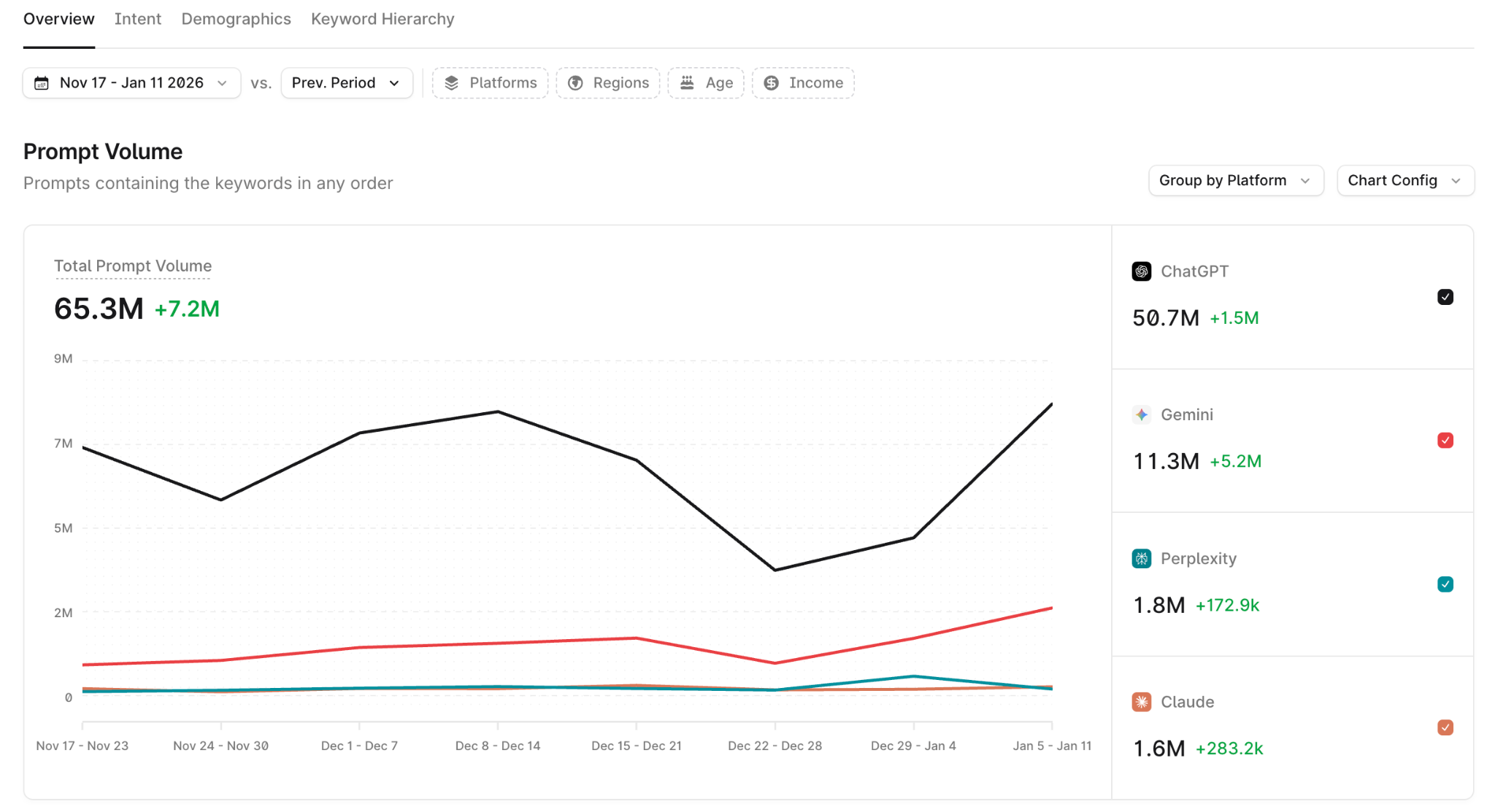
Profound's Prompt Volumes feature is the most direct research input for this work. Because it draws from 1.5B+ actual AI conversations broken down by platform, intent, and audience demographics, you can see exactly which questions real users are asking about your category and at what volume.
On answer quality, FAQ answers should be short, specific, and direct. Two to four sentences is the right length. Longer answers dilute the signal for that question; shorter ones may not include enough specificity to be worth citing.
4. Add a summary or key takeaways section to every page
A dedicated summary or key takeaways section gives answer engines a pre-packaged extraction target for your page's most important claims. The structural logic is the same as for FAQ sections: clearly formatted, answer-first blocks are easier to extract than claims buried in flowing prose. A summary section adds a second layer of extractability to the same URL—the main body covers the topic in depth, and the summary gives the engine a faster path to the same answers in compressed form. Both can earn citations for different prompts.
For a summary section to do its job, the same rules apply here as everywhere else on the page. Each point should lead with the claim, not the setup:
- "Answer engines extract from the beginning of a section outward—context before the answer gets left out or misrepresented" is extractable.
- "There are some things to know about how answer engines read pages" is not.
Each takeaway should stand alone as a direct answer to a specific question. For pages covering multiple distinct topics—feature pages, buyer's guides, technical tutorials—a summary section also serves as structural disambiguation. When an engine is matching a narrow prompt to a page, a clearly structured list of specific claims makes it faster to confirm whether your page directly answers the query.
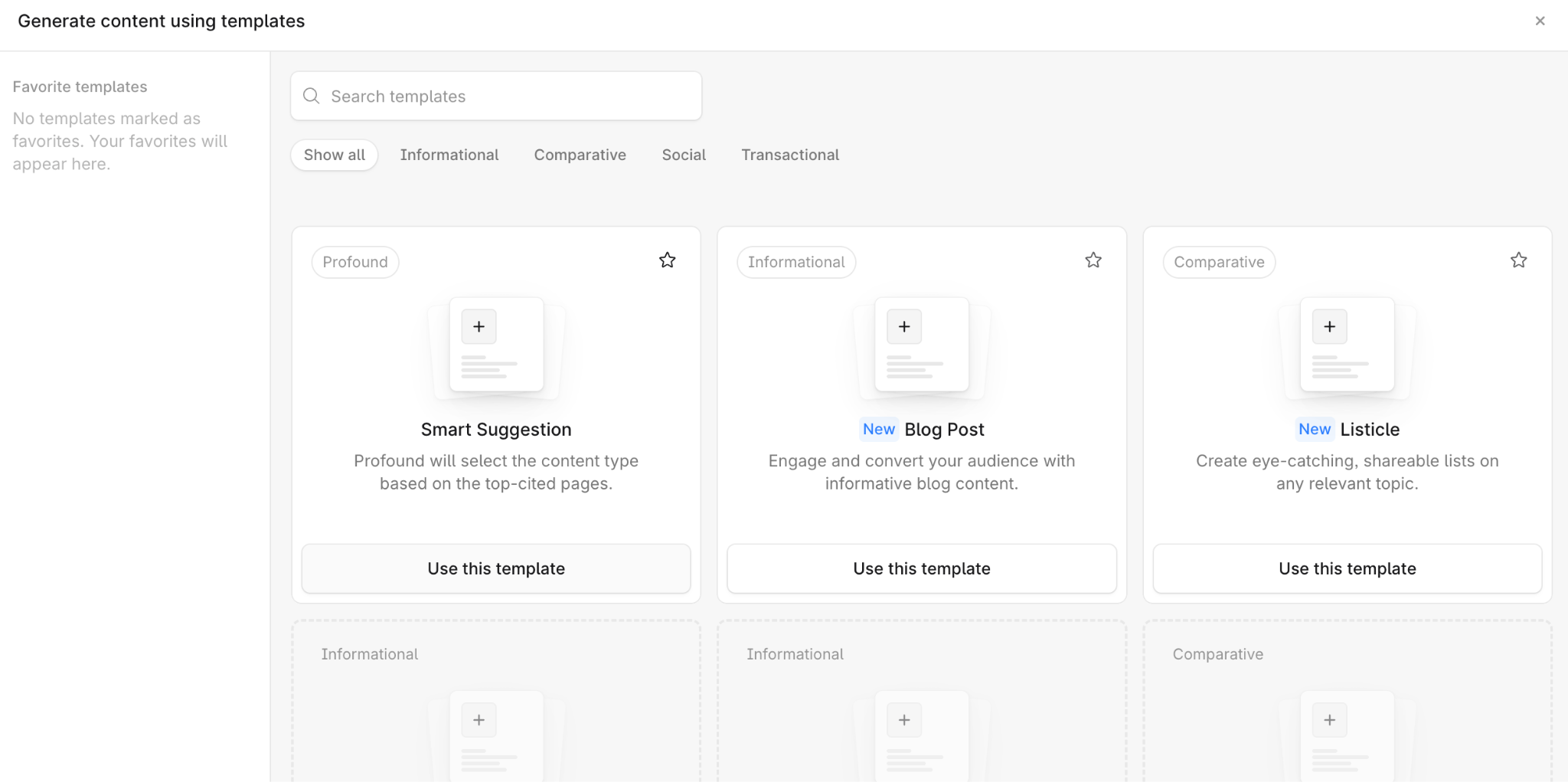
Profound's AEO Content Optimization and Content Refresh Agent templates include structured summary and FAQ blocks as a standard output, built against citation patterns from the most-cited pages for your target prompts.
5. Cite sources and be specific to signal authority
Much like Google, answer engines respond to demonstrated expertise. The structural cues that signal credibility to answer engines are the same ones that signal it to human readers: specific data, named examples, cited sources, and stated methodology.
The tactics you use to ensure EEAT are much the same as those you should apply in answer engine optimization (AEO), chiefly:
- Link to original research and primary sources rather than articles summarizing them
- Cite specific studies, datasets, reports, and experts whenever making factual claims
- Include proprietary research, survey data, or firsthand experience where possible.
- Use precise numbers, dates, and statistics instead of vague qualifiers like "many" or "significant"
- Name customers, case studies, and results specifically rather than describing them generically
- Demonstrate subject-matter expertise through detailed examples and practical knowledge
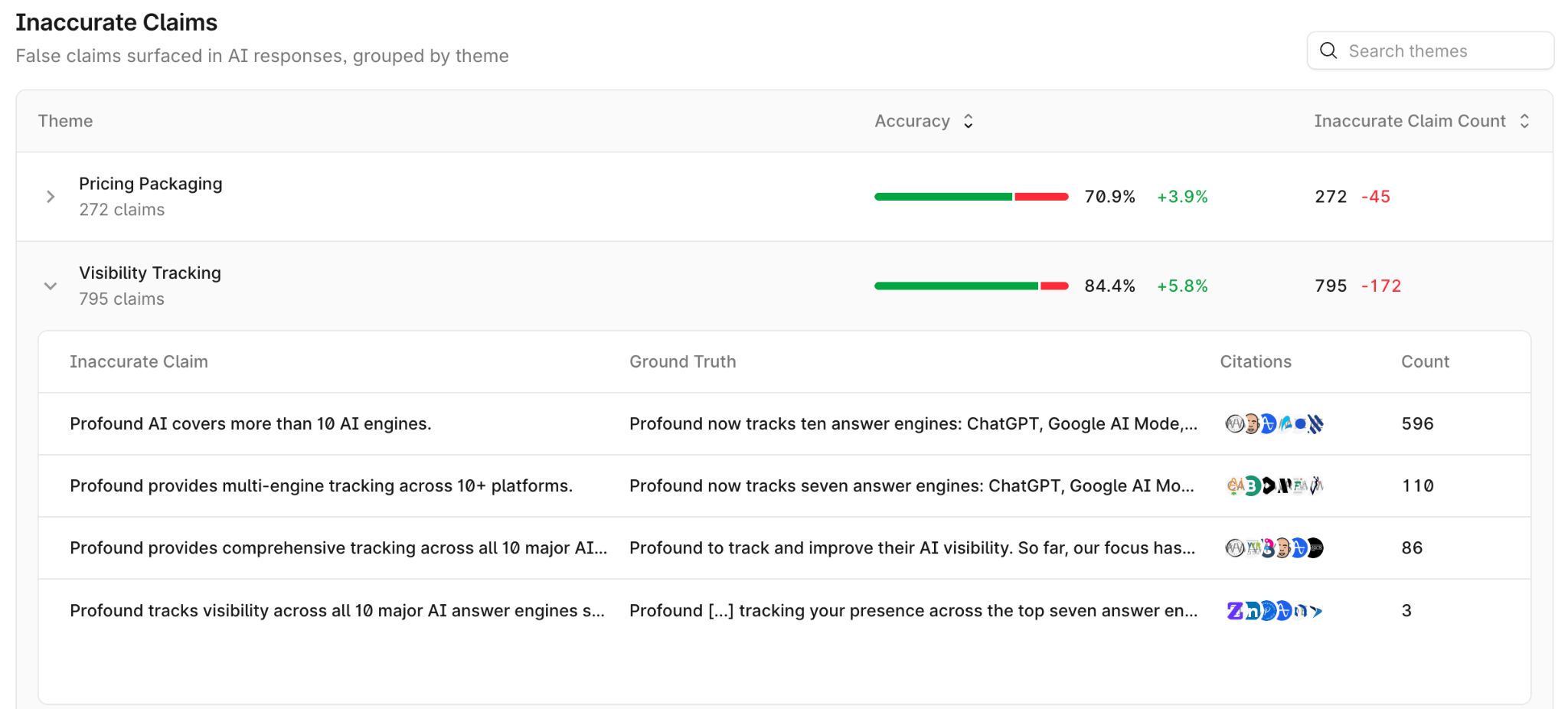
There's a second reason specificity is so important in AEO, beyond citations. When your content is vague, AI doesn't leave the question blank—it fills the gap. A page that says "our platform integrates with leading CRM tools" doesn't give the engine a fact to extract. It gives it a cue to interpolate from. The engine might name integrations you don't have, omit the ones you do, or describe the relationship in a way that sounds plausible but isn't accurate. The vaguer the claim, the more room the engine has to substitute its own answer for yours.
A page that says "Profound integrates with Salesforce, HubSpot, and Marketo" sidesteps that abgiuity entirely because there's nothing to interpolate.
Profound's FactCheck feature surfaces factually wrong AI claims about your brand, traced back to the specific pages that created the opening for misrepresentation.
If AI answers about your brand are currently inaccurate, tighten the vague content first. Running a structural optimization pass on top of a loose foundation doesn't fix an accuracy problem; it just gives the engine more surface area to get wrong.
6. Use AI Agents to bring visibility insights into content
The path from identifying which prompts you're absent from to publishing content that addresses them is where AEO programs tend to slow down. The analysis is thorough, the intent is genuine, but the production cadence doesn't keep pace with how frequently AI visibility changes.
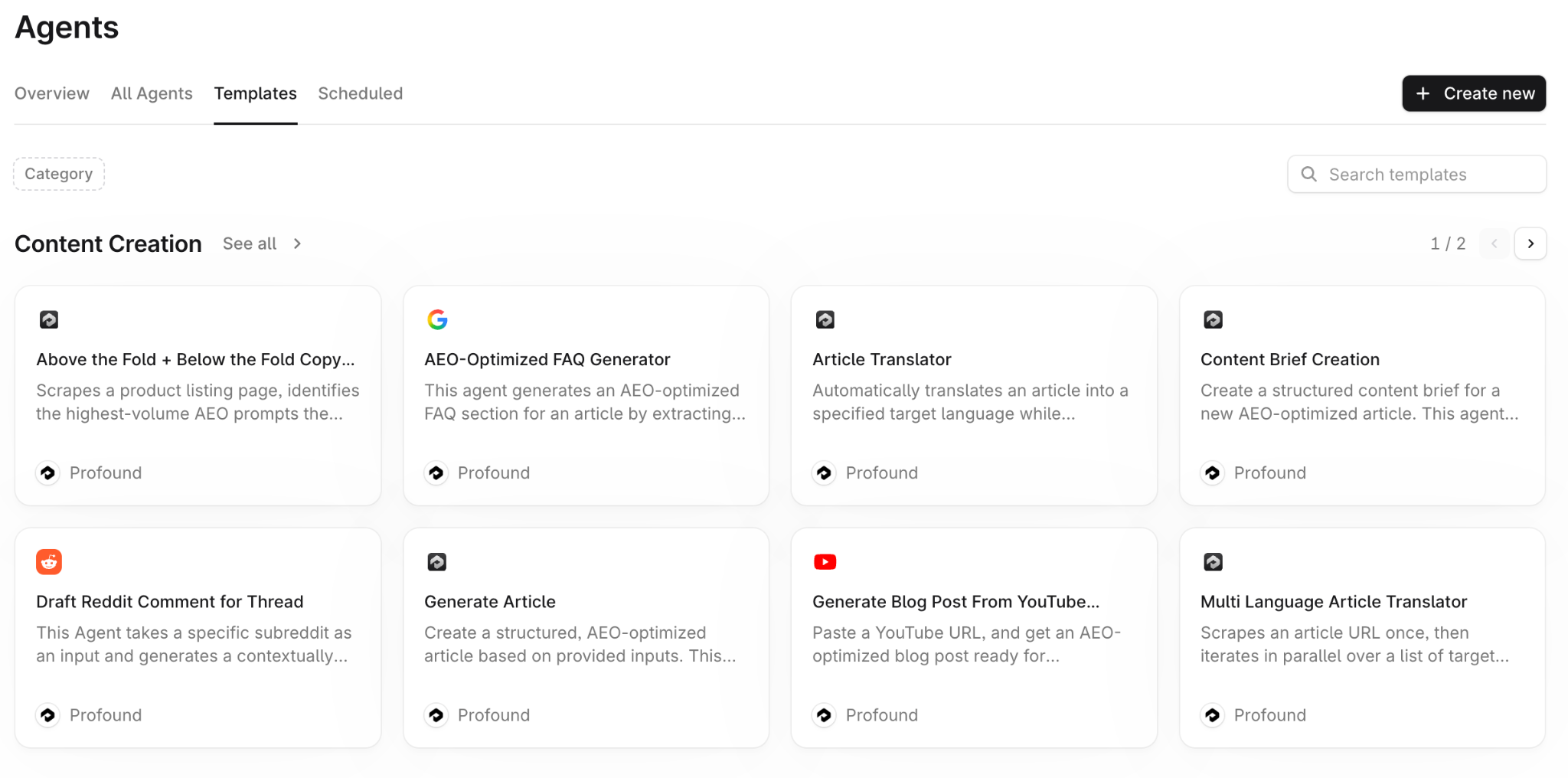
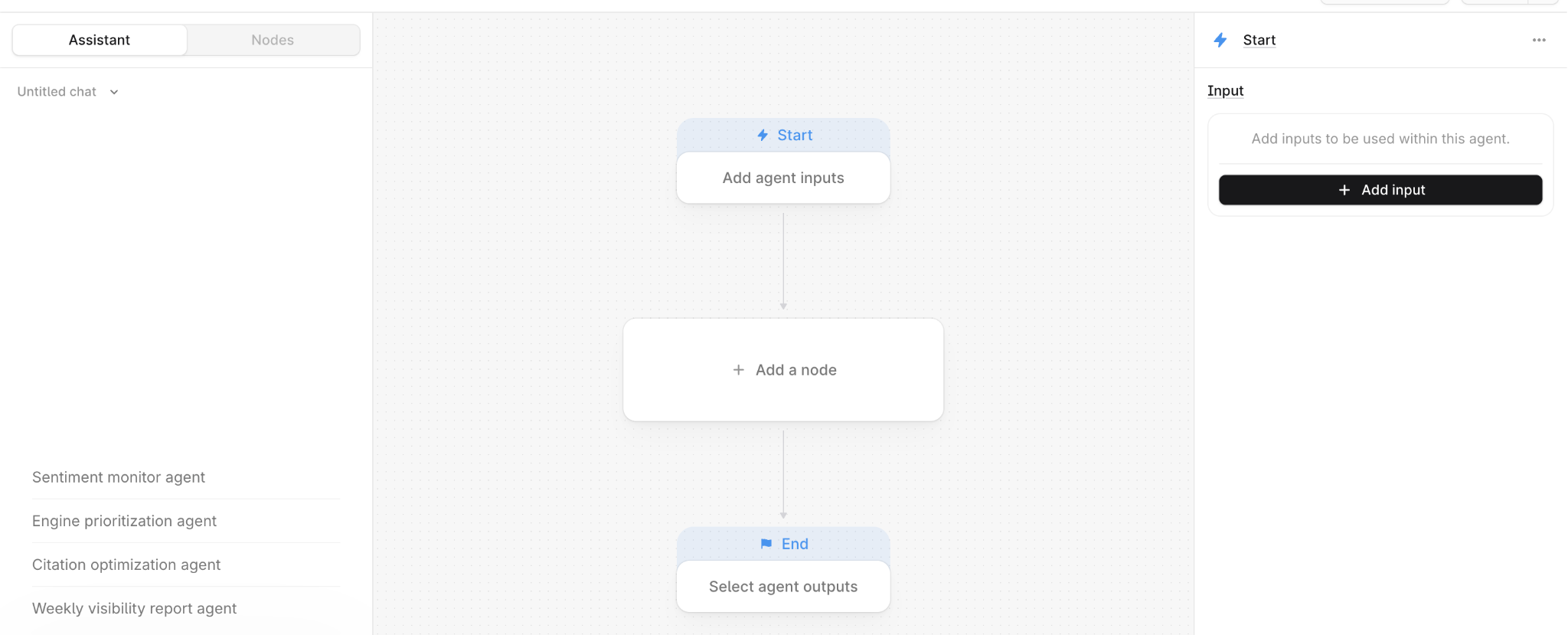
Profound Agents solve that by connecting AI visibility data directly to content production. Rather than manually auditing missing prompts, briefing a writer, then editing for AEO structure, Agents pull citation data from the most-cited pages for your target prompts, run deep research across 16+ reasoning models, and produce structured drafts built on the patterns that demonstrably earn AI citations.
Templates cover the most common AEO content jobs: FAQ Generator to expand prompt coverage on existing pages, AEO Content Refresh for pages that have lost visibility, and Content Optimization to improve structure and answer-first formatting across a content library. You can also build custom Agents using a drag-and-drop builder, without tapping the engineering team to get workflows off the ground.
This is distinct from AI writing tools in general due to the data connection. Profound Agents produce drafts informed by real citation data: which pages answer engines are citing for your target prompts, the structure of those pages, and the specific claims they make. The visibility insight feeds directly into what Agents write, rather than sitting in a dashboard while content is briefed separately.
In practice, a content team using Profound Agents runs a tight loop. They start in Profound's Prompt Volumes and visibility dashboard, identifying a prompt cluster where competitors are earning citations and they're not. That data feeds directly into an Agent as the brief input. The Agent analyzes which pages are cited for those prompts, extracts the structural patterns and specific claims those pages use, conducts additional research using supporting sources, and produces a structured first draft.
The compounding effect makes this a strategic capability. Each Agent run operates on current citation insights. As competitors publish and citation patterns shift, Agents run on fresh data, so the content output adapts to the visibility landscape in near real time.
Go from a one-off edit to a scalable AEO content program
None of these tactics requires a full content rebuild. Most can be applied in a single editing pass—rewriting headers, flipping section openers, adding FAQs, tightening vague claims. The compounding effect comes from running that pass consistently across your content library and tracking what changes in AI visibility as a result.
Profound brings everything full circle:
- Prompt Volumes shows you which questions are generating real conversation volume in your category.
- FactCheck surfaces inaccuracies in how AI answers describe your brand and traces each one back to the specific page producing the ambiguity.
- Profound Agents turn visibility gaps directly into structured first drafts—built from the citation patterns that answer engines reward.
If you want to see how your content is performing across ChatGPT, Claude, and Google AI Overviews—and what it would take to improve—book a demo to see Profound in action.
How to optimize content for AI search FAQs
How is optimizing content for AI search different from traditional SEO?
SEO optimization targets ranking signals: keyword relevance, backlink authority, technical page structure. AI search optimization (AEO) targets extraction quality: whether an answer engine can parse your page, match a section to a specific prompt, and extract a useful response cleanly. The two overlap, and a well-structured, authoritative page performs well in both. But they diverge in emphasis. AEO weights structural clarity, answer-first formatting, and demonstrated specificity more heavily than traditional SEO signals.
Should I optimize existing pages for AI search or create new content?
Both, but the sequencing matters. If you have existing pages being ignored by answer engines despite covering the right topics, start with structural optimization: rewrite headers, move answers to the first sentence of each section, add FAQ sections, and ensure every specific claim is substantiated. Create new content for prompts where you have no page at all, and build focused, specific pages rather than expanding existing guides.
How do I identify which prompts to target?
Real user prompt data is the most reliable input. Profound's Prompt Volumes draws from 1.5B+ actual AI conversations, real questions submitted by real users to ChatGPT, Gemini, Claude, and Perplexity, broken down by intent, platform, and demographic factors, including region, age, and income. That data shows which specific questions are generating high conversation volume in your category, which is a more accurate content strategy input than keyword research adapted for AI platforms.
How long does it take to see results from AEO content changes?
AI visibility typically moves faster than traditional SEO rankings. Teams publishing well-structured, targeted content often see changes in citations and visibility within days to a few weeks. The caveat is that answer engines update responses as the underlying web content changes, so visibility gains can reverse if competitors publish better-structured content on the same topics. Consistent production matters as much as individual page quality.
What content formats earn the most AI citations?
Pages structured as direct answers to specific questions earn the most consistently. That means answer-first opening paragraphs, headers framed as questions or direct statements, FAQ sections covering related prompts, and specific data and examples in place of vague generalizations. Any format that puts the direct answer first and supports it with specific evidence will outperform one that buries the answer in context.