

Executive summary
Travel planning is moving away from the traditional search bar and into AI answer engines like ChatGPT. For the better part of two decades, a typical traveler would type a destination-focused keyword into Google, open a dozen tabs, and piece together a trip on their own. Now, they ask a question or have an ongoing conversation, letting the answer engine synthesize recommendations or even book a trip.
This shift rewrites how searchers find travel brands. Visibility no longer comes from securing top-ranked blue links in traditional search. Instead, it results from earning mentions and citations in AI search. Increasingly, the brands that appear in AI search are the ones that win the trip.
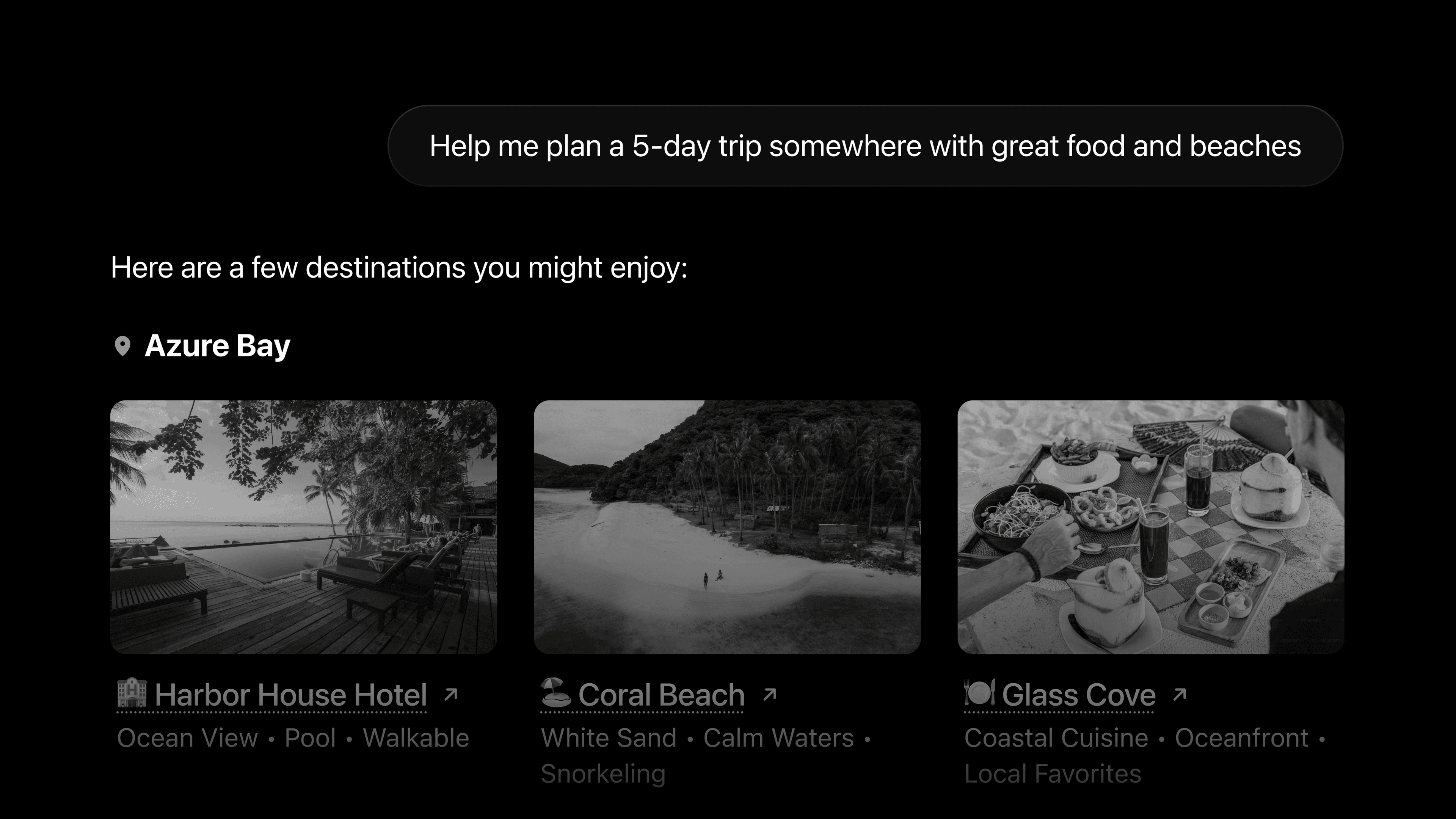
We built this report from Profound’s Prompt Volumes data to analyze what travelers ask answer engines as they plan and book trips. The prompt dataset reveals that most travelers aren’t searching for a single flight, hotel, or activity. Nearly half (48.6%) of prompts focus on general travel planning, with many asking answer engines to plan the entire trip.
Instead of compressing the traditional booking funnel, AI search often skips it altogether. Prompts cluster at the start of the journey, with 40.1% focused on travel inspiration and just 8% indicating the searcher is ready to book. For travel brands, the most impactful move is to show up during inspiration, not just at booking.
Throughout this report, we explore which travel queries dominate AI search, where they fit in the funnel, and how brands can answer them. Travelers are already rebuilding their planning habits around AI. The brands that meet them inside answer engines will earn the opportunity to shape those trips.
Key takeaways
Answer engines have replaced the search bar for trip planning
Nearly half of all non-branded travel prompts (48.6%) are about general trip planning. Travelers ask AI to design the whole trip, not just help with a single element. In this zero-click environment, answer engines often skip the booking funnel.
Many travel brands are invisible in AI search when it matters most
Most (40.1%) prompts fit in the dreaming and inspiration stage (top of funnel), while only 8% suggest the traveler is ready to book (bottom of funnel). Travel brands that optimize for the 8% end up missing the 40.1%. Travel brands should be the answer at awareness, not just at the point of purchase.
Post-purchase is a key AI search moment
After booking management accounts for 24.7% of the funnel, and post-purchase represents 25.5% of the customer journey. Booking changes (11%) and cancellations and refunds (7.3%) are major retention themes. Travel brands that spend nothing on AI-optimized post-purchase content lose customers at their most frustrated moments.
Convenience outranks price for most travelers
Convenience appears as a value driver in 81.6% of prompts, while variety of choices appears in 65.2%. Lowest price appears in only 20.4% of prompts, and 82.7% of prompts ∑don’t mention price at all. Travel brands should lead with availability and ease rather than prioritizing discounts.
Travel brands with persona-specific content can win
Budget saver is the largest identified persona at 10.3%, followed by group organizer (7.2%) and family planner (7.1%). Yet 79% of prompts leave traveler type unclassified. Most travel AI content is persona-blind. Brands that build persona-specific content libraries can win disproportionately.
What categories and topics travelers ask AI engines about
General trip planning leads travel queries by a wide margin, with nearly half (48.6%) of prompts seeking assistance with broad questions. A typical prompt asks the answer engine to plan a trip to a region, recommend the best destinations to visit, and suggest the optimal duration for the journey, or do all three at once.
Product-focused prompts are less prevalent. But among prompts that do focus on products, flight-related queries (18.9%) are more than twice as common as those that ask about hotels (6.6%), car rentals (2.1%), or vacation rentals (1.1%).
Given this breakdown, there are far more opportunities for airlines and online travel agencies (OTAs) that offer flight bookings to join the conversation. Brands that can answer common flight-related queries about managing bookings or sharing insider tips about certain planes and in-flight experiences can earn mentions in AI search.
When broken down into semantically related topics, the prompts reveal a much wider range of themes. The largest topic cluster is custom itinerary planning (18.8%), which includes prompts seeking to book specific trips and coordinate group travel plans. Prompts in this cluster tend to focus on the moment of purchase or booking.
Destination ideas and activities (16.6%) are also common. The queries in this cluster are more exploratory, with prompts primarily focused on navigating to popular activities and finding hotels in certain locations with particular amenities. Prompts that focus on these themes are much more common than queries about topics like travel packing checklists (2.5%) and travel site comparisons and rewards (2.3%).
The majority of travelers using answer engines are looking for inspiration and asking AI to compile a neat set of recommendations. Brands that successfully answer these queries with travel guides and destination tips can better position themselves to earn mentions.
How searchers phrase their travel queries
Given the prevalence of general trip planning prompts, it’s no surprise that the most common way for travelers to phrase their queries is with a “travel ideas for X” structure. Altogether, 29.4% of prompts pose broad questions that ask answer engines to analyze information and ideas across sources.
About one in five (20.9%) use a “how to manage my booking” structure when prompting AI engines as they actively look to update itineraries and confirm plans. Travelers are seeking post-booking support from trusted sources.
On the opposite side of the spectrum, however, far fewer prompts use a “best flights to X” (1.6%) or “best package to X” (0.8%) structure. Travelers are less apt to rely on AI for authoritative “best of” lists and more likely to prompt answer engines for ideas.
Travel brands can create opportunities for mentions and citations by reverse engineering the winning prompt templates and publishing content that responds to them. For example:
- Destination guides that read as idea sets rather than articles (“23 ways to do Tokyo”)
- “X for Y” articles that mirror how travelers prompt (“Peru for solo travelers”)
- Step-by-step guides to complete common post-booking tasks
- Booking, upgrade, and cancellation explainers that answer common questions
What travelers want from their AI searches
When travelers prompt answer engines for assistance with trips, their typical intent is for AI to plan the entire trip (28.1%). They tend to create ongoing conversation threads with questions about each aspect of the journey. For example, they might ask for tips to take a solo trip and then request ideas for relevant transit options.
Most other prompts focus on discovering travel options (13.6%), managing existing bookings (12.8%), and understanding rules and policies (12.3%). They might want to modify a booking, clarify if an airline allows flight changes, or search for trip options during a certain time frame.
Travelers’ question types skew toward informational (28.9%), how-to (26.5%), and recommendation (20.5%) queries. Each of these query types includes more than double the percentage of prompts about price (9.3%). Most travelers are searching for ideas, explanations, and procedures rather than promotions.
Where travel verticals fall in the customer journey
The majority of searchers using answer engines for travel purposes are in the awareness stage (37.5%). These travelers are at the top of the funnel, just beginning to explore ideas and seek information about different travel modes or vacation options. Their queries align with the activities vertical, where 69.9% of prompts relate to dreaming and inspiration.
The second-largest group is at the post-purchase stage (25.5%). They’ve already booked part or all of a trip, and they’re looking to make adjustments. For example, they may want to change seats on a flight or confirm pickup arrangements for a tour. Their queries fit with the hotels, travel account, and car rentals verticals, where the majority of prompts relate to after-booking management.
As a result, prompts related to the middle of the funnel make up a much smaller percentage. Together, queries focused on the research stage (14.7%) and the consideration stage (13.4%) make up just over a quarter of the prompt dataset. These queries tend to align with the flights vertical, where most prompts focus on shortlisting and comparison.
Prompts that reflect the decision stage (7.8%) make up by far the smallest segment. They align with the packages vertical, which is the most commercially oriented.
Overall, this breakdown neatly fits the standard funnel concept. The top of the funnel contains the most prompts, the middle of the funnel reflects fewer prompts, and the bottom of the funnel includes the fewest prompts.
Who asks AI travel questions and how they feel
Across all travel-related searches, no dominant audience personas emerge. Instead, three personas surface most often.
Budget savers are most common, with 10.3% of prompts overall. Their queries focus on booking travel with cancellation and refund options, indicating that they’re looking to minimize costs.
Group organizers and family planners are tied for second place, with each submitting about 7% of prompts. Both typically ask about travel options for multiple people. But the former focuses on group trips and getaways with friends, with queries about multiday tours and surveying friends about upcoming travel plans.
Far fewer prompts reflect luxury seekers (0.7%) or frequent travelers (1.8%). Yet these segments still have potential, indicating that travel brands can reach a relevant audience with the right content.
Across personas, the majority of travel prompts (57.8%) are curious in nature. These queries reflect that travelers are interested in information and seeking to understand travel details. As a result, travel brands should prioritize creating content for this emotional state.
Far fewer prompts reflect a confused (7%) or frustrated (4.5%) emotional state. These queries seek to confirm travel policies, cancel bookings, or process refunds.
Although they’re less common, these prompts signal important conversion and retention moments. Travel brands shouldn’t ignore these frames of mind. By optimizing content for these moments and emotions, brands can guide searchers toward a purchase, improve their travel planning experience, and even prevent negative reviews.
What drives travel planning decisions
Several factors drive travel planning decisions at a similar rate. Destination fit is most common overall, appearing in a third (33.3%) of prompts. Booking ease (30.8%) and ticket or reservation availability (29.8%) are close behind.
Although cost doesn’t surface in the top three decision factors, both price (28.1%) and total trip value (26.7%) are still relatively common drivers of travel planning decisions. Policy clarity (27.8%) and convenience (24.2%) round out the most prevalent factors.
To encourage booking and purchase decisions, travel brands should focus on these common factors. In addition to highlighting price and value, travel content should elaborate on destinations and relevant audiences, support seamless bookings, and clarify policies and procedures.
For example, destination fit prompts center on finding appropriate trips for specific destinations and dates. Booking ease prompts focus on securing tickets and reservations for certain activities and dates, while availability prompts target exploring inventory and options within set parameters.
Travel brands should also optimize for the value drivers that matter most during these decisions. Convenience is by far the most common value driver, appearing in more than three-quarters (81.6%) of prompts. Searchers are seeking readily available information about inventory and booking processes.
Additionally, variety of choices appears in nearly two-thirds (65.2%) of prompts. Searchers also perceive value from being able to review a range of relevant options.
To respond to these value drivers, travel brands should focus their messaging on these aspects when relevant. This might look like providing clear explanations and booking flows and making inventory readily available so answer engines can easily synthesize options for travelers.
In general, brands should place less emphasis on savings, rewards, and ratings. These value drivers rarely appear in prompts, which suggests that travel brands may be overinvesting in messaging centered on loyalty programs and customer reviews.
How ready searchers are to spend on travel
The majority (59.1%) of travel prompts reflect commercial intent. Searchers are actively researching and evaluating travel choices, asking questions about accommodation and flight packages and comparing available options.
Over half (52.8%) of prompts also indicate a high-value opportunity. Instead of seeking out budget options or bookings for single products, searchers are looking for packages that include multiple modes of travel and that cover multiple people.
However, about a third as many prompts (17.2%) show purchase intent. While most searchers are preparing to make a reservation or booking, far fewer are at the decision stage and ready to buy.
Travel brands can best position themselves for AI visibility by creating content that connects the two types of intent. Content should respond to commercial intent with clear information and comparisons and make it easy for searchers to purchase when they’re ready.
However, marketers should remember that most travel prompts don’t lead with pricing. Over three-quarters (82.7%) of prompts don’t discuss price, indicating that cost isn’t a primary concern for most searchers.
Of the prompts that do reflect price sensitivity, most seek deals (7.3%), put budget first (6.8%), or prioritize value (2%). Fewer than one percent (0.9%) of prompts indicate that the searcher has interest in a premium travel experience.
Branded travel content doesn’t need to optimize for price. But when it does, it should typically appeal to budget travelers. For instance, travel content might include messaging about package deals, discounts, and extras included in the standard rate.
Where the travel content opportunity lies
Altogether, the prompt dataset reveals four main travel content opportunities. Destination inspiration (36.2%) leads, pointing to an easy win for travel brands. By developing a content library with long-form travel guides that highlight activities in high-demand destinations, travel brands can best position themselves to maximize visibility in AI search.
In general, this content should target travelers at the top and middle of the funnel to align with the way searchers prompt AI. Since comparison win (16%) and informational only (13.3%) opportunities are also prominent, content should also focus on helping searchers evaluate trip options and discover travel ideas.
But travel brands shouldn’t ignore content geared toward travelers at the post-purchase stage. Retention support (23%) is the second-largest content opportunity, indicating that brands can benefit from creating content that answers policy questions and guides customers through cancellation and booking processes.
How travel brands can maximize visibility in AI search
Winning in AI search means being visible and useful across the travel planning journey. The brands that earn recommendations are the ones travelers discover early on, when the destination is still just an idea. But they don’t disappear after providing the initial inspiration. The brands that win AI search remain helpful through booking, rebooking, and every question that follows.
The tactics that worked for traditional search don’t carry over neatly to AI search. Answer engines pull from content that’s clear, accurate, and easy to parse. That means the brands that earn mentions and citations publish useful guides, itineraries, and straightforward answers rather than pages built to rank.
It’s still early. Answer engines are determining which travel brands to recommend. Brands that start publishing for this moment have a real chance to establish trust and influence AI search. Those that opt out of answer engine optimization (AEO) miss out on being part of the travel planning conversation.
But before you can develop a winning AEO strategy, you need to know how your brand appears in AI search. Profound shows how answer engines represent your brand, where you earn mentions and citations, and where you’re missing. From there, you’ll know how to improve your AI visibility, and you’ll have the tools to track trends over time.
Earn the travel AEO narrative before the competition does. Book a Profound demo.
Methodology
To create this report, we relied on data from Profound’s Prompt Volumes tool, which reveals what users ask answer engines like ChatGPT, Claude, Gemini, and Perplexity. It’s powered by anonymized, aggregated data from real answer engine users, totaling hundreds of millions of prompts per month.
We devised up to 150 keyword + instruction pairs, aligned with non-branded, topic-relevant prompts. Then, we embedded keyword + instruction pairs as vectors, matching them against real user prompts by cosine similarity.
We pulled up to 400,000 rows per keyword, keeping the top 200,000 candidates by similarity. Then, we narrowed the dataset to less than 6,000 via a Qwen3-8B GPU LLM relevance filter, using GPT-5.4 Mini to confirm each prompt was on-topic. This yielded 4,352 prompts retained for analysis. Finally, we grouped the retained prompts into semantic clusters before classification, using GPT-5.4 Mini to layer in question intent, audience persona, customer journey, decision drivers, and content opportunity sizing.