
6 Best AI agents for content creation, reviewed [2026]
An AI marketing agent isn’t a writing assistant with a nicer UI. It’s a system that takes a goal, breaks it into steps, and executes them across tools without a human driving each one. Applied to content, that means the difference between a tool that helps you write faster and a tool that runs the pipeline from “we have an AI visibility gap” to “the page is live, and earning citations.”
Not every tool in the market clears that bar the same way. Some are genuinely agentic end-to-end. Some are excellent at one stage—usually recommendation or drafting—and hand the rest back to you. A few carry the word “agent” mostly as marketing.
This guide sorts out the top AI agent contenders in content creation: what each one does, what you’ll like, and where it falls short.
1. Profound
Best for
- Enterprise SEO, AEO, and growth teams looking to automate the entire monitor-to-execution pipeline for AI search presence
- Content leaders who want autonomous sub-agents generating ready-to-publish, heavily cited content
- Mid-market and enterprise brands requiring an always-on system to intercept and win competitive AI prompts
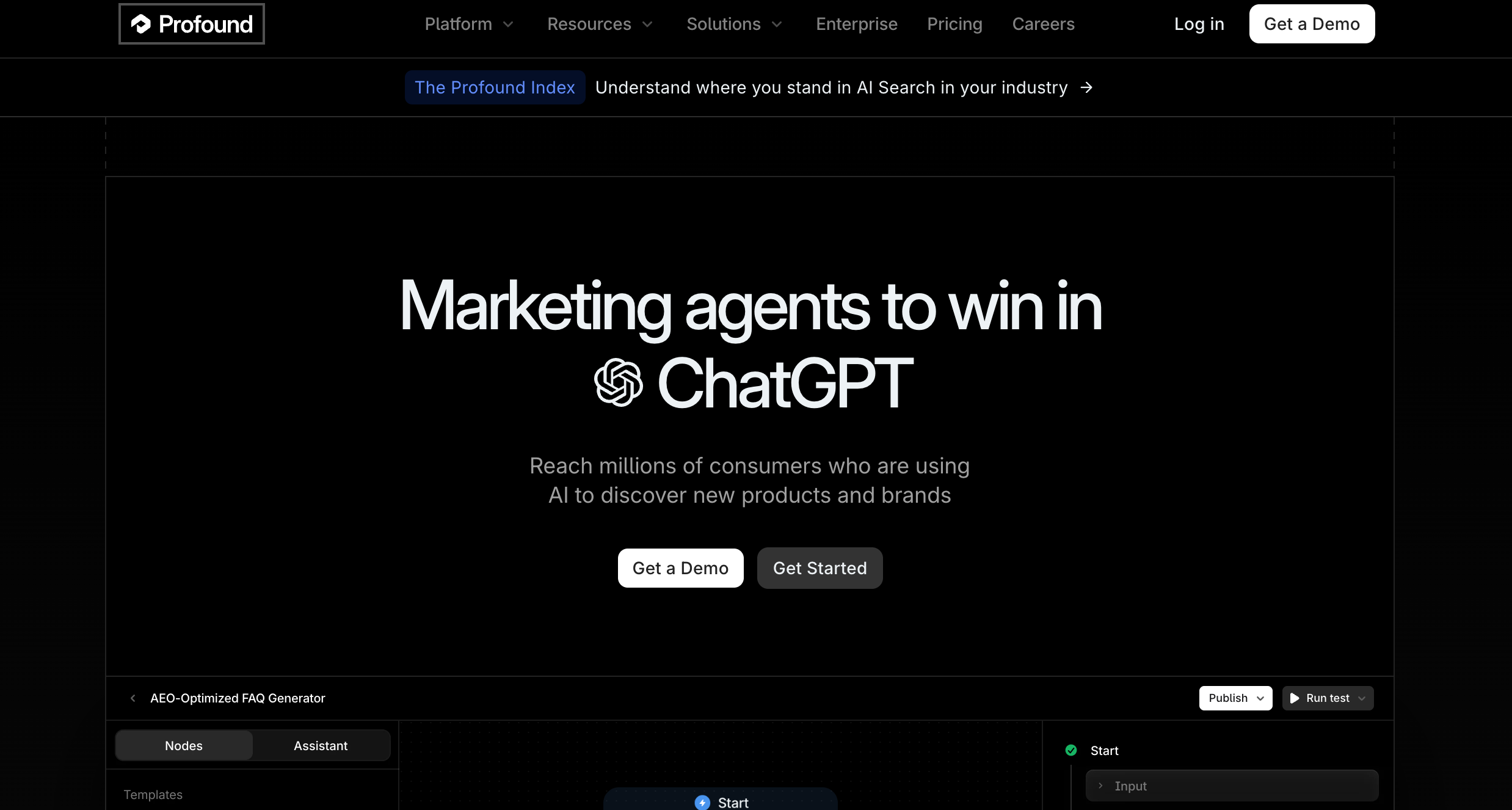
Many tools in this category bolt an agent onto an existing product—an SEO suite, a writing app, a monitoring dashboard. Profound built the other direction: it started as an answer engine optimization (AEO) platform, and the content agents grew out of the data to form an agentic marketing platform.
Underneath Prompt Volumes sit 1.9 billion-plus real user prompts—the actual questions people type into AI engines, broken down by intent, demographics, and topic. That’s not a keyword database repurposed as a proxy for AI demand. It’s the demand itself. That data feeds Answer Engine Insights, which tracks visibility, share of voice, sentiment, accuracy, and competitor benchmarking across every major answer engine, daily. So before you draft any content, the system already knows what your audience is asking AI, who’s currently getting cited for it, and where you’re absent.
The agentic layer goes to work on top of that. Aim is an always-on background agent—the first background agent built for marketing—that continuously scans your AI search data, prompt volumes, and competitive metrics without anyone opening a dashboard. When it spots something relevant, like a dropped citation or a rising topic nobody in your category owns yet, it turns that signal into a scoped Project: a structured brief with an explicit goal, ready to execute.
From there, Profound Agents do the production. You can start from the template library— ready-made agents for the jobs a content team runs every week, like brief creation, article generation, FAQ generation, and content refresh—and run them as-is or clone and adjust a step. When something's genuinely custom, the same drag-and-drop builder lets any marketer wire a workflow from scratch, no engineering required.
Whichever path, the agents crawl the highest-cited competing pages, reverse-engineer their structure and semantics, and draft content specifically shaped to be crawled, parsed, and cited by answer engines. Before drafting, each Agent queries 16 reasoning models and Profound's real prompt data to establish what's earning citations for the topic. Every run pulls from your brand kit and tone guidelines to stay on-voice, and every run keeps a human approval step before anything publishes.
The loop closes with Agent Analytics. It tracks which pages AI crawlers reach and which ones AI engines reward after they publish. Content that wins reinforces the pattern that produced it. Content that doesn’t is weeded out of the next production cycle. The engine learns what works for your brand, in your category, and becomes more precise every cycle.
What you’ll love
- AI-search demand data, drafting, and citation tracking live in one closed loop—a gap Aim finds becomes a brief becomes a draft becomes a tracked result, without leaving the tool or stitching four products together
- 1.9B+ real user prompts as the foundation, so topic selection reflects what people actually ask AI
- Agents draft for citation, not just for ranking—structured from patterns in millions of the most-cited pages across ChatGPT, Perplexity, Gemini, and AI Overviews
- A marketer-friendly drag-and-drop builder plus a library of 14 content-creation templates (and dozens more for research, optimization, and reporting) means teams ship in minutes without dev support
Where it falls short
- Agents are most powerful once your monitoring is set up—teams that haven’t completed their AEO tracking will get less out of the content pipeline on day one, because the recommendations are only as sharp as the visibility data underneath them
- Profound is purpose-built for the AEO era, so it doesn’t try to replicate traditional SEO tooling like backlink analysis or rank tracking; teams that want one tool for legacy SEO and AEO will still keep a dedicated SEO suite alongside it
2. AirOps
Best for
- Agencies and enterprise content teams that need brand-governed production at scale, not a single-user writing assistant
- Teams running high-volume refresh and creation programs across large content libraries
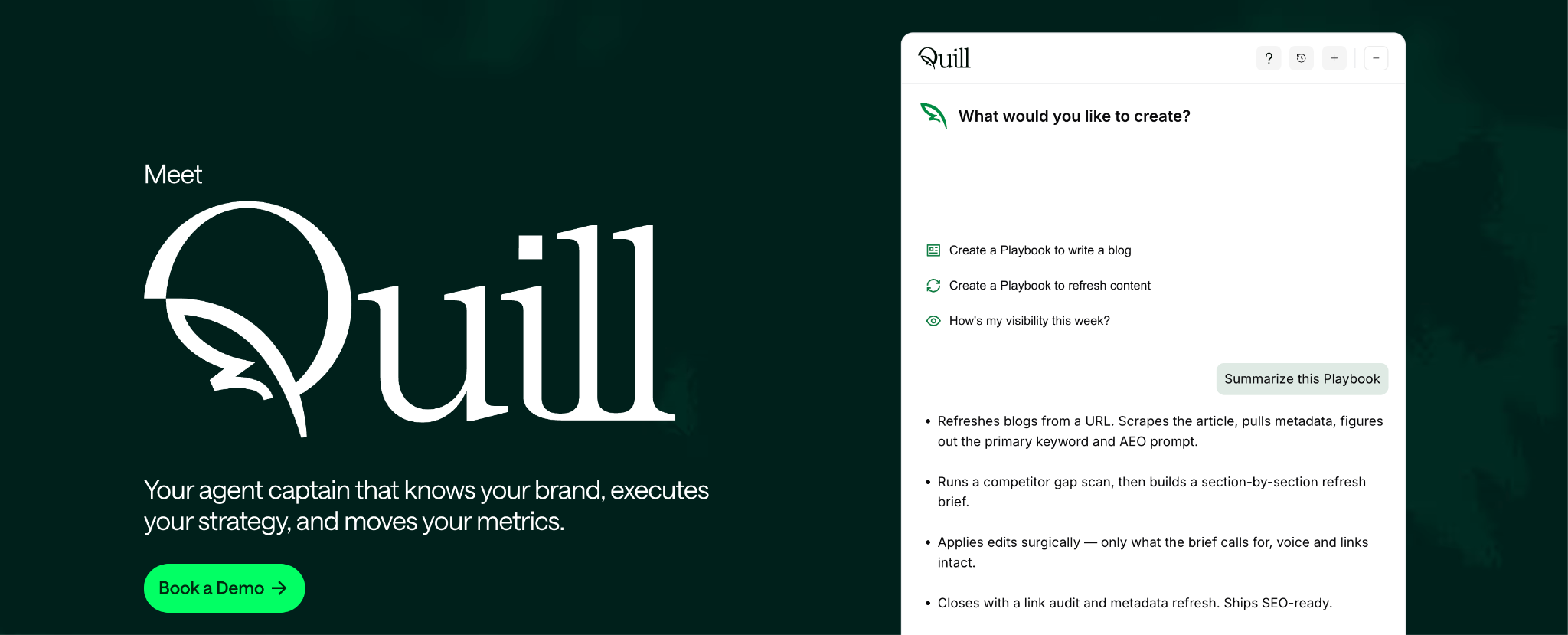
AirOps built its 2026 product around Quill, an agent persona it bills as an "AI agent captain" for content and AEO. You define your strategy, voice, and success criteria in Playbooks; Quill watches your AI-search signals, recommends and runs Campaigns against them, and routes every output through an inline approval gate before it reaches your CMS. Grids handle bulk execution across large batches, and Brand Kits plus Knowledge Bases give teams running several brands real governance from a single seat.
AirOps' Insights layer blends AI-search citations with rankings, brand drift, and engagement, and surfaces prompt volume as one tracked metric sourced through third-party data providers. Profound is built the other way around: its native core is a corpus of 1.9 billion-plus real user prompts—what people actually ask AI engines—with the rest of the pipeline tuned toward citations specifically rather than a composite target. Both are strong engines; they're anchored differently.
What you'll love
- Brand Kits and Knowledge Bases deliver real multi-brand governance, valuable for agencies running several clients from one seat
- Grids make large-scale library refreshes practical instead of punishing, with bulk execution across big batches
- Human review is built in by default as inline approval gates, not tacked on afterward
- A deep integration ecosystem—CMS, SEO, AEO, and project tools—for slotting into an existing content operation
Where it falls short
- No flat published price for the self-serve tiers: Solo and Pro are defined by task allotments with usage-based overage, and AirOps' own guidance says the number of tasks you'll need depends on many factors and points you to their team to size it—so total cost is hard to estimate before you commit
- The AI-search signal is one tracked input blended with rankings and engagement, surfaced through third-party data providers rather than a first-party prompt corpus at Profound's scale, so the system optimizes toward a composite target rather than citations specifically
- The learning curve is real; the power comes with genuine setup complexity that teams may find heavy
3. Writesonic
Best for
- Teams that need fast, high-volume drafts optimized for both Google and AI search from one pipeline
- Agencies wanting per-client brand voice at speed
Writesonic launched as a straightforward AI writing tool, years before “GEO” or “AEO” were phrases anyone used. Its AI-search monitoring layer arrived later, added onto an existing writing product rather than built as its foundation. That’s the reverse of the build order behind AEO-native platforms, and it’s the single most important thing to understand about the tool, because it explains both its strength and its ceiling.
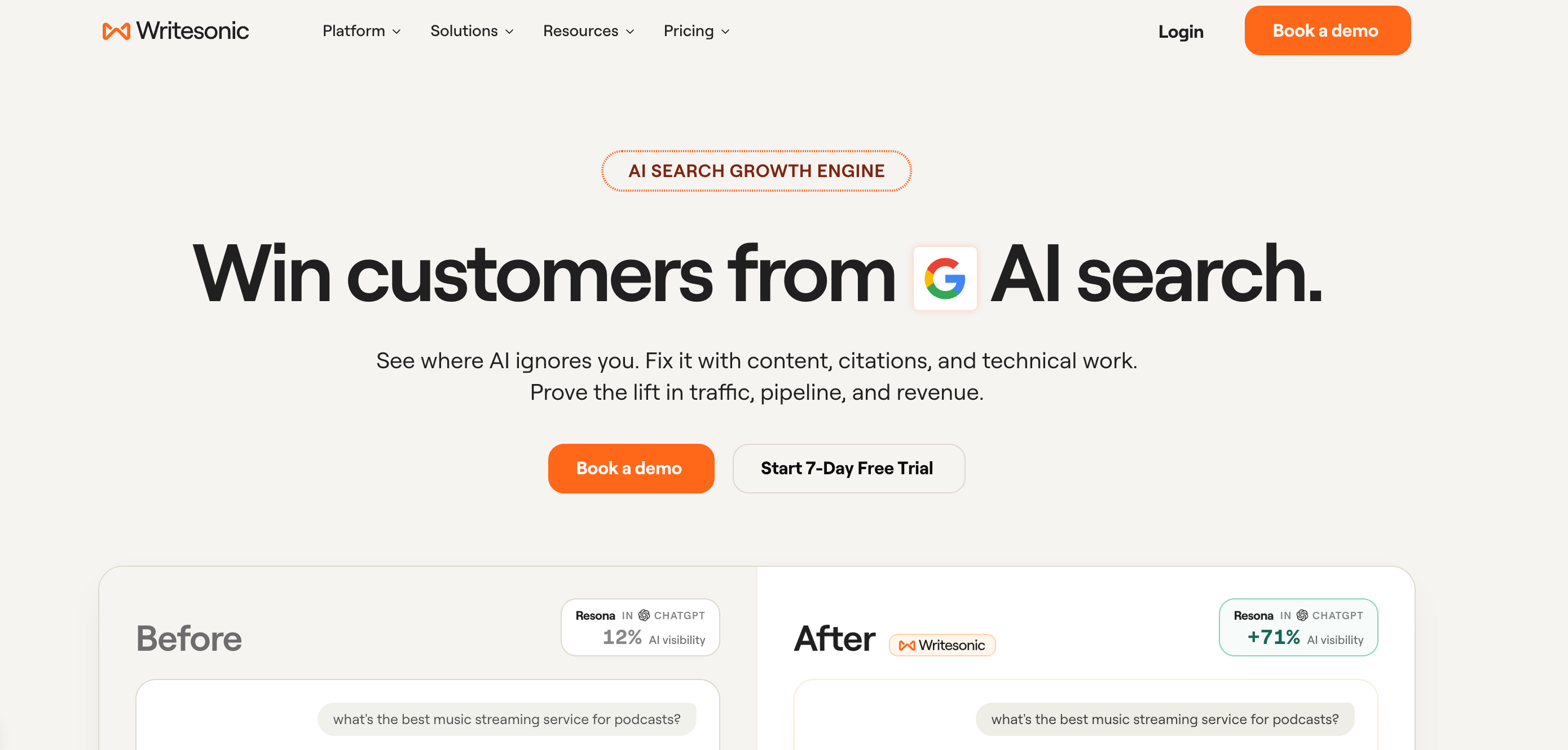
The current flagship, AI Article Writer, is marketed as a 100+ step “agentic content pipeline”: it scrapes SERPs, pulls in Ahrefs data, draws on a 2B+ prompt dataset, runs drafts through a multi-expert review chain, and finishes with a humanizer pass.
For raw drafting throughput, it’s fast, and it’s competent, and its dual Google/AI-search optimization from a single draft is a real selling point for teams that live on volume. But the AEO capability is a layer on a writing engine, not the organizing principle of the product. When your foundation was built to produce a lot of publishable text quickly, adding answer-engine structure on top gets you closer to citation-ready—it doesn’t get you to a system that was designed around citations from the first line of code.
What you’ll love
- Fast turnaround from topic to publishable draft, grounded in real-time SERP data instead of stale training knowledge
- Enterprise tier brings real governance: brand and author profiles, reviewer attribution, SOC 2, HIPAA, GDPR, SSO, and per-client voice controls for agencies
- Strong all-in-one appeal for teams that want writing, monitoring, and optimization under one login
Where it falls short
- The AEO layer was added years after the writing product shipped—volume drafting is the core competency, with answer-engine structure reading as a later addition rather than the design center
- No mechanism connecting a published page’s citation performance back into how future drafts get structured, unlike an agentic marketing platform built around a closed loop from the start
- Output quality can require meaningful editing at scale, a common tradeoff for speed-first generation
4. AthenaHQ
Best for
- Teams whose bottleneck is knowing what to fix, not producing finished drafts
- E-commerce brands that want AI visibility tied directly to revenue
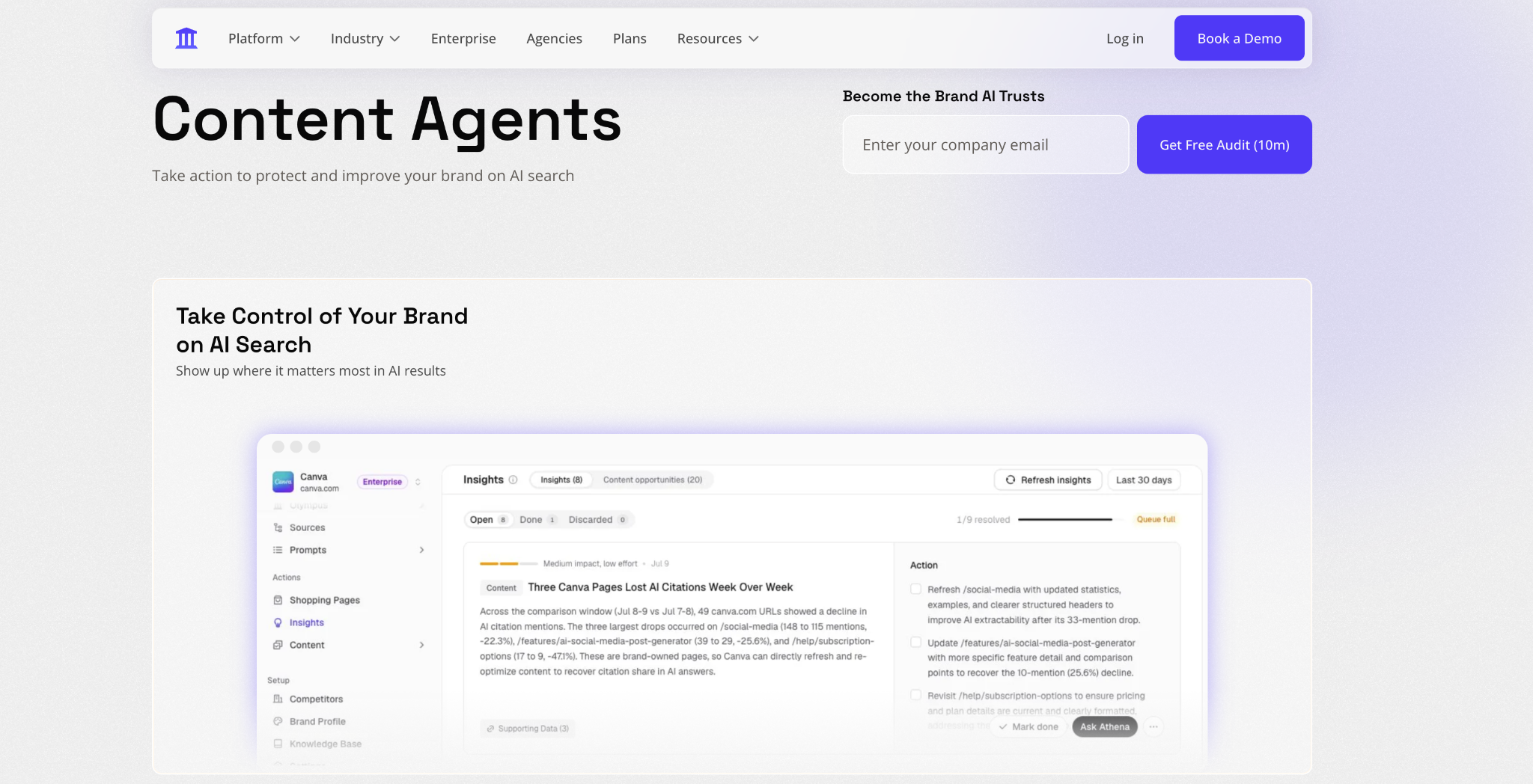
AthenaHQ’s content agents reverse-engineer the probability that a given source gets cited, analyzing on-page and off-page signals to predict why something wins a citation, and the Action Center turns that into a ranked list of what to create or fix, with the reasoning attached. As a diagnostic layer, it’s strong.
The ceiling is where its center of gravity sits: diagnosis. Athena brands its content product a "recommendation" engine, and that's the honest description of what it's best at—telling you which gaps to close and why. Its agents will draft and rewrite from there, but that work skews toward optimizing pages you already have rather than running the full arc from "we're invisible for this topic" to a net-new page that's live, getting cited, and informs the subsequent output.
What you’ll love
- Citation-probability modeling gives specific, ranked reasoning for every recommendation instead of a generic gap list
- Native Shopify and GA4 integrations connect AI visibility to real revenue
- Source Intelligence pinpoints the exact URLs AI engines pull from in your category, sharpening outreach targeting
- Clean, low-learning-curve interface with a strong bias toward action over dashboards
Where it falls short
- Positioned by its own maker as a recommendation engine
- Off-page recommendations often amount to lists of subreddits and third-party pages with no next step for how to earn the mention
- No closed citation-feedback loop feeding published outcomes back into the next draft; it tells you what changed, not how to auto-correct because of it
5. Ahrefs (Agent A)
Best for
- Teams already living in Ahrefs who want one general-purpose agent across SEO, research, and content
- Practitioners who want unrestricted programmatic access to Ahrefs’ full dataset
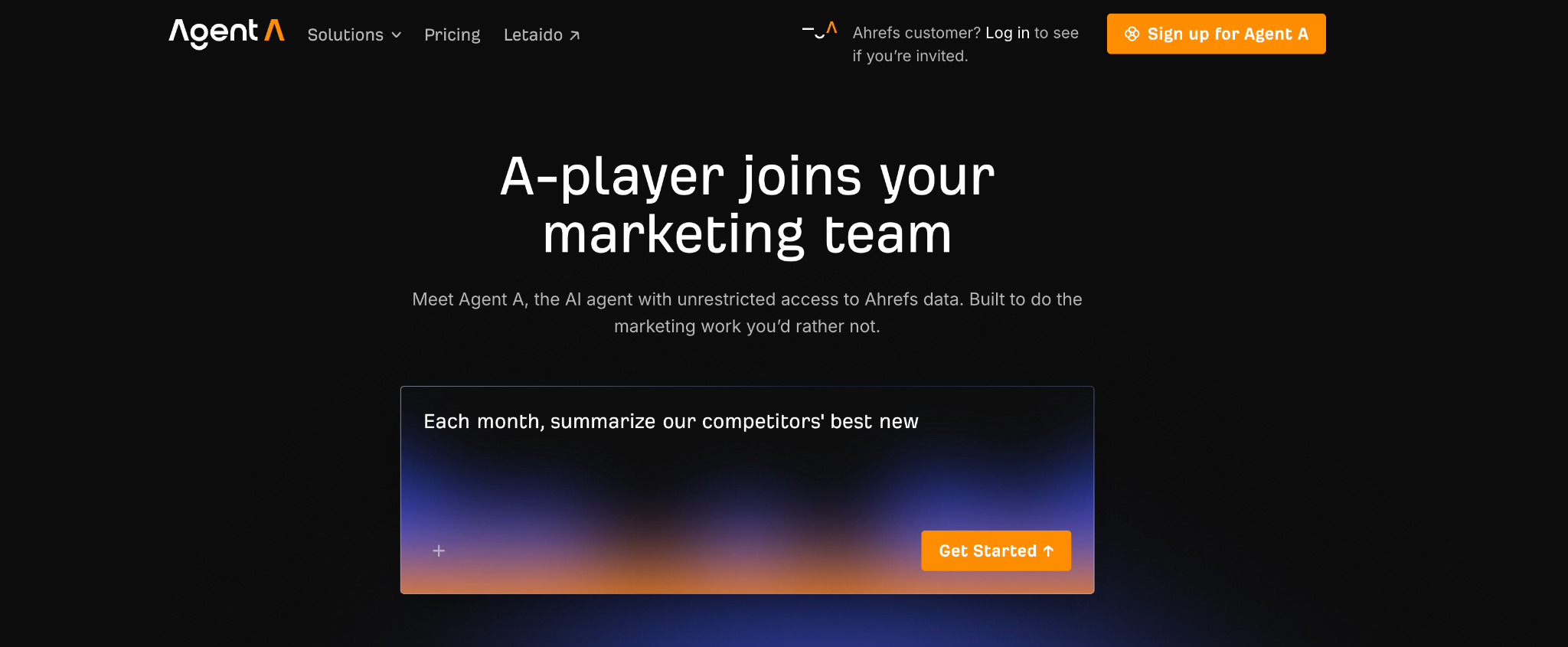
Ahrefs’ Agent A isn’t built as a content-creation tool per se. It’s a horizontal marketing agent sitting on top of Ahrefs’ full dataset—170 trillion-plus indexed pages, updated continuously—running on frontier models and executing a growing skills library that spans technical audits, competitive research, reporting, and content tasks. Ahrefs pitches it, accurately, as a generalist that replaces tedious cross-tool work: it’ll build a content calendar, run a gap analysis, or ship a report to Notion, Linear, or Slack.
The catch for this specific use case is right there in the design. Content is one lane among many, and of the content-adjacent skills—Content Gap Analysis, Trending Keyword Research, Programmatic SEO Keywords—none is a dedicated drafting-and-publishing engine. It surfaces opportunities and data; it doesn’t run the production pipeline from brief to cited page.
And it’s built on Ahrefs’ web index and keyword database, not on real AI-search prompt or citation data, so its content recommendations infer AI demand from traditional SEO signals rather than observing it directly. For a team that wants a Swiss-army agent and already pays for Ahrefs, that’s a strong deal. For a team whose core job is producing content that gets cited in AI answers, it’s a powerful research assistant, not a content agent.
What you’ll love
- Full, unrestricted access to Ahrefs’ actual UI-level data, not the more limited public API or MCP most integrations are stuck with
- Runs on whichever frontier model fits the task—Claude ot GPT—with no per-model choice or charge for the user
- Ships output to real destinations (Slack, Linear, Notion) instead of leaving results in a dashboard
- Genuinely broad skill coverage across the whole marketing function, backed by best-in-class SEO data
Where it falls short
- Content is a skill among many, not the main selling point; the rest cover SEO, technical, and reporting work unrelated to drafting
- No dedicated drafting or publishing engine—content-adjacent skills surface opportunities and data, not finished, citation-structured copy
- Built on a web index and keyword database rather than real AI-search prompt data, so content recommendations infer AI demand from SEO signals instead of observing it
6. Semrush (AI Marketing Agent + Content Toolkit)
Best for
- Teams that want strategy consolidation and SEO-grounded drafts inside a platform they may already pay for
- Marketers who prefer one vendor across research, SEO, and drafting
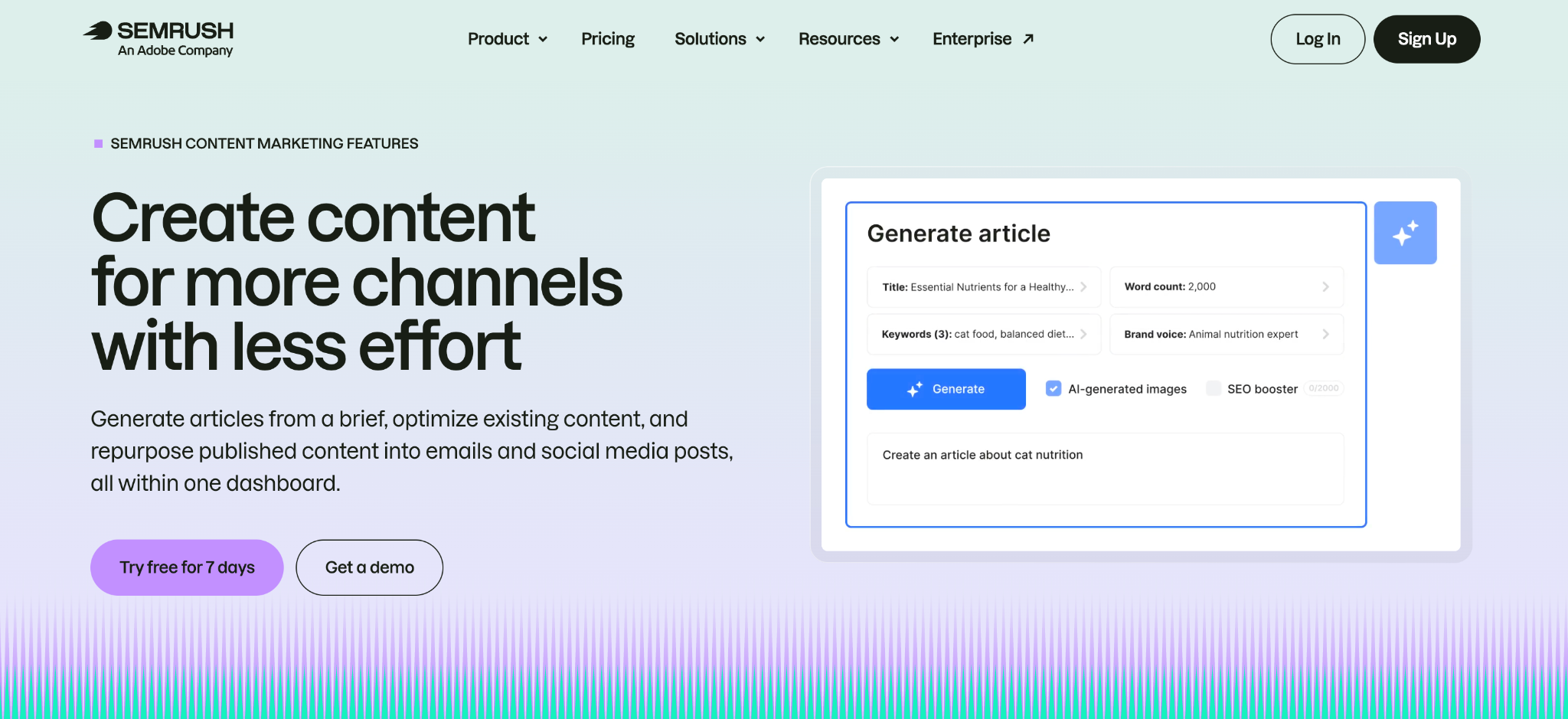
Semrush’s content story splits across two products that don’t share a pipeline. The AI Marketing Agent is a strategy and research assistant: a “Data Room” for uploaded briefs and assets, Strategy Canvases for structuring frameworks, and competitor-comparison flows. It helps you plan, but it doesn’t write.
The actual drafting engine is Content Toolkit. That one generates full SEO-optimized articles from SERP data in six-plus languages, with brand-voice controls and one-click WordPress publishing. And AI visibility tracking sits under yet a third layer, Semrush One / AI Optimization (AIO).
Each piece is competent on its own, and for a team already running its SEO workflow in Semrush, keeping everything under one login has obvious appeal. But the pieces don’t connect into a loop. A gap you identify in the AI Marketing Agent doesn’t flow automatically into a Content Toolkit draft, which doesn’t flow automatically into AIO’s tracking. What Profound runs as one continuous motion—signal to brief to draft to measured result— Semrush runs as three separate tools you move between by hand. And Content Toolkit’s drafting is built around traditional SEO structure; there’s no AEO-specific citation-format optimization comparable to what an answer-engine-native platform bakes into every draft.
What you’ll love
- Content Toolkit’s SERP-grounded drafting is a mature, battle-tested feature, not a rushed 2026 add-on
- One login spans strategy research, SEO data, and drafting—real value for teams avoiding another subscription
- Six-plus-language publishing with brand-voice controls built in
- The broader Semrush ecosystem is deep and familiar to millions of marketers
Where it falls short
- AI Marketing Agent and Content Toolkit are separate tools with no handoff—a gap surfaced in one doesn’t become a draft in the other, so a single motion elsewhere is a manual, multi-step chore here
- Content structure is built around traditional SEO signals, with no AEO-specific citation-format optimization comparable to answer-engine-native platforms
- AI visibility, strategy, and drafting live in three differently-branded products (AIO, AI Marketing Agent, Content Toolkit) inside one platform, which is a lot of surface area to learn just to get from gap to published page
- No closed loop feeding citation outcomes back into future drafts
How to use Profound for content creation and automation
Knowing Profound runs the full loop is one thing; seeing what a content team does with it is another. The work happens in Agents, either via drag-and-drop workflows you build once or the template library, which ships ready-made agents for the most common jobs. You can run a template as-is, clone it and adjust a step, or wire your own from scratch. No engineering required, and every run ends at a human approval step before anything publishes.
Here's how that maps to content work, from research through to a published page:
Start with what to write
The Content Brief Creation agent analyzes top-cited pages, live Google results, and your existing content, then produces a researched, writer-ready brief—so a writer opens a document that already knows what's ranking, what's being cited, and what's missing.
If you'd rather validate the topic first, the AEO + SEO Research Report agent shows which keywords matter, what's ranking on Google, and how AI systems answer the same query, in one pass. And before you commit, the Cannibalization Checker scans your sitemap for overlapping pages and tells you whether to create net-new, optimize an existing page, or skip the topic entirely—the kind of check that saves a team from competing against itself.
Produce the page
The Generate Article agent builds a complete, AEO-optimized draft from those same inputs—top-cited pages, live results, brand content—for teams that want a finished draft rather than a brief to hand off. For pages that live or die on their opening, the Above the Fold + Below the Fold Copy Generation agent scrapes a product listing page, identifies the highest-volume AEO prompts it should be answering, and writes ATF and BTF copy tuned for both human shoppers and answer engines.
The AEO-Optimized FAQ Generator, one of Profound's most-used templates, extracts an article's core intent, infers the underlying search query, and pulls in Google People Also Ask questions plus related query fanouts to build an FAQ section structured exactly the way answer engines like to cite.
Keep existing content working
A lot of a content team's value is locked in pages already published, and Profound's optimization agents are built to unlock it. AEO Content Refresh pulls optimization suggestions for a given article and applies them, bringing an older page back up to current answer-engine standards. Content Optimization Suggestions runs an existing article against Profound's optimization algorithm and live AEO insights to surface specific, ranked fixes instead of generic advice. And Optimize Lowest Performing Cited Page does what it says on the tin—finds your weakest cited page for a topic, scores its AEO, infers the target prompt, and hands back concrete changes—so a refresh program starts with the pages that need it most.
Scale and extend
Once a page performs in English, the Article Translator agent localizes it into any target language while preserving tone, meaning, and formatting—brand-consistent global content without a manual rewrite per market.
And when accuracy is on the line, the FactCheck Action–Create Content agent generates authoritative, sourced content specifically to counter misinformation about your brand, replacing an inaccurate narrative in AI answers with one you control.
That's eleven agents covering the full arc—research, drafting, optimization, localization, and defense—and the library goes well beyond them, including community-built templates from practitioners. The same data foundation feeds every one of them, and the same Agent Analytics measure what each one produces, so you get a content engine that becomes sharper every cycle.
Content creation, from gap to cited page
The tools above are good at pieces of the job. AirOps produces on-brand content at scale. Writesonic drafts fast. AthenaHQ tells you what’s broken. Ahrefs and Semrush bring deep, familiar data to teams already inside their ecosystems. Every one of them is a reasonable choice for the specific slice it does well.
But a slice is what each of them is. The content team’s job isn’t to “draft faster”—it’s to span the distance from noticing you’re invisible for a topic buyers are asking AI about, to shipping a page that closes that gap, to knowing whether it worked. That full distance is what Profound was built to run:
- The data foundation tells you what your audience asks AI.
- Aim turns the highest-impact gaps into scoped briefs on its own.
- Agents draft content structured to get cited, with a human approving every publish.
- Agent Analytics measures which pages actually earned citations and feeds that back so the next cycle is sharper than the last.
If your team is trying to win in AI search, these are the features you need. See what Profound’s AI agents can do for your content motion—book a demo.
Best AI agents for content creation FAQs
What’s the difference between an AI writing tool and an AI agent for content creation?
An AI writing tool generates text from a prompt. An AI content agent researches what’s ranking and being cited for a topic first, drafts to that research, and in the more advanced systems tracks whether the finished page gets results after it publishes, then feeds that result back into future drafts. One helps you write; the other runs the pipeline.
Do I need separate tools for AI visibility tracking and content creation?
Not if the platform connects them. The thing to check is whether visibility and creation actually share a pipeline or just a login. Profound runs them as one loop—a gap Aim finds becomes a brief, a draft, and a tracked result inside one system. Others, like Semrush’s AI Marketing Agent and Content Toolkit, keep them as separate tools that don’t hand off to each other, which puts the stitching work back on you.
How do AI content agents know what topics to write about?
The strongest AI content agents start from real user prompt data rather than a keyword database standing in as a proxy for it. Profound’s agents draw on 1.9B+ real prompts, so a citation gap becomes a content brief directly. Agents without that foundation infer AI demand from traditional search signals, which is a guess at the real thing rather than the real thing.
Can AI-generated content get cited by ChatGPT or Perplexity?
Yes, when it’s structured for it. Content built around answer-first openers, specific claims, and formats that mirror what’s already earning citations for a topic performs meaningfully better than generic AI-generated drafts.