
How we found it
We noticed it in our own data first.
On May 7, OpenAI referrals to tryprofound.com jumped 200% overnight and held there. Our homepage's share of those referrals more than doubled, from ~28% to ~62% of all ChatGPT-driven traffic. That kind of step-change doesn't happen by accident.
So we checked across every brand site we monitor. Same pattern, everywhere. What you're reading is what we found.
Summary of takeaways
- On May 7, 2026, ChatGPT quietly shipped what we're calling the Branded Link Update: the largest single-day change in AI-driven brand traffic we've measured all year.
- OpenAI referral traffic to monitored brand websites nearly doubled overnight (~60-65%) and has stayed there.
- The mechanism: ChatGPT started embedding brand homepage URLs inline in its answers at least ~5x more often. Each link is a clickable, attributable referral.
- The result is a homepage unlock. Homepage share of OpenAI referrals jumped from ~3.5% to ~24% industry-wide. Brand front doors went from a rounding error to roughly 1 in 4 referral clicks in a week.
- For brands: AI mentions are no longer a perception metric. They're a referral channel. And OpenAI can move this number again at any time.
Background: what changed on May 7
Across a basket of brand sites Profound monitors for live referral traffic, daily OpenAI referrals roughly doubled (60%-65%) starting May 7, 2026.
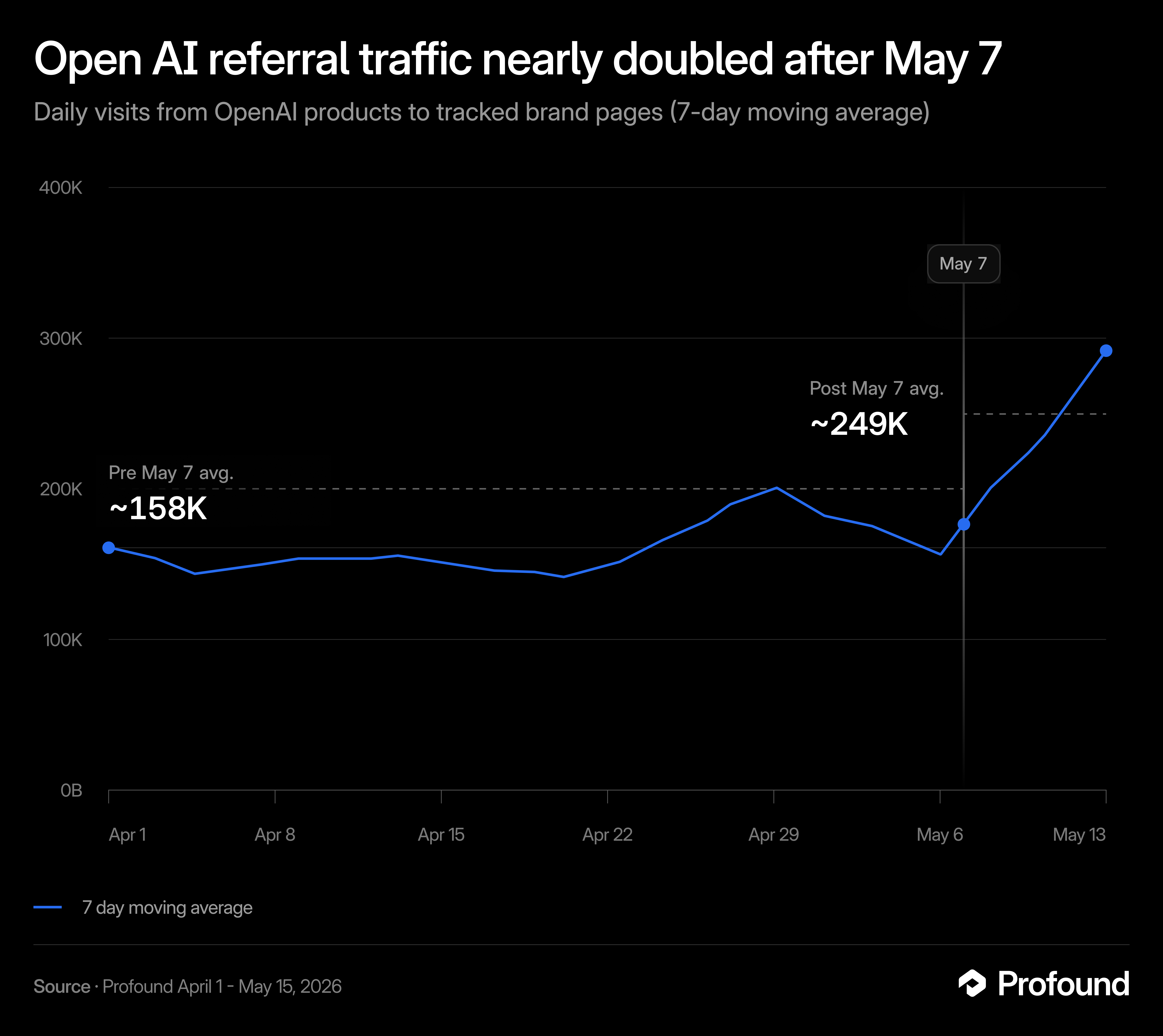
What happened: ChatGPT started embedding brand homepage URLs inline in its answers far more often. The share of ChatGPT responses containing a url jumped from ~4.5% to ~20–24% on the same day, roughly a 5x increase that maps cleanly onto the referral lift.
Before vs. after: how ChatGPT answers changed
The Branded Link Update is visible to the naked eye in the same kinds of questions, asked days apart.
Before May 7: "Best Online Learning Platforms" answers rendered brand names as plain bold text alongside citation chips. The model surfaced the same brands, but there was nowhere for the user to click through to the brand itself, only into the source citations.
After May 7: the same kind of answer renders every brand name as an inline hyperlink directly to that brand's homepage. The user is now one click from the brand site, every time it's named.
That's the Branded Link Update in a single picture: the model didn't change who it was recommending. It changed how those recommendations terminate. Brand mentions used to dead-end in citation chips. Now they route to the brand's front door.
The homepage unlock: share of referrals to homepages exploded
Homepages went from a rounding error in OpenAI referral mix to roughly 1 in 4 clicks in a week. The deep-page share fell not because deep-page traffic dropped (it grew modestly), but because homepage volume exploded on top of it.
It's broad-based, but with clear winners and losers
The Branded Link Update is showing up across most industries, albeit unevenly. Ratios of post-May 7 vs. pre-May 7 daily OpenAI referrals:
- B2B Software & SaaS: the largest gainer in absolute terms, daily OpenAI referrals up more than 200% their pre-May 7 baseline.
- Financial Services & Fintech: a 60% lift.
The most striking laggard:
- E-commerce & Retail: essentially flat. ChatGPT's new link behavior is seemingly not flowing to retailers. The likely explanation is that retail recommendations route through ChatGPT's product/shopping surface rather than the branded recommendation flow that got the hyperlink treatment.
The pattern: Categories where ChatGPT recommends companies gained. Categories where ChatGPT recommends products did not.
Why might OpenAI have shipped this?
Two threads worth flagging:
1. It's the same day OpenAI rolled out ads to the general public. The timing is almost certainly not a coincidence. OpenAI rolled out self-serve ads the same day. Embedding brand URLs inline and watching which ones get clicked generates exactly the CTR signal an ad ranking model needs. Which means organic brand links become training data for "which recommendations drive clicks in which contexts." Whether or not that's stated intent, it's a direct byproduct, and it's hard to imagine the timing is accidental.
2. It's a peace offering to the open web. A dominant complaint from publishers and commercial brands since ChatGPT launched has been the same: LLMs answer the question, the user never clicks through, and our search-driven referral traffic dries up. The Branded Link Update directly addresses that complaint; for the first time, a meaningful share of ChatGPT answers end in clickable links to the brands being recommended. It doesn't replace Google-scale referral volume, but it does make AI a real (and growing) traffic source rather than purely a traffic sink. That matters for OpenAI's relationships with publishers, brands, and regulators.
The simpler read is that they're optimizing user experience by making recommendations actionable, is also plausible and not mutually exclusive. But for anyone tracking the AI-traffic ecosystem, the Branded Link Update flips ChatGPT from a referral destination to a referral source, and that's the lens commercial brands will (and should) view it through.
What this means for brands
- AI mentions are now directly monetizable as homepage traffic. Pre-May 7, being mentioned by ChatGPT was a perception signal. Post-May 7, it converts into measurable referral sessions. The "is anyone clicking?" objection just got a lot weaker.
- Referral attribution is now table-stakes infrastructure. Brands need a system of record for "were we mentioned, did it land, did it convert." Any brand not tracking chatgpt.com and openai.com as named referral channels right now is flying blind.
- The brand homepage is suddenly a landing page again. With ~1 in 4 ChatGPT referral clicks now going to /, that page needs to work for cold AI-driven traffic → visitors who arrived because ChatGPT recommended you, and who may know nothing else about your brand.
- The mention-to-traffic ratio is now the metric. Share-of-voice and Visibility score in ChatGPT answers isn't a vanity number anymore. It maps to a quantifiable referral coefficient.
- The zero-click era for ChatGPT is over. AI mentions were a perception metric. They're now a referral channel with a measurable coefficient. The brands that treat this as infrastructure now will compound that advantage as OpenAI inevitably moves this number again.
Track the traffic ChatGPT is sending you
The Branded Link Update made AI referrals real and larger but only brands with the right infrastructure can see them. Profound Agent Analytics closes the attribution loop: server-side tracking that captures every ChatGPT and Perplexity referral, tells you which pages they're landing on, and shows you exactly how AI-driven visitors convert.
If you're not measuring it, you're missing it. Get a demo →

