
This analysis started with a simple question: is ChatGPT a place where people create, learn, or buy? To answer it, we took a one-year sample of 7.5 million ChatGPT conversations from Profound's Prompt Volumes database, classified each one by intent, and watched how the distribution evolved.
Between June 2025 and June 2026, the share of conversations with commercial intent rose from 13.9% to 19.2%, with most of that growth landing in the final quarter of the window. When extrapolated to ChatGPT's reported scale, the absolute volume of commercial conversations more than doubled over the year, growing from an estimated 243 million to 533 million a week. At the current run-rate, this translates to 28 billion commercial conversations per year.
We found three things worth calling out:
- Commercial intent is not just rising as a share. Each user is starting meaningfully more commercial conversations than a year ago.
- Commercial conversations are the stickiest intent on the platform. People go deeper before they decide.
- Commercial intent is highly industry-dependent. The spread between the top and bottom verticals is roughly 10x.
The share is climbing, and so is the volume behind it
Commercial share held a long plateau around 14 to 15% through late 2025, punctuated by two seasonal spikes that fall exactly where the retail calendar would predict: late November 2025 for Black Friday, and late December 2025 for Christmas and end-of-year shopping. From April 2026 it climbed steadily to end the window at 19.2%.
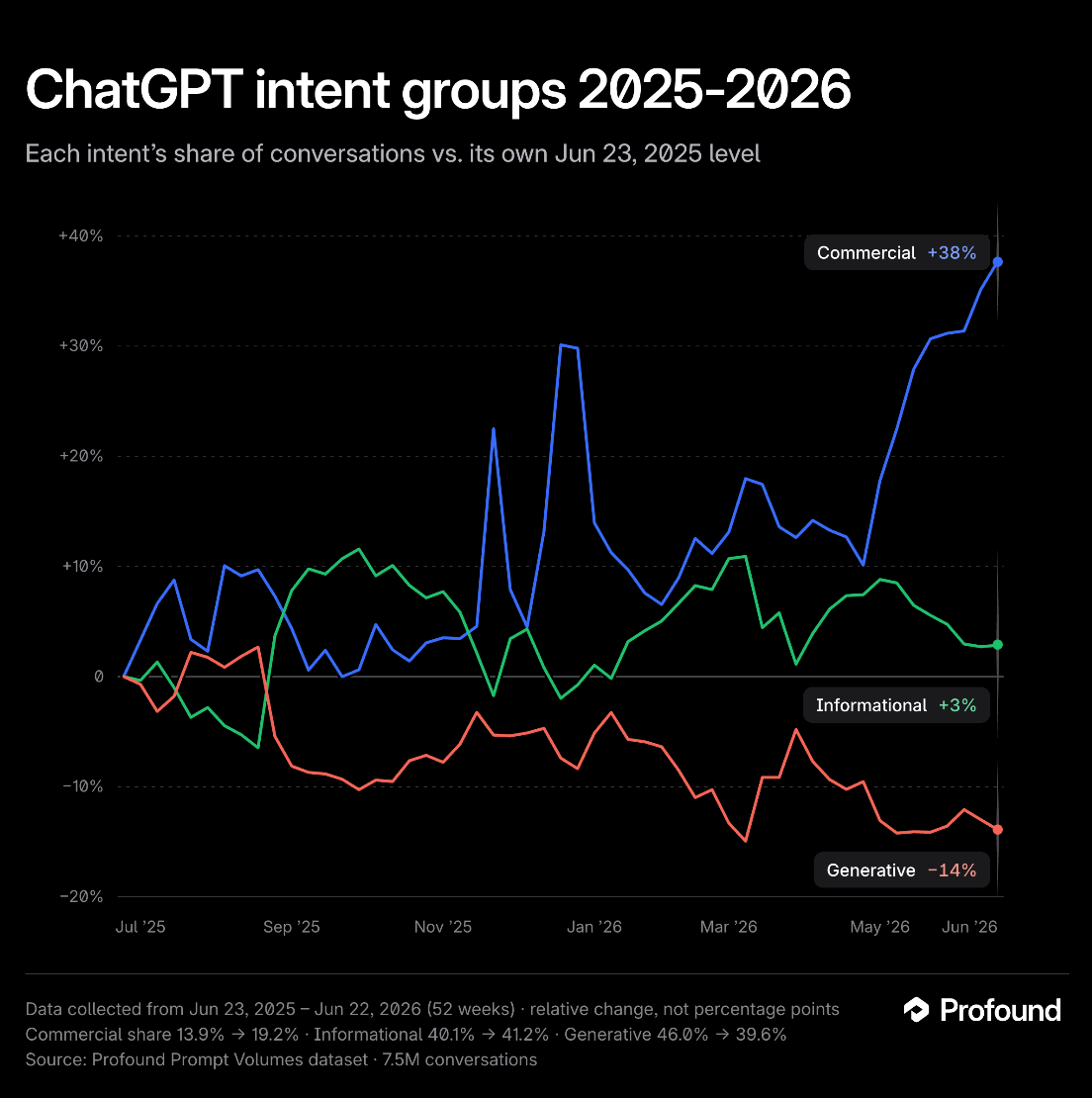
That share is gained mostly at the expense of generative conversations, while informational intent holds roughly steady in the mid-teens.
Growth is driven by users having more commercial conversations, not by a contraction in other intent types. Users are having more commercial conversations (a 41% increase from 0.38 to 0.54 conversations per active user per week), which is the multiplier applied in the scale estimate below.
An estimated 28 billion commercial conversations a year
The headline number is the product of two trends: a climbing per-user commercial rate and OpenAI's growing user base over the course of the last year.
We anchor the user base to OpenAI's publicly reported weekly active user (WAU) milestones and apply the commercial rate observed in our sample:
Against the first week of the window, at an estimated 243 million commercial conversations a week, that is a 119% increase over the year.
Note: Mid-2026 WAU figures are an estimate rather than a reported number, so we stress-tested the headline. Across a plus-or-minus 10% range on the user base, commercial conversations run between 490 and 570 million a week, or 25 to 30 billion a year. The order of magnitude holds regardless of the exact user count.
Commercial conversations are the stickiest intent
Commercial intent is not only growing, each individual conversation is longer. Comparing the three intent classes across the window:
Two takeaways:
- Conversation depth compressed across every intent over the year. This is likely a model and product effect: over the year, models have gotten smarter while also accumulating more context on their users, resolving in a single answer what once took several turns of back-and-forth.
- Commercial conversations are consistently the least one-and-done. They carry the lowest single-turn rate throughout the window and the highest average turn count by its end.
Each additional turn is another chance for a brand to be surfaced, compared, or omitted, and commercial conversations sustain more of them than any other intent.
Which industries drive commercial intent
The natural next question is where this commercial intent is concentrated. To answer it, we classified conversations from the same one-year window into 19 industries, kept only the 1.75 million labels that passed a confidence audit, and measured the commercial share of each.
The spread from top to bottom is roughly 10x difference in commercial share (percentage points).
Where the options are known, the decisions are typically commercial. Automotive and Travel top the ranking, with Telecom, Hardware, and Financial Services close behind. A car, a flight, a mortgage, a phone plan, an industrial contract: people arrive already knowing what they need to buy, and the conversation is about which one. Roughly half of these high consideration conversations carry commercial intent.
Where the situation comes first, the conversation steers informational. Healthcare (53.3%) and Legal Services (49.4%) lead here. The stakes are just as high, but users arrive with a scenario to understand rather than a shortlist to narrow.
Where the output is content, conversations skew generative. Marketing & Advertising, Non-profit, and Consumer Goods carry the highest generative shares on the table: campaign drafts, donor communications, product copy.
What this means for brands
A year ago, commercial intent was a stable minority of ChatGPT usage. Today, the share reached 19.2% by June 2026, the per-user rate climbed 41%, and the platform's user base approached a billion. Compounded, that is 28 billion commercial conversations a year shaping a new era of how people make purchasing decisions.
However, the shift has not arrived evenly. Purchasing journeys in Automotive, Travel, and Financial Services look very different from those in content and knowledge verticals, where usage remains concentrated in informational and generative prompts. But the direction is the same everywhere: commercial share is climbing, volume is compounding, and the brands that show up in these conversations will capture a growing share of decisions, shaping a new stream of revenue flowing through artificial intelligence.
Methodology
The trend analysis is built on a consistent one-year sample of en-US ChatGPT conversations, 2025-06-23 to 2026-06-22, spanning 53 weekly aggregates and 7.5 million conversations. Every conversation is assigned an intent and sorted into one of three mutually exclusive buckets: commercial, informational, and generative.
The scale extrapolation applies the sample's per-user commercial rate to ChatGPT's weekly active users, anchored to OpenAI's publicly reported milestones (500 million in early 2025 rising toward an estimated 1 billion by mid-2026) with linear interpolation between them. The mid-2026 user figure is an estimate, and the sensitivity range in the headline section reflects that.
The industry analysis started with a keyword pre-filter, screening the conversations for 19 industry categories to create a candidate pool of roughly 3 million vertical-related conversations. An LLM then assigned each conversation in the pool a single industry or other, along with a confidence score. We calibrated those scores against a hand-labeled golden set and filtered on the confidence threshold, leaving 1.75 million classified conversations inside the one-year window. We validated the result against a smaller independent, non-keyword-filtered random sample under the same confidence for a final validation.
Get Started
Your customers are starting more commercial conversations with ChatGPT every week, and the trend is accelerating. Book a demo to see how Profound helps brands show up when your customers are ready to buy.

