
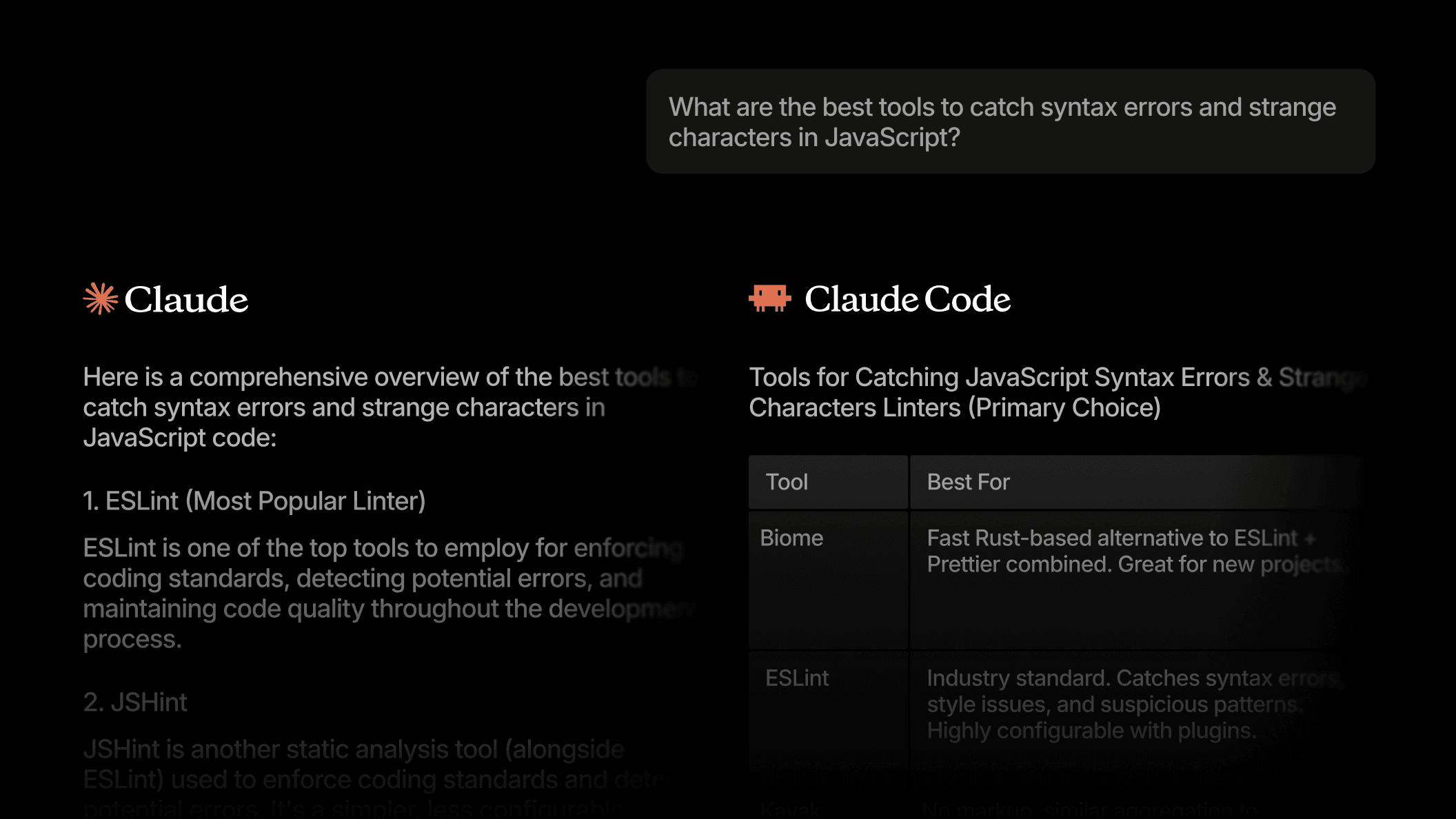
If Claude and Claude Code use the same underlying models, should we expect them to give the same answers and cite the same sources?
Claude Code is Anthropic’s coding harness, which has grown to an estimated 2–4 million weekly active users. While it’s powered by the same intelligence as Claude, it has different instructions, tools, and interfaces. This affects how it responds, the brand it mentions, and the pages it cites.
To better understand the similarities and differences between Claude and Claude Code, we analyze two separate datasets:
- 24,135 Claude and Claude Code responses across a set of prompts from 11 randomly sampled categories, including a coding subset
- The top 1,000 webpages visited by Claude and Claude Code agents over a 30-day period, among a large collection of internally tracked domains
TL;DR
- Claude and Claude Code behave like different Answer Engines. In our sample where web search is enabled, Claude Code searches in 13% of responses, compared to Claude’s 93%. Even though they mention a similar number of brands in each response, those brands overlap by only 20% on average.
- Their agents read different parts of the web. Nearly three-quarters of Claude Code’s observed website visits went to documentation, informational, and pricing pages. Meanwhile, 60% of Claude’s visits went to robots.txt files, sitemaps, and home pages.
- Marketers should optimize for Claude and Claude Code separately. For Claude Code, prioritize accurate, machine-readable documentation and pricing pages. This means including specific claims for Answer Engines to extract, using question-shaped headings, and leading with the answer.
How do Claude and Claude Code responses differ?
Claude and Claude Code behave differently in how often they search, what brands they mention, and the structure of their responses.
The clearest difference was in search behavior: in our sample, Claude Code only searched in 13% of responses, while Claude searched in over 93% of responses.
The platforms tend to mention different brands for the same prompt. On average, Claude and Claude Code only mention 1 in 5 of the same brands. On the other hand, 1 in 2 mentioned brands overlap between two distinct Claude responses, and 2 in 5 overlap between two distinct Claude Code responses. Both platforms are significantly more consistent across repeated responses than they are with each other.
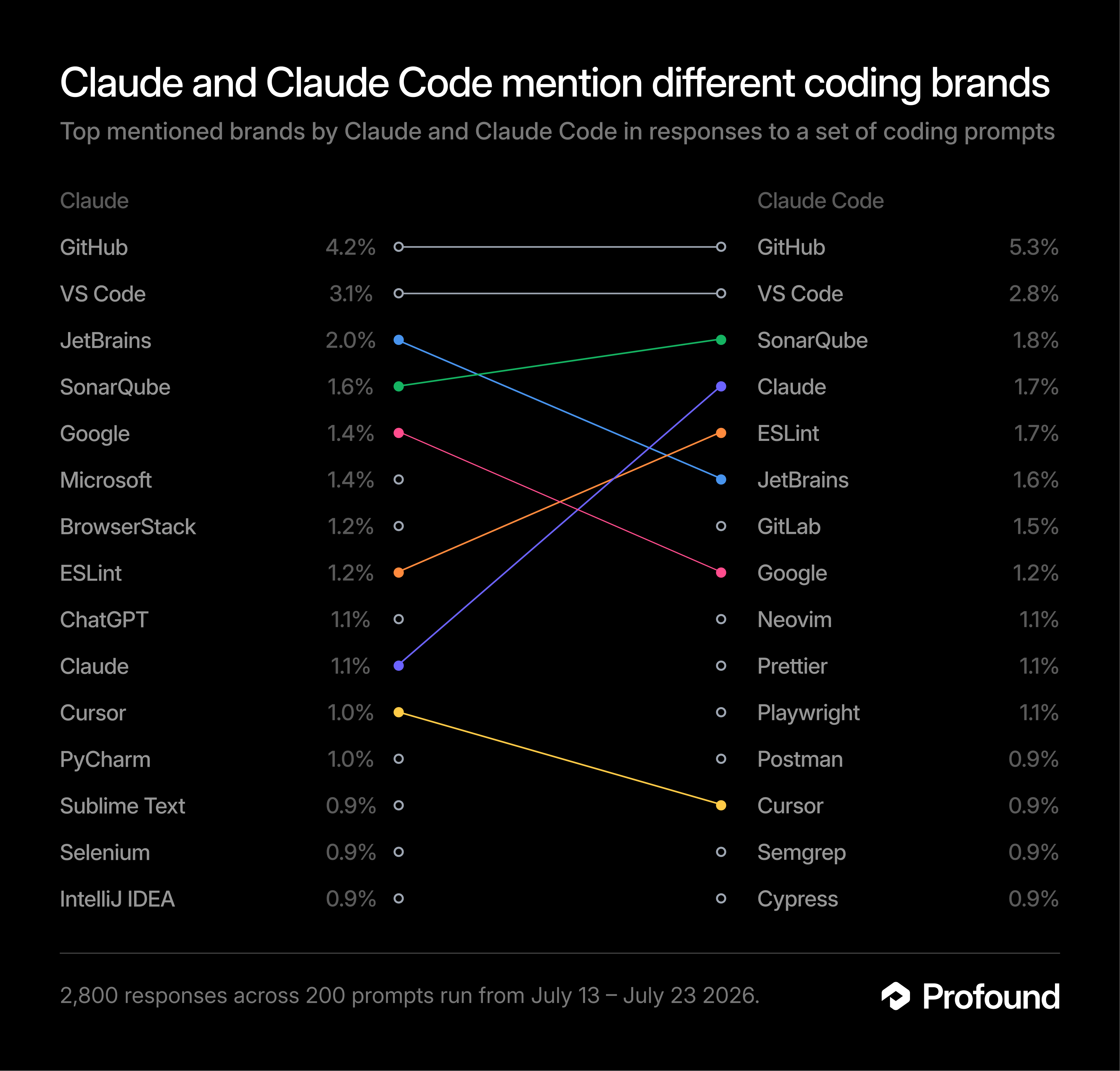
Claude Code mentions a similar number of brands per response compared to Claude (6.6 and 5.2, respectively) despite searching less often. As Claude Code is primarily used in technical workflows, we further examined which brands each product mentioned in response to coding prompts.
Among the top 15 brands, Claude leaned toward code editors and IDEs, while Claude Code more often surfaced code-quality and development-workflow tools.
Claude Code responses were also shorter and more structured. Additionally, repeated responses from the same platform were more semantically similar than Claude and Claude Code responses to the same prompt.
Claude Code’s agent read different types of webpages than Claude’s
Although Claude Code rarely searches or cites sources, its agent generated substantial traffic across our tracked domains. We compared the 1,000 most-visited pages over a 30-day period for each agent and found that Claude’s and Claude Code’s agents read fundamentally different parts of the web.
Both agents visit brand-owned content more than earned media or social pages, but nearly three-quarters of observed visits from Claude Code’s agent go to documentation, informational, and pricing pages, compared to just 5% for Claude’s agent. By contrast, 60% of Claude’s agent visits go to robots.txt files, sitemaps, and home pages, compared to 4% from Claude Code’s agent.
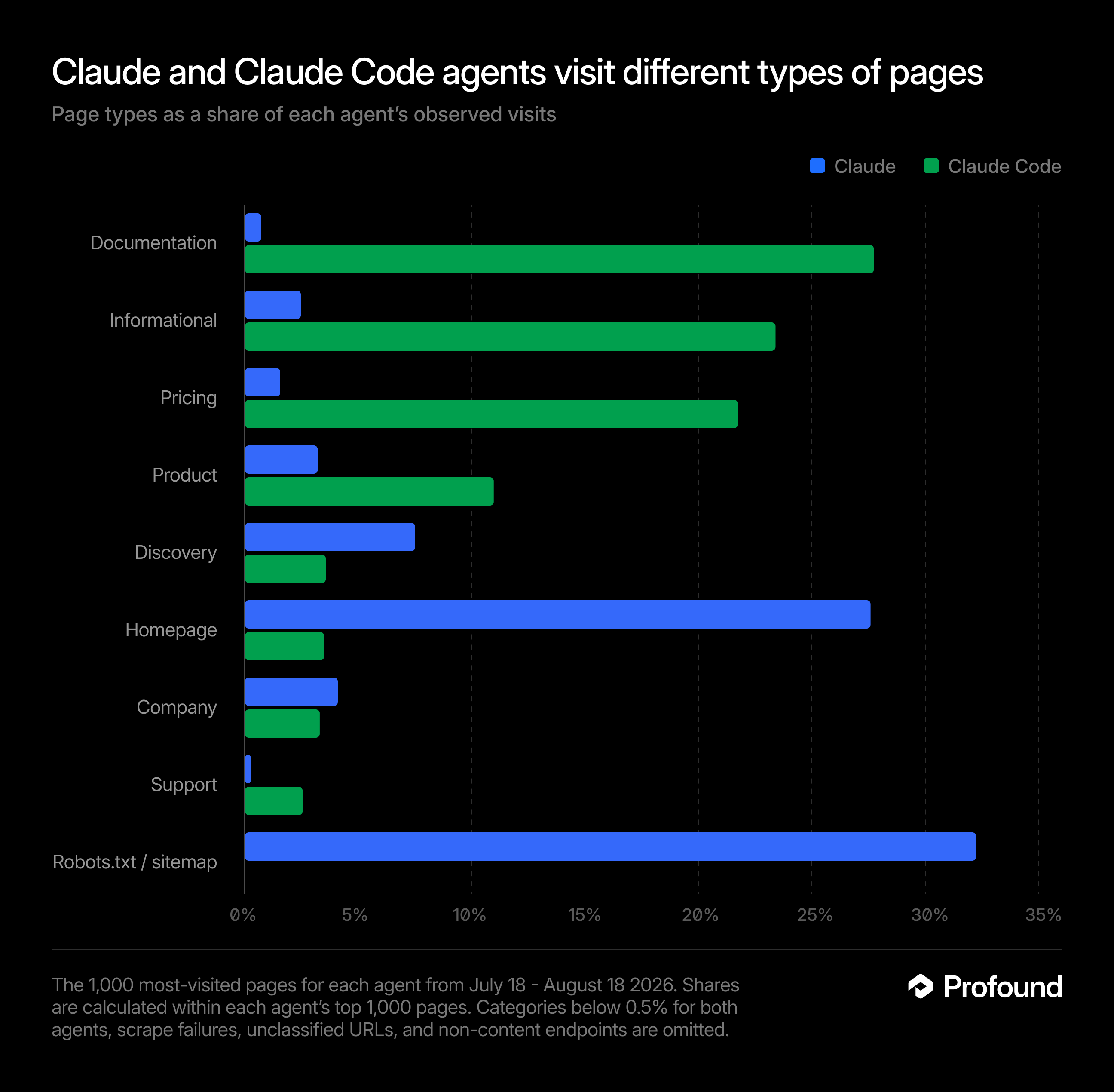
While Claude’s agent will try to discover what a site contains, Claude Code’s focuses on retrieving specific information from known page types. For Claude Code, broad site visibility may matter less than making specific technical and pricing information easy to find.
Concretely, pages should state clear, extractable facts about uptime, latency, environment support, and other details. Specific claims such as “Supports Python 3.10–3.13, Node.js 20+, and Go 1.22+” are easier for an Answer Engine to retrieve than vague statements like “works with your existing stack.” Headings should be framed as questions (“How do I authenticate API requests?”), and the answer should follow before any background information or explanation.
What it means for marketers
Treat Claude and Claude Code as separate Answer Engines. What works for one may not reliably work for the other.
Although Claude Code rarely displays citations, its observed agent is concentrated among specific types of pages. If your customers use Claude Code, focus on keeping documentation, informational, and pricing pages current and machine-readable. Make it easy for the agent to retrieve the exact details needed to evaluate and use your product.
More broadly, we’re seeing that harnesses significantly impact downstream response, citation, and mention behavior. Foundation models may not be good proxies for the harnesses that they are part of, and as more harnesses attract meaningful user traffic, marketers may need to measure them as distinct Answer Engines.
Methodology
Our prompt-response dataset contains 24,135 responses across 1,724 prompts; the coding subset contains 2,800 responses across 200 prompts. Prompts were run from 07/13/2026 to 07/23/2026, and web search was enabled for all platforms.
Our analysis of top pages visited by agents uses the top 1,000 pages visited by Claude and Claude Code agents from July 18–August 18 among a large collection of internally tracked domains. These pages were scraped using Firecrawl, then categorized by page type using an LLM (gpt-4.1-mini).
Get started
If your customers are using Claude Code as their primary Answer Engine, you will need to optimize for it accordingly. Book a demo to see how Profound helps brands show up where their customers are.

