

Can this product do what I need? Will it work with the tools I already use? How much will it cost?
These are questions software companies answer through product pages, documentation, and sales conversations. They’re also questions people bring to AI.
Profound partnered with Kyle Poyar of Growth Unhinged to explore those questions through 27,374 real user prompts across six software and AI product categories. The data comes from Profound’s Prompt Volumes dataset, which is made up of anonymized user conversations from double opt-in consumer panels. Below, Kyle shares the findings and what they mean for marketers.
The research methodology
There isn’t a single B2B buying journey that applies to every software product. To explore how people use AI across different software categories, we examined prompts about six types of products:
- Website builders (8,347 prompts)
- AI coworkers (7,507 prompts)
- CRM (6,698 prompts)
- Coding agents (3,777 prompts)
- ERP (740 prompts)
- AI customer support (305 prompts)
We analyzed English-language prompts across these categories and separated informational questions from queries with commercial intent. We then categorized commercial queries by funnel stage: top-of-funnel, mid-funnel, bottom-of-funnel, post-purchase, or ambiguous.
AI tagged the prompts by topic, such as pricing and functional fit, and by question framing, such as “Can X do Y?” and “What’s the best X?”
Insight 1: Buyers use AI search in the middle of the funnel
Google searches used to happen relatively early in the buying journey. B2B brands optimized for discoverability in top-of-funnel search terms, which had the most volume.
AI search looks different. It’s shaped like a diamond: narrow top-of-funnel, wide middle-of-funnel, narrow bottom-of-funnel. Buyers turn to AI search after they’re aware of the problem and likely already have a vendor in mind.
Our data shows that 57% of AI prompts are in the middle of the funnel. This was consistent across all six product categories. We defined the middle of the funnel as users who are comparing or evaluating specific products, services, or brands. At this point they’ve already narrowed down to specific options and are deciding between them.
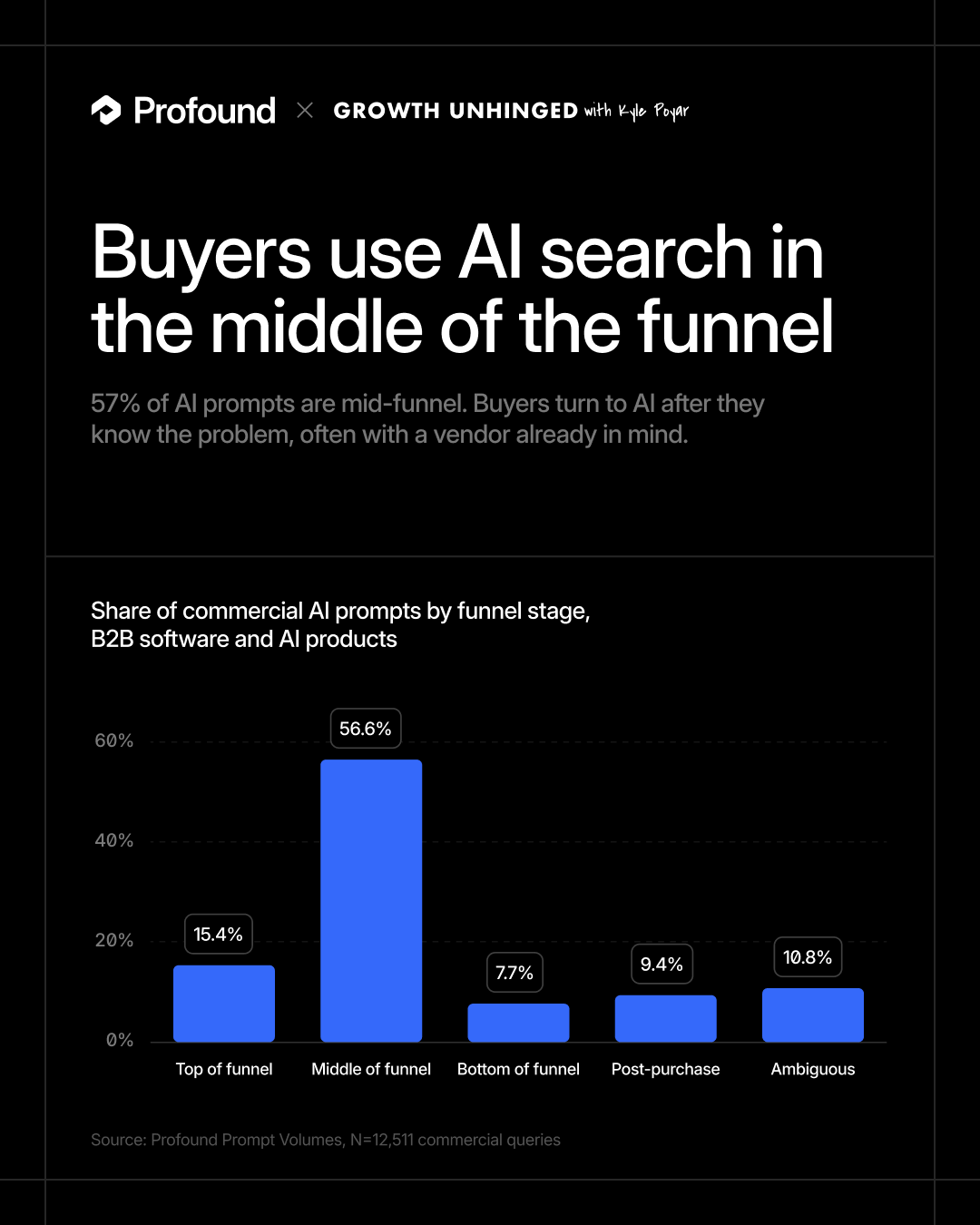
Just 15% of prompts were top of the funnel, which is the opposite of what you’d assume when picturing a funnel! These were slightly more common for AI coworkers (21% of prompts), which is the newest product category in our dataset.
Roughly 8% of prompts were in the bottom of the funnel, which is actually higher than I expected. At this stage buyers are talking directly to their shortlist of vendors, yet they still turn to AI for answers. The rest were post-purchase or ambiguous.
How to use this data: Optimize your AI search presence around the mid-funnel where buyers are evaluating products. Do this by writing specific pages for each persona, industry, and use case (HubSpot built 141 of these pages). Use your sales calls as keyword research, helping you find real buyer questions that show zero volume in traditional search tools. Audit past content and rewrite pages to ensure you describe yourself the same way everywhere.
Insight 2: Buyers vet pricing earlier than you’d think
Next we investigated what exactly buyers were asking about.
The biggest theme was pricing, which was the focus of 5.5% of commercial prompts. This included any query related to product cost, budget, free options, or value for money. (Unfortunately, relatively few B2B companies have optimized their pricing for AI readability.)
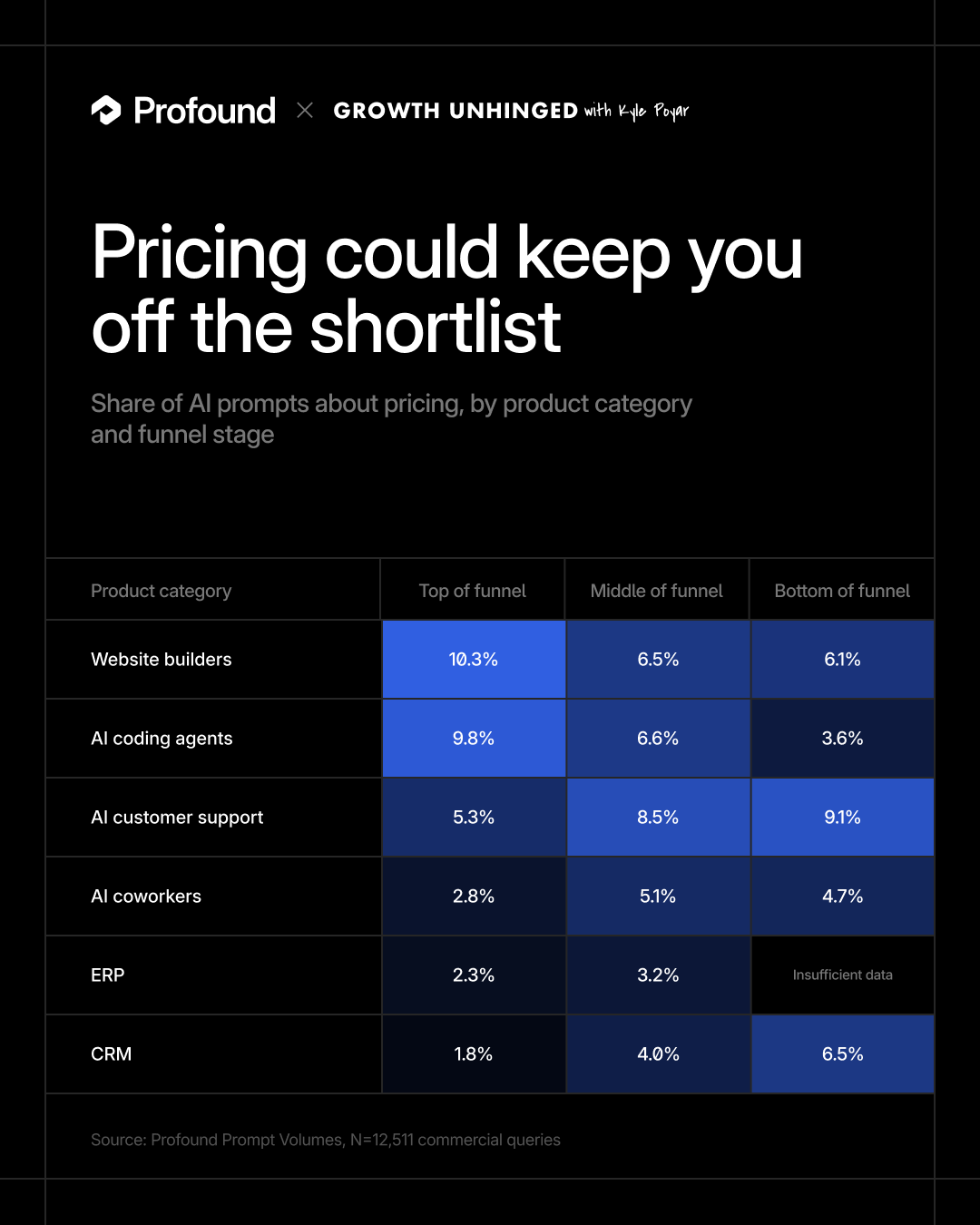
I expected pricing to be mostly a mid- and bottom-of-funnel topic. That’s the case for SaaS products like CRM and ERP where just 2% of top-of-funnel queries are about pricing.
People buying AI products seem to be especially price conscious, though. Or they don’t yet have a reference for how much these products will cost. 10% of top-of-funnel queries for AI coding agents and website builders were about pricing. That makes opaque pricing a risk from the very first prompt.
Insight 3: Buyers want to know what your product does before they see a demo
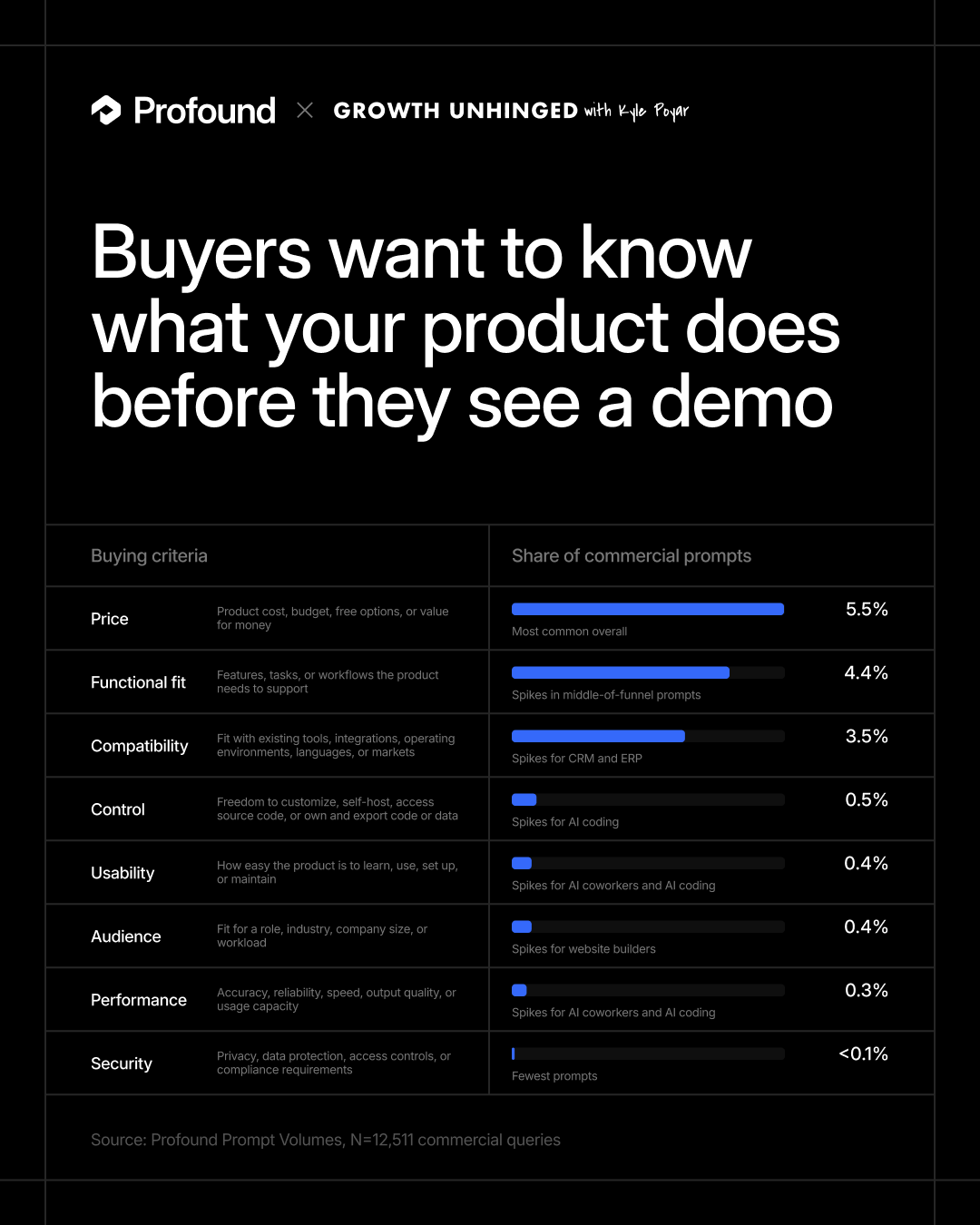
Aside from price, buyers are interested in functional fit (4.4% of queries) and compatibility with their existing tools and operating environments (3.5% of queries).
These used to be things you’d cover on a demo. Now AI engines are describing them for you, and missing or outdated content could block you from being able to explain yourself.
Control, usability, audience, performance, and security came up less frequently than I expected (<1% of queries), although it differed by product category.
Your product could be mentioned, only to be dropped from the shortlist when a buyer asks about pricing, functional fit, compatibility.
The average B2B company designs their AI search strategy around getting mentioned or cited in AI answers. What really matters is what’s being said in these answers.
Insight 4: Buyers are asking AI for a recommendation
I think it’s especially revealing to see exactly how buyers ask AI about products.
Most companies focus on being recommended in prompts like “what’s the best CRM for small businesses.” There’s a good reason why.
Nearly 15% of commercial queries were asking AI for a recommendation. These were usually framed as Recommend X or Best X, likely with modifiers based on what the buyer cared about.
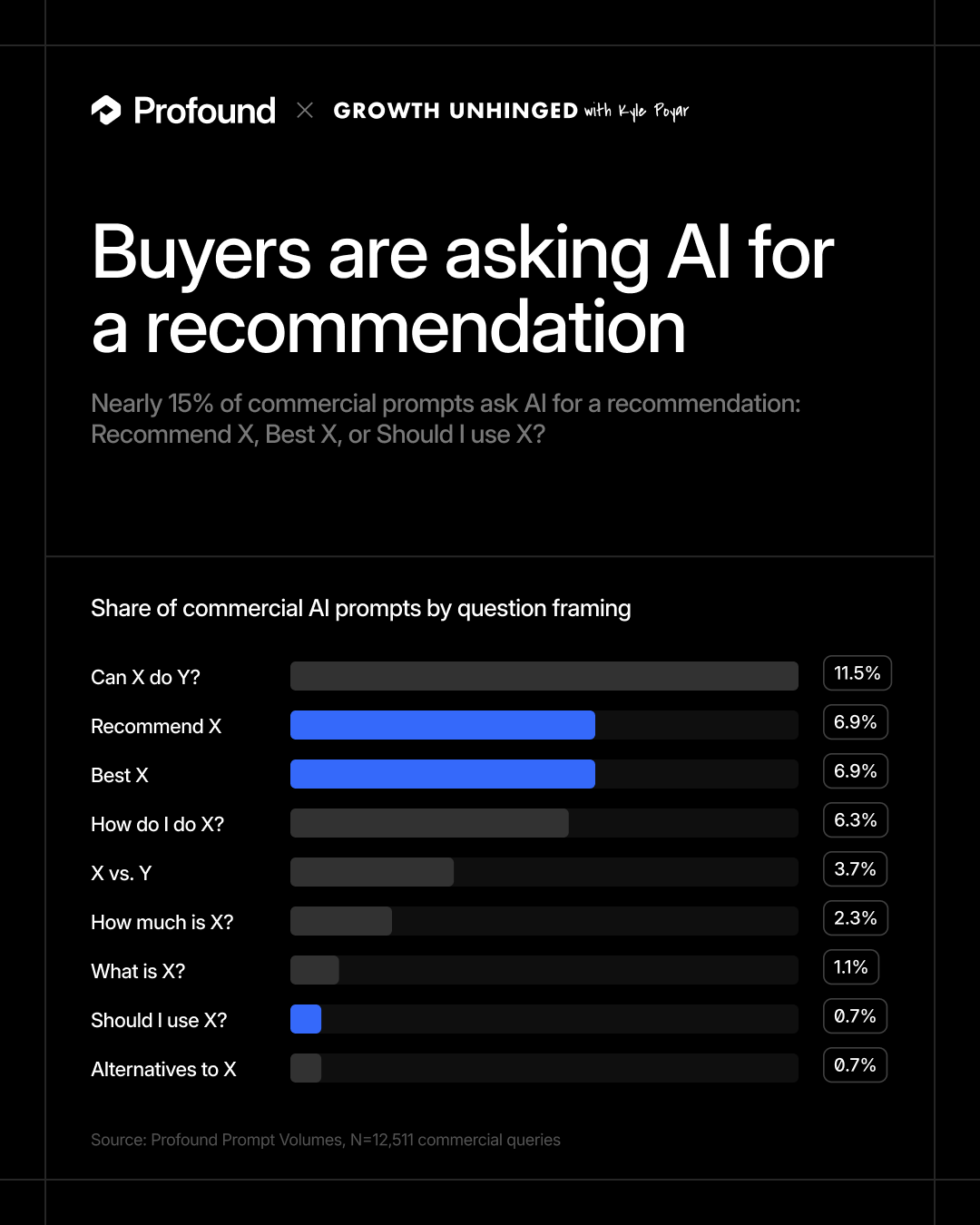
This is similar to my experience building the Growth Unhinged MCP. I trusted Claude to find the best products given my exact situation, and picked its top recommendations.
Where you land on the AI shortlist makes a world of difference: being fourth is the equivalent of landing on the second page of Google. Track where you rank, not just how often you’re mentioned.
Insight 5: The AI recommendation might not be enough
I wanted to see how the question framing changed based on the stage of the funnel.
What I found is that the AI recommendation usually happens in the middle of the buying journey. What’s recommended gets shaped based on what the buyer is trying to do (‘How do I do X?’). It’s then pressure-tested against the buyer’s specific criteria (‘Can X do Y?’ and ‘How much is X?’).
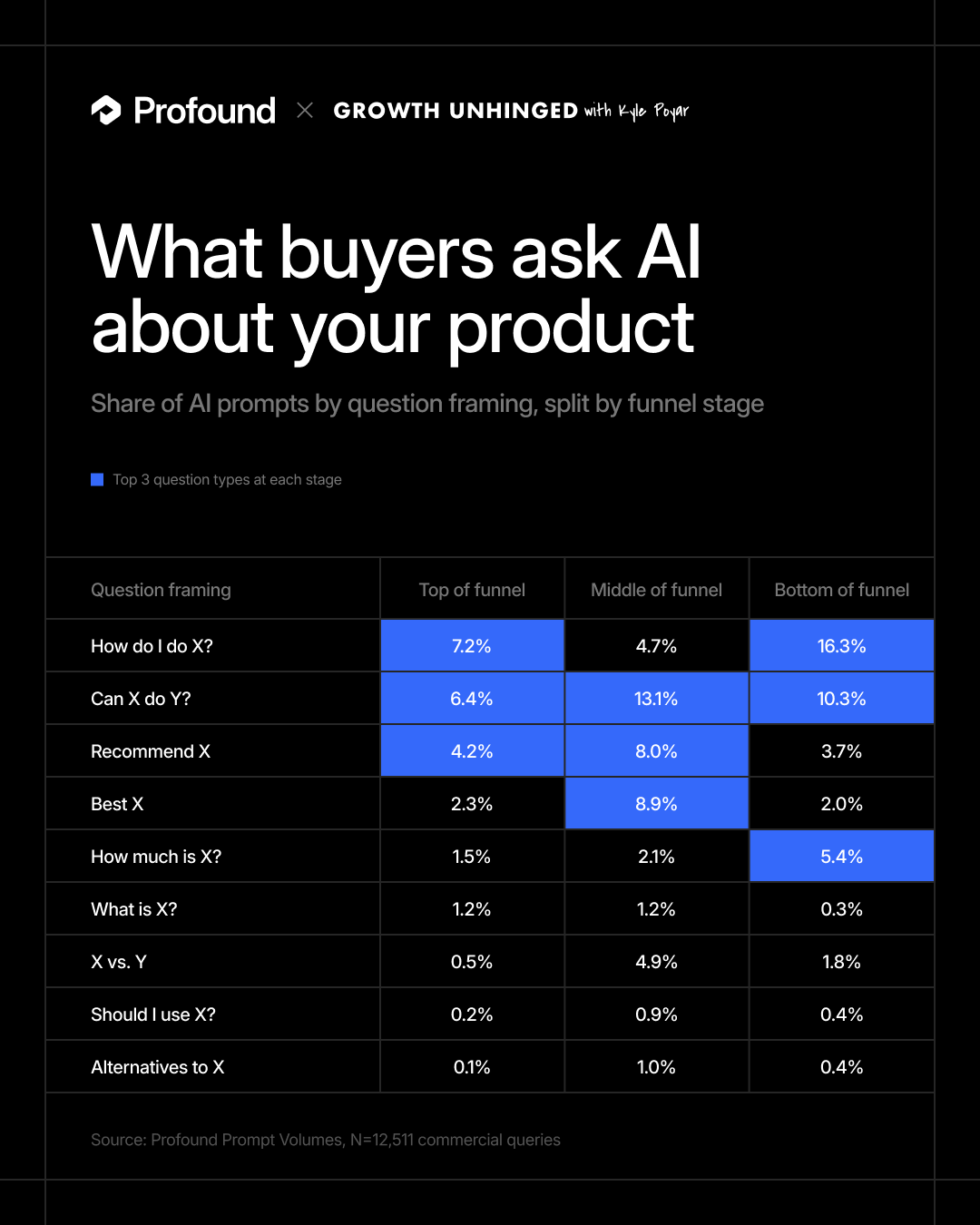
Track how frequently you’re recommended in AI answers. Complement this with AEO metrics at the product- and feature-level, especially as you bring new products to market. Then check that what AI says about your product is accurate, from pricing to features.
What to do with these insights
AI hasn’t replaced the B2B buying journey entirely. It’s taken over the long, messy middle.
Buyers rarely discover a category through AI: just 15% of prompts are top-of-funnel. They show up already aware of the problem, often with a vendor in mind, and use AI to build and pressure-test a shortlist.
That means three jobs:
- Create demand outside of AI. Awareness still comes from people, content, and communities.
- Get recommended once buyers start asking AI for answers. Track how often you show up in “best X for Y” answers.
- Make sure the answers about you are right. Pricing, functional fit, and integrations are where recommendations get pressure-tested.
Get this right and buyers reach your site already having made up their mind.


