
Introduction
Since the launch of ChatGPT, brands have been scrambling to understand how they show up in AI conversations. Our focus at Profound has been building tools to help. The harder question to answer is what happens after AI mentions a brand. Does the person who received the brand mention go on to visit that brand’s website? Do they do so at a higher rate than they otherwise would have?
Surely AI mentions have an impact on downstream browsing behavior? In some sense this is the bet that Profound is built on: that it matters how, where and why AI talks about your brand. This study represents our first direct measurement of this behavior: using a data panel of real-user AI and browsing behavior, we measure AI’s impact on downstream page visits directly, by joining what people saw in AI responses to what those people did next in their web browsing.
Key Takeaways
- AI mentions drive real downstream traffic. After an AI assistant mentions a brand, users visit that brand's website at 1.5–2.5x their forecasted baseline rate over the following 7 days.
- Platform impact varies significantly. Gemini shows the largest relative lift (~2.5x baseline), Google AI Overviews has the largest absolute lift and exposure volume, and ChatGPT delivers the most consistent uplift across industries (38–86% above baseline).
- Most visits aren't instant, but many aren't slow either. 20.5% of downstream visits happen within an hour, 42% within 24 hours; but the majority occur after day one, which is why a 7-day window (not just click-through) is the right way to measure impact.
- Standard attribution massively undercounts this effect. Even after ChatGPT's May 2026 update made links more clickable, only ~2.5% of downstream visits carried a trackable AI-referral parameter.
The data behind this study
This study is built on a double-opt-in, privacy-safe panel of real-user AI conversations and web browsing in the US. The data is anonymized and reported here exclusively at the level of category and platform.
Crucially, the panel captures both sides of the user journey: an AI-interaction stream, recording the prompts and responses a user exchanged with an AI assistant, and a browsing stream, recording the pages they subsequently visited.
We analyzed more than 2 million AI conversations and associated browsing activity from January through June 2026. The data spans three AI platforms: ChatGPT, Gemini, and Google AI Overviews.
Definitions
An AI-exposure is a brand mention that does not appear in the user's prompt but does appear in the AI response. Cases where the user independently introduces the brand name suggest preexisting brand interest, so we omit them.
A match is a downstream brand-site visit: did the same user subsequently navigate to the mentioned brand's own website?
Experimental Setup
Measuring the raw rate that AI mentioned a brand and the user later visited that brand's website overstates the impact of the AI mention, because some of those visits would have happened anyway. To separate the signal from baseline, we use a forecasted backward-placebo design.
For each brand exposure, anchored at the response time T, we measure whether an AI-exposure visit occurs in the treated window: the seven days after the response. We compare that against the same user's behavior toward the same brand website in three equal-width placebo windows before exposure. We then use those pre-period windows to forecast the expected post-exposure baseline. The forecast-adjusted lift is the treated seven-day visit rate minus the linear forecast from the three prior seven-day placebo rates.
We also apply a filter to remove AI-exposures where the user searched for or visited the brand in the prior week, and we omit common-platform and generic high-traffic domains. Finally, we report confidence intervals from a user-clustered bootstrap: 2,000 replicates, resampling users with replacement and recomputing both the treated rate and the forecasted placebo baseline in each replicate.
Over 7 days, AI mentions drive up to 1.5-2.5x brand site visits
Across every platform, AI-introduced exposures are followed by a higher seven-day matched-site visit rate than the forecast baseline. After an AI assistant introduced a brand into conversation, users were measurably more likely to visit that brand's site over the following week than their own prior behavior would predict.
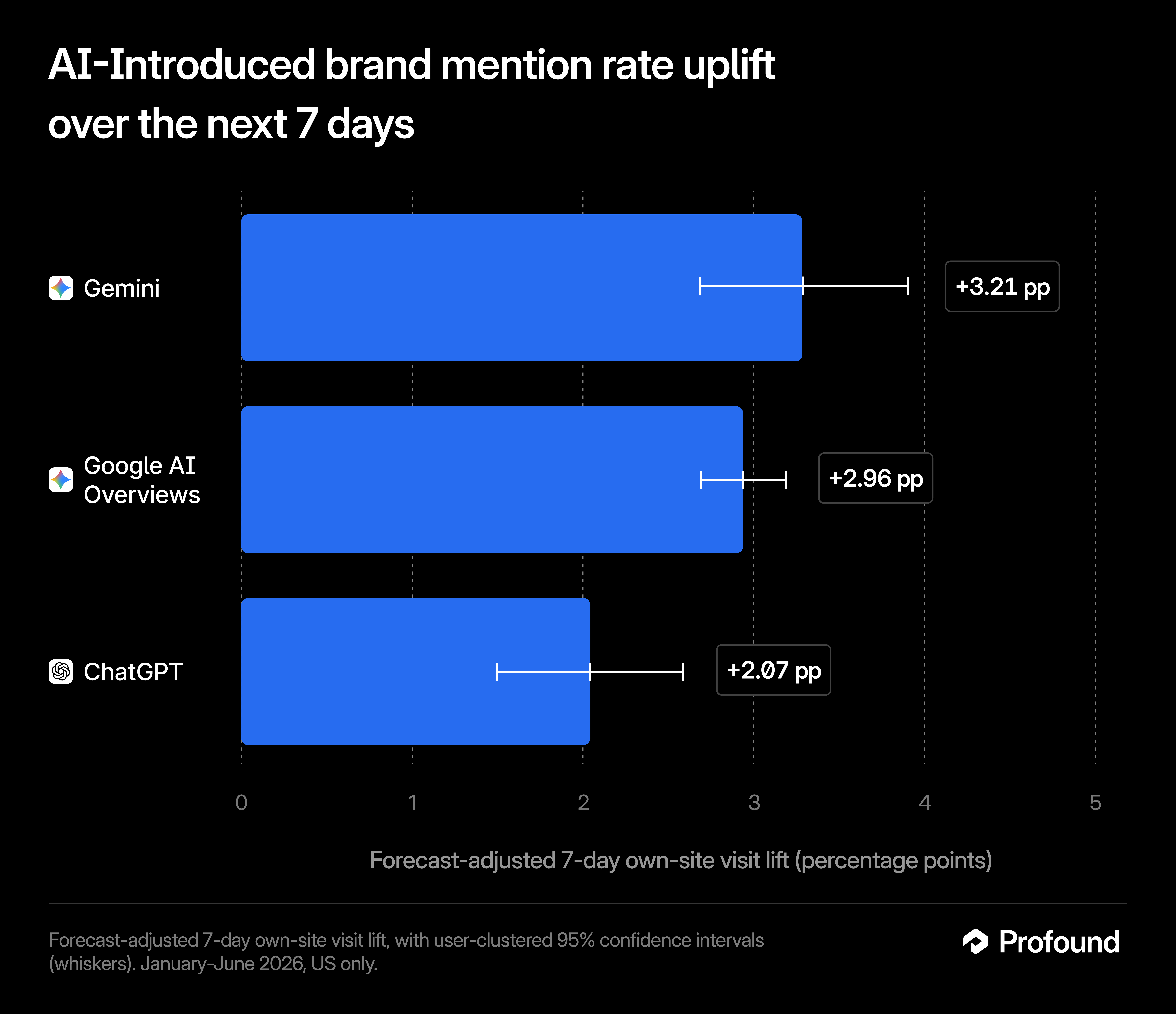
AI mention to site visit 7-day uplift, by platform
Table 1. Forecast-adjusted 7-day own-site visit lift, with user-clustered 95% confidence intervals. January-June 2026, US only.
Gemini shows the largest relative increase, lifting visits to roughly 2.5x its forecast baseline (5.42% versus 2.21%). Google AI Overviews carries the largest exposure volume and a large absolute lift (7.79% versus 4.83%). ChatGPT lifts visits to about 1.5x baseline (6.39% versus 4.33%). This effect is consistent across platforms. All three AI assistants show matched-site visit upticks following an AI-introduced exposure.
The uplift varies by industry
The uplift is positive across the major AI platforms, but its magnitude varies considerably by industry. The color in each cell below is scaled to the size of the percentage-point lift within that platform; the small number is the same lift expressed relative to the forecast baseline.
AI mention to site visit 7-day uplift, by vertical
Table 2. Forecast-adjusted 7-day brand-site visit lift following AI-exposure, by industry and platform. January-June 2026, US only.
The percentage-point uplift is distinct from the relative impact on the forecast baseline. A practical reading for marketers is that not all AI platforms are created equal for driving users to your brand's website. Where you focus depends on the industry you compete in.
Many downstream visits happen quickly
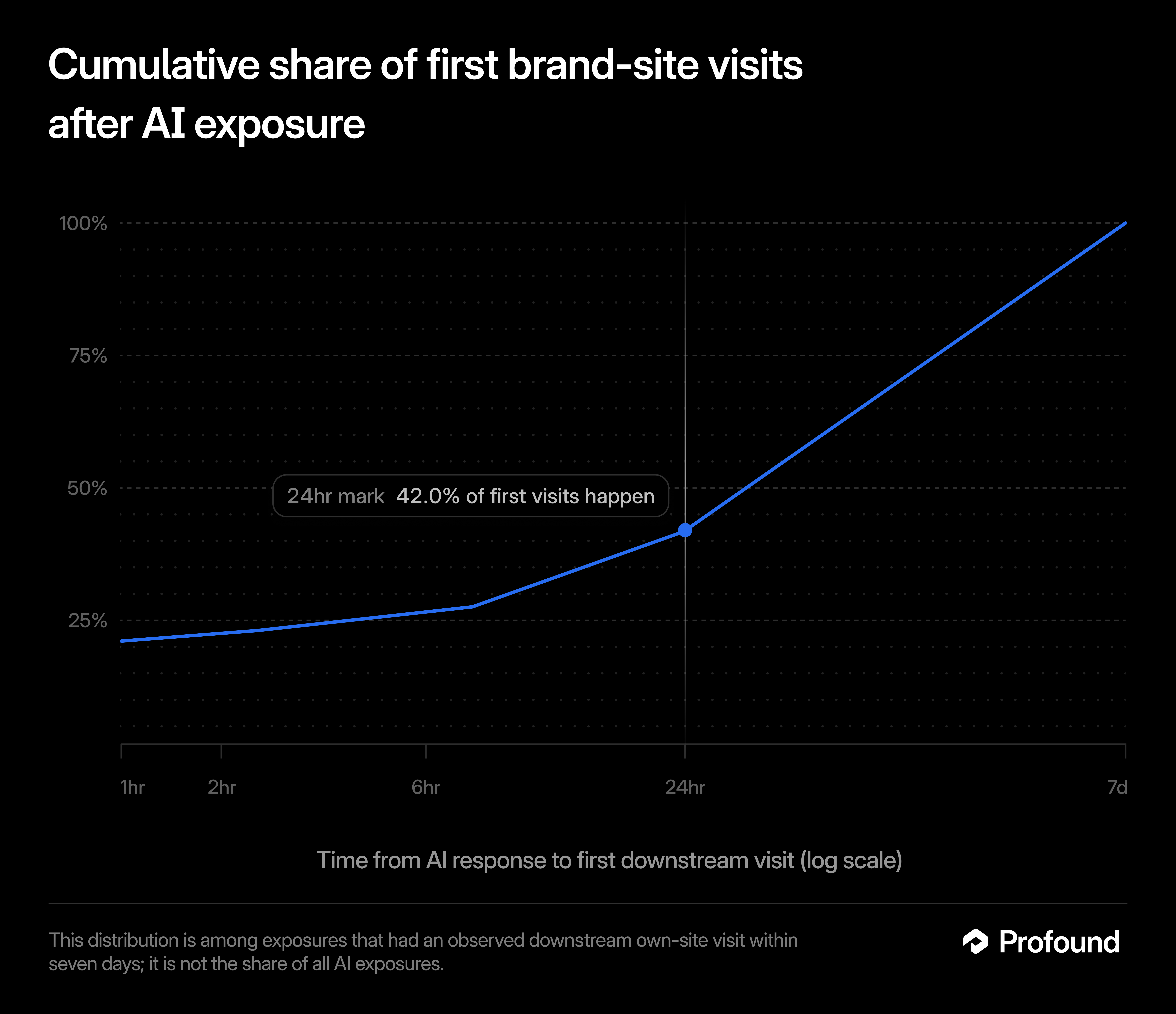
We also looked at the distribution of time from the AI response to the first downstream brand-site visit. This answers a practical question: are visits bunched close to the AI mention, or spread across the full seven-day window?
The answer is both. A meaningful minority of visits happen quickly, but the majority of first visits occur after the first day, which supports using a seven-day outcome window rather than only same-session or same-hour clicks. Across all platforms, 20.5% of first visits occur within one hour and 42.0% within 24 hours. Google AI Overviews is the most immediate (45.7% within a day); ChatGPT follows (38.7%); Gemini is the slowest on this measure (30.0%).
Tracking click-throughs misses most of the traffic
We also audited how often users clicked through to brand websites directly from AI. To do this we looked at how often the first post-AI-exposure visits contained a UTM tag or other AI-referral parameter. Our findings: product-matched AI-referral parameters are visible mainly for ChatGPT, where they account for roughly 1.0% of post-exposure visits from January through April, rising to 1.79% in May and 2.47% in June. June is partial, so its value should be read as directional.
This uplift in direct traffic from an AI mention coincides with the early-May 2026 change that made ChatGPT answers more clickable; as such it is unsurprising that a larger share of downstream brand visits arrived directly from AI. That said, even with the increase in directly attributable downstream traffic, more than 97% of these brand site visits still did not include a UTM.
ChatGPT AI mention to site visit 7-day uplift, before-and-after May 7
Table 3. ChatGPT forecast-adjusted lift before and after the early-May 2026 link change, with 95% confidence intervals. US only.
There is a moderate uplift in the 7-day mention-to-visit uplift around this May 7 event, +2.16% vs +2.00% respectively. Even taking this effect into account, the overwhelming majority of post AI-mention brand traffic occurs downstream of the immediate next click.
What this means for your brand
Even if it’s not directly measurable, AI is driving more traffic to your website. When an AI assistant mentions your brand in conversation, that same user is measurably more likely to visit your site over the next week than their own recent behavior would predict. The visit happens; your analytics just cannot always see when the journey started or how they got there.
AI visibility behaves, for now, like a billboard: its impact shows up in what people do hours and days later. With model updates like clickable links in ChatGPT, shopping, and ads, we expect the measurable impact of AI on brand website traffic to increase. We also expect the majority of the effect to remain downstream of the next click.
Actions you can take today:
- Match your effort to the AI platform. The assistant that best moves your category is not the same one that moves the next. Put weight where your category has the most uplift from AI mentions.
- Measure three layers together. Visibility (do you appear), behavior (does appearance lead to a visit), and context (is that lift strong for your category and platform) all impact performance together. Profound’s Answer Engine Insights, Agent Analytics and Profound Index are three tools to help you understand each layer for your own brand.
If you are not yet a Profound customer and want to learn more, we encourage you to schedule a demo.
Methodology
Panel
A double-opt-in, privacy-safe panel of consenting users in the US, including AI interactions (prompts and responses) and browsing data (page views).
Exposure
An AI-introduced exposure is a brand mentioned in the AI response but not in the user's prompt, isolating cases where the assistant raised the brand rather than where the user already had it in mind. The study covers January-June 2026 across ChatGPT, Gemini, and Google AI Overviews.
Forecasted backward-placebo lift
Anchoring at the response time T, we measure the own-site visit rate in the seven days after exposure and compare it to a forecasted baseline built from those same users' own-site visit rates for those same brands across three equal-width seven-day windows before exposure. The final lift is the treated seven-day rate minus the forecasted seven-day baseline. Rates are computed across all exposures in a platform-by-category cell.
Headline filters
To isolate genuine discovery, the main population requires prior-week observable browsing, excludes common-platform and generic domains, and drops any exposure where the user had already searched for or visited that brand in the prior week.
Confidence intervals
User-clustered bootstrap, 2,000 replicates, resampling users with replacement and taking the 2.5th and 97.5th percentiles.
Caveats
This is a site-visit study, not a purchase or conversion study, and not a randomized experiment. The forecasted placebo design controls for the same user's recent baseline and pre-exposure trend, but does not fully eliminate selection bias between exposed and non-exposed users. Results are reported at platform and industry level; individual brands are excluded from publication.


