

Personal agents can search for products, compare them against each other, and make purchasing decisions on behalf of users. For marketers, that raises a practical question: how do these agents decide which products make the shortlist? And how big of an opportunity is this?
Meta’s Muse app has been downloaded over 2.5 million times since its launch on September 8. Instinct, a personal agent that lives in your phone’s text messages, is reportedly approaching an annualized transaction volume of $1B.
What are personal agents?
Personal agents use large language models to carry out requests for users, much like a personal assistant would. Today’s Answer Engines focus on search and knowledge work, whereas personal agents are designed to help with everyday tasks like making dinner reservations, canceling forgotten subscriptions, purchasing items, or planning trips.
Unlike typing into a chatbot and waiting for an answer, the experience feels more like texting another person: agents can proactively raise issues or opportunities, and everything happens in one ongoing conversation.
Marketers have spent the past couple of years shaping how Answer Engines talk about their brands. Personal agents expand the challenge from influencing what AI says to understanding how AI acts on a user’s behalf.
How are personal agents different from Answer Engines?
Personal agents are built on the same foundational components as Answer Engines, but they utilize richer personal context and defined workflows to act more autonomously.
- Context: Personal agents build detailed profiles of their users, capturing preferences and lifestyle facts that may be relevant to future tasks. They draw on past conversations and sources the user chooses to connect, such as their email, calendar, or messaging apps. Muse, for example, maintains a shopping profile for each user that records tastes by product category. This context enables agents to make choices that reflect a user’s needs and preferences.
- Workflows: Muse and Instinct use detailed instruction files that act as operating guides for tasks such as shopping. These files define how each agent gathers context and uses tools to move from a request to a result, establishing repeatable processes designed to reliably produce helpful and useful outputs.
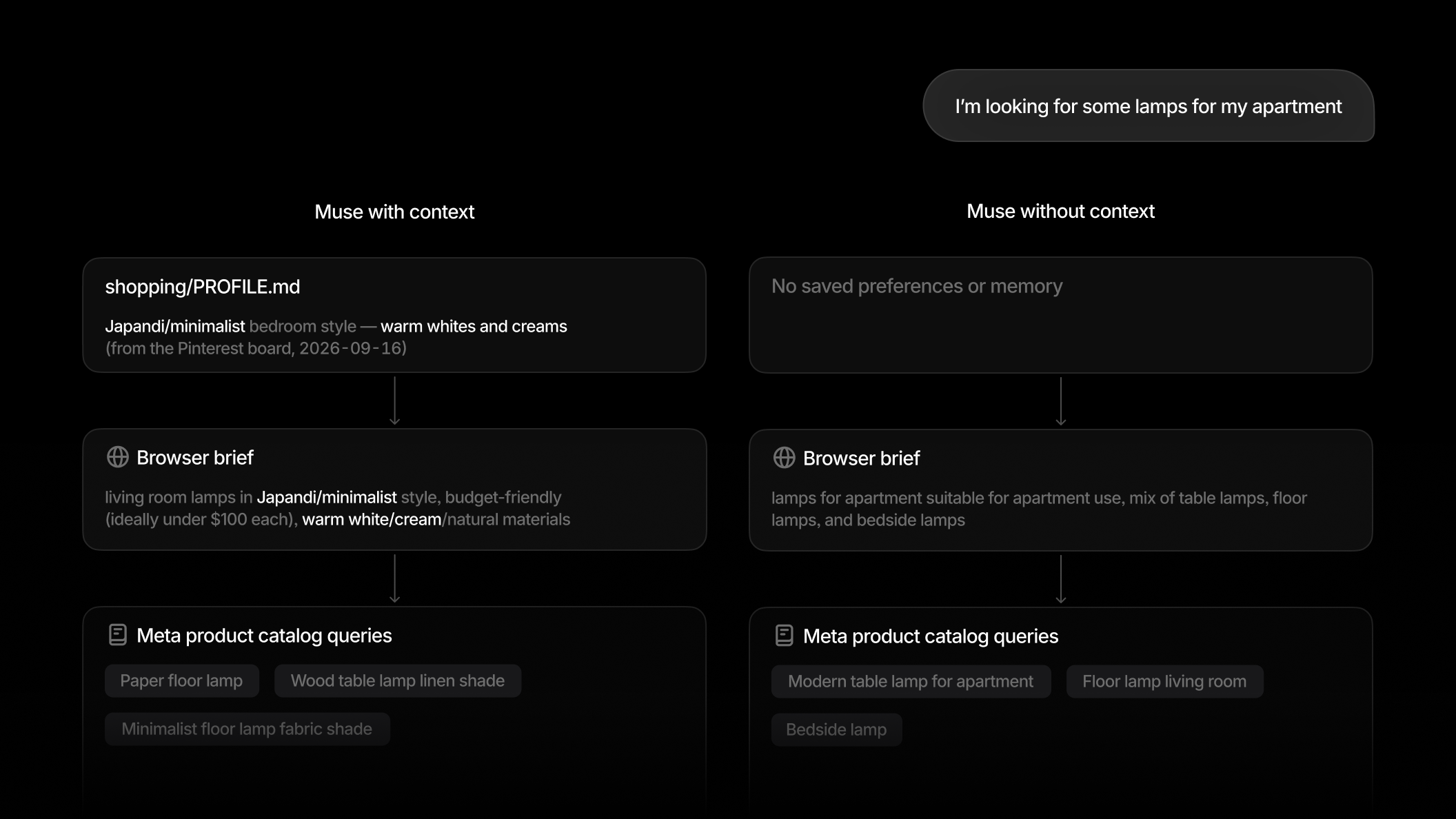
There are two additional differences between these agents and Answer Engines that have practical implications for marketers:
- Personal agents navigate websites under different rules. Answer Engines read the static content of webpages that have previously been discovered and indexed by bots. Muse and Instinct, in addition to fetching static content, can also visit your website live and read each page using a browser. They navigate pages using the accessibility tree, a structured description of the page's content and controls that the browser builds from your HTML and accessibility labels. Using semantic HTML and clear labels make that description more complete and accurate, helping agents understand how to use your site.
- Conversations don’t contain citations. By default, Muse and Instinct do not name the sources they visit when gathering realtime information for a response. Measuring how website content influences these agents’ decisions will require alternative signals.
How are Muse and Instinct different?
ChatGPT and Claude reference different sources and generate different responses for the same query. Likewise, Muse and Instinct are also built differently, relying on different models, tools, and sources.
To start, they use different underlying large language models, which shape how they respond and make judgements. They also draw on different integrated sources when discovering products for shopping queries. Muse has access to Meta's product catalog and Facebook Marketplace, whereas Instinct searches Shopify's catalog.
How does Muse shop?
Personal agents differ from answer engines in how they act, not just what they know. To see how personal context and defined workflows shape a personal agent’s behavior, here's what happens when a user makes a shopping request to Muse:
- Conversation: After the user expresses shopping intent, Muse may ask follow‑up questions to further narrow the request if necessary. It always checks the user's shopping profile for recorded preferences, and it sometimes searches its memory for additional context.
- Discovery: Muse kicks off two searches in parallel. It uses a browser to search merchant sites, and separately queries a Meta product catalog in parallel. This catalog also powers shopping on Instagram and Facebook.
- Recommendation: The candidates from the browser session and Meta product catalog query are filtered and ranked, resulting in a final recommendation set.
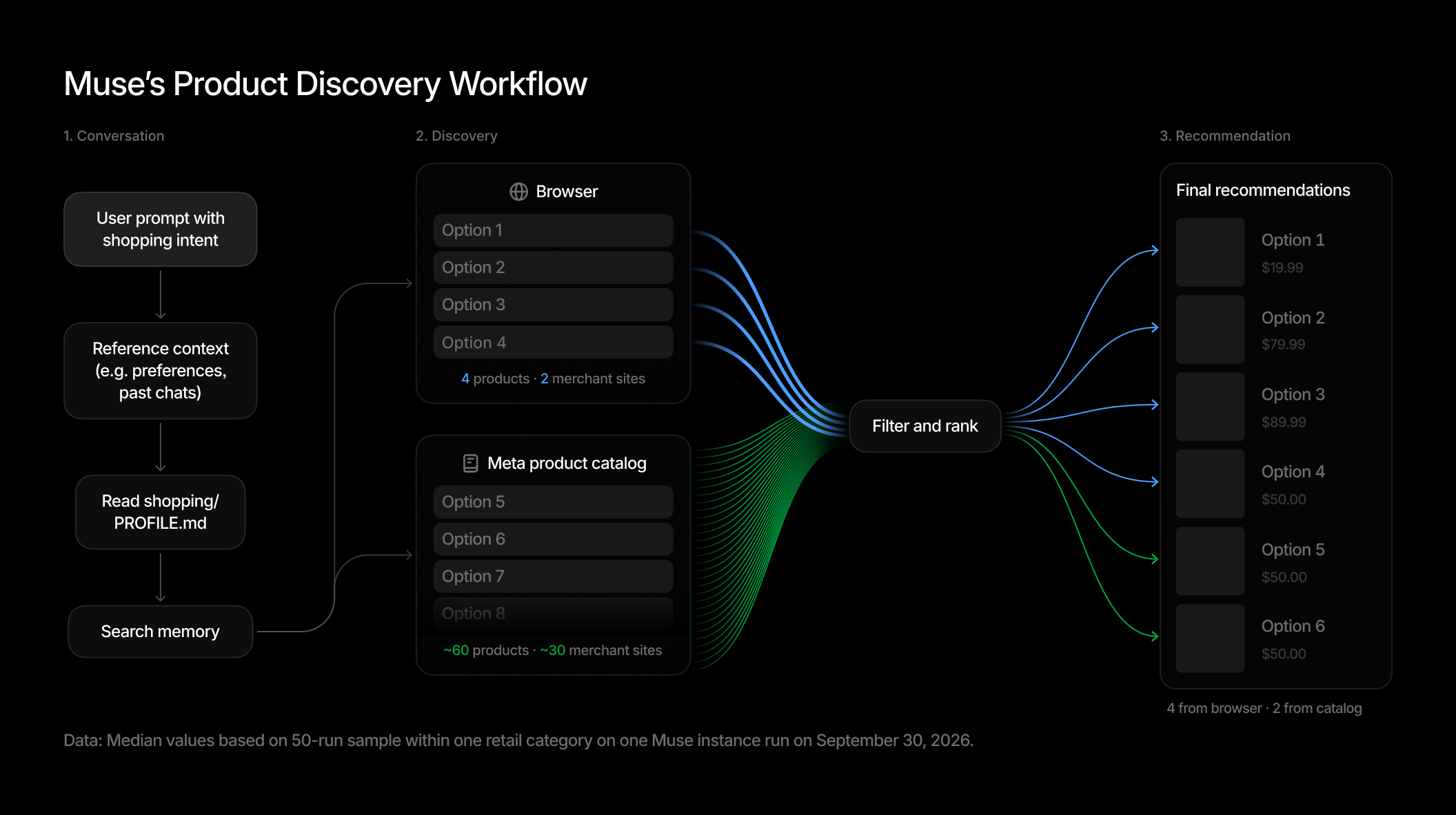
How much does each source contribute to discovery and recommendation? To see this workflow in practice, we ran 50 prompts from a single consumer retail category through one Muse instance. This is a small, exploratory sample, so the patterns below are illustrative rather than definitive. For each prompt, we found that:
- The browser typically visited 3 domains and returned 4 products from 2 merchant sites.
- Meta’s product catalog returned roughly 60 products from 30 merchant sites.
- The candidate sets were combined and filtered to produce Muse’s recommendations, which typically contained 6 product cards: 2 from the catalog and 4 from the browser.
We’re still learning more about Muse's shopping behavior across retail categories, but marketers can make sure their brand's products are visible to Muse now by including them in Meta's product catalog and having web pages that are easy to read and navigate via the accessibility tree.
What can we see in website traffic?
Unlike some answer engines, Muse and Instinct do not identify themselves by name when browsing websites. Instead, they route traffic through residential internet connections and present as ordinary human visitors, which makes them difficult to separate from human traffic. Fortunately, Muse's staggered rollout, reaching the US and Canada before the rest of the world, lets us obtain a conservative estimate of its traffic by comparing visit trends across geographies.
In our manual tests, some Muse browser sessions triggered a self-identified "meta-webindexer" bot immediately before the human-passing visit(s). Historically, requests from these bots have come from IP addresses publicly claimed by Meta. These did not. We treat these unverified requests as a signal of trends in Muse activity.
In the 20 days after Muse launched, the increase in unverified meta-webindexer requests, relative to a 20-day pre-launch baseline, was 1.6 times as large on US and Canada websites as on websites in the rest of the world.
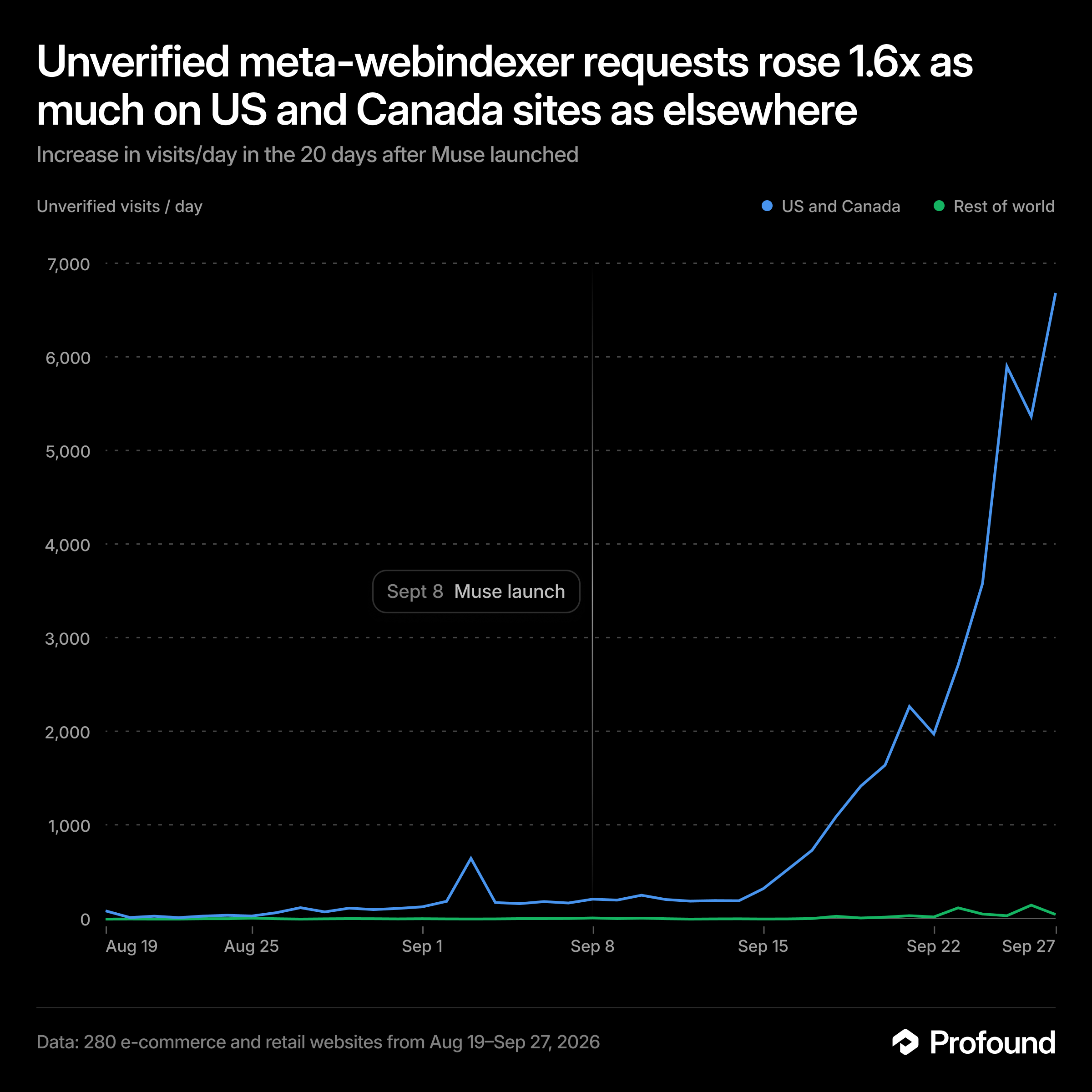
This is only a proxy for Muse traffic, but it’s an early sign that agents are driving a meaningful and rapidly growing volume of web traffic. They are navigating websites with a user in mind, evaluating products to recommend or even purchase for that person. All marketers should be keeping an eye on this.
What it means for marketers
- The fundamentals of AEO haven’t changed. AI still needs to understand your brand and products to recommend them accurately.
- Make your products visible to personal agents. Include your products in the feeds that agents integrate with, such as Meta product catalog and Shopify product catalog. Additionally, test that agents can navigate your website in the browser.
- Explain who each product is for. Make intended uses, compatibility, dimensions, materials, and relevant limitations easy to find. Agents are comparing products for each unique user with unique needs and preferences, so give them the right information to decide.
Get started
Profound helps companies understand how AI represents their brand, monitor how visible their products are in AI responses, and track AI agents reading their website. Book a demo to get started.
Methodology
We provide additional details on our estimate of Muse traffic.
Data. We counted daily unverified meta-webindexer requests to e-commerce and retail websites tracked by Profound from Aug 19 to Sep 27, 2026. A request is unverified if it identifies itself as meta-webindexer but does not come from IP addresses publicly claimed by Meta.
Exclusions. We excluded 15 high-volume domains that showed evidence of being targeted by automated activity. They received tens of thousands of requests a day from only a few hundred IP addresses.
Groups. The remaining set has 115 unique hostnames belonging to the US and Canada, and 165 belonging to the rest of the world. We assign each domain to a country by its suffix (for example, .uk to the United Kingdom).
Periods. The baseline is the 20 days before Muse launched (Aug 19 to Sep 7). The post-launch period is the 20 days from launch (Sep 8 to Sep 27).
Calculation. For each group, we averaged requests per day in each period and calculated the percent change from the baseline average. The headline compares the two percent changes: 1,313% ÷ 827% ≈ 1.6.


