
SEO has always rewarded patience: a page earns links over months, a domain earns trust over years, and a ranking, once won, is something you hold.
To determine whether that model transfers to AI search, we measured how long citations last for 883,000 pages across ChatGPT, Perplexity, Claude, Google AI Overviews, Google AI Mode, Google Gemini, and Microsoft Copilot over twelve months, using the Profound platform's citation decay metric. Each page is measured separately on each engine that cites it, which yields 1.19 million page and engine lifecycles.
We found that authority in AI search expires rather than accumulates. The median page loses half its citation share within 11 days of peaking, and the median interval from a page's first citation to the point where it has lost half its peak share is 42 days. Four findings follow.
- Most AI citations are single events. 78% of cited pages fall to half their peak share within two weeks of peaking. The remaining 22% have a median half-life of 27 to 29 days.
- Which engine cites you matters, and engines do not move together. Among pages that last beyond two weeks, a Claude citation is 2.8 times as likely as a ChatGPT citation to still be relevant eight weeks later. When a page decays on one engine tells you almost nothing about when it decays on another; cross-engine correlations run between 0.03 and 0.09.
- Being broadly cited predicts lasting anywhere. Pages cited by five or more engines are 5.5 times as likely as pages cited by one to still be above half their peak share after eight weeks.
- Pages tied to a date or event fade first. Everything else holds at 1.4 to 1.6 times their rate.
How we define half-life
For each page an engine cites, we measure citation share (how frequently it is cited relative to all other pages in its category), by day, and identify the day of peak citation. Half-life is the number of days after that peak required for the page to fall to half its peak level and remain there. A page that never does so is classified as still holding. The full specification, including smoothing, qualification floors, and the treatment of pages that have not yet decayed, is provided in the methodology.
Four in five AI citations are single events
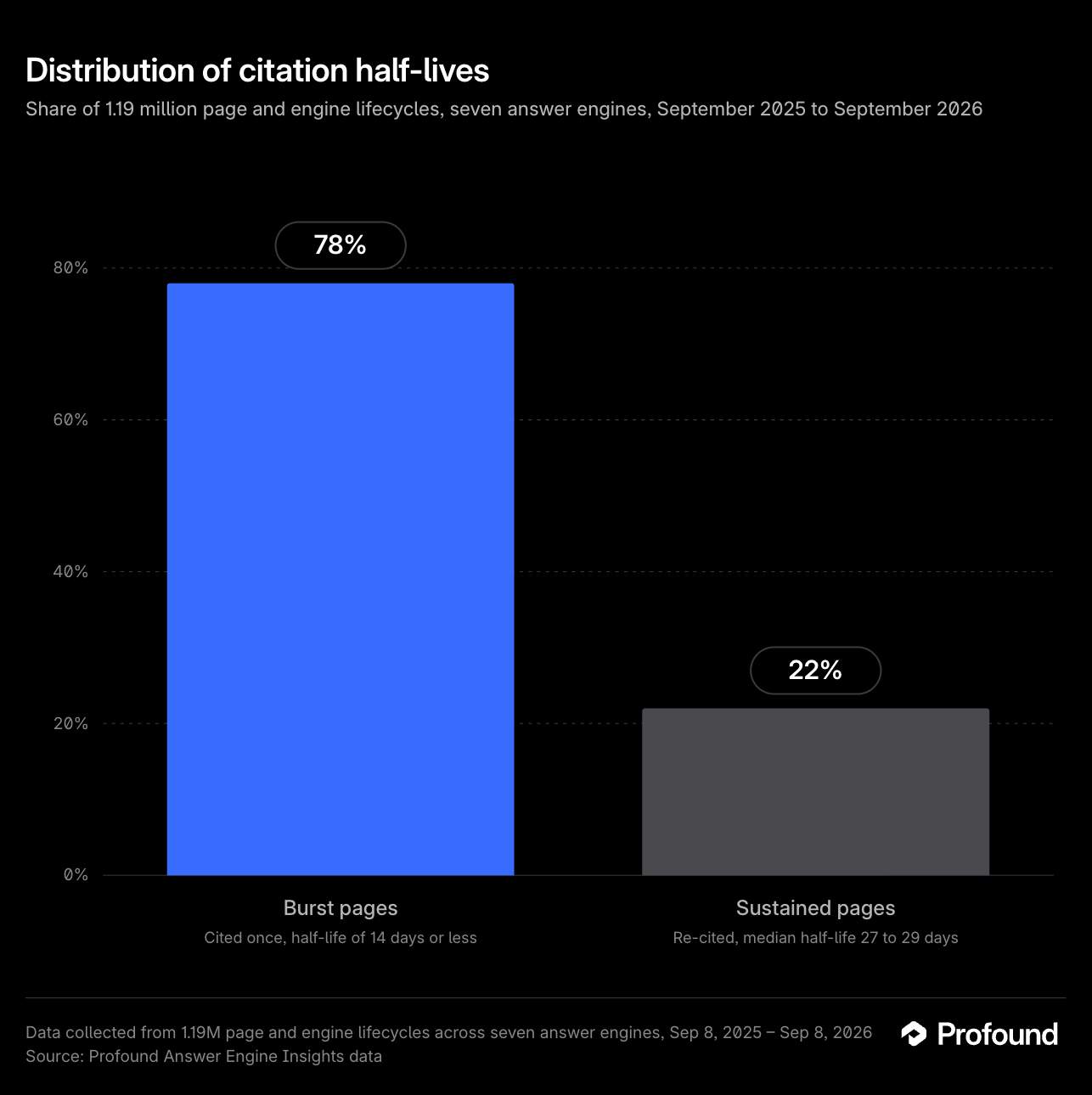
Of the 1.11 million page and engine pairings observed for at least two weeks past their peak, 78% have a half-life of fourteen days or less. The remaining 22% persist beyond it.
Most of these short-lived pages appear in a single burst of citations and are never cited at that rate again. Because citation shares are averaged over a rolling two-week window to suppress daily noise, a burst holds a page's share up for as long as it remains inside that window. Two weeks is therefore the longest half-life a page cited once can have, and most land at or just below it.
The reason so many pages fall there is the breadth of the source pool. A human searching the web saw roughly ten blue links; an Answer Engine draws from a pool several orders of magnitude wider. When the pool is that wide, the probability that any given page is cited a second time is low, and the burst pattern follows directly.
This divides cited pages into two populations with little in common. Burst pages are cited within a short interval and not thereafter; with a median rise of roughly 20 days, their full arc from first citation to half-peak runs a little over a month. Sustained pages continue to be cited after their initial burst. Their median half-life is 27 to 29 days depending on engine, and their median rise from first citation to peak is 36 to 46 days. The remainder of this analysis concerns the sustained population: how it behaves across engines, and what predicts membership in it.
The engine you are cited on matters most
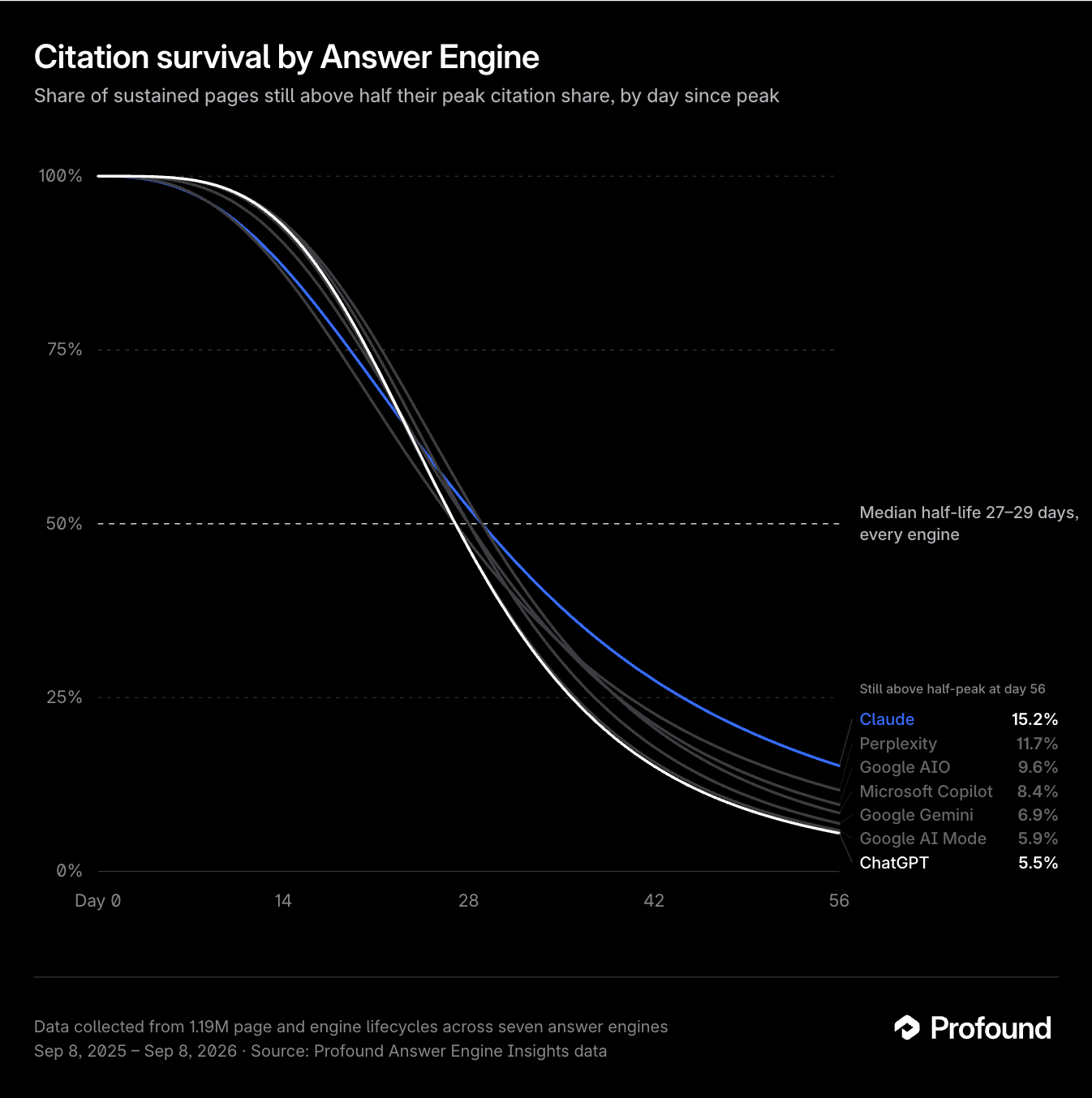
The median half-life varies little across engines; however, engines begin to diverge after four weeks. A sustained page on Claude is 2.8 times as likely as one on ChatGPT to still carry half its peak share two months out.
Part of what separates the top two engines from the rest is how they cite. Perplexity and Claude return to a page repeatedly, so its citations are spread across weeks. ChatGPT, Google AI Mode, and Gemini tend to cite a page intensively over a few days and then stop. Among sustained pages, 62% of Perplexity's and 63% of Claude's had their citations spread across weeks before peaking, compared with 18% to 26% on the other five engines, where 37% to 46% of pages instead had citations concentrated into a few days.
Every engine makes its own decision
For pages cited on more than one engine, we tested whether their lifecycles move together, meaning whether a page dropped by one engine tends to be dropped by the others at the same time.
The correlation between how long a page lasts on one engine and how long it lasts on another is 0.03 to 0.09, effectively zero, for every pair except Google's three surfaces, which correlate with each other at 0.12 to 0.17. The engines decide independently.
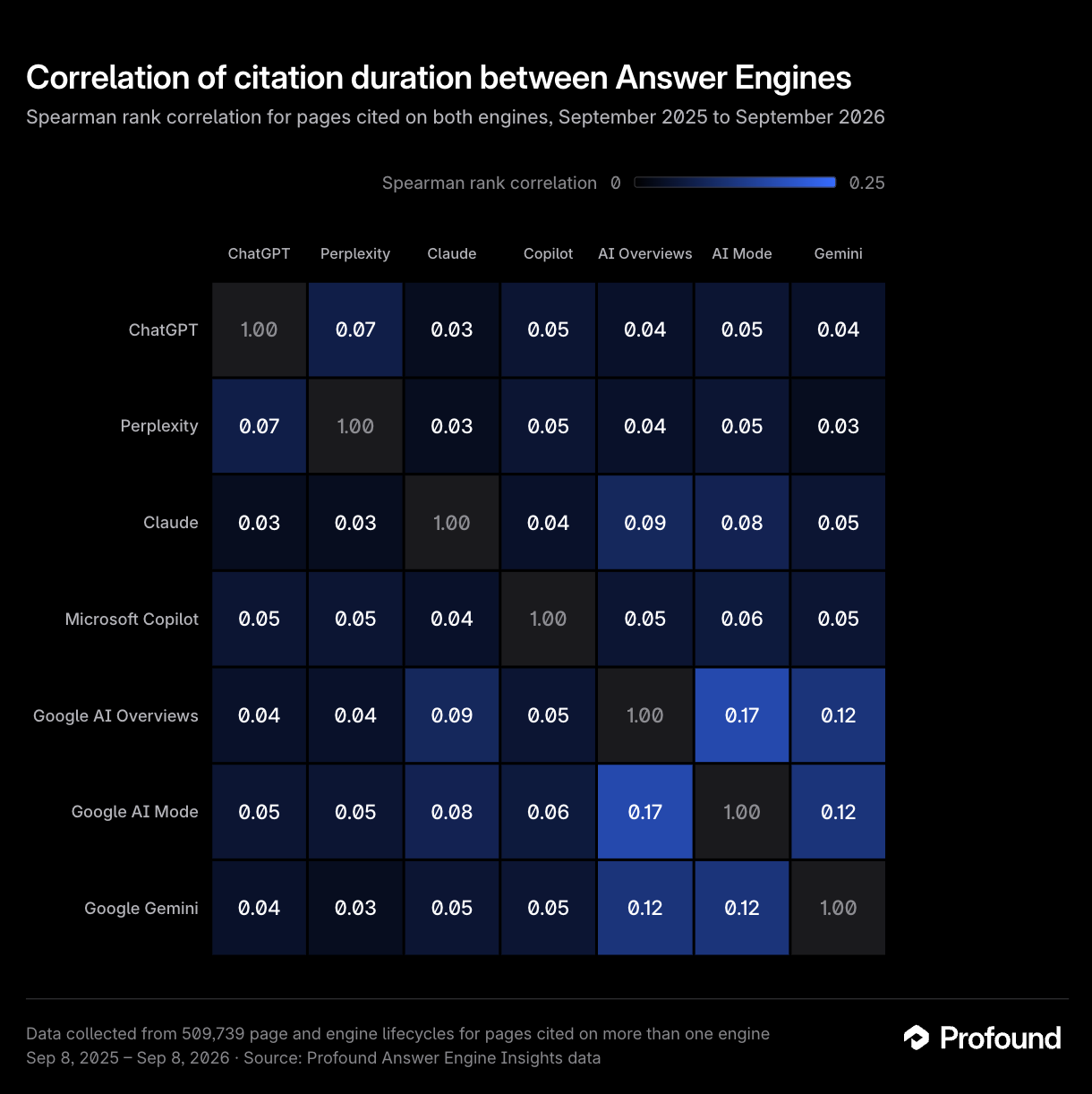
This finding most directly contradicts the SEO mental model. A citation holds seven independent AI search positions, and gaining or losing on any one of them says nothing about the others.
Being cited everywhere predicts lasting anywhere
The one cross-engine pattern that does hold is breadth.
A page cited by five or more of the seven engines is 5.5 times as likely as a page cited by one to still carry half its peak share after eight weeks, and it takes more than twice as long to reach that peak.
Reporting fades first, on every engine
Quite intuitively, a page tied to a date fades before one that is not. We classified the 133,000 sustained pages by what each page is for, and grouped them into four families.
Reporting is last of the four on all seven engines, and the other three hold at 1.4 to 1.6 times its rate. Reporting pages also peak faster, a median rise of 34 days against 41 to 43, so they arrive fast and leave fast.
What this means for marketing teams
Google search rewarded what a brand had already built. Answer engines are under no obligation to return to the same blue links, and with a source pool that wide, most pages are cited once and not again. Authority in AI search has a half-life, measured in days rather than months, and it does not accumulate.
For marketers, both demands have risen together. Queries have grown more specific, so more content must exist to answer them, and citations expire within weeks, so that content must arrive on a regular cadence to remain eligible. The modern marketer's job is to keep the brand eligible: to publish with enough specificity to be chosen and enough consistency to be chosen again.
Get started
Profound's Citation Decay view shows the rise, peak, and half-life of every URL an Answer Engine cites, so your team can see which of its pages are still being chosen and which have already begun to fall. Get a demo to see where your brand stands.
Methodology
The analysis covers 2025-09-08 to 2026-09-08 daily across seven answer engines: ChatGPT, Perplexity, Claude, Google AI Overviews, Google AI Mode, Google Gemini, and Microsoft Copilot. Pages were drawn from a deterministic 1-in-128 sample of cited URLs, and each page is measured separately on each engine, so a page cited by both Perplexity and ChatGPT contributes two observations with two independent lifecycles.
For each page on each engine, the daily outcome is its share of citations: the page's citations divided by all citations that engine issued that day within the page's category. The denominator is frozen. It counts only the prompts that were already running in that category on that engine on the day the page was first cited.
The daily share is smoothed with a trailing 14-day average. The peak is the maximum of the smoothed series, resolved to the earliest day when several days tie. Half-life is the number of days from the peak until the smoothed share falls to half the peak and remains there for 14 consecutive days. If that never occurs within the window, the page is still holding.
A page qualifies if it was first cited at least 28 days before the end of the window and carries at least 5 citations in the 14-day window at its smoothed peak. Two further guards remove pages that cannot be scored inside a fixed window: pages first cited within 30 days of the window start or their engine's first observed day, to avoid left truncation, and pages peaking within 14 days of the window end, because a 14-day decay window cannot be observed for them. 1,188,816 page and engine pairings qualify. The burst versus sustained split excludes 74,121 of them that were still above half-peak with under 14 days of follow-up when the window closed; every survival figure includes them as censored.
Content types are an LLM classification of the 133,070 sustained Owned and Earned pages from their extracted HTML. Reviews, documentation, reference entries, tools, social and video pages sit outside the three families; 5,556 pages could not be classified.
Still-holding pages are treated as right-censored, not dropped, and every survival figure is a Kaplan-Meier estimate with Greenwood intervals. Two groups are called different only when their 95% intervals do not overlap. The first-citation-to-half-peak figure is rise plus half-life; its median is a Kaplan-Meier estimate with still-holding pages censored. The steady versus concentrated citation pattern is measured as the coefficient of variation of daily citations over the pre-peak window only, so it cannot be contaminated by the decay it is meant to explain; sustained pages are split into terciles on that measure across all engines.


