

On September 28, Anthropic released Sonnet 5.5. To measure what changed, we ran 711 prompts twenty times each through Sonnet 5 and Sonnet 5.5 totalling 28,440 runs. Here is what we found.
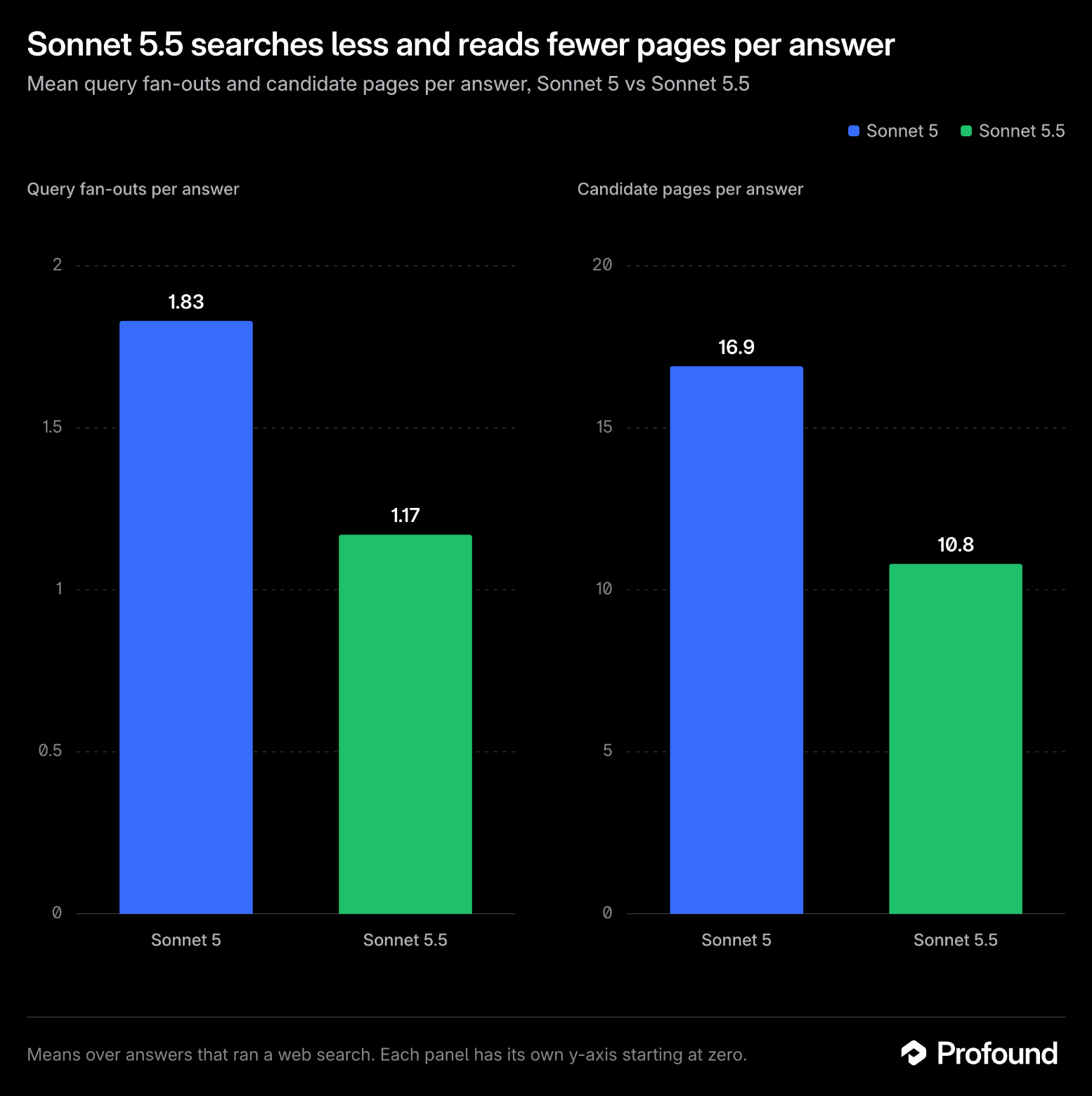
- It searches once. Sonnet 5.5 averages 1.17 search calls per searched answer; Sonnet 5 averages 1.83.
- It names the current year more often. “2026” appears in 59% of its query fan-outs, more than twice Sonnet 5’s rate.
- It is more concise. Answers are 19% shorter, and nearly three-quarters of their words appear in bullet points or numbered lists.
- It invites more context. About six in ten responses ask for details such as the reader’s budget or use case.
We use three terms below: the “candidate pool” includes all pages returned by an answer’s searches, along with their URLs, titles and page age. A “cited page” is one the model chooses to cite at least once. Each individual reference is an “inline citation,” so a single page can have several.
How Sonnet 5.5 searches
Sonnet 5.5 searches about as often as Sonnet 5, but with fewer query fan-outs and appends the current year in its queries.
More consistent search decisions
The web-search trigger rate barely moved: 77.0% of Sonnet 5.5 answers ran a web search, against 74.8% for Sonnet 5. What changed is consistency. Repeating the same prompt could produce a different search decision. With Sonnet 5, this happened for 207 of the 711 prompts (29.1%); Sonnet 5.5 switched between searching and not searching on just 55 (7.7%). The rest, the model either searched on every run or on none showing far more consistency.
It writes one query fan-out and stops
On answers that search, Sonnet 5.5 executes 1.17 query fan-outs on average, against 1.83 for Sonnet 5, and two or more on 14.5% of them, against 78.4%. As a result, the citation candidate pool shrinks with it, by 36%.
The year appears in most query fan-outs
Sonnet 5.5 names the current year in most of its query fan-outs. “2026” appears in 59%, more than twice Sonnet 5’s rate. The pages it cites also carry the year more often, particularly in their titles.
How Sonnet 5.5 responds
Similar citation volume, newer sources
Both models average about 12 inline citations per searched answer, drawing from 6.19 pages for Sonnet 5.5 and 6.93 for Sonnet 5.
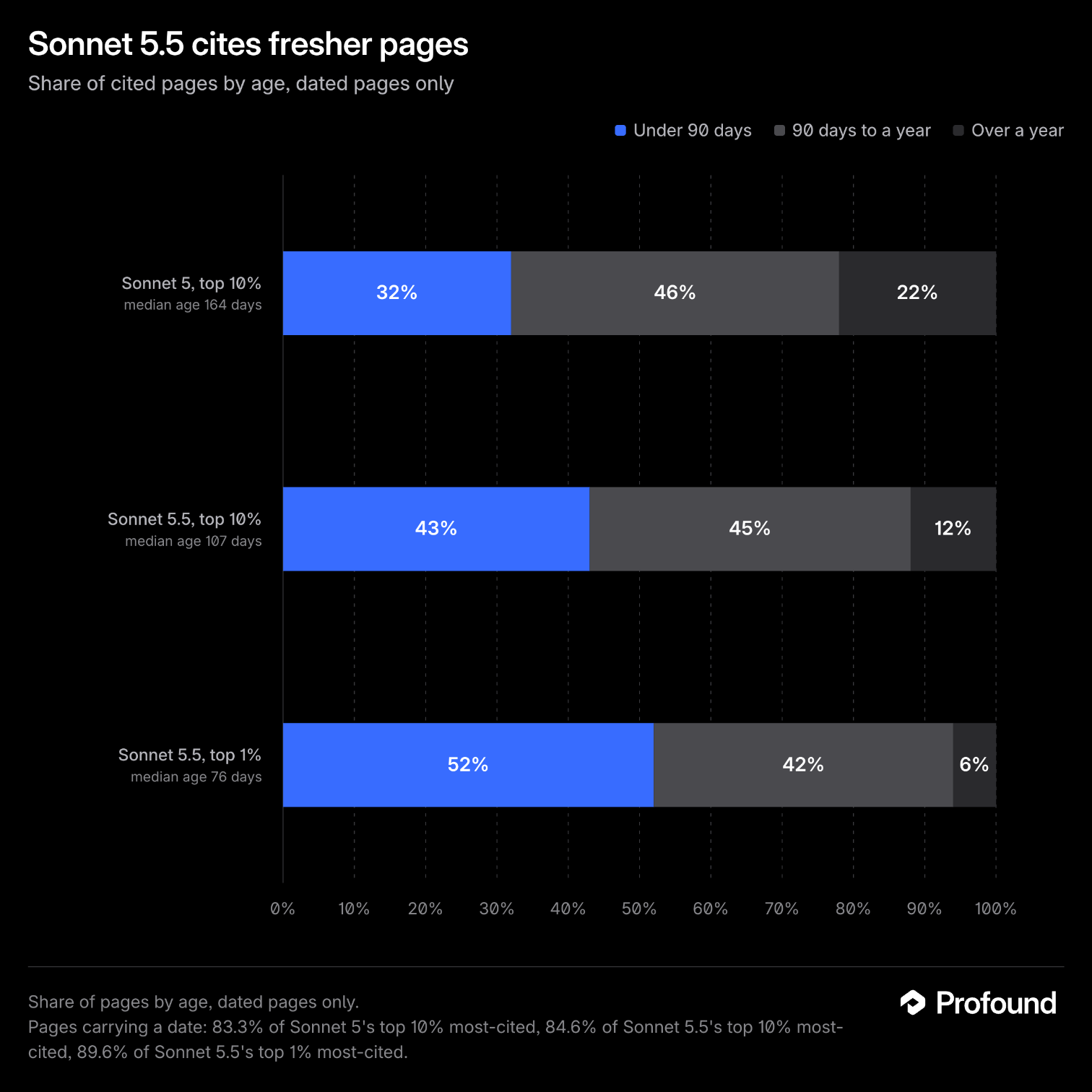
However, Sonnet 5.5’s most frequently cited pages are fresher. Sonnet 5.5’s most-cited 10% of pages have a median age of 107 days, against 164 for Sonnet 5, and its top 1% are younger still at 76 days.
It is more concise, and writes in bullets
Bullet points and numbered lists account for 71.6% of Sonnet 5.5’s answer text. Sonnet 5 uses them for 35.9%. Answers are also 19% shorter overall. Anthropic’s launch line for the model is that it needs fewer tokens to do the same work; on the answer side, this is what that looks like.
It ends by asking, not by picking
Sonnet 5.5 asks the reader for more details about their situation, including budget, use case, or location in 60.6% of answers, against 12.5% for Sonnet 5, 4.9 times the rate. The ask arrives as a conditional offer with no question mark: endings on a question mark fall from 17.0% to 2.5%, endings on an offer rise from 16.2% to 64.3%, and the one-line verdict that opens with "Bottom line:", "Short answer:", "Verdict:", "My pick:" or "TL;DR" falls from 33.0% of answers to 5.9%.
Share of all answers, 14,220 runs per model.
To illustrate the difference, consider a question like “Which plants are easiest to care for indoors?” A Sonnet 5-style closing would be: “Bottom line: For the lowest maintenance, choose a snake plant or a ZZ plant.” A Sonnet 5.5-style closing would be: “If you tell me how much light your space gets, whether you have pets and how often you want to water, I can narrow this down.”
What this means for marketers
Six in ten Sonnet 5.5 answers ask the reader for more context. For marketers, that makes it important to explain how your product fits a buyer’s particular circumstances. Content should be specific about who it serves and which needs it meets, with clear limitations where relevant. Those details give the model a basis for narrowing its recommendations as the reader shares more.
Freshness also deserves greater priority. Sonnet 5.5 explicitly searches for the current year more often than Sonnet 5, and its most-cited sources are newer. Keeping information current should be an ongoing part of your content strategy, across both your own pages and the sources that describe your brand. Give the model a clear reason to recommend you, backed by current evidence that shows why you fit the buyer’s needs.
Get started
Profound’s Answer Engine Insights tracks the latest models, giving you an up-to-date view of how they search for and surface information. Get a demo today to see what that means for your content strategy.
Methodology
We ran 711 prompts through Sonnet 5 and Sonnet 5.5, 20 times each, 28,440 answers in total, in a single-turn harness through the Anthropic API with web search enabled and no output cap. The prompts are a random sample of ordinary questions; we did not cut by industry.
For each answer the API returns every search query the model wrote, every page each query returned (its URL, its title, and for 73% of pages a page age), and every inline citation with the passage it quotes.
All data is Profound internal, October 2026.


