
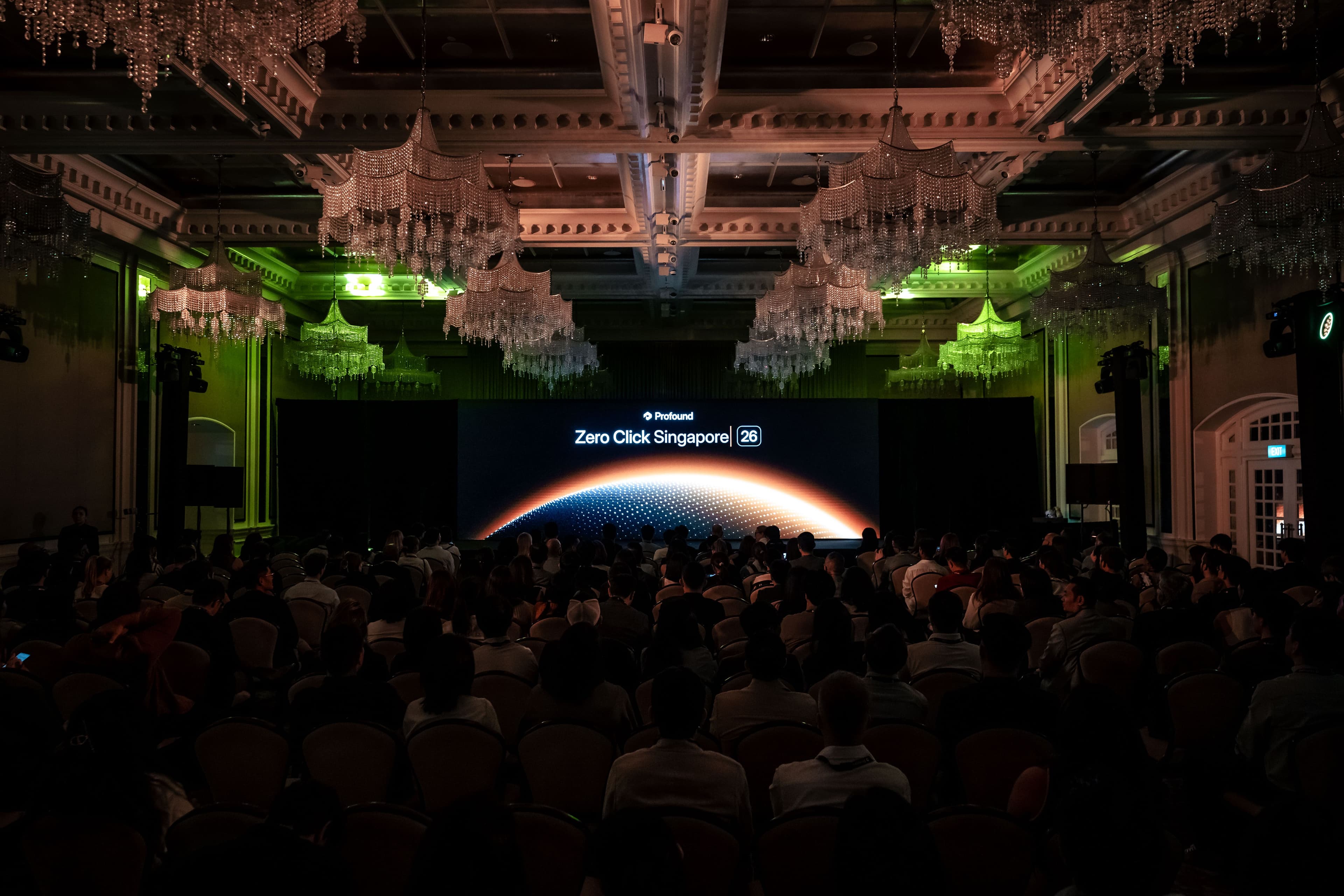
On November 3, 400+ marketing leaders gathered at Raffles Singapore for Zero Click Singapore 2026.
We brought together speakers from Singtel, Standard Chartered Bank, iQuanti, DHL Express, Unilever, and L'Oréal to share how they're approaching marketing strategy, team design, and measurement in the AI era.
Alongside them, our research team presented never-before-seen data on how agents use the web. This article summarizes our key takeaways from each session.
Marketing in the AI era
James Cadwallader (Co-Founder and CEO at Profound) opened the day by arguing that there's a new discipline of marketing developing, one aimed towards agents. To keep up, brands will have to use AI to produce high-quality content at scale.
Key takeaways:
- James said the shift towards agentic commerce is accelerating. He cited ChatGPT crossing 1.2 billion weekly active users, Claude adding a million new users per day, and a Gartner estimate that one in five online purchases will be made by an agent by 2030.
- He said "slop is a skill issue." Humans create slop with AI, and context is the antidote, in the same way a new hire needs weeks of learning about a brand before producing good work.
- He shared three customer examples. A global electronics brand updates thousands of product pages weekly, estimates it saves about 900 hours a month, and has seen a 78% increase in AI citations. A major CPG company built an agent that monitors Answer Engines for ingredient inaccuracies and suggests corrections. A product marketing team that feeds sales recordings into an agent updating its talk track saw a 7% increase in win rate.
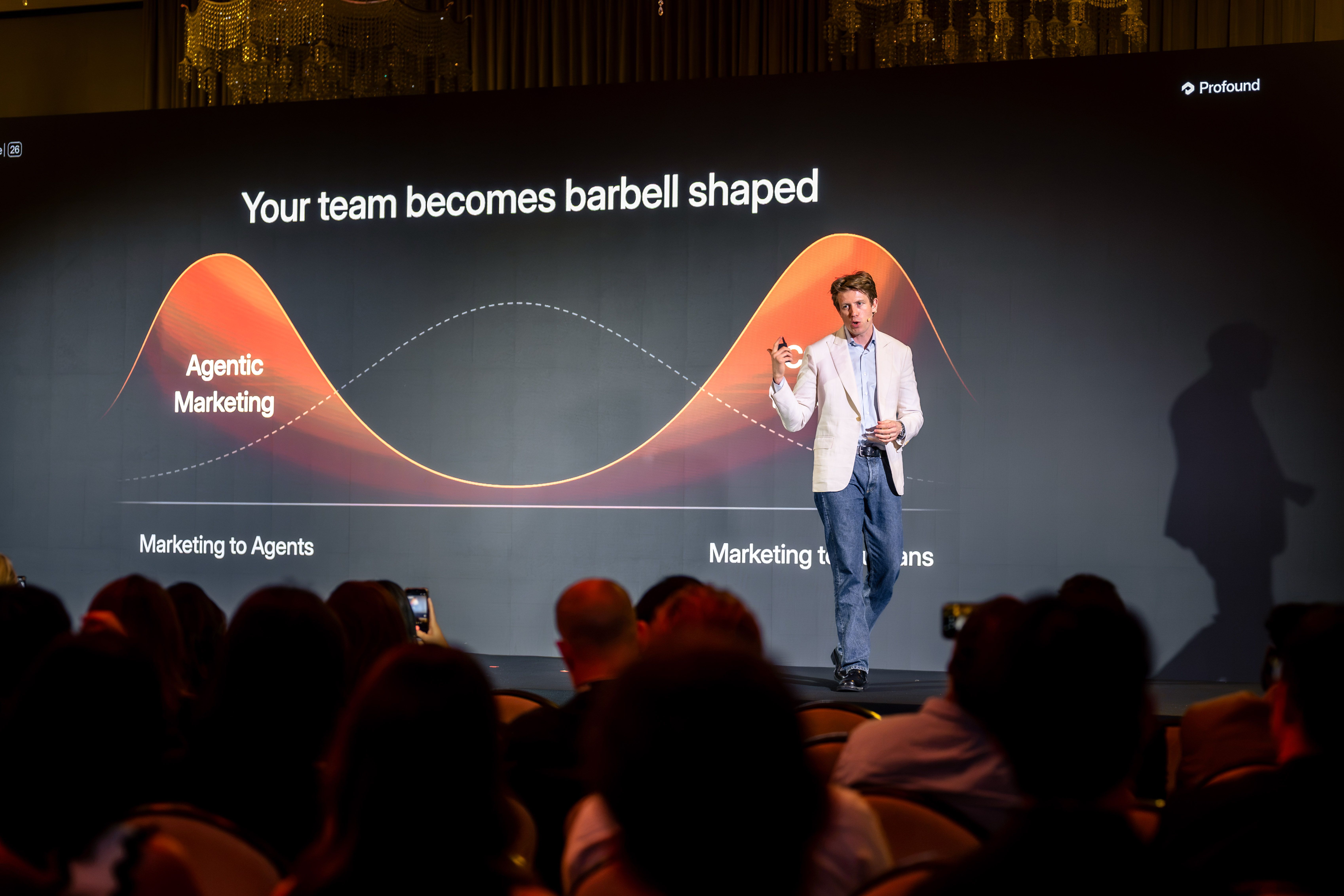
- James said marketing has no verifiable right answer, so humans keep a creative role. He expects teams to split between human-first marketing (events, influencers, dinners) and agentic marketing built for agents as customers, and he named the Marketing Engineer as the role that connects them.
The Marketing Engineer
Nick Lafferty (Founding Marketing Engineer at Profound) officially introduced the Marketing Engineer to Singapore. A Marketing Engineer is a marketer first, part artist and part builder.
Key takeaways:
- Nick said Marketing Engineers understand the brand, audience, and messaging, and also build end-to-end systems that connect data to tools. They sit in the middle of the marketing team, working with growth, demand, SEO, product, brand, PR, and content.
- He profiled two builders. Aaron Lou (Marketing Engineer at Notion) built a creative duplicator that localizes ad creative across Google, Meta, and LinkedIn and saves about eight hours a week. Austin Lau (first growth marketer at Anthropic) connected Claude to his ad platforms and added monthly budgets by channel, so reporting updates automatically.
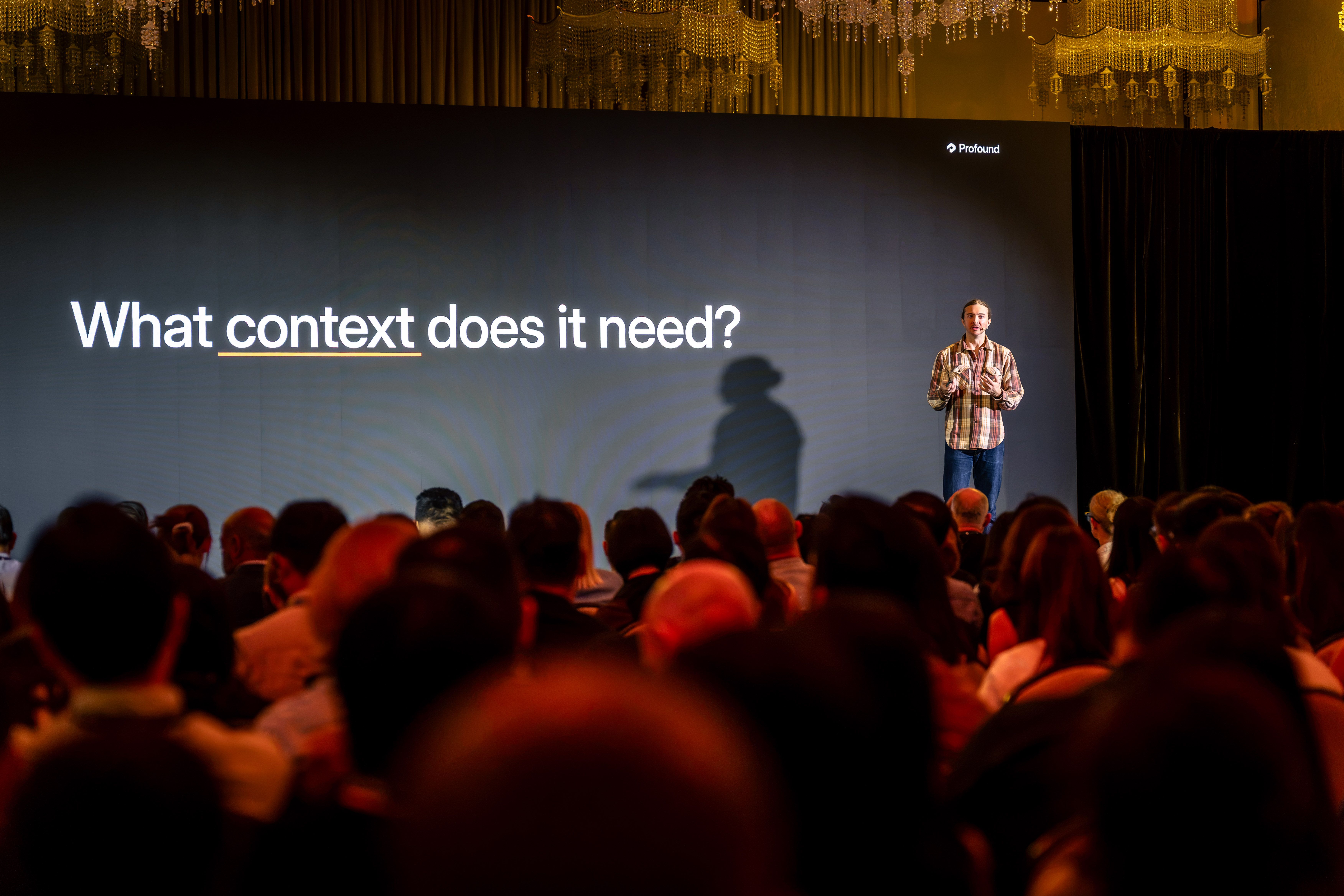
- His advice was to start with a manual, repetitive, easy-to-verify process, which is often the part of the job you like least. Give the system context, tell it what good looks like, and check the output.
- He outlined a five-step maturity curve: prompting, workflows, a first agent, multiple agents, and proactive agents.
The genesis of agentic attention
Josh Blyskal (Researcher at Profound) presented first-of-its-kind data drawn from tens of millions of citations, thousands of network logs, and hundreds of real browsing sessions.
Key takeaways:
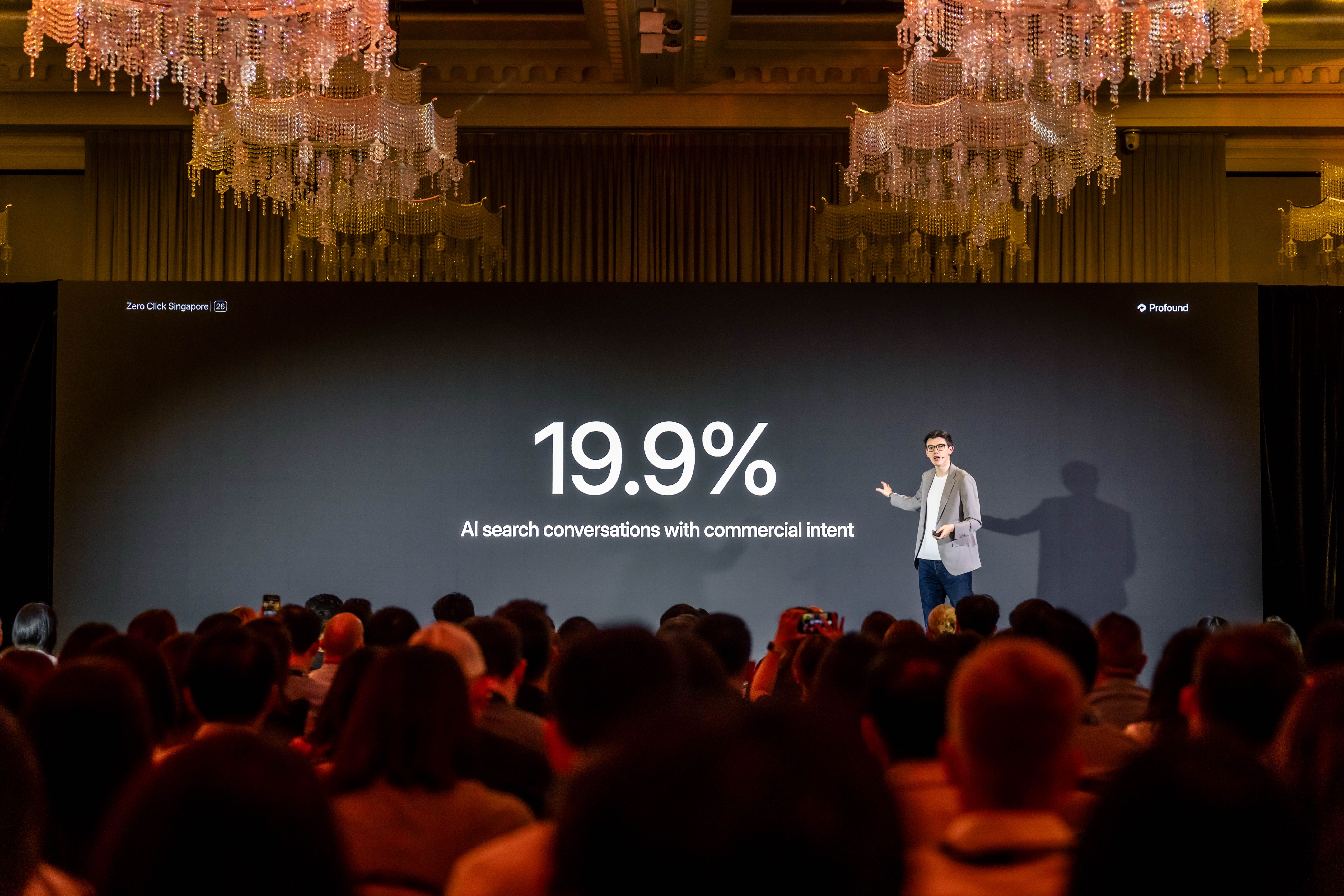
- Josh reported that 19.9% of AI conversations carry commercial intent, the fastest-growing intent type, up 119%. He also reported that 60% of people name no brand in their first prompt and that one in three turns in a conversation recommends a brand.
- The average shopping journey in AI Search lasts 5.2 days, and one in five AI conversations ends in a transaction. Among people who bought within a week, 13.5% had a relevant AI conversation beforehand, rising to one in three over 30 days.
- ChatGPT doubled how often and how deeply it searches while its citation count stayed flat. Josh said ChatGPT now cites commercial pages 35% more often and documentation 84% more often, while listicles fell 38% and social fell 91%. Claude, by contrast, still favors evaluative content, which made up 64% of its citations across 20 million citations.
- Josh walked through how the personal agent Muse shops. A skill file shapes a task, and a browser carries it out. The agent had already chosen brands before searching. His advice was to publish product facts and specifications, keep price and stock accessible, and test your site with agents.
Being cited isn't being correct
Nauman Bashir (Global Head of WRB Sales at Standard Chartered Bank) explained why accuracy matters as much as visibility in AI Search.
Key takeaways:
- Nauman described a strategy that starts with customer demand, then prioritizes topics, checks AI readiness, and aims to be known as an authority and a trusted source.
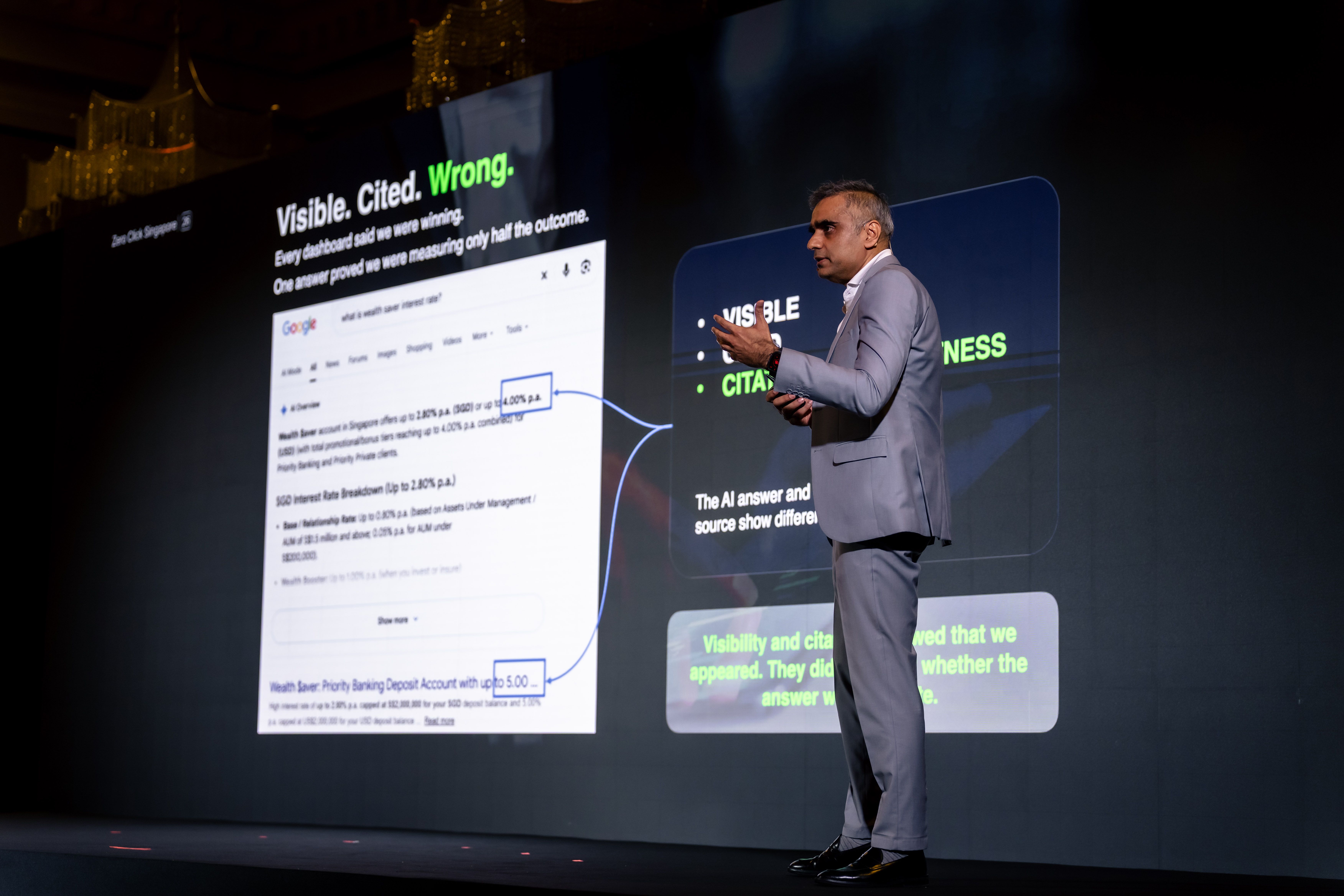
- Testing showed that visibility did not mean accuracy. In one example, the bank offered a 5% rate, while customers saw 4%.
- The team tested 5,000+ prompts and found accuracy varied across platforms. Most inaccuracies traced back to the bank's own content, including old documents and terms and conditions that Answer Engines read differently than a human would.
- Fixing this took the whole enterprise, including product, content, creative, and risk teams. They used Profound FactCheck to detect and diagnose issues, corrected them under a governed process, and retested continuously.
From scattered signals to real time actions
Arnab Sen (CEO at iQuanti) argued that AI is moving from answers to decision orchestration, and that brands need a unified, real-time view of the consumer to stay part of the decision.
Key takeaways:
- Arnab said journeys are collapsing and can start anywhere, so brands directly control only the last stages. His guidance was to be present where it matters rather than everywhere.
- He cited a Forrester and Experian survey on credit cards in Singapore. Between 83% and 87% of respondents were comfortable with AI doing the analysis, and 49% were comfortable with AI submitting applications, rising to 77% when the brand was trusted.
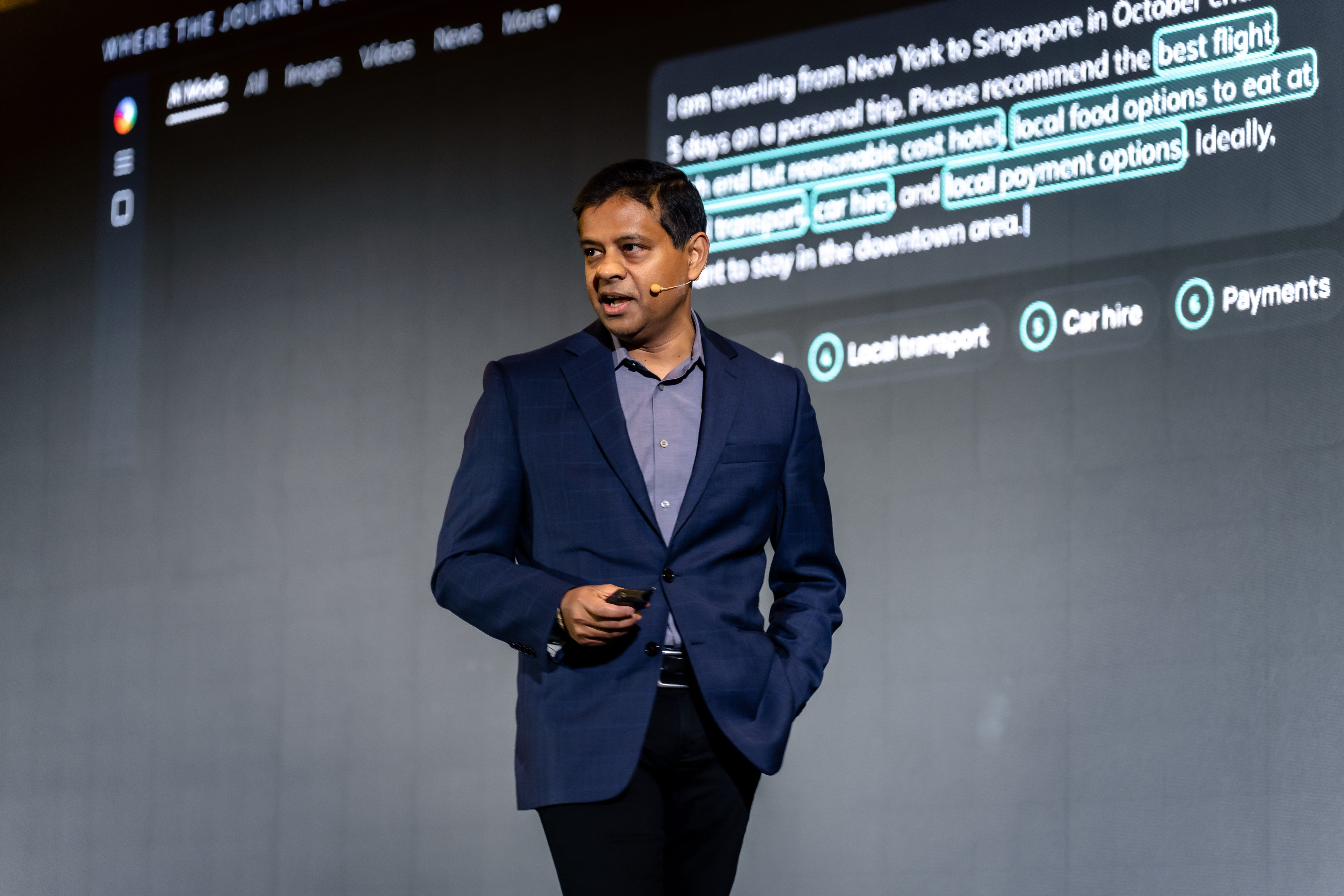
- Using the example of Maya, a product designer relocating to Singapore, he showed how unified signals can reveal intent six weeks before a credit card search begins.
- He described iQuanti's approach as a connected signal feed, an intelligence layer, prioritized action maps, and agentic activation. He called it a new operating cadence rather than a project.
From insights to action
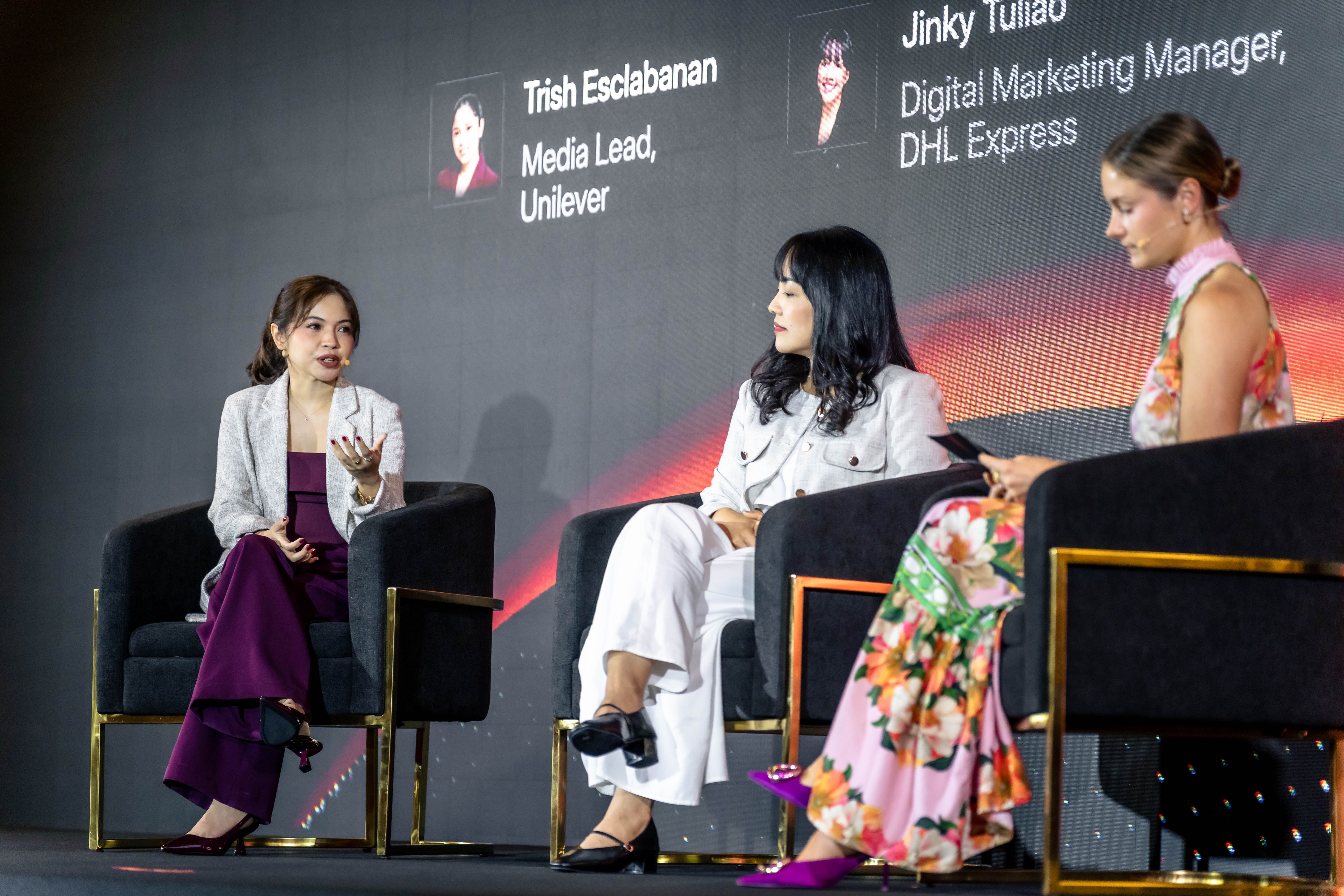
Trish Esclabanan (Media Lead at Unilever) and Jinky Tuliao (Digital Marketing Manager at DHL Express) joined Joanie Sanders (Head of Partnerships at Profound) to discuss turning AI Search insights into business results.
Key takeaways:
- Jinky said DHL saw impressions rise while clicks and traffic did not grow at the same pace. Visitors who did arrive converted at a notably higher rate, and DHL has attributed AI Search to conversions and revenue.
- DHL now writes FAQ-style content and rewrites titles and headlines as questions people ask. Jinky said local-language sites in Japan, Indonesia, Hong Kong, and Thailand earn more citations than the English content.
- Trish said Unilever's funnel has become an infinity loop, which led the team to measure search by citations rather than clicks. She described AEO as a consumer insight discipline, not only an optimization one.
- On winning internal support, Trish recommended adding AI visibility metrics alongside familiar KPIs such as reach, share of voice, and ROAS, and showing competitive evidence and incrementality. Jinky tied the case to revenue, and said that if AEO were not a priority, she would use fear of missing out.
From AI Search intelligence to trusted enterprise action
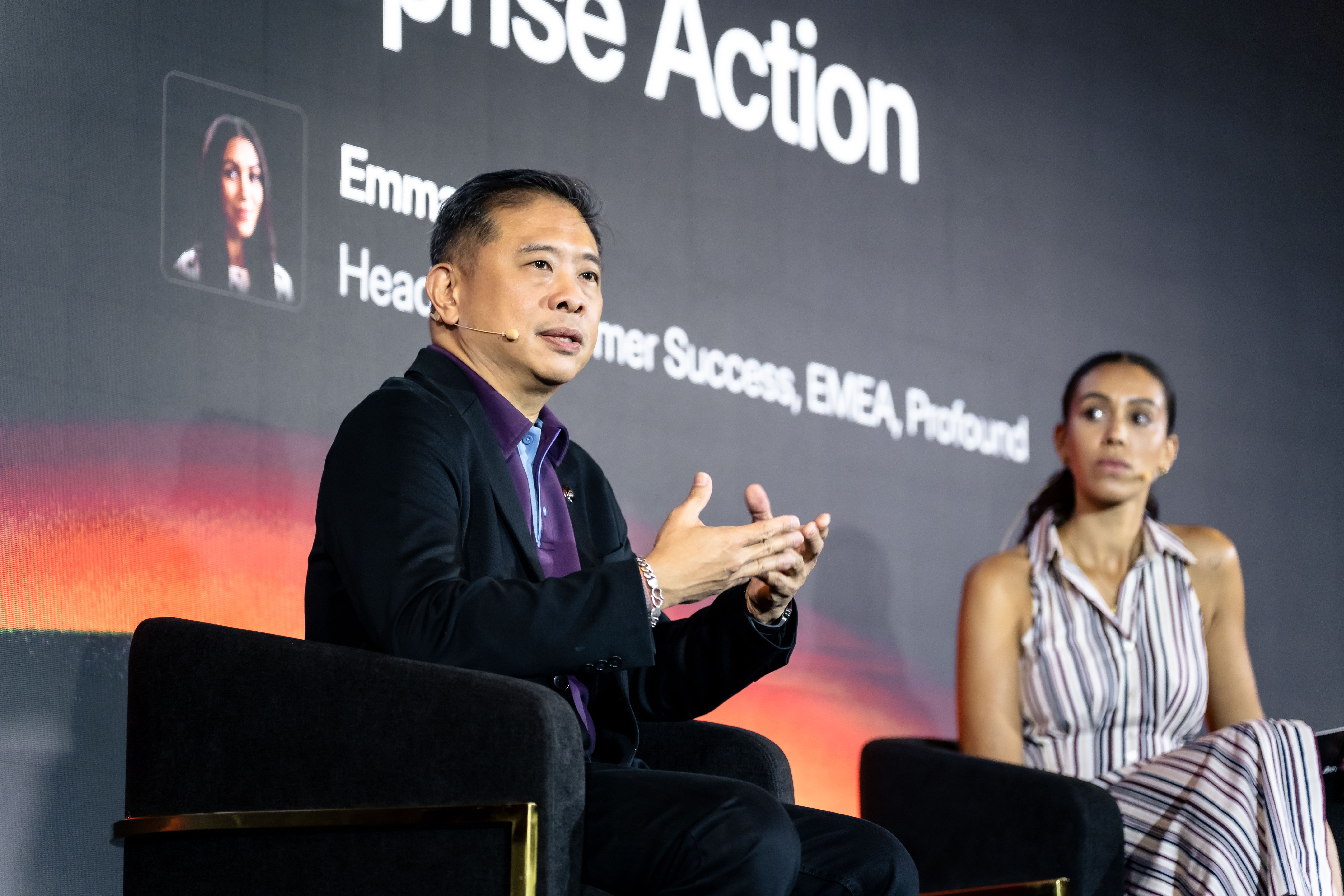
Robin Seow (CMO at Digital InfraCo, Singtel) and Emma Mayo (Head of Customer Success, EMEA at Profound) discussed how enterprises in Asia are approaching AI Search.
Key takeaways:
- Robin said awareness of AEO and GEO is established across the enterprises he speaks with. The open question is how to turn it into business value.
- He said Singtel's AEO spend is calculated and early stage, because capacity constraints in data centers, GPUs, and energy mean demand exceeds supply in his business unit. AEO will be a consideration in next fiscal year's planning.
- Robin said share of voice alone does not satisfy a business owner if sales are flat. He called for clear ownership, a tighter link between sales and marketing, and last-mile execution, because AEO spend is wasted if no one corrects the factual content on touchpoints.
- He said a growing number of enterprise customers want their data to stay in-country. Singtel provides sovereign AI cloud services in Singapore, and he said sovereign capability for AEO services is part of Profound's roadmap.
Marketing hasn't changed but marketers must
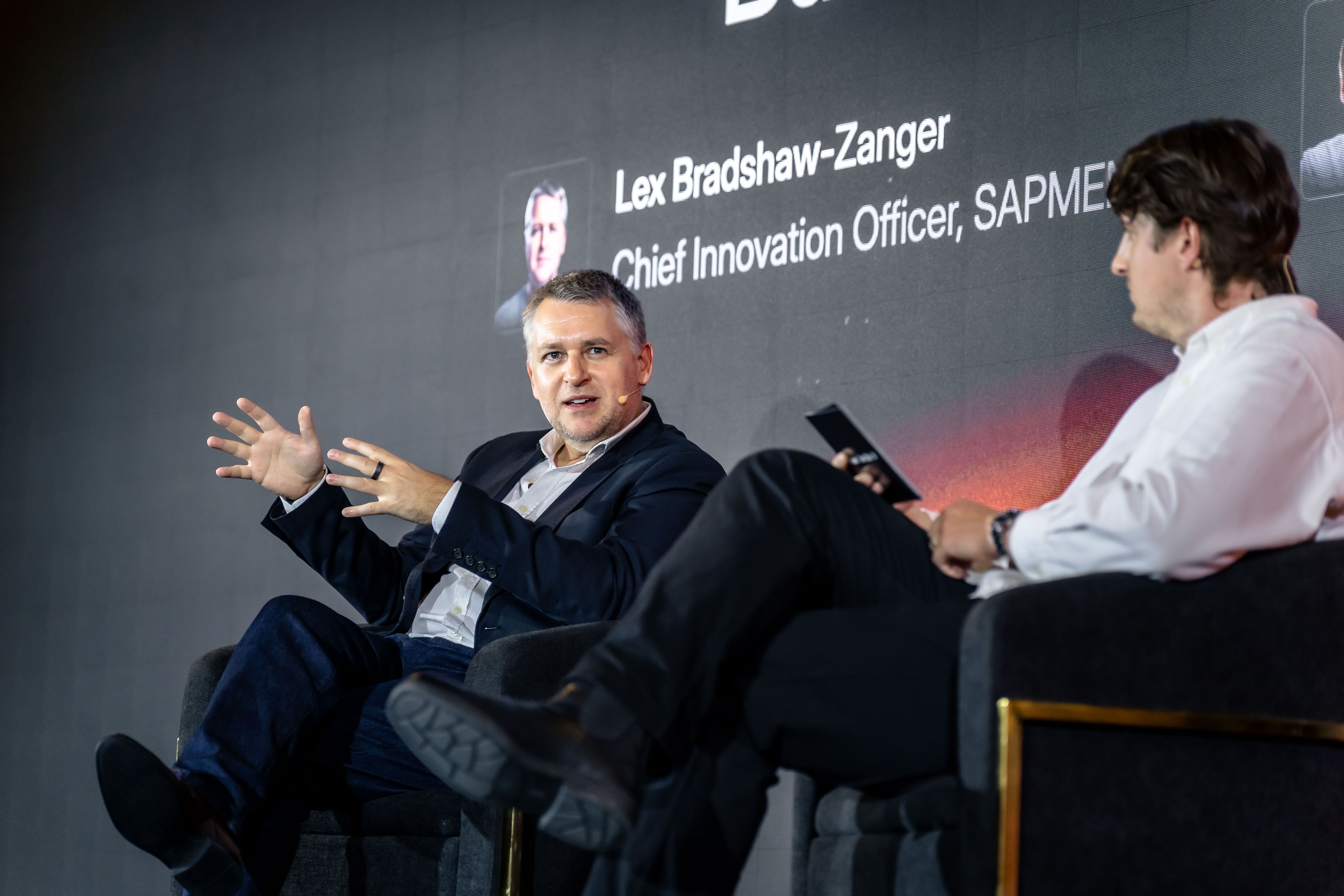
Lex Bradshaw-Zanger (Chief Business Capabilities and Innovation Officer, SAPMENA at L'Oréal) joined Trevor Pyle (Head of Marketing at Profound) for a closing fireside conversation.
Key takeaways:
- Lex said his role moved from CMO to innovation and AI. He argued that performance marketing and last-touch attribution pulled marketers away from brand building, reach, and consumer insight, and that measurement has become "very lazy."
- He said AI Search and brand marketing are linked. In the SEO era brands could be inconsistent across channels, but consistency now matters, and marketing teams must orchestrate product attributes, data, agents, and humans together.
- Lex described AI adoption as a people challenge rather than a technology one, covering training, curiosity, integration, and security. He said sovereign, clean, structured first-party data is the starting point, since everyone has access to the same models.
- He said AI works on data and probability, so human creative leaps still matter. He is researching a project called "Gray Hair at 30," on how to encode experience and judgment for younger marketers.
Closing remarks
Thank you to our speakers, partners, and the 400+ attendees who joined us at Raffles. Zero Click Singapore also gave us the chance to introduce Profound to the market ahead of the opening of our Singapore office later this year.
You can watch the sessions on demand at Zero Click Singapore Unlocked.


