
In July 2022, Prabhakar Raghavan, the Google senior vice president in charge of Search at the time, told an audience at Fortune’s Brainstorm Tech conference that young people were starting to look elsewhere. “Something like almost 40% of young people, when they’re looking for a place for lunch, they don’t go to Google Maps or Search,” he said. “They go to TikTok or Instagram.”
Four months later, OpenAI released ChatGPT, and AI engines became one more place to ask. By May 2026, Gartner research presented at its Marketing Symposium found that 60% of B2B buyers and 47% of consumers had consulted generative AI tools or chatbots for a recent purchase decision.
Search is still there, but it now shares the spotlight with social video, marketplaces, communities, the press, and AI answers, and each leaves a different trail. Traffic panels see visits, social listening sees conversation, ad intelligence sees spend, and AI search platforms see answers. Each one also collects its data in its own way, from opt-in panels to crawlers to models that estimate what they can’t measure directly. No single marketing intelligence platform covers every input, so the best one for you depends on which signals your decisions rest on.
Below, we compare seven platforms by what they watch and where their data comes from. Each one is the strongest pick for a different input.
For a quick side-by-side comparison, see the table below:
1. Profound: best for AI search intelligence
Best for:
- SEO and AEO teams that need to see, prompt by prompt, where they appear across engines and regions, and which pages the engines cite instead of theirs.
- Content teams deciding what to write or refresh next, based on what people ask AI engines and which pages earn citations.
- PR and brand teams finding the publishers and listicles that influence AI answers, and correcting what the engines get wrong about the brand.
- Agencies running AI search programs for several clients, with each brand in its own workspace.
- Marketing leaders who need AI search numbers they can take to the board.
What you’ll love:
- Answers captured from each engine’s consumer interface, across nine engines.
- Prompt demand drawn from more than 2 billion real prompts.
- Wrong claims traced back to the page that caused them.
- AI crawler and agent visits read straight from your server logs.
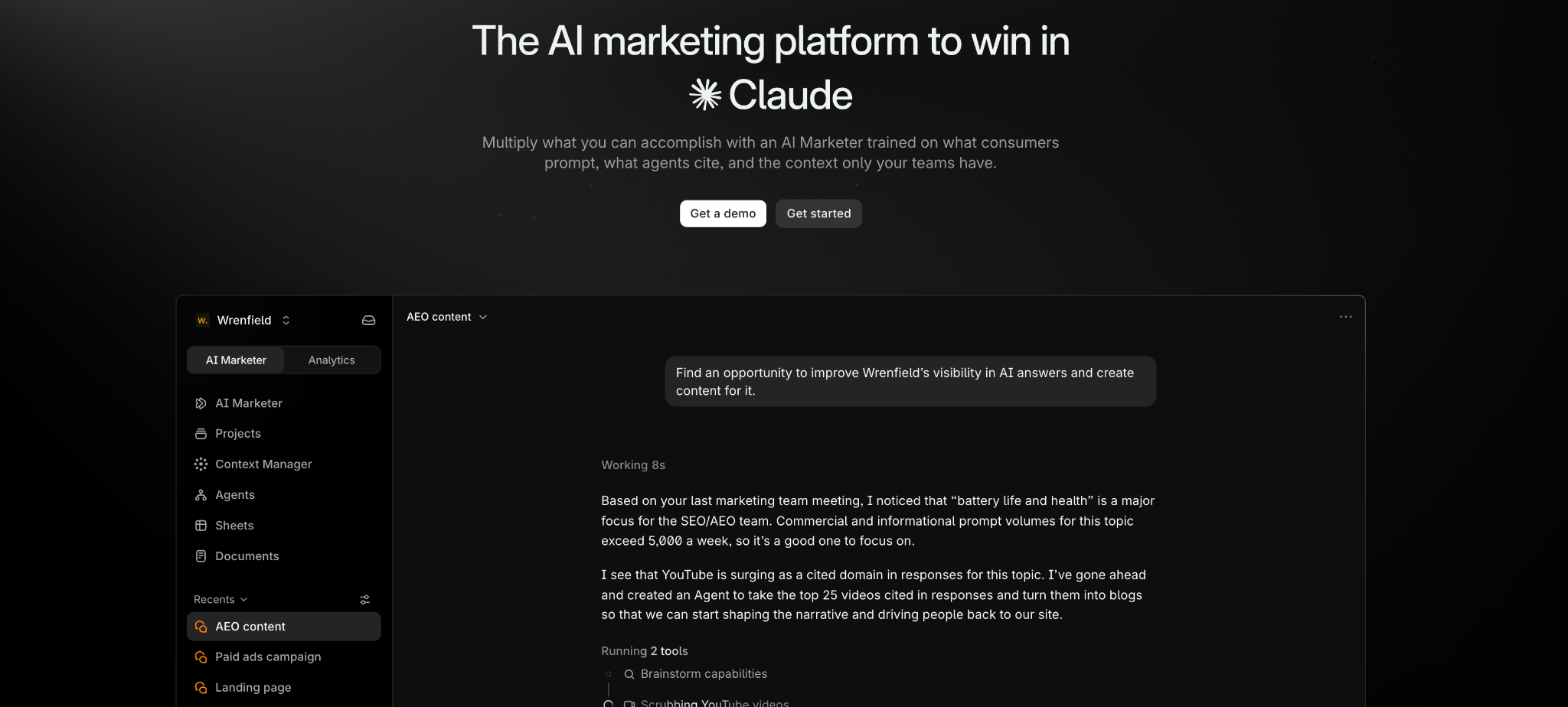
- Aim, which picks the week’s priorities from the data and builds the agents to work on them.
When ChatGPT arrived in November 2022, it changed where people take their questions. Within a couple of years, buyers were asking AI engines which products to shortlist, and the SEO tools marketers had always relied on couldn’t follow them there.
Profound launched in 2024 with the mission to make those answers visible. It now tracks nine AI engines, from ChatGPT and Perplexity to Google’s AI Overviews and AI Mode, and a third of the Fortune 100 rely on it to run and scale their answer engine optimization (AEO) programs.
Answer Engine Insights captures each answer from the engine’s consumer interface, the same version a buyer sees, instead of pulling it through an API. For every prompt you track, it shows how often you appear against competitors and which pages the engine cites. It also shows how the engine describes you through Sentiment, and which of its claims about you are wrong through FactCheck, along with the page each wrong claim came from. You can break all of it down by engine, region, topic, and persona.
Profound also covers the demand behind those answers and the traffic they send. Prompt Volumes estimates how often people ask AI engines about your category, drawing on more than 2 billion real prompts from double opt-in consumer panels, and flags prompts where a competitor gets cited and you don’t. Agent Analytics reads your server logs to record the AI crawlers and agents visiting your site, which a JavaScript tag never sees, and shows how many people arrive from AI answers and convert. Retailers can add Shopping for product-level visibility in ChatGPT Shopping.
Seeing the answers was the first problem Profound set out to solve. Acting on them came next. When the platform launched AI Marketer (Aim) in July 2026, the idea was that marketing teams had plenty of dashboards and needed to know what to do next. Aim works through Profound’s data in the background, along with the brand context your team keeps in Context Manager. Every week, it brings a ranked list of opportunities, like a competitor gaining on a topic your pipeline depends on or rising demand in a category you don’t own yet, each with the reasoning and data behind it. When your team accepts an opportunity, Aim turns it into a project and builds the agents that execute each task, from refreshing a page the engines stopped citing to drafting a correction for a publisher.
2. Similarweb: best for web traffic and channel benchmarking
Best for:
- Benchmarking competitors' traffic, channel mix, and audiences.
- Ecommerce brands tracking sales and search on Amazon, Walmart, and Target.
- Sales teams prospecting on digital signals.
What you'll love:
- Traffic and engagement estimates for almost any website.
- Market sizing and trend analysis by category.
- SKU-level marketplace sales and on-site search data.
- A published methodology that names its four data sources.
Where it falls short:
- Its figures are model-based estimates, so treat them as directional for sites outside its direct-measurement network.
- Web, app, shopper, and sales intelligence are separate solutions, so broad coverage means more than one product.
- Its AI visibility tracker covers four engines, and the page doesn't explain how tracked prompts are chosen.
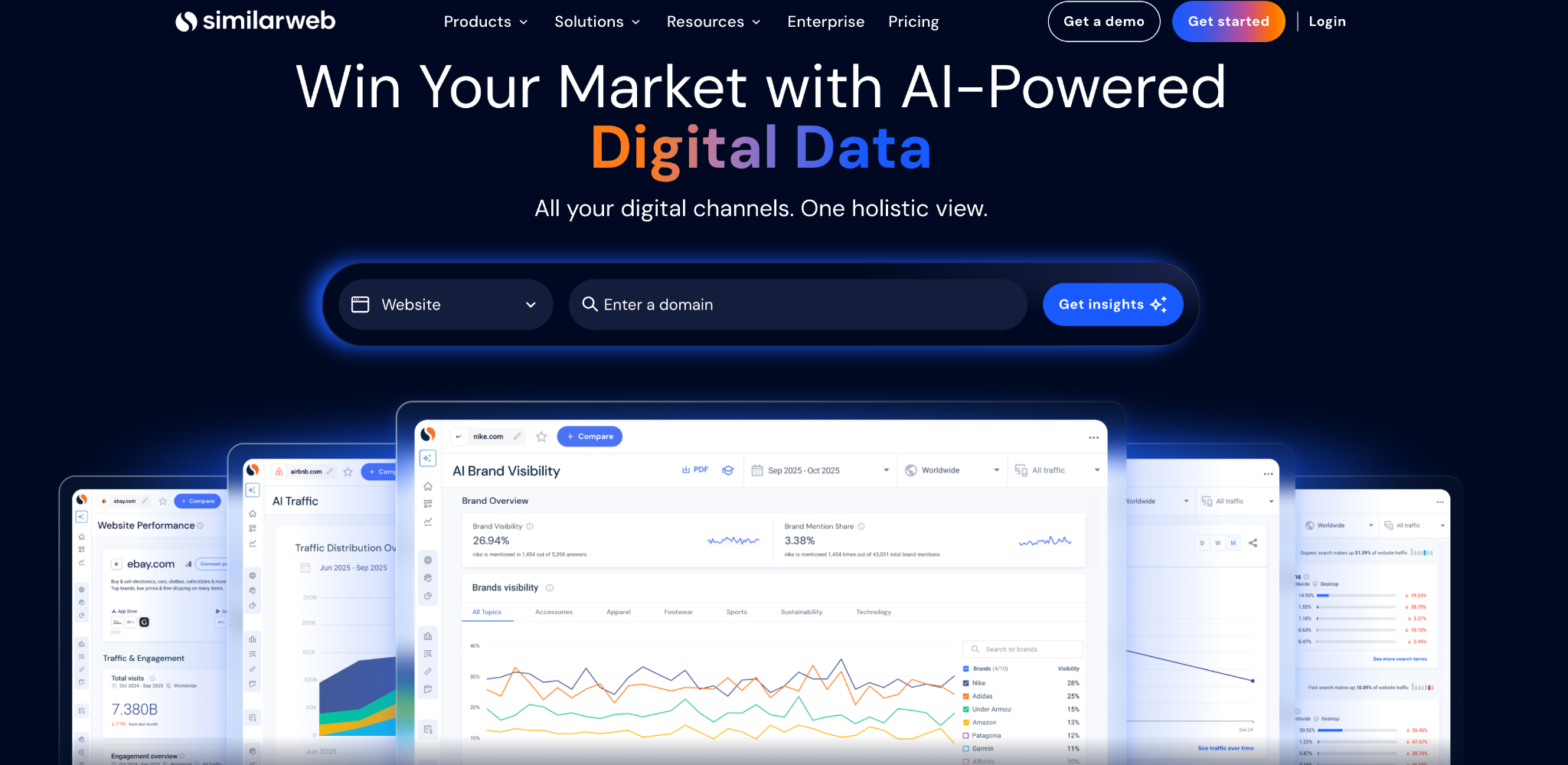
Similarweb estimates how much traffic almost any website gets, where it comes from, and who visits. Its Web Intelligence product lets you benchmark your site against competitors across channels, traffic, keywords, and conversions, analyze their campaigns, and set alerts when their share of traffic moves. It also sizes markets, tracks category trends, and profiles audiences, including where they go and how loyal they are.
Similarweb makes no secret of its methodology. It combines four sources: direct measurement from millions of websites and apps that share their first-party analytics, a contributory network of consumer products that collect anonymous device behavior, partnerships with organizations like internet service providers and ad platforms, and automated extraction of public data. Machine-learning models then calibrate all of it into estimates.
For ecommerce, Retail Intelligence covers Amazon, Walmart, Target, and hundreds of other retailers. It reports weekly SKU-level sales, market share by category, brand, and product, and keyword data on what shoppers search for inside retail sites. Sales Intelligence turns the same digital signals into prospect lists, using traffic and engagement trends to flag when an account may be in the market.
On the AI side, Similarweb's agents tie demand spikes to real-world events and build SEO content plans. Its AI Brand Visibility tracker follows your brand across ChatGPT, Google AI Mode, Gemini, and Perplexity, and updates continuously.
3. Semrush: best for traditional search intelligence
Best for:
- SEO and content teams researching what competitors rank for.
- PPC teams studying competitors' search and shopping ads.
- Teams benchmarking competitor traffic across many domains at once.
What you'll love:
- Keyword Gap and Backlink Gap reports against named competitors.
- Competitors' search ads going back to 2012.
- Side-by-side traffic benchmarks for up to 100 domains.
- Data you can pull into AI tools through its MCP server and ChatGPT app.
Where it falls short:
- Specialist toolkits, including Traffic & Market, Advertising, and Social, are bought individually on top of your plan.
- Display, video, and social ad tracking through AdClarity needs the Pro version of the Advertising Toolkit.
- AI visibility features vary by tier, and prompt tracking runs on ChatGPT, Google AI Mode, and Gemini.
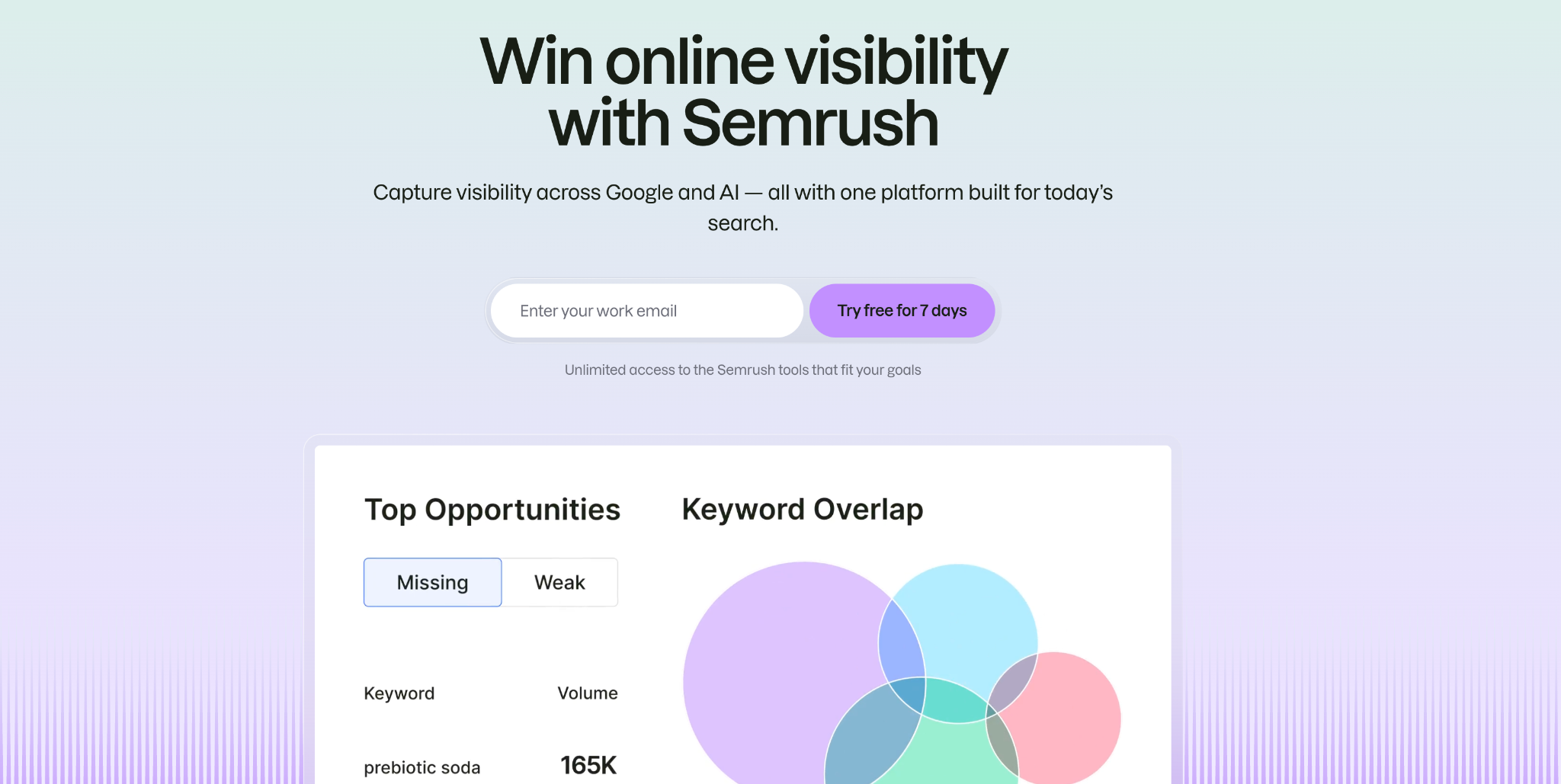
Semrush is built on search data, with a database of more than 27 billion keywords, 43 trillion backlinks, and 808 million domain profiles. Its SEO Toolkit turns that into competitive research. You can see any domain's organic rankings and top pages, compare domains side by side, and run Keyword Gap and Backlink Gap reports against competitors.
Traffic & Market adds traffic intelligence from a clickstream panel of more than 200 million people across 190+ countries, with data back to 2017. You can benchmark up to 100 domains at once, split a competitor's traffic across eight channels, see its fastest-growing pages, profile its audience, and get alerts when it publishes new pages or ads.
Other toolkits cover more channels. The Advertising Toolkit shows the keywords competitors bid on and examples of their search ads going back to 2012, and it analyzes their Google Shopping campaigns. Through AdClarity, it also tracks their display, video, and social ads across 50+ markets. The Social Toolkit tracks social performance and media mentions, and the AI PR Toolkit monitors coverage alongside outreach.
For AI search, the AI Visibility toolkit adds prompt research, daily prompt tracking, and reports on your share of voice and sentiment in AI answers. For AEO specifically, Semrush covers fewer engines and less prompt data than a dedicated platform. See how it compares to Profound.
4. Crayon: best for competitive intelligence in B2B sales
Best for:
- Product marketing and competitive intelligence teams supporting sales.
- Keeping battlecards current as competitors change pricing and messaging.
- Measuring win rates against specific competitors.
What you'll love:
- Before-and-after tracking of competitors' websites, pricing, and docs.
- Competitor mentions pulled from Gong and Chorus calls, Slack, and Teams.
- Battlecards inside Salesforce, HubSpot, Slack, and Teams.
- Win-loss analysis and influenced revenue by competitor.
Where it falls short:
- It's built around B2B sales enablement, so brand and consumer teams get less from it.
- It sends competitive intel into AI tools but doesn't track what AI engines tell buyers about you or your competitors.
Crayon watches competitors' entire digital footprint. It captures before-and-after changes to their websites, along with pricing updates, news, support documents, and customer reviews. Inside your company, its data agents pull competitor mentions from call recordings in Gong and Chorus, conversations in Slack and Teams, shared drives, and win-loss tools. Its AI scores each piece of intel by likely market impact, tags it into more than 80 subcategories, grades its sentiment, and flags unusual changes.
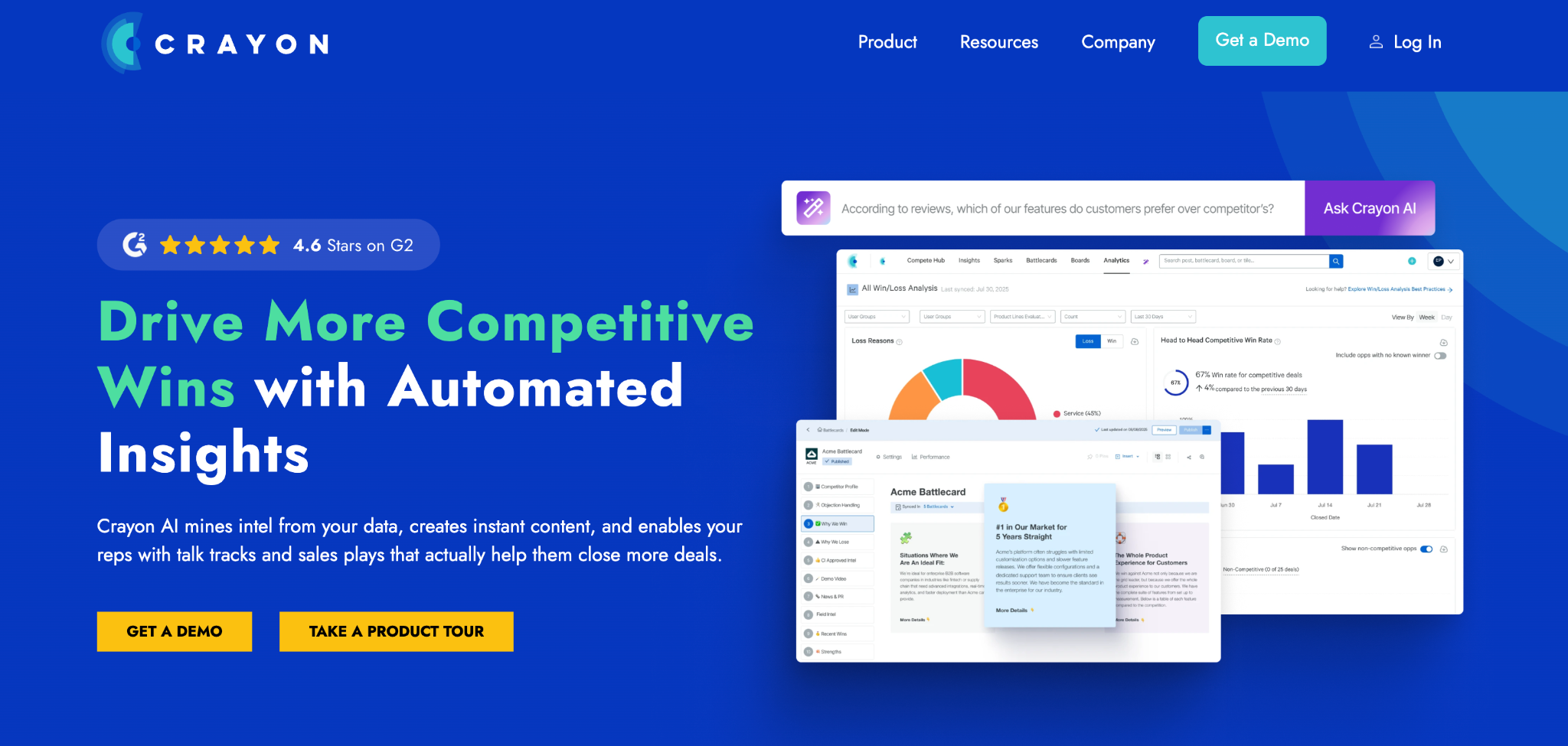
Crayon is built to get that intel to sellers. Battlecards live where reps already work, including Salesforce, HubSpot, Slack, Microsoft Teams, Highspot, and Seismic. In Salesforce, they sit on each opportunity record. The Sparks agent turns research into battlecards and other sales content, and Crayon Answers lets reps ask about a competitor in Slack or Teams.
It also measures the results. Win-loss analysis shows which competitors appear in your deals, how often you win, and why. Managers can track each rep's competitive performance on leaderboards, and an influenced-revenue metric ties battlecard use to revenue. An MCP server and APIs send Crayon's content into ChatGPT, Claude, Copilot, and enterprise search tools like Glean.
5. Brandwatch: best for consumer and social intelligence
Best for:
- Market and consumer researchers studying how people talk about a category.
- Social teams benchmarking against competitors.
- Brands that need long-run historical comparisons.
What you'll love:
- An archive of 1.7 trillion conversations going back to 2010.
- Coverage from TikTok and Threads to WeChat, Weibo, and broadcast TV and radio.
- Image analysis that finds logos, objects, and scenes.
- Social publishing, benchmarking, and influencer tools in the same suite.
Where it falls short:
- Consumer intelligence, social media management, and influencer marketing are separate solutions with their own plans.
- The Search Intelligence page names ChatGPT as its only AI engine and doesn't explain how the monitored prompts are chosen.
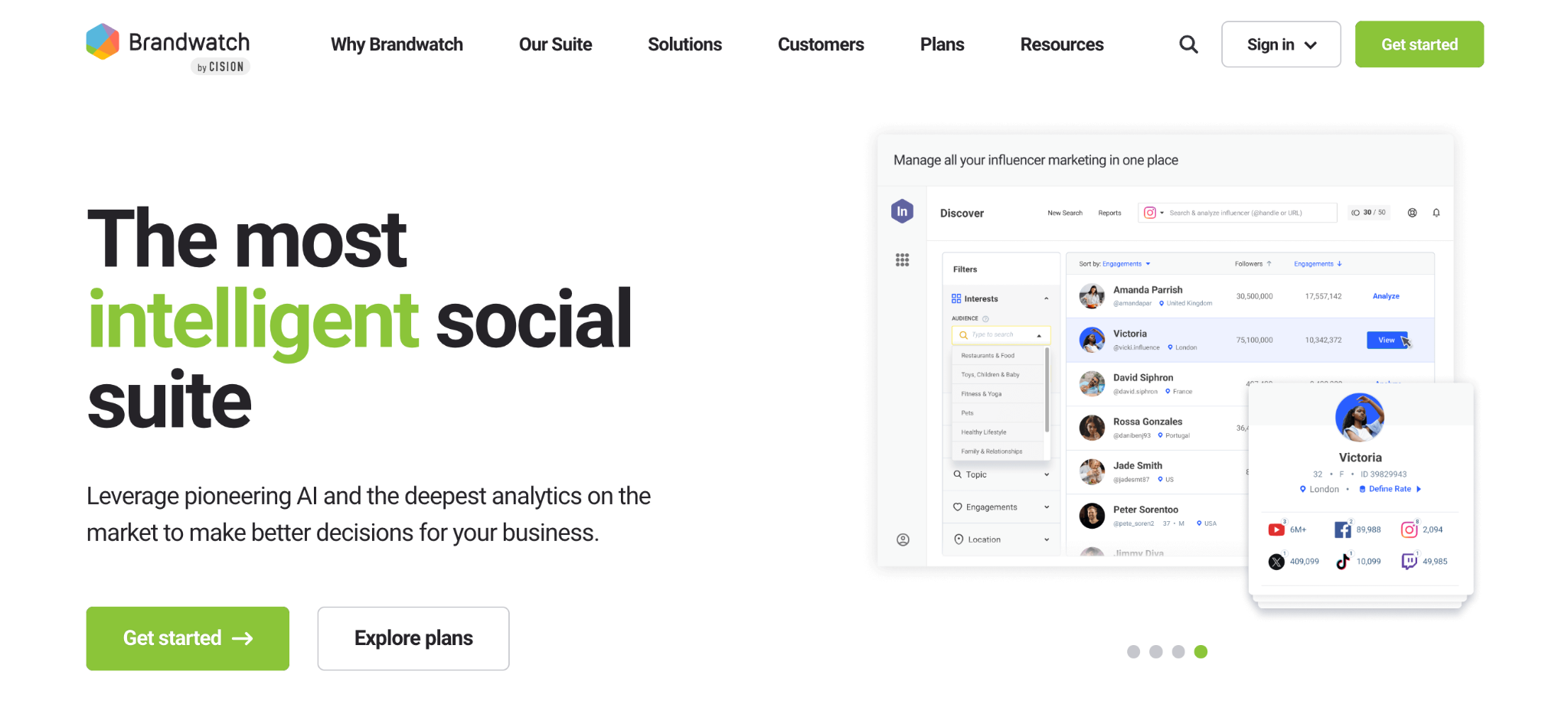
Brandwatch's Consumer Intelligence product draws on an archive of 1.7 trillion conversations going back to 2010, with 501 million new conversations added every day and official firehose access to X, Tumblr, and Reddit. Its data networks span more than 100 million sources. They run from TikTok, Instagram, LinkedIn, Threads, Bluesky, YouTube, and Twitch to WeChat, Weibo, and RedNote, plus reviews, news, blogs, forums, and TV and radio broadcasts.
You can segment those conversations, analyze images for logos, objects, and scenes, and ask Iris, its AI assistant, to summarize what the data shows. Market researchers, analysts, agencies, and PR teams are among the users Brandwatch is designed for.
The rest of the suite puts that research to work. Social Media Management covers publishing, ads, engagement, and measurement, with a Benchmark tool that compares your performance with competitors'. Influence, formerly Paladin, handles influencer discovery and campaigns. A newer product, Search Intelligence, comes from Trajaan, a separate Cision acquisition, and its pages don’t explain how the monitored prompts are chosen.
6. Meltwater: best for media and PR intelligence

Best for:
- PR and comms teams monitoring coverage across news, broadcast, and social.
- Teams that pitch journalists and need a current media database.
- Global brands working in many languages.
What you'll love:
- Coverage that includes print, all 210 US broadcast markets, and 20,000+ podcasts.
- Share of voice by platform, with benchmarks against competitors.
- A database of 800,000+ journalists and media contacts.
- GenAI Lens coverage across up to 11 AI engines, with Mistral as a paid add-on.
Where it falls short:
- GenAI Lens is typically sold as an add-on, and availability varies by package.
- GenAI Lens data refreshes every 24 to 48 hours, depending on your package.
- Claude, Gemini, and Copilot aren’t included in the GenAI Lens Lite plan.
Meltwater is built for PR, communications, and marketing leaders. The platform ingests more than 1.3 billion documents a day in more than 240 languages, and its media monitoring covers more than 200 million online publications and 400,000+ newspapers, magazines, and trade titles. It also covers all 210 US broadcast markets plus thousands of TV and radio stations worldwide, more than 20,000 podcasts, and social platforms from X, Reddit, and YouTube to WeChat, Weibo, and LINE.
On top of that coverage, Meltwater measures sentiment, breaks out share of voice by platform, and benchmarks you against competitors, regions, campaigns, and time periods. Custom alerts and AI-generated summaries flag narrative shifts and unusual activity as they happen, and integrated reports are built to show PR impact.
For outreach, the media database holds more than 800,000 journalists, bloggers, and media contacts, which you can filter by beat, location, outlet, and recent coverage. It suggests pitches, tracks email opens and clicks, and includes press release distribution. Meltwater also offers consumer insights and influencer marketing.
For AI search, GenAI Lens tracks how often your brand appears in up to 11 engines, including ChatGPT, Perplexity, Google AI Overviews, AI Mode, Claude, and Gemini, with share of voice, citations, and sentiment over time.
7. Pathmatics by Sensor Tower: best for ad intelligence
Best for:
- Brand and media teams tracking competitors' ad spend.
- Agencies planning media.
- Retail and consumer brands watching retail media.
What you'll love:
- The actual ad creative, messaging, and calls to action next to spend and impressions.
- Coverage of social, streaming, display, video, and programmatic.
- Share of voice across retail media networks.
- App, web, and audience data from the same company.
Where it falls short:
- Spend and impressions are estimates.
- Search ads aren’t among its listed channels.
- Coverage centers on the US, Canada, Western Europe, and Australia, plus select markets in the Nordics, MENA, LATAM, and APAC.
- It tracks paid ads in ChatGPT, not what AI answers say about brands.
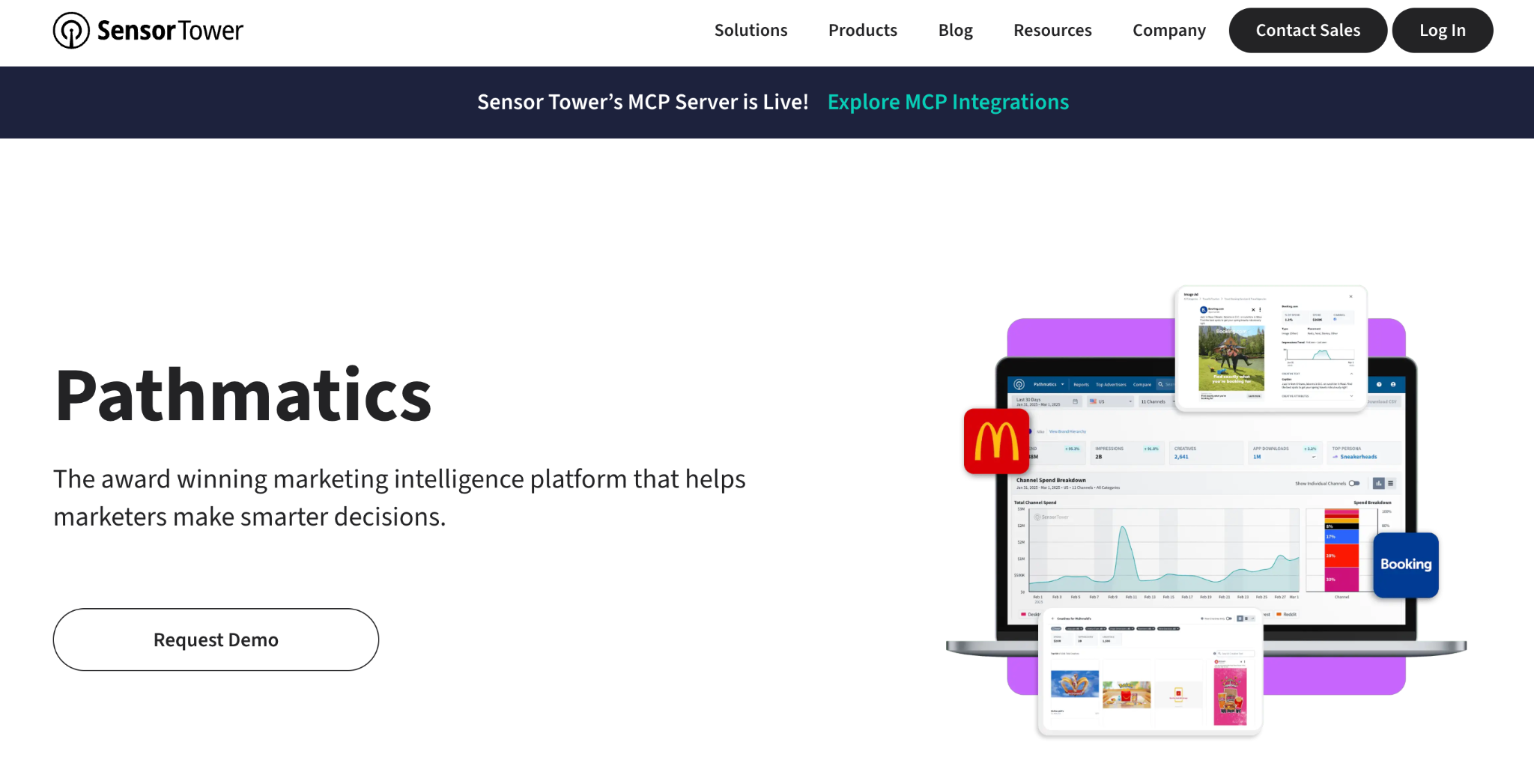
Pathmatics shows where competitors spend on digital ads and what they run. It estimates spend and impressions across Facebook, Instagram, YouTube, TikTok, X, Snapchat, and LinkedIn. It also covers display, video, mobile and desktop, programmatic and direct buys, linear TV, streaming services like Netflix, Prime Video, Disney+, Hulu, and Peacock, and, since August 2026, ads in ChatGPT in the US. For each creative, you can see the actual ad, its messaging, and its call to action.
The platform’s data comes from a first-party panel of opt-in users, automated crawlers, partnerships and platform integrations, and machine-learning models. Retail Media Insights is a separate product that adds share of voice across retail media networks, along with the creatives, spend, and messaging behind co-branded campaigns.
Pathmatics is part of Sensor Tower, which adds app performance, web traffic, and audience data built on the same consumer panel and app store APIs. Audience Insights, for example, shows which apps consumers use and which ads they see. Sensor Tower also runs an MCP server.
Keep up with where your buyers look next
Raghavan's lunch example was an early sign of where search was heading. A buyer today might check TikTok, a marketplace, a review site, and ChatGPT before they ever reach your site, and each of those stops leaves a trail that a different platform on this list can read. So build your stack from the questions you need answered, and pick the platform that collects each signal best.
AI answers are the newest of those stops. Profound tracks what AI engines tell buyers about you and your competitors, how often people ask about your category, and which AI crawlers and agents read your site. Aim turns those signals into a ranked list of what to do each week, and Profound's agents do the work your team approves. You'll still want the rest of your stack for traffic, social, and media, and Profound brings what AI tells buyers into the same planning meeting.
See what AI engines tell your buyers about you, and what to do about it. Book a demo.
Marketing intelligence platforms FAQs
What's the difference between marketing intelligence and marketing analytics?
The difference is direction. Marketing analytics measures your own campaigns, from web sessions to conversions to attribution across channels. Intelligence looks outward, at competitors, customers, the press, and the AI answers buyers read before they ever reach your site. You'll probably use both. Analytics tells you which of your channels worked last quarter. Intelligence tells you what changed in the market around them, like a competitor's new pricing page, a spike in negative reviews, or an AI engine that started recommending someone else.
Where does marketing intelligence data come from?
Mostly from five places: opt-in panels, sites that share their own analytics, crawlers that read public pages, partnerships with data owners like internet providers and ad platforms, and statistical models that fill the gaps. Survey-based research adds audience data on top.
Each method has tradeoffs. Panels and direct measurement are closer to real behavior but only cover the people or sites that opted in. Crawlers see public pages but nothing behind a login. Models extend coverage but produce estimates. The vendors on this list publish their methods, and it's worth reading them before you put a number in front of leadership.
Can one platform cover all of marketing intelligence?
No, because each one collects a different signal in a different way. A traffic panel can't tell you what a journalist wrote, a social archive can't tell you what a competitor spends on TikTok ads, and neither shows you an AI answer the way a buyer sees it.
How does Profound collect its AI search data?
From the consumer side of each engine, the way buyers see the answers. Answer Engine Insights captures responses from the front end of nine AI engines instead of calling their APIs, so what you see matches what a buyer sees in the app. Prompt Volumes estimates demand from more than 2 billion real prompts licensed from double opt-in consumer panels, with statistical modeling to correct for demographic and geographic bias. Agent Analytics uses a third method. It reads your server logs, through integrations with providers like Cloudflare, Akamai, Fastly, and Vercel, so it records AI crawlers and agents that never trigger a JavaScript tag.
How does Profound turn intelligence into work?
Every week, AI Marketer (Aim) reads your AI search data and brand context and brings your team a ranked list of opportunities, like a visibility gap on a priority topic or a competitor gaining in one region. Each comes with the reasoning and data behind it.
When you accept an opportunity, Aim turns it into a project, writes a brief for each task, and builds the agents that do the work, such as refreshing a page the engines stopped citing or drafting a correction for a wrong claim. It tracks the project’s visibility and citation share afterward. Nothing goes out without your team’s approval.