
Brand Radar is Ahrefs’ fastest-growing product, generating $1M in ARR every two weeks. But how good is the tool? And is it the right choice for you? I tested the tool extensively to see how it holds up.
Here’s what Brand Radar does well, what it doesn’t, and when you might need a different AI visibility provider.
Long story short: Ahrefs is a good choice for existing enterprise Ahrefs users
Ahrefs is the ideal choice for marketing teams who’ve already been using the tool and can afford to pay an additional $699/month for AI visibility. It’s a decent choice if your core focus is AI Overviews.
But if you’re looking for deep AI visibility insights, actionable recommendations, and built-in content generation, refreshes, and optimization, Ahrefs isn’t enough. Here’s the TL;DR on the pros and cons:
Continue reading for a deep dive into how Brand Radar works.
Brand Radar: What it does right
Brand Radar can be a great add-on product to your existing Ahrefs subscription if you can afford it. I found these primary advantages while testing the tool:
Brand Radar is bundled well with Ahrefs’ other tools
Perhaps the top benefit of Brand Radar is how well it integrates with the Ahrefs suite. If you already use Ahrefs for SEO, Brand Radar integrates seamlessly into your strategy. The Overview even shows your AI share of voice alongside search demand, web visibility, and YouTube visibility.
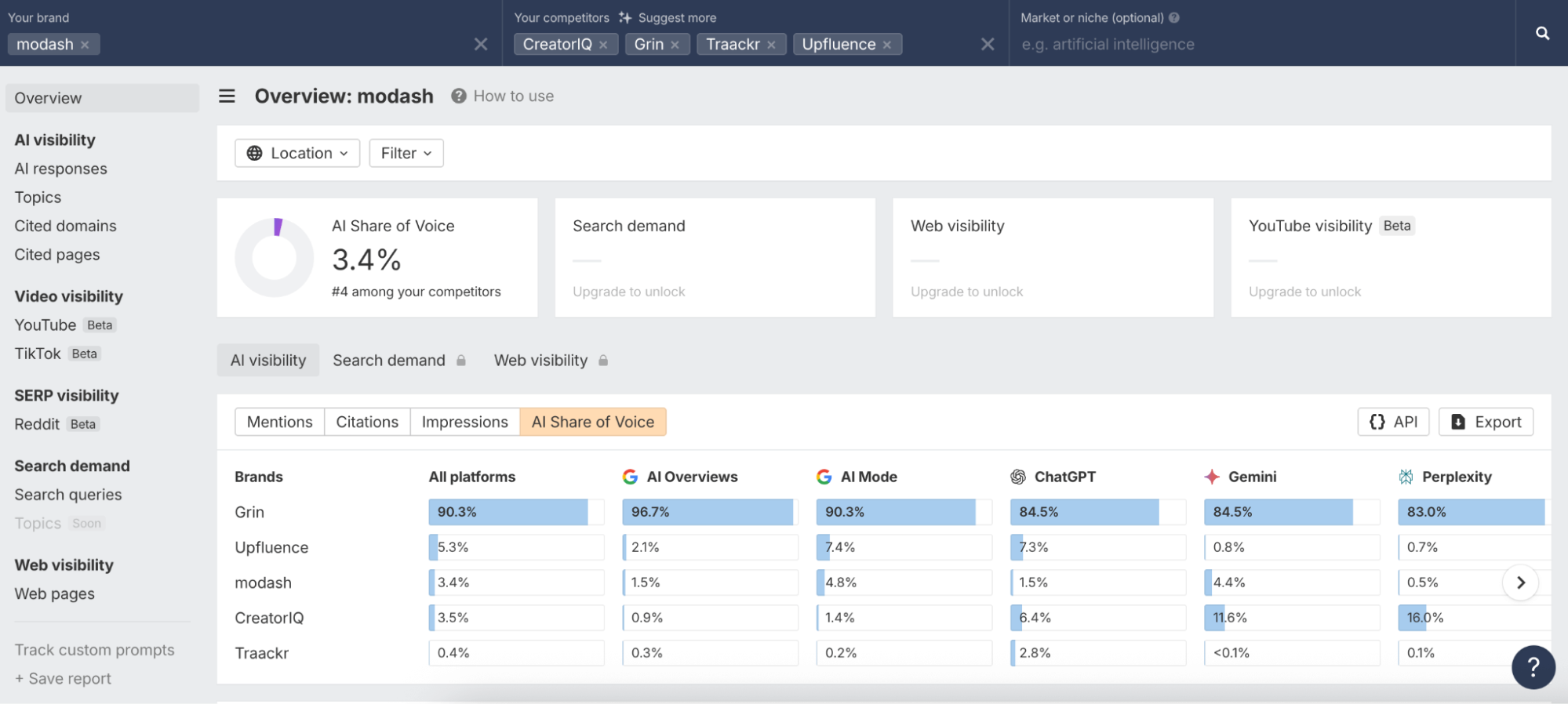
Note: You don’t get access to the search demand, web visibility, and YouTube visibility metrics unless you purchase the Ahrefs standard plans, too. I specifically tested Brand Radar, which is why the screenshot above doesn’t display anything beyond AI Share of Voice.
If you want a 360-degree view of how your brand is performing across the internet, Ahrefs is a good solution.
The only problem is the “topics” Ahrefs suggests you target might not be totally accurate. For example, for Modash (an influencer marketing tool), there were all sorts of unrelated topics like “alligator vs. crocodile” and “passport photos.”
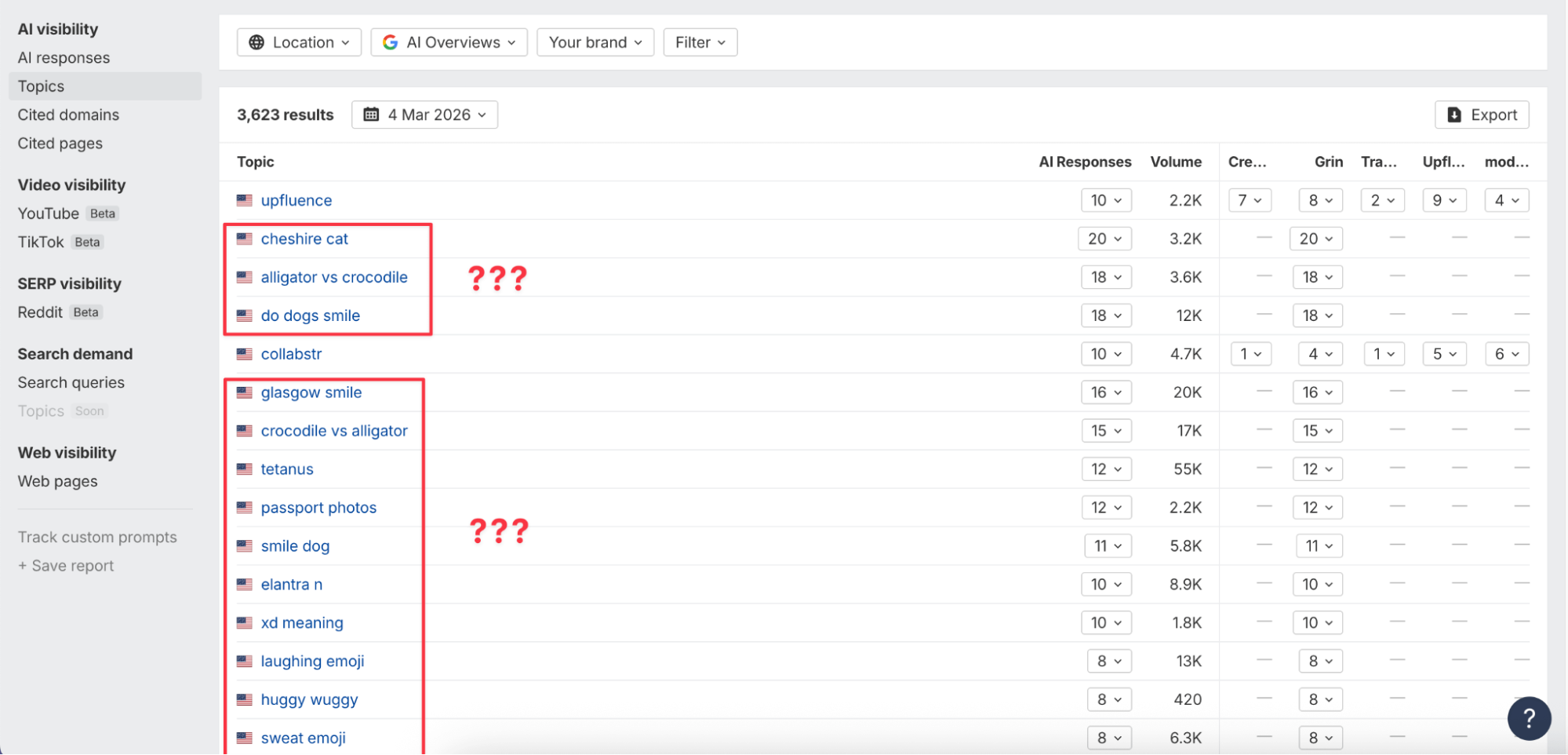
I realized the tool was confusing a competitor (Grin) with the verb “grin.” It’s the same issue I encountered while testing Semrush’s AI visibility toolkit—it confused “Later” the company for the “later” adverb. Lo and behold, once I removed Grin as a competitor, the topics made much more sense.
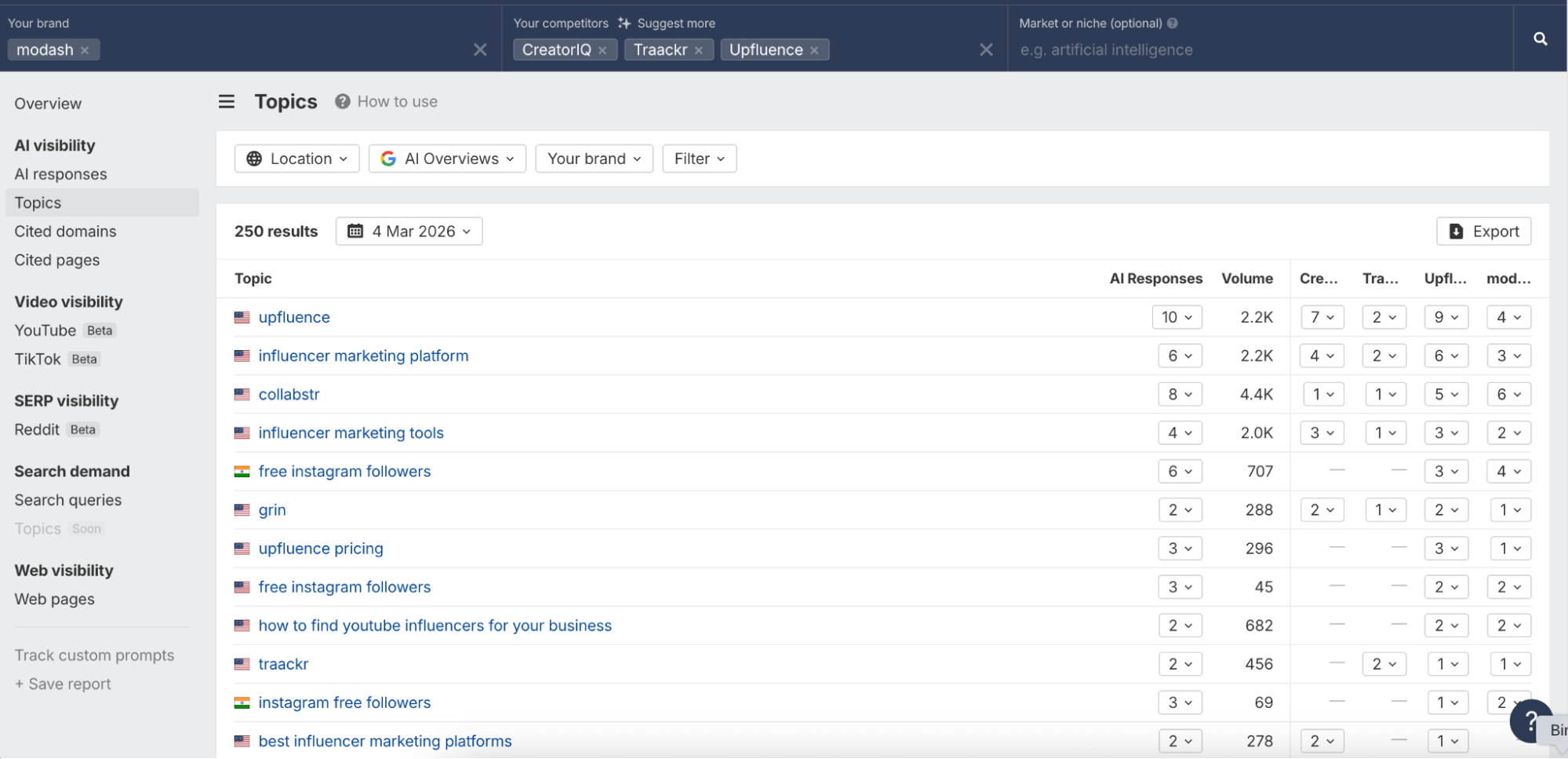
This still raises the question: What do you do if your competitor’s name doubles as a common word? Niche problem, but it definitely exists.
I didn’t face this problem when I added Modash to Profound. The tool instantly recognized the competitor, Grin, and didn’t confuse it with the verb anywhere. All the suggested prompts and topics were 100% relevant.
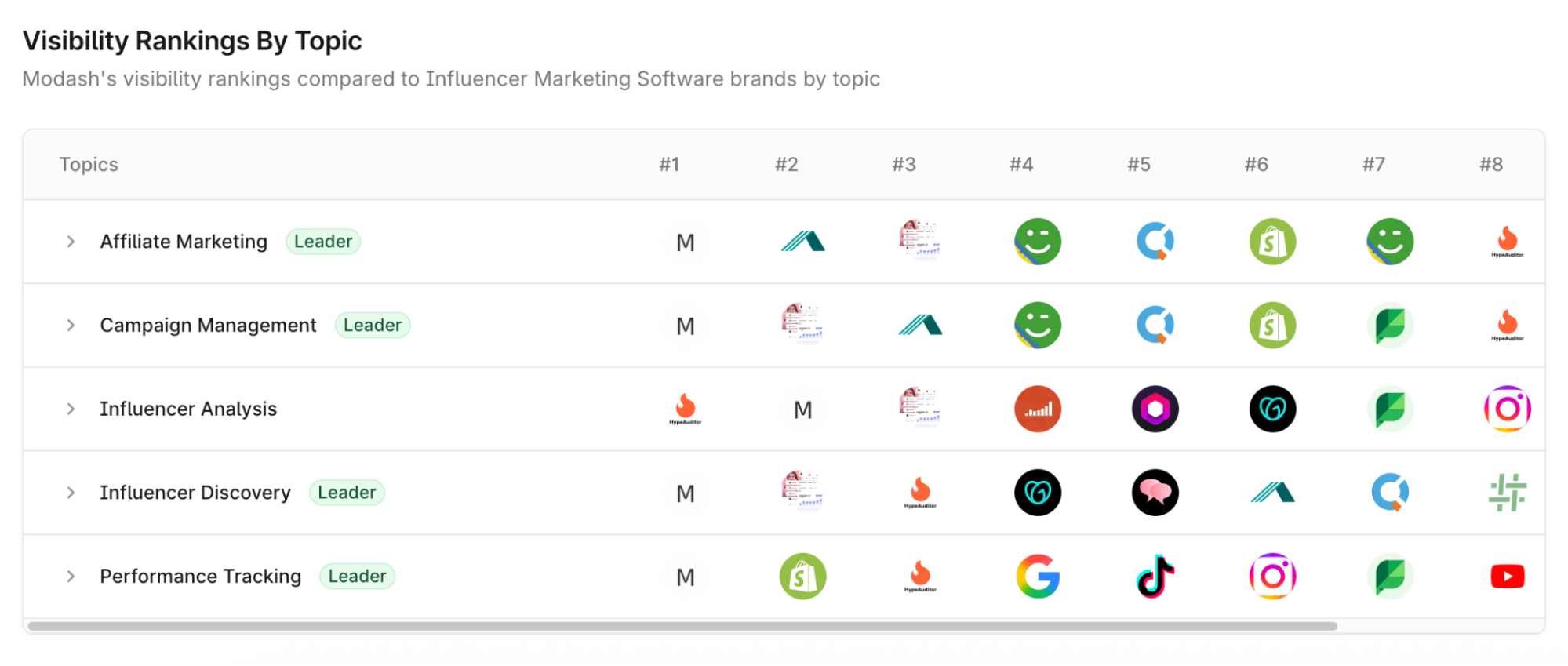
Apart from this minor hurdle, Ahrefs topics are a good way to find which content subject you can cover to improve your AI visibility. You can also apply filters to specifically view topics where your brand is not mentioned to discover content gaps.
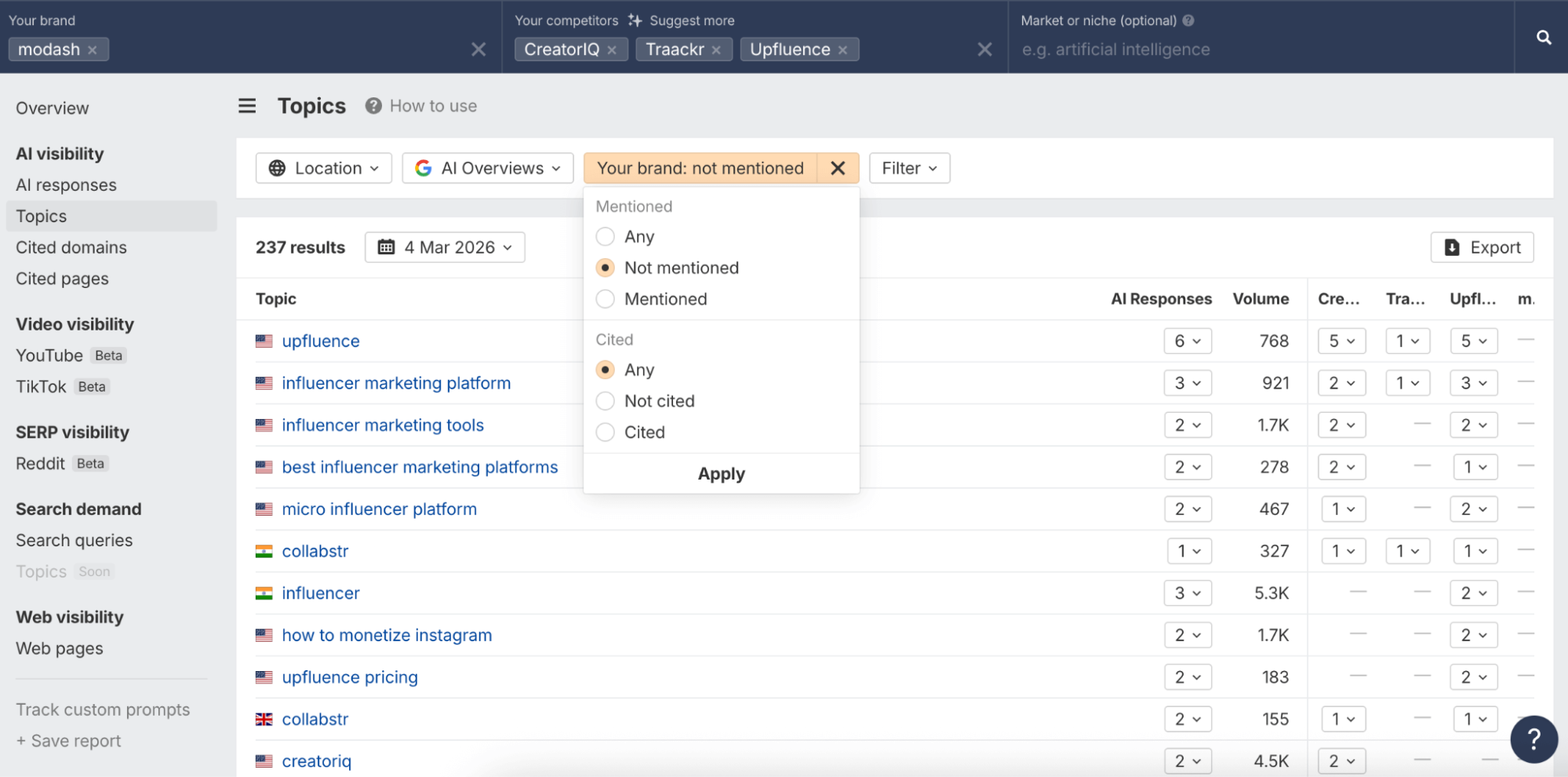
I wish there were a way to see the top topics from all the AI platforms Ahrefs contains in one window, though.
Right now, you can only look at the top topics from one AI platform at a time. There’s no option to select multiple AI tools. If you're optimizing across multiple AI platforms, you need to see which topics give you the highest ROI across all of them—not one at a time.
The prompt database is huge (but primarily from Google’s ecosystem)
At the time of writing this, Ahrefs contains over 218M+ prompts across six AI platforms—which is quite a decent number compared to many other AI visibility tools.
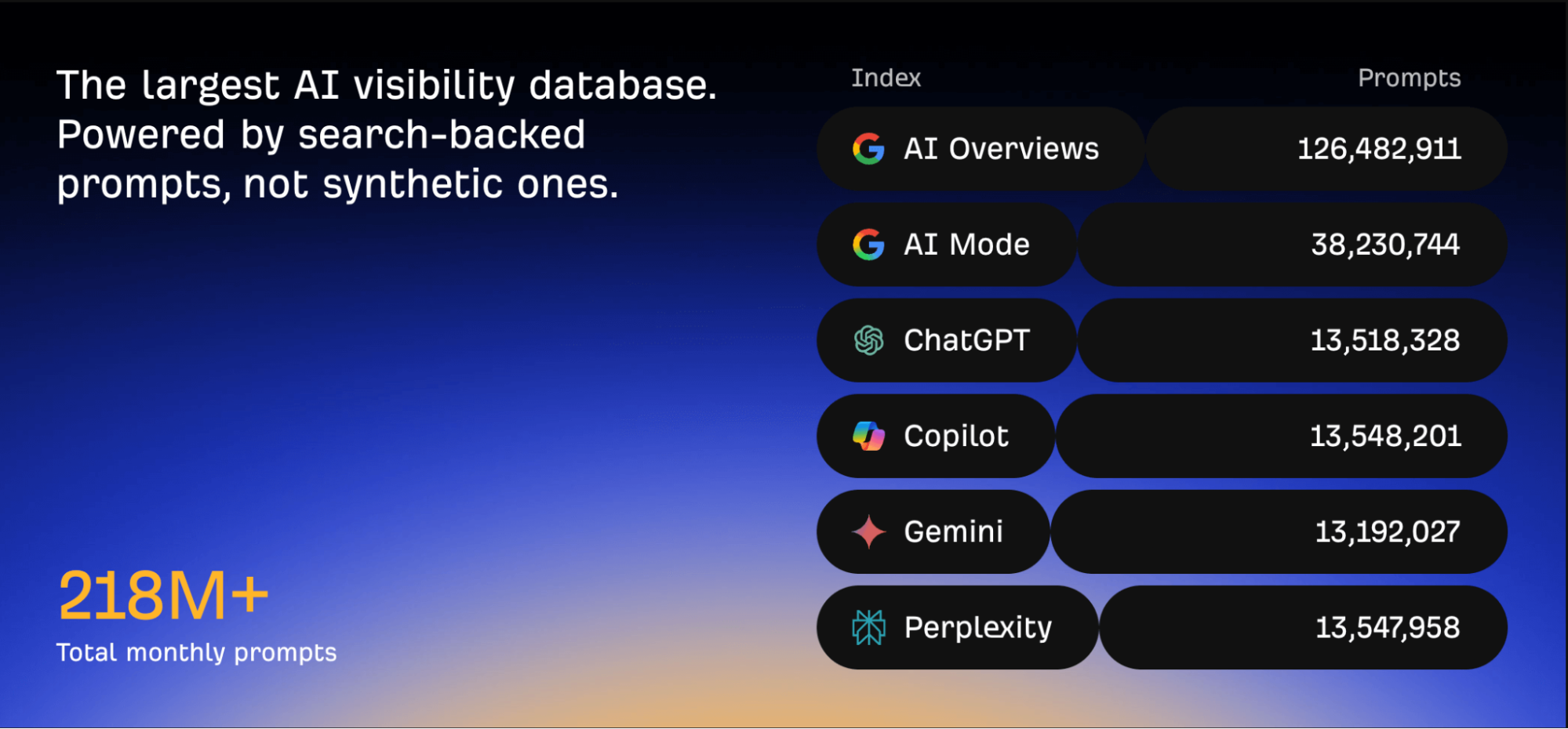
But there are two caveats:
The majority of the prompts are from Google AI Overviews and AI Mode. This makes sense since Ahrefs’ foundation is SEO, but it does mean your AI visibility metrics will be significantly less for other AI platforms like ChatGPT or Perplexity. If your GEO strategy primarily focuses on Google’s AI Overviews, Brand Radar might be fine. But if you want a more wholesome picture of your AI visibility (aka, enough prompt data beyond Google), it’ll be insufficient.
Note: Despite the large difference in prompt data, you’re paying the same amount to add Google AI Overviews and AI Mode as ChatGPT, Perplexity, Gemini, and Copilot. It’d really make sense to reduce the pricing to add these tools since the AI visibility data for them is a fraction of what’s available for Google AI Overviews and AI Mode.
The prompt database is built from search query data. This also makes sense—SEO is the foundation of Ahrefs. But the way people search on AI tools is significantly different from how they search on Google. For example, someone might search “best CRM for small business” on Google. But on ChatGPT, they’ll be much more specific, saying something like: “I run a 10-person agency and I'm drowning in client follow-ups. What should I use?” The tools AI platforms recommend might be completely different from Google’s results—depending on the context of the prompt.
Our study confirms this: Only 8–12% of ChatGPT answers overlap with Google’s search results. That’s minuscule. Google search behavior is definitely not enough to provide accurate insight into AI search behavior.
This is why it’s more reliable to use something like Profound for understanding relevant prompts and deciphering prompt volume. Instead of relying solely on a search-backed approach, Profound also uses:
- Direct AI querying: Sending millions of prompts daily to 10+ AI engines and capturing the full rendered responses.
- Agent analytics: Profound connects with your site using CDN integrations to understand how AI agents interact with your content.
- Prompt volumes: A proprietary dataset of over 400M+ actual AI conversations that create an accurate estimation of search conversations on LLMs.
You can see how AI associates certain topics with your brand
Brand Radar reveals how your AI visibility fares in the core topics you want associated with your brand. For example, I checked Modash’s AI visibility for topics like:
- Influencer marketing
- Affiliate marketing
- Influencer marketing tools
You can add as many niches or broader markets as you like and see how your AI visibility is doing in those topics and/or markets. By layering the competitor filter, you can also benchmark your performance against rivals.
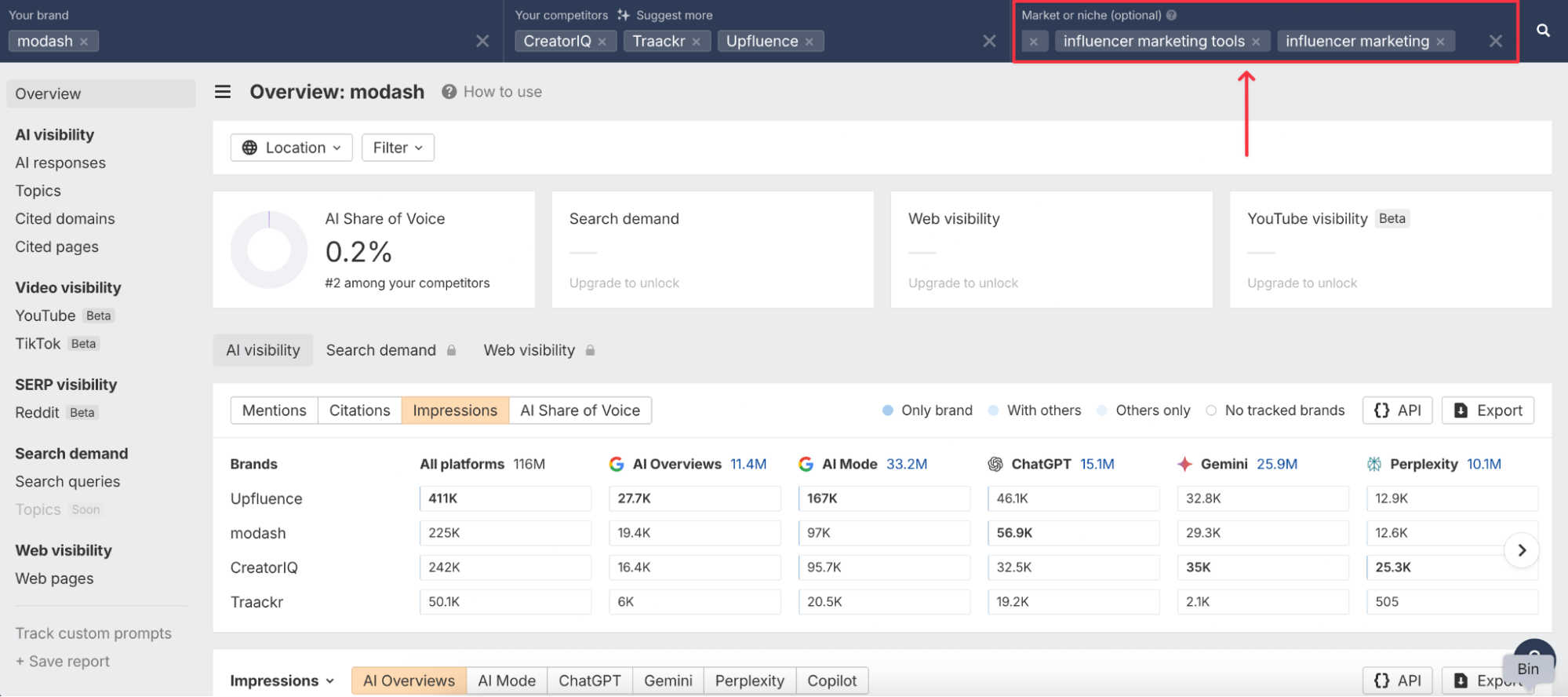
If you’re a brand trying to dominate multiple categories, this feature would come in handy to compare how you’re faring in each category. For example, I can compare how Modash’s AI visibility is tracking for influencer marketing vs. affiliate marketing because the tool offers solutions for both.
The limitation here is that these prompts are still based primarily on Google search behavior as opposed to AI search. So the more specialized your search is, the bigger the blind spots. For niche topics, AI visibility might not be available entirely—especially if Ahrefs doesn’t have those subjects in its keyword database.
For example, there were no results when I searched for AI powered influencer discovery—which is one of Modash’s key differentiators.
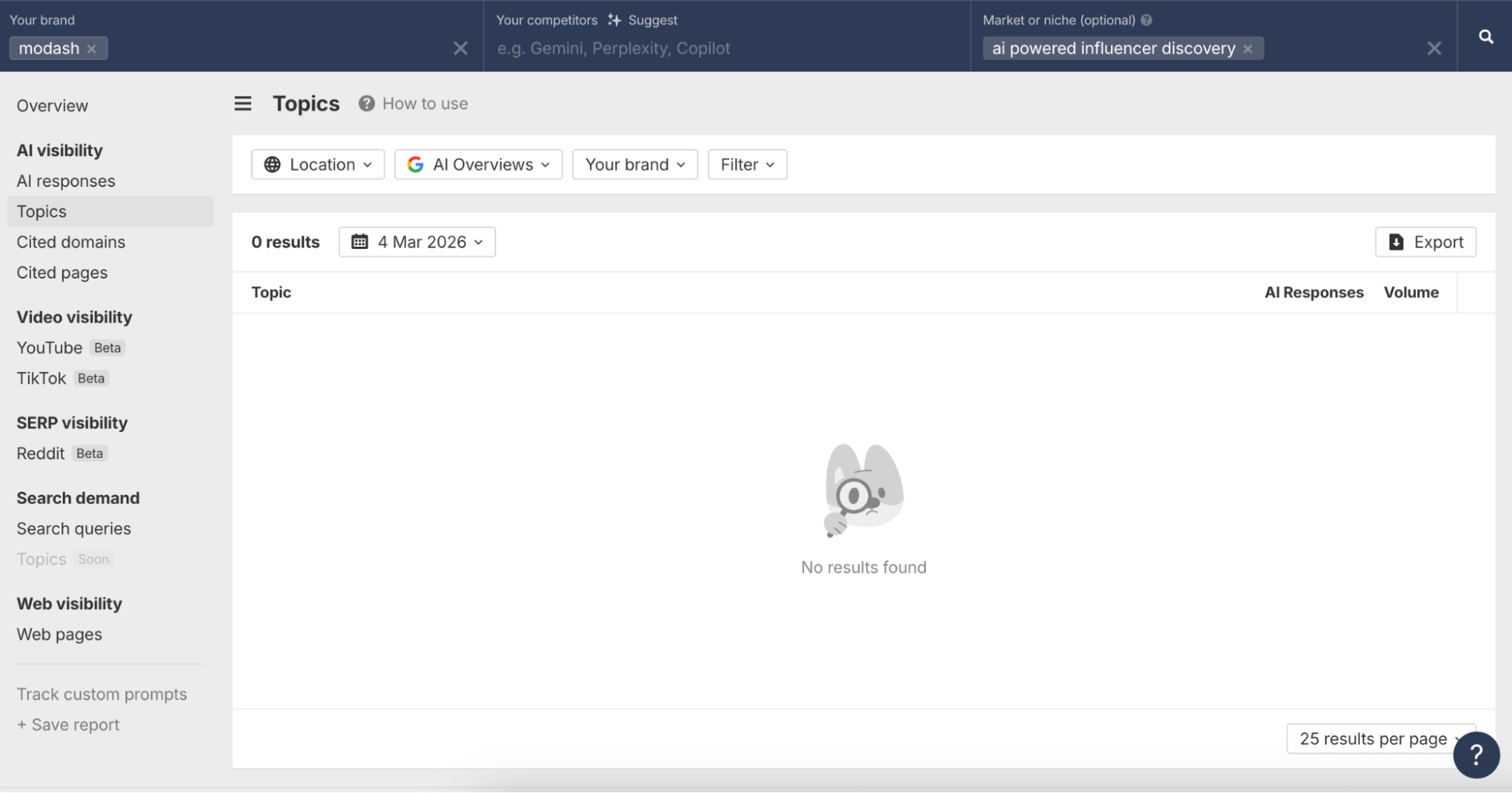
There’s a good probability Ahrefs will add more prompts to its database and the overall market/niche options will expand—but you’ll have to wait for the company’s keyword database to catch up because that’s what the data depends on. Even then, there’s always the fact that Google search behavior doesn’t equate to AI search behavior.
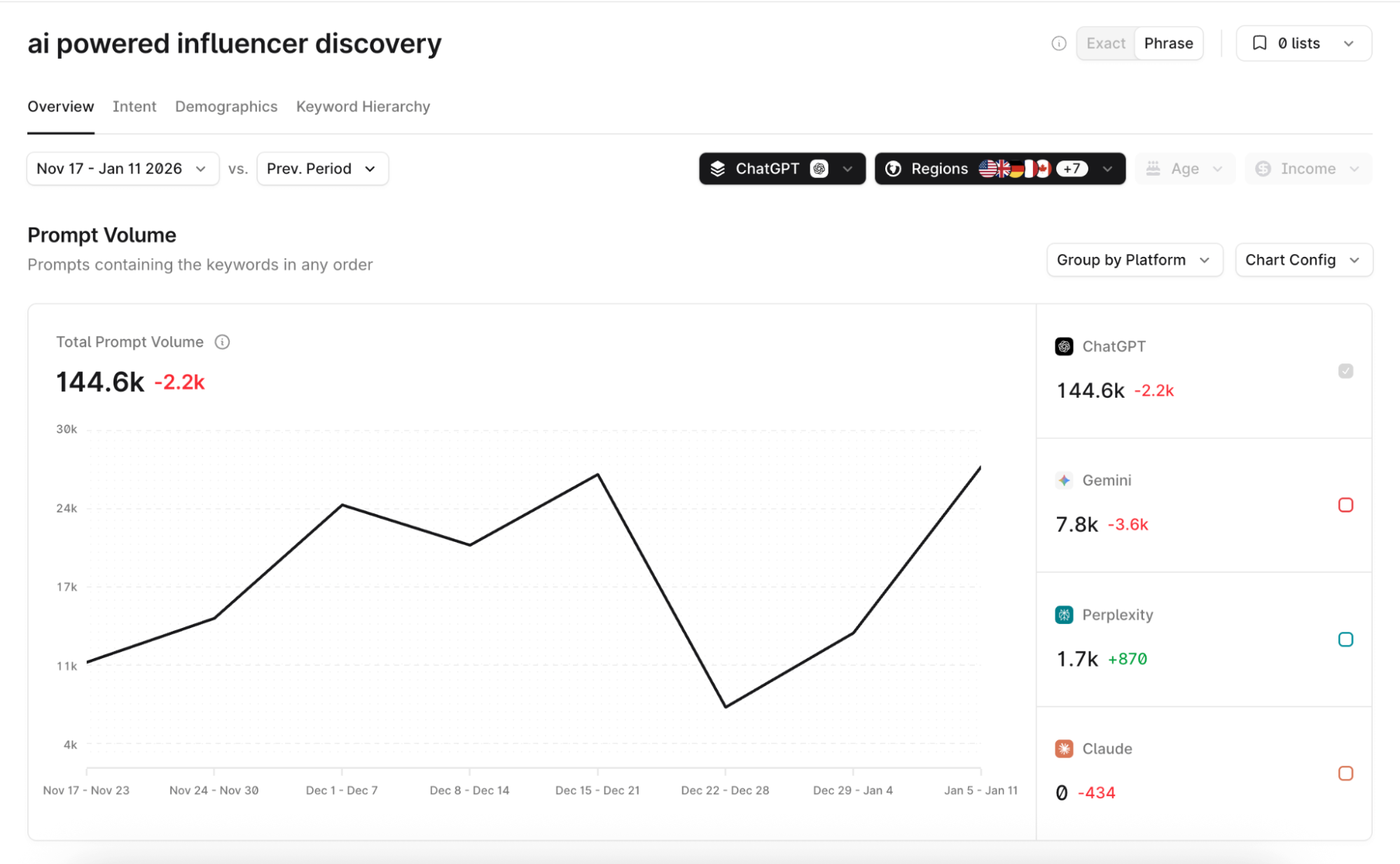
Profound takes a different approach to overall market visibility. For starters, Prompt Volumes allows you to enter and search for any keyword you want and understand its:
- Volume (you can filter it by platform, time period, region, income demographics, etc.)
- Search intent
- Keyword hierarchy
- Relevant prompts related to your keyword
- Similar keywords
If a keyword isn’t present in Profound’s database, the tool calculates its volume in real time—you’re never stuck with a blank screen. For example, I searched for the same “AI-powered influencer discovery” topic and Profound came back with accurate data.
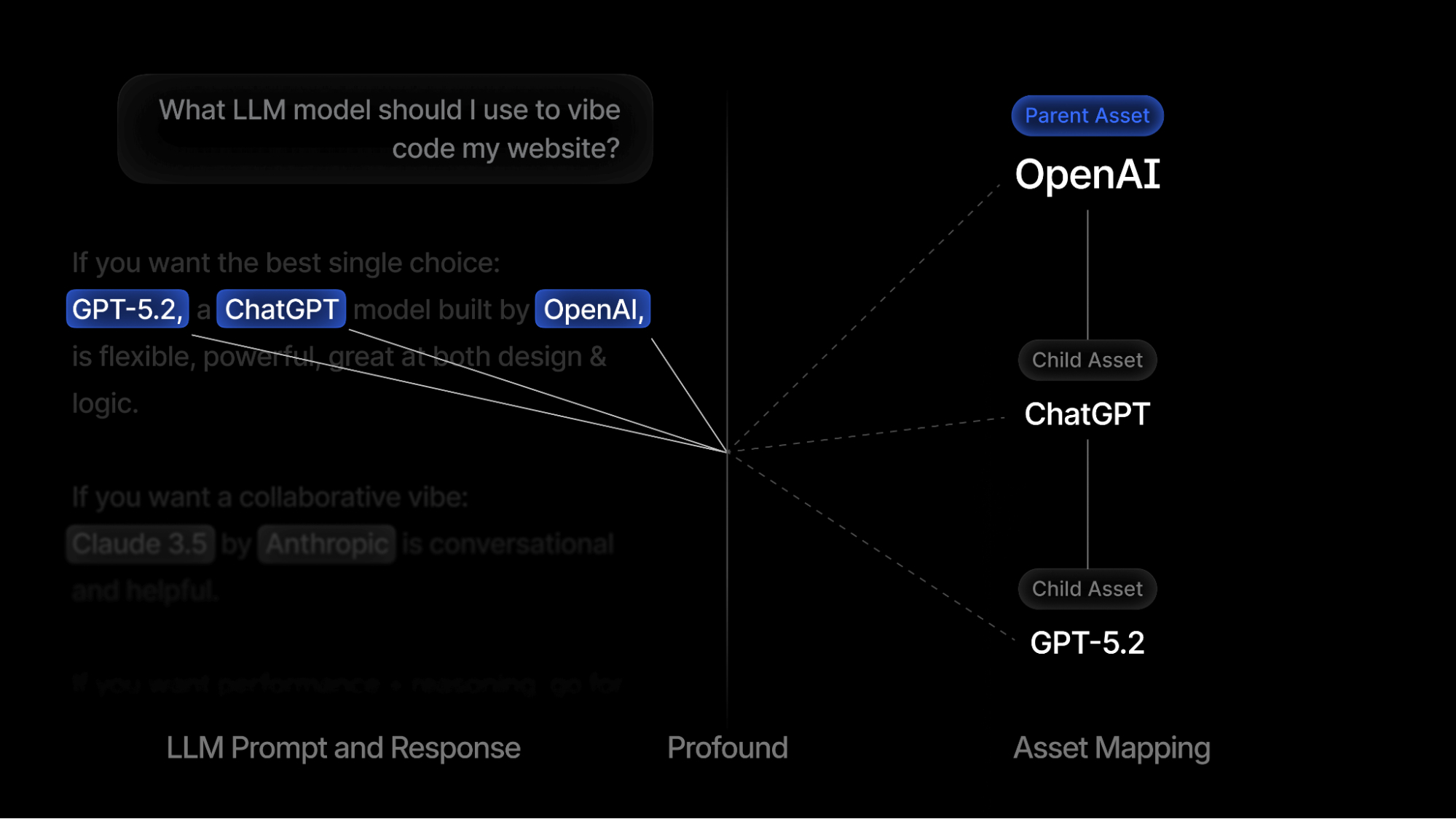
Profound also recently launched Asset Hierarchies, which let you track your products, features, and other sub-assets individually, while still rolling their visibility into your overall brand performance. This makes it super easy to understand which products, ideas, or subjects generate the most AI mentions.
It’s possible to monitor your visibility on TikTok and YouTube (at an additional cost)
One of the biggest differentiators of Brand Radar is it also monitors TikTok and YouTube videos to calculate your AI visibility. As of this moment, the feature is in beta and only available to existing Ahrefs customers who already have a paid plan.
If your brand appears in conversations on TikTok and YouTube, those discussions eventually become training data and retrieval sources for LLMs—which means monitoring these platforms gives you a leading indicator of future AI visibility.
Three caveats to remember:
- YouTube data goes back to December 2023. YouTube is a long-term play. If your brand has been mentioned before that date, it might affect your AI visibility—but Brand Radar can’t track it.
- Tracking YouTube and TikTok visibility will cost an additional $199/month. Right now, video visibility tracking is free for paid subscribers. After the beta stage, the add-on will cost an additional $199/month.
- Reddit visibility is only visible in SERPs. Brand Radar doesn’t track your brand mentions on Reddit for AI search, but it does track it for Google search results. They might overlap, but then again, they might not.
Brand Radar: What needs improvement
Brand Radar does a lot of things right—especially for existing Ahrefs enterprise customers. But there are some areas which can be a dealbreaker for many marketing teams.
Brand Radar is (extremely) costly and doesn’t have a free trial
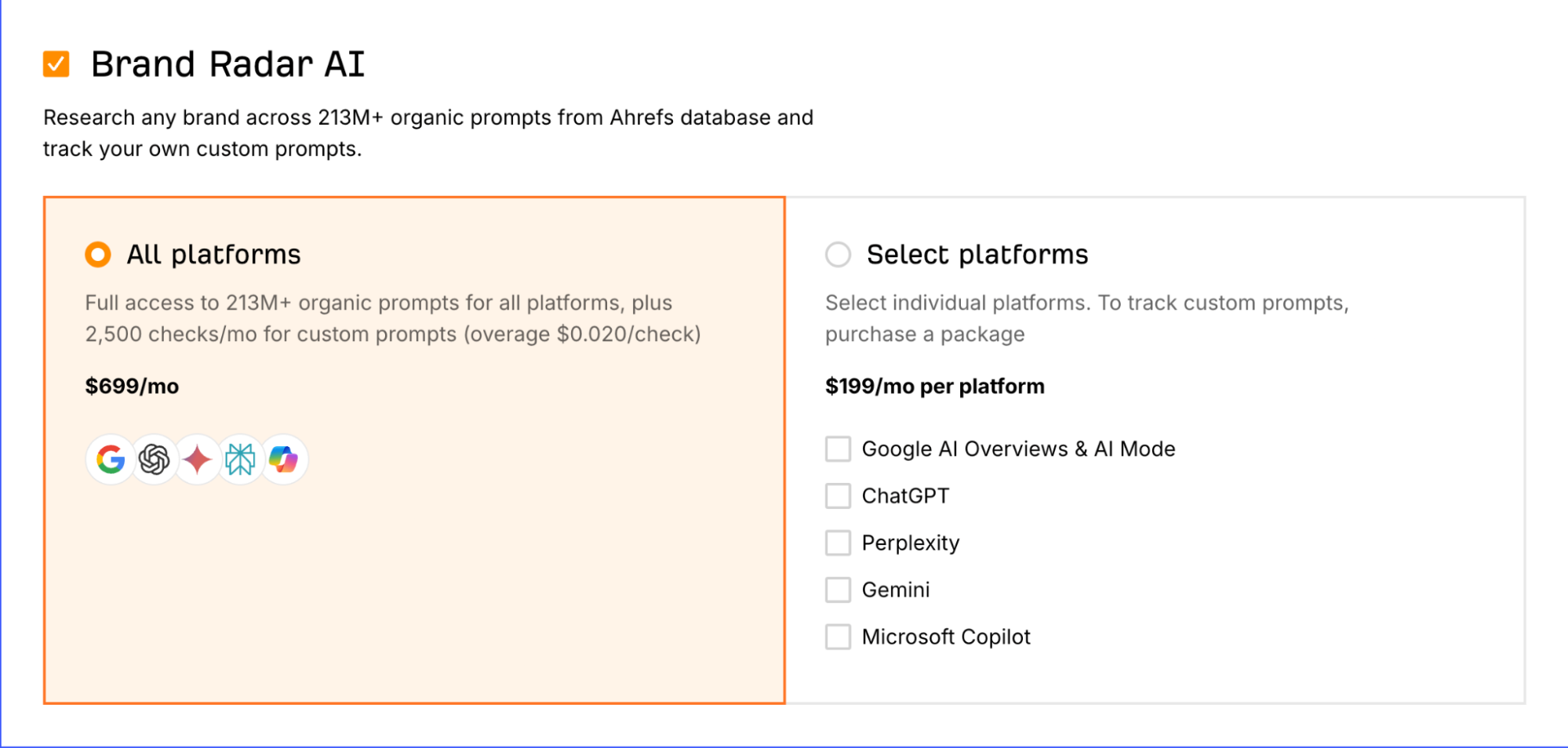
By far the most common complaint customers have is the price of Brand Radar. Each AI answer engine costs $199/month. So for six AI engines, you pay a whopping $699/month.
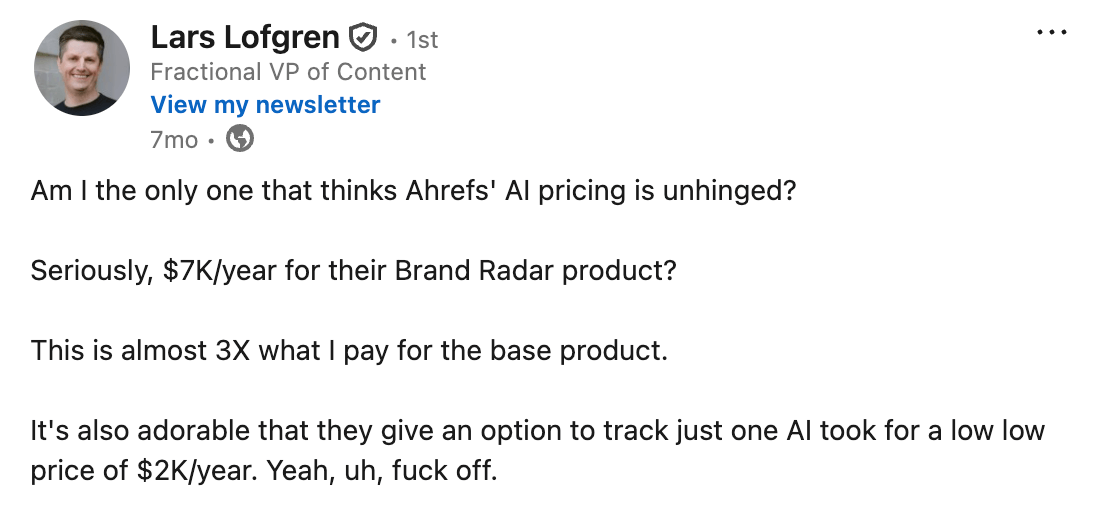
Many OG Ahrefs customers—who have been loyal to the tool for decades—have been ticked off about the price.
On top of this, there’s an additional cost for tracking custom prompts. By default, Brand Radar offers 2,500 checks per month. Here’s how one “check” is calculated:
1 check = 1 prompt execution × 1 LLM × 1 location
So if you want to track 10 prompts in six LLMs across three locations every day, you’ve already hit your limit in less than 14 days. The overage pricing isn’t outrageous, but at this price point, I would expect more checks included by default.
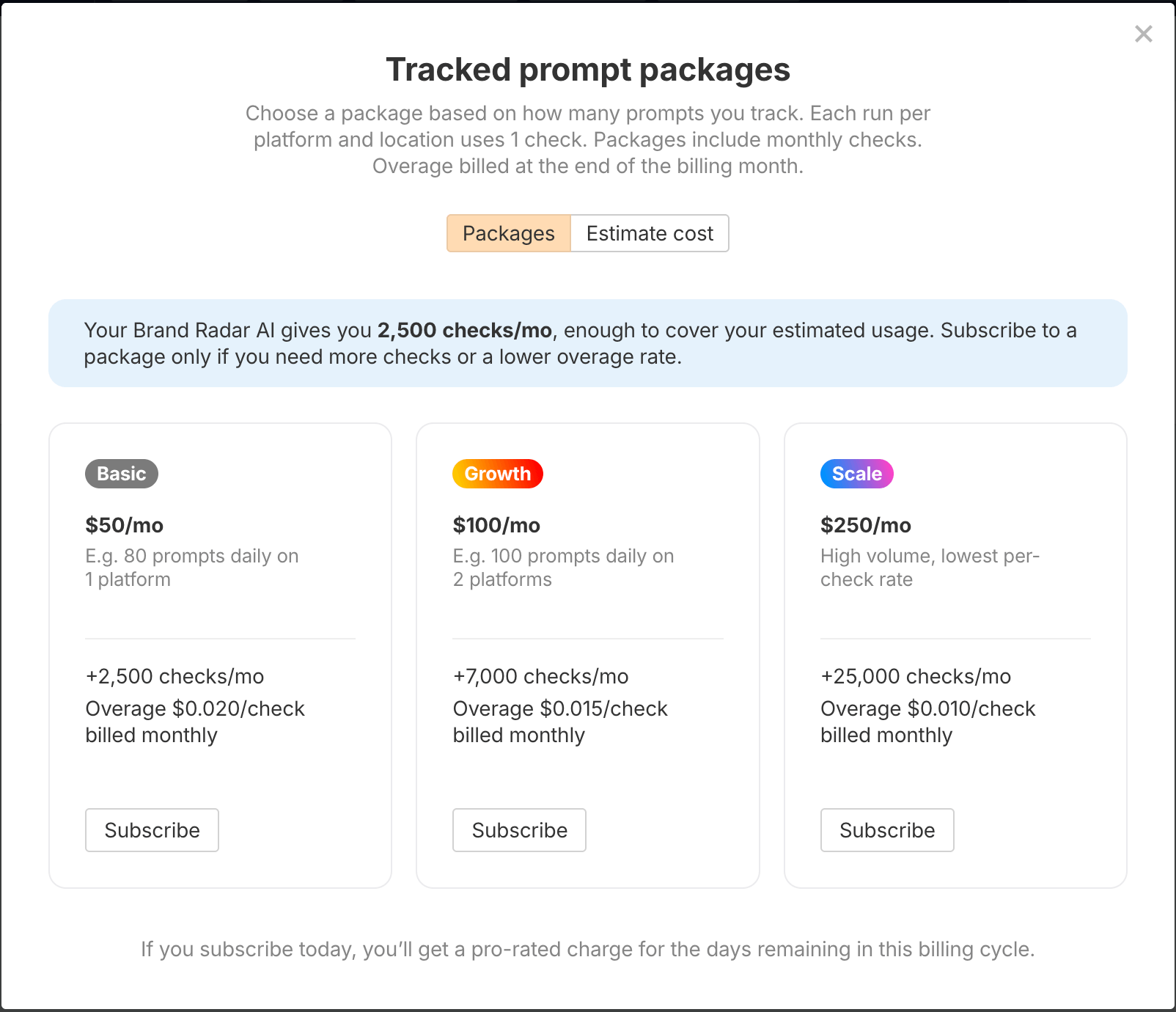
Overall, here’s why Brand Radar’s price is hard to justify:
- The cost of Ahrefs’ base product is significantly less
- Tracking video visibility costs an additional $199/month
- There’s no free trial for new customers who’d like to test the tool
- The default number of custom prompts feels far too low for the price
- The prompt database is backed by synthetic data of Google search, not AI search
- You only get AI visibility insights into six AI platforms (which is heavily skewed toward AI Overviews)
Compared to Brand Radar, Profound’s pricing feels more flexible and worth the cost.
- You can try the Growth plan for free
- If you want to track just ChatGPT, you just have to pay $99/month
- For enterprise pricing, you get insight into AI visibility for over 10 LLMs
- Instead of surface-level data, you can dive deep and check your AI visibility by persona, monitor prompt volume, discover opportunities to improve AI visibility, and even generate content
Brand Radar has limited LLM coverage
Brand Radar offers AI visibility insights into six tools:
- AI Overviews
- AI Mode
- ChatGPT
- Perpelexity
- Gemini
- Copilot
It’s missing some crucial LLMs like Claude, Grok, Meta, and DeepSeek (which Profound’s enterprise plan covers).
This is fine if your GEO strategy is just showing up in AI Overviews. If you’re aiming for a holistic AI visibility strategy, it’s important to be visible everywhere your buyers are searching. Missing major platforms like Claude, Meta AI, and Grok undermines that—and is hard to justify at Brand Radar’s price point.
There are no AI shopping features or agent analytics
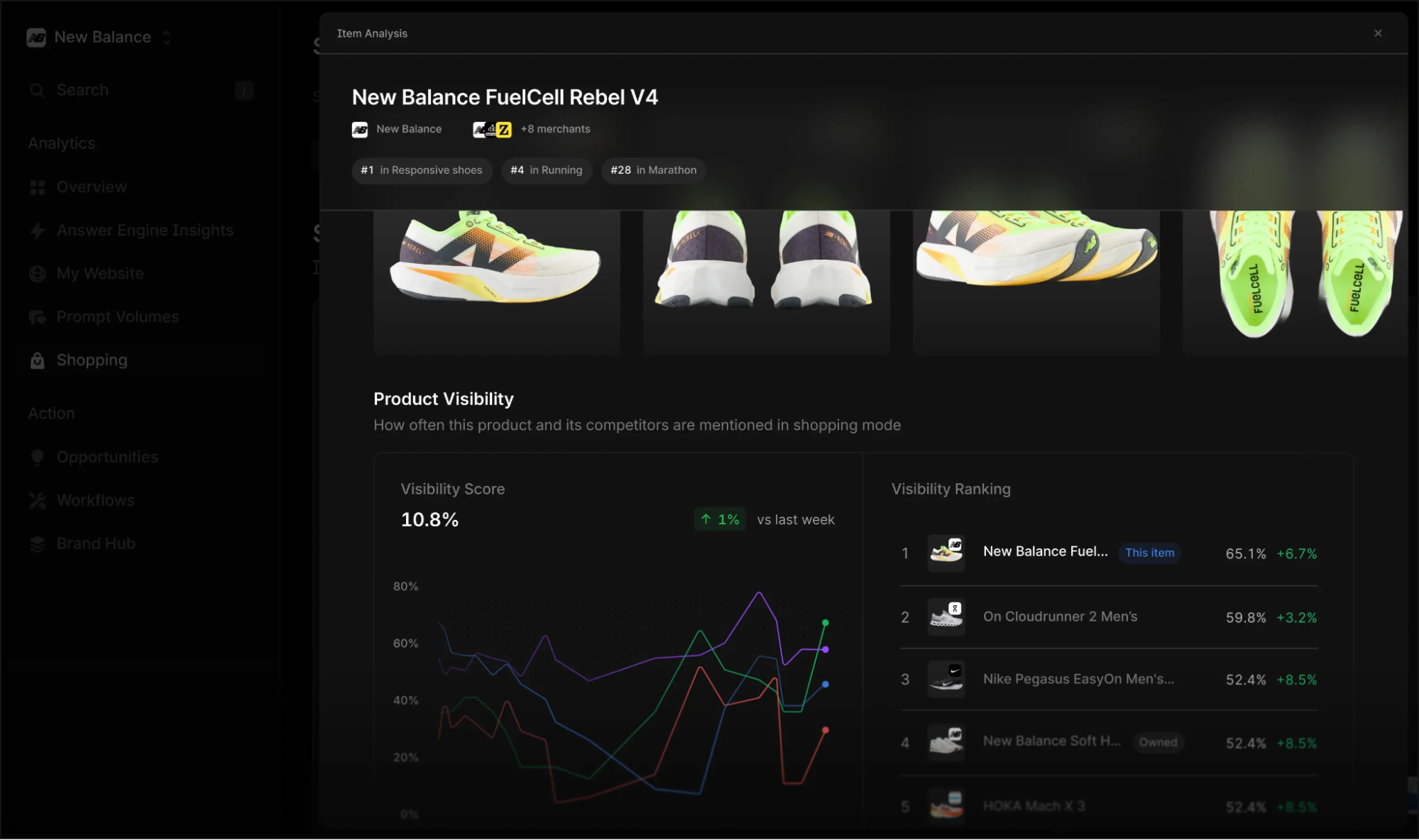
Ahrefs doesn’t show anything about how your products appear in ChatGPT shopping or assess how AI crawlers interact with your site. Profound offers both these things.
With Profound’s Shopping dashboard, you can understand:
- If your brand is visible in AI platforms when potential buyers talk about purchasing something relevant
- How answer engines are describing your product(s) and influencing shopper sentiment
- Analyze individual SKUs to see related citations and keywords
Similarly, Profound's Agent Analytics helps you understand how AI sees your website so you can ensure your whole site is optimized for AI retrieval and indexing.
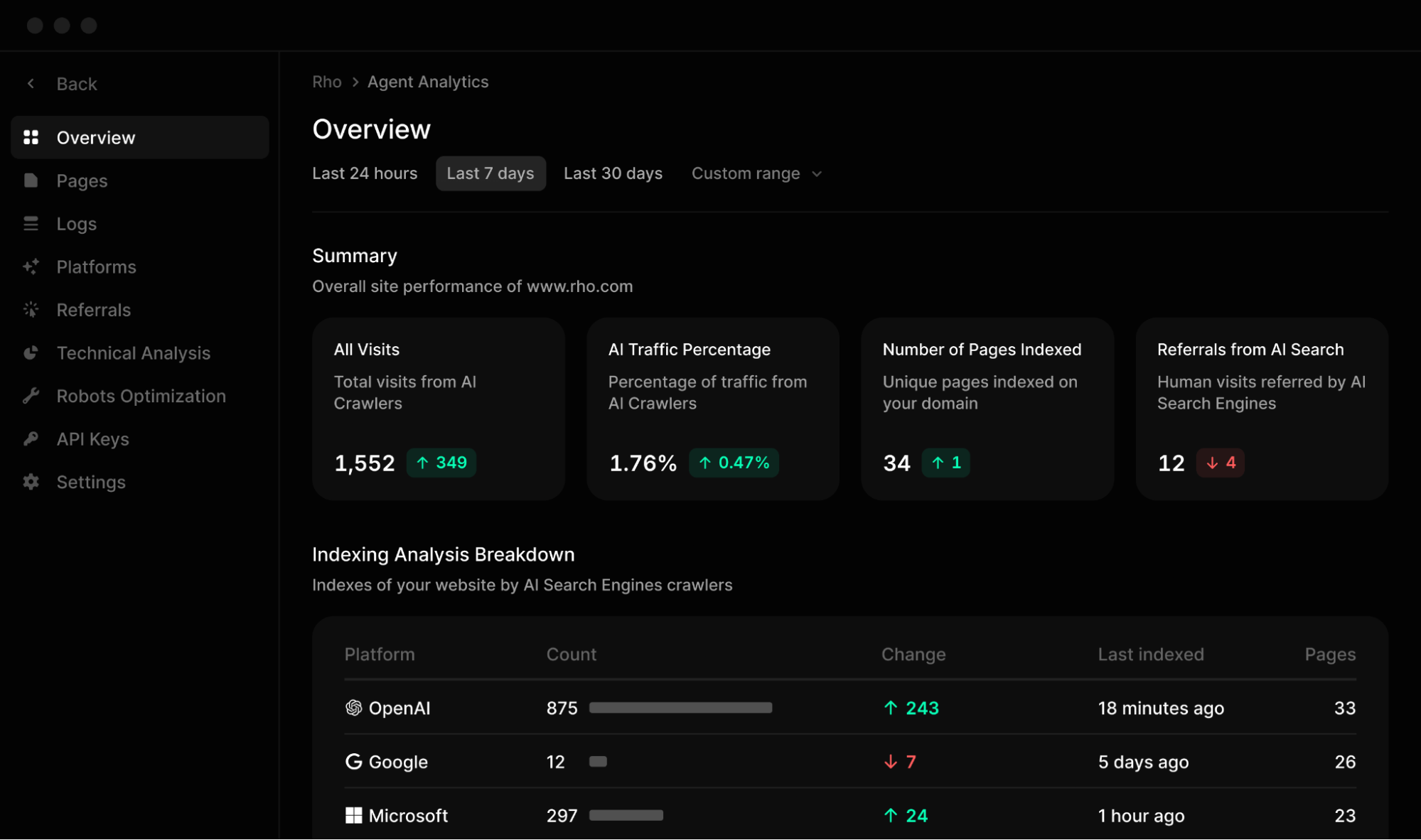
Both of these are critical if you’re serious about AI search. If LLMs can’t index your site or if you’re an ecommerce brand and AI platforms aren’t referencing your products, you’re missing out on a lot of revenue. But you won’t know it until you track it.
The AI visibility metrics are surface-level and not updated frequently enough (except Google AI Overviews)
Brand Radar can give you a lot of data, but it’s still missing some crucial elements:
- Evaluate your LLM visibility for specific customer demographics
- Sentiment analysis of how your brand is perceived in AI search
- Straightforward comparisons about how your AI visibility has improved/declined
- Ability to slice and dice the data to identify the topics you lead across each AI platform
- Bifurcated citations to understand AI visibility into owned, paid, earned, and competitor media
On top of that, the Ahrefs data (that’s present) is not updated enough. Apart from Google AI Overviews, all AI chatbot data is updated just once a month.
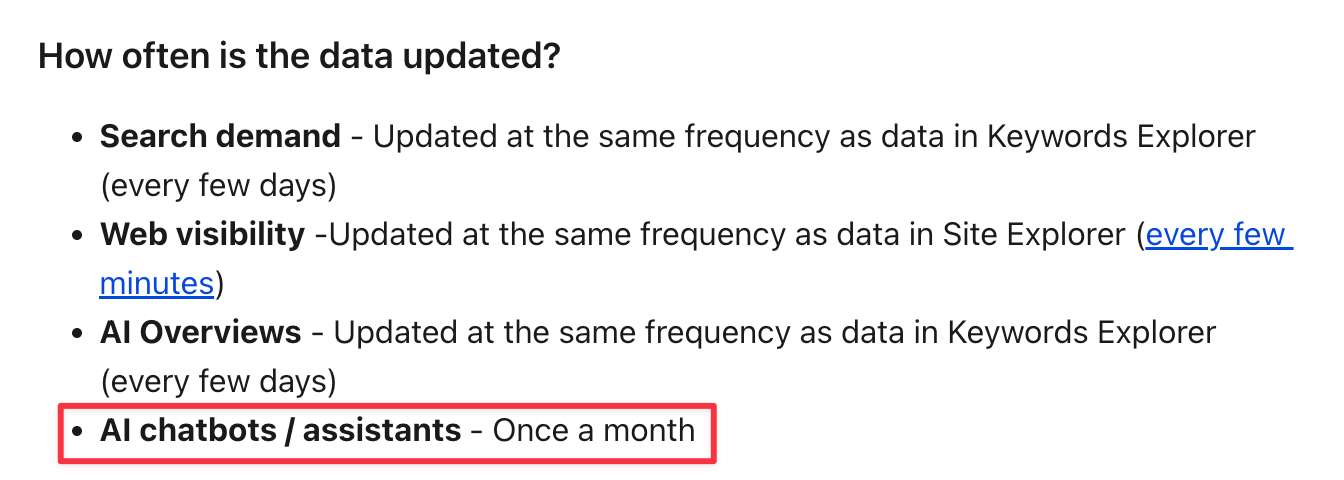
Profound updates its data hourly to keep up with the volatility of AI search. Unlike Google, LLM responses shift constantly, so stale data means stale strategy.
Profound also has all the missing puzzles mentioned earlier—which means you aren’t just getting surface-level data, but deep insight into how your brand shows up in AI search.
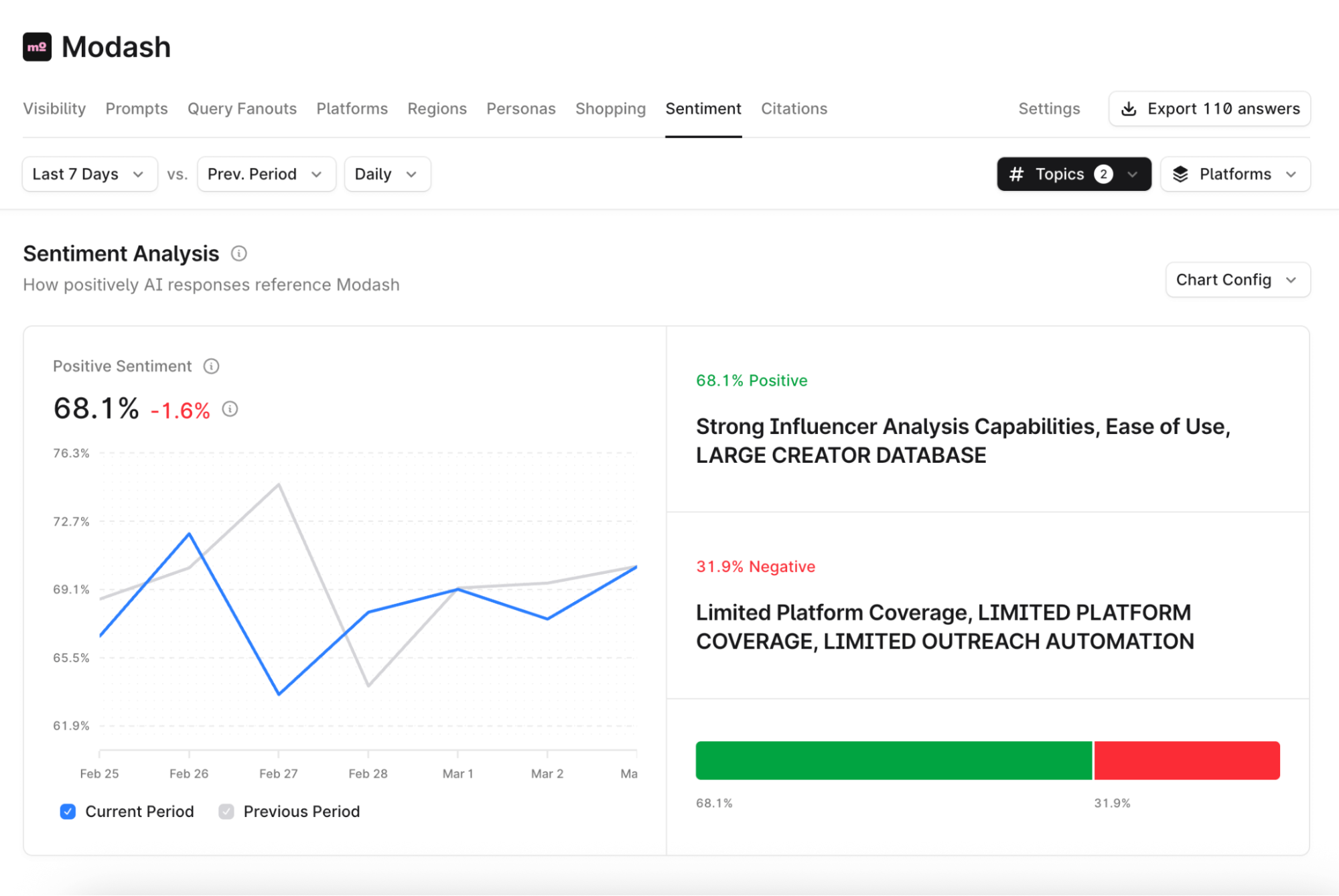
- There’s a dedicated section about sentiment analysis with insight into the top negative thing said about your brand (and the top positive)
- You can compare your AI visibility to the previous period to monitor the effectiveness of your efforts
- Citations are divided into categories of owned, earned, social, PR, etc.
- There’s a dedicated “Platform” tab to dissect your performance (share of voice, sentiment, position, etc.) on various AI platforms
- You can set up specific personas and monitor your AI visibility in those customer segments
Ahrefs only provides data (not suggestions to improve your AI visibility)
Brand Radar arms you with the (albeit limited) data on your brand’s AI visibility. But it doesn’t provide you with any direction to improve it.
And the Ahrefs team are SEO experts, given their legacy in this space. But there aren’t AEO experts available to assist you. In the end, it can feel overwhelming to have all this data thrown at you with no guidance on how to move forward.
Profound solves this by having:
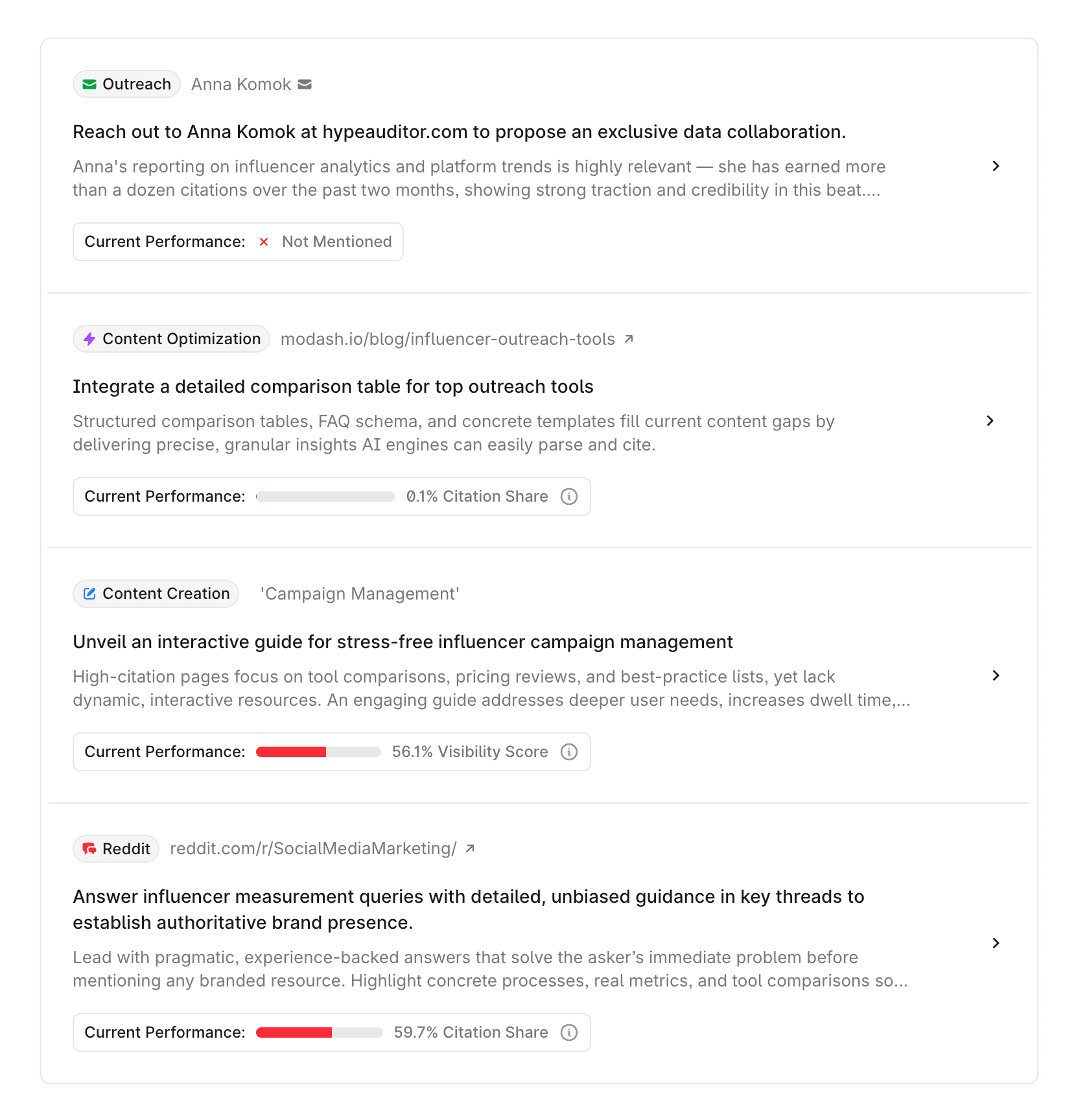
- Opportunities that clearly and thoroughly share potential actions you can take to improve your AI visibility
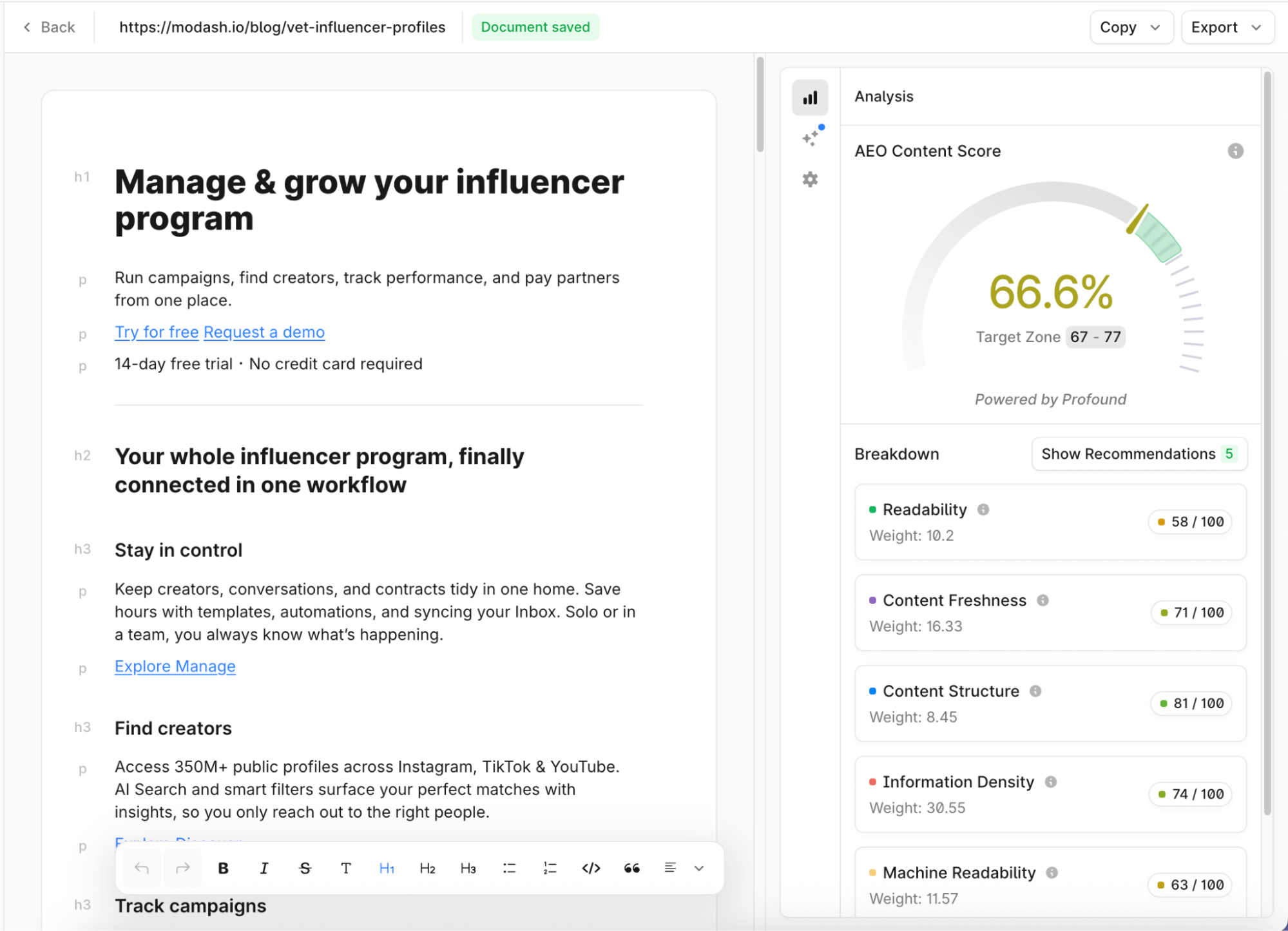
- Strategic content creation (with templates!) to write AI-optimized content and refresh existing ones quickly
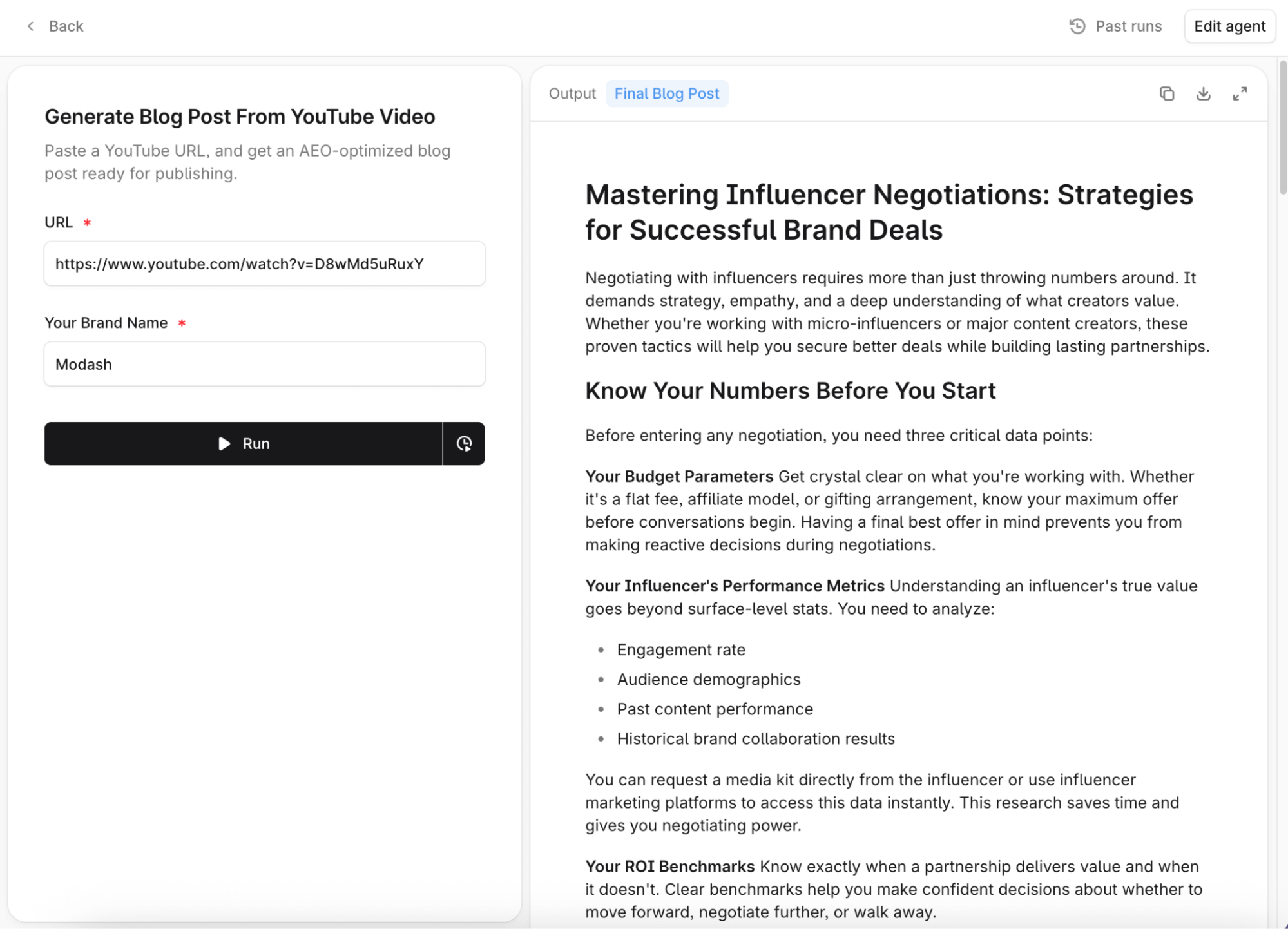
- Agents to build workflows to automate some tasks to improve your AI visibility (like creating briefs, creating weekly brand health reports, generating a blog post from a YouTube video, etc.)
In the Enterprise plan, Profound also offers access to a dedicated AEO strategist—you’re never flying blind.
Is Brand Radar the right choice for you?
I’d recommend choosing Brand Radar if:
- You already use Ahrefs and need AI visibility in the same tool
- AI Overviews are your main AEO focus
- SEO is your priority and AEO is secondary
However, if you need:
- A distinct strategy for AEO
- Deep insights into your brand’s LLM visibility
- Full AI search engine coverage (Claude, Grok, Meta, etc.)
- Actionable and expert guidance to improve your AI visibility
Then Profound is the better choice. Sign up today and see the difference comprehensive AI visibility data can make for your strategy.
