
Personal agents like Meta's Muse are built to carry out everyday tasks for users. An Answer Engine can tell you how to cancel a subscription, but a personal agent is meant to cancel it for you.
Plenty of people are trying it. In its Q3 earnings call, Meta reported that more than 10 million people set up Muse in six weeks, and 25% of those use it on any given day. Are people actually using Muse for personal tasks? What else do they use it for, and how does this usage differ from ChatGPT?
To find out, we labeled 8 days of real user prompts to Muse with two taxonomies: the topic labels from OpenAI's How People Use ChatGPT, and intent labels from Profound Prompt Volumes. ChatGPT comparisons come from OpenAI's published figures and from US ChatGPT users over the same dates via Profound's Prompt Volumes data.
Key findings:
- Usage is meaningfully different. People ask Muse to do things for them, mostly everyday personal tasks such as managing email, calendars, reminders, and subscriptions. They don't ask for writing help nearly as much as they ask ChatGPT for it, and they chat more casually with Muse.
- Muse is accessing external services and the web for users. It opened a web browser for about 1 in 4 users, and offered about 1 in 5 users a connection to Gmail or Google Calendar.
- A larger share of Muse prompts have commercial intent (28% of turns vs 17% for ChatGPT), and most of the extra comes after the purchase. This includes using, fixing, returning, or canceling something the person already has.
- For brands, this is an early sign of a shift. Being found by AI is now just the first step. As people ask agents to act for them, the next step is making sure an agent can complete the task with your business.
Overall mix
OpenAI defines seven core topics a prompt can fall into. Across these categories, we saw three big differences in usage.
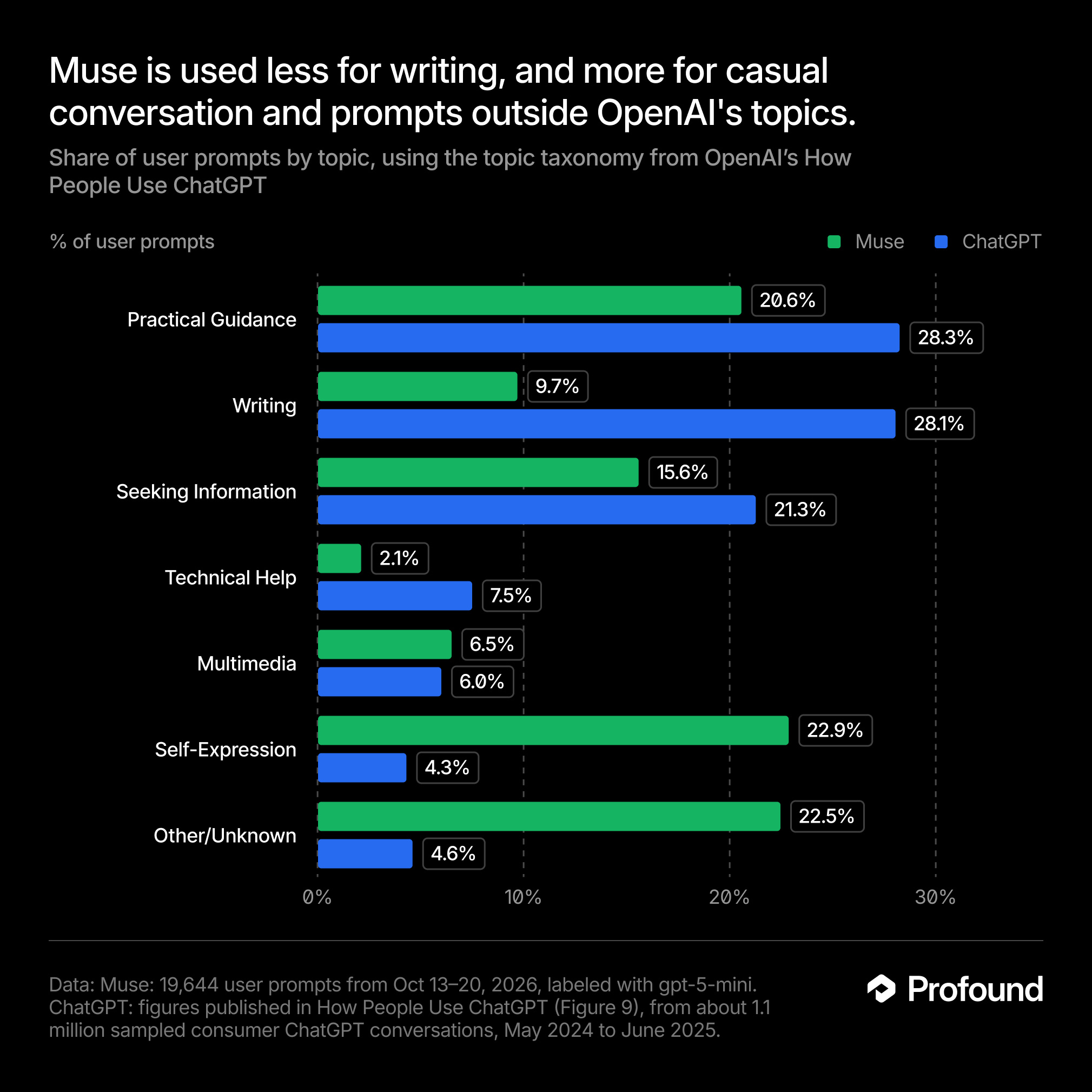
People ask Muse to complete tasks that rarely show up on ChatGPT. 7% of Muse prompts ask it to do a task that falls outside OpenAI's topic categories, such as finding or cleaning up email, setting reminders, managing a calendar, or handling money and subscriptions. On ChatGPT, these requests are about 1% of prompts. These asks help explain why the "other/unknown" category is so much larger on Muse (23% vs 5%); much of the rest is chatter or too short to classify.
Muse gets fewer requests to write. Editing or critiquing text the user supplies is 2% of Muse prompts but 11% of ChatGPT's. More broadly, generative intent is a smaller share of Muse usage. 21% of Muse conversation turns have generative intent, compared to 39% of ChatGPT turns.
People talk to Muse more casually. The primary topic of 23% of Muse prompts is self-expression, whereas only 4% of ChatGPT prompts fall under this topic. Three-quarters of Muse self-expression prompts are greetings and chitchat.
Together, these show people using Muse less as a writing tool and more as an assistant for personal errands.
Browser use and connectors
To handle tasks, an agent has to interact with the user's accounts and the wider internet. While Muse can fetch an indexed webpage the same way that Answer Engines typically do, it can also start a browser instance and use the web like a human. This enables it to see real-time information and take actions, such as going through a checkout flow.
Muse spun up a browser task for about a quarter of users in our data. The most common request just before the browser opened was about a product to buy (23% of those prompts), followed by looking up a specific fact (17%).
For certain services, Muse has custom connectors to retrieve information or take action. ChatGPT and Claude also let users connect outside services, but Muse offers them during the conversation. It offered a connection to 22% of users, nearly always Gmail (21% of users) or Google Calendar (18%). The next most common, Plaid, reached only 0.5% of users.
Those two services match the errands people bring to Muse, like finding an email, setting reminders, and managing a calendar.
Commercial intent
In our data, shopping is the most common reason Muse opens a browser, and it's also one of the top use cases for Muse according to Meta. More than a quarter of weekly active users use it to shop, and the average purchase is over $200.
We count a conversation as commercial if it involves any stage of buying a product or service, from early research through support after the purchase. By this measure, 28% of Muse conversation turns are commercial, compared with 17% on ChatGPT.
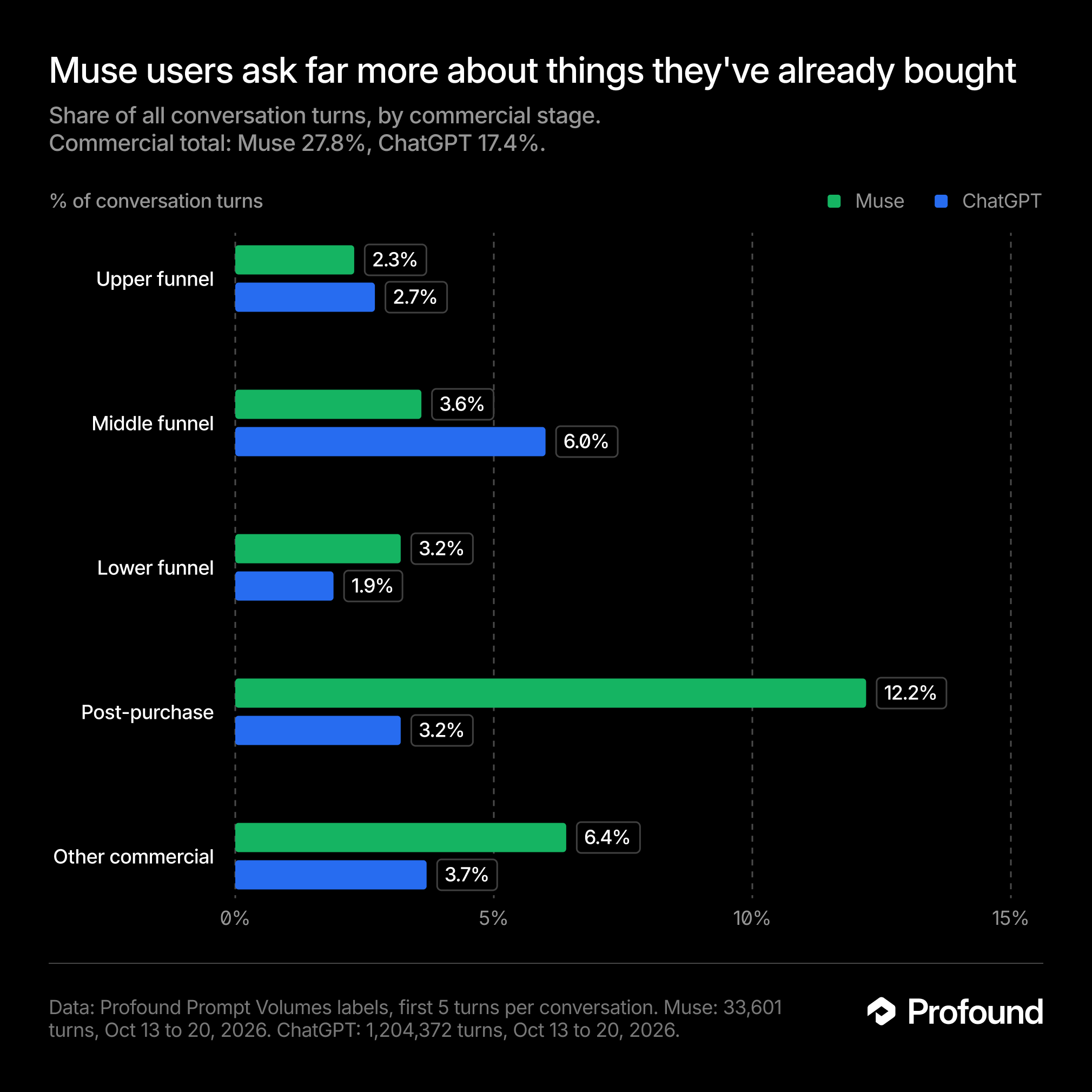
Most of that difference comes after the sale. 12% of all Muse turns are about a product or service the person already has, such as using, fixing, returning, or canceling it. On ChatGPT, that figure is 3%.
Pre-purchase shopping takes up a similar share of each platform (9% of Muse turns and 11% of ChatGPT turns), but on Muse it sits later in the funnel. We label pre-purchase turns as upper-funnel when users explore what they need without specific products in mind, mid-funnel when they compare or evaluate specific options, and lower-funnel when they decide where or how to buy.
Lower-funnel turns make up 36% of Muse's pre-purchase turns, twice ChatGPT's 18%. Mid-funnel turns make up 39%, compared with 57% on ChatGPT. In the chart, where each bar is a share of all turns, the same lower-funnel gap appears as 3% vs 2%.
What it means for brands
These are early signals, but they indicate a change in what users are asking of AI. Many of these asks revolve around personal tasks and shopping, so the agent now sits between people and the businesses they interact with.
This changes what it means to optimize for AI. Agents still need to find and understand your business, which requires fresh, specific, and original information. Shopping before a purchase is about as common on Muse as on ChatGPT, so being recommended still matters. But as people ask agents to act for them, agents will also need to get things done with your business, such as completing a purchase, applying a deal, or canceling a subscription.
There's no standard way yet for an agent to do this. Today, Muse works through a web browser and a small set of connected accounts. Protocols that let agents work with businesses directly, such as Sierra's Personal Agent Protocol, are emerging. Whether the industry will settle on a single standard is an open question.
Regardless of the interface, businesses should begin identifying which interactions matter most to their customers and which ones a personal agent could handle. We're at the beginning of a shift in which agents act on customers' behalf, instead of just retrieving information.
Get started
Being found by AI is the first step as agents start acting for people. Profound tracks how Muse Spark, the model behind Muse, talks about your brand, and shows which AI agents visit your website. Book a demo to get started.
Methodology
We analyzed Muse usage captured from 2,221 users between October 13 and October 20, 2026, which totals 83,580 exchanges across 12,979 conversations.
Topics. To compare with OpenAI's How People Use ChatGPT, we drew a random sample of 5,042 whole conversations, containing 19,644 user prompts. We labeled these turns following the methodology in the paper, which prompts gpt-5-mini to classify a user message with up to 10 preceding messages. The ChatGPT figures are the rounded percentages OpenAI published in the paper's Figures 9 and 10, which cover May 2024 to June 2025.
Intent and shopping. Our Prompt Volumes classifier labels each conversation's intent from its first five turns, and each of those turns takes the conversation's label. The Muse figures cover 33,601 turns from 11,735 conversations. The ChatGPT figures cover 1,204,372 turns from 457,718 conversations by Profound's panel of US desktop ChatGPT users over the same dates.
Browser use and connectors. We counted browser starts and connector offers from Muse's replies across all 83,580 turns using exact text matches. To see what prompted the browser, we labeled the 973 user prompts sent just before a browser start with the same topic classifier.


