
AI search is volatile. Our research shows 40 to 60% of cited domains change monthly across answer engines, even for the same questions. If you're trying to compete in this environment, you can't settle for a simple AI visibility monitoring tool. You need a bona fide system that helps you understand and influence that visibility.
Among the many players in the AI visibility market, Profound and Peec AI are often evaluated side-by-side. At first glance, they appear to do similar things: track visibility, monitor citations, benchmark competitors. But look closer, and you’ll find the differences are significant—especially when you're thinking long-term.
This article compares Profound and Peec AI across five dimensions: prompt data and AI visibility depth, content creation and actionability, AI crawler intelligence, strategic support, and enterprise readiness and compliance. By the end, you’ll have everything you need to make an informed, strategic decision on which platform is right for your team.
For a quick comparison between Profound and Peec AI, check out the table below:
Profound vs. Peec AI: Prompt volume data and AI visibility depth
The quality of an AEO strategy is capped by the quality of the data sustaining it. Knowing you're not being cited is useful. Knowing which prompts your audience is typing, how often, and with what intent—that's where the value is.
Peec AI: Clean analytics with limited data depth
At a glance
Pros:
- Clean dashboard tracking three core metrics: Visibility, Position, and Sentiment
- AI-suggested prompts help teams identify relevant queries to track
Cons:
- No Query Fanout analysis
- Prompt volume scores are derived from clickstream and external signals, not a proprietary dataset of real AI conversations
- Useful insights often require manual exports and additional filtering
Peec AI's dashboard is genuinely well-designed. It tracks Visibility (how often your brand appears in AI responses), Position (where you rank within those responses), and Sentiment (how AI characterizes your brand) in a clean, intuitive interface. Reviewers universally praise how easy it is to read. For teams new to AI visibility, that simplicity is a plus.
Where things get more limited is in the underlying data. Peec AI uses clickstream-based volume indicators to help users prioritize which prompts to track. It’s a reasonable proxy, but not the same as a dataset of real AI conversations.
Without intent or demographic data, you don't know if a frequently searched prompt is coming from your target buyers, a different audience entirely, or a geography you don't even serve. That distinction is important when you're deciding where to focus your content resources.
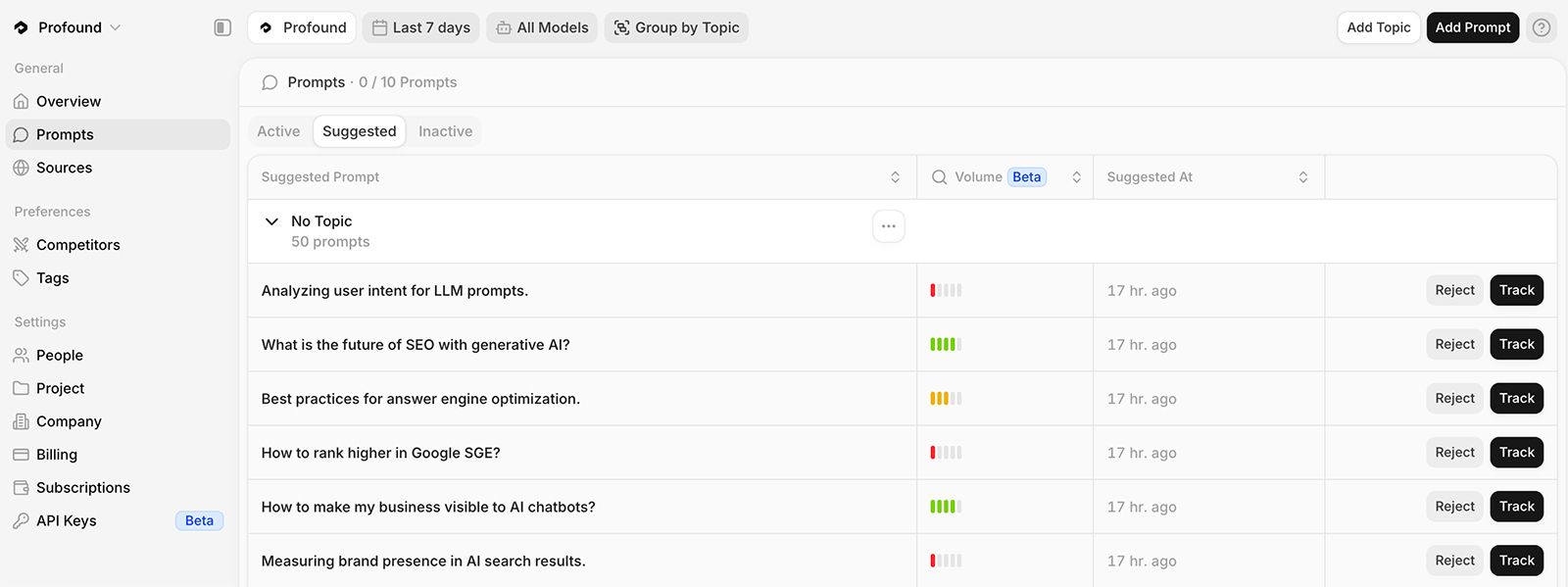
Peec AI suggests prompts based on estimated volume—useful for getting started, but without the real user data to know how accurate those estimates are.
Peec AI also doesn't show which queries AI engines expand a user's prompt into before generating a response (aka query fanouts).
Profound: The largest real user dataset in AEO
At a glance
Pros:
- 1.3B+ real user prompts, updated with 170M+ new queries monthly
- Prompts broken down by intent and demographics including age, income, and region
- Prompt Volumes surfaces real user behavior across ChatGPT, Perplexity, and other answer engines
- Prompts run through front-end browsers, not APIs, reflecting actual user experience
Cons:
- The depth of the data set is most accessible at higher plan tiers
Profound tracks visibility, positioning, sentiment, citations, and competitive standing across all major answer engines. What separates it from every other platform in the category is the data powering those insights.
Profound's Prompt Volumes are built on 1.3B+ real user queries, updated with 170M+ new prompts every month. Each prompt is categorized by intent and broken down by demographic factors including age, income, and region. This tells you not just which topics people are searching for in AI, but who is searching for them and why—the intel you need to decide what content to create, for whom, and how to prioritize it. You can go even deeper with Query Fanouts and optimize for the full set of searches an AI system ran, not just the prompt a user typed.
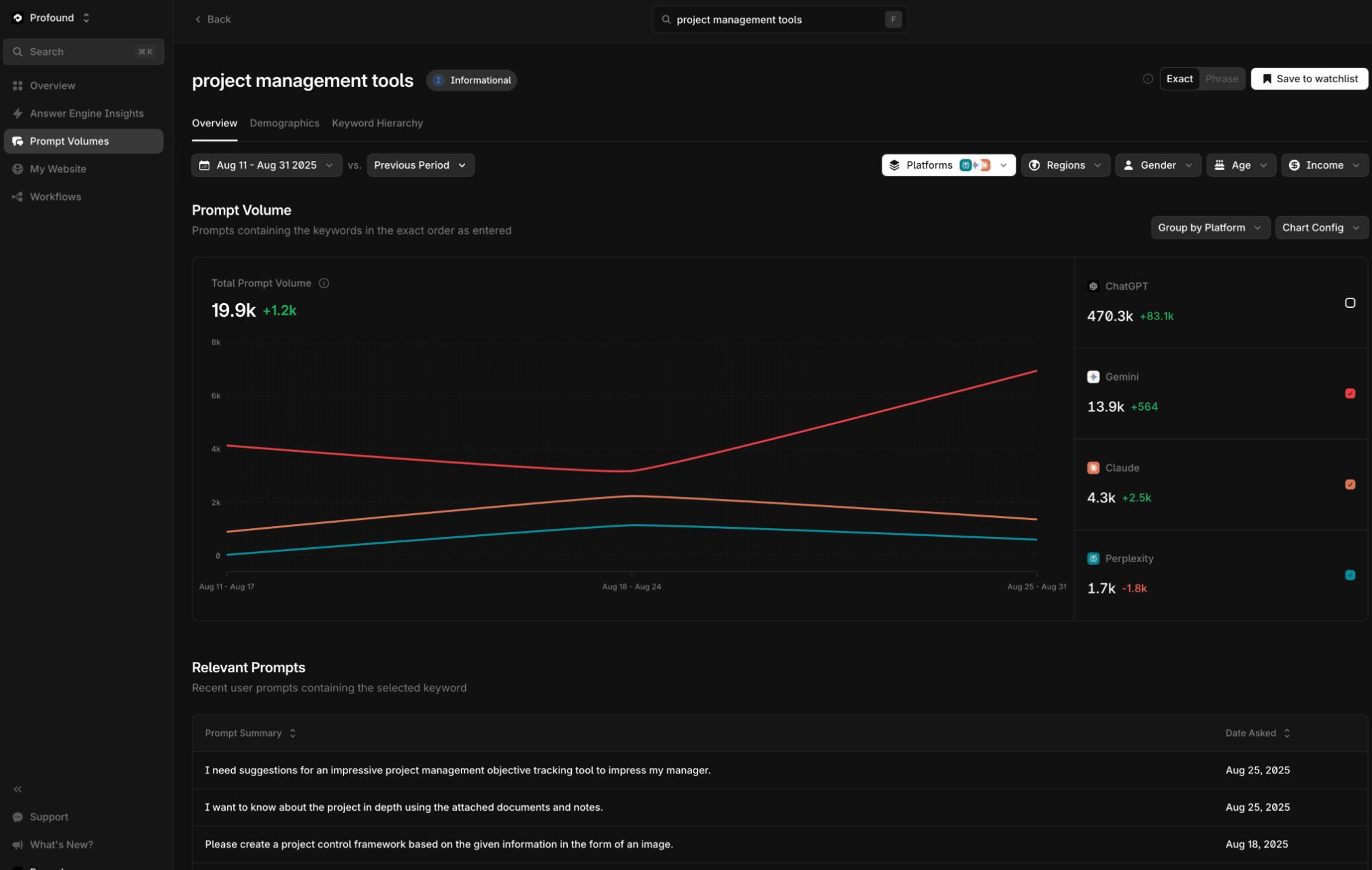
Profound Prompt Volumes shows how often real users are searching a topic across every major answer engine, broken down by platform, region, age, and income.
This data foundation is both fresh and accurate. Profound runs prompts daily through the front-end browser interfaces of each answer engine—not API calls, which return different results than what real users see. Peec AI also uses UI scraping rather than API calls, which is worth acknowledging. The difference is in what sits behind the prompts: Profound's data is powered by 1.3B+ real user queries; Peec AI's volume estimates rely on clickstream proxies.
Profound vs. Peec AI: AI crawler intelligence
How often your brand gets cited in AI responses is only part of the visibility story. You also need to understand what's happening at the infrastructure level: which AI crawlers are visiting your site, how often, which pages they're accessing, and whether that crawl activity is translating into human traffic.
Peec AI: No AI crawler insights
At a glance
Pros:
- Tracks citation sources and which URLs appear in AI responses, giving teams a surface-level view of content performance
Cons:
- No CDN-level or server-level monitoring of AI crawler activity
- No visibility into which pages AI systems are crawling, how frequently, or what they're doing with that content
- No attribution connecting AI crawler behavior to human referral traffic
- No way to verify whether content improvements are being picked up by AI bots before they surface in responses
Peec AI surfaces which URLs are being cited in AI responses, which helps you identify the types of content that are resonating with AI engines. But that's it. There's no infrastructure-level monitoring of AI crawler behavior, no way to see which pages bots are accessing and at what frequency, and no attribution layer that connects crawler activity to human traffic.
It's a hefty limitation for teams who want to understand whether their AEO content investments are working. If you're publishing or optimizing content and your citations aren't moving, Peec AI won't tell you whether the problem is that AI crawlers aren't finding your pages, aren't retrieving them, or aren't coming back. You're left puzzling over a technical problem with no technical data to diagnose it.
Profound: CDN-level intelligence into how AI interacts with your site
At a glance
Pros:
- CDN-level integrations with Cloudflare, Akamai, AWS CloudFront, Fastly, Netlify, Vercel, and others
- Real-time AI bot crawling activity
- Distinguishes AI bots from spoofed crawlers for accurate reporting
- GA4 integration connects crawler activity to human referral traffic
Cons:
- Requires CDN or server-level integration to set up, a technical step that needs engineering involvement
Profound operates at the infrastructure layer. Our Agent Analytics feature collects request data at the CDN or server level, which means it sees AI crawler activity as it happens. You get a real-time view of which AI bots are accessing your site, which pages they're retrieving, and how frequently they're coming back. It also differentiates real AI crawlers from spoofed ones, so the data you're looking at is accurate.
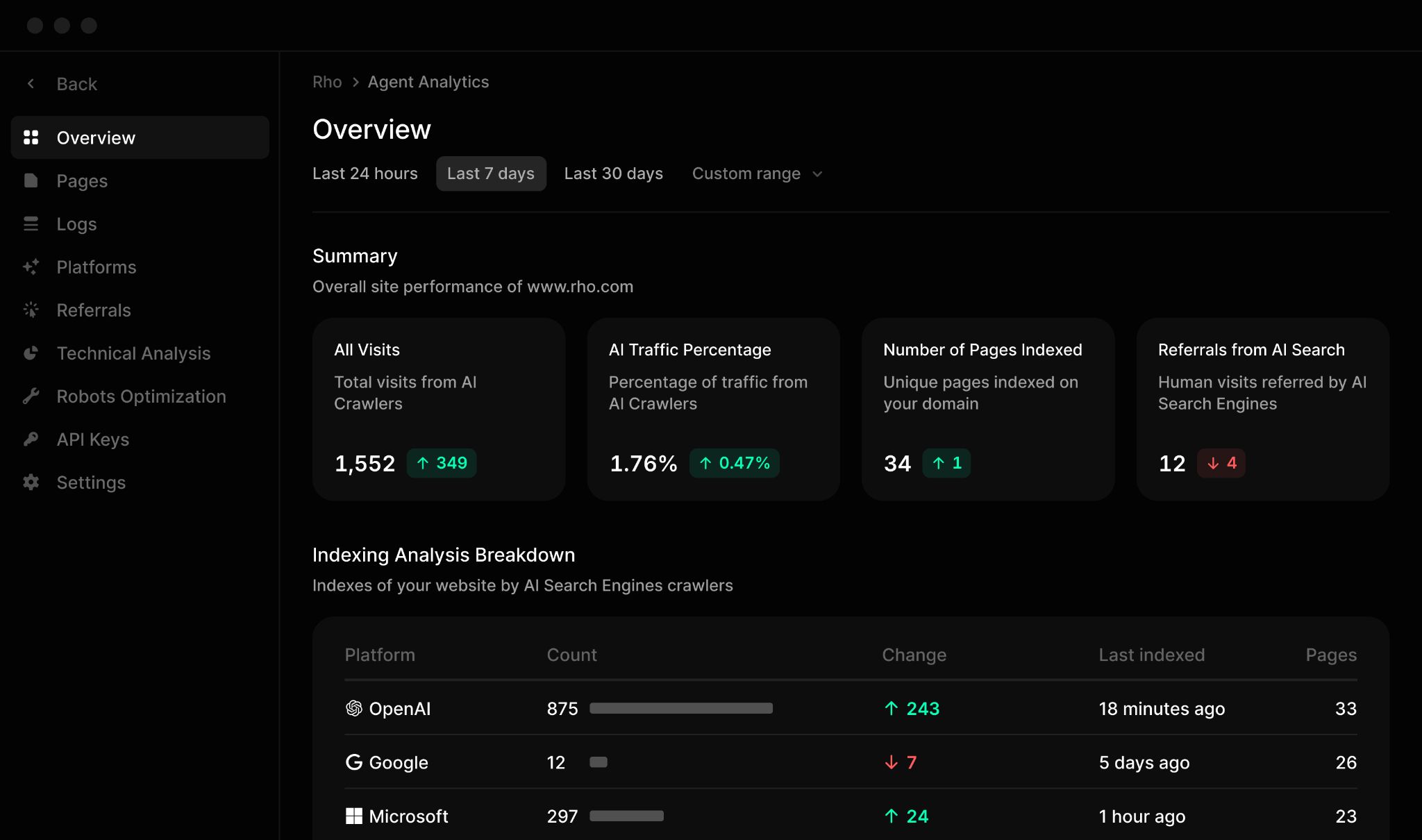
Profound's Agent Analytics tracks every AI crawler visit to your site—which bots, how often, which pages—and connects that activity to human referral traffic.
The GA4 integration connects that crawler activity to human traffic, empowering you to draw a direct line from "GPTBot crawled this page" to "ChatGPT cited it" to "traffic increased."
The loop closes back into content strategy. Knowing which pages AI crawlers retrieve and which they skip guides your optimization efforts. Combined with a content submission tool that lets you push new pages directly to AI crawlers for faster discovery, Agent Analytics turns a passive monitoring question into an active part of your workflow.
Profound vs. Peec AI: Content creation and actionability
AI visibility is influenced by three things: your on-page content, your off-page presence, and your technical infrastructure. Creating and optimizing pages for AI citations is where the bulk of AEO work happens—and how well each platform supports that journey is one of the most consequential differences between them.
Peec AI: Useful citation insights, no tools to act on them
At a glance
Pros:
- Source-level citation data helps teams identify which content formats and publishers perform well in AI search
- Clean exports make it easy to take data into other tools
Cons:
- No built-in content creation workflows
- Acting on insights requires separate tools
- Manual handoffs slow iteration cycles, especially for lean teams
Peec AI surfaces useful signals: which sources get cited, their category, and which competitors are showing up. If you’re doing an audit or mapping the competitive landscape, that's a good place to start.
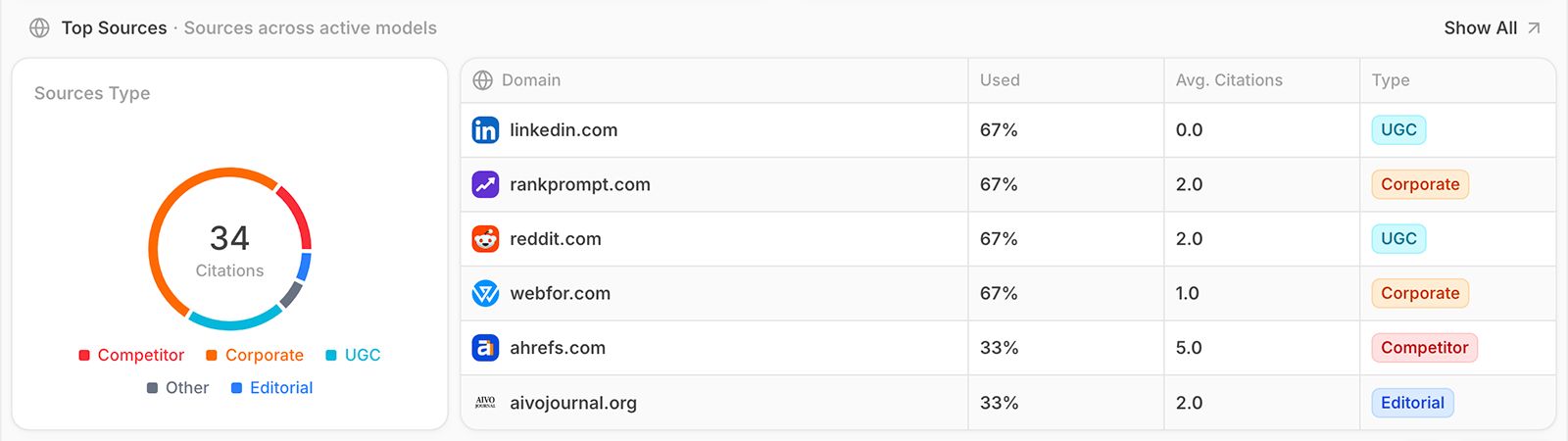
Peec AI's Sources view shows which domains AI models are citing in your category—helpful context for identifying where to build presence.
The bad news is that the platform stops there. Peec AI doesn't offer built-in content creation, optimization workflows, or automated agents. Once you've identified what to do, you're on your own to do it. You have to export insights, hand them off, and execute in separate tools, which introduces friction into a channel that all but demands speed. The way one reviewer described Peec AI, “the gold often comes from exports and lots of manual filtering and report set up.”
Profound: Insight-to-action in one platform
At a glance
Pros:
- Drag-and-drop interface to build content workflows
- Template library built on millions of the most-cited pages
- Self-learning content engine feeds citation data back into the generation process, improving output over time
Cons:
- Content generation is most powerful at Growth and Enterprise tiers; Starter plan has limited access
While Peec AI caps at the insight, Profound carries it through to published content. With Agents, you can run through the full pipeline—brief, draft, optimize, publish—without ever leaving the platform.
One of the main draws is how fast teams can move. The workflow builder is drag-and-drop, or you can choose from pre-loaded templates that mimic the most-cited page formats across AI platforms.
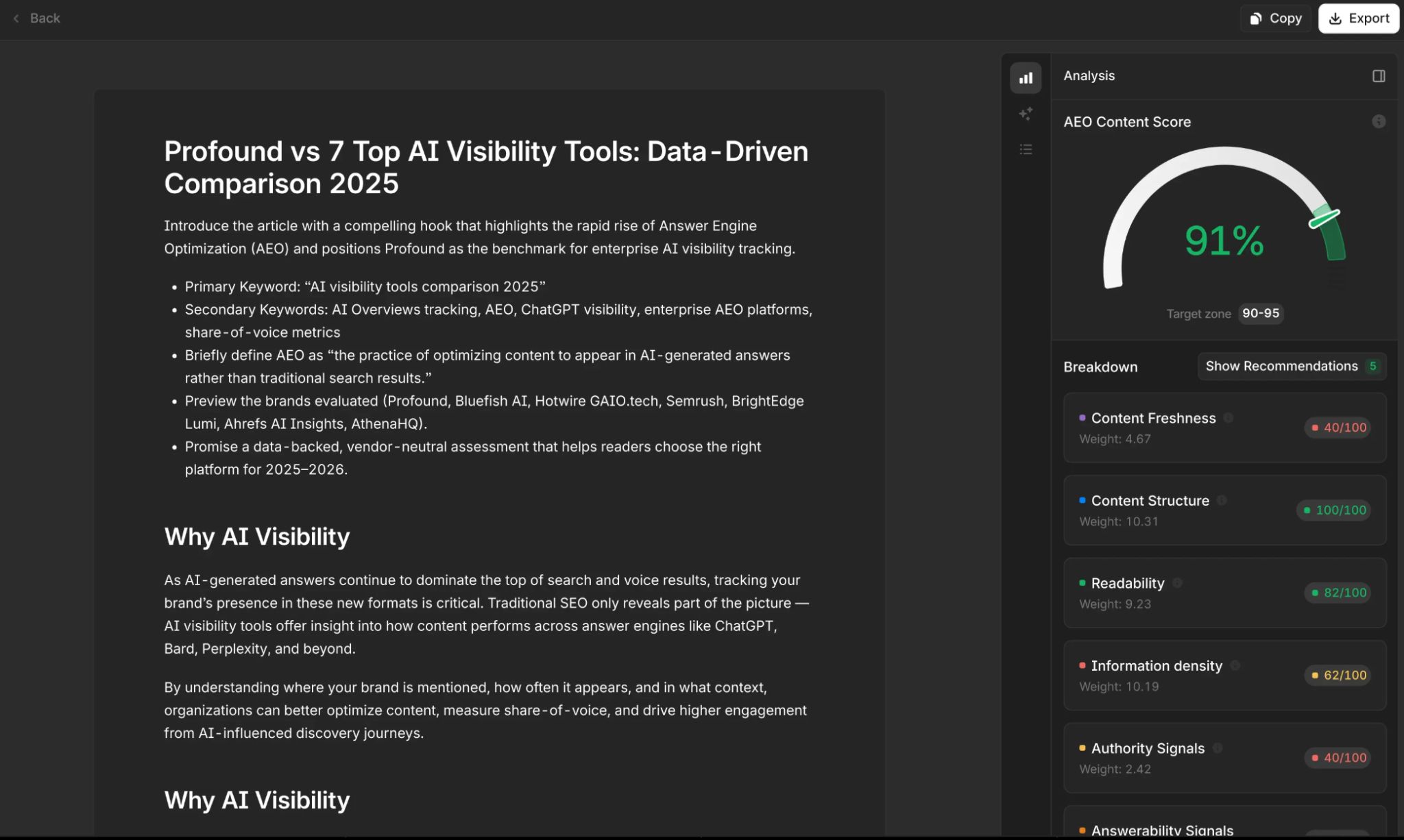
Profound scores content against AEO criteria before you publish—so you know how citation-ready a piece is, and exactly where to improve it.
What really differentiates the output is that every Agent pulls data from live Answer Engine Insights. Content isn't written against a blank brief. It starts with context: what's being cited for this prompt, how competitors are positioned, and what the data says needs to change.
After publication, Profound tracks which content gets cited and by which AI platforms, then feeds that signal back into the content engine. The system gets sharper over time because it's learning from what answer engines reward for your brand, your topics, and your prompts.
One reviewer described Agents a "major unlock," noting that "the combination of rapid innovation and practical, high-level marketing utility makes Profound an essential asset for any organization looking to master their AI presence."
Profound vs. Peec: Strategic partnership and guidance
AEO is, for all intents and purposes, a new discipline. A lot of the teams building an AI visibility program are doing it for the first time, without established playbooks, without in-house expertise, and under pressure to show results. In that context, the support model behind a platform matters just as much as the platform itself.
Peec AI: Responsive support, self-serve model
At a glance
Pros:
- Responsive team with proactive onboarding
- Dedicated coaching for agency accounts
- Documented help center and community resources for self-directed teams
Cons:
- No dedicated implementation specialists or AI strategists
- No structured guidance for building an AEO program from scratch
Peec AI's support team gets good marks.
Reviewers heap praise on the team's responsiveness during onboarding, and the platform has invested in documentation, a help center, and community resources, while agency accounts get dedicated coaching. Teams who already know what they're doing in AEO and only need a tool to support their existing workflow will likely find this model sufficient.
The limitation shows up when teams don't already know what they're doing—which is most of them. Peec AI's model is primarily self-serve, with email and Slack access and account representatives available at higher tiers. There are no dedicated implementation specialists, AI strategists, or structured programs for building an AEO strategy from scratch. That puts the burden of figuring it out squarely on the customer.
For a lean team, that implies learning an entirely new discipline while also trying to generate results. For an enterprise, it translates to slow adoption, inconsistent usage, and an AEO program that never quite gets off the ground.
Profound: Dedicated strategic support at every turn
At a glance
Pros:
- Enterprise plan includes CSMs, implementation specialists, and AI strategists
- Dedicated Slack channel with 24-hour SLA, guided onboarding, and access to performance benchmarks from leading brands
- Support functions as a strategic extension of the customer's team
Cons:
- The depth of strategic support is tied to the Enterprise plan; smaller plans have more limited access
We engineered Profound's support model around the principle that most teams buying an AEO platform aren't AEO experts—and shouldn't have to become one before they see results. Every enterprise customer gets a dedicated customer success manager, implementation specialists, and AI strategists. Not technical support on a ticket system, but hands-on partnership, with a Slack channel and a 24-hour SLA.
Our experts share competitive intelligence, provide tailored strategy recommendations, and actively help customers refine their approach over time. The Profound team effectively functions as an extension of the marketing org. You can even complement that support and build your team's in-house expertise with Profound University. Our free educational hub offers structured courses, step-by-step tutorials, cohort-based pods, and industry-first certifications in AEO and agent-building.
Ronak Patel, Head of Marketing at CRS, describes Profound's approach as "strategic counsel” that helped them “adapt as answer engines evolve.” Linda Schwaber-Cohen, VP of Marketing at Hone, said Profound provided "both the data and the partnership we needed," noting that the team "had a really strong point of view of what was happening in the world" at a time when she had more questions than answers.
A lot of teams are under pressure to show executive-level results from a channel that didn't exist two years ago. Profound knows it, and puts the right people in your corner to help you tackle the challenge.
Profound vs. Peec AI: Enterprise readiness and compliance
Enterprise adoption is one of the clearest signals of platform maturity. The brands that show up on a vendor's customer list tell you a lot about what the platform can handle—the security requirements it's passed, the complexity it's proven it can manage, and the level of results it's capable of delivering at scale.
Peec AI is trusted by 2,000+ marketing teams, particularly in Europe. Those are great numbers; however, the roster skews toward agencies, startups, and mid-market companies rather than the household-name enterprise logos that signal platform maturity. It's also worth noting that Peec AI caps at 9 reviews on G2, compared to Profound's 300+. That's not a knock on Peec AI, but it does reflect a meaningful difference in customer scale and market presence.
Profound powers AEO for some of the most recognized brands in the world: Indeed, Expedia, Uber, Airbnb, LinkedIn, Ramp, Figma, Walmart, U.S. Bank, and DocuSign, among hundreds of others. Operating at this level demands a compliance posture and infrastructure that few AEO providers have achieved. Profound holds SOC 2 Type II certification, is HIPAA compliant, supports SSO via SAML/OIDC, and enforces role-based access control.
Here's a closer look at how the two platforms compare on compliance and enterprise infrastructure:
The absence of SOC 2 certification is a hard stop for many enterprise buyers, particularly in regulated industries like financial services, healthcare, and cybersecurity. Procurement teams aren't equipped to make exceptions, and security reviews don't bend for promising products.
Profound vs. Peec AI: Final verdict
Peec AI is a capable monitoring tool. The UI is clean and accessible, and the support team is responsive. Agencies running AEO audits, mid-market teams getting their first read on AI visibility, or organizations that just need to know where they stand have a good partner in Peec AI.
But as far as AEO goes, monitoring isn’t a strategy. Enterprise brands who are serious about improving their AI visibility will find that the limitations compound, and fast.
We purpose-built Profound for teams that need more than a dashboard. Partnering with us means access to:
- The industry's deepest prompt dataset
- A full content creation and automation layer
- AI crawler intelligence
- A strategic support model that functions as an extension of your team
- Enterprise grade security features
Profound is the only platform where insight, action, and measurement sit in one place and reinforce each other over time. If you're ready to see where your brand stands in AI search—and build a program to improve it—book a demo with our team.
Profound vs Peec AI FAQs
What is the main difference between Profound and Peec AI?
Peec AI is a visibility monitoring tool—it tracks where your brand appears in AI responses, how you rank, and how you're perceived. Profound does all of that, but adds a proprietary dataset of 1.3B+ real user prompts, built-in content creation and optimization workflows, CDN-level agent analytics, and dedicated strategic support. The core difference is that Peec AI tells you where you stand, while Profound tells you where you stand and gives you the tools to change it.
Does Peec AI offer content creation or optimization tools?
No. Peec AI surfaces citation data and competitive insights, but there are no built-in content creation tools, optimization workflows, or automated agents. Teams have to export insights and execute in separate tools. Profound's Agents, on the other hand, handle the full pipeline—brief, draft, optimize, publish—within the platform, informed by live Answer Engine Insights.
Which platform is better for enterprise brands, Profound or Peec AI?
Profound is better for enterprise brands, by a significant margin. Peec AI lacks SOC 2 certification, has no dedicated implementation or AI strategist support, and its customer base skews toward agencies and mid-market brands. Profound is SOC 2 Type II certified, HIPAA compliant, and trusted by Indeed, Expedia, Uber, Airbnb, LinkedIn, Ramp, and Walmart, among others. The compliance posture alone disqualifies Peec AI from most enterprise procurement processes.
Is Peec AI SOC 2 compliant?
No, Peec AI isn’t SOC 2 compliant. It offers SSO login and GDPR compliance, but that’s it. Profound does hold SOC 2 Type II certification and has completed an independent HIPAA compliance assessment conducted by Sensiba LLP.
Which platform is better for agencies managing multiple clients, Profound or Peec AI?
Both platforms have agency functionality, but they serve different agency profiles. Peec AI's multi-project structure, Looker Studio connector, and agency pricing tiers make it a reasonable fit for boutique agencies doing visibility reporting across a handful of clients. Profound's Agency Mode supports more complex operations -- separate client workspaces, centralized management, a dedicated agency team, and access to the full platform including Agents and Agent Analytics. For agencies looking to deliver AEO strategy and execution, not just reporting, Profound is the stronger choice.
