
For two decades, marketers have treated YouTube as a channel for people: videos made to be watched, judged on views and subscribers. Today it has a second audience: agents. An agent cannot physically try on running shoes, dine at the top five restaurants in Louisiana, or deploy a CRM. A creator can, and they can then turn that experience into a recommendation. When AI draws on that recommendation, the video's influence can extend to people who never press play.
To understand YouTube’s role in AI answers, we studied the sources six AI answer engines cited from August through October 2026, with a separate November 11–18 analysis of cited videos’ view counts.
Four findings stand out.
- YouTube is the most cited domain on Google AI Overviews and AI Mode. It appears in 37 and 27% of their US answers that cite at least one source.
- Most cited videos have under 10,000 views. 69% of the long-form videos cited by AI Overviews, AI Mode, and Gemini have under 10,000 views.
- On Google's AI engines, about a quarter of video citations go to an organization's own channel. The other three quarters go to creators, review channels, and publishers.
- Recent videos carry most of the citation volume. Among videos cited repeatedly by both AI Overviews and AI Mode, those published in 2025 and 2026 account for 75% of citations.
YouTube ranks first on AI Overviews and AI Mode
YouTube ranks first among over 3.7 million cited domains on both Google AI Overviews and AI Mode. We measure its presence in two ways. Citation share is YouTube's portion of all citations. Coverage is the percentage of responses with at least one source that cite YouTube.
US, English prompts, August to October 2026.
The table splits the engines into two groups. AI Overviews and AI Mode, which sit inside Google Search, cite YouTube in 27% to 37% of answers that cite at least one source. The four assistants, Gemini included, cite it in under 4%.
Despite citing YouTube far less often, Gemini often picks the same videos: about 70% of the videos Gemini cites are also cited by both AI Overviews and AI Mode for the same prompt. AI Overviews and AI Mode also agree with each other at about the same rate.
For marketers, AI Overviews and AI Mode are the clearest starting point for measuring YouTube's presence in AI search. The overlap with Gemini suggests that a shared content strategy can serve all three Google engines, even though the size of the opportunity differs substantially.
Your category determines the size of the opportunity
Within Google's AI engines, how often YouTube appears depends on the category. Citation coverage runs from 45.91% in Consumer Electronics to 3.02% in Casual Dining, a spread of about 15x.
Google AI Overviews, AI Mode, and Gemini combined. Top five and bottom five of 31 industries by citation coverage. US, August to October 2026; 513,699 YouTube citations.
The headline ranking is a reason to investigate YouTube, but category coverage is a better guide to investment. Start with the questions customers ask about your category, then identify where video already supplies the answer. That gives social teams a more useful brief than simply producing more video.
Seven in ten videos cited by Google’s AI engines have under 10,000 views
To understand which videos Google cites, we compared the lifetime views of long-form videos cited by AI Overviews, AI Mode, and Gemini with those cited by ChatGPT. This analysis covers US citations from November 11–18, 2026, with views measured within a week of citation.
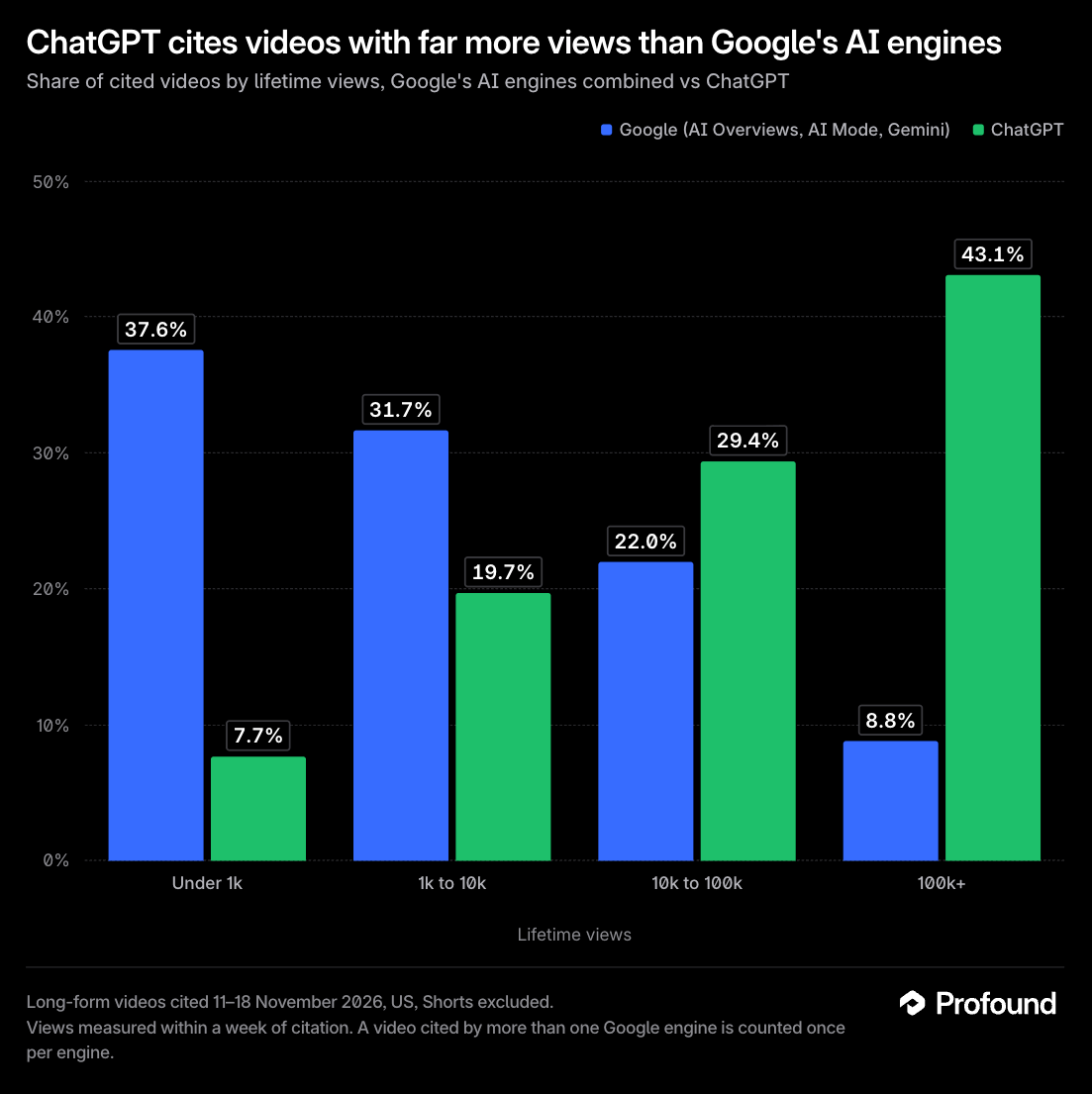
Across Google’s three AI engines, 69.3% of cited videos have under 10,000 views, including 37.6% with fewer than 1,000. Only 8.8% have 100,000 views or more. Videos cited by multiple Google engines are counted once per engine.
ChatGPT cites a different population. Just 27.4% of its cited videos have under 10,000 views, while 43.1% have at least 100,000. The contrast is sharpest at the extremes: Google’s cited videos are concentrated in the smallest audience bracket, while ChatGPT’s are concentrated in the largest.
For social teams, this means a video’s audience size can miss part of its value. A focused product comparison from a small channel may deserve attention if it repeatedly appears in answers to customers’ buying questions. These findings do not establish that low-view videos are more likely to be cited. They show that a large audience is not a prerequisite for becoming a source in Google’s AI answers.
Three quarters of Google video citations go to creators, reviewers, and publishers
We also classified the channels behind cited videos by who runs them, using the same four engines.
Four engines. Share of each engine's video citations, US, August to October 2026. 5,558 channels classified by a language model and weighted to represent all cited channels.
A brand's own channel covers only part of its potential YouTube presence in AI answers. On Google's AI engines, most cited videos come from creators and reviewers, so creator partnerships and product seeding sit alongside owned video.
Recent videos carry most of the citation volume
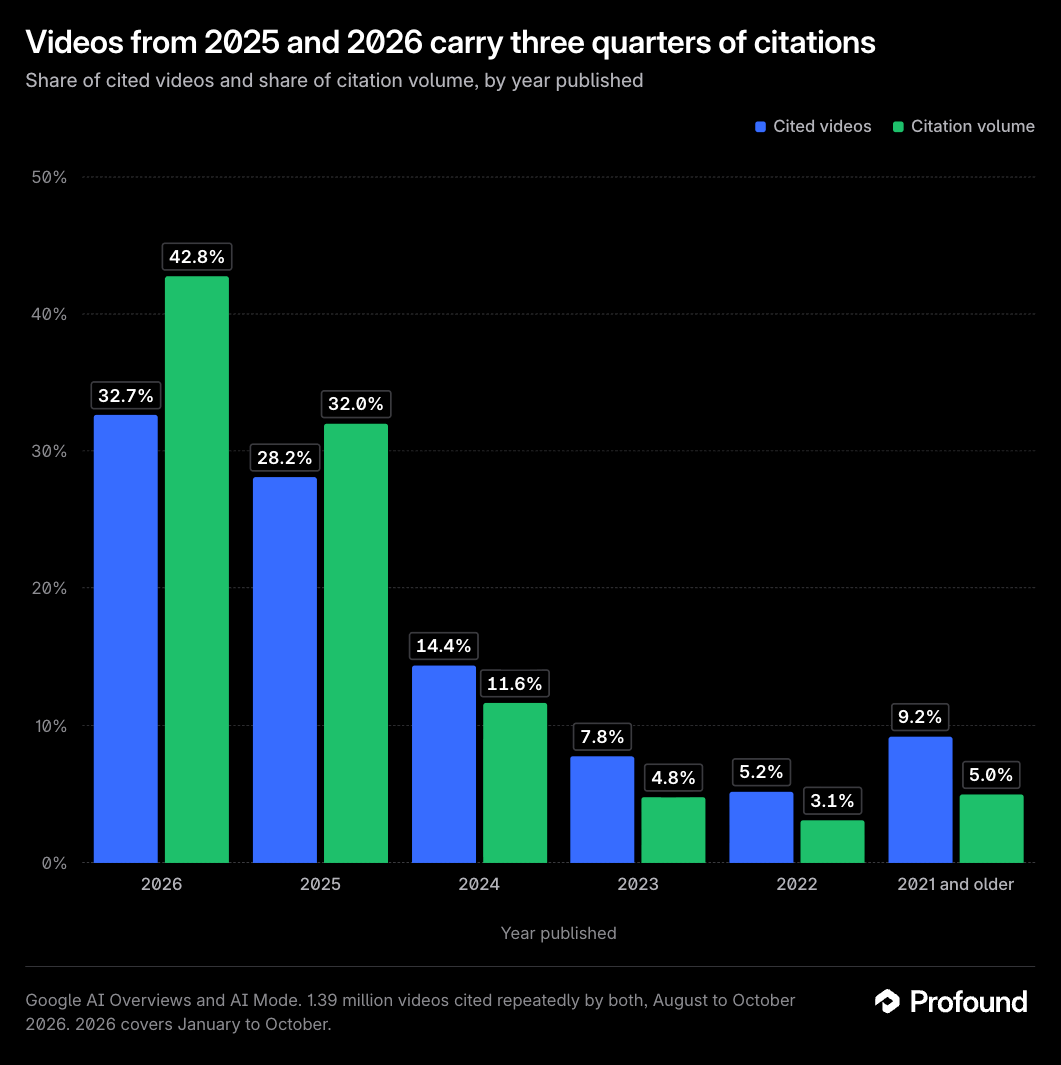
Videos published in 2025 and 2026 make up 60.8% of the videos cited repeatedly by both AI Overviews and AI Mode and 74.8% of their citation volume.
Among videos that received citations in our analysis, discovery was often quick. The median time to first observed citation was 7.8 days on AI Mode, 8.2 on Gemini, and 15.2 on AI Overviews. Most were cited within a month: 84% on AI Mode and Gemini, and 71% on AI Overviews. These are timelines for videos that were cited, not a forecast for every upload. For social teams, the first month is a useful checkpoint to see whether a new video is appearing for the questions it was intended to answer.
Ranked list videos receive a disproportionate share of citations
Within the cited-video sample, some title formats account for a disproportionate share of citations. Lift is a title format's share of citations divided by its share of videos.
AI Overviews and AI Mode. Long-form videos, August to October 2026. Patterns overlap.
Titles that rank, compare, or date the content account for more citations than their share of cited videos. How-to titles perform roughly at par and are common, appearing on 22.75% of cited videos. These associations do not show that changing a title causes more citations. They do suggest a useful editorial question: does the title make the buying decision or practical question the video addresses clear?
The median cited video runs 8.7 minutes. Chapters are more common among the most-cited videos, though most still have none.
What this means for marketing teams
YouTube videos have always been judged by who watched. That still holds for people, but no longer holds for the agents now answering their questions.
Most of what this shift requires is work social teams already know how to do. Creator partnerships, review programs, and a steady publishing cadence all feed the videos Google cites. What changes is the measure. Alongside views and engagement, the question becomes which videos appear when customers ask about the category, and whose they are.
The bigger implication is that YouTube strategy now reaches beyond the channel itself. A review or comparison can inform a purchase even when the buyer never sees the video or knows the creator’s name. For enterprise social teams, that expands the mandate: understand which questions customers are bringing to AI, then build the body of firsthand experience that helps answer them. The value of that work extends beyond the audience a video attracts to the decisions it informs.
Get started
Profound's Answer Engine Insights shows which domains and URLs each Answer Engine cites for the prompts your brand tracks, including the specific YouTube videos cited in AI Overviews and AI Mode. Get a demo to see which videos are being cited in your category.


