
The brands that see ROI from AI search over the next few years will have made an important decision: which platform they trusted to tell them where they stood and what to do about it. That decision is harder than it looks. The category is moving fast, vendors are multiplying, and the distance between “monitoring dashboard” and “platform that drives results” is wider than the marketing language suggests.
Both Profound and Bluefish are purpose-built for the AI visibility era. Bluefish has genuine strengths, particularly for organizations where brand safety and AI reputation monitoring are the primary concern. Profound covers that same ground and connects it to action: content creation, workflow automation, and attribution data that shows whether your work is producing results.
Below, we compare both Answer Engine Optimization (AEO) platforms across prompt customization and flexibility, citation insights, enterprise reporting, actionable workflows and content optimization, proprietary prompt volume data, and enterprise compliance.
Profound vs. Bluefish: Control over the prompts you track
Profound and Bluefish both support custom prompt configuration. The difference is who's doing the configuring, how quickly you can change it, and whether you know what's running.
Bluefish: Managed methodology, limited transparency
Pros:
- Prompt methodologies are built in collaboration with Bluefish's professional services team
- Custom AI Audiences let enterprise teams segment insights by audience type
Cons:
- Prompt execution methodology not disclosed publicly
- Less agility when tracking needs to change quickly, such as during a product launch or competitive shift
Bluefish's prompt configuration is a managed engagement. In practice, that means you work with their professional services team to build custom methodologies tailored to your industry, product lines, and competitive landscape. It's a nice enough approach for organizations with the time for that kind of onboarding. The tradeoff is agility: when your product launches a new line, enters a new market, or needs to track a competitor comparison that just emerged, you're not updating prompts yourself. It's also, by nature, an inflexible approach that wrenches control and autonomy away from the user.
Bluefish also doesn't disclose how those prompts are executed once they're running. The platform doesn't publish whether queries run through front-end browser interfaces or API calls, so it's a toss up whether the responses that you're seeing reflect those your target audience sees.
Profound: Direct control, transparent execution
Pros:
- Full self-serve control—configure any topic, product line, competitor comparison, regional variation, or funnel stage, with no restrictions on query types
- Choose from Profound's own prompt suggestions or upload and define your own
- Every prompt runs daily through front-end browser queries, reflecting what real users actually see
- Query fanout data exposes the sub-queries answer engines run internally before assembling a response
Cons:
- Volume of configuration options can require initial setup time to organize effectively
In Profound, you define what gets tracked: specific product lines, competitor comparisons, regional variations, funnel stage language. There are no restrictions on the types of queries you can configure, and you can either pull from Profound's prompt suggestions or upload and define your own.
What's more, every prompt runs daily through front-end browser queries rather than API calls—an important distinction because API responses can differ from what users see when they interact with AI engines.
Profound also surfaces query fanout data, the internal sub-queries an answer engine generates when processing a user’s prompt. A single prompt can trigger several sub-queries before the model assembles a response. Knowing what those sub-queries are tells you what the model is retrieving to build its answer—which in turn helps inform your content optimization and creation efforts.
Profound vs Bluefish: Proprietary prompt volume data
The success of your AEO strategy depends on the accuracy of your data. You need to know whether the visibility and citation insights you're seeing are, indeed, derived from the questions real users are asking answer engines. Educated guesses aren't good enough if you're serious about leveraging AI search as a channel.
Bluefish: No real user prompt volume data
Pros:
- Bluefish's team applies expert knowledge to prompt strategy—useful for organizations that want guidance rather than raw data
Cons:
- No real user prompt volume data—the platform doesn't surface how frequently users are actually asking about specific topics in answer engines
- Prompt suggestion methodology not disclosed
- Teams choosing which prompts to track are doing so without demand evidence
Bluefish doesn’t offer prompt volume data. The platform doesn’t surface information about how frequently real users are asking about specific topics in answer engines, and it doesn’t disclose the methodology behind its prompt suggestions.
The practical consequence is that users choosing which prompts to track and which content topics to prioritize are doing so without evidence. A team that invests months optimizing for prompts that real users rarely ask has no way to know it until results fail to materialize.
Profound: A data foundation based on 1.3B+ real user prompts
Pros:
- Prompt Volumes dataset built on real conversations from ChatGPT, Gemini, Claude, Perplexity, and more—not estimated or synthetically generated data
- Query frequency broken down by age range, income bracket, and geographic region
- Intent classification shows not just how often a topic comes up, but why—informational, commercial, conversational, or generative
- Dataset grows monthly, compounding the data advantage over time
Cons:
- Demographic and intent breakdowns may be more granularity than smaller teams need
Profound’s Prompt Volumes dataset is built on 1.3B+ conversations people have had with ChatGPT, Gemini, Claude, Perplexity & co., not estimated or synthetically generated data. Profound licenses this data from global human data panels, cleans it, and applies probabilistic modeling to build visualizations. The dataset grows by roughly 150M prompts monthly. All data is anonymized, GDPR and CCPA compliant, and scrubbed of PII.
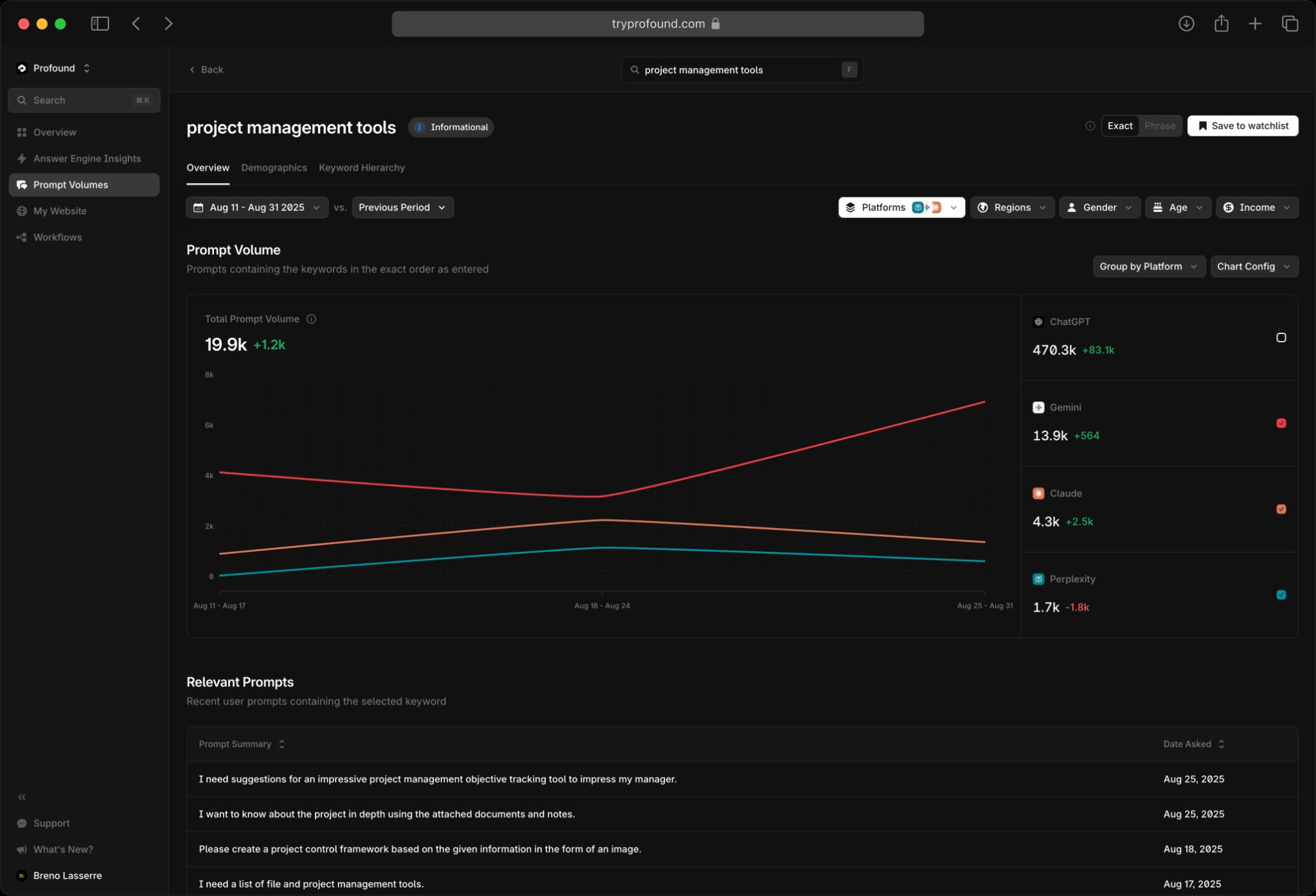
Prompt Volumes shows real query frequency by platform—so teams know which topics users are actually asking about before committing content resources.
That scale is important because of what it enables you to see. Prompt Volumes shows how often real users ask about a given topic, broken down by age range, income bracket, and geographic region. The Intent tab adds another layer, as Profound classifies every prompt as informational, commercial, conversational, or generative, showing not just how often a topic comes up, but why users are asking about it. Teams that can see that distinction build content strategies that match actual user needs rather than mirroring what competitors have already covered.
The data advantage compounds over time. Better prompt volume data produces better prompt selection, which produces more relevant visibility tracking, which produces more targeted content, which earns more citations. Each step in that chain is stronger when it starts from real demand signals. Competitors without this data are making the same decisions at every step with less information—and the gap widens as Profound’s dataset grows.
Profound vs. Bluefish: Granular citation insights
At this point in the game, every AI visibility tool worth their salt offers citation insights. The depth and breadth of those insights are the differentiators you need to pay close attention to.
Bluefish: Citation frequency without page-level depth
Pros:
- Impact Score measures how closely a cited page's content aligns with actual AI response text
- Influence Rank aggregates impact across thousands of responses to identify which sources most consistently shape brand representation
Cons:
- Citation data doesn't break down by individual URLs—teams can see domain-level citation trends but not which specific pages are earning or missing citations
- Without page-level data, content optimization decisions lack the targeting they need to be effective
Bluefish has done interesting work on citation analytics. Their AI Impact and Influence metrics do more than show citation counts: Impact Score measures how closely a cited page’s content aligns with the AI response text, and Influence Rank aggregates that signal across thousands of responses to identify which sources most consistently influence your brand’s representation. If you're focused on understanding narrative authority, those are good, solid metrics.
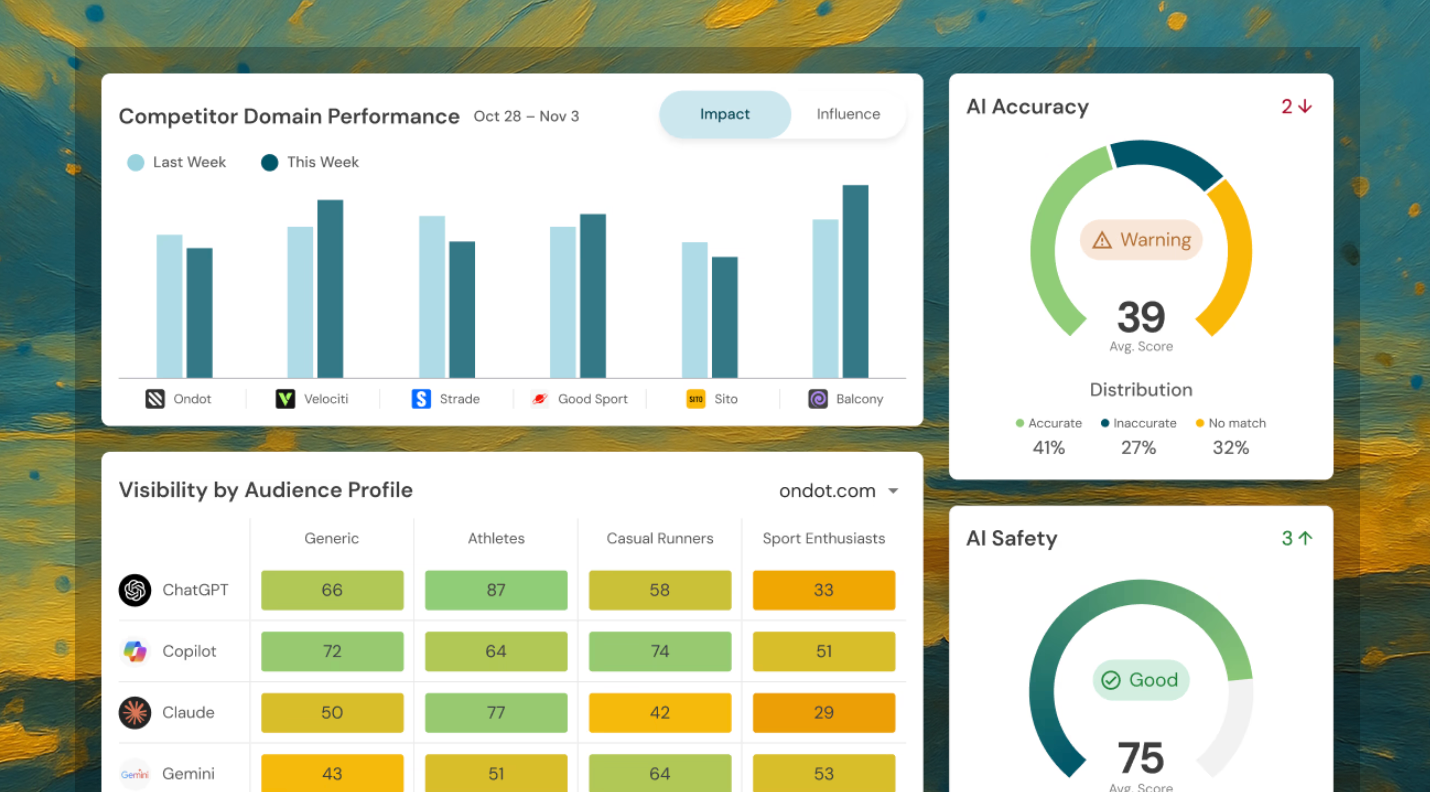
Bluefish's monitoring dashboards surface competitive visibility and brand safety metrics—but data doesn't extend to page-level depth.
Where the platform falters is in granularity. Bluefish doesn’t break citation data down by individual URLs; users can see that their domain is getting cited, and they can see which sources carry influence—but they can’t identify which specific pages on their own site are earning citations and which are being ignored. You can't base a content optimization strategy off of nothing. Even if you know citations are happening somewhere, you don't know where to invest or what to fix.
Profound: Citation tracking at the individual page level
Pros:
- Citation tracking at the URL level—see which pages are being cited, by which answer engines, how often, and in what prompt contexts
- Self-learning content engine reinforces patterns behind cited pages and deprioritizes approaches that aren't producing citations
- GA4, Google Search Console, and AEO citation data unified in a single view for ROI correlation
Cons:
- Volume of URL-level data requires dedicated time to analyze across large content libraries
Profound tracks citations at the URL level, so you can see which pages are being cited by which answer engines, how often, and in what prompt contexts. That's already a great level of insight, but even more impressive is what we do with it.
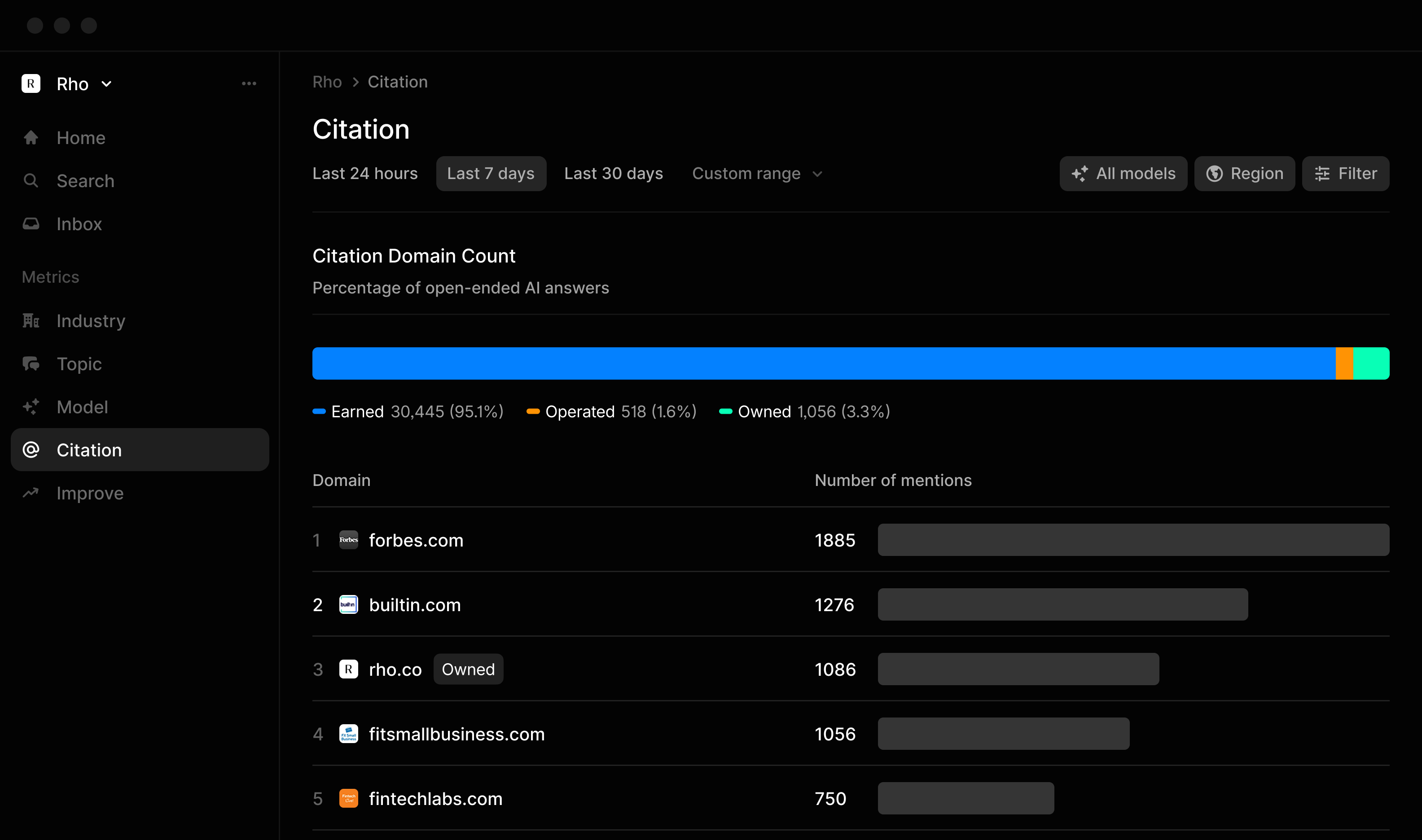
Profound's citation view shows which domains are driving mentions and whether those citations come from earned, operated, or owned sources
All of that citation data feeds directly into a self-learning content engine. Profound tracks which pages get cited, reinforces the patterns behind those pages in its content generation recommendations, and deprioritizes approaches that aren’t producing citations. Every piece of content you publish makes the engine smarter about what earns citations for your brand specifically, and sharper about what doesn't.
OpusClip is one of many Profound customers who put these citation insights to work formidably. Competing against legacy video editing tools with a decade of SEO advantage, OpusClip tapped into Profound to identify the topics that were driving citation gains—and pushed hard on those. Within 30 days, they climbed from roughly 30% brand visibility to over 45% on core topics and hit #1 in citation share among competitors.
Speaking on his experience with Profound, Derek Coleman, Senior Growth Marketer at OpusClip, explained that “when I saw that you could see the exact response that the Answer Engines give for each prompt and query sent, and that you could look at the history over the past three months or so and export over 50,000 citations (...). That's when I really realized that this would be a platform that we would be using consistently.”.
Profound vs. Bluefish: Enterprise reporting that proves ROI
At some point, every AEO program faces the same test: can you show the work to someone who doesn't live and breathe the platform? Here's how Profound and Bluefish can help (or hinder) your quest to prove AEO is worth the investment.
Bluefish: Monitoring dashboards without enterprise reporting depth
Pros:
- Monitoring dashboards cover visibility, sentiment, brand safety, and audience-level performance
- Collections feature lets teams bundle related assets and track their combined AI impact
Cons:
- Basic CSV export and some API access, but without native integrations into major BI tools, data tends to stay where it was collected
- No native connections to GA4, BigQuery, Tableau, or Looker
- No attribution linking AI crawler activity to human traffic or pipeline
Bluefish's monitoring dashboards cover the bases marketing teams need day-to-day: visibility, sentiment, brand safety, and audience-level performance. Their Collections feature even allows you to bundle a group of related assets—pages, earned media, campaign content—and track their combined AI impact over time using Bluefish's Impact, Frequency, and Influence Rank metrics.
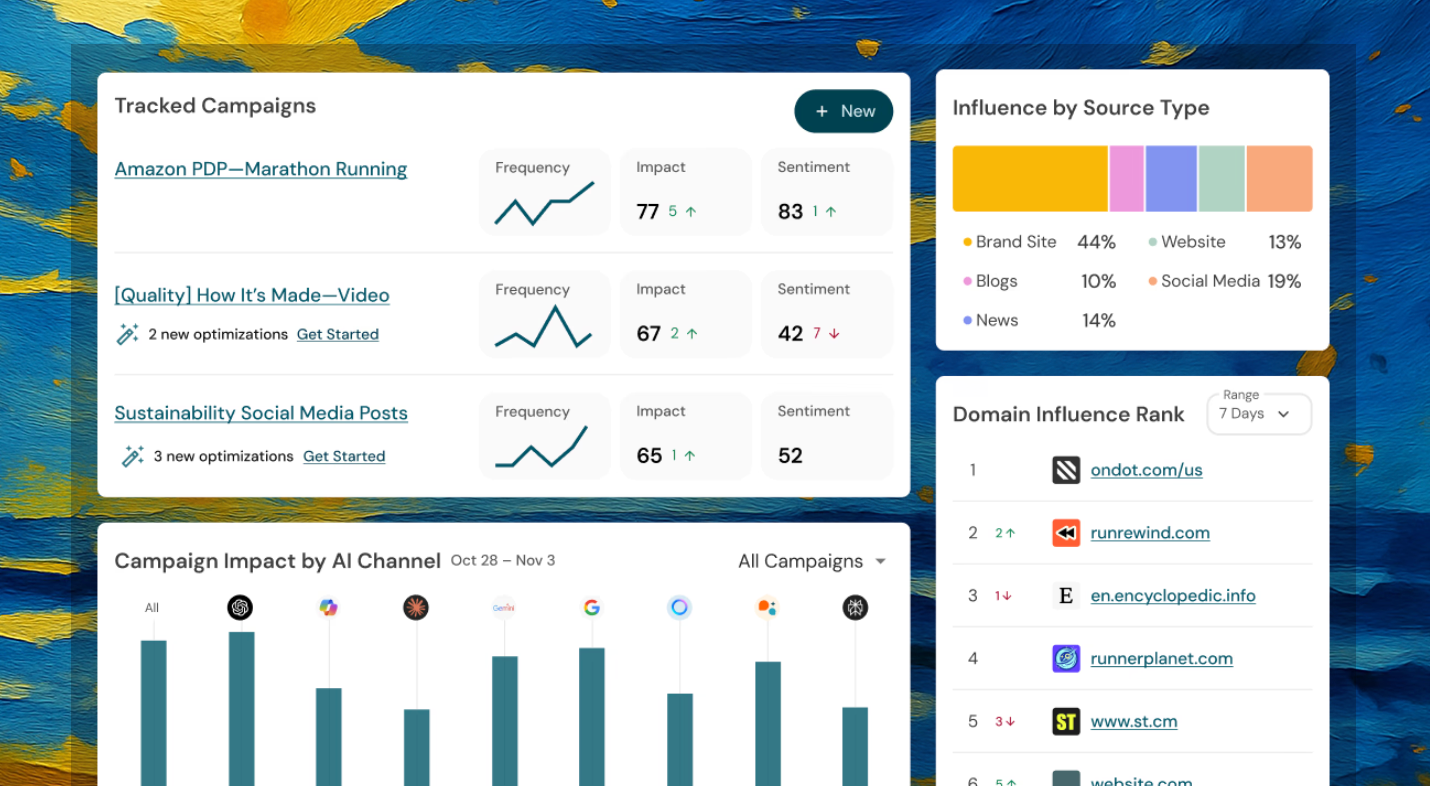
Bluefish's Collections feature tracks combined AI impact across campaigns.
Where it gets dicier is when those insights need to travel. Bluefish offers basic data export and some API access, but without native integrations into the BI tools enterprise organizations already run, AEO data tends to stay where it was collected. Insights that live inside a monitoring dashboard don't reach the quarterly business review. They certainly don't inform a board slide. And without clear attribution connecting AI search activity to traffic, pipeline, or revenue, you'll find it hard to defend the investment when it counts.
Profound: Structured reporting built for enterprise stakeholders
Pros:
- CSV, JSON, and API exports; native integrations with GA4, Looker, BigQuery, Adobe Analytics, Tableau, Slack, and Microsoft Teams
- Agent Analytics uses CDN-level integrations with Akamai, Cloudflare, AWS, and Fastly to connect AI crawler activity to human referral traffic
- All data filterable by brand, competitor, topic, region, and persona
- Over 300 G2 reviews from enterprise customers attesting to reporting depth
Cons:
- Depth of reporting options requires initial configuration to match your org's existing BI setup
Profound exports data in CSV and JSON formats and provides API access so teams can pipe AEO data directly into the BI tools their organizations already use. Native integrations include GA4, Looker, BigQuery, Adobe Analytics, Tableau, Slack, and Microsoft Teams. Visibility trends, competitive benchmarking, citation tracking by prompt and page, sentiment over time, and Agent Analytics attribution are all available—filterable by brand, competitor, topic, region, and persona.
Agent Analytics is where the attribution story gets concrete for all interested parties. Profound uses CDN-level integrations with Akamai, Cloudflare, AWS, and Fastly to detect when AI crawlers access your content, which specific pages they hit, and how that crawler activity correlates with human referral traffic via the GA4 integration. That’s the data that answers the question every CMO eventually asks: is our AEO investment producing results?
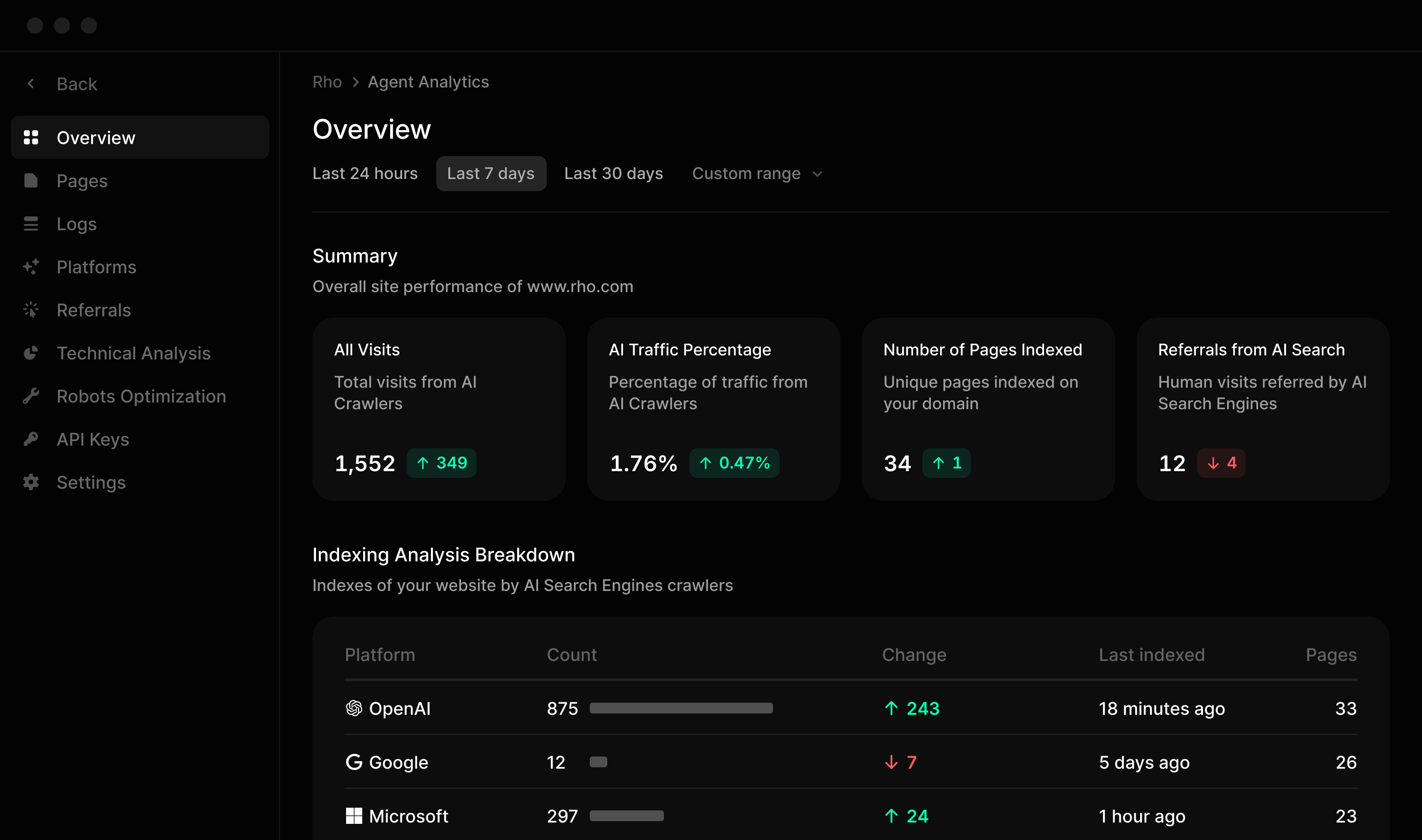
Agent Analytics connects AI crawler activity to human referral traffic, giving teams the attribution data needed to prove AEO is producing results.
Users thoroughly appreciate Profound's reporting, with one reviewer pointing out that “we’ve tried so many different tools over the past year or two, and Profound has everything the other tools had, plus more, with higher levels of reporting and insights available—including insights on your competitors. There really isn’t another platform out there right now that’s doing everything Profound is doing.”.
Profound vs. Bluefish: Actionable workflows that go from insight to execution
When you're scaling an AEO program, gaining insights into what to write is seldom the only bottleneck. The brief still needs to become a draft, and the draft still needs to be optimized, reviewed, and published. How far each platform goes with you on that journey is a worthwhile consideration.
Bluefish: Optimization recommendations without workflows
Pros:
- Daily recommendations ranked by impact
- AI Narratives analysis identifies which narratives resonate across millions of AI responses
- Content Briefs identify the topic to address, the facts and differentiators AI engines rely on, and the language most likely to influence how models surface your brand
Cons:
- No content generation, optimization, or publishing pipeline
- Teams still need a separate workflow to move from recommendation to published content
Bluefish's optimization capabilities should be acknowledged. The platform delivers daily recommendations ranked by impact, analyzes which narratives resonate with consumers across millions of AI responses, and tailors guidance by function. The latter means that content teams, search teams, and brand marketers each get recommendations relevant to their work instead of a single undifferentiated feed.
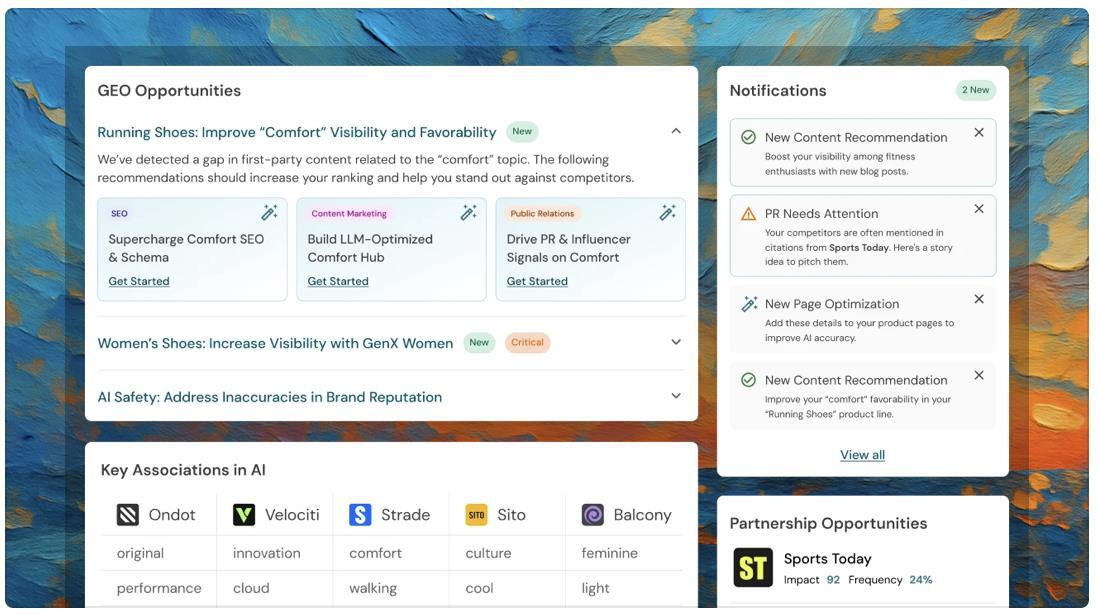
Bluefish surfaces prioritized recommendations by function—but the brief is where the platform stops, leaving content production to your team.
As far as anything resembling workflows goes, the Content Briefs feature is the star. Part of Bluefish’s AI Activation Suite, it analyzes how a brand is represented across AI responses, identifies narrative gaps, and produces a structured brief with the topic to address, the facts and differentiators AI engines rely on, and the language most likely to influence how models surface content.
The brief, however, is pretty much all you get. There’s no content creation, no generation workflow, no drag-and-drop builder for automating campaigns. The platform identifies what to fix and hands that analysis to your content team or agency. If your problem is knowing what to write, Bluefish helps. If your bottleneck is producing, optimizing, and publishing content at scale, you’re on your own.
Profound: AI Agents that create, optimize, and learn from what drives results
Pros:
- Full content pipeline in a single drag-and-drop builder
- Pre-built Agent templates built on patterns from millions of the most-cited pages across answer engines
- Every Agent run draws from live Answer Engine Insights: current citations, sentiment signals, and prompt volume data
- Self-learning loop: post-publication citation tracking feeds back into the content generation engine
Profound Agents empower marketing teams to build automated content campaigns without writing a line of code. The full pipeline—gather insights, use AI for content brief generation, produce a draft, optimize for citation potential, publish—runs inside a single drag-and-drop builder. Pre-loaded templates you can tap into include AEO Content Refresh, FAQ Generator, Content Optimization Suggestions, and more, all built on patterns from millions of the most-cited pages across answer engines.
The output isn’t generic AI content. Every Agent run draws from live Answer Engine Insights, i.e., citations, sentiment signals, and prompt volume data, so the draft reflects what AI engines favor in that moment, not what performed well months ago.
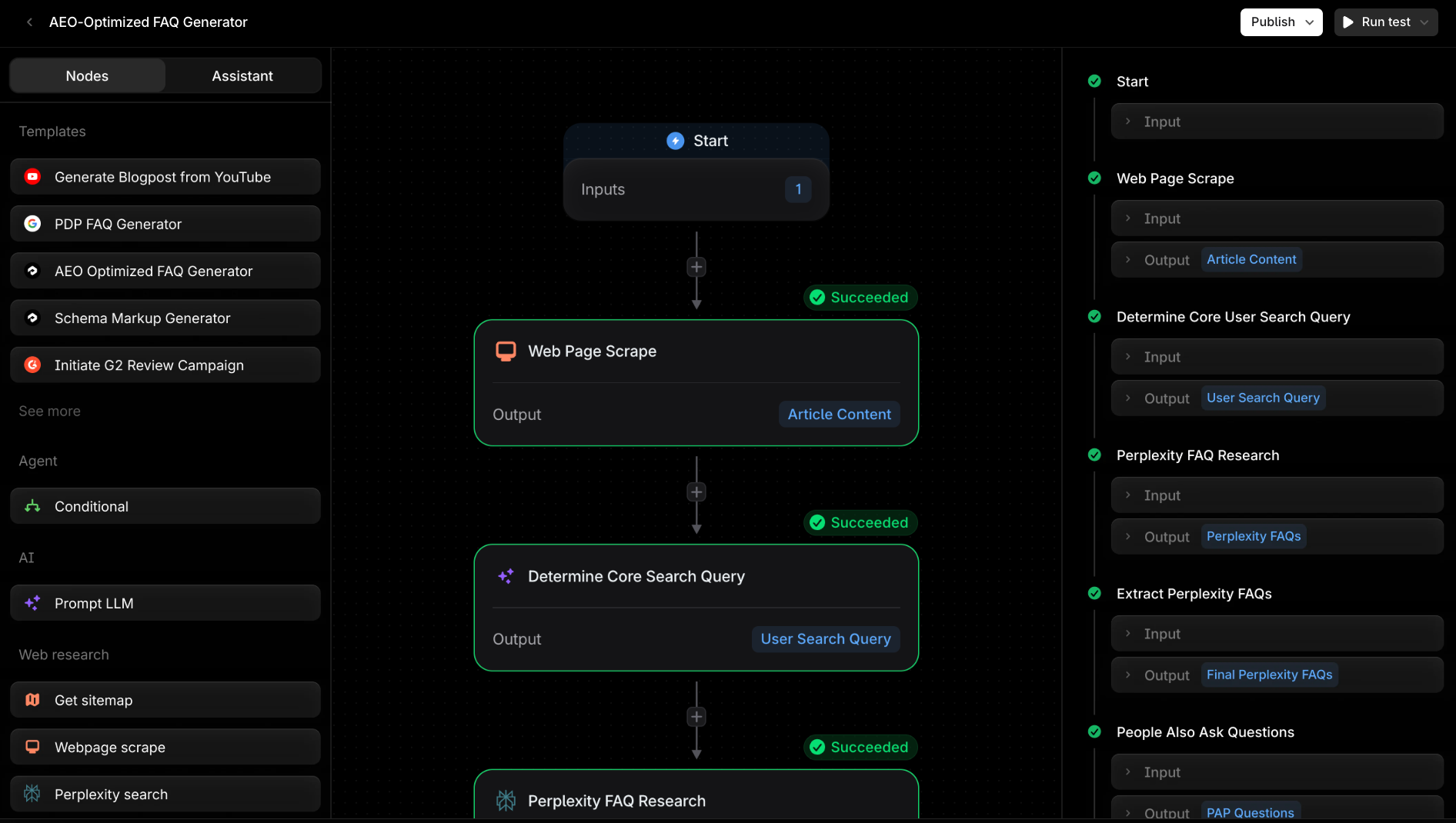
Profound Agents walk teams through the full content pipeline—from research to draft—inside a single drag-and-drop workflow builder.
Remember the self-learning loop we mentioned earlier? This is where it shines. Profound tracks which pages get cited by which answer engines after publication, then feeds that signal back into the content generation engine. Pages that attract crawler attention reinforce those patterns in future recommendations, so the engine improves with every piece of content you produce.
Hone, a player in the learning and development category, used Profound’s content workflows to create and optimize articles specifically for AI crawler and citation potential. Their citation share for the category grew from nearly 0% to 7%, making their domain the #1 most cited source for relevant prompts. Visibility in their most critical product category increased 800%.
Reflecting on Hone's partnership with Profound, Linda Schwaber-Cohen, VP of Marketing, stated that “Profound gave us both the data and the partnership we needed. They helped us identify where to focus, how to structure our content, and what success should look like. In a world where the rules for marketing are changing really quickly, Profound is helping me rewrite the modern marketing playbook.”
Profound vs. Bluefish: Enterprise compliance and security readiness
For enterprise buyers, compliance isn’t a checkbox at the end of procurement. It’s often the first gate, and not every platform is equipped to satisfy the necessary requirements.
Bluefish: SOC 2 still in progress
Pros:
- Google Workspace SSO and standard encryption protocols
- Passes infosec reviews according to the company
Cons:
- SOC 2 certification audit still in progress—not yet independently certified
- No HIPAA compliance
- Incomplete certification status can block or stall vendor approval in regulated industries
Bluefish positions itself as “Enterprise Ready” on its platform page and targets Fortune 500 brands. The security basics are in place: Google Workspace SSO and standard encryption protocols. But Bluefish has yet to complete its SOC 2 certification—the audit is still in progress, meaning no independent third-party has validated its security controls over time.
Enterprise legal and security teams typically require SOC 2 Type II before approving a new vendor, as Type II evaluates whether controls hold over an extended observation period, not just at a single point in time. For organizations in financial services, healthcare, insurance, or other regulated verticals, an incomplete SOC 2 status is a hard line.
Profound: SOC 2 Type II, HIPAA, SSO, and role-based access control
Pros:
- SOC 2 Type II certified—extended evaluation of security controls by an independent auditor
- HIPAA compliant, independently assessed by Sensiba LLP
- SSO via SAML and OIDC (Okta and Azure AD), RBAC, AES-256 encryption at rest, TLS in transit, automated daily backups, and a strict no-PII policy
- Customers include U.S. Bank, Chime, and Walmart—organizations with procurement processes that require SOC 2 Type II at minimum
Cons:
- Full compliance stack may be more than teams outside regulated industries need to evaluate
Profound is SOC 2 Type II certified. That certification reflects an extended evaluation of security controls by an independent auditor, thus meeting the standard enterprise procurement and legal teams require.
Profound is also HIPAA compliant, independently assessed by Sensiba LLP. That makes Profound one of the only AEO platforms cleared for healthcare and pharmaceutical organizations. For brands in regulated industries where AI visibility work touches workflows involving patient or customer data, HIPAA compliance removes a procurement blocker that few other platforms in this category can address.
The full enterprise security stack includes SSO via SAML and OIDC (supporting Okta and Azure AD), role-based access control for fine-grained permissions, data encryption at rest and in transit, automated daily backups, and a strict no-PII policy. Profound never stores end-user personal data, ensuring privacy compliance across jurisdictions.
The customer base reflects the compliance rigor in practice. U.S. Bank, Chime, and Walmart all use Profound—organizations with procurement processes that require SOC 2 Type II at minimum before a new vendor touches their data environment.
Profound vs. Bluefish: Final verdict
Bluefish is a legitimate choice for a specific kind of buyer. Its brand safety monitoring, hallucination detection, and AI narrative tracking are great help for organizations whose primary concern is protecting how AI represents their brand. If reputation management is the job, Bluefish addresses it.
But the moment you need to do more than monitor, the cracks begin to show. Limited prompt customization means visibility data that may not reflect real competitive dynamics. No content creation workflows means insights stop at the recommendation stage. No real user prompt volume data means content strategy is built on inference rather than demand signals.
Profound covers brand monitoring too, but connects it to the full stack enterprise teams need to excel at AI search: the industry’s largest real-user prompt dataset, page-level citation tracking, AI Agents that take insights through to published content, enterprise-grade reporting, and a self-learning engine that improves with every piece of content produced.
See for yourself how Profound can take your AEO program to the next level. Book a demo with our team.
Profound vs. Bluefish FAQs
What is the main difference between Profound and Bluefish?
Bluefish focuses on AI monitoring and brand safety: tracking how your brand appears across answer engines, detecting hallucinations, and protecting brand reputation. Profound covers monitoring and extends into content creation, workflow automation, proprietary prompt volume data, and attribution. For teams that need to grow AI visibility rather than just track it, Profound provides the full platform.
Does Bluefish offer content creation workflows like Profound?
No. Bluefish provides Content Briefs—a structured document that tells your team what to create and how to frame it—but the platform doesn't generate, optimize, or publish content. Profound Agents handle the full pipeline: brief, draft, optimize, and publish, inside a drag-and-drop workflow builder that draws from live citation and prompt volume data.
Which platform provides real user prompt volume data, Profound or Bluefish?
Profound is the platform that provides real user prompt volume data. The Prompt Volumes dataset contains 1.3B+ real user prompts drawn from actual conversations across ChatGPT, Gemini, Claude, Perplexity, and more, growing by roughly 150M monthly. It breaks down query frequency by region, age, income, and intent. Bluefish doesn't offer prompt volume data and doesn’t disclose the methodology behind its prompt suggestions.
Which platform is better for enterprise brands, Profound or Bluefish?
Profound is the best choice for enterprise brands. It holds SOC 2 Type II certification and HIPAA compliance, and integrates natively with GA4, BigQuery, Looker, Tableau, Adobe Analytics, Slack, and Microsoft Teams. Bluefish’s SOC 2 audit is still in progress, which can stall or block vendor approval in regulated industries. Profound also has over 300 G2 reviews from customers; Bluefish has none.