


Every day, hundreds of millions of people ask AI engines about products, prices, and brands. The problem is that ChatGPT, Perplexity, Gemini, and the rest don't just answer the question. They editorialize. They pull from thousands of sources, synthesize conflicting information, and generate claims a brand never made, prices that no longer exist, and features that changed two launches ago.
This isn't a rare edge case. Profound research across 50,000 LLM responses found that 47% of response content is completely unsolicited, meaning the AI isn't answering the question asked, it's adding its own commentary about your brand. Inside all that extra content, inaccuracy runs rampant.
Until now, most brands only found out something was wrong the hard way. A customer calls to complain about a price the AI quoted. A post goes viral mocking an answer no one at the company ever wrote. That's reactive, and it doesn't scale.
We built FactCheck to change that. FactCheck is the first system that tells brands how accurate AI’s claims about their brand are and how to remedy inaccurate claims at the source.
The third pillar of brand health in AI
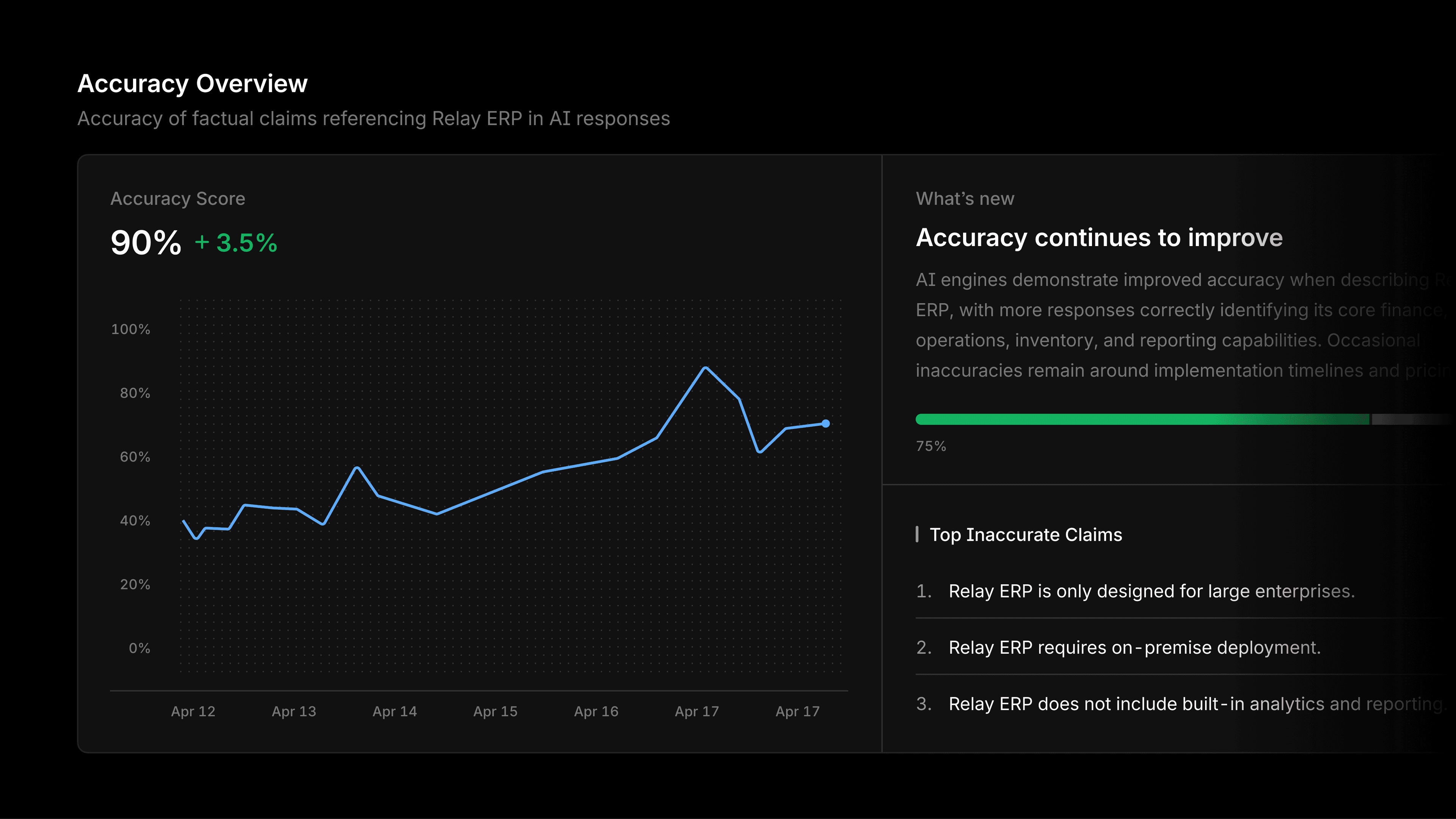
Visibility tells you whether AI engines are mentioning you. Sentiment tells you how they're talking about you. Neither answers the question that matters most once your brand starts showing up in answers: is what the AI says actually true?
FactCheck systematically compares what AI engines say about your brand against your own source of truth, then tells you what's accurate, what's wrong, and which specific sources are driving the inaccuracies. Visibility, Sentiment, and FactCheck together give you a complete picture of how your brand exists inside AI search, not just whether you show up.
How FactCheck works
FactCheck runs on the prompts and product surfaces you already use in Profound. There are four steps to get from setup to insight.
Tag your prompts. In the Prompt Designer, mark the prompts you want to verify with the ‘FactCheck’ type. These work best on questions with a deterministically correct answer: pricing, specs, features, availability, policies. You can tag anywhere from a handful to a thousand, and a single prompt can run across visibility, sentiment, and accuracy at the same time.
Build your Knowledge Base. This is your ground truth. Populate it by crawling your domain, pointing at specific product or pricing pages, uploading files, or syncing from Google Drive and Notion so it stays current. FAQ-style content works especially well. The accuracy of your results depends on keeping this source of truth up to date.
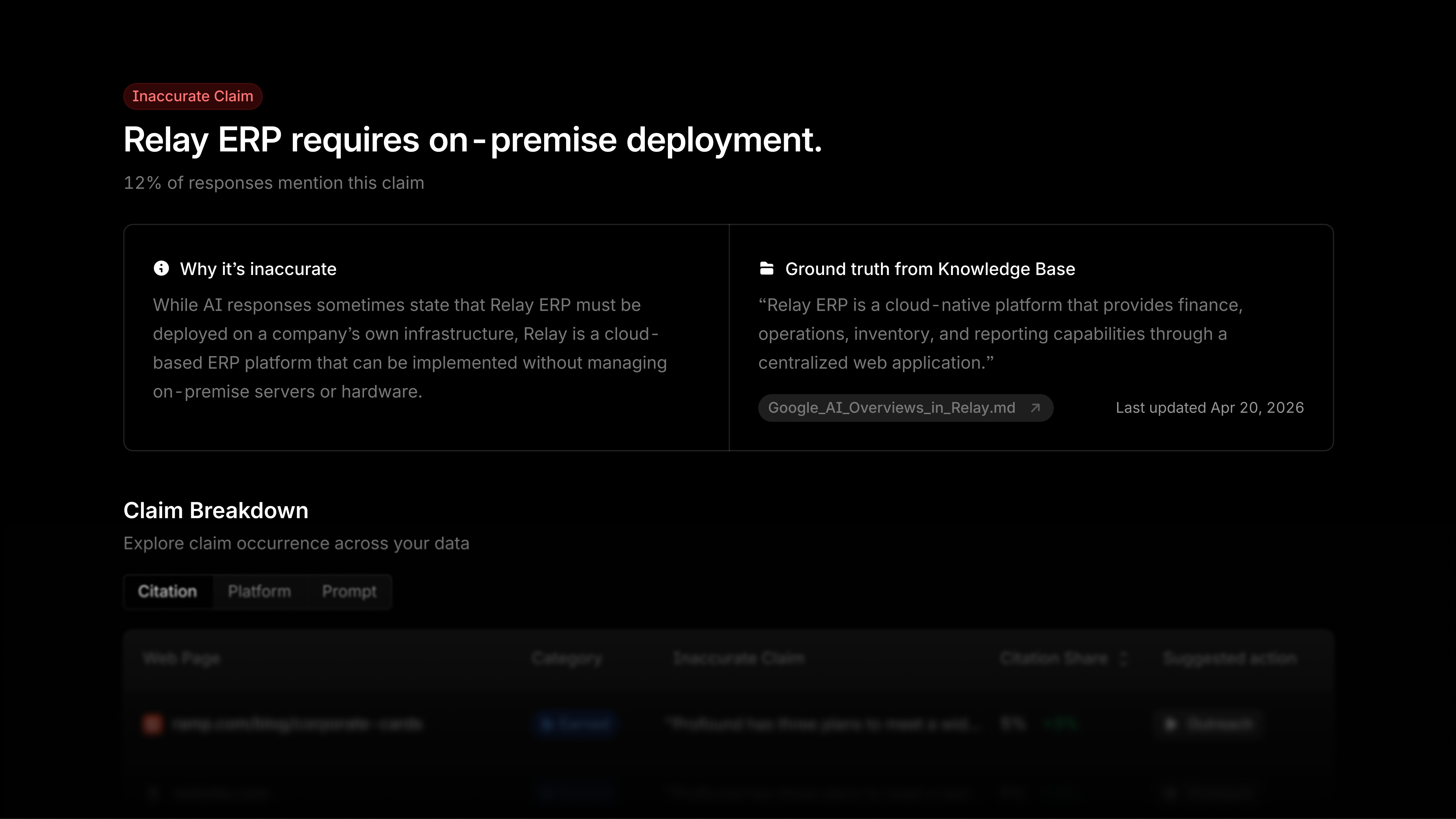
Let Profound run the analysis. Profound queries every major answer engine with your tagged prompts and collects the responses. Then Profound's own claim-detection model reads every sentence, finds where a verifiable claim is being made about your brand, and compares it against your Knowledge Base. This is a model we built, not a pass-through that asks one AI to grade another.
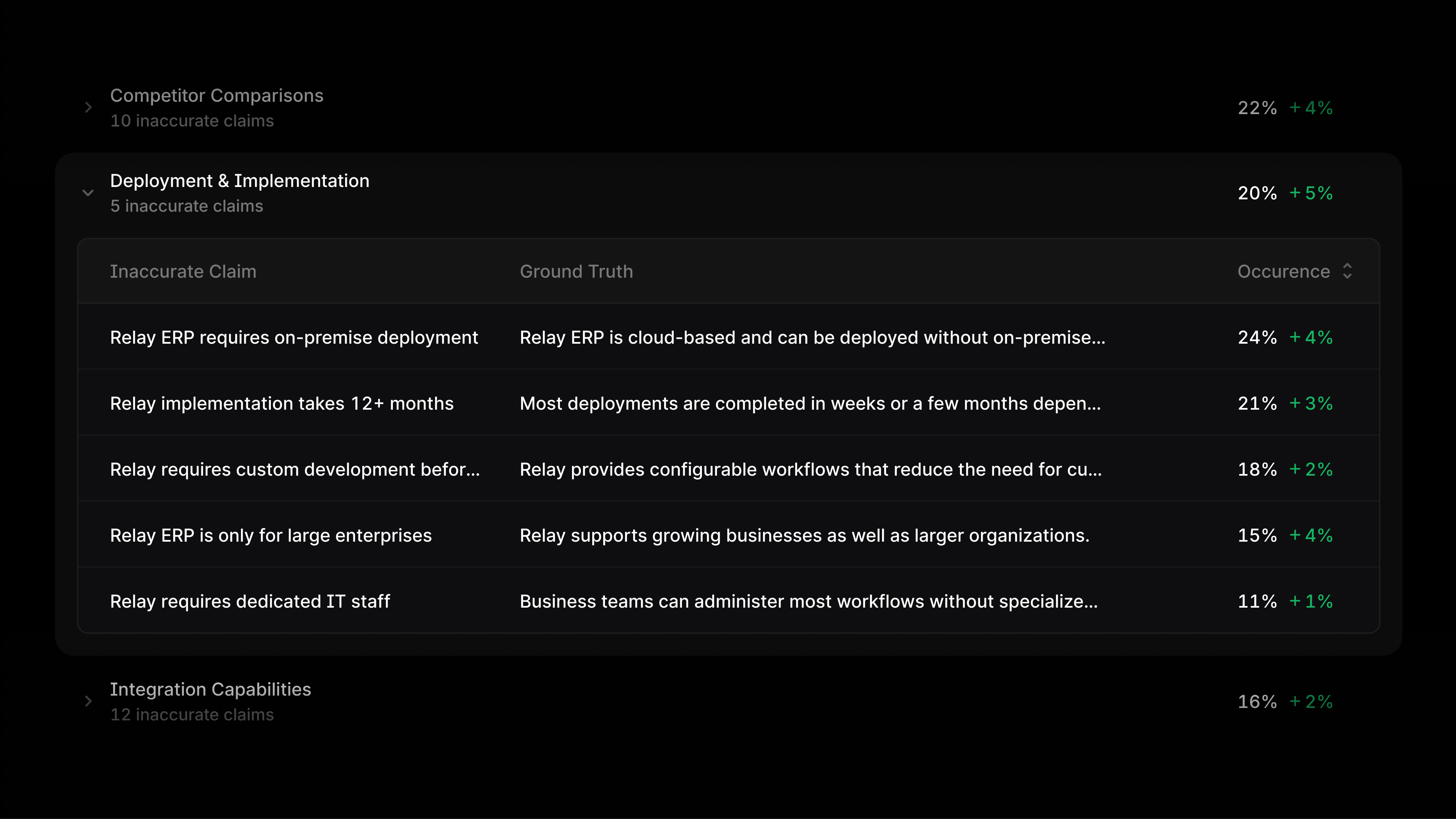
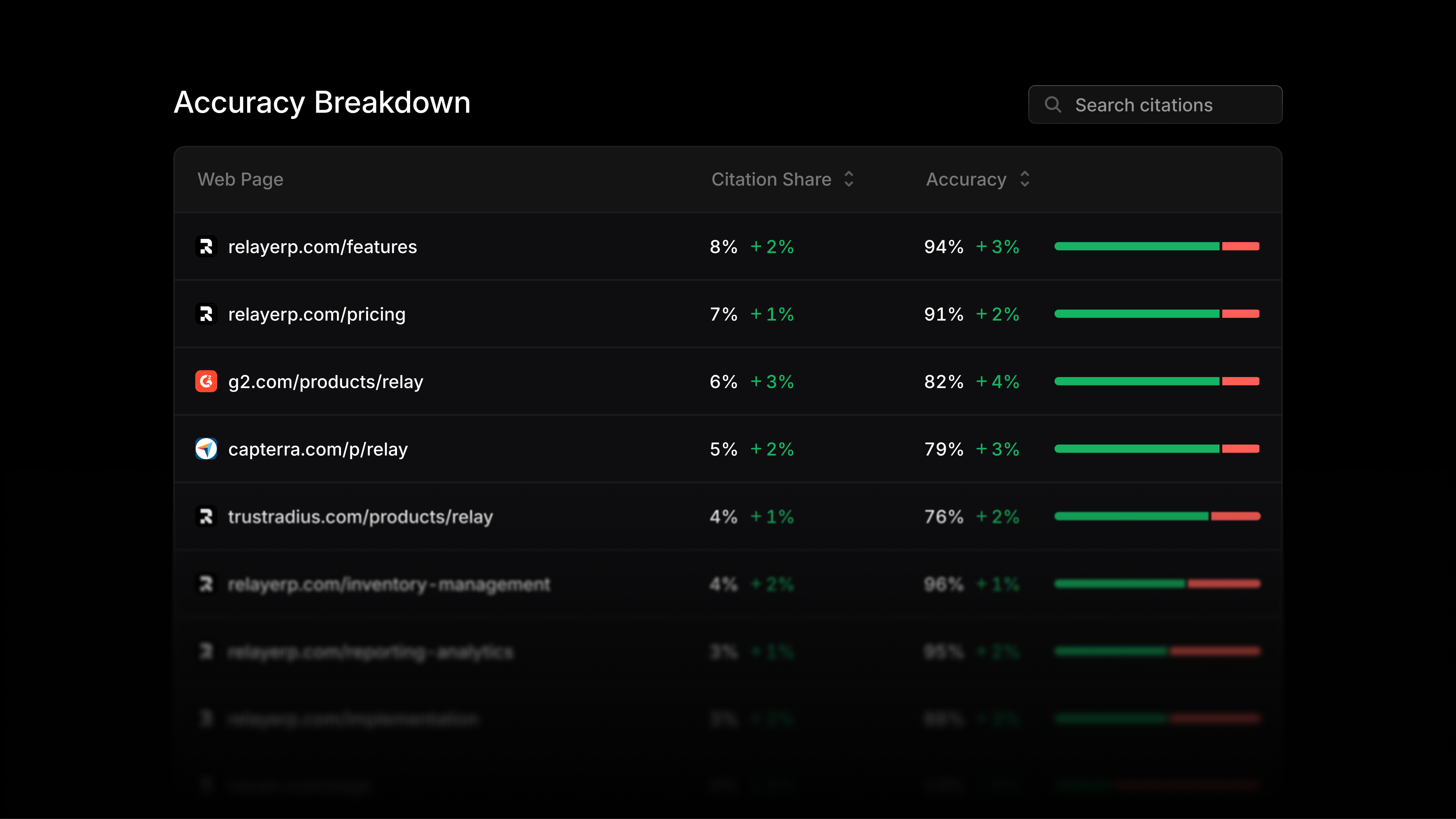
Review results in the FactCheck tab. Inside Answer Engine Insights, you get an overall accuracy score, inaccurate claims grouped by theme, and claim-level detail that puts the exact LLM claim in the AI response side by side with your ground truth. Source attribution shows which URLs and domains are feeding the wrong answers, and an accuracy breakdown by page tells you exactly which content is consistently producing them.
How to use FactCheck
The strongest workflow we've seen from early customers follows a simple arc: discover what's wrong, diagnose where it's coming from, then fix the root cause and watch accuracy climb.
Catch pricing and spec errors before customers do
Prices change, promotions rotate, regional pricing varies, and LLMs lag behind all of it. Tag your pricing and packaging prompts, and FactCheck flags the moment an engine starts quoting a number that no longer exists. The same applies to product specifications, especially after a launch, rebrand, or acquisition, when AI engines are often still describing the old version of your product.
Trace inaccuracies back to their source
The hard part of fixing AI misinformation has never been knowing something is wrong. It's knowing why. FactCheck's source attribution tells you which specific URL is producing a bad claim, which means you can tell whether the problem is your own outdated content, a third-party publication with stale information, or a competitor-adjacent source. One company ran their first FactCheck and discovered the single biggest source of inaccurate claims was their own website, pages that hadn't been touched in years. That's the highest-impact, lowest-effort fix there is.
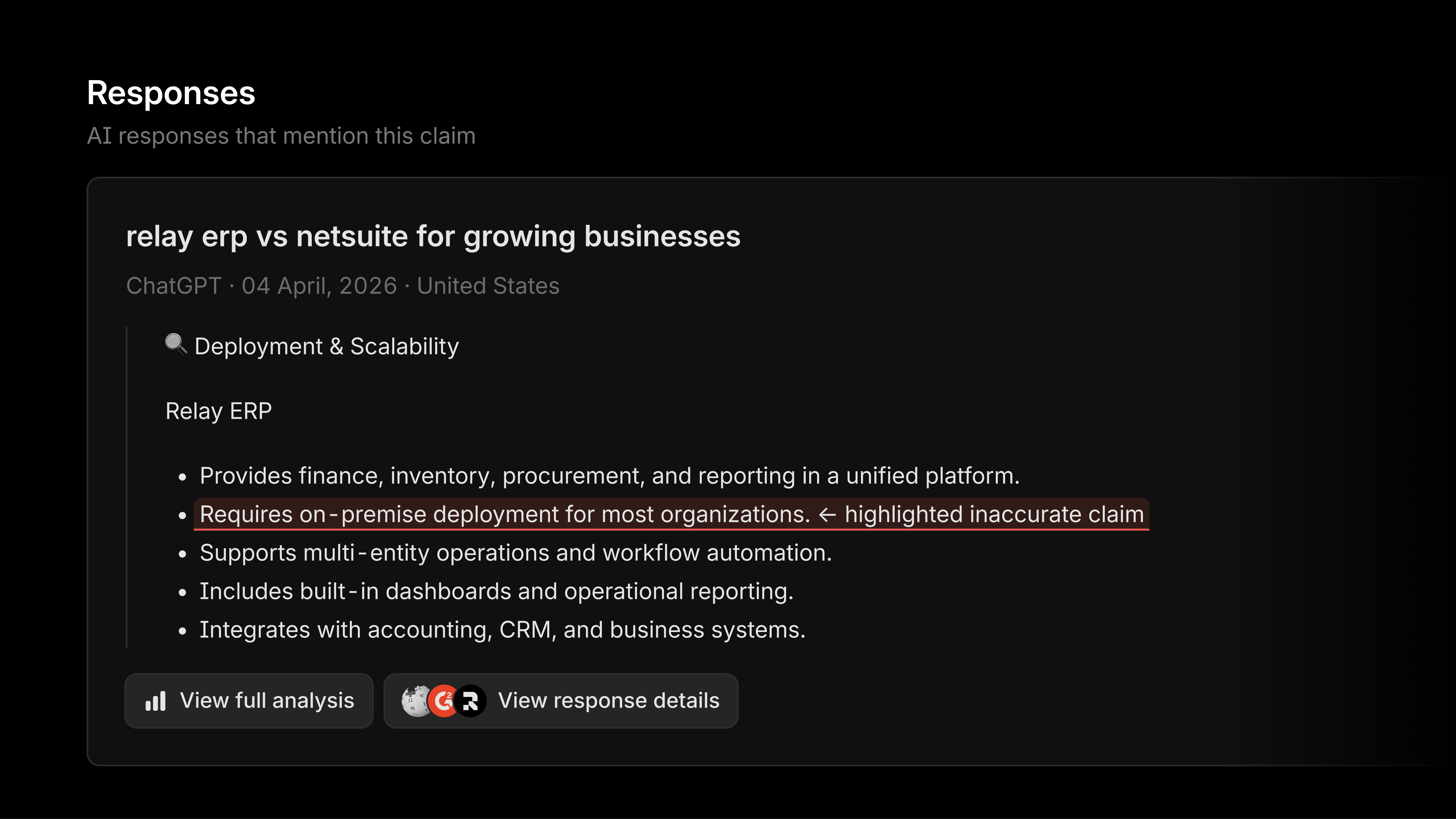
Give PR and comms a real correction pipeline
When the source of a wrong claim is an outside publication, source attribution turns a vague complaint into a precise outreach list. Your comms team can go to a publisher with documented evidence and request a correction, then use FactCheck to track whether the fix actually moves accuracy over time.
Govern accuracy in regulated categories
For pharmaceutical, financial services, healthcare, and other regulated industries, an inaccurate AI claim isn't just frustrating, it can carry compliance and legal weight. FactCheck gives those teams an audit trail showing the brand's AI representation is being actively monitored, with the citation source attached to every flagged claim.
Move from detection to remediation in one click with Agents
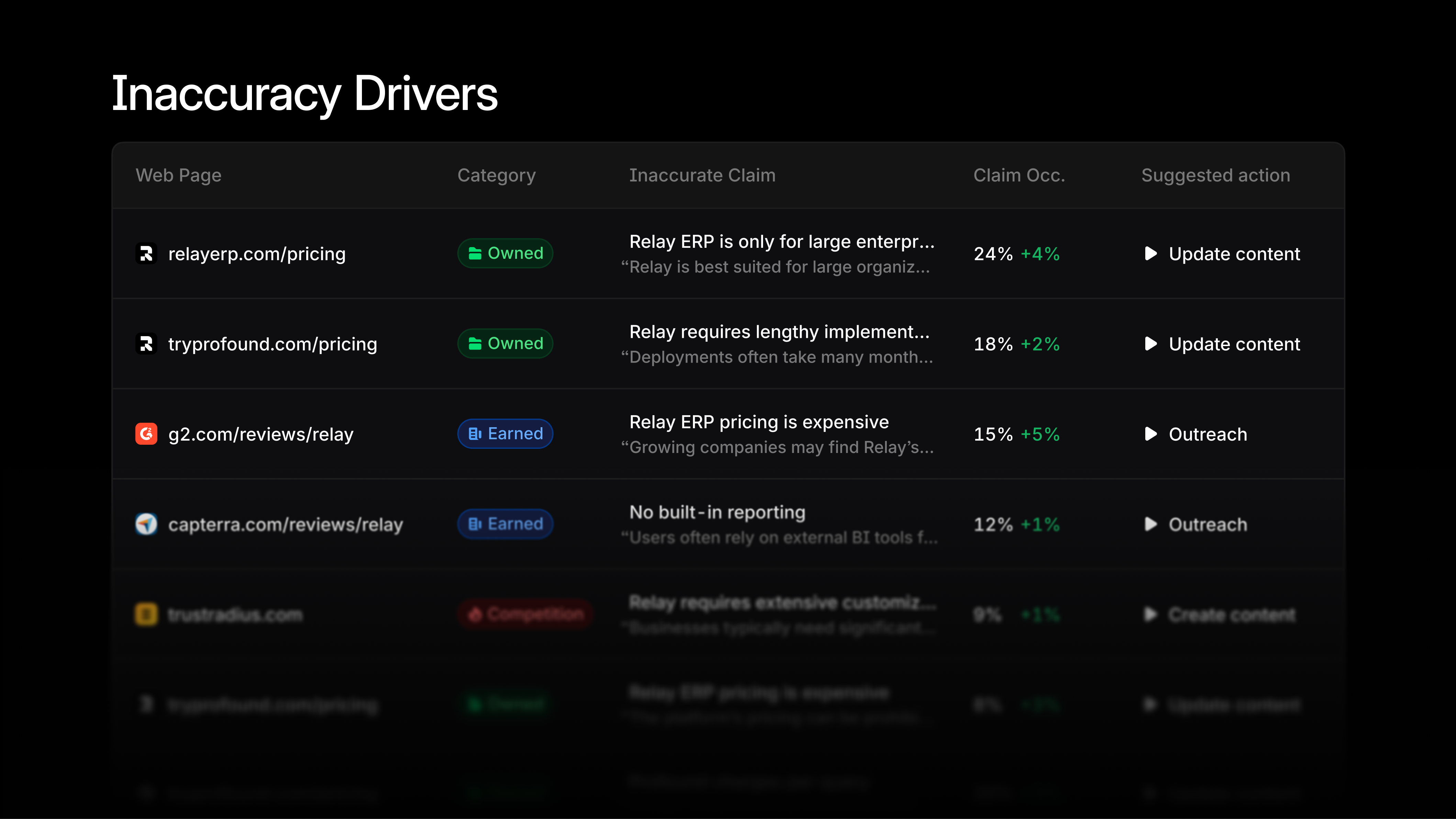
Finding an inaccurate claim is only half the job. FactCheck connects directly to Profound Agents, so the moment you spot a problem you can launch a workflow to fix it without leaving the platform or rebuilding context somewhere else. Because the Agent runs on the same Profound data, it already knows what the claim was, where it came from, and what the correct answer should be. What you do next depends on the source, which is exactly what the attribution layer tells you.
When the inaccuracy traces back to your own content, launch an Agent that updates the page driving the wrong claim, so your live content matches the ground truth you want AI engines to read.
When a competitor is shaping the answer, kick off an Agent that creates new content built to answer the prompt accurately and win back the recommendation.
When the source is a third party, launch an Agent that drafts outreach to the publisher with the inaccurate claim, the correct information, and the evidence behind it, turning a documented error into a ready-to-send correction request.
This is what closes the loop. You go from discovering an inaccuracy, to tracing its source, to acting on it, without stitching the steps together by hand.
Measure whether your work is working
Because FactCheck runs continuously rather than as a one-time audit, you can set a baseline, make your content and outreach changes, and watch the accuracy score respond. A point-in-time audit can only tell you what was true on the day you ran it. AI answers drift constantly as new content gets indexed, and continuous monitoring is what catches that drift.
The scale of the problem is the reason it's worth doing. In one early example, one of the biggest fitness wearable brands in the world ran FactCheck and found AI was misrepresenting them 11% of the time within the first week. Across millions of daily queries, that's millions of wrong answers reaching their customers. They traced it to the source, corrected it, and tracked the improvement.
Get started
FactCheck is available today for all Profound customers on enterprise plans at no additional cost. To get up and running, tag your most brand-critical prompts and set up your Knowledge Base.
If you are not yet a Profound customer and want to see this in action, we encourage you to get a demo.


